An Association for All IT Architects
10 Lessons from
Solutiuon Architects
Better Architecture Every Day
Architecture
The art and science of
designing and
delivering valuable
technology strategy.
68 percent of global business leaders list digital transformation as a top priority for their business.
(Forrester)
Technology IS business…
1. Solution
architects are
technical product
owners
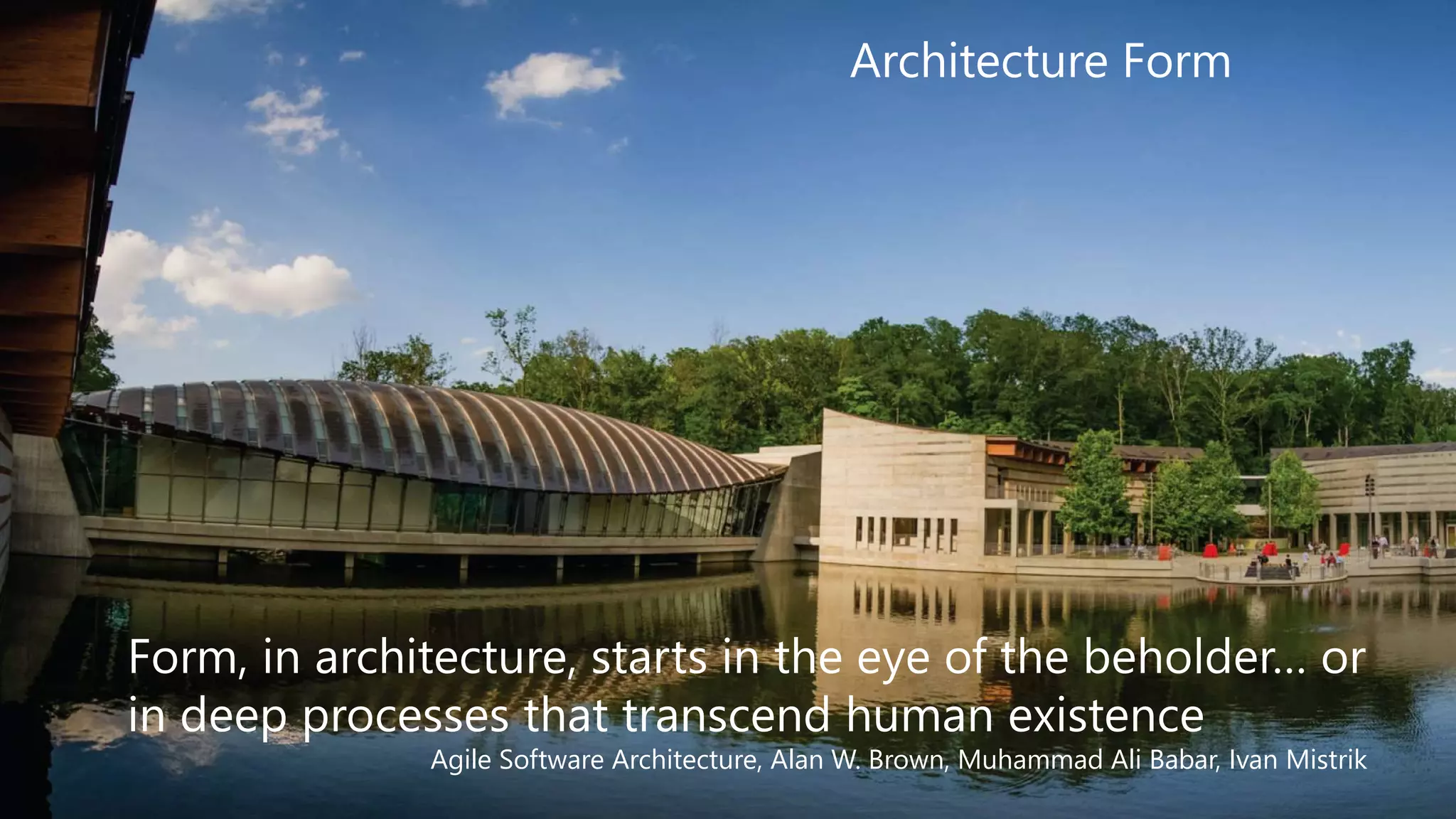
Form, in architecture, starts in the eye of the beholder… or
in deep processes that transcend human existence
Agile Software Architecture, Alan W. Brown, Muhammad Ali Babar, Ivan Mistrik
Architecture Form
An Association for All IT Architects
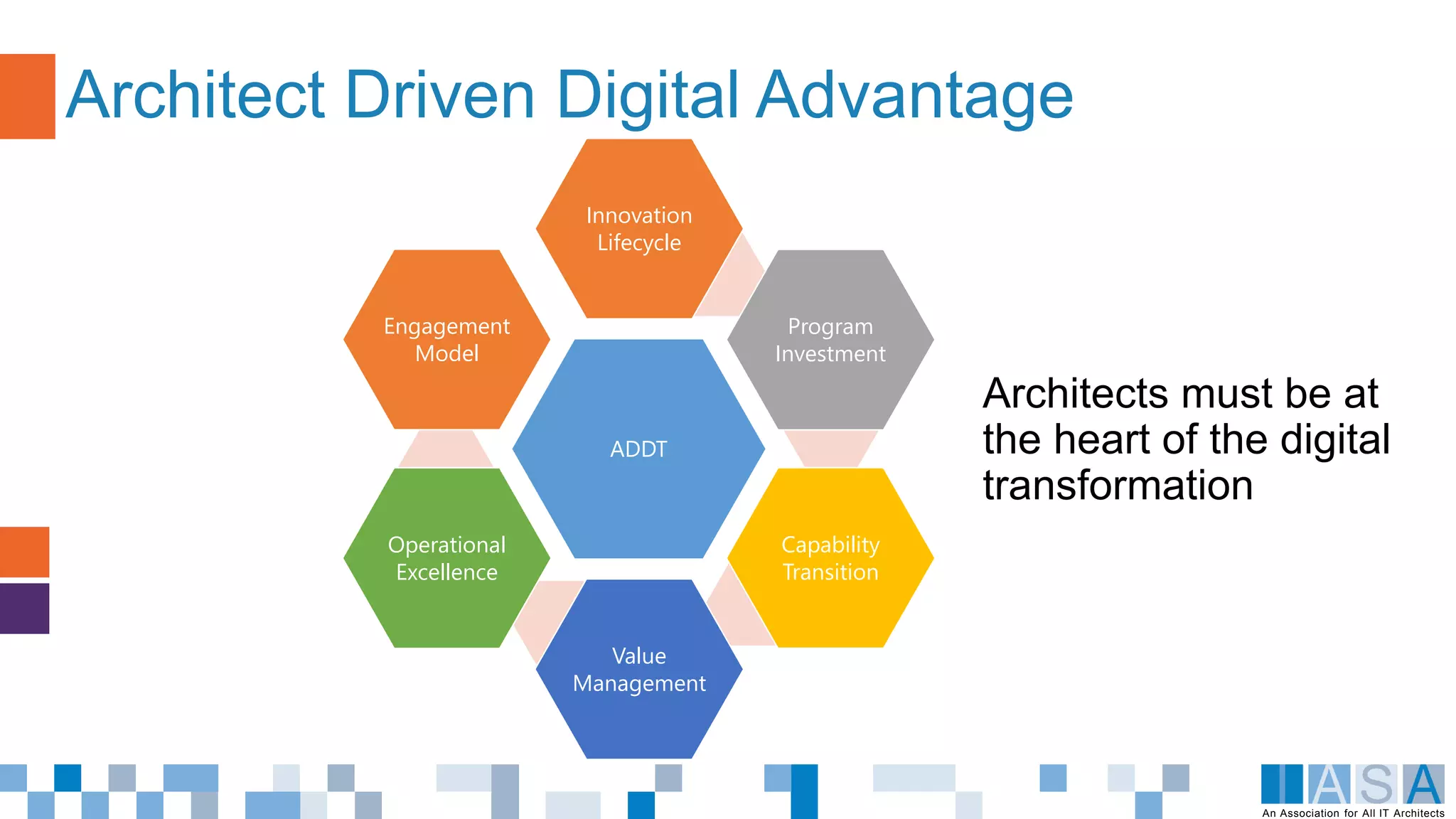
Architect Driven Digital Advantage
Architects must be at
the heart of the digital
transformation
ADDT
Innovation
Lifecycle
Program
Investment
Capability
Transition
Value
Management
Operational
Excellence
Engagement
Model
2. Design emerges architecture is proven
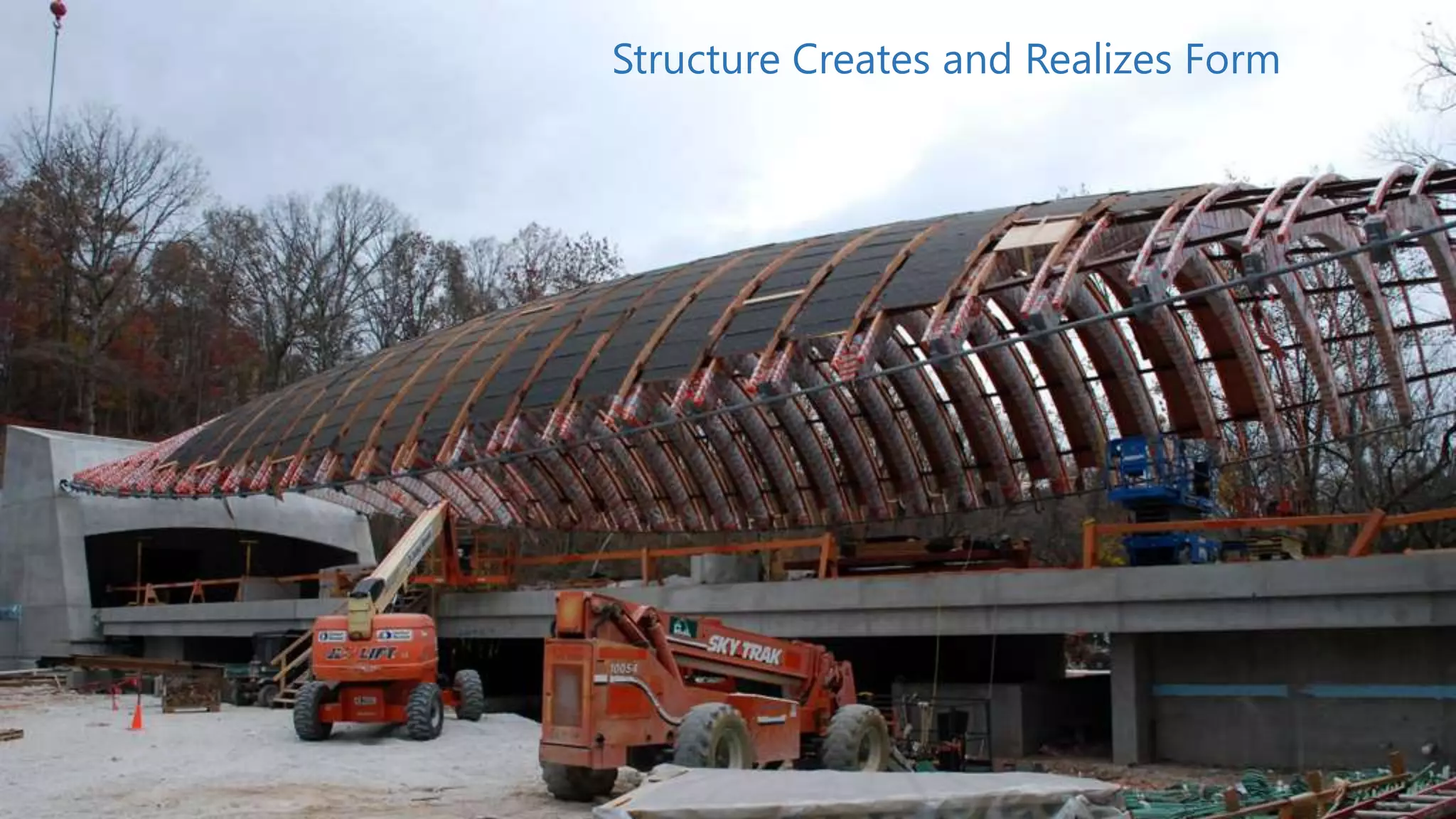
Structure Creates and Realizes Form
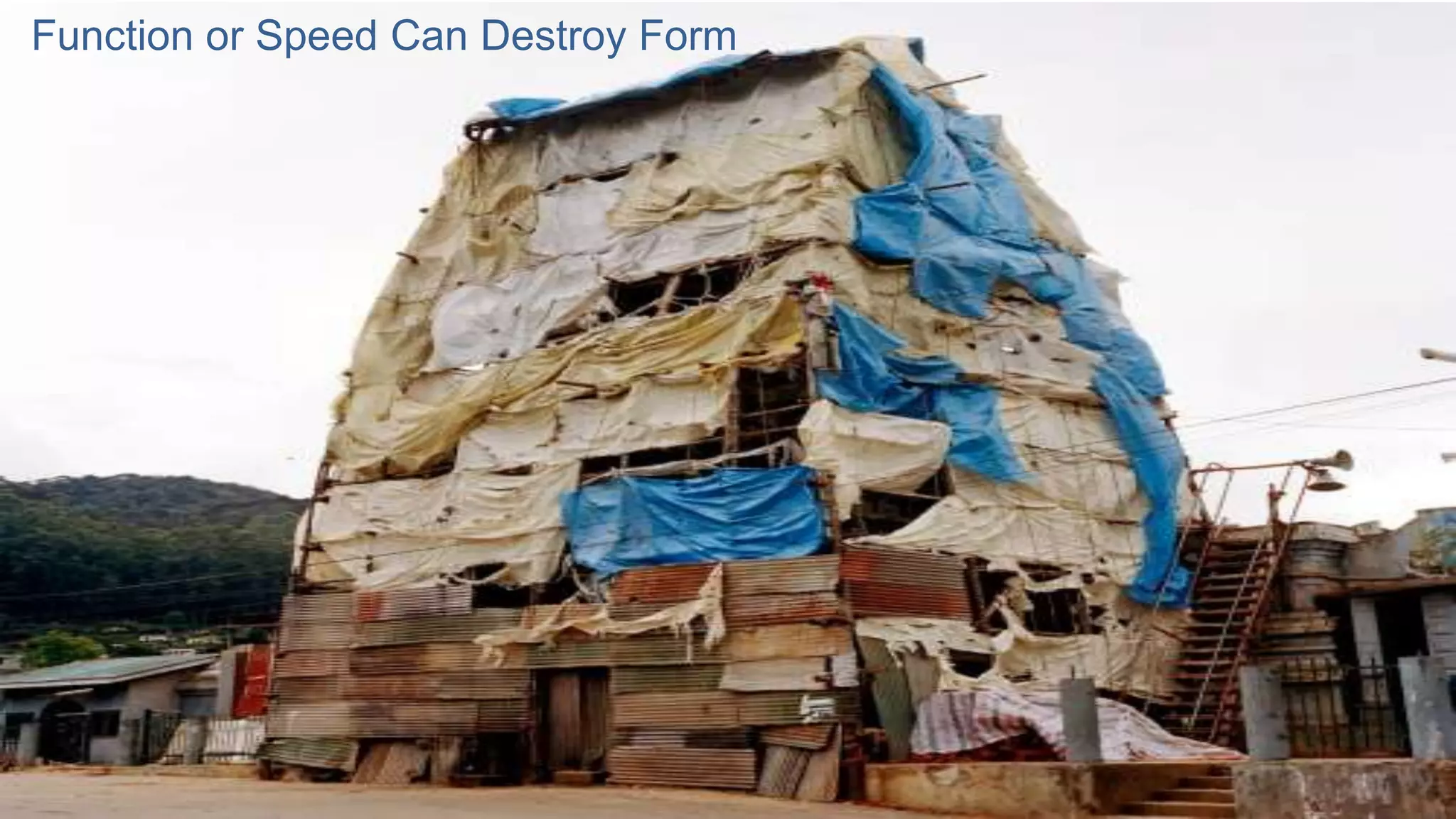
Function or Speed Can Destroy Form
“Architecture is the important stuff. Whatever that is.”
Martin Fowler
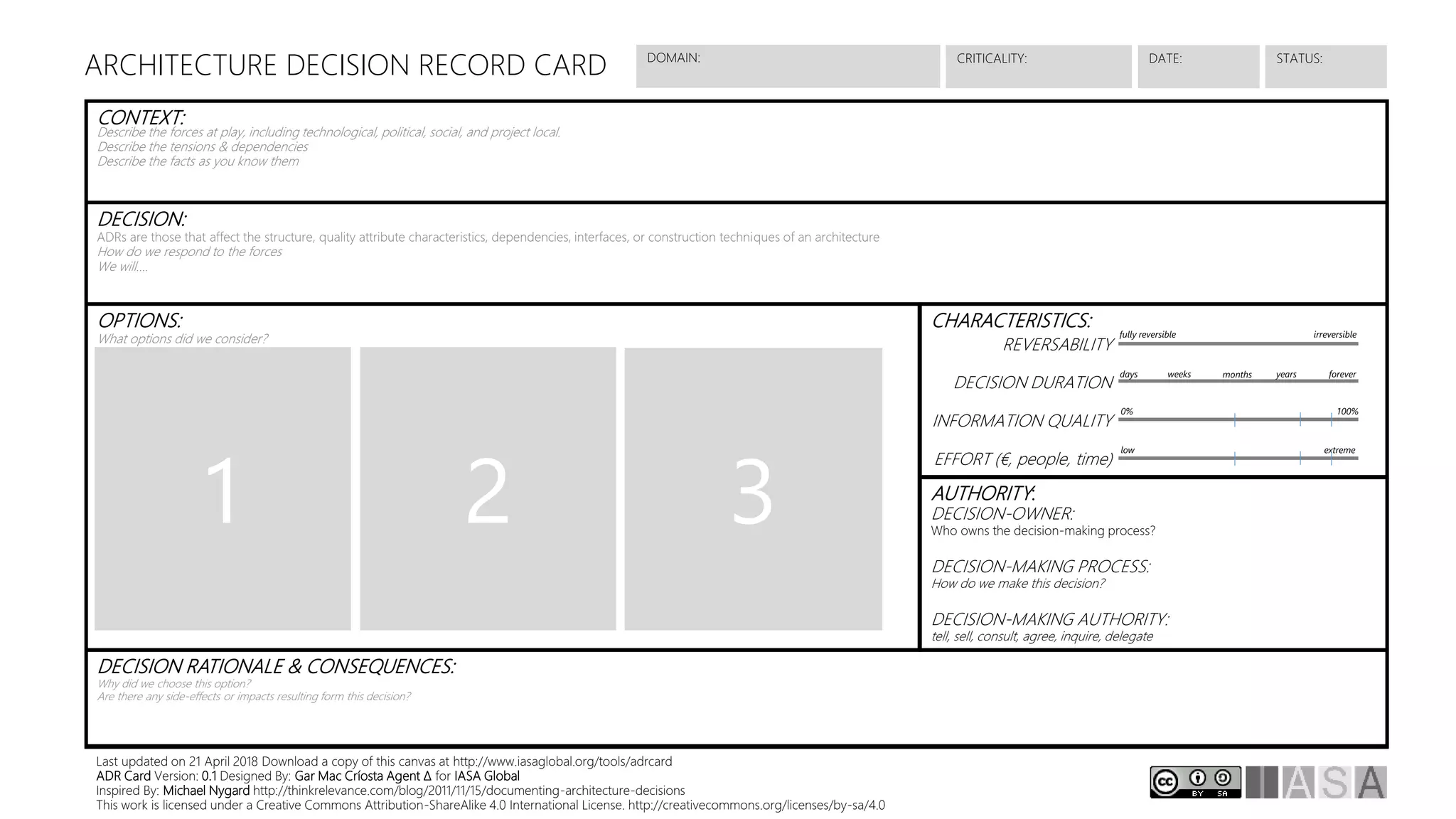
CONTEXT:
Describe the forces at play, including technological, political, social, and project local.
Describe the tensions & dependencies
Describe the facts as you know them
DECISION:
ADRs are those that affect the structure, quality attribute characteristics, dependencies, interfaces, or construction techniques of an architecture
How do we respond to the forces
We will….
CHARACTERISTICS:
AUTHORITY:
DECISION-OWNER:
Who owns the decision-making process?
DECISION-MAKING PROCESS:
How do we make this decision?
DECISION-MAKING AUTHORITY:
tell, sell, consult, agree, inquire, delegate
ARCHITECTURE DECISION RECORD CARD DOMAIN: DATE: STATUS:
Last updated on 21 April 2018 Download a copy of this canvas at http://www.iasaglobal.org/tools/adrcard
ADR Card Version: 0.1 Designed By: Gar Mac Críosta Agent ∆ for IASA Global
Inspired By: Michael Nygard http://thinkrelevance.com/blog/2011/11/15/documenting-architecture-decisions
This work is licensed under a Creative Commons Attribution-ShareAlike 4.0 International License. http://creativecommons.org/licenses/by-sa/4.0
REVERSABILITY
DECISION DURATION
INFORMATION QUALITY
EFFORT (€, people, time)
fully reversible irreversible
days forever
0% 100%
weeks months years
CRITICALITY:
low extreme
OPTIONS:
What options did we consider?
1 2 3
DECISION RATIONALE & CONSEQUENCES:
Why did we choose this option?
Are there any side-effects or impacts resulting form this decision?
3. You are designing an ecosystem
An Association for All IT Architects
 As business ecosystems become further involved they form
ecosystem platforms with multiple interchangeable parts
 Co-opetition become increasingly important and the rate of ‘new
entry’ increases
 Platform business models require empowerment of others in the
ecosystem
Business Model Challenges
An Association for All IT Architects
 The customer’s world changes daily even hourly
 New tools
 New ecosystems
 New costs
 Customers are involved in pseudo-information expertise
 They are bombarded with similar information sources
 This results in expectations that often far exceed transactional value
Customer Challenges
4. Hold
An Association for All IT Architects
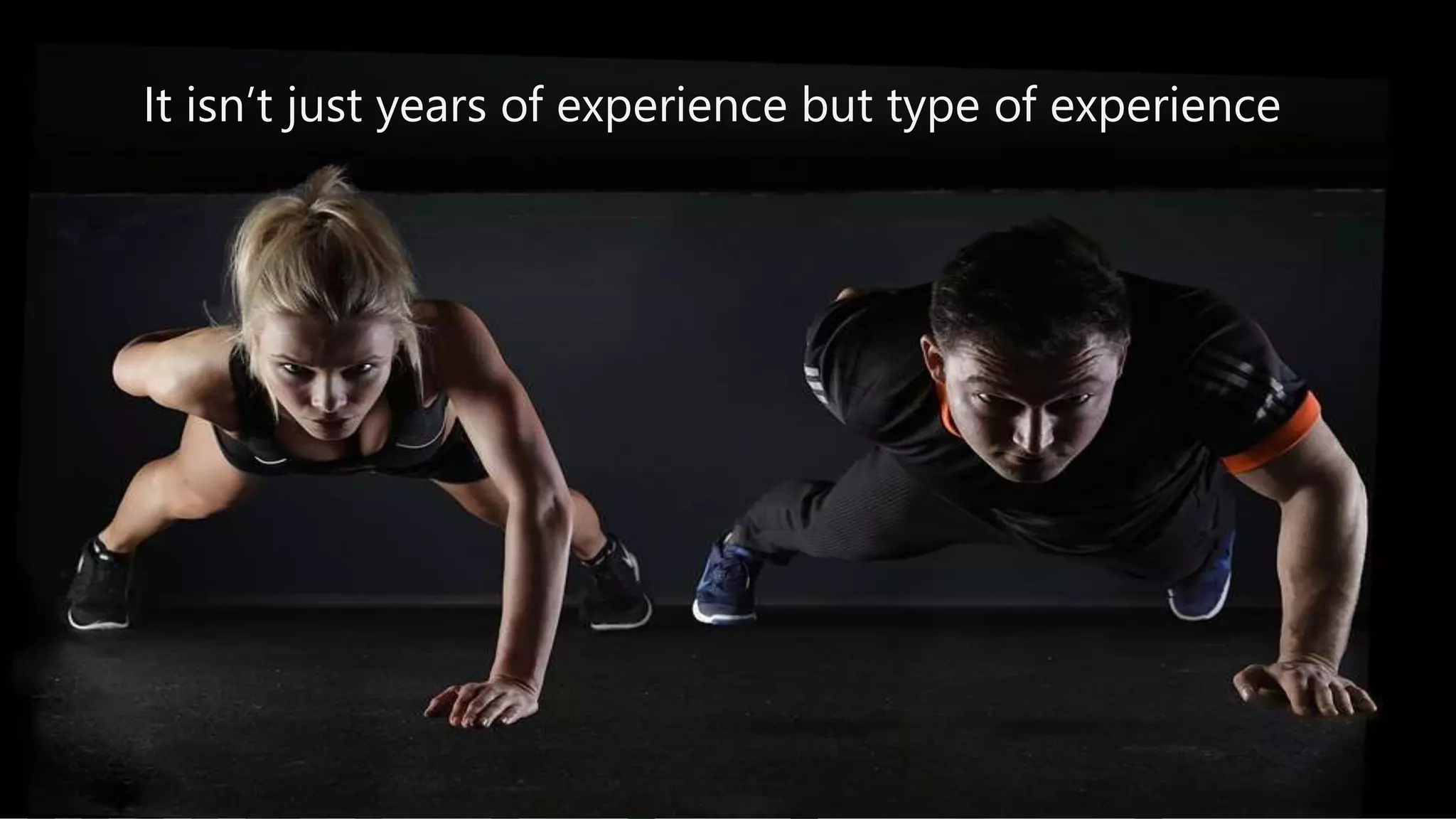
It isn’t just years of experience but type of experience
5. Quality attribute focus
6. You don’t get
certainty, you get
comfortable with
uncertainty
7. It is Minimum Valuable Product
An Association for All IT Architects
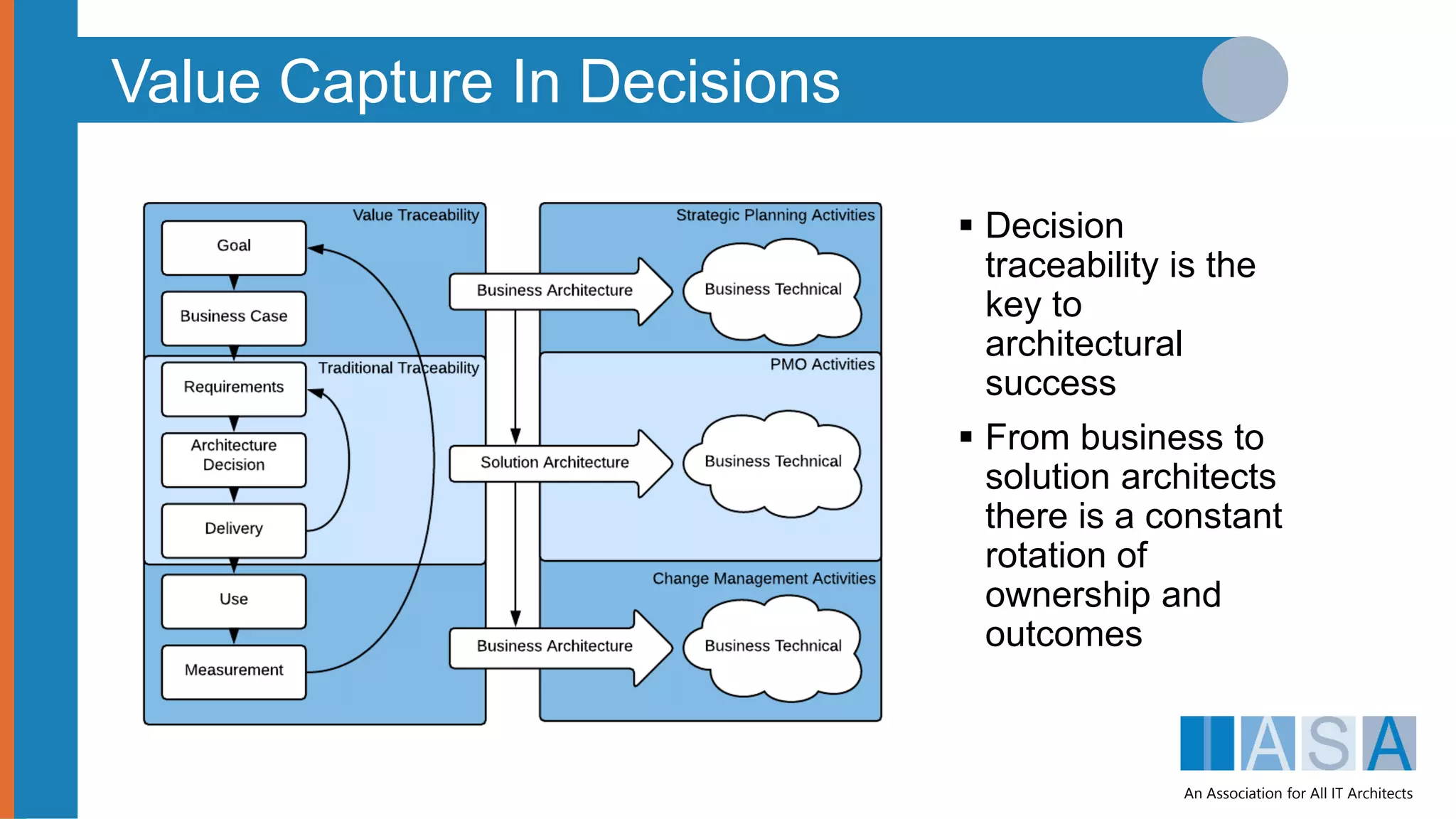
Value Capture In Decisions
 Decision
traceability is the
key to
architectural
success
 From business to
solution architects
there is a constant
rotation of
ownership and
outcomes
8. Healthy tension is a good thing
An Association for All IT Architects
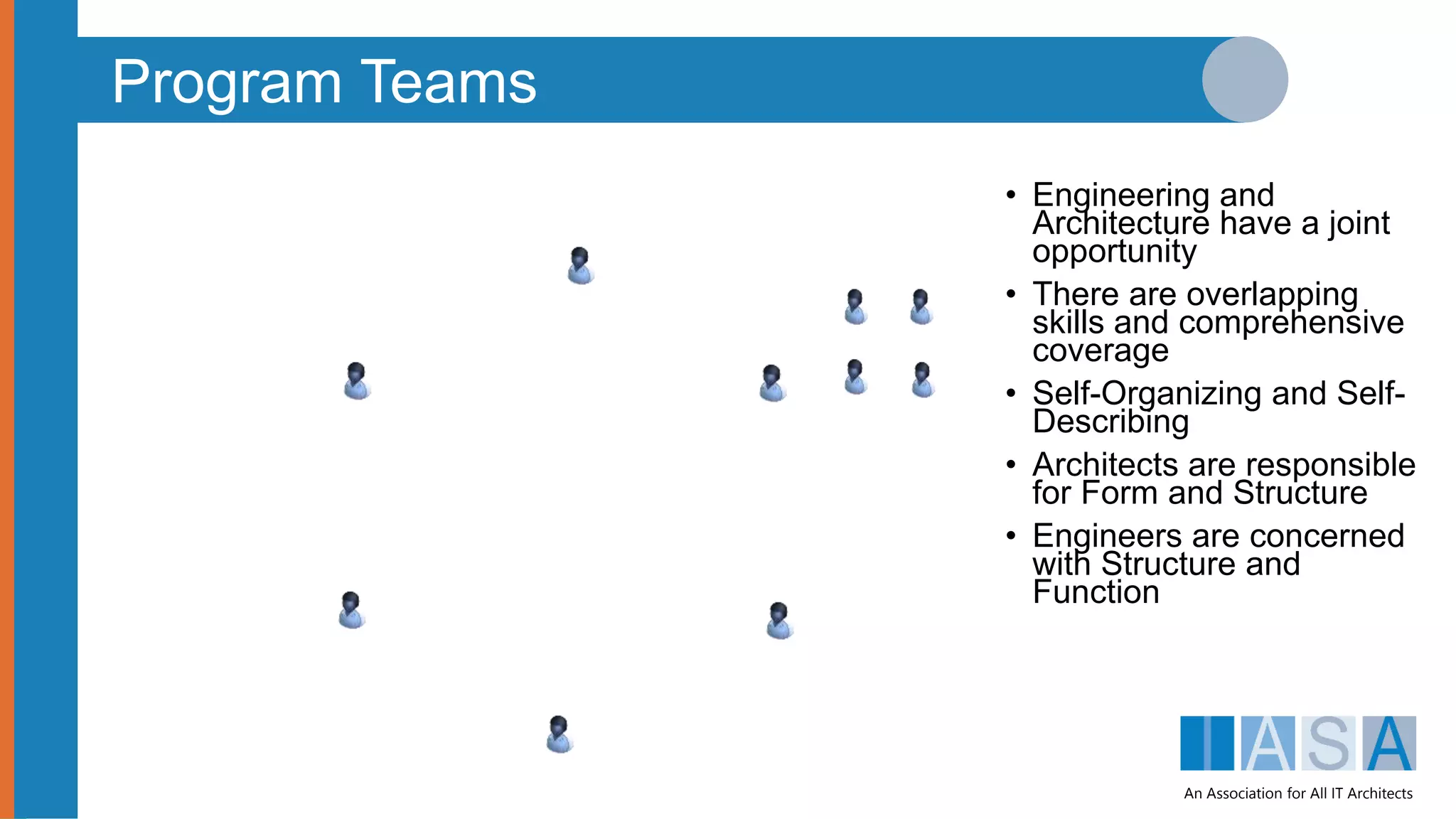
Program Teams
• Engineering and
Architecture have a joint
opportunity
• There are overlapping
skills and comprehensive
coverage
• Self-Organizing and Self-
Describing
• Architects are responsible
for Form and Structure
• Engineers are concerned
with Structure and
Function
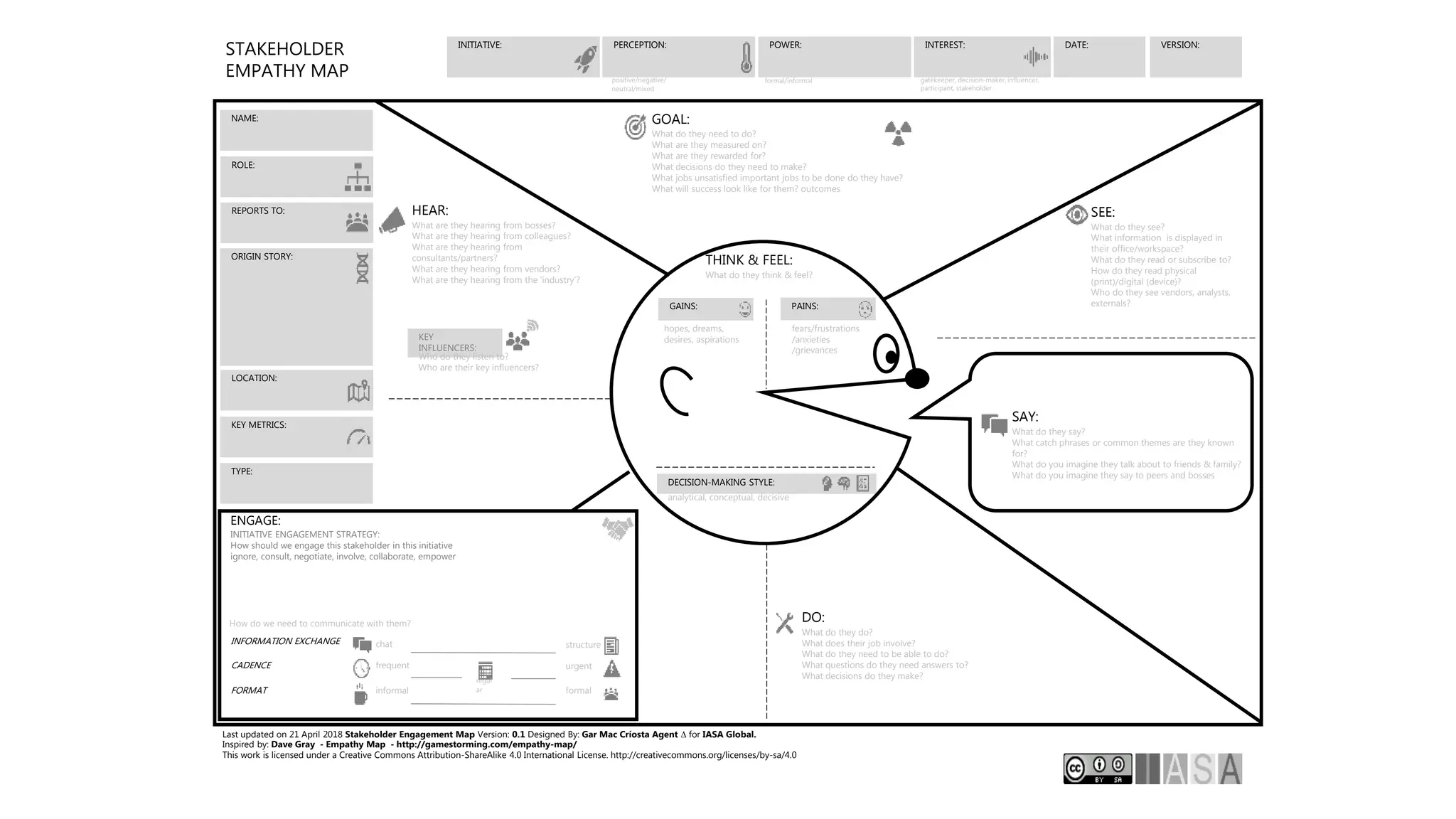
9. It’s not people skills, it is stakeholder management
How do we need to communicate with them?
KEY METRICS:
DECISION-MAKING STYLE:
PAINS:
ORIGIN STORY:
STAKEHOLDER
EMPATHY MAP
DATE: VERSION:
Last updated on 21 April 2018 Stakeholder Engagement Map Version: 0.1 Designed By: Gar Mac Críosta Agent ∆ for IASA Global.
Inspired by: Dave Gray - Empathy Map - http://gamestorming.com/empathy-map/
This work is licensed under a Creative Commons Attribution-ShareAlike 4.0 International License. http://creativecommons.org/licenses/by-sa/4.0
INITIATIVE:
ROLE:
PERCEPTION:
LOCATION:
POWER:
REPORTS TO:
GAINS:
THINK & FEEL:
What do they think & feel?
SEE:
What do they see?
What information is displayed in
their office/workspace?
What do they read or subscribe to?
How do they read physical
(print)/digital (device)?
Who do they see vendors, analysts,
externals?
hopes, dreams,
desires, aspirations
fears/frustrations
/anxieties
/grievances
SAY:
What do they say?
What catch phrases or common themes are they known
for?
What do you imagine they talk about to friends & family?
What do you imagine they say to peers and bosses
DO:
What do they do?
What does their job involve?
What do they need to be able to do?
What questions do they need answers to?
What decisions do they make?
analytical, conceptual, decisive
GOAL:
What do they need to do?
What are they measured on?
What are they rewarded for?
What decisions do they need to make?
What jobs unsatisfied important jobs to be done do they have?
What will success look like for them? outcomes
KEY
INFLUENCERS:
Who do they listen to?
Who are their key influencers?
formal/informal
positive/negative/
neutral/mixed
INTEREST:
gatekeeper, decision-maker, influencer,
participant, stakeholder
NAME:
TYPE:
HEAR:
What are they hearing from bosses?
What are they hearing from colleagues?
What are they hearing from
consultants/partners?
What are they hearing from vendors?
What are they hearing from the ‘industry’?
ENGAGE:
INITIATIVE ENGAGEMENT STRATEGY:
How should we engage this stakeholder in this initiative
ignore, consult, negotiate, involve, collaborate, empower
informal formal
frequent
regul
ar
chat structure
urgent
INFORMATION EXCHANGE
CADENCE
FORMAT
10. Get an engagement model… now
An Association for All IT Architects
Building
Complex Things
With Unskilled
People Is
Dangerous
Or Stupid
An Association for All IT Architects
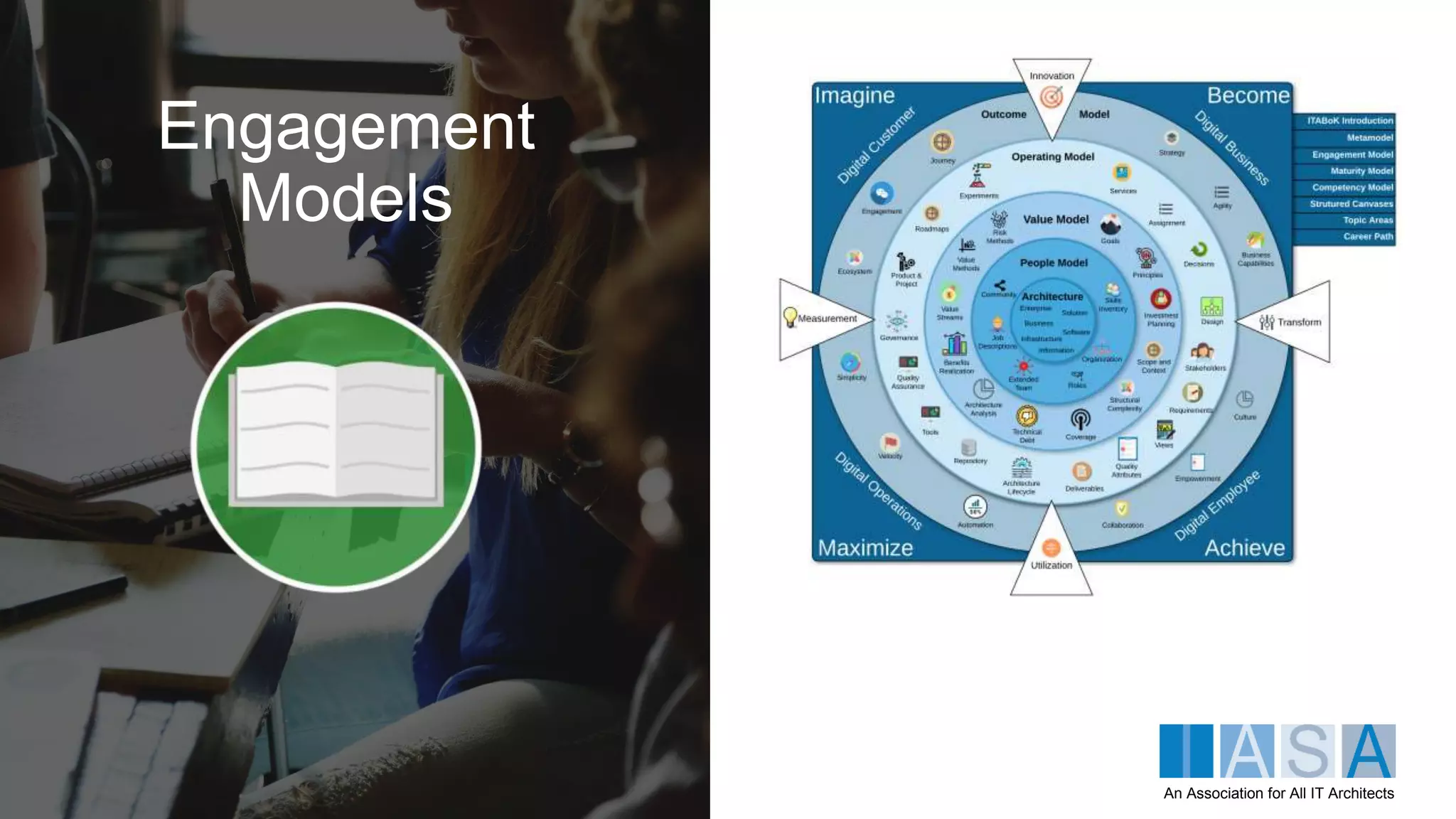
Engagement
Models
An Association for All IT Architects
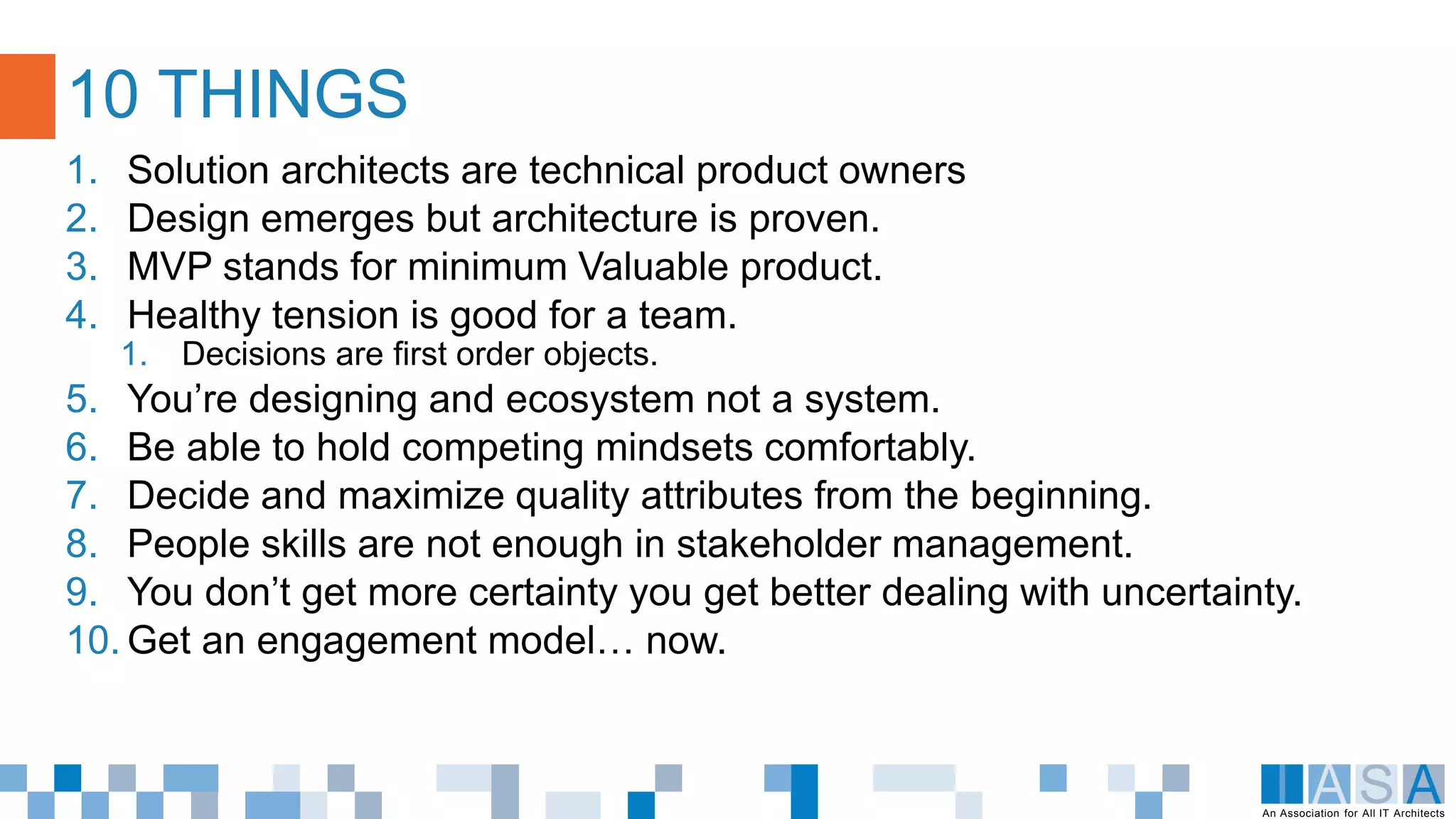
1. Solution architects are technical product owners
2. Design emerges but architecture is proven.
3. MVP stands for minimum Valuable product.
4. Healthy tension is good for a team.
1. Decisions are first order objects.
5. You’re designing and ecosystem not a system.
6. Be able to hold competing mindsets comfortably.
7. Decide and maximize quality attributes from the beginning.
8. People skills are not enough in stakeholder management.
9. You don’t get more certainty you get better dealing with uncertainty.
10. Get an engagement model… now.
10 THINGS
© 2020 IASA GLOBAL. All rights reserved. The information herein is for informational purposes only and represents the current view of IASA GLOBAL as of the date of this presentation. IASA GLOBAL cannot guarantee the
accuracy of any information provided after the date of this presentation. IASA GLOBAL MAKES NO WARRANTIES, EXPRESS, IMPLIED OR STATUTORY, AS TO THE INFORMATION IN THIS PRESENTATION
An Association for All IT Architects
For further information, please contactus@iasaglobal.org

10 solution architecture concepts

  • 1.
    An Association forAll IT Architects 10 Lessons from Solutiuon Architects Better Architecture Every Day
  • 2.
    Architecture The art andscience of designing and delivering valuable technology strategy.
  • 3.
    68 percent ofglobal business leaders list digital transformation as a top priority for their business. (Forrester) Technology IS business…
  • 4.
  • 5.
    Form, in architecture,starts in the eye of the beholder… or in deep processes that transcend human existence Agile Software Architecture, Alan W. Brown, Muhammad Ali Babar, Ivan Mistrik Architecture Form
  • 6.
    An Association forAll IT Architects Architect Driven Digital Advantage Architects must be at the heart of the digital transformation ADDT Innovation Lifecycle Program Investment Capability Transition Value Management Operational Excellence Engagement Model
  • 7.
    2. Design emergesarchitecture is proven
  • 8.
    Structure Creates andRealizes Form
  • 9.
    Function or SpeedCan Destroy Form
  • 10.
    “Architecture is theimportant stuff. Whatever that is.” Martin Fowler
  • 11.
    CONTEXT: Describe the forcesat play, including technological, political, social, and project local. Describe the tensions & dependencies Describe the facts as you know them DECISION: ADRs are those that affect the structure, quality attribute characteristics, dependencies, interfaces, or construction techniques of an architecture How do we respond to the forces We will…. CHARACTERISTICS: AUTHORITY: DECISION-OWNER: Who owns the decision-making process? DECISION-MAKING PROCESS: How do we make this decision? DECISION-MAKING AUTHORITY: tell, sell, consult, agree, inquire, delegate ARCHITECTURE DECISION RECORD CARD DOMAIN: DATE: STATUS: Last updated on 21 April 2018 Download a copy of this canvas at http://www.iasaglobal.org/tools/adrcard ADR Card Version: 0.1 Designed By: Gar Mac Críosta Agent ∆ for IASA Global Inspired By: Michael Nygard http://thinkrelevance.com/blog/2011/11/15/documenting-architecture-decisions This work is licensed under a Creative Commons Attribution-ShareAlike 4.0 International License. http://creativecommons.org/licenses/by-sa/4.0 REVERSABILITY DECISION DURATION INFORMATION QUALITY EFFORT (€, people, time) fully reversible irreversible days forever 0% 100% weeks months years CRITICALITY: low extreme OPTIONS: What options did we consider? 1 2 3 DECISION RATIONALE & CONSEQUENCES: Why did we choose this option? Are there any side-effects or impacts resulting form this decision?
  • 12.
    3. You aredesigning an ecosystem
  • 13.
    An Association forAll IT Architects  As business ecosystems become further involved they form ecosystem platforms with multiple interchangeable parts  Co-opetition become increasingly important and the rate of ‘new entry’ increases  Platform business models require empowerment of others in the ecosystem Business Model Challenges
  • 14.
    An Association forAll IT Architects  The customer’s world changes daily even hourly  New tools  New ecosystems  New costs  Customers are involved in pseudo-information expertise  They are bombarded with similar information sources  This results in expectations that often far exceed transactional value Customer Challenges
  • 15.
  • 16.
    An Association forAll IT Architects It isn’t just years of experience but type of experience
  • 17.
  • 19.
    6. You don’tget certainty, you get comfortable with uncertainty
  • 20.
    7. It isMinimum Valuable Product
  • 21.
    An Association forAll IT Architects Value Capture In Decisions  Decision traceability is the key to architectural success  From business to solution architects there is a constant rotation of ownership and outcomes
  • 22.
    8. Healthy tensionis a good thing
  • 23.
    An Association forAll IT Architects Program Teams • Engineering and Architecture have a joint opportunity • There are overlapping skills and comprehensive coverage • Self-Organizing and Self- Describing • Architects are responsible for Form and Structure • Engineers are concerned with Structure and Function
  • 24.
    9. It’s notpeople skills, it is stakeholder management
  • 25.
    How do weneed to communicate with them? KEY METRICS: DECISION-MAKING STYLE: PAINS: ORIGIN STORY: STAKEHOLDER EMPATHY MAP DATE: VERSION: Last updated on 21 April 2018 Stakeholder Engagement Map Version: 0.1 Designed By: Gar Mac Críosta Agent ∆ for IASA Global. Inspired by: Dave Gray - Empathy Map - http://gamestorming.com/empathy-map/ This work is licensed under a Creative Commons Attribution-ShareAlike 4.0 International License. http://creativecommons.org/licenses/by-sa/4.0 INITIATIVE: ROLE: PERCEPTION: LOCATION: POWER: REPORTS TO: GAINS: THINK & FEEL: What do they think & feel? SEE: What do they see? What information is displayed in their office/workspace? What do they read or subscribe to? How do they read physical (print)/digital (device)? Who do they see vendors, analysts, externals? hopes, dreams, desires, aspirations fears/frustrations /anxieties /grievances SAY: What do they say? What catch phrases or common themes are they known for? What do you imagine they talk about to friends & family? What do you imagine they say to peers and bosses DO: What do they do? What does their job involve? What do they need to be able to do? What questions do they need answers to? What decisions do they make? analytical, conceptual, decisive GOAL: What do they need to do? What are they measured on? What are they rewarded for? What decisions do they need to make? What jobs unsatisfied important jobs to be done do they have? What will success look like for them? outcomes KEY INFLUENCERS: Who do they listen to? Who are their key influencers? formal/informal positive/negative/ neutral/mixed INTEREST: gatekeeper, decision-maker, influencer, participant, stakeholder NAME: TYPE: HEAR: What are they hearing from bosses? What are they hearing from colleagues? What are they hearing from consultants/partners? What are they hearing from vendors? What are they hearing from the ‘industry’? ENGAGE: INITIATIVE ENGAGEMENT STRATEGY: How should we engage this stakeholder in this initiative ignore, consult, negotiate, involve, collaborate, empower informal formal frequent regul ar chat structure urgent INFORMATION EXCHANGE CADENCE FORMAT
  • 26.
    10. Get anengagement model… now
  • 27.
    An Association forAll IT Architects Building Complex Things With Unskilled People Is Dangerous Or Stupid
  • 28.
    An Association forAll IT Architects Engagement Models
  • 29.
    An Association forAll IT Architects 1. Solution architects are technical product owners 2. Design emerges but architecture is proven. 3. MVP stands for minimum Valuable product. 4. Healthy tension is good for a team. 1. Decisions are first order objects. 5. You’re designing and ecosystem not a system. 6. Be able to hold competing mindsets comfortably. 7. Decide and maximize quality attributes from the beginning. 8. People skills are not enough in stakeholder management. 9. You don’t get more certainty you get better dealing with uncertainty. 10. Get an engagement model… now. 10 THINGS
  • 30.
    © 2020 IASAGLOBAL. All rights reserved. The information herein is for informational purposes only and represents the current view of IASA GLOBAL as of the date of this presentation. IASA GLOBAL cannot guarantee the accuracy of any information provided after the date of this presentation. IASA GLOBAL MAKES NO WARRANTIES, EXPRESS, IMPLIED OR STATUTORY, AS TO THE INFORMATION IN THIS PRESENTATION An Association for All IT Architects For further information, please contactus@iasaglobal.org

Editor's Notes

  • #6 Form and function. Form and structure
  • #9 Engineering parts - structure
  • #10 Function driven – the great fear keeping us from agile adoption – but also a hint of reality
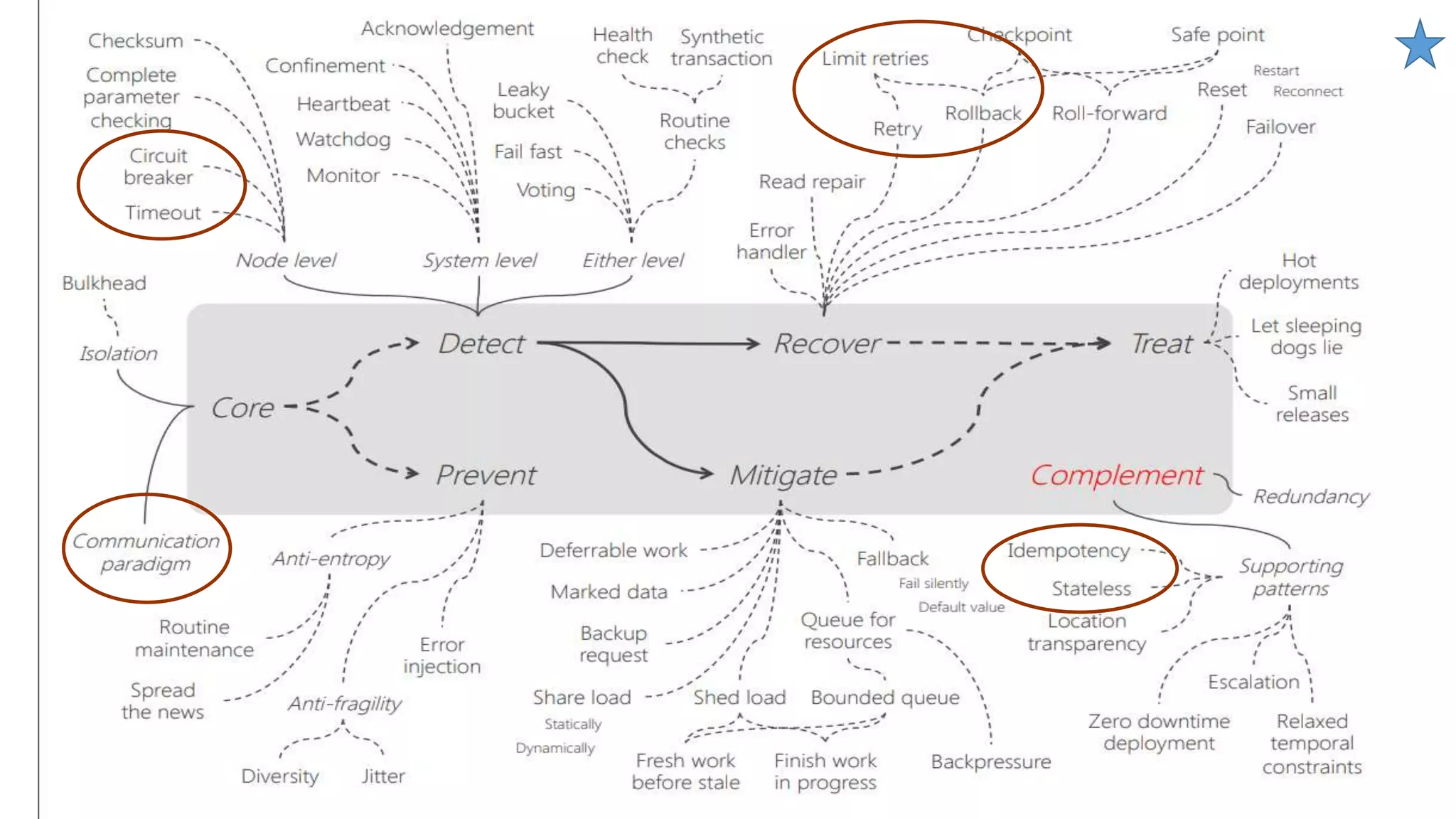
  • #19 Resilient software design in a nutshell, Uwe Friedrichsen (codecentric AG) – Software Architecture Conference – London, 18. October 2017
  • #22 Walk through architect ownership and handoff analysis. The architect is responsible from goal to measure where the traditional IT team is responsible from requirements to delivery test. However the value is generated after usage. That means while IT is throwing parties after deployment the project is at its most expensive and least used for the company. Agile and DevOps attempt to address this specifically with team product owners but the product owners are not technical enough. The team if it stays with its solution still needs the architect involved deeply.