Network Characteristics of Cloud Architecture1
Performance Dimensions
2
¨  Application performance differs according to perspective.
¤  For a user, an ideal application would deliver high performance
and responsiveness.
¤  For an administrator, an ideal application would consume the
least amount of network resources.
¨  Performance also differs based on application type.
¤  Performance for a bulk file transfer application might have
different implications than performance for a transactional
application.
Stakeholders: Users and Administrators
¨  Users want applications to be fast
and predictable.
¨  Users judge application performance
by their experience:
¤  Is the application quick to respond?
¤  Is an hourglass icon/pinwheel
displayed while background
operations are carried out?
¤  Does the application launch and close
quickly?
¤  Are errors handled in an
understandable way?
¨  Administrators want applications to scale.
¨  Administrators often judge an
application's performance on how
efficiently it uses network resources.
¨  Administrators may ask:
¤  Does the application have low overhead
and efficient network usage?
¤  Are the minimum number of connections
used, so my server can service as many
users at once as possible?
¤  Am I constantly calling helpdesk?
3
Measuring application performance
4
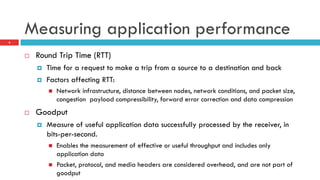
¨  Round Trip Time (RTT)
¤  Time for a request to make a trip from a source to a destination and back
¤  Factors affecting RTT:
n  Network infrastructure, distance between nodes, network conditions, and packet size,
congestion payload compressibility, forward error correction and data compression
¨  Goodput
¤  Measure of useful application data successfully processed by the receiver, in
bits-per-second.
n  Enables the measurement of effective or useful throughput and includes only
application data
n  Packet, protocol, and media headers are considered overhead, and are not part of
goodput
Measuring application performance
5
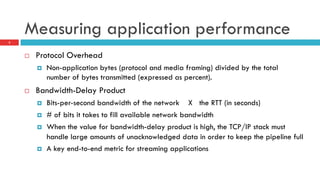
¨  Protocol Overhead
¤  Non-application bytes (protocol and media framing) divided by the total
number of bytes transmitted (expressed as percent).
¨  Bandwidth-Delay Product
¤  Bits-per-second bandwidth of the network X the RTT (in seconds)
¤  # of bits it takes to fill available network bandwidth
¤  When the value for bandwidth-delay product is high, the TCP/IP stack must
handle large amounts of unacknowledged data in order to keep the pipeline full
¤  A key end-to-end metric for streaming applications
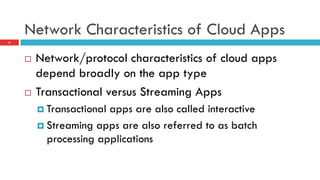
Network Characteristics of Cloud Apps
6
¨  Network/protocol characteristics of cloud apps
depend broadly on the app type
¨  Transactional versus Streaming Apps
¤  Transactional apps are also called interactive
¤  Streaming apps are also referred to as batch
processing applications
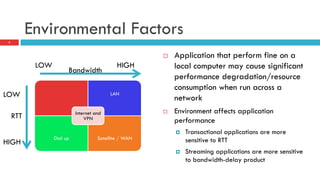
Environmental Factors
7
¨  Application that perform fine on a
local computer may cause significant
performance degradation/resource
consumption when run across a
network
¨  Environment affects application
performance
¤  Transactional applications are more
sensitive to RTT
¤  Streaming applications are more sensitive
to bandwidth-delay product
LAN
Dial up Satellite / WAN
Internet and
VPN
LOW HIGH
LOW
HIGH
Bandwidth
RTT
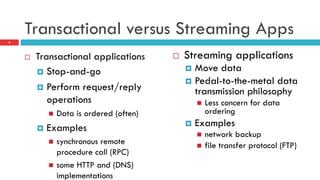
Transactional versus Streaming Apps
¨  Transactional applications
¤  Stop-and-go
¤  Perform request/reply
operations
n  Data is ordered (often)
¤  Examples
n  synchronous remote
procedure call (RPC)
n  some HTTP and (DNS)
implementations
¨  Streaming applications
¤  Move data
¤  Pedal-to-the-metal data
transmission philosophy
n  Less concern for data
ordering
¤  Examples
n  network backup
n  file transfer protocol (FTP)
8
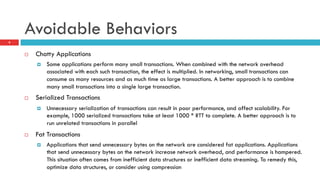
Avoidable Behaviors
9
¨  Chatty Applications
¤  Some applications perform many small transactions. When combined with the network overhead
associated with each such transaction, the effect is multiplied. In networking, small transactions can
consume as many resources and as much time as large transactions. A better approach is to combine
many small transactions into a single large transaction.
¨  Serialized Transactions
¤  Unnecessary serialization of transactions can result in poor performance, and affect scalability. For
example, 1000 serialized transactions take at least 1000 * RTT to complete. A better approach is to
run unrelated transactions in parallel
¨  Fat Transactions
¤  Applications that send unnecessary bytes on the network are considered fat applications. Applications
that send unnecessary bytes on the network increase network overhead, and performance is hampered.
This situation often comes from inefficient data structures or inefficient data streaming. To remedy this,
optimize data structures, or consider using compression
Questions and discussion on topic
10
11
Thank you.

Network characteristics of the cloud

  • 1.
    Network Characteristics ofCloud Architecture1
  • 2.
    Performance Dimensions 2 ¨  Applicationperformance differs according to perspective. ¤  For a user, an ideal application would deliver high performance and responsiveness. ¤  For an administrator, an ideal application would consume the least amount of network resources. ¨  Performance also differs based on application type. ¤  Performance for a bulk file transfer application might have different implications than performance for a transactional application.
  • 3.
    Stakeholders: Users andAdministrators ¨  Users want applications to be fast and predictable. ¨  Users judge application performance by their experience: ¤  Is the application quick to respond? ¤  Is an hourglass icon/pinwheel displayed while background operations are carried out? ¤  Does the application launch and close quickly? ¤  Are errors handled in an understandable way? ¨  Administrators want applications to scale. ¨  Administrators often judge an application's performance on how efficiently it uses network resources. ¨  Administrators may ask: ¤  Does the application have low overhead and efficient network usage? ¤  Are the minimum number of connections used, so my server can service as many users at once as possible? ¤  Am I constantly calling helpdesk? 3
  • 4.
    Measuring application performance 4 ¨ Round Trip Time (RTT) ¤  Time for a request to make a trip from a source to a destination and back ¤  Factors affecting RTT: n  Network infrastructure, distance between nodes, network conditions, and packet size, congestion payload compressibility, forward error correction and data compression ¨  Goodput ¤  Measure of useful application data successfully processed by the receiver, in bits-per-second. n  Enables the measurement of effective or useful throughput and includes only application data n  Packet, protocol, and media headers are considered overhead, and are not part of goodput
  • 5.
    Measuring application performance 5 ¨ Protocol Overhead ¤  Non-application bytes (protocol and media framing) divided by the total number of bytes transmitted (expressed as percent). ¨  Bandwidth-Delay Product ¤  Bits-per-second bandwidth of the network X the RTT (in seconds) ¤  # of bits it takes to fill available network bandwidth ¤  When the value for bandwidth-delay product is high, the TCP/IP stack must handle large amounts of unacknowledged data in order to keep the pipeline full ¤  A key end-to-end metric for streaming applications
  • 6.
    Network Characteristics ofCloud Apps 6 ¨  Network/protocol characteristics of cloud apps depend broadly on the app type ¨  Transactional versus Streaming Apps ¤  Transactional apps are also called interactive ¤  Streaming apps are also referred to as batch processing applications
  • 7.
    Environmental Factors 7 ¨  Applicationthat perform fine on a local computer may cause significant performance degradation/resource consumption when run across a network ¨  Environment affects application performance ¤  Transactional applications are more sensitive to RTT ¤  Streaming applications are more sensitive to bandwidth-delay product LAN Dial up Satellite / WAN Internet and VPN LOW HIGH LOW HIGH Bandwidth RTT
  • 8.
    Transactional versus StreamingApps ¨  Transactional applications ¤  Stop-and-go ¤  Perform request/reply operations n  Data is ordered (often) ¤  Examples n  synchronous remote procedure call (RPC) n  some HTTP and (DNS) implementations ¨  Streaming applications ¤  Move data ¤  Pedal-to-the-metal data transmission philosophy n  Less concern for data ordering ¤  Examples n  network backup n  file transfer protocol (FTP) 8
  • 9.
    Avoidable Behaviors 9 ¨  ChattyApplications ¤  Some applications perform many small transactions. When combined with the network overhead associated with each such transaction, the effect is multiplied. In networking, small transactions can consume as many resources and as much time as large transactions. A better approach is to combine many small transactions into a single large transaction. ¨  Serialized Transactions ¤  Unnecessary serialization of transactions can result in poor performance, and affect scalability. For example, 1000 serialized transactions take at least 1000 * RTT to complete. A better approach is to run unrelated transactions in parallel ¨  Fat Transactions ¤  Applications that send unnecessary bytes on the network are considered fat applications. Applications that send unnecessary bytes on the network increase network overhead, and performance is hampered. This situation often comes from inefficient data structures or inefficient data streaming. To remedy this, optimize data structures, or consider using compression
  • 10.
  • 11.