1
Advanced Computer Networks
Lecture No. 02
2
Multiplexing
• Physical links/switches must be shared among users
– (synchronous) Time-Division Multiplexing (TDM)
– Frequency-Division Multiplexing (FDM)
L1
L2
L3
R1
R2
R3
Switch 1 Switch 2
Multiple flows
on a single link
Do you see any problem with TDM / FDM ?
3
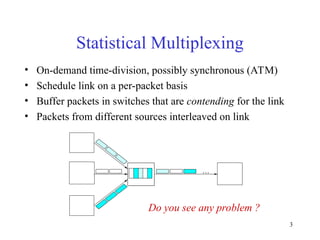
Statistical Multiplexing
• On-demand time-division, possibly synchronous (ATM)
• Schedule link on a per-packet basis
• Buffer packets in switches that are contending for the link
• Packets from different sources interleaved on link
…
Do you see any problem ?
4
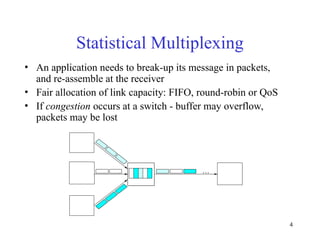
Statistical Multiplexing
• An application needs to break-up its message in packets,
and re-assemble at the receiver
• Fair allocation of link capacity: FIFO, round-robin or QoS
• If congestion occurs at a switch - buffer may overflow,
packets may be lost
…
5
Enough … ?
• A network is delivering packets among a
collection of computers
• How application processes communicate in
a meaningful way ?
• Hide network complexity by implementing
the common services once
6
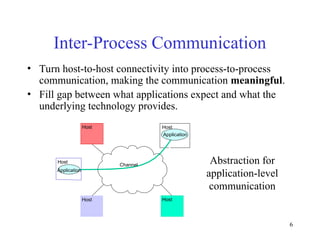
Inter-Process Communication
• Turn host-to-host connectivity into process-to-process
communication, making the communication meaningful.
• Fill gap between what applications expect and what the
underlying technology provides.
Host Host
Application
Host
Application
Host Host
Channel
Abstraction for
application-level
communication
7
IPC Abstractions
• Semantics and interface depend on applications
• Request/Reply
– distributed file systems
• file servers (FTP)
– digital libraries / HTTP
• information retrieval
• Message stream
– video on-demand
– video conferencing
• delay sensitive
• two-way frame flow
• 1/4 NTSC = 352x240 pixels
• (352 x 240 x 24)/8=247.5KB
• 30 fps = 7500KBps = 60Mbps
• 10fps + compression < 10Mbps
• reliable ?
• prioritized ?
• delay/bandwidth guarantees ?
8
Abstract Channel Functionality
• What functionality does a channel provide ?
– Smallest set of abstract channel types adequate
for largest number of applications
• Where the functionality is implemented ?
– Network as a simple bit-pipe with all high-level
communication semantics at the hosts
– More intelligent switches allowing hosts to be
“dumb” devices (telephone network)
9
What Goes Wrong in the Network?
Reliability at stake
• Bit-level errors (electrical interference)
• Packet-level errors (congestion)
– distinction between lost and late packet
• Link and node failures
– distinction between broken and flaky link
– distinction between failed and slow node
10
What Goes Undesirable in the Network?
Required performance at stake
• Messages are delayed
• Messages are delivered out-of-order
• Third party’s eavesdrop
The challenge is to fill the gap between
application expectations and hardware
capabilities
11
Performance Metrics
• … and to do so while delivering
“good” performance
• Bandwidth (throughput)
– data transmitted per unit time, e.g. 10 Mbps
– link bandwidth versus end-to-end bandwidth
– notation
• KB = 210
bytes
• Kbps = 103
bits per second
12
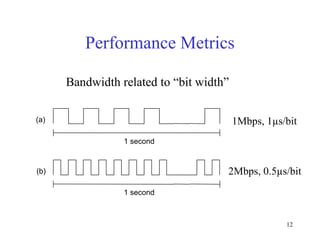
Performance Metrics
1 second
(a)
1 second
(b)
1Mbps, 1µs/bit
2Mbps, 0.5µs/bit
Bandwidth related to “bit width”
13
Performance Metrics
• Latency / delay
– time to send message from point A to point B
– one-way versus round-trip time (RTT)
– components
Latency = Propagation + Transmit + Queue
Propagation = Distance / c
Transmit = Size / Bandwidth
• Note:
• No queuing delay in direct (point-to-point) link
• Bandwidth irrelevant if size = 1 bit
• Process-to-process latency includes software processing overhead
(dominates over shorter distances)
14
Bandwidth versus Latency
• Relative importance, depends on application
• 1-byte character:
– Choice of 1ms vs 100ms dominates 1Mbps vs
100Mbps
• 25MB file:
– Choice of 1Mbps vs 100Mbps dominates 1ms vs
100ms
• Large data (file transfer) is bandwidth critical
• Small data (HTTP) is latency critical
15
Network Architecture
• The challenge is to fill the gap between hardware
capabilities and application expectations, and to
do so while delivering “good” performance
• Designers cope with this complex task by
developing a network architecture as a guideline
– Layering, protocols, standards
16
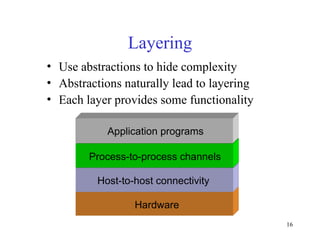
Layering
• Use abstractions to hide complexity
• Abstractions naturally lead to layering
• Each layer provides some functionality
Hardware
Host-to-host connectivity
Process-to-process channels
Application programs
17
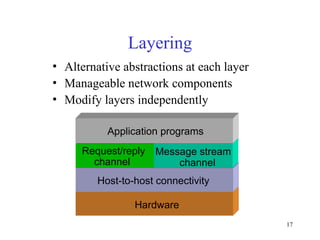
Layering
• Alternative abstractions at each layer
• Manageable network components
• Modify layers independently
Hardware
Host-to-host connectivity
Application programs
Request/reply
channel
Message stream
channel
18
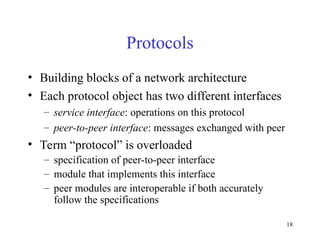
Protocols
• Building blocks of a network architecture
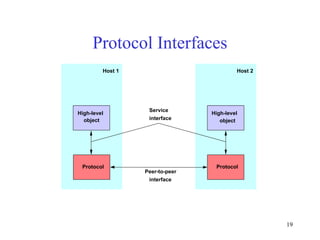
• Each protocol object has two different interfaces
– service interface: operations on this protocol
– peer-to-peer interface: messages exchanged with peer
• Term “protocol” is overloaded
– specification of peer-to-peer interface
– module that implements this interface
– peer modules are interoperable if both accurately
follow the specifications
19
Host 1 Host 2
Service
interface
Peer-to-peer
interface
Protocol Interfaces
High-level
object
High-level
object
Protocol
Protocol
20
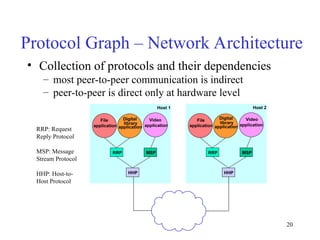
Protocol Graph – Network Architecture
• Collection of protocols and their dependencies
– most peer-to-peer communication is indirect
– peer-to-peer is direct only at hardware level
Host 1 Host 2
File
application
Digital
library
application
Video
application
File
application
Digital
library
application
Video
application
RRP RRP
MSP MSP
HHP HHP
RRP: Request
Reply Protocol
MSP: Message
Stream Protocol
HHP: Host-to-
Host Protocol
21
Wrap-up
• Established a comprehensive set of requirements
for network design
• Networks evolve to accommodate changes in
underlying technologies and user demands
• However, hardware and user expectations are
moving targets …

Advanced Computer Networks Lecture 2.ppt

  • 1.
  • 2.
    2 Multiplexing • Physical links/switchesmust be shared among users – (synchronous) Time-Division Multiplexing (TDM) – Frequency-Division Multiplexing (FDM) L1 L2 L3 R1 R2 R3 Switch 1 Switch 2 Multiple flows on a single link Do you see any problem with TDM / FDM ?
  • 3.
    3 Statistical Multiplexing • On-demandtime-division, possibly synchronous (ATM) • Schedule link on a per-packet basis • Buffer packets in switches that are contending for the link • Packets from different sources interleaved on link … Do you see any problem ?
  • 4.
    4 Statistical Multiplexing • Anapplication needs to break-up its message in packets, and re-assemble at the receiver • Fair allocation of link capacity: FIFO, round-robin or QoS • If congestion occurs at a switch - buffer may overflow, packets may be lost …
  • 5.
    5 Enough … ? •A network is delivering packets among a collection of computers • How application processes communicate in a meaningful way ? • Hide network complexity by implementing the common services once
  • 6.
    6 Inter-Process Communication • Turnhost-to-host connectivity into process-to-process communication, making the communication meaningful. • Fill gap between what applications expect and what the underlying technology provides. Host Host Application Host Application Host Host Channel Abstraction for application-level communication
  • 7.
    7 IPC Abstractions • Semanticsand interface depend on applications • Request/Reply – distributed file systems • file servers (FTP) – digital libraries / HTTP • information retrieval • Message stream – video on-demand – video conferencing • delay sensitive • two-way frame flow • 1/4 NTSC = 352x240 pixels • (352 x 240 x 24)/8=247.5KB • 30 fps = 7500KBps = 60Mbps • 10fps + compression < 10Mbps • reliable ? • prioritized ? • delay/bandwidth guarantees ?
  • 8.
    8 Abstract Channel Functionality •What functionality does a channel provide ? – Smallest set of abstract channel types adequate for largest number of applications • Where the functionality is implemented ? – Network as a simple bit-pipe with all high-level communication semantics at the hosts – More intelligent switches allowing hosts to be “dumb” devices (telephone network)
  • 9.
    9 What Goes Wrongin the Network? Reliability at stake • Bit-level errors (electrical interference) • Packet-level errors (congestion) – distinction between lost and late packet • Link and node failures – distinction between broken and flaky link – distinction between failed and slow node
  • 10.
    10 What Goes Undesirablein the Network? Required performance at stake • Messages are delayed • Messages are delivered out-of-order • Third party’s eavesdrop The challenge is to fill the gap between application expectations and hardware capabilities
  • 11.
    11 Performance Metrics • …and to do so while delivering “good” performance • Bandwidth (throughput) – data transmitted per unit time, e.g. 10 Mbps – link bandwidth versus end-to-end bandwidth – notation • KB = 210 bytes • Kbps = 103 bits per second
  • 12.
    12 Performance Metrics 1 second (a) 1second (b) 1Mbps, 1µs/bit 2Mbps, 0.5µs/bit Bandwidth related to “bit width”
  • 13.
    13 Performance Metrics • Latency/ delay – time to send message from point A to point B – one-way versus round-trip time (RTT) – components Latency = Propagation + Transmit + Queue Propagation = Distance / c Transmit = Size / Bandwidth • Note: • No queuing delay in direct (point-to-point) link • Bandwidth irrelevant if size = 1 bit • Process-to-process latency includes software processing overhead (dominates over shorter distances)
  • 14.
    14 Bandwidth versus Latency •Relative importance, depends on application • 1-byte character: – Choice of 1ms vs 100ms dominates 1Mbps vs 100Mbps • 25MB file: – Choice of 1Mbps vs 100Mbps dominates 1ms vs 100ms • Large data (file transfer) is bandwidth critical • Small data (HTTP) is latency critical
  • 15.
    15 Network Architecture • Thechallenge is to fill the gap between hardware capabilities and application expectations, and to do so while delivering “good” performance • Designers cope with this complex task by developing a network architecture as a guideline – Layering, protocols, standards
  • 16.
    16 Layering • Use abstractionsto hide complexity • Abstractions naturally lead to layering • Each layer provides some functionality Hardware Host-to-host connectivity Process-to-process channels Application programs
  • 17.
    17 Layering • Alternative abstractionsat each layer • Manageable network components • Modify layers independently Hardware Host-to-host connectivity Application programs Request/reply channel Message stream channel
  • 18.
    18 Protocols • Building blocksof a network architecture • Each protocol object has two different interfaces – service interface: operations on this protocol – peer-to-peer interface: messages exchanged with peer • Term “protocol” is overloaded – specification of peer-to-peer interface – module that implements this interface – peer modules are interoperable if both accurately follow the specifications
  • 19.
    19 Host 1 Host2 Service interface Peer-to-peer interface Protocol Interfaces High-level object High-level object Protocol Protocol
  • 20.
    20 Protocol Graph –Network Architecture • Collection of protocols and their dependencies – most peer-to-peer communication is indirect – peer-to-peer is direct only at hardware level Host 1 Host 2 File application Digital library application Video application File application Digital library application Video application RRP RRP MSP MSP HHP HHP RRP: Request Reply Protocol MSP: Message Stream Protocol HHP: Host-to- Host Protocol
  • 21.
    21 Wrap-up • Established acomprehensive set of requirements for network design • Networks evolve to accommodate changes in underlying technologies and user demands • However, hardware and user expectations are moving targets …