By: Aali Khanna 
Bhavika Kumar 
Ayushi Daga 
Ishita Sood 
Mansi Narula
MUMBAI DABBAWALAS 
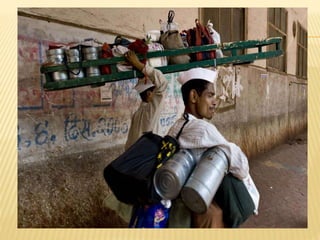
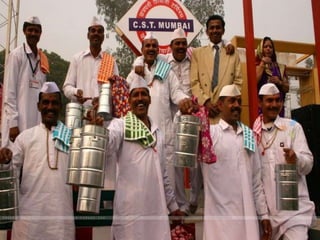
 There are 5,000 or so dabbawalas in the city who have 
an astounding service record. 
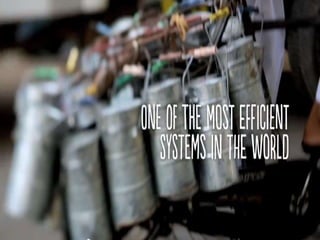
 Every working day they transport more than 130,000 
lunchboxes throughout Mumbai, the world’s fourth-most- 
populous city. 
 That entails conducting upwards of 260,000 
transactions in six hours each day, six days a week, 52 
weeks a year (minus holidays), but mistakes are 
extremely rare. 
 Amazingly, the dabbawalas—semiliterate workers who 
largely manage themselves—have achieved that level of 
performance at very low cost, in an ecofriendly way, 
without the use of any IT system or even cell phones.
THE QUESTION 
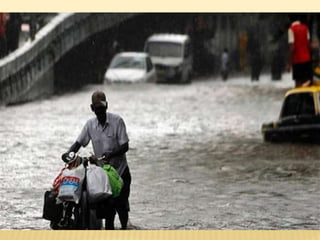
 Since it was founded, in 1890, it has endured 
famines, wars, monsoons, Hindu-Muslim riots, 
and a series of terrorist attacks The dabbawala 
service is legendary for its reliability. 
How can a poorly educated, decentralized 
workforce perform so beautifully in an 
environment that can charitably be described 
as unpredictable and challenging?
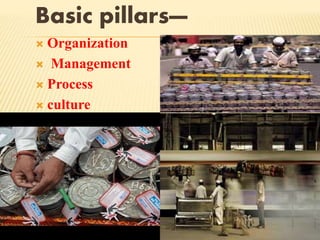
Basic pillars— 
 Organization 
 Management 
 Process 
 culture
ORG:- A CLOCKWORK DESIGN 
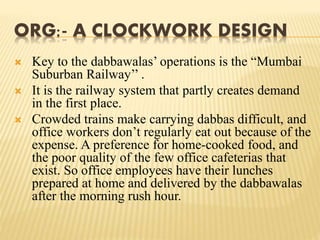
 Key to the dabbawalas’ operations is the “Mumbai 
Suburban Railway’’ . 
 It is the railway system that partly creates demand 
in the first place. 
 Crowded trains make carrying dabbas difficult, and 
office workers don’t regularly eat out because of the 
expense. A preference for home-cooked food, and 
the poor quality of the few office cafeterias that 
exist. So office employees have their lunches 
prepared at home and delivered by the dabbawalas 
after the morning rush hour.
WORK PROCEDURE 
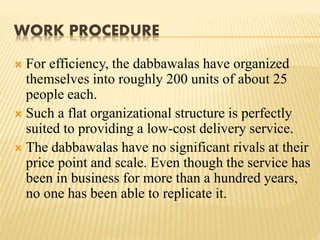
 For efficiency, the dabbawalas have organized 
themselves into roughly 200 units of about 25 
people each. 
 Such a flat organizational structure is perfectly 
suited to providing a low-cost delivery service. 
 The dabbawalas have no significant rivals at their 
price point and scale. Even though the service has 
been in business for more than a hundred years, 
no one has been able to replicate it.
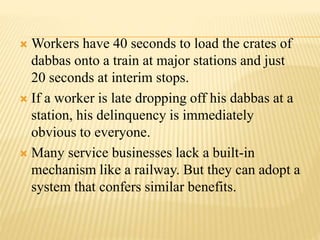
Workers have 40 seconds to load the crates of 
dabbas onto a train at major stations and just 
20 seconds at interim stops. 
 If a worker is late dropping off his dabbas at a 
station, his delinquency is immediately 
obvious to everyone. 
 Many service businesses lack a built-in 
mechanism like a railway. But they can adopt a 
system that confers similar benefits.
MANAGEMENT- A SELF ORGANIZED 
DEMOCRACY 
 Each dabbawala is an entrepreneur who is responsible for 
negotiating prices. 
 However, governing committees set guidelines which take 
into account factors such as the distance between a 
customer’s residence and office and the distance between 
that office and the closest railway station. 
 The dabbawalas within a group don’t have a monopoly over 
any particular area. 
 However, once the relationship is established, no other 
dabbawala is permitted to go after the same customer and 
“steal” him.
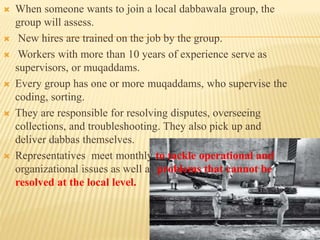
 When someone wants to join a local dabbawala group, the 
group will assess. 
 New hires are trained on the job by the group. 
 Workers with more than 10 years of experience serve as 
supervisors, or muqaddams. 
 Every group has one or more muqaddams, who supervise the 
coding, sorting. 
 They are responsible for resolving disputes, overseeing 
collections, and troubleshooting. They also pick up and 
deliver dabbas themselves. 
 Representatives meet monthly to tackle operational and 
organizational issues as well as problems that cannot be 
resolved at the local level.
PROCESS: SIMPLICITY, FLEXIBILITY AND 
RIGOR 
 The right process in place means more than simply implementing 
efficient work flows. It also entails just about everything in the 
organization, including the way information is managed, the use of 
built-in buffers, and a strict adherence to standards. 
 It doesn’t allow for full addresses. The dabbawalas, who run the same 
route for years, don’t need all those details, and inserting them would 
clutter the lid, slow the sorting process, and possibly lead to errors. 
 To stay on schedule, each group has two or three extra workers who fill 
in wherever they are needed, and all members are cross-trained in 
different activities: collecting, sorting, transporting, finance, and 
customer relations. 
 Rigorous adherence to processes and standards. The dabbas, for 
instance, are all roughly the same size and cylindrical shape. To 
encourage customers to conform, containers incur an additional fee 
when, say, they are so large that they require special handling. Unusual 
containers that interfere with the delivery operation are simply not 
accepted. This uniformity allows the dabbas to be packed quickly onto 
crates, which are also a standard size so that they can be efficiently 
loaded onto trains.
CRACKING THE DABBA CODE 
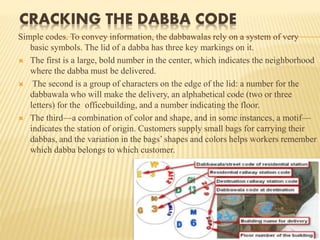
Simple codes. To convey information, the dabbawalas rely on a system of very 
basic symbols. The lid of a dabba has three key markings on it. 
 The first is a large, bold number in the center, which indicates the neighborhood 
where the dabba must be delivered. 
 The second is a group of characters on the edge of the lid: a number for the 
dabbawala who will make the delivery, an alphabetical code (two or three 
letters) for the officebuilding, and a number indicating the floor. 
 The third—a combination of color and shape, and in some instances, a motif— 
indicates the station of origin. Customers supply small bags for carrying their 
dabbas, and the variation in the bags’ shapes and colors helps workers remember 
which dabba belongs to which customer.
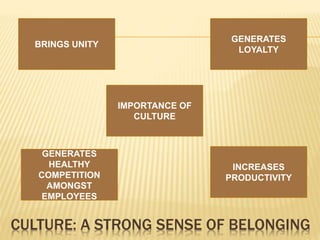
IMPORTANCE OF 
CULTURE 
BRINGS UNITY 
GENERATES 
LOYALTY 
GENERATES 
HEALTHY 
COMPETITION 
AMONGST 
EMPLOYEES 
INCREASES 
PRODUCTIVITY 
CULTURE: A STRONG SENSE OF BELONGING
CULTURE IN DABBAWALA COMMUNITY 
 This group has a sense of belonging and 
care about each other which is the major 
reason for their success. 
 Each Dabbawala act as a pillar and 
contributes to a system that is focused on 
achieving on simple goal: on-time delivery. 
 Dabbawalas range in age from 18 to 65 
and tend to remain in their groups for their 
entire working lives. As a result members 
of each team care deeply for one another.
CONTD.. 
 The men, and few women, who make 
up the Dabbawalas network, trace their 
lineage to a clutch of villages around 
Pune and they share the same 
language, values, work ethic and 
religious beliefs. So they bond like a 
family. 
 Hence Unity and culture are the main 
driving forces for the success of the 
Dabbawalas community.
A SELF-REINFORCING SYSTEM 
 The coding system. It is simple and visual, which 
allows a semiliterate workforce to sort dabbas 
quickly. That allows the use of a hub-and-spoke 
organization in which railway stations serve as hubs 
and the need for centralized management is minimal. 
This is an important lesson for executives who 
mistakenly think they can alter just one pillar 
without taking into account the impact on the other 
three.
 What happened when companies like Microsoft 
and Hindustan Unilever were interested in having 
advertising materials and product samples 
delivered along with the dabbas. 
After conducting trial experiments, the dabbawalas 
found that the extra time required to affix flyers 
or samples to the dabbas was too big a disruption 
to their system, and the projects were tabled.
 They acknowledge they must adapt to major trends 
sweeping India, such as the exploding numbers of 
women entering the workforce. 
 This shift will put a big crimp in their operations 
because in India preparing lunches and packing them in 
dabbas has traditionally been a woman’s domain. 
Consequently, the dabbawalas have started to collaborate 
with small companies and canteens that provide freshly 
prepared meals 
 At the same 0time, they have rebuffed any proposals for 
backward integration—for example, setting up their own 
kitchens. 
The reason is simple: They won’t allow themselves to be 
distracted from their core mission of delivering 
dabbas on time.
 This is a lesson that the Lego Group learned the hard 
way. When the company tried to grow aggressively in 
the mid-1990s, its leaders encouraged their businesses 
to venture outside the company’s core play systems. 
Operational complexity grew, costs got out of hand, 
and customers became confused about Lego’s brand 
and values. 
 A new management team created a successful business 
model that carefully balanced growing. 
The dabbawalas have shown that with the right 
system, an organization doesn’t need extraordinary 
talent to achieve extraordinary performance. 
Leaders who see themselves as system architects 
can obtain the same results.
The dabbawalas, too, are facing challenges as 
their market undergoes a transformation. But 
with judicious adjustments to their four 
pillars, they may continue to achieve amazing 
results. And that’s a lesson managers of all 
enterprises should take to heart.
The mumbai dabbawalas

The mumbai dabbawalas

  • 1.
    By: Aali Khanna Bhavika Kumar Ayushi Daga Ishita Sood Mansi Narula
  • 4.
    MUMBAI DABBAWALAS There are 5,000 or so dabbawalas in the city who have an astounding service record.  Every working day they transport more than 130,000 lunchboxes throughout Mumbai, the world’s fourth-most- populous city.  That entails conducting upwards of 260,000 transactions in six hours each day, six days a week, 52 weeks a year (minus holidays), but mistakes are extremely rare.  Amazingly, the dabbawalas—semiliterate workers who largely manage themselves—have achieved that level of performance at very low cost, in an ecofriendly way, without the use of any IT system or even cell phones.
  • 5.
    THE QUESTION Since it was founded, in 1890, it has endured famines, wars, monsoons, Hindu-Muslim riots, and a series of terrorist attacks The dabbawala service is legendary for its reliability. How can a poorly educated, decentralized workforce perform so beautifully in an environment that can charitably be described as unpredictable and challenging?
  • 7.
    Basic pillars— Organization  Management  Process  culture
  • 8.
    ORG:- A CLOCKWORKDESIGN  Key to the dabbawalas’ operations is the “Mumbai Suburban Railway’’ .  It is the railway system that partly creates demand in the first place.  Crowded trains make carrying dabbas difficult, and office workers don’t regularly eat out because of the expense. A preference for home-cooked food, and the poor quality of the few office cafeterias that exist. So office employees have their lunches prepared at home and delivered by the dabbawalas after the morning rush hour.
  • 9.
    WORK PROCEDURE For efficiency, the dabbawalas have organized themselves into roughly 200 units of about 25 people each.  Such a flat organizational structure is perfectly suited to providing a low-cost delivery service.  The dabbawalas have no significant rivals at their price point and scale. Even though the service has been in business for more than a hundred years, no one has been able to replicate it.
  • 10.
    Workers have 40seconds to load the crates of dabbas onto a train at major stations and just 20 seconds at interim stops.  If a worker is late dropping off his dabbas at a station, his delinquency is immediately obvious to everyone.  Many service businesses lack a built-in mechanism like a railway. But they can adopt a system that confers similar benefits.
  • 11.
    MANAGEMENT- A SELFORGANIZED DEMOCRACY  Each dabbawala is an entrepreneur who is responsible for negotiating prices.  However, governing committees set guidelines which take into account factors such as the distance between a customer’s residence and office and the distance between that office and the closest railway station.  The dabbawalas within a group don’t have a monopoly over any particular area.  However, once the relationship is established, no other dabbawala is permitted to go after the same customer and “steal” him.
  • 12.
     When someonewants to join a local dabbawala group, the group will assess.  New hires are trained on the job by the group.  Workers with more than 10 years of experience serve as supervisors, or muqaddams.  Every group has one or more muqaddams, who supervise the coding, sorting.  They are responsible for resolving disputes, overseeing collections, and troubleshooting. They also pick up and deliver dabbas themselves.  Representatives meet monthly to tackle operational and organizational issues as well as problems that cannot be resolved at the local level.
  • 13.
    PROCESS: SIMPLICITY, FLEXIBILITYAND RIGOR  The right process in place means more than simply implementing efficient work flows. It also entails just about everything in the organization, including the way information is managed, the use of built-in buffers, and a strict adherence to standards.  It doesn’t allow for full addresses. The dabbawalas, who run the same route for years, don’t need all those details, and inserting them would clutter the lid, slow the sorting process, and possibly lead to errors.  To stay on schedule, each group has two or three extra workers who fill in wherever they are needed, and all members are cross-trained in different activities: collecting, sorting, transporting, finance, and customer relations.  Rigorous adherence to processes and standards. The dabbas, for instance, are all roughly the same size and cylindrical shape. To encourage customers to conform, containers incur an additional fee when, say, they are so large that they require special handling. Unusual containers that interfere with the delivery operation are simply not accepted. This uniformity allows the dabbas to be packed quickly onto crates, which are also a standard size so that they can be efficiently loaded onto trains.
  • 14.
    CRACKING THE DABBACODE Simple codes. To convey information, the dabbawalas rely on a system of very basic symbols. The lid of a dabba has three key markings on it.  The first is a large, bold number in the center, which indicates the neighborhood where the dabba must be delivered.  The second is a group of characters on the edge of the lid: a number for the dabbawala who will make the delivery, an alphabetical code (two or three letters) for the officebuilding, and a number indicating the floor.  The third—a combination of color and shape, and in some instances, a motif— indicates the station of origin. Customers supply small bags for carrying their dabbas, and the variation in the bags’ shapes and colors helps workers remember which dabba belongs to which customer.
  • 15.
    IMPORTANCE OF CULTURE BRINGS UNITY GENERATES LOYALTY GENERATES HEALTHY COMPETITION AMONGST EMPLOYEES INCREASES PRODUCTIVITY CULTURE: A STRONG SENSE OF BELONGING
  • 17.
    CULTURE IN DABBAWALACOMMUNITY  This group has a sense of belonging and care about each other which is the major reason for their success.  Each Dabbawala act as a pillar and contributes to a system that is focused on achieving on simple goal: on-time delivery.  Dabbawalas range in age from 18 to 65 and tend to remain in their groups for their entire working lives. As a result members of each team care deeply for one another.
  • 18.
    CONTD..  Themen, and few women, who make up the Dabbawalas network, trace their lineage to a clutch of villages around Pune and they share the same language, values, work ethic and religious beliefs. So they bond like a family.  Hence Unity and culture are the main driving forces for the success of the Dabbawalas community.
  • 20.
    A SELF-REINFORCING SYSTEM  The coding system. It is simple and visual, which allows a semiliterate workforce to sort dabbas quickly. That allows the use of a hub-and-spoke organization in which railway stations serve as hubs and the need for centralized management is minimal. This is an important lesson for executives who mistakenly think they can alter just one pillar without taking into account the impact on the other three.
  • 21.
     What happenedwhen companies like Microsoft and Hindustan Unilever were interested in having advertising materials and product samples delivered along with the dabbas. After conducting trial experiments, the dabbawalas found that the extra time required to affix flyers or samples to the dabbas was too big a disruption to their system, and the projects were tabled.
  • 22.
     They acknowledgethey must adapt to major trends sweeping India, such as the exploding numbers of women entering the workforce.  This shift will put a big crimp in their operations because in India preparing lunches and packing them in dabbas has traditionally been a woman’s domain. Consequently, the dabbawalas have started to collaborate with small companies and canteens that provide freshly prepared meals  At the same 0time, they have rebuffed any proposals for backward integration—for example, setting up their own kitchens. The reason is simple: They won’t allow themselves to be distracted from their core mission of delivering dabbas on time.
  • 23.
     This isa lesson that the Lego Group learned the hard way. When the company tried to grow aggressively in the mid-1990s, its leaders encouraged their businesses to venture outside the company’s core play systems. Operational complexity grew, costs got out of hand, and customers became confused about Lego’s brand and values.  A new management team created a successful business model that carefully balanced growing. The dabbawalas have shown that with the right system, an organization doesn’t need extraordinary talent to achieve extraordinary performance. Leaders who see themselves as system architects can obtain the same results.
  • 24.
    The dabbawalas, too,are facing challenges as their market undergoes a transformation. But with judicious adjustments to their four pillars, they may continue to achieve amazing results. And that’s a lesson managers of all enterprises should take to heart.