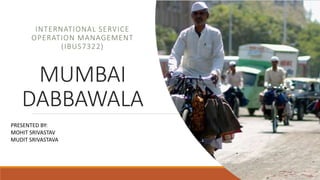
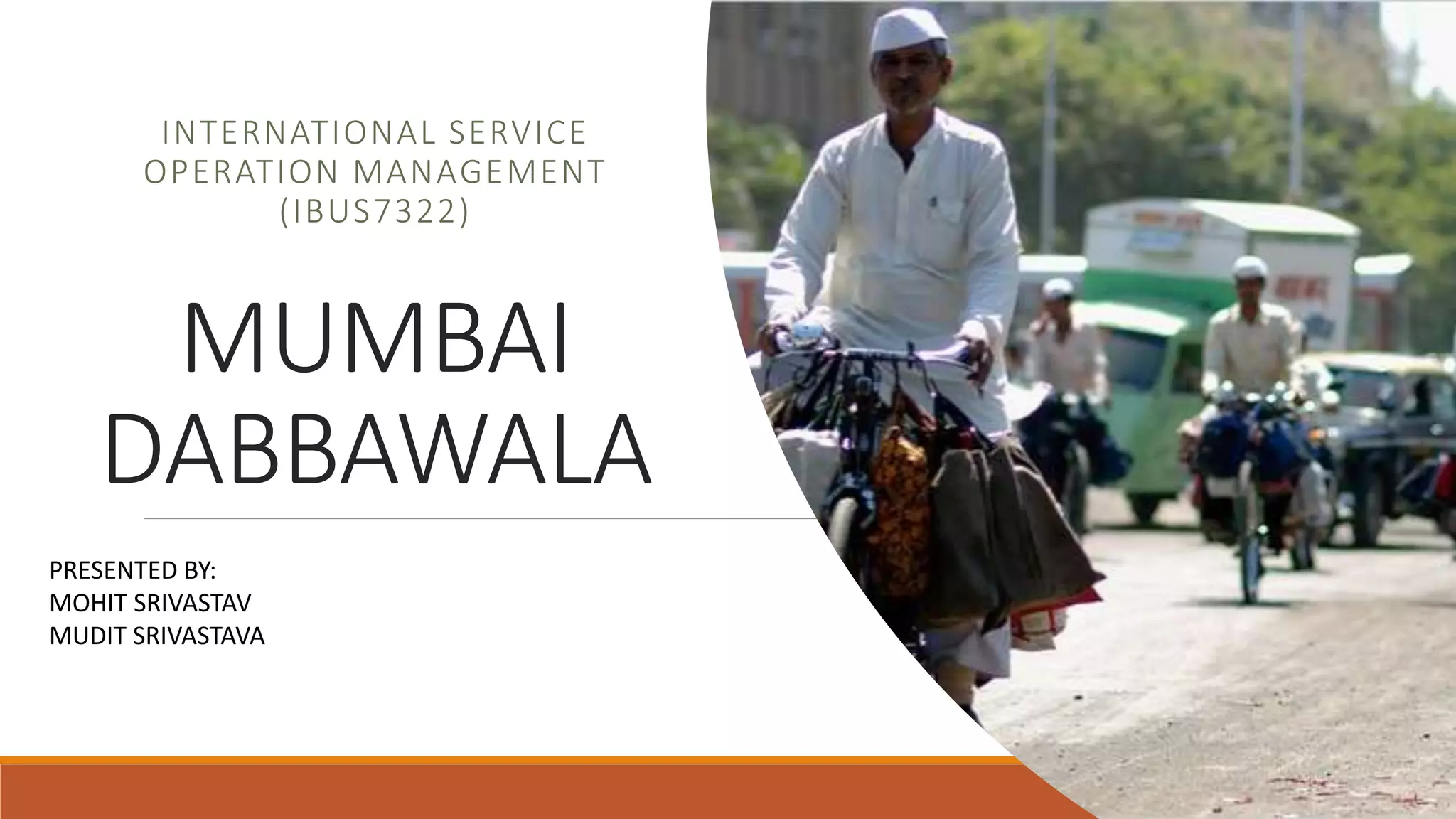
MUMBAI
DABBAWALA
INTERNATIONAL SERVICE
OPERATION MANAGEMENT
(IBUS7322)
PRESENTED BY:
MOHIT SRIVASTAV
MUDIT SRIVASTAVA
OUTLINE
INTRODUTION
By: Mohit Srivastav
EVOLUTION
By: Mohit Srivastav
SUPPLY CHAIN
By: Mudit Srivastava
BUSINESS MODEL
By: Mudit Srivastava
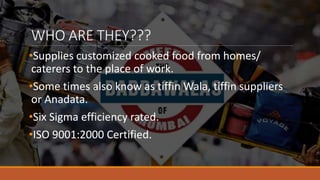
WHO ARE THEY???
•Supplies customized cooked food from homes/
caterers to the place of work.
•Some times also know as tiffin Wala, tiffin suppliers
or Anadata.
•Six Sigma efficiency rated.
•ISO 9001:2000 Certified.
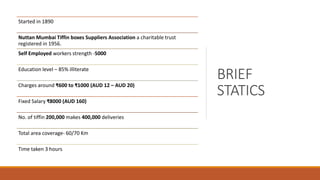
BRIEF
STATICS
Started in 1890
Nuttan Mumbai Tiffin boxes Suppliers Association a charitable trust
registered in 1956.
Self Employed workers strength -5000
Education level – 85% illiterate
Charges around ₹600 to ₹1000 (AUD 12 – AUD 20)
Fixed Salary ₹8000 (AUD 160)
No. of tiffin 200,000 makes 400,000 deliveries
Total area coverage- 60/70 Km
Time taken 3 hours
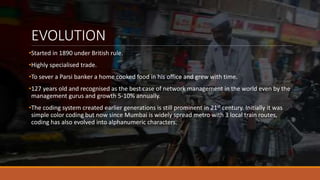
EVOLUTION
•Started in 1890 under British rule.
•Highly specialised trade.
•To sever a Parsi banker a home cooked food in his office and grew with time.
•127 years old and recognised as the best case of network management in the world even by the
management gurus and growth 5-10% annually.
•The coding system created earlier generations is still prominent in 21st century. Initially it was
simple color coding but now since Mumbai is widely spread metro with 3 local train routes,
coding has also evolved into alphanumeric characters.
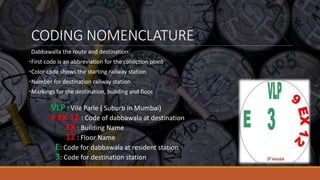
CODING NOMENCLATURE
Dabbawalla the route and destination:
•First code is an abbreviation for the collection point
•Color code shows the starting railway station
•Number for destination railway station
•Markings for the destination, building and floor.
VLP : Vile Parle ( Suburb in Mumbai)
9 EX 12 : Code of dabbawala at destination
EX : Building Name
12 : Floor Name
E: Code for dabbawala at resident station
3: Code for destination station
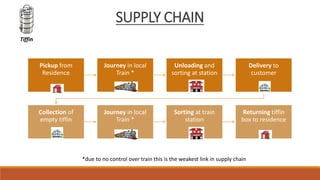
Pickup from
Residence
Journey in local
Train *
Unloading and
sorting at station
Delivery to
customer
Collection of
empty tiffin
Journey in local
Train *
Sorting at train
station
Returning tiffin
box to residence
*due to no control over train this is the weakest link in supply chain
SUPPLY CHAIN
Tiffin
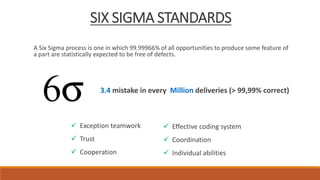
SIX SIGMA STANDARDS
A Six Sigma process is one in which 99.99966% of all opportunities to produce some feature of
a part are statistically expected to be free of defects.
3.4 mistake in every Million deliveries (> 99,99% correct)
 Exception teamwork
 Trust
 Cooperation
 Effective coding system
 Coordination
 Individual abilities
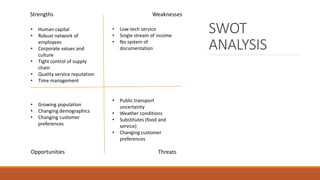
SWOT
ANALYSIS
Strengths
Opportunities
Weaknesses
Threats
• Public transport
uncertainty
• Weather conditions
• Substitutes (food and
service)
• Changing customer
preferences
• Human capital
• Robust network of
employees
• Corporate values and
culture
• Tight control of supply
chain
• Quality service reputation
• Time management
• Growing population
• Changing demographics
• Changing customer
preferences
• Low-tech service
• Single stream of income
• No system of
documentation
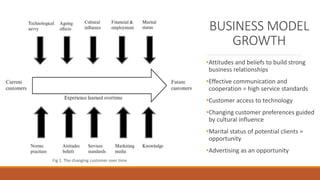
BUSINESS MODEL
GROWTH
•Attitudes and beliefs to build strong
business relationships
•Effective communication and
cooperation = high service standards
•Customer access to technology
•Changing customer preferences guided
by cultural influence
•Marital status of potential clients =
opportunity
•Advertising as an opportunity
Fig 1. The changing customer over time
REFERENCES
•Mumbai Dabbawala. (2017). Mumbai Dabbawala. Retrieved from Dabbawala: http://mumbaidabbawala.in/
•Parmar, B. (2014). Mumbai's dabbawalas up delivery charges by ₹100. Retrieved from The Hindu-
Business Line: http://www.thehindubusinessline.com/news/mumbais-dabbawalas-up-delivery-charges-by-
100/article6170725.ece
•Parker, D. (2012). Service Operations Management: The Total Experience. Cheltenham, Gloucestershire:
Edward Elgar Publishing.
THANKS!!

Mumbai Dabbawala

  • 1.
  • 2.
    OUTLINE INTRODUTION By: Mohit Srivastav EVOLUTION By:Mohit Srivastav SUPPLY CHAIN By: Mudit Srivastava BUSINESS MODEL By: Mudit Srivastava
  • 3.
    WHO ARE THEY??? •Suppliescustomized cooked food from homes/ caterers to the place of work. •Some times also know as tiffin Wala, tiffin suppliers or Anadata. •Six Sigma efficiency rated. •ISO 9001:2000 Certified.
  • 4.
    BRIEF STATICS Started in 1890 NuttanMumbai Tiffin boxes Suppliers Association a charitable trust registered in 1956. Self Employed workers strength -5000 Education level – 85% illiterate Charges around ₹600 to ₹1000 (AUD 12 – AUD 20) Fixed Salary ₹8000 (AUD 160) No. of tiffin 200,000 makes 400,000 deliveries Total area coverage- 60/70 Km Time taken 3 hours
  • 5.
    EVOLUTION •Started in 1890under British rule. •Highly specialised trade. •To sever a Parsi banker a home cooked food in his office and grew with time. •127 years old and recognised as the best case of network management in the world even by the management gurus and growth 5-10% annually. •The coding system created earlier generations is still prominent in 21st century. Initially it was simple color coding but now since Mumbai is widely spread metro with 3 local train routes, coding has also evolved into alphanumeric characters.
  • 6.
    CODING NOMENCLATURE Dabbawalla theroute and destination: •First code is an abbreviation for the collection point •Color code shows the starting railway station •Number for destination railway station •Markings for the destination, building and floor. VLP : Vile Parle ( Suburb in Mumbai) 9 EX 12 : Code of dabbawala at destination EX : Building Name 12 : Floor Name E: Code for dabbawala at resident station 3: Code for destination station
  • 7.
    Pickup from Residence Journey inlocal Train * Unloading and sorting at station Delivery to customer Collection of empty tiffin Journey in local Train * Sorting at train station Returning tiffin box to residence *due to no control over train this is the weakest link in supply chain SUPPLY CHAIN Tiffin
  • 8.
    SIX SIGMA STANDARDS ASix Sigma process is one in which 99.99966% of all opportunities to produce some feature of a part are statistically expected to be free of defects. 3.4 mistake in every Million deliveries (> 99,99% correct)  Exception teamwork  Trust  Cooperation  Effective coding system  Coordination  Individual abilities
  • 9.
    SWOT ANALYSIS Strengths Opportunities Weaknesses Threats • Public transport uncertainty •Weather conditions • Substitutes (food and service) • Changing customer preferences • Human capital • Robust network of employees • Corporate values and culture • Tight control of supply chain • Quality service reputation • Time management • Growing population • Changing demographics • Changing customer preferences • Low-tech service • Single stream of income • No system of documentation
  • 10.
    BUSINESS MODEL GROWTH •Attitudes andbeliefs to build strong business relationships •Effective communication and cooperation = high service standards •Customer access to technology •Changing customer preferences guided by cultural influence •Marital status of potential clients = opportunity •Advertising as an opportunity Fig 1. The changing customer over time
  • 11.
    REFERENCES •Mumbai Dabbawala. (2017).Mumbai Dabbawala. Retrieved from Dabbawala: http://mumbaidabbawala.in/ •Parmar, B. (2014). Mumbai's dabbawalas up delivery charges by ₹100. Retrieved from The Hindu- Business Line: http://www.thehindubusinessline.com/news/mumbais-dabbawalas-up-delivery-charges-by- 100/article6170725.ece •Parker, D. (2012). Service Operations Management: The Total Experience. Cheltenham, Gloucestershire: Edward Elgar Publishing.
  • 12.