1 2
Learning Outcomes
Representreal-life
situations using
both verbal
descriptions and
mathematical
functions.
Identify and apply
two different types
of functions to
model relationships
between variables.
3.
Warm-Up
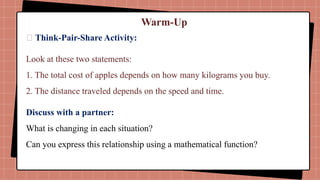
📌 Think-Pair-Share Activity:
Lookat these two statements:
1. The total cost of apples depends on how many kilograms you buy.
2. The distance traveled depends on the speed and time.
Discuss with a partner:
What is changing in each situation?
Can you express this relationship using a mathematical function?
4.
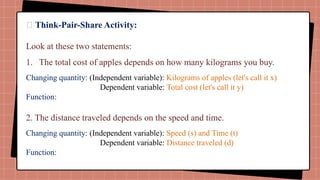
📌 Think-Pair-Share Activity:
Lookat these two statements:
1. The total cost of apples depends on how many kilograms you buy.
Changing quantity: (Independent variable): Kilograms of apples (let's call it x)
Dependent variable: Total cost (let's call it y)
Function:
2. The distance traveled depends on the speed and time.
Changing quantity: (Independent variable): Speed (s) and Time (t)
Dependent variable: Distance traveled (d)
Function:
5.
Function in RealLife
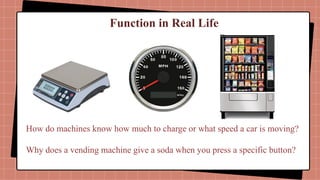
How do machines know how much to charge or what speed a car is moving?
Why does a vending machine give a soda when you press a specific button?
6.
Function in RealLife
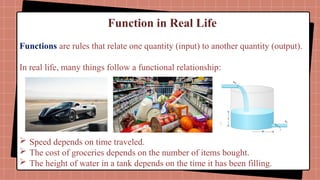
Functions are rules that relate one quantity (input) to another quantity (output).
In real life, many things follow a functional relationship:
Speed depends on time traveled.
The cost of groceries depends on the number of items bought.
The height of water in a tank depends on the time it has been filling.
7.
Understanding Functions
A functionis a rule that assigns each input (x) to exactly one output (y).Functions
express relationships between quantities.
Real-Life Example:
Fatima buys pencils and pens. The total cost depends on the number of each
item she buys.
c= Number of pencils k= Number of pens
Each pencil costs $2, each pen costs $6, and the total cost is $30.
Key Understanding:
A function can be written in words or as an equation. The function must make
logical sense in the given context.
8.
Implicit Functions
Some functionsare not written in the standard y = mx + c form but still
express a relationship.
Example 1:
Ali and Bella have $37 in total.
Equation:
Interactive Question:
Answer: B
9.
Worked Example
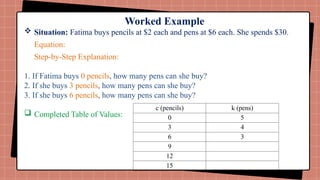
Situation:Fatima buys pencils at $2 each and pens at $6 each. She spends $30.
Equation:
Step-by-Step Explanation:
1. If Fatima buys 0 pencils, how many pens can she buy?
2. If she buys 3 pencils, how many pens can she buy?
3. If she buys 6 pencils, how many pens can she buy?
Completed Table of Values:
c (pencils) k (pens)
0 5
3 4
6 3
9
12
15
10.
Worked Example
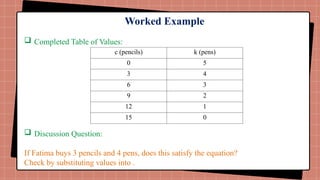
CompletedTable of Values:
Discussion Question:
If Fatima buys 3 pencils and 4 pens, does this satisfy the equation?
Check by substituting values into .
c (pencils) k (pens)
0 5
3 4
6 3
9 2
12 1
15 0
11.
Practice Questions
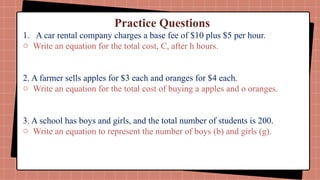
1. Acar rental company charges a base fee of $10 plus $5 per hour.
o Write an equation for the total cost, C, after h hours.
2. A farmer sells apples for $3 each and oranges for $4 each.
o Write an equation for the total cost of buying a apples and o oranges.
3. A school has boys and girls, and the total number of students is 200.
o Write an equation to represent the number of boys (b) and girls (g).
12.
Practice Questions
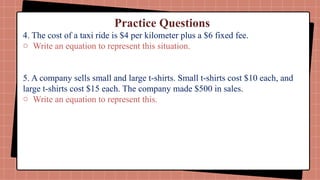
4. Thecost of a taxi ride is $4 per kilometer plus a $6 fixed fee.
o Write an equation to represent this situation.
5. A company sells small and large t-shirts. Small t-shirts cost $10 each, and
large t-shirts cost $15 each. The company made $500 in sales.
o Write an equation to represent this.
13.
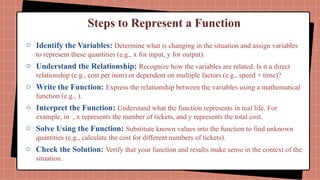
Steps to Representa Function
o Identify the Variables: Determine what is changing in the situation and assign variables
to represent these quantities (e.g., x for input, y for output).
o Understand the Relationship: Recognize how the variables are related. Is it a direct
relationship (e.g., cost per item) or dependent on multiple factors (e.g., speed × time)?
o Write the Function: Express the relationship between the variables using a mathematical
function (e.g., ).
o Interpret the Function: Understand what the function represents in real life. For
example, in , x represents the number of tickets, and y represents the total cost.
o Solve Using the Function: Substitute known values into the function to find unknown
quantities (e.g., calculate the cost for different numbers of tickets).
o Check the Solution: Verify that your function and results make sense in the context of the
situation.