Housekeeping
Last week:
• Unit 1 Pretest – Functions
• MAP tests
Unit 1 Functions
Unit Summary: In this unit, students will be
introduced to the concept of
functions. Emphasis will be placed on the
definition of function, domain and range,
evaluating functions, calculating slope of a
linear function, identifying the rate of change of
a function and whether it is increasing or
decreasing, and representing functions in
different ways.
Learning Objectives:
Upon successful completion of this unit, students will be
able to:
• define function
• recognize a function and determine its domain and range
• evaluate a function using substitution
• calculate slope and compare rates of change for linear
functions
• construct an equation from a graph or table of values
• model real world situations with functions
Essential Questions/What is the Purpose for Learning
This?
Make sure you can answer these questions before
attempting the Unit Test.
Why are relations and functions represented in multiple
ways?
How are properties of functions and functional operations
useful?
Lesson Content
Lesson 1: Defining Functions--learn the definition of a function;
determine the domain and range; recognize when an equation is
not a function
Lesson 2: Evaluating Functions--use substitution to evaluate a
function; realize that for a function, every input has only one
output
Lesson 3: Comparing Functions--calculate slope; compare the rate
of change for various equations; represent functions in multiple
ways
Lesson 4: Using Functions to Model Linear Relationships--interpret
the rate of change from a model; identify if a function is increasing
or decreasing; construct and equation with information from a
graph or table
Lesson 1: Defining a Function
• learn the definition of a function
• determine the domain and range
• recognize when an equation is not a function
Why are functions important to me if I’m buying candy at the local
store?
In this lesson you will learn what a function is
by evaluating examples of relations.
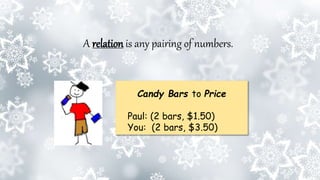
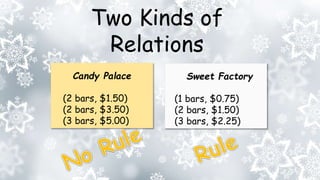
A relation is any pairing of numbers.
Candy Bars to Price
Paul: (2 bars, $1.50)
You: (2 bars, $3.50)
Candy Palace
(2 bars, $1.50)
(2 bars, $3.50)
(3 bars, $5.00)
Sweet Factory
(1 bars, $0.75)
(2 bars, $1.50)
(3 bars, $2.25)
Two Kinds of
Relations
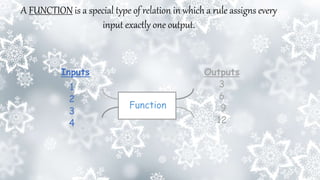
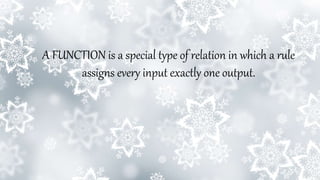
A FUNCTION is a special type of relation in which a rule assigns every
input exactly one output.
4
3
2
1
Inputs
12
9
6
3
Outputs
Function
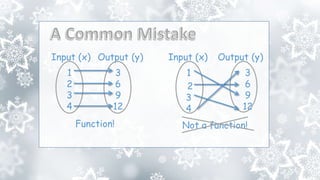
Input (x) Output (y) Output (y)Input (x)
1
2
3
4
3
6
9
12
1
2
3
4
3
6
9
12
Function! Not a function!
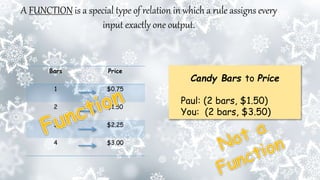
A FUNCTION is a special type of relation in which a rule assigns every
input exactly one output.
Bars Price
1 $0.75
2 $1.50
3 $2.25
4 $3.00
Candy Bars to Price
Paul: (2 bars, $1.50)
You: (2 bars, $3.50)
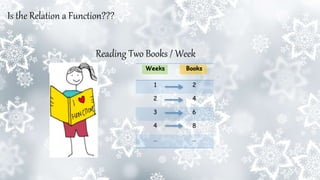
Weeks Books
1 2
2 4
3 6
4 8
… …
Reading Two Books / Week
Is the Relation a Function???
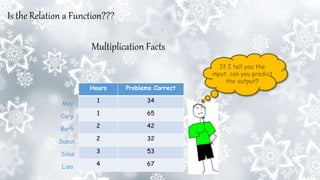
Hours Problems Correct
1 34
1 65
2 42
2 32
3 53
4 67
Multiplication Facts
May
Cory
Barb
Susan
Silas
Lisa
If I tell you the
input, can you predict
the output?
Is the Relation a Function???
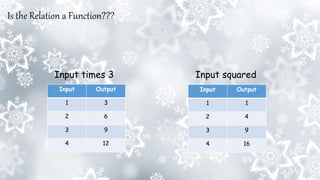
Input Output
1 3
2 6
3 9
4 12
Input Output
1 1
2 4
3 9
4 16
Input times 3 Input squared
Is the Relation a Function???
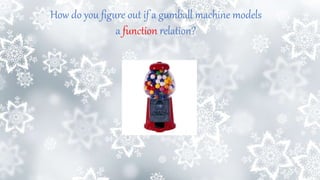
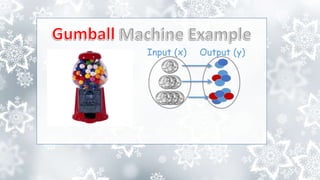
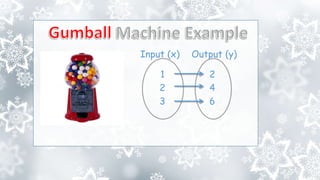
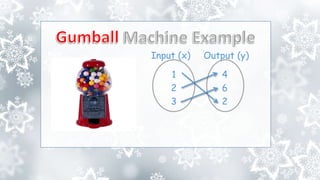
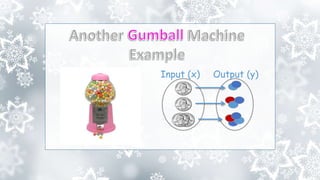
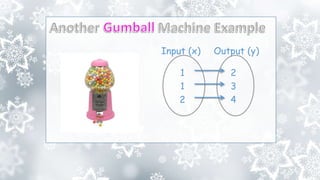
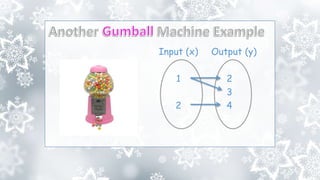
How do you figure out if a gumball machine models
a function relation?
Input (x) Output (y)
1
2
3
2
4
6
Input (x) Output (y)
1
2
3
4
6
2
Input (x) Output (y)
1
1
2
2
3
4
Input (x) Output (y)
1
2
2
3
4
A FUNCTION is a special type of relation in which a rule
assigns every input exactly one output.
What is a function

What is a function

  • 1.
    Housekeeping Last week: • Unit1 Pretest – Functions • MAP tests
  • 2.
    Unit 1 Functions UnitSummary: In this unit, students will be introduced to the concept of functions. Emphasis will be placed on the definition of function, domain and range, evaluating functions, calculating slope of a linear function, identifying the rate of change of a function and whether it is increasing or decreasing, and representing functions in different ways.
  • 4.
    Learning Objectives: Upon successfulcompletion of this unit, students will be able to: • define function • recognize a function and determine its domain and range • evaluate a function using substitution • calculate slope and compare rates of change for linear functions • construct an equation from a graph or table of values • model real world situations with functions
  • 5.
    Essential Questions/What isthe Purpose for Learning This? Make sure you can answer these questions before attempting the Unit Test. Why are relations and functions represented in multiple ways? How are properties of functions and functional operations useful?
  • 6.
    Lesson Content Lesson 1:Defining Functions--learn the definition of a function; determine the domain and range; recognize when an equation is not a function Lesson 2: Evaluating Functions--use substitution to evaluate a function; realize that for a function, every input has only one output Lesson 3: Comparing Functions--calculate slope; compare the rate of change for various equations; represent functions in multiple ways Lesson 4: Using Functions to Model Linear Relationships--interpret the rate of change from a model; identify if a function is increasing or decreasing; construct and equation with information from a graph or table
  • 7.
    Lesson 1: Defininga Function • learn the definition of a function • determine the domain and range • recognize when an equation is not a function
  • 8.
    Why are functionsimportant to me if I’m buying candy at the local store?
  • 11.
    In this lessonyou will learn what a function is by evaluating examples of relations.
  • 12.
    A relation isany pairing of numbers. Candy Bars to Price Paul: (2 bars, $1.50) You: (2 bars, $3.50)
  • 13.
    Candy Palace (2 bars,$1.50) (2 bars, $3.50) (3 bars, $5.00) Sweet Factory (1 bars, $0.75) (2 bars, $1.50) (3 bars, $2.25) Two Kinds of Relations
  • 14.
    A FUNCTION isa special type of relation in which a rule assigns every input exactly one output. 4 3 2 1 Inputs 12 9 6 3 Outputs Function
  • 15.
    Input (x) Output(y) Output (y)Input (x) 1 2 3 4 3 6 9 12 1 2 3 4 3 6 9 12 Function! Not a function!
  • 16.
    A FUNCTION isa special type of relation in which a rule assigns every input exactly one output. Bars Price 1 $0.75 2 $1.50 3 $2.25 4 $3.00 Candy Bars to Price Paul: (2 bars, $1.50) You: (2 bars, $3.50)
  • 17.
    Weeks Books 1 2 24 3 6 4 8 … … Reading Two Books / Week Is the Relation a Function???
  • 18.
    Hours Problems Correct 134 1 65 2 42 2 32 3 53 4 67 Multiplication Facts May Cory Barb Susan Silas Lisa If I tell you the input, can you predict the output? Is the Relation a Function???
  • 19.
    Input Output 1 3 26 3 9 4 12 Input Output 1 1 2 4 3 9 4 16 Input times 3 Input squared Is the Relation a Function???
  • 20.
    How do youfigure out if a gumball machine models a function relation?
  • 21.
  • 22.
    Input (x) Output(y) 1 2 3 2 4 6
  • 23.
    Input (x) Output(y) 1 2 3 4 6 2
  • 24.
  • 25.
    Input (x) Output(y) 1 1 2 2 3 4
  • 26.
    Input (x) Output(y) 1 2 2 3 4
  • 27.
    A FUNCTION isa special type of relation in which a rule assigns every input exactly one output.