CC Math 6:
Expressions and Equations
Unit 3
Purpose
Standards
Expressions and
Equations
Learning
Progression
Lesson Agenda
Getting Ready
for the Lesson
(Resources and
Tips)
Vocabulary
Activities
Lesson
(Presentation
and Video)
Textbook
Connections
Additional
Resources
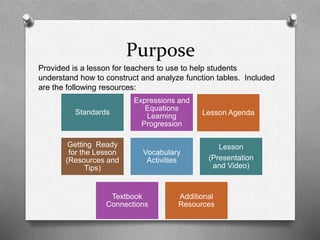
Provided is a lesson for teachers to use to help students
understand how to construct and analyze function tables. Included
are the following resources:
Common Core Standards
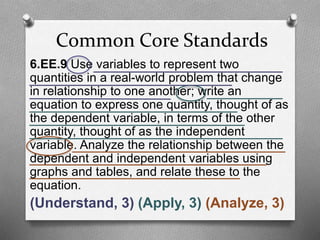
6.EE.9 Use variables to represent two
quantities in a real-world problem that change
in relationship to one another; write an
equation to express one quantity, thought of as
the dependent variable, in terms of the other
quantity, thought of as the independent
variable. Analyze the relationship between the
dependent and independent variables using
graphs and tables, and relate these to the
equation.
(Understand, 3) (Apply, 3) (Analyze, 3)
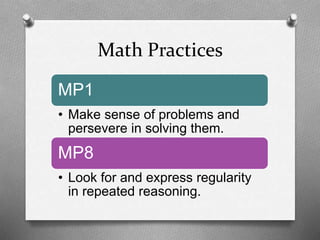
Math Practices
MP1
• Make sense of problems and
persevere in solving them.
MP8
• Look for and express regularity
in repeated reasoning.
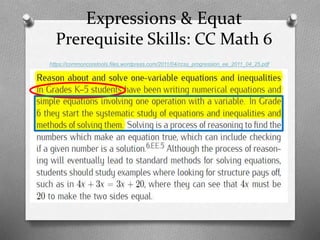
Expressions & Equat
Prerequisite Skills: CC Math 6
https://commoncoretools.files.wordpress.com/2011/04/ccss_progression_ee_2011_04_25.pdf
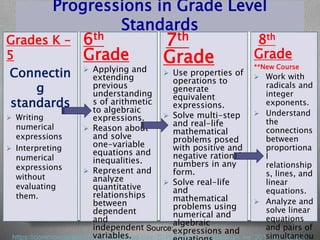
Progressions in Grade Level
Standards
Grades K –
5
Connectin
g
standards
 Writing
numerical
expressions
 Interpreting
numerical
expressions
without
evaluating
them.
Source:
https://commoncoretools.files.wordpress.com/2011/04/ccss_progression_ee_2011_04_25.pdf-
6th
Grade
 Applying and
extending
previous
understanding
s of arithmetic
to algebraic
expressions.
 Reason about
and solve
one-variable
equations and
inequalities.
 Represent and
analyze
quantitative
relationships
between
dependent
and
independent
variables.
7th
Grade
 Use properties of
operations to
generate
equivalent
expressions.
 Solve multi-step
and real-life
mathematical
problems posed
with positive and
negative rational
numbers in any
form.
 Solve real-life
and
mathematical
problems using
numerical and
algebraic
expressions and
8th
Grade
**New Course
 Work with
radicals and
integer
exponents.
 Understand
the
connections
between
proportiona
l
relationship
s, lines, and
linear
equations.
 Analyze and
solve linear
equations
and pairs of
simultaneou
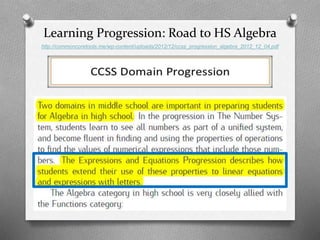
Learning Progression: Road to HS Algebra
http://commoncoretools.me/wp-content/uploads/2012/12/ccss_progression_algebra_2012_12_04.pdf
Lesson Agenda
OVocabulary
OVideo: Recognize how an equation relates
independent and dependent variables
OLesson: Pancake Mix
OTextbook Connections
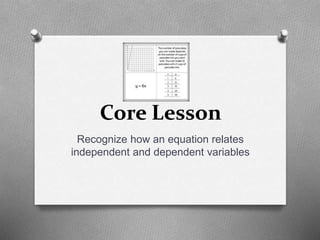
Core Lesson
Recognize how an equation relates
independent and dependent variables
Getting Ready
O Pre-assessment- used to determine understanding of
prerequisite skills
O Prerequisite skills include
O 6 EE.1
O Write and evaluate numerical expressions involving whole number
exponents.
O 6 EE.2A
O Write expressions that record operations with numbers and letters
standing for numbers.
O 6 EE.6
O Use variables to represent numbers and write expressions when
solving a real-world or mathematical problem; understand that a
variable can represent an unknown number, or, depending on the
purpose at hand, any number in a specified set.
Source: http://curtismapper.pic.ucla.edu/MapApp/app/#/map
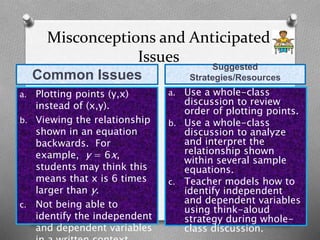
Misconceptions and Anticipated
Issues
Common Issues
a. Plotting points (y,x)
instead of (x,y).
b. Viewing the relationship
shown in an equation
backwards. For
example, y = 6x,
students may think this
means that x is 6 times
larger than y.
c. Not being able to
identify the independent
and dependent variables
Suggested
Strategies/Resources
a. Use a whole-class
discussion to review
order of plotting points.
b. Use a whole-class
discussion to analyze
and interpret the
relationship shown
within several sample
equations.
c. Teacher models how to
identify independent
and dependent variables
using think-aloud
strategy during whole-
class discussion.
Required Resources
Materials Required
Special Materials:
O Graph paper for each student
Handouts:
O LearnZillion presentation handouts
O LearnZillion additional worksheets
O https://learnzillion.com/lesson_plans/681-recognize-how-an-
equation-relates-independent-and-dependent-variables
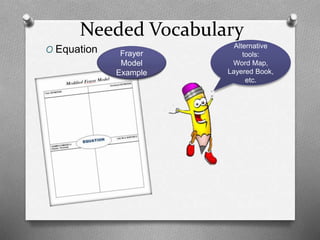
Needed Vocabulary
O Equation Alternative
tools:
Word Map,
Layered Book,
etc.
Frayer
Model
Example
Learnzillion
For this lesson you need to create an
account to access the handouts from
Learnzillion.
This is a free account and you will have
access to many more lessons.
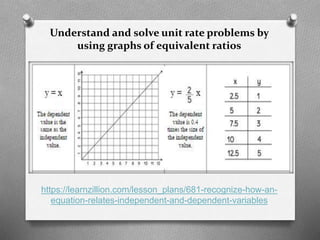
Understand and solve unit rate problems by
using graphs of equivalent ratios
https://learnzillion.com/lesson_plans/681-recognize-how-an-
equation-relates-independent-and-dependent-variables
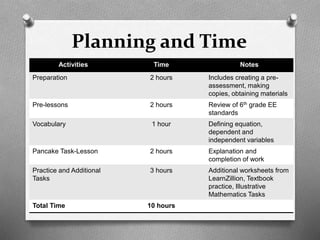
Planning and Time
Activities Time Notes
Preparation 2 hours Includes creating a pre-
assessment, making
copies, obtaining materials
Pre-lessons 2 hours Review of 6th grade EE
standards
Vocabulary 1 hour Defining equation,
dependent and
independent variables
Pancake Task-Lesson 2 hours Explanation and
completion of work
Practice and Additional
Tasks
3 hours Additional worksheets from
LearnZillion, Textbook
practice, Illustrative
Mathematics Tasks
Total Time 10 hours
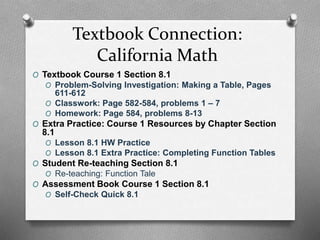
Textbook Connection:
California Math
O Textbook Course 1 Section 8.1
O Problem-Solving Investigation: Making a Table, Pages
611-612
O Classwork: Page 582-584, problems 1 – 7
O Homework: Page 584, problems 8-13
O Extra Practice: Course 1 Resources by Chapter Section
8.1
O Lesson 8.1 HW Practice
O Lesson 8.1 Extra Practice: Completing Function Tables
O Student Re-teaching Section 8.1
O Re-teaching: Function Tale
O Assessment Book Course 1 Section 8.1
O Self-Check Quick 8.1
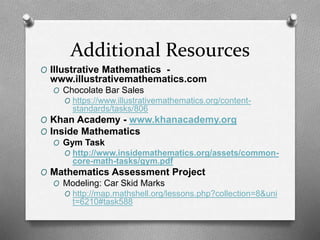
Additional Resources
O Illustrative Mathematics -
www.illustrativemathematics.com
O Chocolate Bar Sales
O https://www.illustrativemathematics.org/content-
standards/tasks/806
O Khan Academy - www.khanacademy.org
O Inside Mathematics
O Gym Task
O http://www.insidemathematics.org/assets/common-
core-math-tasks/gym.pdf
O Mathematics Assessment Project
O Modeling: Car Skid Marks
O http://map.mathshell.org/lessons.php?collection=8&uni
t=6210#task588
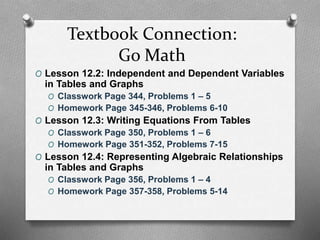
Textbook Connection:
Go Math
O Lesson 12.2: Independent and Dependent Variables
in Tables and Graphs
O Classwork Page 344, Problems 1 – 5
O Homework Page 345-346, Problems 6-10
O Lesson 12.3: Writing Equations From Tables
O Classwork Page 350, Problems 1 – 6
O Homework Page 351-352, Problems 7-15
O Lesson 12.4: Representing Algebraic Relationships
in Tables and Graphs
O Classwork Page 356, Problems 1 – 4
O Homework Page 357-358, Problems 5-14
Textbook Connection
CPM
O 8.1.2 What is Typical Value?
O Classwork, Pages 382-383
O Homework, Pages 384-388
O 8.1.3 How else can I describe the data ?
O Classwork, Pages 389-392
O Homework, Page 393
Need Help?
Contact your
Secondary Math Coordinator

Math 6 Pocket PD - Express - Equations (1).pptx

  • 1.
    CC Math 6: Expressionsand Equations Unit 3
  • 2.
    Purpose Standards Expressions and Equations Learning Progression Lesson Agenda GettingReady for the Lesson (Resources and Tips) Vocabulary Activities Lesson (Presentation and Video) Textbook Connections Additional Resources Provided is a lesson for teachers to use to help students understand how to construct and analyze function tables. Included are the following resources:
  • 3.
    Common Core Standards 6.EE.9Use variables to represent two quantities in a real-world problem that change in relationship to one another; write an equation to express one quantity, thought of as the dependent variable, in terms of the other quantity, thought of as the independent variable. Analyze the relationship between the dependent and independent variables using graphs and tables, and relate these to the equation. (Understand, 3) (Apply, 3) (Analyze, 3)
  • 5.
    Math Practices MP1 • Makesense of problems and persevere in solving them. MP8 • Look for and express regularity in repeated reasoning.
  • 6.
    Expressions & Equat PrerequisiteSkills: CC Math 6 https://commoncoretools.files.wordpress.com/2011/04/ccss_progression_ee_2011_04_25.pdf
  • 7.
    Progressions in GradeLevel Standards Grades K – 5 Connectin g standards  Writing numerical expressions  Interpreting numerical expressions without evaluating them. Source: https://commoncoretools.files.wordpress.com/2011/04/ccss_progression_ee_2011_04_25.pdf- 6th Grade  Applying and extending previous understanding s of arithmetic to algebraic expressions.  Reason about and solve one-variable equations and inequalities.  Represent and analyze quantitative relationships between dependent and independent variables. 7th Grade  Use properties of operations to generate equivalent expressions.  Solve multi-step and real-life mathematical problems posed with positive and negative rational numbers in any form.  Solve real-life and mathematical problems using numerical and algebraic expressions and 8th Grade **New Course  Work with radicals and integer exponents.  Understand the connections between proportiona l relationship s, lines, and linear equations.  Analyze and solve linear equations and pairs of simultaneou
  • 8.
    Learning Progression: Roadto HS Algebra http://commoncoretools.me/wp-content/uploads/2012/12/ccss_progression_algebra_2012_12_04.pdf
  • 9.
    Lesson Agenda OVocabulary OVideo: Recognizehow an equation relates independent and dependent variables OLesson: Pancake Mix OTextbook Connections
  • 10.
    Core Lesson Recognize howan equation relates independent and dependent variables
  • 11.
    Getting Ready O Pre-assessment-used to determine understanding of prerequisite skills O Prerequisite skills include O 6 EE.1 O Write and evaluate numerical expressions involving whole number exponents. O 6 EE.2A O Write expressions that record operations with numbers and letters standing for numbers. O 6 EE.6 O Use variables to represent numbers and write expressions when solving a real-world or mathematical problem; understand that a variable can represent an unknown number, or, depending on the purpose at hand, any number in a specified set. Source: http://curtismapper.pic.ucla.edu/MapApp/app/#/map
  • 12.
    Misconceptions and Anticipated Issues CommonIssues a. Plotting points (y,x) instead of (x,y). b. Viewing the relationship shown in an equation backwards. For example, y = 6x, students may think this means that x is 6 times larger than y. c. Not being able to identify the independent and dependent variables Suggested Strategies/Resources a. Use a whole-class discussion to review order of plotting points. b. Use a whole-class discussion to analyze and interpret the relationship shown within several sample equations. c. Teacher models how to identify independent and dependent variables using think-aloud strategy during whole- class discussion.
  • 13.
    Required Resources Materials Required SpecialMaterials: O Graph paper for each student Handouts: O LearnZillion presentation handouts O LearnZillion additional worksheets O https://learnzillion.com/lesson_plans/681-recognize-how-an- equation-relates-independent-and-dependent-variables
  • 14.
    Needed Vocabulary O EquationAlternative tools: Word Map, Layered Book, etc. Frayer Model Example
  • 15.
    Learnzillion For this lessonyou need to create an account to access the handouts from Learnzillion. This is a free account and you will have access to many more lessons.
  • 16.
    Understand and solveunit rate problems by using graphs of equivalent ratios https://learnzillion.com/lesson_plans/681-recognize-how-an- equation-relates-independent-and-dependent-variables
  • 17.
    Planning and Time ActivitiesTime Notes Preparation 2 hours Includes creating a pre- assessment, making copies, obtaining materials Pre-lessons 2 hours Review of 6th grade EE standards Vocabulary 1 hour Defining equation, dependent and independent variables Pancake Task-Lesson 2 hours Explanation and completion of work Practice and Additional Tasks 3 hours Additional worksheets from LearnZillion, Textbook practice, Illustrative Mathematics Tasks Total Time 10 hours
  • 18.
    Textbook Connection: California Math OTextbook Course 1 Section 8.1 O Problem-Solving Investigation: Making a Table, Pages 611-612 O Classwork: Page 582-584, problems 1 – 7 O Homework: Page 584, problems 8-13 O Extra Practice: Course 1 Resources by Chapter Section 8.1 O Lesson 8.1 HW Practice O Lesson 8.1 Extra Practice: Completing Function Tables O Student Re-teaching Section 8.1 O Re-teaching: Function Tale O Assessment Book Course 1 Section 8.1 O Self-Check Quick 8.1
  • 19.
    Additional Resources O IllustrativeMathematics - www.illustrativemathematics.com O Chocolate Bar Sales O https://www.illustrativemathematics.org/content- standards/tasks/806 O Khan Academy - www.khanacademy.org O Inside Mathematics O Gym Task O http://www.insidemathematics.org/assets/common- core-math-tasks/gym.pdf O Mathematics Assessment Project O Modeling: Car Skid Marks O http://map.mathshell.org/lessons.php?collection=8&uni t=6210#task588
  • 20.
    Textbook Connection: Go Math OLesson 12.2: Independent and Dependent Variables in Tables and Graphs O Classwork Page 344, Problems 1 – 5 O Homework Page 345-346, Problems 6-10 O Lesson 12.3: Writing Equations From Tables O Classwork Page 350, Problems 1 – 6 O Homework Page 351-352, Problems 7-15 O Lesson 12.4: Representing Algebraic Relationships in Tables and Graphs O Classwork Page 356, Problems 1 – 4 O Homework Page 357-358, Problems 5-14
  • 21.
    Textbook Connection CPM O 8.1.2What is Typical Value? O Classwork, Pages 382-383 O Homework, Pages 384-388 O 8.1.3 How else can I describe the data ? O Classwork, Pages 389-392 O Homework, Page 393
  • 22.

Editor's Notes

  • #3 Facilitator notes Time: 2-3 minutes Handouts/participant activity: n/a Focus points: Review the components that this PD provides: Standards Learning Progressions Lesson Agenda Resources & Tips Vocabulary Activities Lesson Textbook Connections Additional Resources
  • #4 Facilitator notes Time: 2-3 minutes Handouts/participant activity: n/a Focus points: Identifying the standards for lesson and unwrapping them.
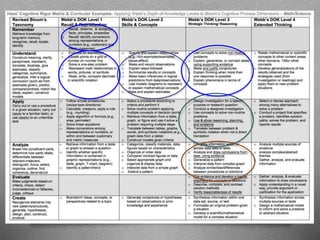
  • #5 Facilitator notes Time: 2-3 minutes Handouts/participant activity: n/a Focus points: Yellow, Red, & Green circles indicate the appropriate levels of DOK as required by the standards The Blue circles fill in the instructional paths needed to assist students in reaching those DOK levels.
  • #6 Facilitator notes Time: 1-2 minutes Handouts/participant activity: n/a Focus points: Review the math practices associated with the lesson being presented.
  • #7 Facilitator notes Time: 2-3 minutes Handouts/participant activity: n/a Focus points: Review the prerequisite skills the students completed prior to 6th grade and connect to what they will study during the CC Math 6 course.
  • #8 Facilitator notes Time: 2-3 minutes Handouts/participant activity: n/a Focus points: There are major changes at each grade level with the domain of statistics and probability that have caused a shift in standards from CST time to Common Core Standards Major points- Statistics and probability are no longer in Grades K – 5. Standards have switched between the 6th and 7th grade. There is also a completely new course for 8th grade students, which is CC Math 8. Therefore, the are now standards that were shifted from CST courses and into this new Common Core Course.
  • #9 Facilitator notes Time: 2-3 minutes Handouts/participant activity: n/a Focus points: Let’s take closer look at the California Department of Education’s description of the CC Math 8 course. Read the highlighted portion The state framework shows the importance of the Grade 8 Math Course and how it has became the new gateway course for higher level math, as well as how Algebra 1 had shifted to high school.
  • #10 Facilitator notes Time: 2-3 minutes Handouts/participant activity: n/a Focus points: Review the lesson agenda prior to implementation
  • #11 Facilitator notes Time: 1 minute Handouts/participant activity: n/a Focus points: Title Page for lesson
  • #12 Facilitator notes Time: 2-3 minutes Handouts/participant activity: n/a Focus points: Review what standards should be covered in a pre-assessment activity. This shows what students should have already learned prior to your course. Using a pre-assessment activity will assist students in frontloading prior knowledge before beginning new
  • #13 Facilitator notes Time: 2-3 minutes Handouts/participant activity: n/a Focus points: These are guided questions to improve our students’ learning when misconceptions may occur. These are guided questions to improve our students’ learning.
  • #14 Facilitator notes Time: 2-3 minutes Handouts/participant activity: n/a Focus points: Review the list of resources needed for the lesson and where to find materials online.
  • #15 Facilitator notes Time: 4-5 minutes Handouts/participant activity: n/a Focus points: This shows a list of required academic language vocabulary that is needed for the lesson. In addition, a strategy, “Layered Book” is shown with the suggestion that there are alternative strategies that can be used as well.
  • #16 Facilitator notes Time: 4-5 minutes Handouts/participant activity: n/a Focus points: This is an introduction to the Learnzillion.com website where today’s lesson was pulled from. Teachers can sign up for a free account and have full access.
  • #17 Facilitator notes Time: 15 - 20 minutes Handouts/participant activity: n/a Focus points: Click on the hyper link to take you to the lesson. Lesson includes: PowerPoint, Video, and handouts. As a department, we will explore this resources together
  • #18 Facilitator notes Time: 1 - 2 minutes Handouts/participant activity: n/a Focus points: Suggested pacing for this lesson
  • #19 Facilitator notes Time: 1-2 minutes Handouts/participant activity: n/a Focus points: Connections to the California Math textbook for this specific standard / concept. As a department we may want to review this as well to compare to the Learnzillion lesson.
  • #20 Facilitator notes Time: 3 - 4 minutes Handouts/participant activity: n/a Focus points: This is a list of additional resources surrounding the standards that may be used. If time permits, as a department, explore these sites.
  • #21 Facilitator notes Time: 1-2 minutes Handouts/participant activity: n/a Focus points: Connections to the Go Math textbook for this specific standard / concept. As a department we may want to review this as well to compare to the Learnzillion lesson.
  • #22 Facilitator notes Time: 1-2 minutes Handouts/participant activity: n/a Focus points: Connections to the CPM textbook for this specific standard / concept. As a department we may want to review this as well to compare to the Learnzillion lesson.