Kelson Pure Theory OF
Law
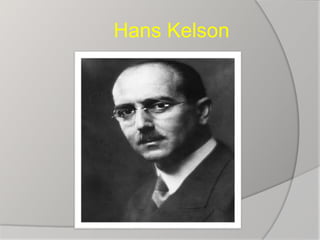
Hans Kelson
About Hans Kelson (1881-1973)
 Hans kelson was the another jurist who has the
credit of reviving the original analytical legal
thought in the 20th century through his “pure
theory of law.”
 He was born at Prague in Austria in 1881 and
was a professor of law at Vienna university.
……cont.
…..continued
 He was also the judge of supreme
constitutional court of Austria for 10 years
during 1920-1930.
 He developed the Austin Positivism theory
as KELSON PURE THEORY OF LAW.
What is Pure Theory of Law
 Kelson described law as normative science.
 It is different from the natural science which
are based on cause and effect such as law of
gravitation.
 The law of natural science are capable of
being accurately described determined and
discovered in the form of “IS” which is an
essential characteristics of all natural
science.
……cont
 But science of law is knowledge of what
law ought to be. It is the ougth character
which provides normative character to
law.
 Example - If “A” commits a theft he
ought to be punished.
 Kelson pure theory of law is based on
pyramid structure of hierarchy of norms
which drive there validity from the basic
norm which he termed as Grundnorm.
 According to this theory kelson consider
legal science as a pyramid of norms with
Grundnorm (basic norm) at the apex.
 The subordinate norms are controlled by
norms superior to them.
Silent Features of Theory
 The theory is aimed to reduce the
confusion created by the supporters of
natural law theory.
 This theory of law deals with the
knowledge of what law is, and is not
concerned about what law ought to be.
 The theory consider law as a normative
science and not a natural science.
Criticism of the pure theory of law
 It is without any sociological foundation.
 Kelson assertion that all the norms excepting
the basic norm(grundnorm) are pure has no
logical basis.
 This theory is found to be based on
hypothetical considerations without any
practicability.
 Kelson theory provides no solution for the
conflicts arising out of ideological differences.
Applicability of pure theory in India

Kelson pure theory

  • 1.
  • 2.
  • 3.
    About Hans Kelson(1881-1973)  Hans kelson was the another jurist who has the credit of reviving the original analytical legal thought in the 20th century through his “pure theory of law.”  He was born at Prague in Austria in 1881 and was a professor of law at Vienna university. ……cont.
  • 4.
    …..continued  He wasalso the judge of supreme constitutional court of Austria for 10 years during 1920-1930.  He developed the Austin Positivism theory as KELSON PURE THEORY OF LAW.
  • 5.
    What is PureTheory of Law  Kelson described law as normative science.  It is different from the natural science which are based on cause and effect such as law of gravitation.  The law of natural science are capable of being accurately described determined and discovered in the form of “IS” which is an essential characteristics of all natural science.
  • 6.
    ……cont  But scienceof law is knowledge of what law ought to be. It is the ougth character which provides normative character to law.  Example - If “A” commits a theft he ought to be punished.
  • 7.
     Kelson puretheory of law is based on pyramid structure of hierarchy of norms which drive there validity from the basic norm which he termed as Grundnorm.  According to this theory kelson consider legal science as a pyramid of norms with Grundnorm (basic norm) at the apex.  The subordinate norms are controlled by norms superior to them.
  • 8.
    Silent Features ofTheory  The theory is aimed to reduce the confusion created by the supporters of natural law theory.  This theory of law deals with the knowledge of what law is, and is not concerned about what law ought to be.  The theory consider law as a normative science and not a natural science.
  • 9.
    Criticism of thepure theory of law  It is without any sociological foundation.  Kelson assertion that all the norms excepting the basic norm(grundnorm) are pure has no logical basis.  This theory is found to be based on hypothetical considerations without any practicability.  Kelson theory provides no solution for the conflicts arising out of ideological differences.
  • 10.
    Applicability of puretheory in India