JURISPRUDENCE
DEFINITIONS OF JURISPRUDENCE,
SCOPE
&
RELATIONSHIP WITH OTHER
SOCIAL SCIENCES
BY
ADV. CAROLINE ELIAS
DEFINITIONS :
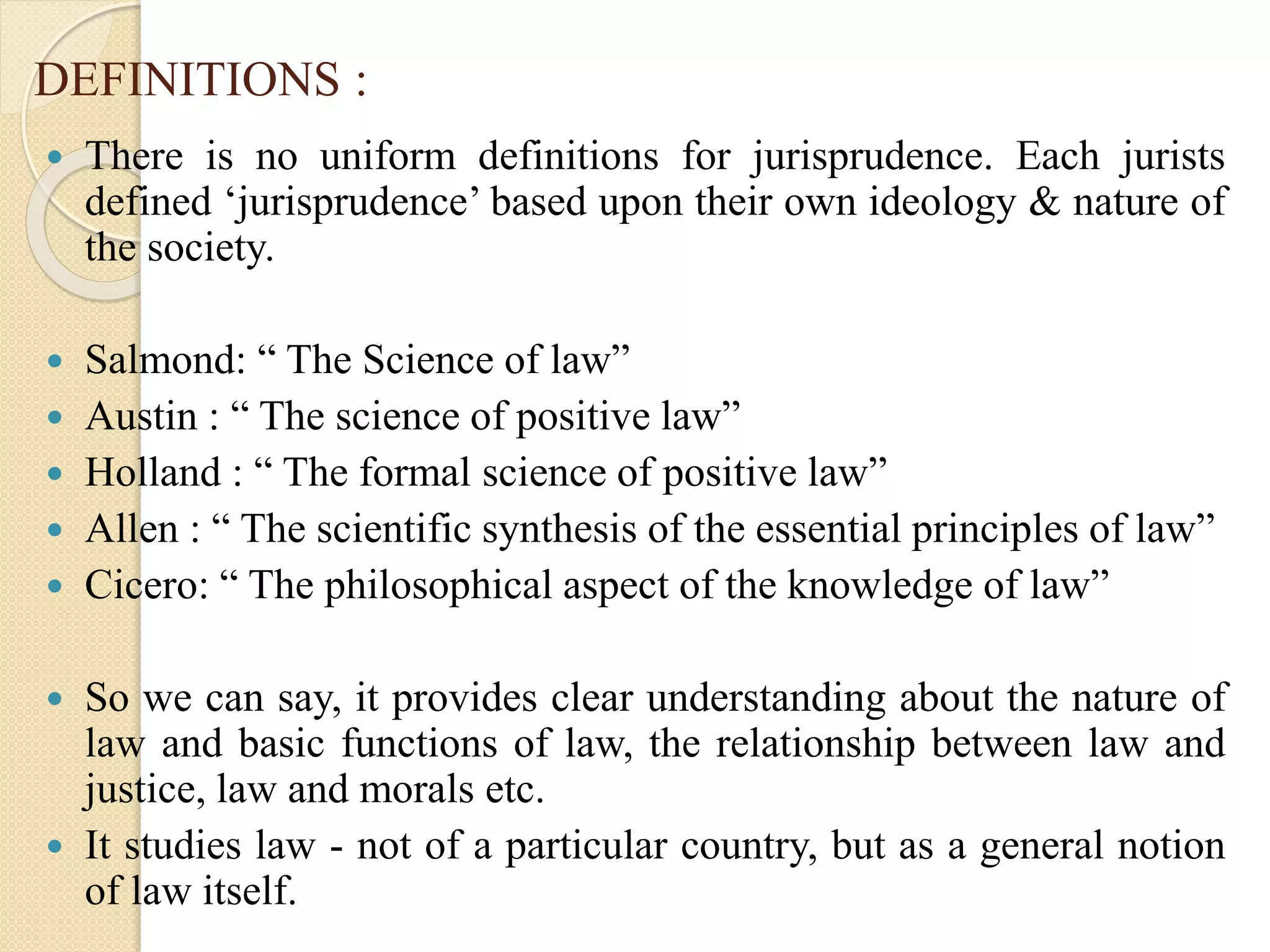
 There is no uniform definitions for jurisprudence. Each jurists
defined ‘jurisprudence’ based upon their own ideology & nature of
the society.
 Salmond: “ The Science of law”
 Austin : “ The science of positive law”
 Holland : “ The formal science of positive law”
 Allen : “ The scientific synthesis of the essential principles of law”
 Cicero: “ The philosophical aspect of the knowledge of law”
 So we can say, it provides clear understanding about the nature of
law and basic functions of law, the relationship between law and
justice, law and morals etc.
 It studies law - not of a particular country, but as a general notion
of law itself.
Meaning :
 In the early decades of the 19th century with the theories
propounded by Bentham and Austin, the term ‘jurisprudence’
acquired a definite meaning.
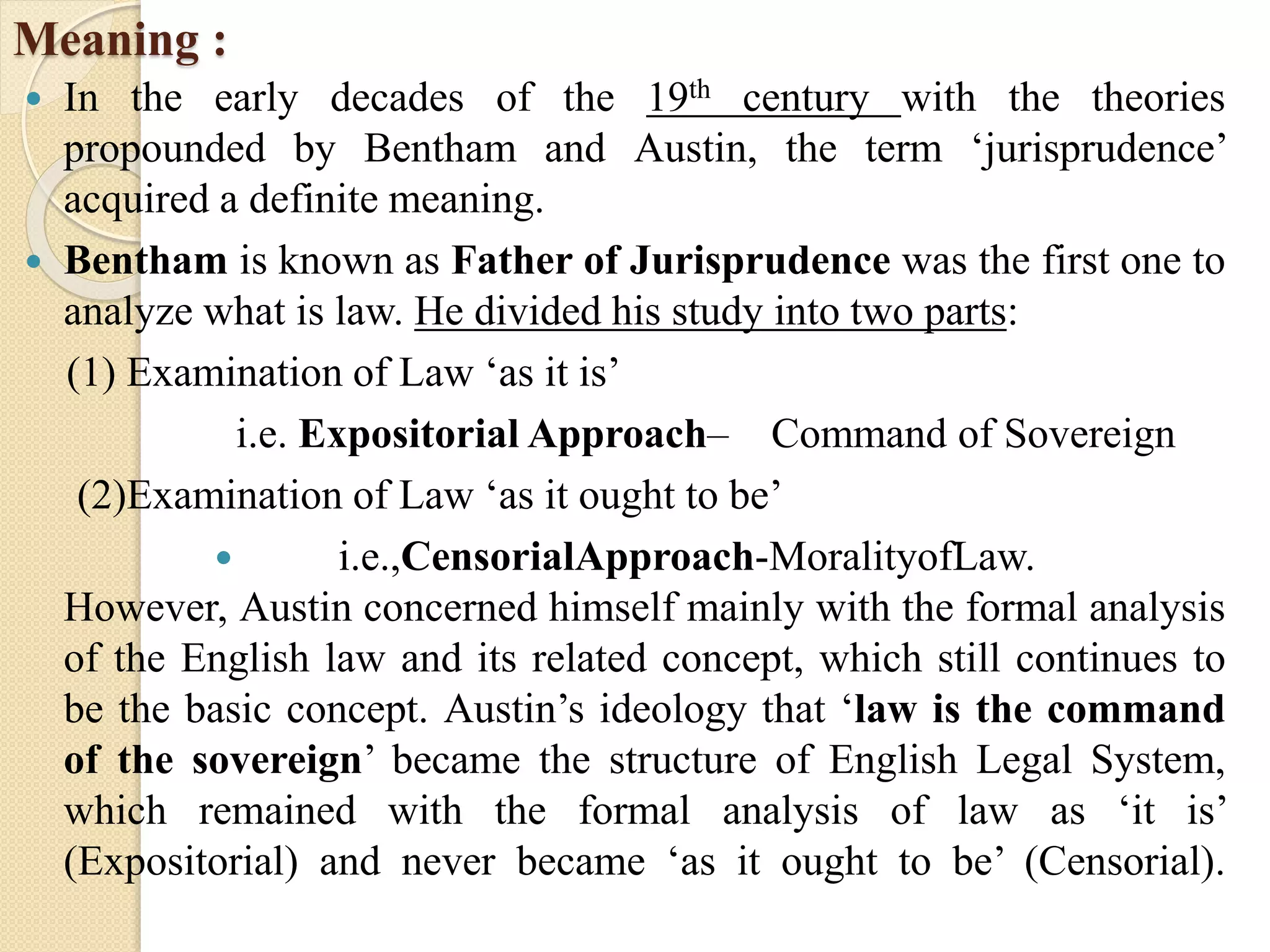
 Bentham is known as Father of Jurisprudence was the first one to
analyze what is law. He divided his study into two parts:
(1) Examination of Law ‘as it is’
i.e. Expositorial Approach– Command of Sovereign
(2)Examination of Law ‘as it ought to be’
 i.e.,CensorialApproach-MoralityofLaw.
However, Austin concerned himself mainly with the formal analysis
of the English law and its related concept, which still continues to
be the basic concept. Austin’s ideology that ‘law is the command
of the sovereign’ became the structure of English Legal System,
which remained with the formal analysis of law as ‘it is’
(Expositorial) and never became ‘as it ought to be’ (Censorial).
Scope of Jurisprudence
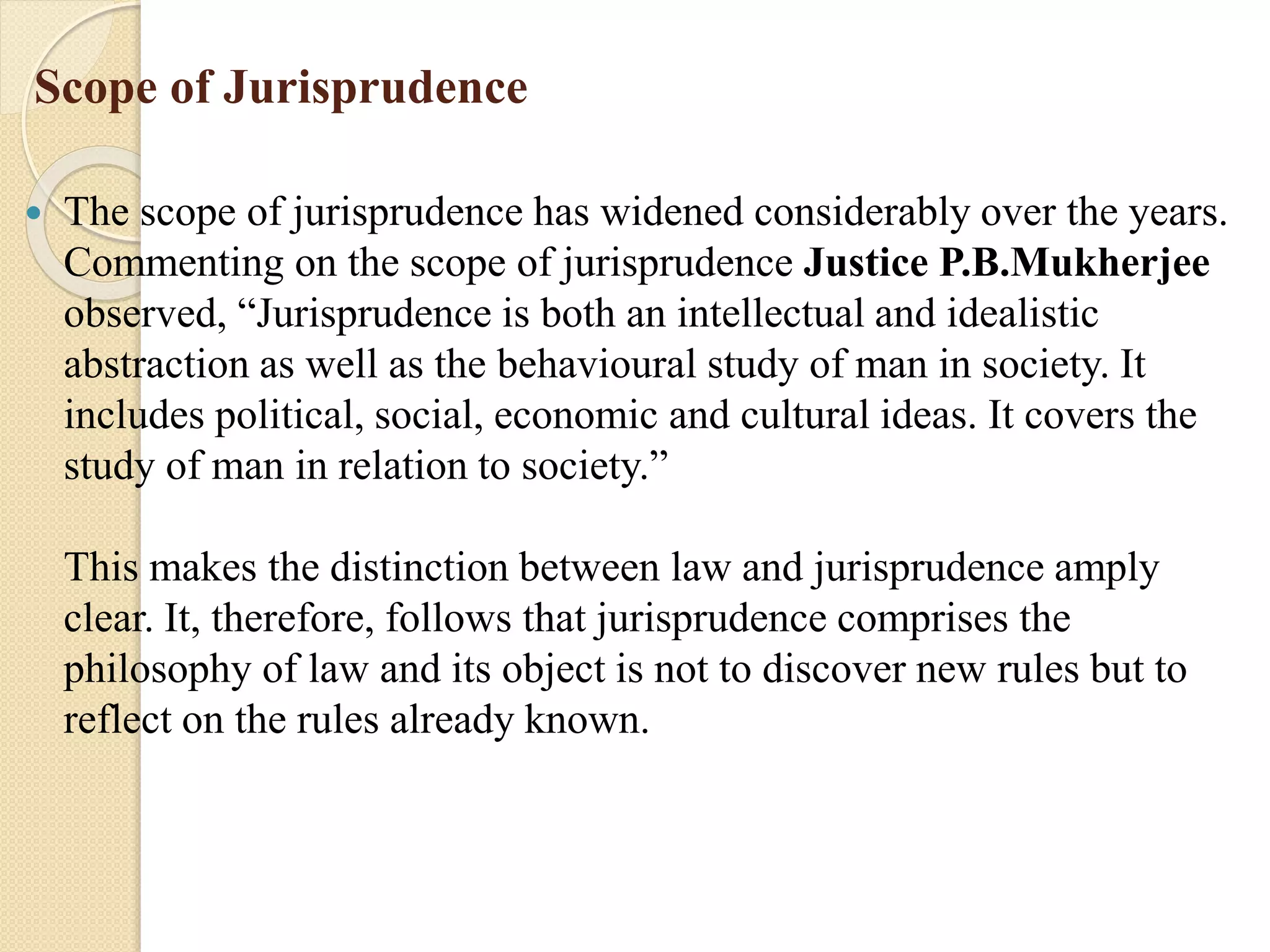
 The scope of jurisprudence has widened considerably over the years.
Commenting on the scope of jurisprudence Justice P.B.Mukherjee
observed, “Jurisprudence is both an intellectual and idealistic
abstraction as well as the behavioural study of man in society. It
includes political, social, economic and cultural ideas. It covers the
study of man in relation to society.”
This makes the distinction between law and jurisprudence amply
clear. It, therefore, follows that jurisprudence comprises the
philosophy of law and its object is not to discover new rules but to
reflect on the rules already known.
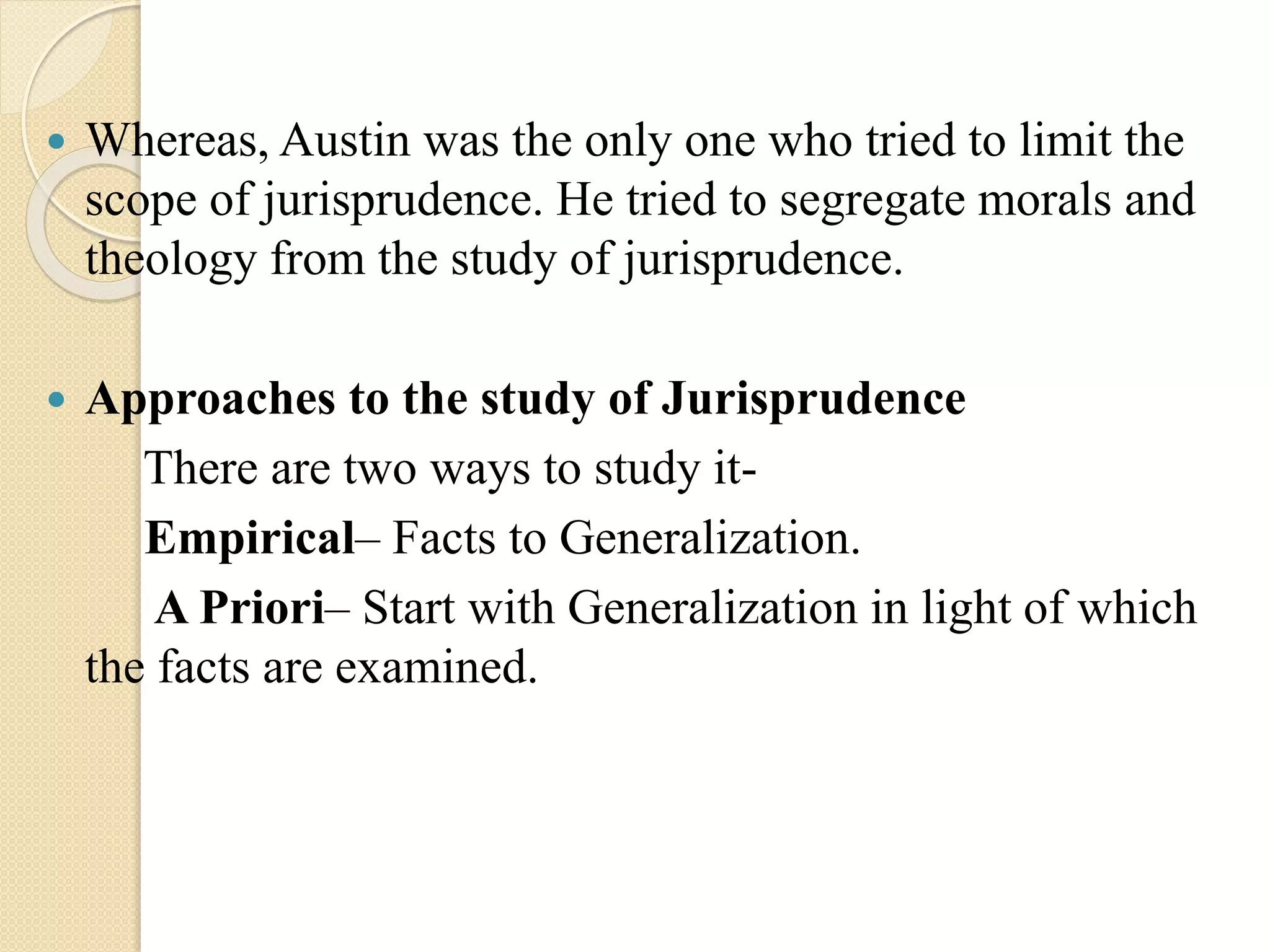
 Whereas, Austin was the only one who tried to limit the
scope of jurisprudence. He tried to segregate morals and
theology from the study of jurisprudence.
 Approaches to the study of Jurisprudence
There are two ways to study it-
Empirical– Facts to Generalization.
A Priori– Start with Generalization in light of which
the facts are examined.
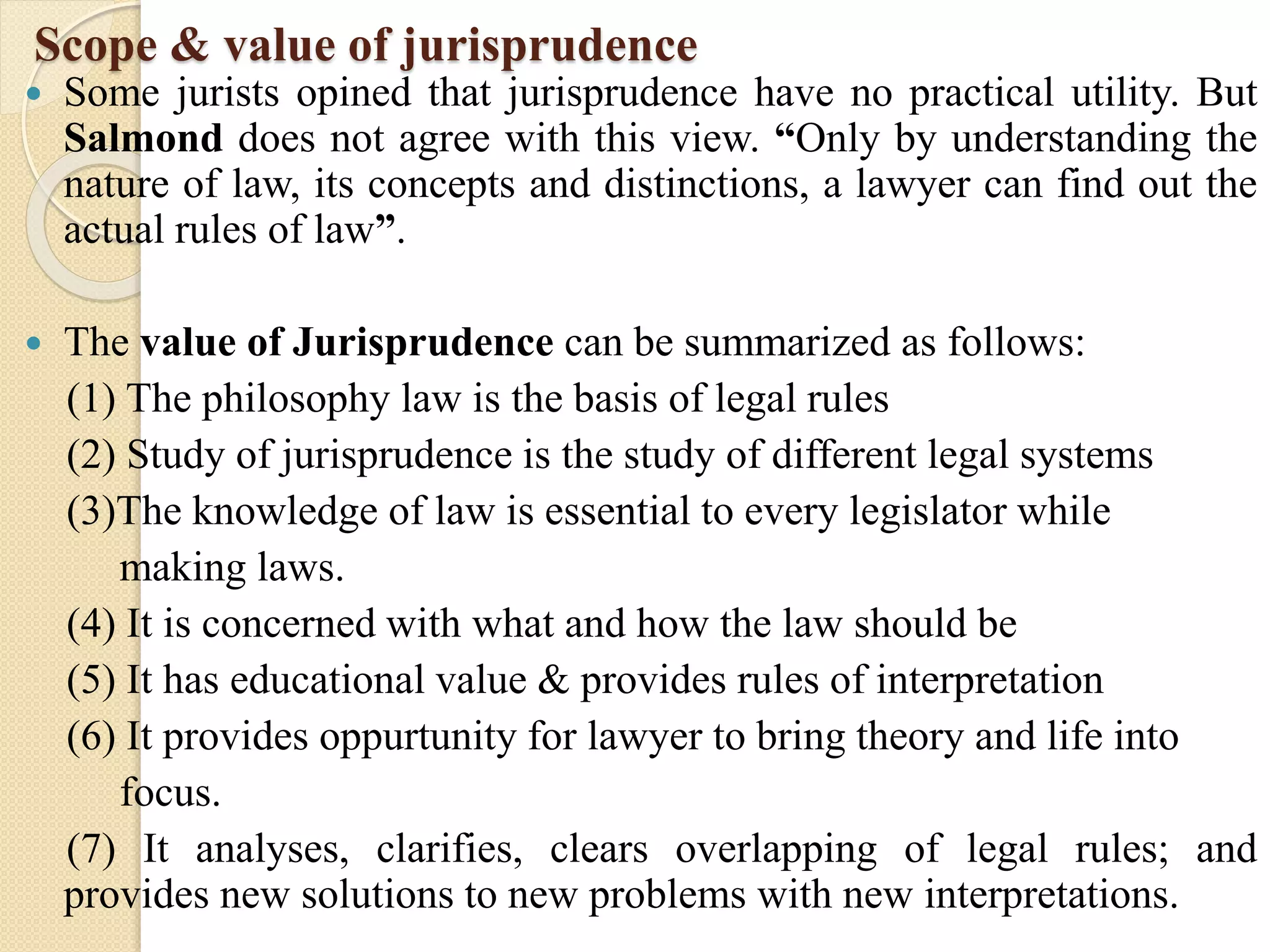
Scope & value of jurisprudence
 Some jurists opined that jurisprudence have no practical utility. But
Salmond does not agree with this view. “Only by understanding the
nature of law, its concepts and distinctions, a lawyer can find out the
actual rules of law”.
 The value of Jurisprudence can be summarized as follows:
(1) The philosophy law is the basis of legal rules
(2) Study of jurisprudence is the study of different legal systems
(3)The knowledge of law is essential to every legislator while
making laws.
(4) It is concerned with what and how the law should be
(5) It has educational value & provides rules of interpretation
(6) It provides oppurtunity for lawyer to bring theory and life into
focus.
(7) It analyses, clarifies, clears overlapping of legal rules; and
provides new solutions to new problems with new interpretations.
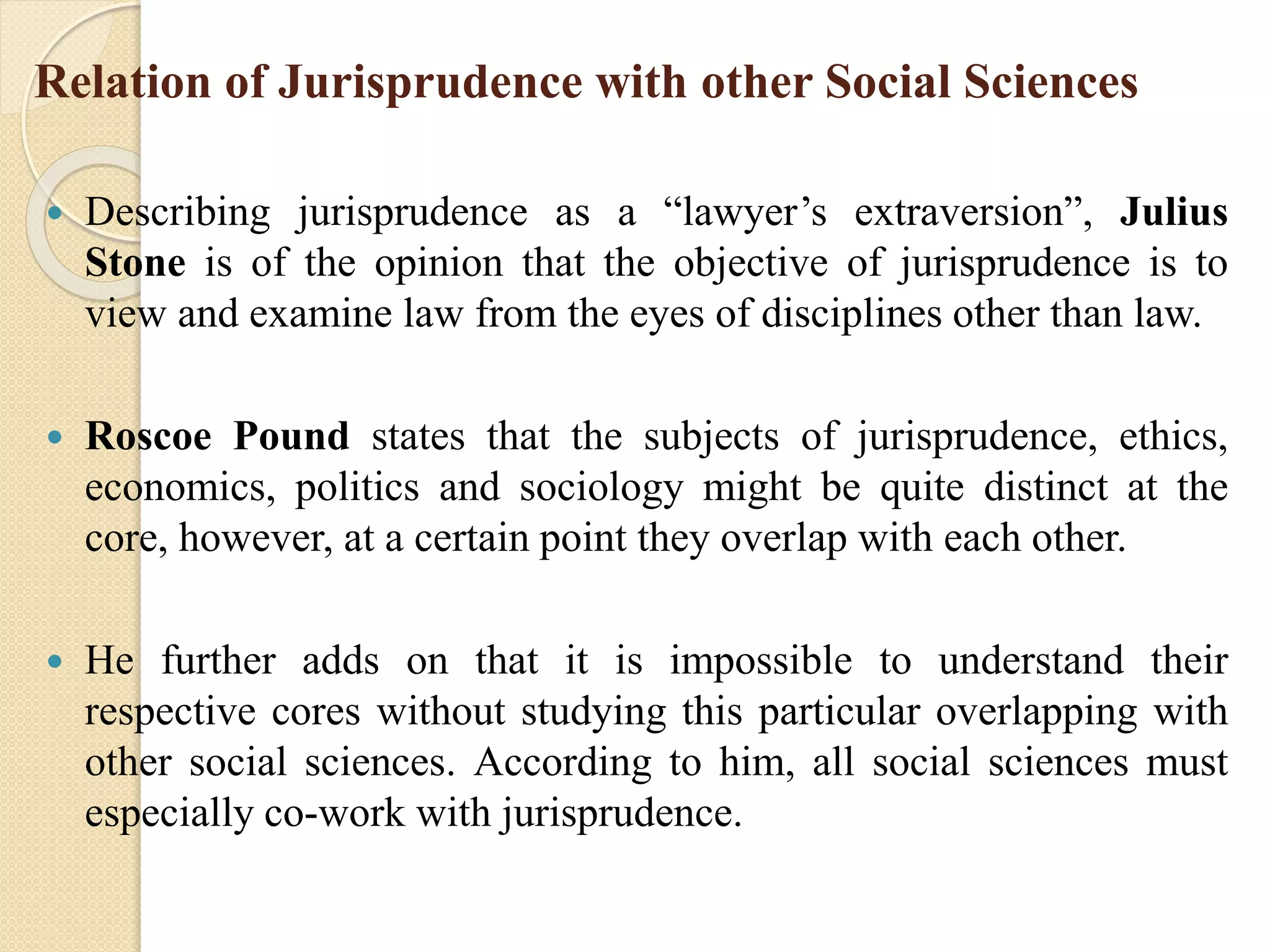
Relation of Jurisprudence with other Social Sciences
 Describing jurisprudence as a “lawyer’s extraversion”, Julius
Stone is of the opinion that the objective of jurisprudence is to
view and examine law from the eyes of disciplines other than law.
 Roscoe Pound states that the subjects of jurisprudence, ethics,
economics, politics and sociology might be quite distinct at the
core, however, at a certain point they overlap with each other.
 He further adds on that it is impossible to understand their
respective cores without studying this particular overlapping with
other social sciences. According to him, all social sciences must
especially co-work with jurisprudence.
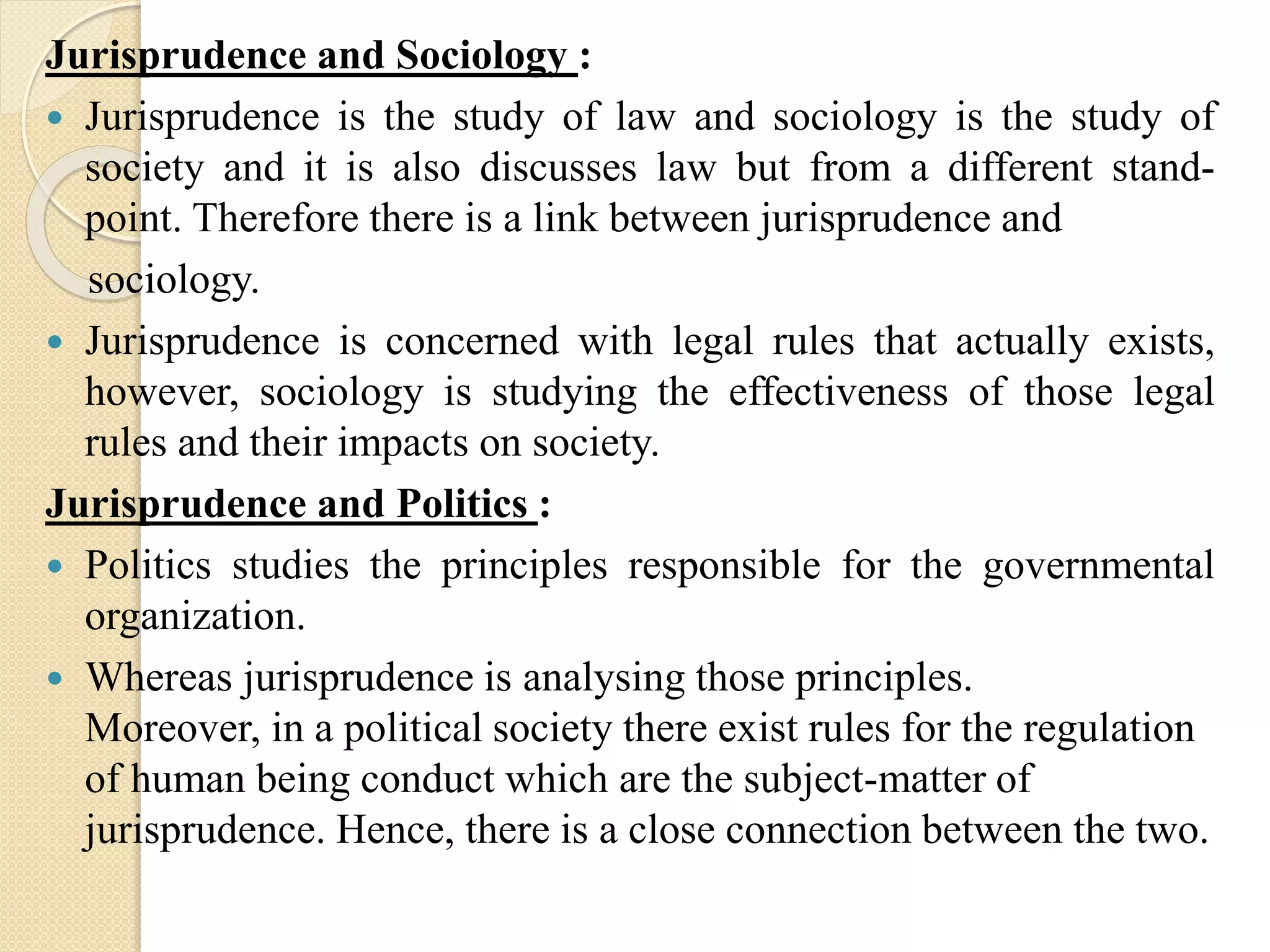
Jurisprudence and Sociology :
 Jurisprudence is the study of law and sociology is the study of
society and it is also discusses law but from a different stand-
point. Therefore there is a link between jurisprudence and
sociology.
 Jurisprudence is concerned with legal rules that actually exists,
however, sociology is studying the effectiveness of those legal
rules and their impacts on society.
Jurisprudence and Politics :
 Politics studies the principles responsible for the governmental
organization.
 Whereas jurisprudence is analysing those principles.
Moreover, in a political society there exist rules for the regulation
of human being conduct which are the subject-matter of
jurisprudence. Hence, there is a close connection between the two.
Jurisprudence and Ethics :
 Ethics is the science of human conduct. It projects an ideal human
behavior, in the light of which it suggests a course of conduct for
individuals living in societies. Whereas, jurisprudence is
discussing the imperative rules, actually existing in the societies.
However, those rules are also connected with the behavior of
human beings in societies.
 Due to the close relationship and interdependency of these
sciences, there emerged a branch of jurisprudence known as
Ethical Jurisprudence, discussing the ideal human behavior or
which is the study of law as it ought to be.
Jurisprudence and Psychology :
 Psychology is the ‘science of mind and behavior’, whereas,
jurisprudence is discussing law.
 Law is aimed to be followed by individuals, and individuals can
only follow law if they intend to follow.
 Therefore, intention is the very basic element behind every law, and
particularly in criminal law the concept of mens rea is having
immense importance. Therefore, jurisprudence and psychology both
are closely inter-related human sciences.
Jurisprudence and Economics :
 Economics studies the production and distribution of wealth and law
is responsible for establishing a fair distribution of wealth through
rules. Moreover, studies show that economic factors are responsible
for the increasing rate of criminal activities, which again brings the
two in close relation with each other.
 Furthermore, economics aims at improvement of the standards of
human lives whereas, this could not possible if a peaceful
environment is not available which is possible through the
application of laws.
 So there is close connection between the two subjects.
Jurisprudence and History :
 History is the scientific narration of the past events, whereas,
jurisprudence is the science of law.
 Law has not come into existence overnight, as a matter of fact, it
has developed through ages.
 History helps jurisprudence in digging out the origin and evolution
of different legal rules.
 Owing to its importance, there developed a separate branch of
jurisprudence, known as Historical Jurisprudence.
 Therefore, it may concluded that there is a close relation between
jurisprudence and history.

Definitions of Jurisprudence. Scope & Relationship with other social sciences

  • 1.
    JURISPRUDENCE DEFINITIONS OF JURISPRUDENCE, SCOPE & RELATIONSHIPWITH OTHER SOCIAL SCIENCES BY ADV. CAROLINE ELIAS
  • 2.
    DEFINITIONS :  Thereis no uniform definitions for jurisprudence. Each jurists defined ‘jurisprudence’ based upon their own ideology & nature of the society.  Salmond: “ The Science of law”  Austin : “ The science of positive law”  Holland : “ The formal science of positive law”  Allen : “ The scientific synthesis of the essential principles of law”  Cicero: “ The philosophical aspect of the knowledge of law”  So we can say, it provides clear understanding about the nature of law and basic functions of law, the relationship between law and justice, law and morals etc.  It studies law - not of a particular country, but as a general notion of law itself.
  • 3.
    Meaning :  Inthe early decades of the 19th century with the theories propounded by Bentham and Austin, the term ‘jurisprudence’ acquired a definite meaning.  Bentham is known as Father of Jurisprudence was the first one to analyze what is law. He divided his study into two parts: (1) Examination of Law ‘as it is’ i.e. Expositorial Approach– Command of Sovereign (2)Examination of Law ‘as it ought to be’  i.e.,CensorialApproach-MoralityofLaw. However, Austin concerned himself mainly with the formal analysis of the English law and its related concept, which still continues to be the basic concept. Austin’s ideology that ‘law is the command of the sovereign’ became the structure of English Legal System, which remained with the formal analysis of law as ‘it is’ (Expositorial) and never became ‘as it ought to be’ (Censorial).
  • 4.
    Scope of Jurisprudence The scope of jurisprudence has widened considerably over the years. Commenting on the scope of jurisprudence Justice P.B.Mukherjee observed, “Jurisprudence is both an intellectual and idealistic abstraction as well as the behavioural study of man in society. It includes political, social, economic and cultural ideas. It covers the study of man in relation to society.” This makes the distinction between law and jurisprudence amply clear. It, therefore, follows that jurisprudence comprises the philosophy of law and its object is not to discover new rules but to reflect on the rules already known.
  • 5.
     Whereas, Austinwas the only one who tried to limit the scope of jurisprudence. He tried to segregate morals and theology from the study of jurisprudence.  Approaches to the study of Jurisprudence There are two ways to study it- Empirical– Facts to Generalization. A Priori– Start with Generalization in light of which the facts are examined.
  • 6.
    Scope & valueof jurisprudence  Some jurists opined that jurisprudence have no practical utility. But Salmond does not agree with this view. “Only by understanding the nature of law, its concepts and distinctions, a lawyer can find out the actual rules of law”.  The value of Jurisprudence can be summarized as follows: (1) The philosophy law is the basis of legal rules (2) Study of jurisprudence is the study of different legal systems (3)The knowledge of law is essential to every legislator while making laws. (4) It is concerned with what and how the law should be (5) It has educational value & provides rules of interpretation (6) It provides oppurtunity for lawyer to bring theory and life into focus. (7) It analyses, clarifies, clears overlapping of legal rules; and provides new solutions to new problems with new interpretations.
  • 7.
    Relation of Jurisprudencewith other Social Sciences  Describing jurisprudence as a “lawyer’s extraversion”, Julius Stone is of the opinion that the objective of jurisprudence is to view and examine law from the eyes of disciplines other than law.  Roscoe Pound states that the subjects of jurisprudence, ethics, economics, politics and sociology might be quite distinct at the core, however, at a certain point they overlap with each other.  He further adds on that it is impossible to understand their respective cores without studying this particular overlapping with other social sciences. According to him, all social sciences must especially co-work with jurisprudence.
  • 8.
    Jurisprudence and Sociology:  Jurisprudence is the study of law and sociology is the study of society and it is also discusses law but from a different stand- point. Therefore there is a link between jurisprudence and sociology.  Jurisprudence is concerned with legal rules that actually exists, however, sociology is studying the effectiveness of those legal rules and their impacts on society. Jurisprudence and Politics :  Politics studies the principles responsible for the governmental organization.  Whereas jurisprudence is analysing those principles. Moreover, in a political society there exist rules for the regulation of human being conduct which are the subject-matter of jurisprudence. Hence, there is a close connection between the two.
  • 9.
    Jurisprudence and Ethics:  Ethics is the science of human conduct. It projects an ideal human behavior, in the light of which it suggests a course of conduct for individuals living in societies. Whereas, jurisprudence is discussing the imperative rules, actually existing in the societies. However, those rules are also connected with the behavior of human beings in societies.  Due to the close relationship and interdependency of these sciences, there emerged a branch of jurisprudence known as Ethical Jurisprudence, discussing the ideal human behavior or which is the study of law as it ought to be. Jurisprudence and Psychology :  Psychology is the ‘science of mind and behavior’, whereas, jurisprudence is discussing law.  Law is aimed to be followed by individuals, and individuals can only follow law if they intend to follow.
  • 10.
     Therefore, intentionis the very basic element behind every law, and particularly in criminal law the concept of mens rea is having immense importance. Therefore, jurisprudence and psychology both are closely inter-related human sciences. Jurisprudence and Economics :  Economics studies the production and distribution of wealth and law is responsible for establishing a fair distribution of wealth through rules. Moreover, studies show that economic factors are responsible for the increasing rate of criminal activities, which again brings the two in close relation with each other.  Furthermore, economics aims at improvement of the standards of human lives whereas, this could not possible if a peaceful environment is not available which is possible through the application of laws.  So there is close connection between the two subjects.
  • 11.
    Jurisprudence and History:  History is the scientific narration of the past events, whereas, jurisprudence is the science of law.  Law has not come into existence overnight, as a matter of fact, it has developed through ages.  History helps jurisprudence in digging out the origin and evolution of different legal rules.  Owing to its importance, there developed a separate branch of jurisprudence, known as Historical Jurisprudence.  Therefore, it may concluded that there is a close relation between jurisprudence and history.