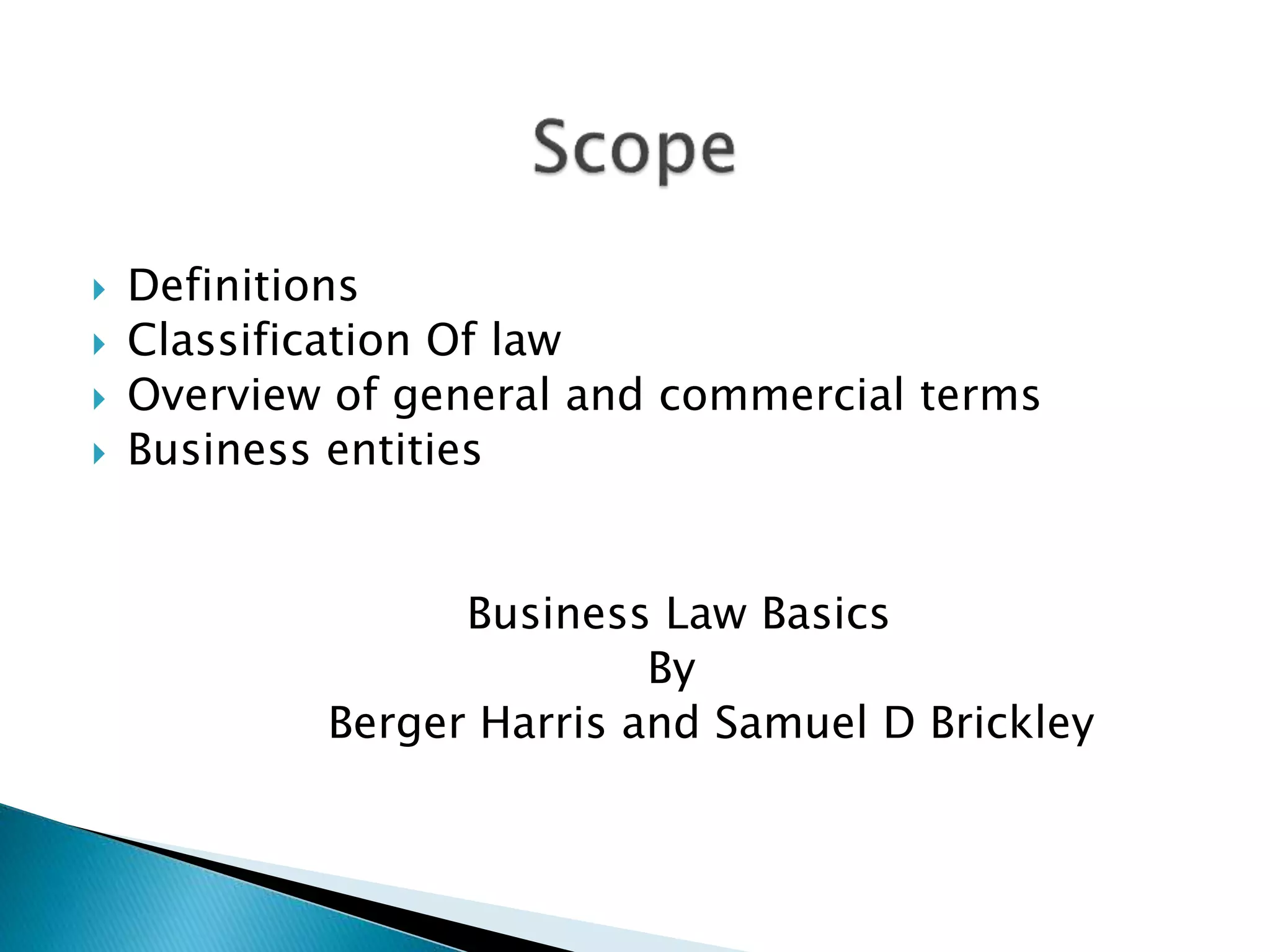
 Definitions
 Classification Of law
 Overview of general and commercial terms
 Business entities
Business Law Basics
By
Berger Harris and Samuel D Brickley
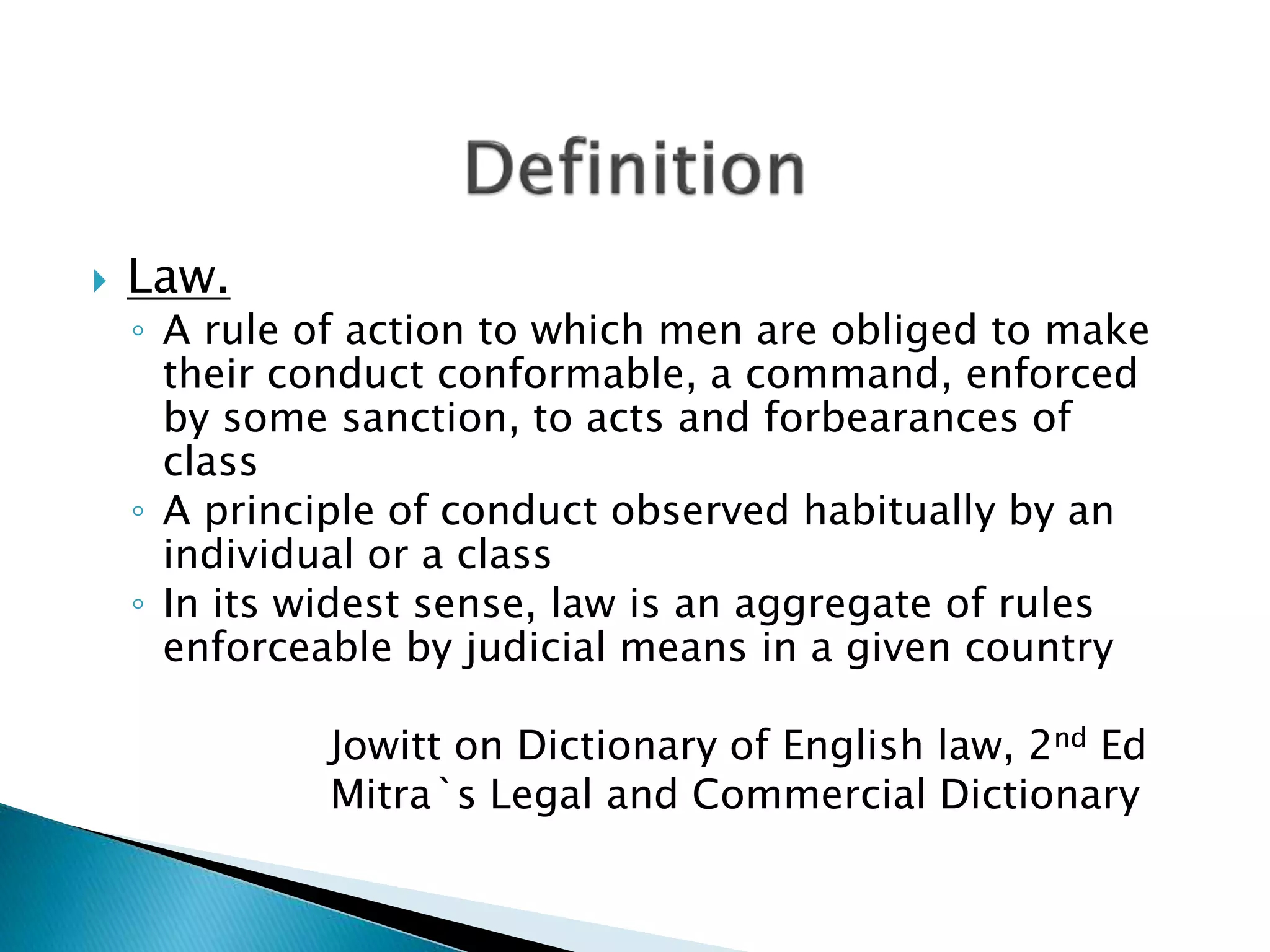
 Law.
◦ A rule of action to which men are obliged to make
their conduct conformable, a command, enforced
by some sanction, to acts and forbearances of
class
◦ A principle of conduct observed habitually by an
individual or a class
◦ In its widest sense, law is an aggregate of rules
enforceable by judicial means in a given country
Jowitt on Dictionary of English law, 2nd Ed
Mitra`s Legal and Commercial Dictionary
 Four principal functions and purposes:-
◦ Establishing standards
◦ Maintaining order
◦ Resolving dispute
◦ Protecting liberties and rights
 A guidepost for minimally acceptable
behavior in society
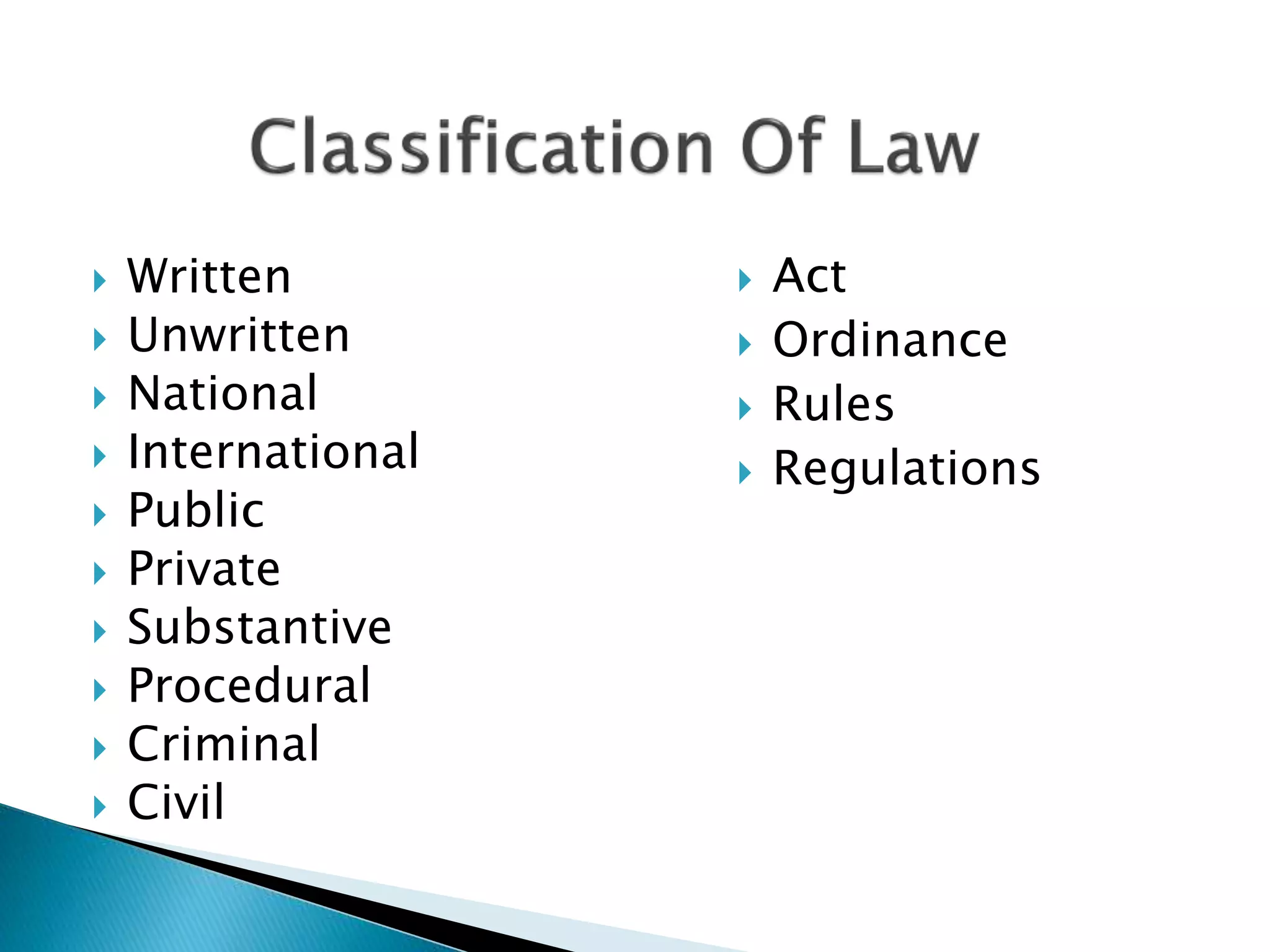
 Written
 Unwritten
 National
 International
 Public
 Private
 Substantive
 Procedural
 Criminal
 Civil
 Act
 Ordinance
 Rules
 Regulations
 These are rules of law those have been
reduced into a written form.
 They are embodied in a formal document e.g
Constitution
 Written laws prevails over unwritten law
 These are rules of Law that have not been
reduced into written form
 They are not embodied in any single
document e.g African customary law,
common law, equity
 Their existence must be proved
 These are rule of law operational within the
boundaries of the country
 Regulates the relation between the citizens
 Regulate the relation between the citizens
and the state
 Based on the act of parliament , customary
and religious practice of the people
 It is a body of rules that regulates relations
between countries/states and other
international persons e.g United Nations
 It is based on international agreements of
treaties and customary practice of states and
general principles
 It consist of those fields or branches of law in
which the state has an interest as the
sovereign e.g Criminal Law, Constitutional
Law, Administrative Law
 Public law is concerned with the constitutions
and functions of the various organs of
Government including local authorities, their
relations with each other and citizens
 Public law asserts state sovereignty and
power
 It consists of those fields or branches of law
in which the state has no direct interest as
the sovereign e.g Law of Contracts, Law of
Property , Law of Succession
 Private law is concerned with day to day
transactions of legal relationship between
persons
 It defines the rights and duties of parties
 Create rights and duties of parties
 Concerned with the rules themselves as
opposed to the procedure on how to apply
them
 Provides remedies when the rights are
violated
 Defines offenses and prescribes punishments
e.g Pakistan Penal Code
 Deals with procedures on how to apply law
 Consist of steps or guiding principles or rules
of practice to be complied with or followed in
the administration of justice or in the
application of substantive law
 Referred to as Adjective Law e,g CrPC, CPC
 It has been defined as the law of crimes
 A crime has been defined as an act or
omission committed or omitted In violation of
public law e.g murder, robbery, theft
 All crimes or offence are created by
parliament through statutes
 Suspects are arrested by the state through
the police
 Offences are generally prosecuted by the
state through the office of the Attorney
General
 It is concerned with the violation of private rights in there
individual or corporate capacity e.g breach of contract ,
negligence , defamation , nuisance, trespassing
 If a persons private rights are violated the person has a
cause of action
 Cause of actions are recognized by statutes and by the
common law
 The person whose rights have been allegedly violated sues
the alleged wrong doer hence civil cases styled as plaintiff
vs defendant
 It is the duty of the plaintiff to adduce evidence to prove
his case the burden of proof lies on plaintiff
 Purpose of civil law is the protection of rights and
enforcement of duties as well as provision of legal
remedies as and when a persons rights have been violated
 Means a thing done, deed, something done by a person
pursuant to his violation.
 Act used with a reference to an offence are or a civil wrong
shall include a series of act and words which refers to acts
done extend also to illegal emission
 Act includes illegal emissions
 The word act extends to illegal emissions and no
distinctions can be made between acts done illegally and
in bad faith and acts done bona fide in official capacity
 According to criminal procedure code act means and
includes the power to examine and cross examine
witnesses and address the court
Mitra`s Legal and Commercial Dictionary
Roop K Shorey V State, AIR 1967 Punj 42
 President of Pakistan has the power to
promulgate Ordinance during reses of
parliament
 Rule shall mean a rule made in exercise of
power conferred by any enactment and shall
include a regulation made as a rule under any
enactment
General Clauses Act 1897 & 1956
Section 3 ( 47 )
 Regulation means a regulation made by the
federal government under government of India
act 1870 or the government of India act 1915 or
under section 95 or section 96 of government of
India act 1935 or by the governor under article
103 or article 104 of the constitution of 1956 or
by the President or by the Governor under article
223 of the constitution of 1962 or by the
President or by the Governor under article 247 of
the constitution of 1973
General Clauses Act 1897 & 1956
Section 3 ( 46 )
 Offer
 Acceptance
 Promise
 Consideration
 Agreement
 Contract
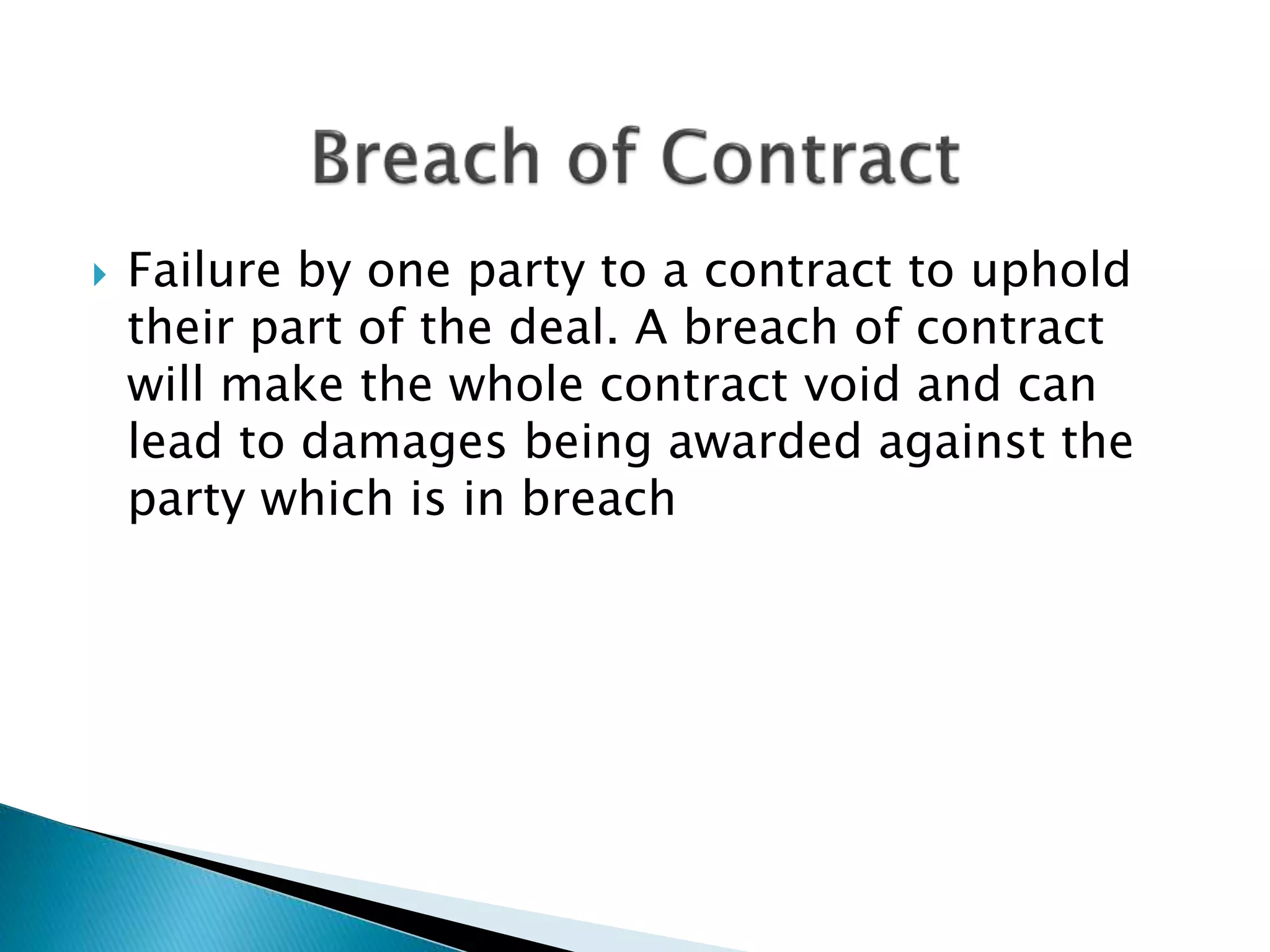
 Breach of contract
 Arbitration
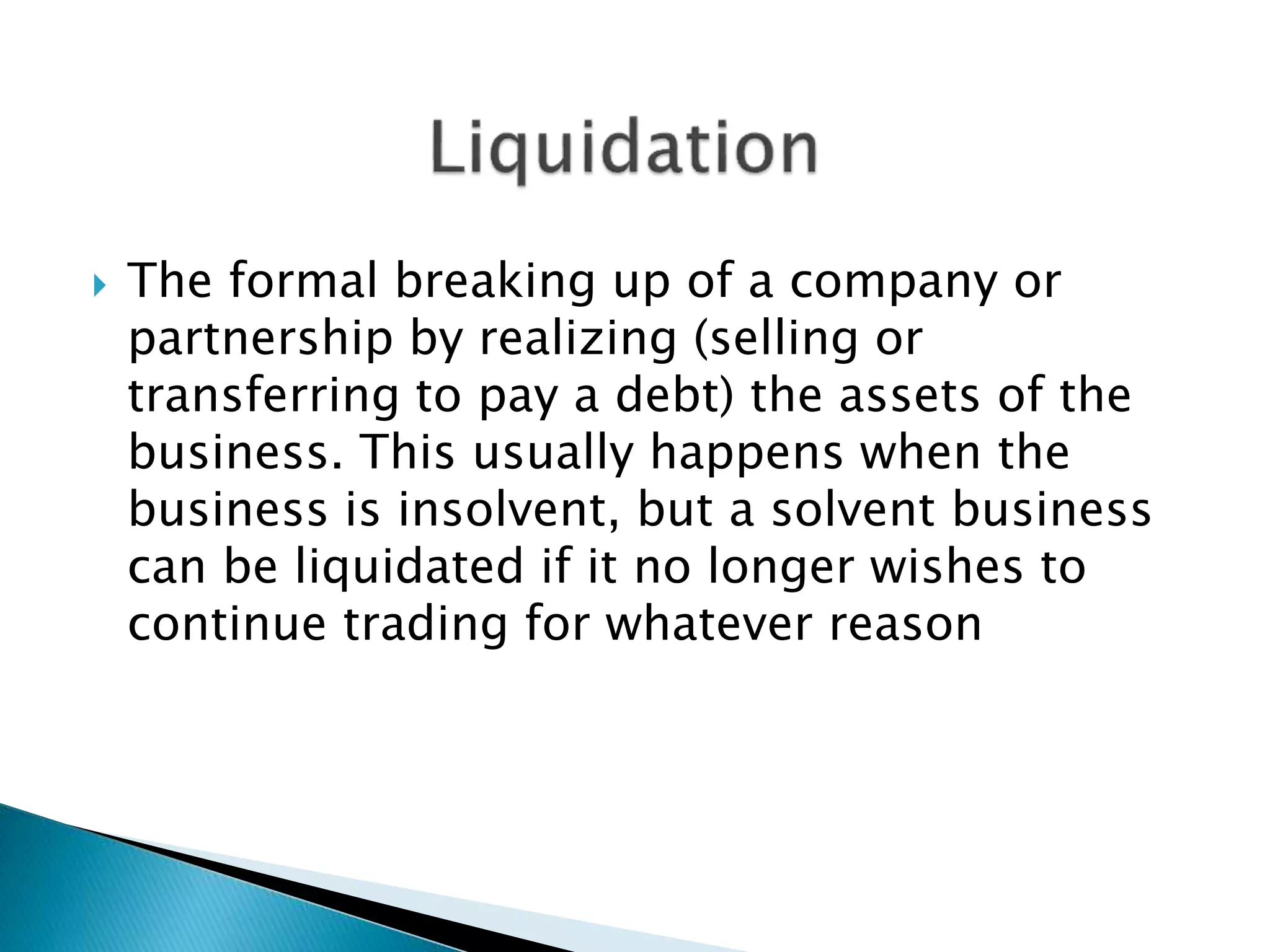
 Liquidation
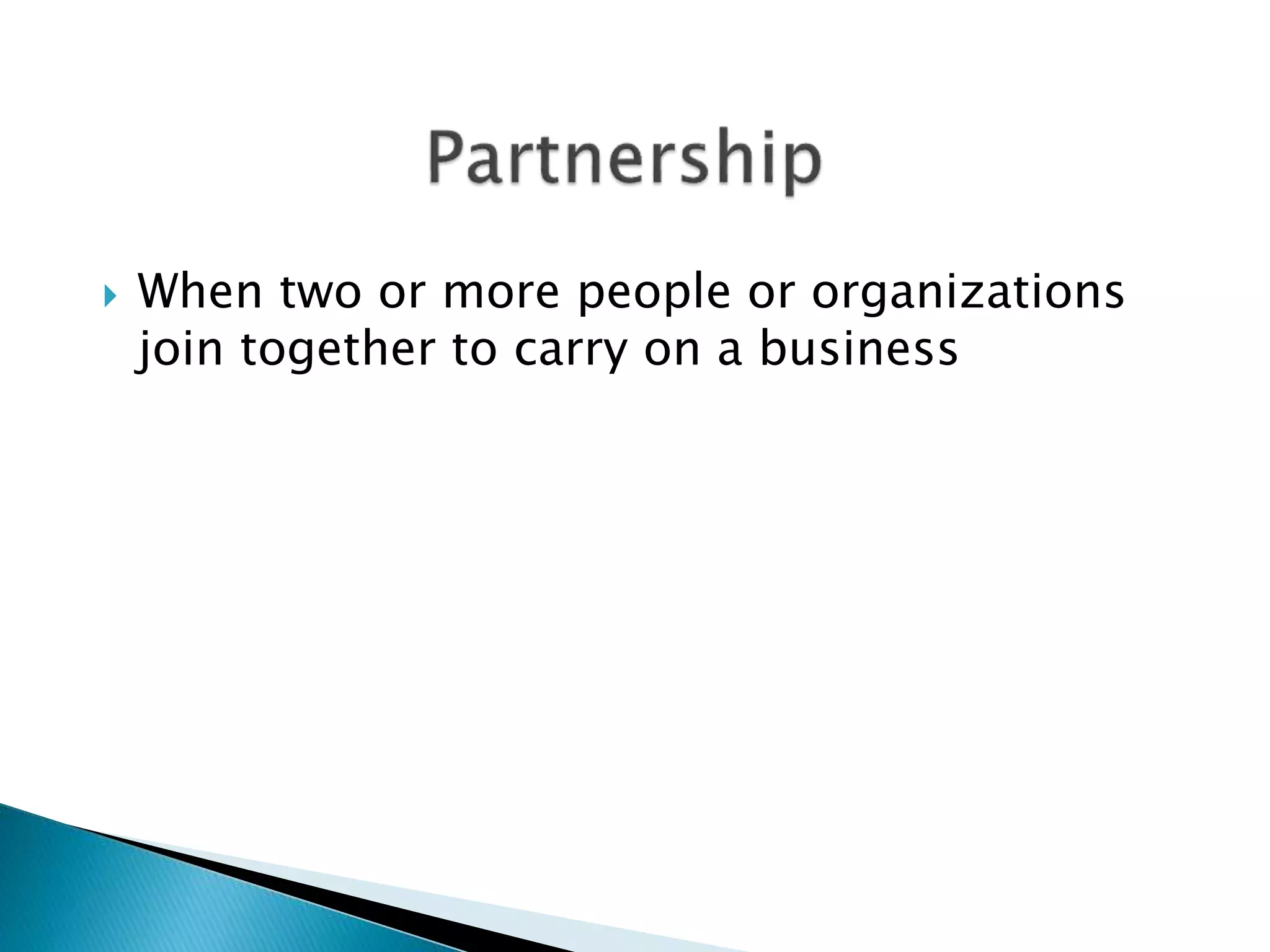
 Partnership
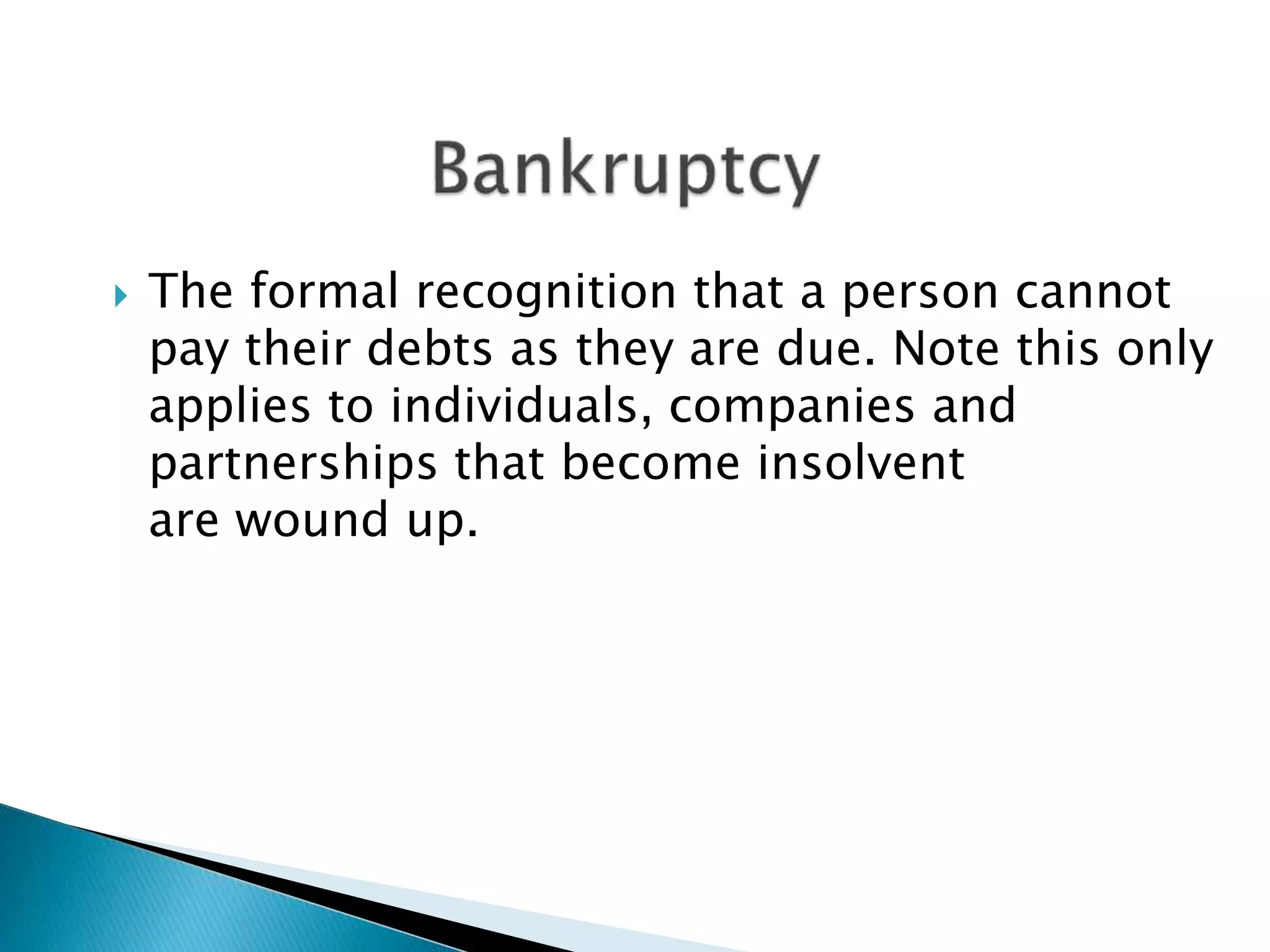
 Bankruptcy
 Damages
 Insolvency
 Deed
 Lease
 Vendor
 Vendee
 When one person signifies to another his
willingness to do or abstain from ding any act
 An offer to contract must be made with the
intention to create, if accepted, a legal
relationship. It must be capable of being
accepted (not containing any impossible
conditions), must also be complete (not
requiring more information to define the
offer) and not merely advertising
 It is the unconditional agreement to an offer.
This creates the contract. Before acceptance,
any offer can be withdrawn, but once
accepted the contract is binding on both
sides. Any conditions have the effect of a
counter offer that must be accepted by the
other party.
 Offer when accepted without any condition
becomes a promise.
Section 2 ( B )
 In a contract each side must give some
consideration to the other. Often referred to
as the quid pro quo. Usually this is the price
paid by one side and the goods supplied by
the other. But it can be anything of value to
the other party, and can be negative - eg
someone promising not to exercise a right of
access over somebody else's land in return
for a payment would be a valid contract, even
if there was no intention of ever using the
right anyway.
 Every promise and every set of promises
forming the consideration is an agreement.
Section 2 ( E )
 An agreement enforceable by law is a
contract.
Section 2 ( H )
 Failure by one party to a contract to uphold
their part of the deal. A breach of contract
will make the whole contract void and can
lead to damages being awarded against the
party which is in breach
 Using an independent third party to settle
disputes without going to court. The third
party acting as arbitrator must be agreed by
both sides. Contracts often include
arbitration clauses nominating an arbitrator
in advance.
 The formal breaking up of a company or
partnership by realizing (selling or
transferring to pay a debt) the assets of the
business. This usually happens when the
business is insolvent, but a solvent business
can be liquidated if it no longer wishes to
continue trading for whatever reason
 When two or more people or organizations
join together to carry on a business
 The formal recognition that a person cannot
pay their debts as they are due. Note this only
applies to individuals, companies and
partnerships that become insolvent
are wound up.
 Money paid as the normal remedy in the law
as compensation for an individual or
company's loss. If another type of remedy is
wanted (such as an injunction) but cannot be
or is not given by the court, then damages
will be awarded instead.
 The situation where a person or business
cannot pay its debts as they fall due
 A written document by which a person
transfers ownership of real property to
another. A deed must be properly executed
and delivered in order to be effective
 A contract by which an owner of property
conveys exclusive possession and use of it
for a specified rent and for a specified period
after which the property reverts to the owner
 The person who is selling a property
 The person to whom a property is sold
 It is an entity that is formed and administered
as per commercial law in order to engage in
business activities, charitable work or other
activities allowable
 Most often business entities are formed to
sell a product or a service
 Corporation
 Corporative
 Partnership
 Sole Proprietorship
 Limited Liability Company
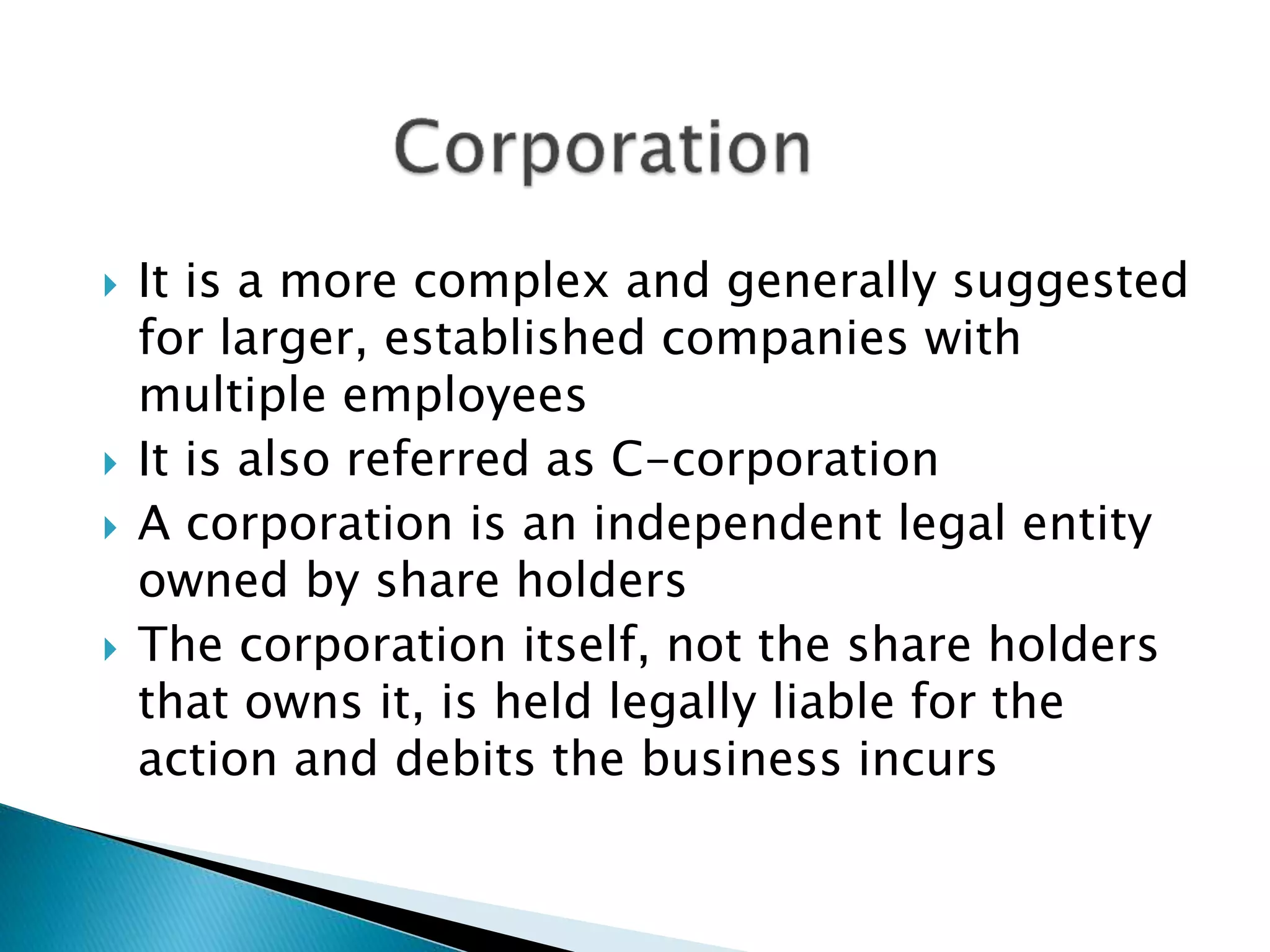
 It is a more complex and generally suggested
for larger, established companies with
multiple employees
 It is also referred as C-corporation
 A corporation is an independent legal entity
owned by share holders
 The corporation itself, not the share holders
that owns it, is held legally liable for the
action and debits the business incurs
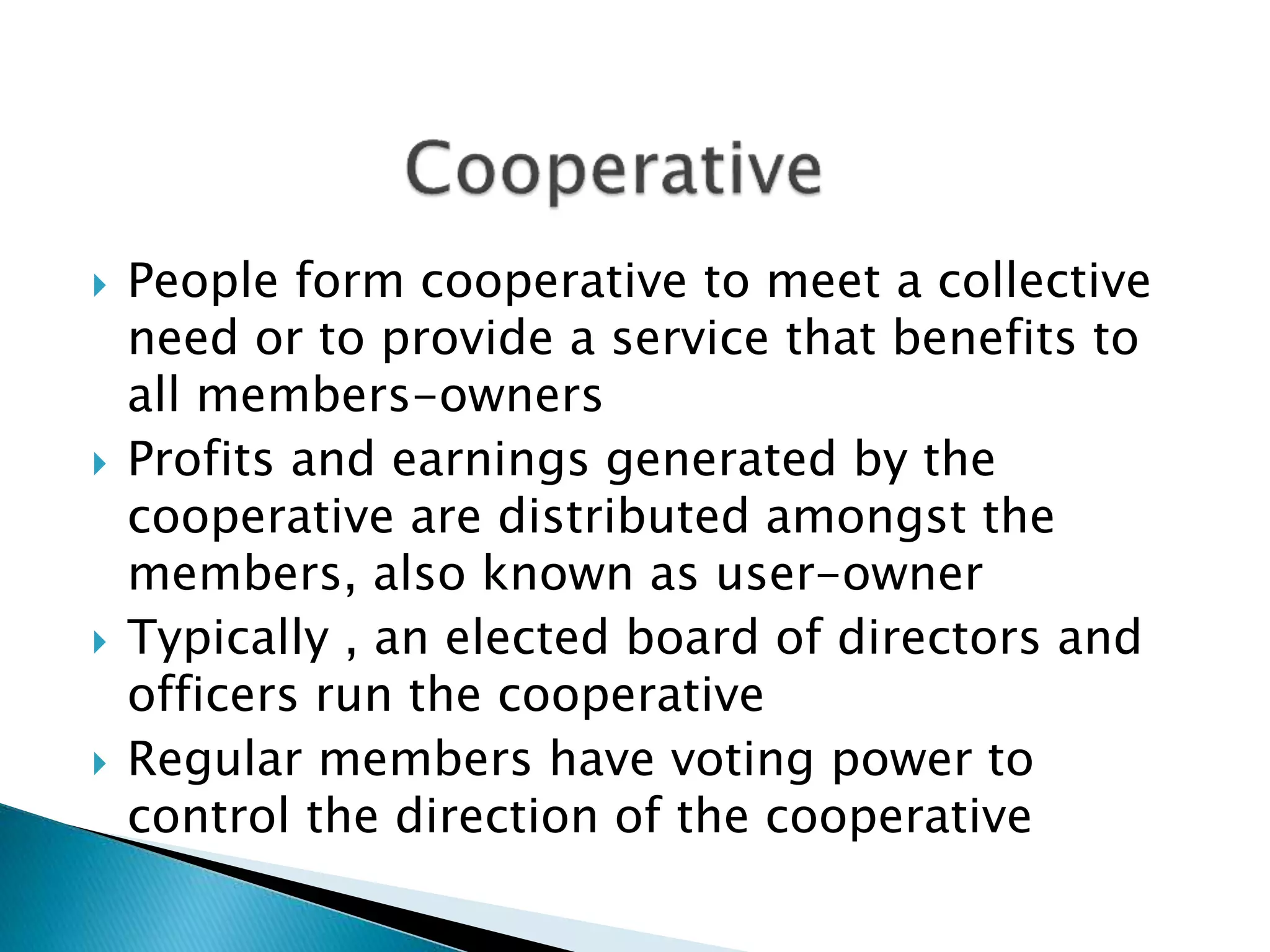
 People form cooperative to meet a collective
need or to provide a service that benefits to
all members-owners
 Profits and earnings generated by the
cooperative are distributed amongst the
members, also known as user-owner
 Typically , an elected board of directors and
officers run the cooperative
 Regular members have voting power to
control the direction of the cooperative
 When two or more persons make an
association to do a business for sharing the
profit
 Business is conducted by all partners or any
of them on behalf of all
 The liabilities' unlimited
 Types:
◦ General, Limited, Particular, At Will
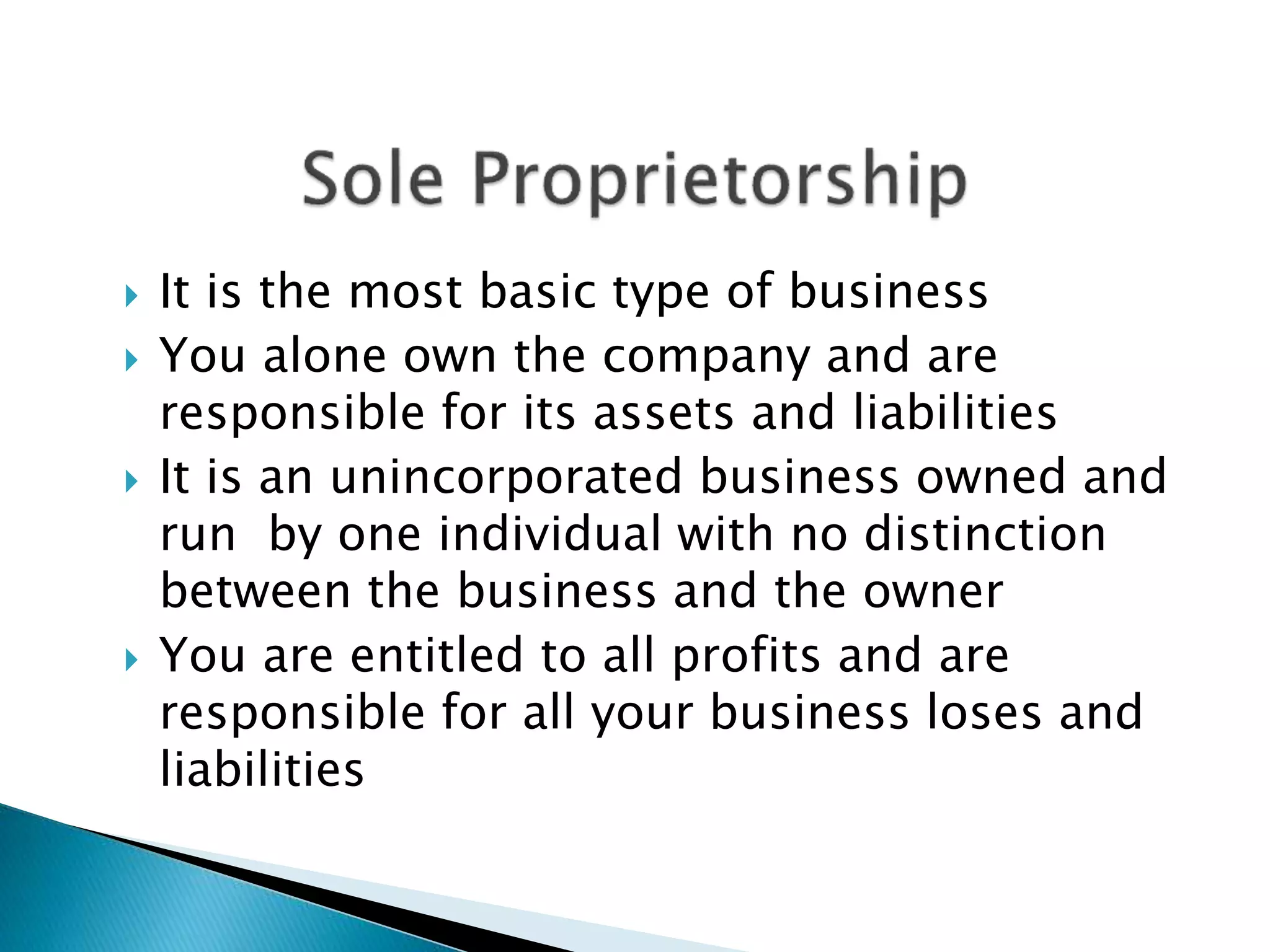
 It is the most basic type of business
 You alone own the company and are
responsible for its assets and liabilities
 It is an unincorporated business owned and
run by one individual with no distinction
between the business and the owner
 You are entitled to all profits and are
responsible for all your business loses and
liabilities
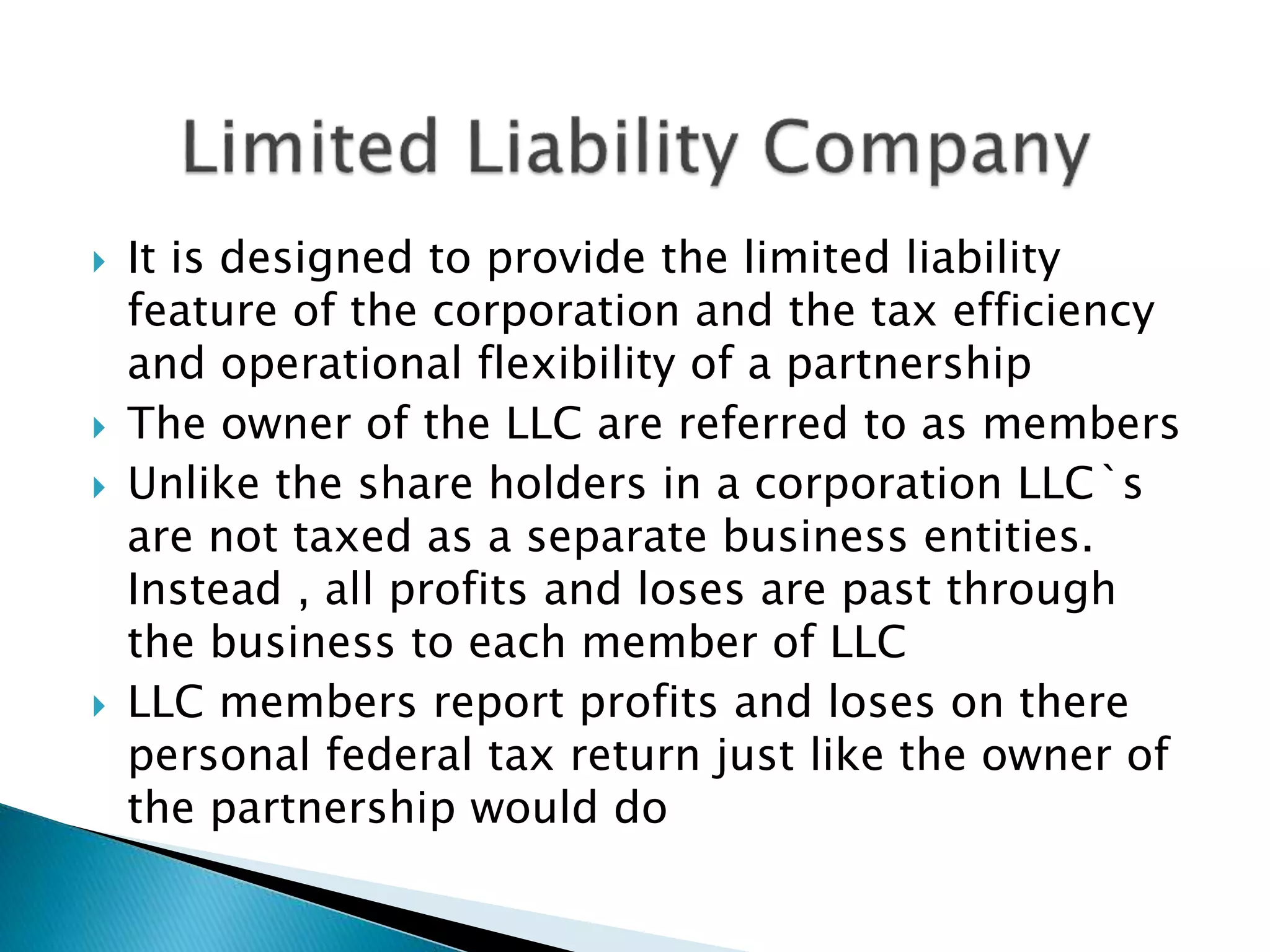
 It is designed to provide the limited liability
feature of the corporation and the tax efficiency
and operational flexibility of a partnership
 The owner of the LLC are referred to as members
 Unlike the share holders in a corporation LLC`s
are not taxed as a separate business entities.
Instead , all profits and loses are past through
the business to each member of LLC
 LLC members report profits and loses on there
personal federal tax return just like the owner of
the partnership would do
Definition and classification of law

Definition and classification of law

  • 2.
     Definitions  ClassificationOf law  Overview of general and commercial terms  Business entities Business Law Basics By Berger Harris and Samuel D Brickley
  • 3.
     Law. ◦ Arule of action to which men are obliged to make their conduct conformable, a command, enforced by some sanction, to acts and forbearances of class ◦ A principle of conduct observed habitually by an individual or a class ◦ In its widest sense, law is an aggregate of rules enforceable by judicial means in a given country Jowitt on Dictionary of English law, 2nd Ed Mitra`s Legal and Commercial Dictionary
  • 4.
     Four principalfunctions and purposes:- ◦ Establishing standards ◦ Maintaining order ◦ Resolving dispute ◦ Protecting liberties and rights  A guidepost for minimally acceptable behavior in society
  • 5.
     Written  Unwritten National  International  Public  Private  Substantive  Procedural  Criminal  Civil  Act  Ordinance  Rules  Regulations
  • 6.
     These arerules of law those have been reduced into a written form.  They are embodied in a formal document e.g Constitution  Written laws prevails over unwritten law
  • 7.
     These arerules of Law that have not been reduced into written form  They are not embodied in any single document e.g African customary law, common law, equity  Their existence must be proved
  • 8.
     These arerule of law operational within the boundaries of the country  Regulates the relation between the citizens  Regulate the relation between the citizens and the state  Based on the act of parliament , customary and religious practice of the people
  • 9.
     It isa body of rules that regulates relations between countries/states and other international persons e.g United Nations  It is based on international agreements of treaties and customary practice of states and general principles
  • 10.
     It consistof those fields or branches of law in which the state has an interest as the sovereign e.g Criminal Law, Constitutional Law, Administrative Law  Public law is concerned with the constitutions and functions of the various organs of Government including local authorities, their relations with each other and citizens  Public law asserts state sovereignty and power
  • 11.
     It consistsof those fields or branches of law in which the state has no direct interest as the sovereign e.g Law of Contracts, Law of Property , Law of Succession  Private law is concerned with day to day transactions of legal relationship between persons  It defines the rights and duties of parties
  • 12.
     Create rightsand duties of parties  Concerned with the rules themselves as opposed to the procedure on how to apply them  Provides remedies when the rights are violated  Defines offenses and prescribes punishments e.g Pakistan Penal Code
  • 13.
     Deals withprocedures on how to apply law  Consist of steps or guiding principles or rules of practice to be complied with or followed in the administration of justice or in the application of substantive law  Referred to as Adjective Law e,g CrPC, CPC
  • 14.
     It hasbeen defined as the law of crimes  A crime has been defined as an act or omission committed or omitted In violation of public law e.g murder, robbery, theft  All crimes or offence are created by parliament through statutes  Suspects are arrested by the state through the police  Offences are generally prosecuted by the state through the office of the Attorney General
  • 15.
     It isconcerned with the violation of private rights in there individual or corporate capacity e.g breach of contract , negligence , defamation , nuisance, trespassing  If a persons private rights are violated the person has a cause of action  Cause of actions are recognized by statutes and by the common law  The person whose rights have been allegedly violated sues the alleged wrong doer hence civil cases styled as plaintiff vs defendant  It is the duty of the plaintiff to adduce evidence to prove his case the burden of proof lies on plaintiff  Purpose of civil law is the protection of rights and enforcement of duties as well as provision of legal remedies as and when a persons rights have been violated
  • 16.
     Means athing done, deed, something done by a person pursuant to his violation.  Act used with a reference to an offence are or a civil wrong shall include a series of act and words which refers to acts done extend also to illegal emission  Act includes illegal emissions  The word act extends to illegal emissions and no distinctions can be made between acts done illegally and in bad faith and acts done bona fide in official capacity  According to criminal procedure code act means and includes the power to examine and cross examine witnesses and address the court Mitra`s Legal and Commercial Dictionary Roop K Shorey V State, AIR 1967 Punj 42
  • 17.
     President ofPakistan has the power to promulgate Ordinance during reses of parliament
  • 18.
     Rule shallmean a rule made in exercise of power conferred by any enactment and shall include a regulation made as a rule under any enactment General Clauses Act 1897 & 1956 Section 3 ( 47 )
  • 19.
     Regulation meansa regulation made by the federal government under government of India act 1870 or the government of India act 1915 or under section 95 or section 96 of government of India act 1935 or by the governor under article 103 or article 104 of the constitution of 1956 or by the President or by the Governor under article 223 of the constitution of 1962 or by the President or by the Governor under article 247 of the constitution of 1973 General Clauses Act 1897 & 1956 Section 3 ( 46 )
  • 20.
     Offer  Acceptance Promise  Consideration  Agreement  Contract  Breach of contract  Arbitration  Liquidation  Partnership  Bankruptcy  Damages  Insolvency  Deed  Lease  Vendor  Vendee
  • 21.
     When oneperson signifies to another his willingness to do or abstain from ding any act  An offer to contract must be made with the intention to create, if accepted, a legal relationship. It must be capable of being accepted (not containing any impossible conditions), must also be complete (not requiring more information to define the offer) and not merely advertising
  • 22.
     It isthe unconditional agreement to an offer. This creates the contract. Before acceptance, any offer can be withdrawn, but once accepted the contract is binding on both sides. Any conditions have the effect of a counter offer that must be accepted by the other party.
  • 23.
     Offer whenaccepted without any condition becomes a promise. Section 2 ( B )
  • 24.
     In acontract each side must give some consideration to the other. Often referred to as the quid pro quo. Usually this is the price paid by one side and the goods supplied by the other. But it can be anything of value to the other party, and can be negative - eg someone promising not to exercise a right of access over somebody else's land in return for a payment would be a valid contract, even if there was no intention of ever using the right anyway.
  • 25.
     Every promiseand every set of promises forming the consideration is an agreement. Section 2 ( E )
  • 26.
     An agreementenforceable by law is a contract. Section 2 ( H )
  • 27.
     Failure byone party to a contract to uphold their part of the deal. A breach of contract will make the whole contract void and can lead to damages being awarded against the party which is in breach
  • 28.
     Using anindependent third party to settle disputes without going to court. The third party acting as arbitrator must be agreed by both sides. Contracts often include arbitration clauses nominating an arbitrator in advance.
  • 29.
     The formalbreaking up of a company or partnership by realizing (selling or transferring to pay a debt) the assets of the business. This usually happens when the business is insolvent, but a solvent business can be liquidated if it no longer wishes to continue trading for whatever reason
  • 30.
     When twoor more people or organizations join together to carry on a business
  • 31.
     The formalrecognition that a person cannot pay their debts as they are due. Note this only applies to individuals, companies and partnerships that become insolvent are wound up.
  • 32.
     Money paidas the normal remedy in the law as compensation for an individual or company's loss. If another type of remedy is wanted (such as an injunction) but cannot be or is not given by the court, then damages will be awarded instead.
  • 33.
     The situationwhere a person or business cannot pay its debts as they fall due
  • 34.
     A writtendocument by which a person transfers ownership of real property to another. A deed must be properly executed and delivered in order to be effective
  • 35.
     A contractby which an owner of property conveys exclusive possession and use of it for a specified rent and for a specified period after which the property reverts to the owner
  • 36.
     The personwho is selling a property
  • 37.
     The personto whom a property is sold
  • 38.
     It isan entity that is formed and administered as per commercial law in order to engage in business activities, charitable work or other activities allowable  Most often business entities are formed to sell a product or a service
  • 39.
     Corporation  Corporative Partnership  Sole Proprietorship  Limited Liability Company
  • 40.
     It isa more complex and generally suggested for larger, established companies with multiple employees  It is also referred as C-corporation  A corporation is an independent legal entity owned by share holders  The corporation itself, not the share holders that owns it, is held legally liable for the action and debits the business incurs
  • 41.
     People formcooperative to meet a collective need or to provide a service that benefits to all members-owners  Profits and earnings generated by the cooperative are distributed amongst the members, also known as user-owner  Typically , an elected board of directors and officers run the cooperative  Regular members have voting power to control the direction of the cooperative
  • 42.
     When twoor more persons make an association to do a business for sharing the profit  Business is conducted by all partners or any of them on behalf of all  The liabilities' unlimited  Types: ◦ General, Limited, Particular, At Will
  • 43.
     It isthe most basic type of business  You alone own the company and are responsible for its assets and liabilities  It is an unincorporated business owned and run by one individual with no distinction between the business and the owner  You are entitled to all profits and are responsible for all your business loses and liabilities
  • 44.
     It isdesigned to provide the limited liability feature of the corporation and the tax efficiency and operational flexibility of a partnership  The owner of the LLC are referred to as members  Unlike the share holders in a corporation LLC`s are not taxed as a separate business entities. Instead , all profits and loses are past through the business to each member of LLC  LLC members report profits and loses on there personal federal tax return just like the owner of the partnership would do