Material: Eugene Moll
BCB 341: Principles ofBCB 341: Principles of
Conservation BiologyConservation Biology
 Term ecotourism is comparatively new
 The ecotourism society define it as
“purposeful travel to natural areas; to understand the
cultural and natural history of the environment; taking care not to
alter the integrity of the ecosystem, while producing economic
opportunities that make conservation of natural resources
beneficial to local people”
 The South African definition

“the protection of living and non-living natural resources,”

“the promotion of appropriate and environmentally sensitive
development, and”

“the contribution to the goals of achieving social justice and
enhancing the quality of life and stability - especially for the
communities in the immediate vicinity of protected area”
WHAT IS ECOTOURISMWHAT IS ECOTOURISM
 The international definition of the word Ecotourism
implies far more than merely a nature-experience
 It uses the term environment to include the diverse
community activities and cultures of a countries people
 The South African definition puts more emphasis on people as the
key role players
 prerequisites that must be met to ensure that Ecotourism is
sustainable

Proper planning before development

Sustainable use of resources. This means that there must be
no negative impact on either the environment and/or local
communities (people)

Economic viability of all tourism products must be ensured,
with significant economic benefits flowing to local
communities

The developers must be held responsible and accountable for
the environment on which their business is dependent

The tourism industry and tourists must be properly regulated
WHAT IS ECOTOURISMWHAT IS ECOTOURISM
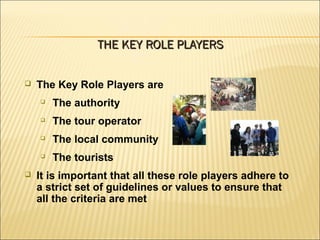
 The Key Role Players are

The authority

The tour operator

The local community

The tourists
 It is important that all these role players adhere to
a strict set of guidelines or values to ensure that
all the criteria are met
THE KEY ROLE PLAYERSTHE KEY ROLE PLAYERS
 Ecotourism in South Africa has also come to include ‘tourist
participation’ in all aspects of the operation
 Important experiential aspects include such things as:

Ethos-bonding

Exposed to the New Democracy

Natural and Cultural Diversity
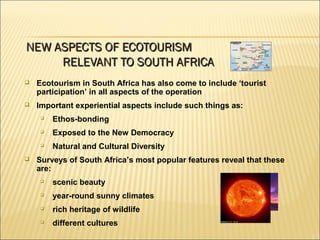
 Surveys of South Africa’s most popular features reveal that these
are:

scenic beauty

year-round sunny climates

rich heritage of wildlife

different cultures
NEW ASPECTS OF ECOTOURISMNEW ASPECTS OF ECOTOURISM
RELEVANT TO SOUTH AFRICARELEVANT TO SOUTH AFRICA
 Ecotourism can contribute to the upliftment of rural communities
 South Africa's biggest challenge is poverty and there are two pre-
conditions before poverty can addressed

Political stability

Economic growth and development
 Some of the poorest people live in densely populated rural areas
often adjacent to highly valued natural areas
 This land is often marginal for farming and ecologically fragile
 Rural Poverty cannot be turned around by agricultural
development because there is not enough suitable agricultural
land and individuals in rural areas may not want to get into
agriculture
 Ecotourism is a way of generating a livelihood
 For every eight tourists one job is created
WHY DOES SOUTH AFRICA NEEDWHY DOES SOUTH AFRICA NEED
ECOTOURISM?ECOTOURISM?
 Our natural resources are soil, water (marine and fresh), air and all
living things (including our ethnic/cultural mix of people)
 The three main objectives for the conservation of living resources
are:

Maintain essential ecological processes

To preserve genetic diversity.

To ensure the sustainable utilisation of species and
ecosystems
 Resources can be used or abused

Exploitation

Under-utilisation

Over-development
WHAT ARE OUR KEY TOURISM RESOURCES?WHAT ARE OUR KEY TOURISM RESOURCES?
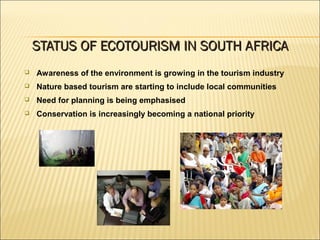
 Awareness of the environment is growing in the tourism industry
 Nature based tourism are starting to include local communities
 Need for planning is being emphasised
 Conservation is increasingly becoming a national priority
STATUS OF ECOTOURISM IN SOUTH AFRICASTATUS OF ECOTOURISM IN SOUTH AFRICA
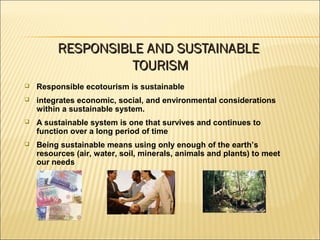
 Responsible ecotourism is sustainable
 integrates economic, social, and environmental considerations
within a sustainable system.
 A sustainable system is one that survives and continues to
function over a long period of time
 Being sustainable means using only enough of the earth’s
resources (air, water, soil, minerals, animals and plants) to meet
our needs
RESPONSIBLE AND SUSTAINABLERESPONSIBLE AND SUSTAINABLE
TOURISMTOURISM
 Things that make ecotourism more sustainable
 Be informative as possible
 Support integrity of place
 Ensure that benefits flow to local residents
 Conserves resources
 Respect local culture and tradition
 Not abuse the product
 For quality, not quantity
 To give unforgettable experiences
 Offer a “romantic” experience
WHAT IS SUSTAINABLE ECOTOURISM?WHAT IS SUSTAINABLE ECOTOURISM?
 The principles of Sustainable Ecotourism are that:
 All resources should be respected and every effort must be
made to use them sparingly
 Education and training of all parties concerned - local
communities, the Ecotourists, government and industry - is
key to success
 Participation by the Ecotourist should be encouraged at all
levels and in all sectors
 Value adding by all parties and at all levels is essential for
success
 Partnerships between all parties involved in the venture
should be promoted
 Ethical and moral attitudes, and responsibility towards the
natural and cultural environment, should be promoted by all
concerned with the operation
 The long term benefits of the resource, to the local
community, and to the operation must be enshrined
THE PRINCIPLES OF SUSTAINABLE ECOTOURISMTHE PRINCIPLES OF SUSTAINABLE ECOTOURISM
 Our Ecotourism has tremendous potential in South Africa
 It is essentially a service industry
 Have to be acutely aware of your market’s needs
 To develop a sustainable Ecotourism industry we need to:
 Provide local communities with strong incentives to
participate in and benefit from the industry
 Provide appropriate training in Ecotourism principles and
service standards at all levels
 And most importantly launch aggressive and effective
marketing strategies that will ultimately maximise local profit
share and capture the lion’s share of the global Ecotourism
market
PROMOTION OF ECOTOURISM IN SOUTHPROMOTION OF ECOTOURISM IN SOUTH
AFRICAAFRICA
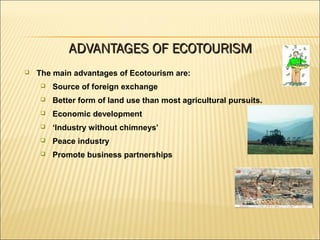
 The main advantages of Ecotourism are:
 Source of foreign exchange
 Better form of land use than most agricultural pursuits.
 Economic development
 ‘Industry without chimneys’
 Peace industry
 Promote business partnerships
ADVANTAGES OF ECOTOURISMADVANTAGES OF ECOTOURISM
 Apply strict conservation measures
 Establish carrying capacity standards
 Maintain essential ecological processes
 Develop small-scale tourist facilities
 Develop a visitor centre
 Prepare and distribute Ecotourism codes of conduct
 Provide well trained tour guides
 Integrate local communities
SOME BASIC PLANNING PRINCIPLES FORSOME BASIC PLANNING PRINCIPLES FOR
ECOTOURISM DEVELOPMENTECOTOURISM DEVELOPMENT
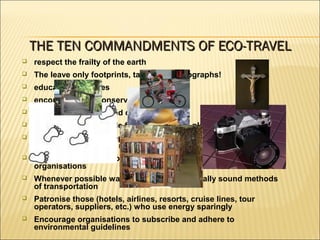
 respect the frailty of the earth
 The leave only footprints, take only photographs!
 educate themselves
 encourage local conservation efforts
 respect the privacy and dignity of others
 not buy products made from endangered plants or animals
 always follow and keep to designated trails, do not disturb
animals, plants or the natural environment
 learn about and support conservation-oriented programmes and
organisations
 Whenever possible walk or use environmentally sound methods
of transportation
 Patronise those (hotels, airlines, resorts, cruise lines, tour
operators, suppliers, etc.) who use energy sparingly
 Encourage organisations to subscribe and adhere to
environmental guidelines
THE TEN COMMANDMENTS OF ECO-TRAVELTHE TEN COMMANDMENTS OF ECO-TRAVEL
 The Ecotourist should check the following procedures and
practices:
 Research their destination before leaving
 Show respect for the people and area
 Get some background on your tour operator
 Be aware of your impact on the area
 Know where your money goes
 Employment practice
 Make others aware
 Buy carefully
 Support a conservation agency
 Question your lifestyle
ASSESSING TOUR OPERATORSASSESSING TOUR OPERATORS
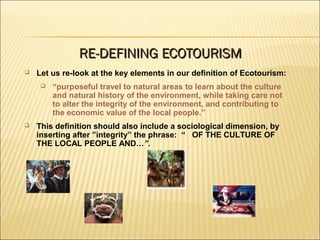
 Let us re-look at the key elements in our definition of Ecotourism:
 “purposeful travel to natural areas to learn about the culture
and natural history of the environment, while taking care not
to alter the integrity of the environment, and contributing to
the economic value of the local people.”
 This definition should also include a sociological dimension, by
inserting after ”integrity” the phrase: “ OF THE CULTURE OF
THE LOCAL PEOPLE AND…”.
RE-DEFINING ECOTOURISMRE-DEFINING ECOTOURISM
 Direct participation
 Indirect participation
 Tourism serves as a very effective starting point for rural
development and growth. Many nature reserves have attempted to
promote a mutual economic interest in Ecotourism by:
 Subcontracting certain services and functions to
neighbouring communities i.e. Laundry services
 Buying local produce
 Offering cultural activities and services to Ecotourists inside
the reserves
 Providing the means for locals to sell their wares: i.e. curios,
arts and crafts
THE ROLE OF ECOTOURISM ON COMMUNITYTHE ROLE OF ECOTOURISM ON COMMUNITY
DEVELOPMENTDEVELOPMENT
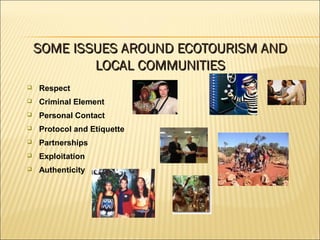
 Respect
 Criminal Element
 Personal Contact
 Protocol and Etiquette
 Partnerships
 Exploitation
 Authenticity
SOME ISSUES AROUND ECOTOURISM ANDSOME ISSUES AROUND ECOTOURISM AND
LOCAL COMMUNITIESLOCAL COMMUNITIES
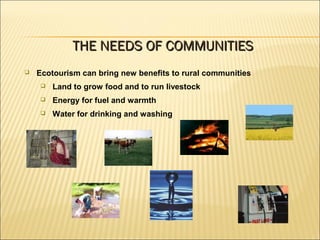
 Ecotourism can bring new benefits to rural communities
 Land to grow food and to run livestock
 Energy for fuel and warmth
 Water for drinking and washing
THE NEEDS OF COMMUNITIESTHE NEEDS OF COMMUNITIES
 Community-based partnerships are important for the following
reasons:
 They benefit the whole community socio-economically
 They demonstrate the value of biodiversity as a key resource
 They engender local ownership of the resource, thus enabling
the communities to accept responsibility
 Developing tourism partnerships
PARTNERSHIP ARRANGEMENTSPARTNERSHIP ARRANGEMENTS
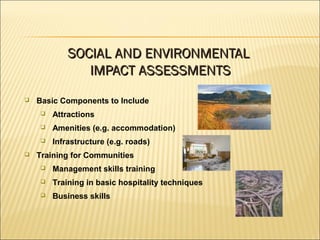
 Basic Components to Include
 Attractions
 Amenities (e.g. accommodation)
 Infrastructure (e.g. roads)
 Training for Communities
 Management skills training
 Training in basic hospitality techniques
 Business skills
SOCIAL AND ENVIRONMENTALSOCIAL AND ENVIRONMENTAL
IMPACT ASSESSMENTSIMPACT ASSESSMENTS
 Land Claims
 Assistance to Communities
 The Risk Factor
 There are FOUR main arrangements that can take place:
 Between the State and/or the Provincial Conservation
Agencies, and Local Communities
 Between Private Sector and Community Programmes
 Community-driven Projects
 Tripartite Alliance - Government, Local Communities and
Private Sector
THEME ROUTESTHEME ROUTES
 Continuous and flexible approach
 Comprehensive approach
 Integrated approach
 Environmental and sustainable approach
 Community based approach
 Implemental approach
 The strategic planning approach
PLANNING APPROACHESPLANNING APPROACHES
 Local communities must be equity partners and their share
of Ecotourism revenue must be contractually guaranteed
over and above the creation of jobs
 Local communities should be clearly identified
 Local communities should receive priority in terms of jobs
 Their legal access to the resource, through their legal
tenure, should be recognised and acknowledged
 The distribution of revenues to local people should be fair,
transparent and accountable
 Capacity building for local people should be part of the
scheme
LOCAL COMMUNITY EXPECTATIONS FROMLOCAL COMMUNITY EXPECTATIONS FROM
ECOTOURISMECOTOURISM