Labour Market Security and Flexibility
The future Directions of Flexicurity in the Age of Austerity
Oscar Molina
QUIT – Centre d’Estudis Sociològics sobre la Vida Quotidiana i el Treball
Universitat Autònoma de Barcelona
WOERRC & UACES Workshop
University of Sheffield, 28 May 2015
Outline
• How was and what has happened?; The Regulation of
Flexicurity and Reform paths under austerity times
– Social partners’ role
– Labour Market Outcomes
• Why has happened?; The impact of supra-national
institutions
– Policy Impact
• What can happen? Rethinking or abandoning
Flexicurity
– Some policy recommendations
Summary
• Low cost Flexicurity model; in MMEs, legal regulation has
been the main instrument to implement flexicurity, CB
remaining largely secondary
• The crisis has opened a window of opportunity for
governments in SE to push an agressive reform agenda;
legitimacy from above (EU), not from below (social partners)
• But paradoxically, the regulatory change most demanded by
the Troika, i.e., the single contract, has not been introduced
– No gains expected from introducing it
• Reforms during the crisis have served to further weaken the
regulatory and protective capacity of CB
• The impact of supranational institutions has accordingly been
mediated by domestic politics / interests
• Even though it has been ‘de facto’ abandoned, it survives in
the discourse of policy-makers
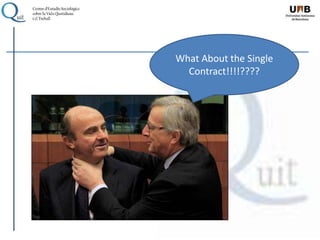
What About the Single
Contract!!!!????
Flexicurity in Spain and MMEs
• Spain: from job security with bad working conditions
(dictatorship) to high unemployment rates and high
levels of temporary employment
• Social policy expenditure remains low by EU standards
– Family support becomes a guarantee
• And the crisis has accentuated the familist character of Southern
European welfare states
• Social attitudes that become rooted:
– Acceptance of unemployment situations affecting
vulnerable groups; better a bad / precarious job than no
job
Flexicurity in Spain and MMEs
• Unbalanced flexibility; high external, low
internal
• EF becomes a substitute for technological and
organizational innovation
• EF is also a mechanism for social control at
the workplace
• Government supports this model as it allows
to reduce the unemployment rate
The role of CB
• Generally speaking, CB has had a very limited role
as an instrument to implement flexicurity
– Structural limitations; predominance of SMEs
– EF becomes entrenched in corporate strategies
• There have been attempts to enhance its role
(1997, 2006) but only limited success in some
sectors and large companies
• The negotiation of internal flexibility is
increasingly important, but still does not provide
an alternative to EF
Flexicurity in Austerity times
• The onset of the economic crisis poses
additional challenges:
– Increase in long-term unemployment; particularly
for young workers and over 45
– Early school leavers unemployed
– Immigrant population
Flexicurity in Austerity times
• Policy responses
– First stage (2010-2011);
• Attempts at enhancing the role of internal flexibility through
CB
• Marginal changes in labour market rules
– Second stage (2012);
• Radical reform of CB
• Cuts in duration and generosity of unemployment protection
• Cuts in ALMP
• Marginal changes in labour market regulation
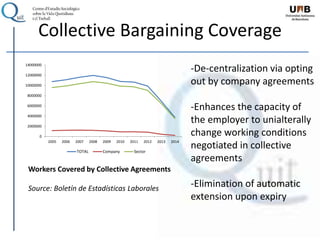
Collective Bargaining Coverage
0
2000000
4000000
6000000
8000000
10000000
12000000
14000000
2005 2006 2007 2008 2009 2010 2011 2012 2013 2014
TOTAL Company Sector
Workers Covered by Collective Agreements
Source: Boletín de Estadísticas Laborales
-De-centralization via opting
out by company agreements
-Enhances the capacity of
the employer to unialterally
change working conditions
negotiated in collective
agreements
-Elimination of automatic
extension upon expiry
Unemployment Benefit Coverage
39.2
37.9
31
24.5
0
5
10
15
20
25
30
35
40
45
2007 2010 2013 2014
-In spite of the fall in
coverage,
the expenditure on passive
policies has increased from
1,45% of GDP in 2007 to 3% in
2012
-Cowding out effect; no
money left for ALMP
-The discourse and the policy
agenda paying increasing
attention to minimum income
schemes
Workers Covered by a Contributory
Unemployment Protection Scheme as a % of
Total Unemployment
Source: Boletín de Estadísticas Laborales
ALMP
7.8 7.9
7.6 7.7
7.4
5.8
3.8
4.1
0
1
2
3
4
5
6
7
8
9
2007 2008 2009 2010 2011 2012 2013 2014
-The policy discourse; have
very little impact; Part of the
Problem
-Limited resources
-Corruption scandals linked
to the management of
training courses by both
trade unions and employer
organizations
-Rationalization and
efficiency without evaluation
Millions of Euros spent on ALMP
Source: SEPE
Reforming labour markets
• There is no space for domestic social dialogue
under the technocratic model of macroeconomic
management imposed on member states
• But this does not mean member states have
implemented all the recommendations
– Recent reports from both the ECB and the EC
recommend further changes
• This is because it is very unlikely it would have
any significant impact on employment creation
(small benefit) and in this way avoid conflict (high
costs)
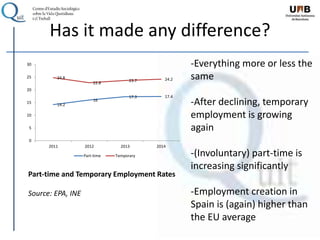
Has it made any difference?
14.2
16
17.3 17.4
24.8
22.8
23.7 24.2
0
5
10
15
20
25
30
2011 2012 2013 2014
Part-time Temporary
Part-time and Temporary Employment Rates
Source: EPA, INE
-Everything more or less the
same
-After declining, temporary
employment is growing
again
-(Involuntary) part-time is
increasing significantly
-Employment creation in
Spain is (again) higher than
the EU average
The impact on Precariousness
80
85
90
95
100
105
Itr2011
IItr2011
IIItr2011
IVtr2011
Itr2012
IItr2012
IIItr2012
IVtr2012
Itr2013
IItr2013
IIItr2013
IVtr2013
Itr2014
IItr2014
IIItr2014
IVtr2014
Precario No precario
-We can accordingly
conclude that the reforms
have contributed very little
to create net employment
-But they apparently have
contributed to make more
precarious the new jobs
created
Precarious Employment Index (1st quarter
2011=100)
Source: Elaboration in the context of the
researh project on Evaluation of Employment
Policies in Spain
Why has happened?
The impact of supra-national institutions
• Austerity has opened a window of opportunity for
governments
• International forces and pressures have not
determined decisions regarding the regulation of
flexicurity
– First, few marginal changes have been introduced in
employment regulation – single contract has not been
introduced in either country; only profound changes in CB
– But at the same time, in two countries falling within a
similar model like Italy and Spain, policy options under
fiscal constraints have been different; the case of ALMP
(very important in the policy discourse in Italy [Jobs Act]
and minimum income schemes (dominate the policy
discourse in Spain)
What can happen?
Rethinking or abandoning Flexicurity
• Flexicurity ‘de facto’ abandoned, but still of
utility in the policy discourse, as the 2012
labour market reform very clearly shows
Policy Recommendations
• Changes in labour market regulation without
implementing a fully-fledged industrial policy
will have very little impact on the type of
employment
• Revitalise and enhance the regulatory and
protective role of collective bargaining,
especially at company level
• FAnticipation / timely activation
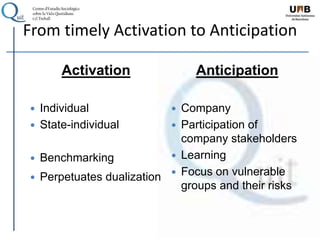
From timely Activation to Anticipation
Activation
 Individual
 State-individual
 Benchmarking
 Perpetuates dualization
Anticipation
 Company
 Participation of
company stakeholders
 Learning
 Focus on vulnerable
groups and their risks
Anticipatory
Policies
Policy Learning
Effective use of
labour market data
Participation
Focus on
Vulnerable groups
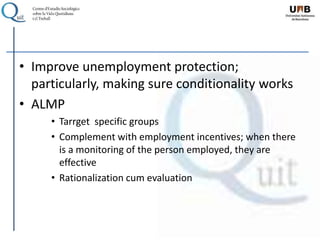
• Improve unemployment protection;
particularly, making sure conditionality works
• ALMP
• Tarrget specific groups
• Complement with employment incentives; when there
is a monitoring of the person employed, they are
effective
• Rationalization cum evaluation
Thank you very much for your attention!

Molina flexicurity workshop sheffield final

  • 1.
    Labour Market Securityand Flexibility The future Directions of Flexicurity in the Age of Austerity Oscar Molina QUIT – Centre d’Estudis Sociològics sobre la Vida Quotidiana i el Treball Universitat Autònoma de Barcelona WOERRC & UACES Workshop University of Sheffield, 28 May 2015
  • 2.
    Outline • How wasand what has happened?; The Regulation of Flexicurity and Reform paths under austerity times – Social partners’ role – Labour Market Outcomes • Why has happened?; The impact of supra-national institutions – Policy Impact • What can happen? Rethinking or abandoning Flexicurity – Some policy recommendations
  • 3.
    Summary • Low costFlexicurity model; in MMEs, legal regulation has been the main instrument to implement flexicurity, CB remaining largely secondary • The crisis has opened a window of opportunity for governments in SE to push an agressive reform agenda; legitimacy from above (EU), not from below (social partners) • But paradoxically, the regulatory change most demanded by the Troika, i.e., the single contract, has not been introduced – No gains expected from introducing it • Reforms during the crisis have served to further weaken the regulatory and protective capacity of CB • The impact of supranational institutions has accordingly been mediated by domestic politics / interests • Even though it has been ‘de facto’ abandoned, it survives in the discourse of policy-makers
  • 4.
    What About theSingle Contract!!!!????
  • 5.
    Flexicurity in Spainand MMEs • Spain: from job security with bad working conditions (dictatorship) to high unemployment rates and high levels of temporary employment • Social policy expenditure remains low by EU standards – Family support becomes a guarantee • And the crisis has accentuated the familist character of Southern European welfare states • Social attitudes that become rooted: – Acceptance of unemployment situations affecting vulnerable groups; better a bad / precarious job than no job
  • 6.
    Flexicurity in Spainand MMEs • Unbalanced flexibility; high external, low internal • EF becomes a substitute for technological and organizational innovation • EF is also a mechanism for social control at the workplace • Government supports this model as it allows to reduce the unemployment rate
  • 7.
    The role ofCB • Generally speaking, CB has had a very limited role as an instrument to implement flexicurity – Structural limitations; predominance of SMEs – EF becomes entrenched in corporate strategies • There have been attempts to enhance its role (1997, 2006) but only limited success in some sectors and large companies • The negotiation of internal flexibility is increasingly important, but still does not provide an alternative to EF
  • 8.
    Flexicurity in Austeritytimes • The onset of the economic crisis poses additional challenges: – Increase in long-term unemployment; particularly for young workers and over 45 – Early school leavers unemployed – Immigrant population
  • 9.
    Flexicurity in Austeritytimes • Policy responses – First stage (2010-2011); • Attempts at enhancing the role of internal flexibility through CB • Marginal changes in labour market rules – Second stage (2012); • Radical reform of CB • Cuts in duration and generosity of unemployment protection • Cuts in ALMP • Marginal changes in labour market regulation
  • 10.
    Collective Bargaining Coverage 0 2000000 4000000 6000000 8000000 10000000 12000000 14000000 20052006 2007 2008 2009 2010 2011 2012 2013 2014 TOTAL Company Sector Workers Covered by Collective Agreements Source: Boletín de Estadísticas Laborales -De-centralization via opting out by company agreements -Enhances the capacity of the employer to unialterally change working conditions negotiated in collective agreements -Elimination of automatic extension upon expiry
  • 11.
    Unemployment Benefit Coverage 39.2 37.9 31 24.5 0 5 10 15 20 25 30 35 40 45 20072010 2013 2014 -In spite of the fall in coverage, the expenditure on passive policies has increased from 1,45% of GDP in 2007 to 3% in 2012 -Cowding out effect; no money left for ALMP -The discourse and the policy agenda paying increasing attention to minimum income schemes Workers Covered by a Contributory Unemployment Protection Scheme as a % of Total Unemployment Source: Boletín de Estadísticas Laborales
  • 12.
    ALMP 7.8 7.9 7.6 7.7 7.4 5.8 3.8 4.1 0 1 2 3 4 5 6 7 8 9 20072008 2009 2010 2011 2012 2013 2014 -The policy discourse; have very little impact; Part of the Problem -Limited resources -Corruption scandals linked to the management of training courses by both trade unions and employer organizations -Rationalization and efficiency without evaluation Millions of Euros spent on ALMP Source: SEPE
  • 13.
    Reforming labour markets •There is no space for domestic social dialogue under the technocratic model of macroeconomic management imposed on member states • But this does not mean member states have implemented all the recommendations – Recent reports from both the ECB and the EC recommend further changes • This is because it is very unlikely it would have any significant impact on employment creation (small benefit) and in this way avoid conflict (high costs)
  • 14.
    Has it madeany difference? 14.2 16 17.3 17.4 24.8 22.8 23.7 24.2 0 5 10 15 20 25 30 2011 2012 2013 2014 Part-time Temporary Part-time and Temporary Employment Rates Source: EPA, INE -Everything more or less the same -After declining, temporary employment is growing again -(Involuntary) part-time is increasing significantly -Employment creation in Spain is (again) higher than the EU average
  • 15.
    The impact onPrecariousness 80 85 90 95 100 105 Itr2011 IItr2011 IIItr2011 IVtr2011 Itr2012 IItr2012 IIItr2012 IVtr2012 Itr2013 IItr2013 IIItr2013 IVtr2013 Itr2014 IItr2014 IIItr2014 IVtr2014 Precario No precario -We can accordingly conclude that the reforms have contributed very little to create net employment -But they apparently have contributed to make more precarious the new jobs created Precarious Employment Index (1st quarter 2011=100) Source: Elaboration in the context of the researh project on Evaluation of Employment Policies in Spain
  • 16.
    Why has happened? Theimpact of supra-national institutions • Austerity has opened a window of opportunity for governments • International forces and pressures have not determined decisions regarding the regulation of flexicurity – First, few marginal changes have been introduced in employment regulation – single contract has not been introduced in either country; only profound changes in CB – But at the same time, in two countries falling within a similar model like Italy and Spain, policy options under fiscal constraints have been different; the case of ALMP (very important in the policy discourse in Italy [Jobs Act] and minimum income schemes (dominate the policy discourse in Spain)
  • 17.
    What can happen? Rethinkingor abandoning Flexicurity • Flexicurity ‘de facto’ abandoned, but still of utility in the policy discourse, as the 2012 labour market reform very clearly shows
  • 18.
    Policy Recommendations • Changesin labour market regulation without implementing a fully-fledged industrial policy will have very little impact on the type of employment • Revitalise and enhance the regulatory and protective role of collective bargaining, especially at company level • FAnticipation / timely activation
  • 19.
    From timely Activationto Anticipation Activation  Individual  State-individual  Benchmarking  Perpetuates dualization Anticipation  Company  Participation of company stakeholders  Learning  Focus on vulnerable groups and their risks
  • 20.
    Anticipatory Policies Policy Learning Effective useof labour market data Participation Focus on Vulnerable groups
  • 21.
    • Improve unemploymentprotection; particularly, making sure conditionality works • ALMP • Tarrget specific groups • Complement with employment incentives; when there is a monitoring of the person employed, they are effective • Rationalization cum evaluation
  • 22.
    Thank you verymuch for your attention!