Data Structures and Algorithms in Java 1/23
1. List Data Structure
Data Structures and Algorithms in Java 2/23
Objectives
2
• Describe List structures
• Describe self-referential structures
• Explain types of linked lists
• Singly Linked Lists
• Circular Lists
• Doubly Linked Lists
• Lists in java.util
Data Structures and Algorithms in Java 3/23
List Data Structures
• A list is a sequential data structure, i.e. it is a sequence of items of a given
base type, where items can be added, deleted, and retrieved from any
position in the list.
• A list can be implemented as an array, or as a dynamic array to avoid
imposing a maximum size.
• An alternative implementation is a linked list, where the items are stored
in nodes that are linked together with pointers. These two
implementations have very different characteristics.
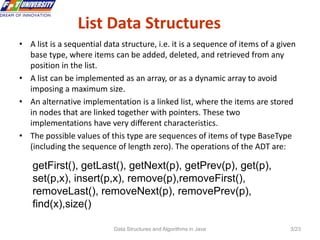
• The possible values of this type are sequences of items of type BaseType
(including the sequence of length zero). The operations of the ADT are:
getFirst(), getLast(), getNext(p), getPrev(p), get(p),
set(p,x), insert(p,x), remove(p),removeFirst(),
removeLast(), removeNext(p), removePrev(p),
find(x),size()
Data Structures and Algorithms in Java 4/23
Drawbacks of Arrays
4
• Array is a very useful data structure in many
situations. However, it has some important
limitations:
– They require size information for creation
– Inserting an element in the middle of an array leads to moving
other elements around
– Deleting an element from the middle of an array leads to moving
other elements around
• Other data structures are more efficient in such
situations.
Data Structures and Algorithms in Java 5/23
Self-Referential Structures
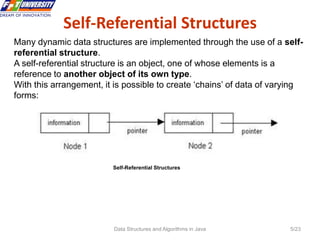
Many dynamic data structures are implemented through the use of a self-
referential structure.
A self-referential structure is an object, one of whose elements is a
reference to another object of its own type.
With this arrangement, it is possible to create ‘chains’ of data of varying
forms:
Self-Referential Structures
11/12/2021 Data Structures and Algorithms in Java 6/23
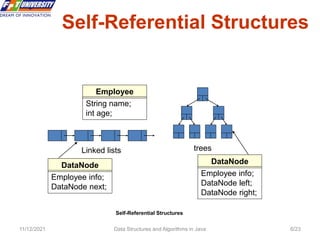
DataNode
Employee info;
DataNode next;
trees
Linked lists
Employee
String name;
int age;
DataNode
Employee info;
DataNode left;
DataNode right;
Self-Referential Structures
Data Structures and Algorithms in Java 7/23
Linked Lists
7
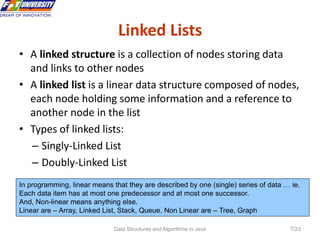
• A linked structure is a collection of nodes storing data
and links to other nodes
• A linked list is a linear data structure composed of nodes,
each node holding some information and a reference to
another node in the list
• Types of linked lists:
– Singly-Linked List
– Doubly-Linked List
In programming, linear means that they are described by one (single) series of data … ie.
Each data item has at most one predecessor and at most one successor.
And, Non-linear means anything else.
Linear are – Array, Linked List, Stack, Queue. Non Linear are – Tree, Graph
Data Structures and Algorithms in Java 8/23
Singly Linked Lists
8
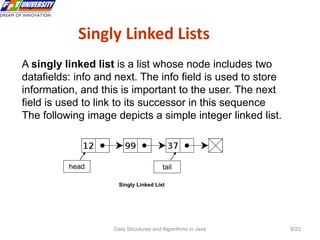
A singly linked list is a list whose node includes two
datafields: info and next. The info field is used to store
information, and this is important to the user. The next
field is used to link to its successor in this sequence
The following image depicts a simple integer linked list.
head tail
Singly Linked List
Data Structures and Algorithms in Java 9/23
Singly Linked List Implementation
9
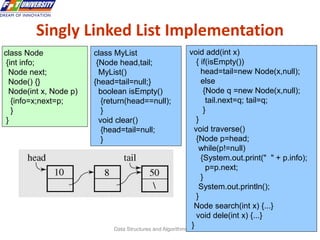
class Node
{int info;
Node next;
Node() {}
Node(int x, Node p)
{info=x;next=p;
}
}
void add(int x)
{ if(isEmpty())
head=tail=new Node(x,null);
else
{Node q =new Node(x,null);
tail.next=q; tail=q;
}
}
void traverse()
{Node p=head;
while(p!=null)
{System.out.print(" " + p.info);
p=p.next;
}
System.out.println();
}
Node search(int x) {...}
void dele(int x) {...}
}
class MyList
{Node head,tail;
MyList()
{head=tail=null;}
boolean isEmpty()
{return(head==null);
}
void clear()
{head=tail=null;
}
Data Structures and Algorithms in Java 10/23
Singly Linked Lists - 1
10
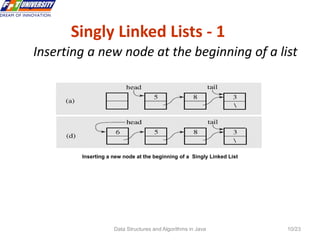
Inserting a new node at the beginning of a list
Inserting a new node at the beginning of a Singly Linked List
Data Structures and Algorithms in Java 11/23
11
Singly Linked Lists - 2
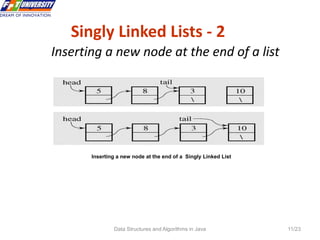
Inserting a new node at the end of a list
Inserting a new node at the end of a Singly Linked List
Data Structures and Algorithms in Java 12/23
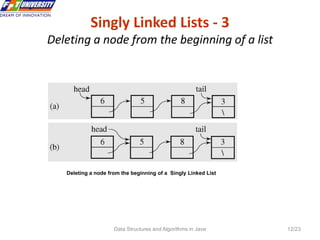
Singly Linked Lists - 3
Deleting a node from the beginning of a list
12
Deleting a node from the beginning of a Singly Linked List
Data Structures and Algorithms in Java 13/23
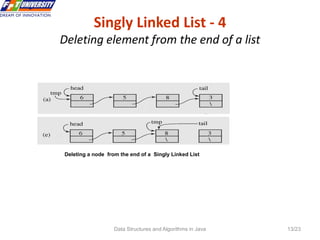
Singly Linked List - 4
Deleting element from the end of a list
13
Deleting a node from the end of a Singly Linked List
Data Structures and Algorithms in Java 14/23
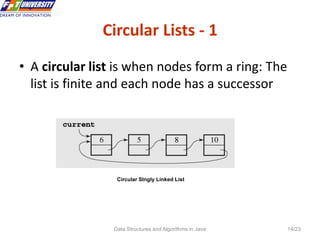
Circular Lists - 1
14
• A circular list is when nodes form a ring: The
list is finite and each node has a successor
Circular SIngly Linked List
Data Structures and Algorithms in Java 15/23
Circular Lists - 2
Inserting nodes
15
Inserting nodes at the front of a circular singly linked list (a) and at its end (b)
Data Structures and Algorithms in Java 16/23
Circular List application
16
1. Round-Robin Scheduling
One of the most important roles of an operating system is in managing the
many processes that are currently active on a computer, including the
scheduling of those processes on one or more central processing units
(CPUs). In order to support the responsiveness of an arbitrary number of
concurrent processes, most operating systems allow processes to effectively
share use of the CPUs, using some form of an algorithm known as round-robin
scheduling. A process is given a short turn to execute, known as a time slice,
but it is interrupted when the slice ends, even if its job is not yet complete.
Each active process is given its own time slice, taking turns in a cyclic order.
2. Using circular linked list to implement Round-Robin Scheduling
We can use circular linked list to implement Round-Robin Scheduling by the
following method: rotate( ): Moves the first element to the end of the list.
With this new operation, round-robin scheduling can be efficiently
implemented by repeatedly performing the following steps on a circularly
linked list C:
1. Give a time slice to process C.first( )
2. C.rotate( )
Data Structures and Algorithms in Java 17/23
Doubly Linked Lists - 1
17
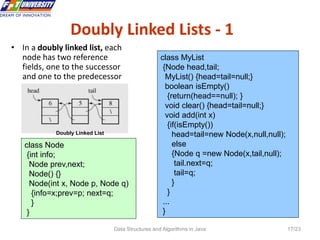
• In a doubly linked list, each
node has two reference
fields, one to the successor
and one to the predecessor
class Node
{int info;
Node prev,next;
Node() {}
Node(int x, Node p, Node q)
{info=x;prev=p; next=q;
}
}
class MyList
{Node head,tail;
MyList() {head=tail=null;}
boolean isEmpty()
{return(head==null); }
void clear() {head=tail=null;}
void add(int x)
{if(isEmpty())
head=tail=new Node(x,null,null);
else
{Node q =new Node(x,tail,null);
tail.next=q;
tail=q;
}
}
...
}
Doubly Linked List
Data Structures and Algorithms in Java 18/23
Doubly Linked Lists - 2
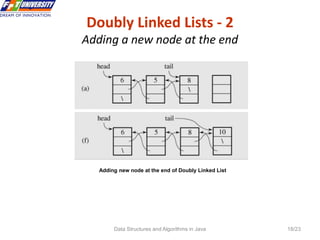
Adding a new node at the end
18
Adding new node at the end of Doubly Linked List
Data Structures and Algorithms in Java 19/23
Doubly Linked Lists -3
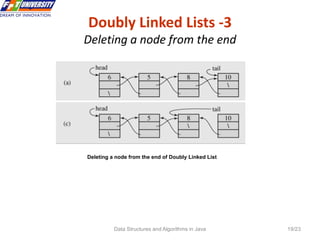
Deleting a node from the end
19
Deleting a node from the end of Doubly Linked List
Data Structures and Algorithms in Java 20/23
Lists in java.util - LinkedList class
boolean add(E o) Appends the specified element to the end of this list.
void addFirst(E o) Inserts the given element at the beginning of this list.
void addLast(E o) Appends the given element to the end of this list.
void clear() Removes all of the elements from this list.
E get(int index) Returns the element at the specified position in this list.
E getFirst() Returns the first element in this list.
E getLast() Returns the last element in this list.
E remove(int index) Removes the element at the specified position in
this list.
E removeFirst()Removes and returns the first element from this list.
E removeLast() Removes and returns the last element from this list.
int size() Returns the number of elements in this list.
Object[] toArray() Returns an array containing all of the elements in this list in the
correct order.
Data Structures and Algorithms in Java 21/23
Lists in java.util
LinkedList class example
import java.util.*;
class Node
{ String name;
int age;
Node() {}
Node(String name1, int age1)
{ name=name1; age=age1;
}
void set(String name1, int age1)
{ name=name1; age=age1;
}
public String toString()
{ String s = name+" "+age;
return(s);
}
}
class Main
{
public static void main(String [] args)
{
LinkedList t = new LinkedList();
Node x; int n,i;
x = new Node("A01",25); t.add(x);
x = new Node("A02",23); t.add(x);
x = new Node("A03",21); t.add(x);
for(i=0;i<t.size();i++)
System.out.println(t.get(i));
}
}
Data Structures and Algorithms in Java 22/23
Lists in java.util - ArrayList class
boolean add(E o) Appends the specified element to the end of this list.
void add(int index, E o) Inserts the given element at the specified pos.
void clear() Removes all of the elements from this list.
E get(int index) Returns the element at the specified position in this list.
E remove(int index) Removes the element at the specified position in this
list.
int size() Returns the number of elements in this list.
void ensureCapacity(int minCapacity) Increases the capacity of this ArrayList
instance, if necessary, to ensure that it can hold at least the number of elements
specified by the minimum capacity argument.
void trimToSize() Trims the capacity of this ArrayList instance to be the list's
current size.
Object[] toArray() Returns an array containing all of the elements in this list in the
correct order.
Data Structures and Algorithms in Java 23/23
Summary
• A list is a sequential data structure, i.e. it is a
sequence of items of a given base type.
• A list can be implemented as an array, or as a dynamic
array to avoid imposing a maximum size.
• An alternative implementation is a linked list , where
the items are stored in nodes that are linked together
with pointers.
• A singly linked list is when a node has a link to its
successor (next node) only.
• A circular list is when nodes form a ring: The list is
finite and each node has a successor.
• A doubly linked list is when a node has links to its
previous and to the next nodes.
Data Structures and Algorithms in Java 24/23
Reading at home
• 3 Fundamental Data Structures 103
• 3.1 Using Arrays - . 104
• 3.2 Singly Linked Lists - 122
• 3.3 Circularly Linked Lists - 128
• 3.4 Doubly Linked Lists - 132
Text book: Data Structures and Algorithms in Java

1 list datastructures

  • 1.
    Data Structures andAlgorithms in Java 1/23 1. List Data Structure
  • 2.
    Data Structures andAlgorithms in Java 2/23 Objectives 2 • Describe List structures • Describe self-referential structures • Explain types of linked lists • Singly Linked Lists • Circular Lists • Doubly Linked Lists • Lists in java.util
  • 3.
    Data Structures andAlgorithms in Java 3/23 List Data Structures • A list is a sequential data structure, i.e. it is a sequence of items of a given base type, where items can be added, deleted, and retrieved from any position in the list. • A list can be implemented as an array, or as a dynamic array to avoid imposing a maximum size. • An alternative implementation is a linked list, where the items are stored in nodes that are linked together with pointers. These two implementations have very different characteristics. • The possible values of this type are sequences of items of type BaseType (including the sequence of length zero). The operations of the ADT are: getFirst(), getLast(), getNext(p), getPrev(p), get(p), set(p,x), insert(p,x), remove(p),removeFirst(), removeLast(), removeNext(p), removePrev(p), find(x),size()
  • 4.
    Data Structures andAlgorithms in Java 4/23 Drawbacks of Arrays 4 • Array is a very useful data structure in many situations. However, it has some important limitations: – They require size information for creation – Inserting an element in the middle of an array leads to moving other elements around – Deleting an element from the middle of an array leads to moving other elements around • Other data structures are more efficient in such situations.
  • 5.
    Data Structures andAlgorithms in Java 5/23 Self-Referential Structures Many dynamic data structures are implemented through the use of a self- referential structure. A self-referential structure is an object, one of whose elements is a reference to another object of its own type. With this arrangement, it is possible to create ‘chains’ of data of varying forms: Self-Referential Structures
  • 6.
    11/12/2021 Data Structuresand Algorithms in Java 6/23 DataNode Employee info; DataNode next; trees Linked lists Employee String name; int age; DataNode Employee info; DataNode left; DataNode right; Self-Referential Structures Self-Referential Structures
  • 7.
    Data Structures andAlgorithms in Java 7/23 Linked Lists 7 • A linked structure is a collection of nodes storing data and links to other nodes • A linked list is a linear data structure composed of nodes, each node holding some information and a reference to another node in the list • Types of linked lists: – Singly-Linked List – Doubly-Linked List In programming, linear means that they are described by one (single) series of data … ie. Each data item has at most one predecessor and at most one successor. And, Non-linear means anything else. Linear are – Array, Linked List, Stack, Queue. Non Linear are – Tree, Graph
  • 8.
    Data Structures andAlgorithms in Java 8/23 Singly Linked Lists 8 A singly linked list is a list whose node includes two datafields: info and next. The info field is used to store information, and this is important to the user. The next field is used to link to its successor in this sequence The following image depicts a simple integer linked list. head tail Singly Linked List
  • 9.
    Data Structures andAlgorithms in Java 9/23 Singly Linked List Implementation 9 class Node {int info; Node next; Node() {} Node(int x, Node p) {info=x;next=p; } } void add(int x) { if(isEmpty()) head=tail=new Node(x,null); else {Node q =new Node(x,null); tail.next=q; tail=q; } } void traverse() {Node p=head; while(p!=null) {System.out.print(" " + p.info); p=p.next; } System.out.println(); } Node search(int x) {...} void dele(int x) {...} } class MyList {Node head,tail; MyList() {head=tail=null;} boolean isEmpty() {return(head==null); } void clear() {head=tail=null; }
  • 10.
    Data Structures andAlgorithms in Java 10/23 Singly Linked Lists - 1 10 Inserting a new node at the beginning of a list Inserting a new node at the beginning of a Singly Linked List
  • 11.
    Data Structures andAlgorithms in Java 11/23 11 Singly Linked Lists - 2 Inserting a new node at the end of a list Inserting a new node at the end of a Singly Linked List
  • 12.
    Data Structures andAlgorithms in Java 12/23 Singly Linked Lists - 3 Deleting a node from the beginning of a list 12 Deleting a node from the beginning of a Singly Linked List
  • 13.
    Data Structures andAlgorithms in Java 13/23 Singly Linked List - 4 Deleting element from the end of a list 13 Deleting a node from the end of a Singly Linked List
  • 14.
    Data Structures andAlgorithms in Java 14/23 Circular Lists - 1 14 • A circular list is when nodes form a ring: The list is finite and each node has a successor Circular SIngly Linked List
  • 15.
    Data Structures andAlgorithms in Java 15/23 Circular Lists - 2 Inserting nodes 15 Inserting nodes at the front of a circular singly linked list (a) and at its end (b)
  • 16.
    Data Structures andAlgorithms in Java 16/23 Circular List application 16 1. Round-Robin Scheduling One of the most important roles of an operating system is in managing the many processes that are currently active on a computer, including the scheduling of those processes on one or more central processing units (CPUs). In order to support the responsiveness of an arbitrary number of concurrent processes, most operating systems allow processes to effectively share use of the CPUs, using some form of an algorithm known as round-robin scheduling. A process is given a short turn to execute, known as a time slice, but it is interrupted when the slice ends, even if its job is not yet complete. Each active process is given its own time slice, taking turns in a cyclic order. 2. Using circular linked list to implement Round-Robin Scheduling We can use circular linked list to implement Round-Robin Scheduling by the following method: rotate( ): Moves the first element to the end of the list. With this new operation, round-robin scheduling can be efficiently implemented by repeatedly performing the following steps on a circularly linked list C: 1. Give a time slice to process C.first( ) 2. C.rotate( )
  • 17.
    Data Structures andAlgorithms in Java 17/23 Doubly Linked Lists - 1 17 • In a doubly linked list, each node has two reference fields, one to the successor and one to the predecessor class Node {int info; Node prev,next; Node() {} Node(int x, Node p, Node q) {info=x;prev=p; next=q; } } class MyList {Node head,tail; MyList() {head=tail=null;} boolean isEmpty() {return(head==null); } void clear() {head=tail=null;} void add(int x) {if(isEmpty()) head=tail=new Node(x,null,null); else {Node q =new Node(x,tail,null); tail.next=q; tail=q; } } ... } Doubly Linked List
  • 18.
    Data Structures andAlgorithms in Java 18/23 Doubly Linked Lists - 2 Adding a new node at the end 18 Adding new node at the end of Doubly Linked List
  • 19.
    Data Structures andAlgorithms in Java 19/23 Doubly Linked Lists -3 Deleting a node from the end 19 Deleting a node from the end of Doubly Linked List
  • 20.
    Data Structures andAlgorithms in Java 20/23 Lists in java.util - LinkedList class boolean add(E o) Appends the specified element to the end of this list. void addFirst(E o) Inserts the given element at the beginning of this list. void addLast(E o) Appends the given element to the end of this list. void clear() Removes all of the elements from this list. E get(int index) Returns the element at the specified position in this list. E getFirst() Returns the first element in this list. E getLast() Returns the last element in this list. E remove(int index) Removes the element at the specified position in this list. E removeFirst()Removes and returns the first element from this list. E removeLast() Removes and returns the last element from this list. int size() Returns the number of elements in this list. Object[] toArray() Returns an array containing all of the elements in this list in the correct order.
  • 21.
    Data Structures andAlgorithms in Java 21/23 Lists in java.util LinkedList class example import java.util.*; class Node { String name; int age; Node() {} Node(String name1, int age1) { name=name1; age=age1; } void set(String name1, int age1) { name=name1; age=age1; } public String toString() { String s = name+" "+age; return(s); } } class Main { public static void main(String [] args) { LinkedList t = new LinkedList(); Node x; int n,i; x = new Node("A01",25); t.add(x); x = new Node("A02",23); t.add(x); x = new Node("A03",21); t.add(x); for(i=0;i<t.size();i++) System.out.println(t.get(i)); } }
  • 22.
    Data Structures andAlgorithms in Java 22/23 Lists in java.util - ArrayList class boolean add(E o) Appends the specified element to the end of this list. void add(int index, E o) Inserts the given element at the specified pos. void clear() Removes all of the elements from this list. E get(int index) Returns the element at the specified position in this list. E remove(int index) Removes the element at the specified position in this list. int size() Returns the number of elements in this list. void ensureCapacity(int minCapacity) Increases the capacity of this ArrayList instance, if necessary, to ensure that it can hold at least the number of elements specified by the minimum capacity argument. void trimToSize() Trims the capacity of this ArrayList instance to be the list's current size. Object[] toArray() Returns an array containing all of the elements in this list in the correct order.
  • 23.
    Data Structures andAlgorithms in Java 23/23 Summary • A list is a sequential data structure, i.e. it is a sequence of items of a given base type. • A list can be implemented as an array, or as a dynamic array to avoid imposing a maximum size. • An alternative implementation is a linked list , where the items are stored in nodes that are linked together with pointers. • A singly linked list is when a node has a link to its successor (next node) only. • A circular list is when nodes form a ring: The list is finite and each node has a successor. • A doubly linked list is when a node has links to its previous and to the next nodes.
  • 24.
    Data Structures andAlgorithms in Java 24/23 Reading at home • 3 Fundamental Data Structures 103 • 3.1 Using Arrays - . 104 • 3.2 Singly Linked Lists - 122 • 3.3 Circularly Linked Lists - 128 • 3.4 Doubly Linked Lists - 132 Text book: Data Structures and Algorithms in Java