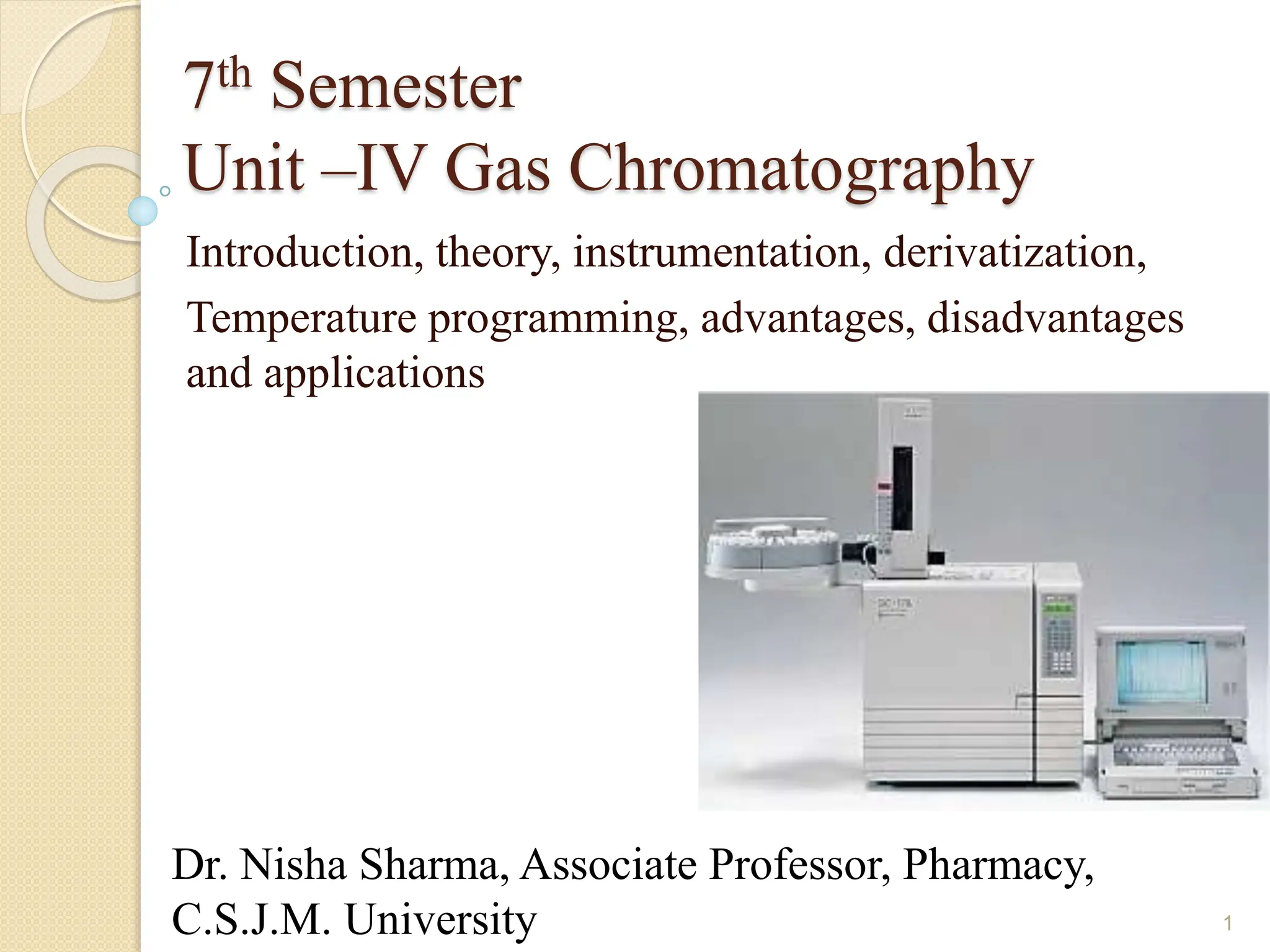
7th Semester
Unit –IV Gas Chromatography
Introduction, theory, instrumentation, derivatization,
Temperature programming, advantages, disadvantages
and applications
1
Dr. Nisha Sharma, Associate Professor, Pharmacy,
C.S.J.M. University
INTRODUCTION: GAS CHROMATOGRAPHY
 Origin of gas chromatography: 1905, W. Ramsey
 Separated mixture of gases and vapors
 Used solid adsorbent: activated charcoal.
 Gas used as mobile phase: introduced in 1952 by
James and Martin.
The technique was based on a suggestion made 11
years earlier by Martin and Synge on partition
chromatography
 Martin and Synge were presented the Nobel Prize in
chemistry in 1952.
Used to analyse volatile substances
2
 Partition takes place b/w gas & solid or gas & liq.
 Nature of stationary phase– Fixed stat. phase-solid
mat. like granular silica/alumina/C.---GSC
 Fixed phase. Non vol. liq. Held as thin layer on
solid support- (diatomacious earth or keisulguhr)--
- GLC
 GSC- limited application. Difficult to reproduce
surface areas, excessive retention of active gases
on solid surfaces which reduce available area,
tailing of elution peaks.
 GLC- Most imp. Widely used.
 Principle: liq. Partition chrom. Mobile phase in gas
liq. Chrom. is gas rather than liquid.
3
4
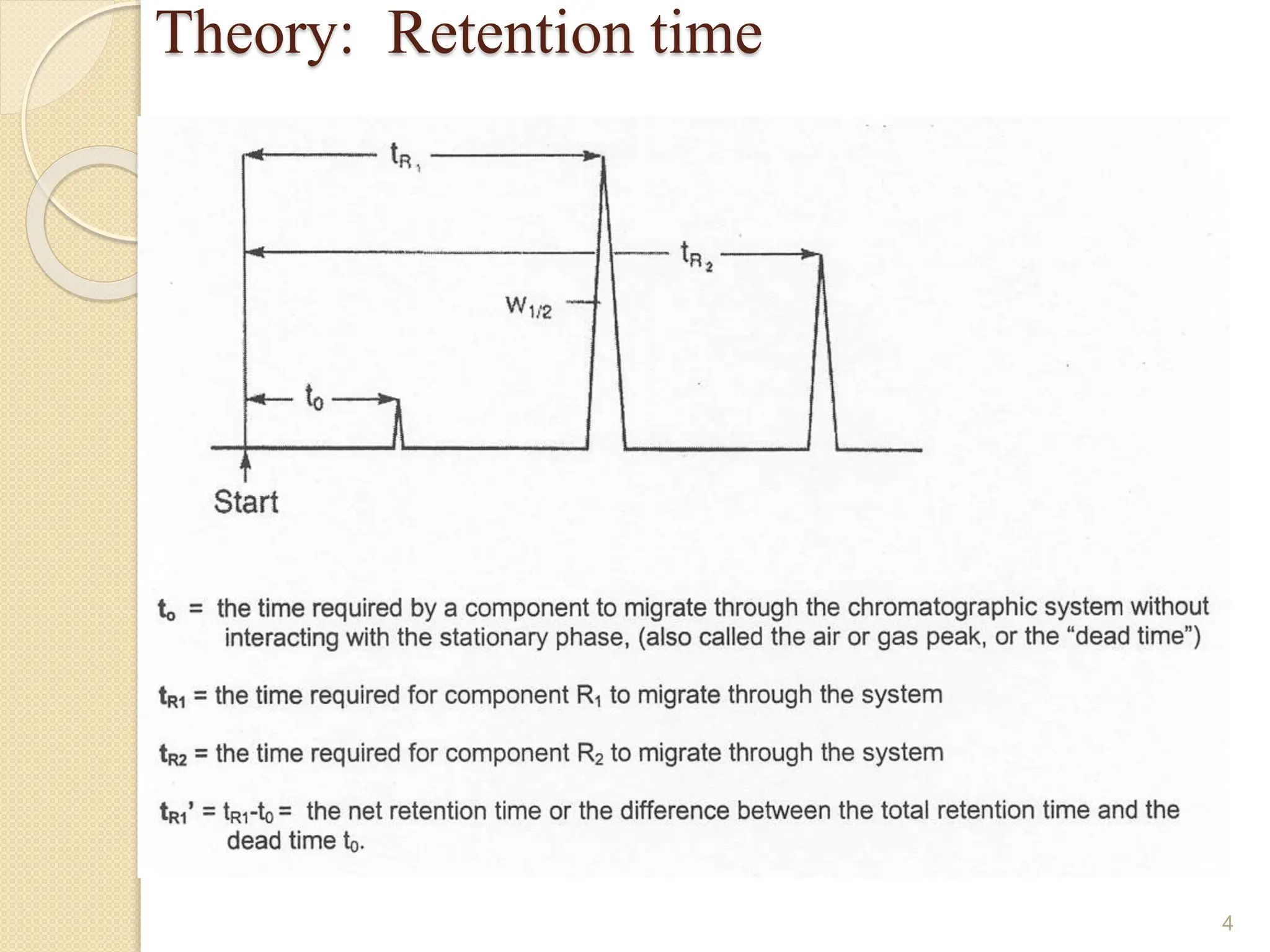
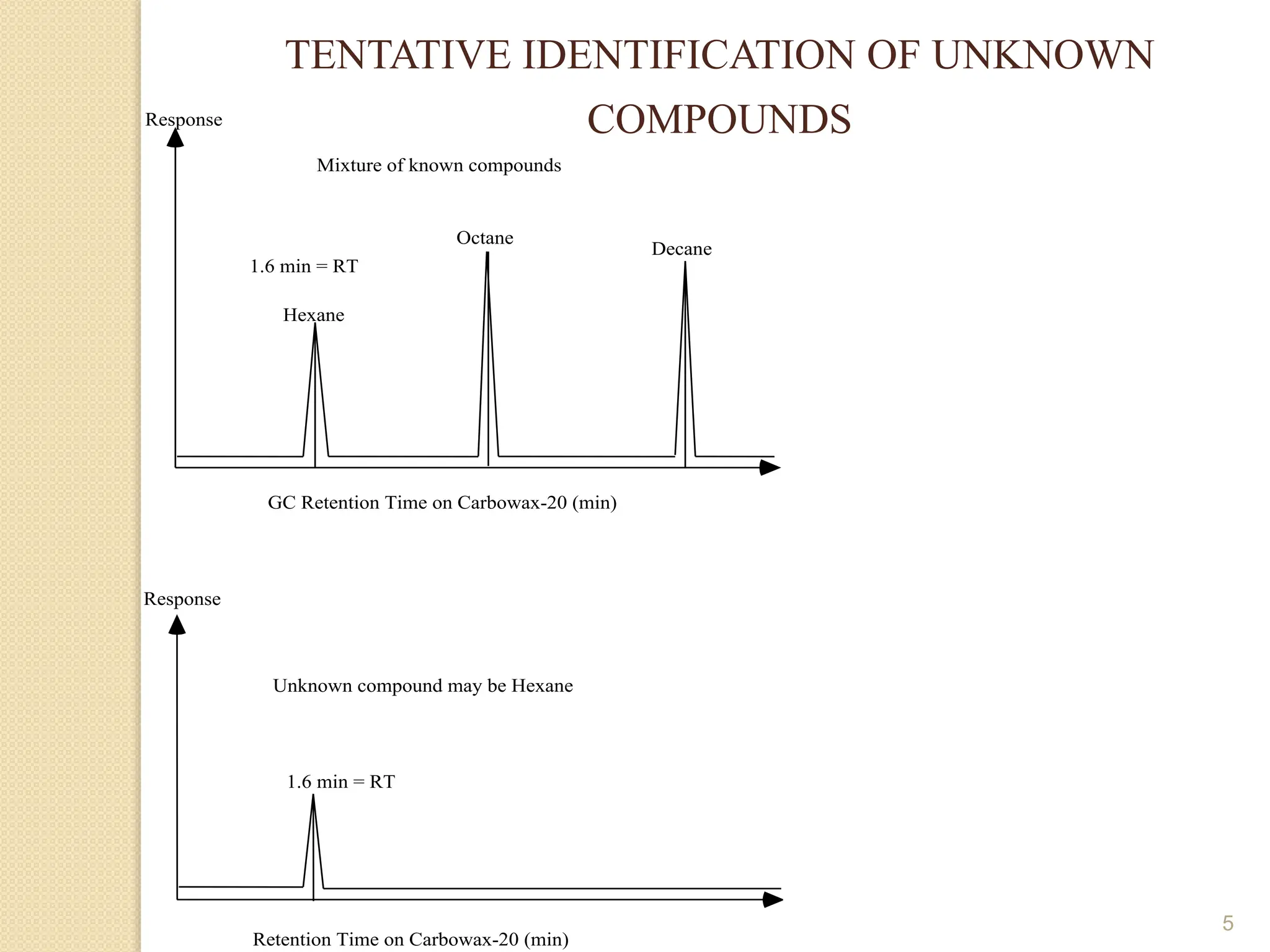
Theory: Retention time
TENTATIVE IDENTIFICATION OF UNKNOWN
COMPOUNDS
Response
GC Retention Time on Carbowax-20 (min)
Mixture of known compounds
Hexane
Octane
Decane
1.6 min = RT
Response
Unknown compound may be Hexane
1.6 min = RT
Retention Time on Carbowax-20 (min)
5
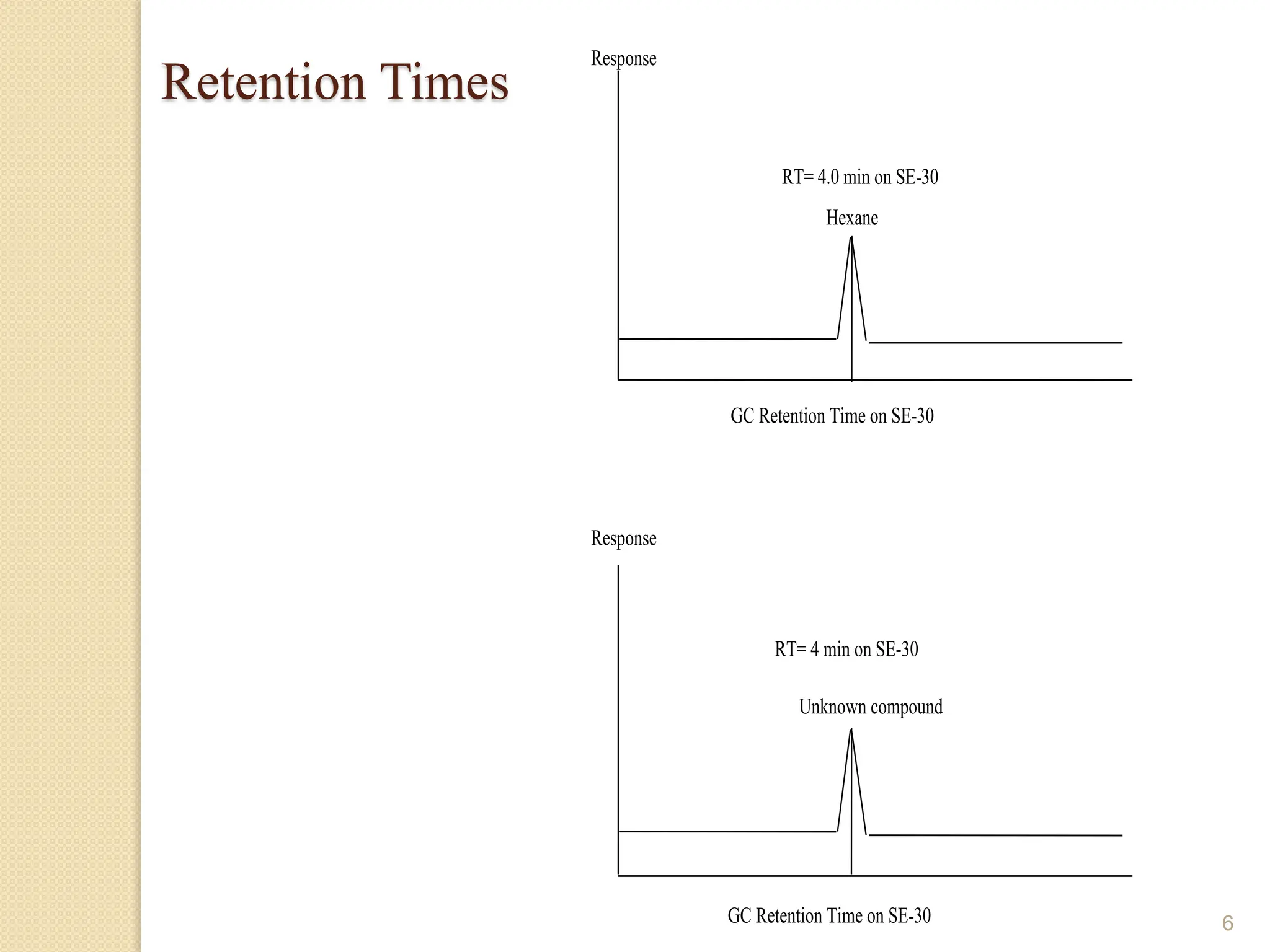
Response
GC Retention Time on SE-30
Unknown compound
RT= 4 min on SE-30
Response
GC Retention Time on SE-30
Hexane
RT= 4.0 min on SE-30
6
Retention Times
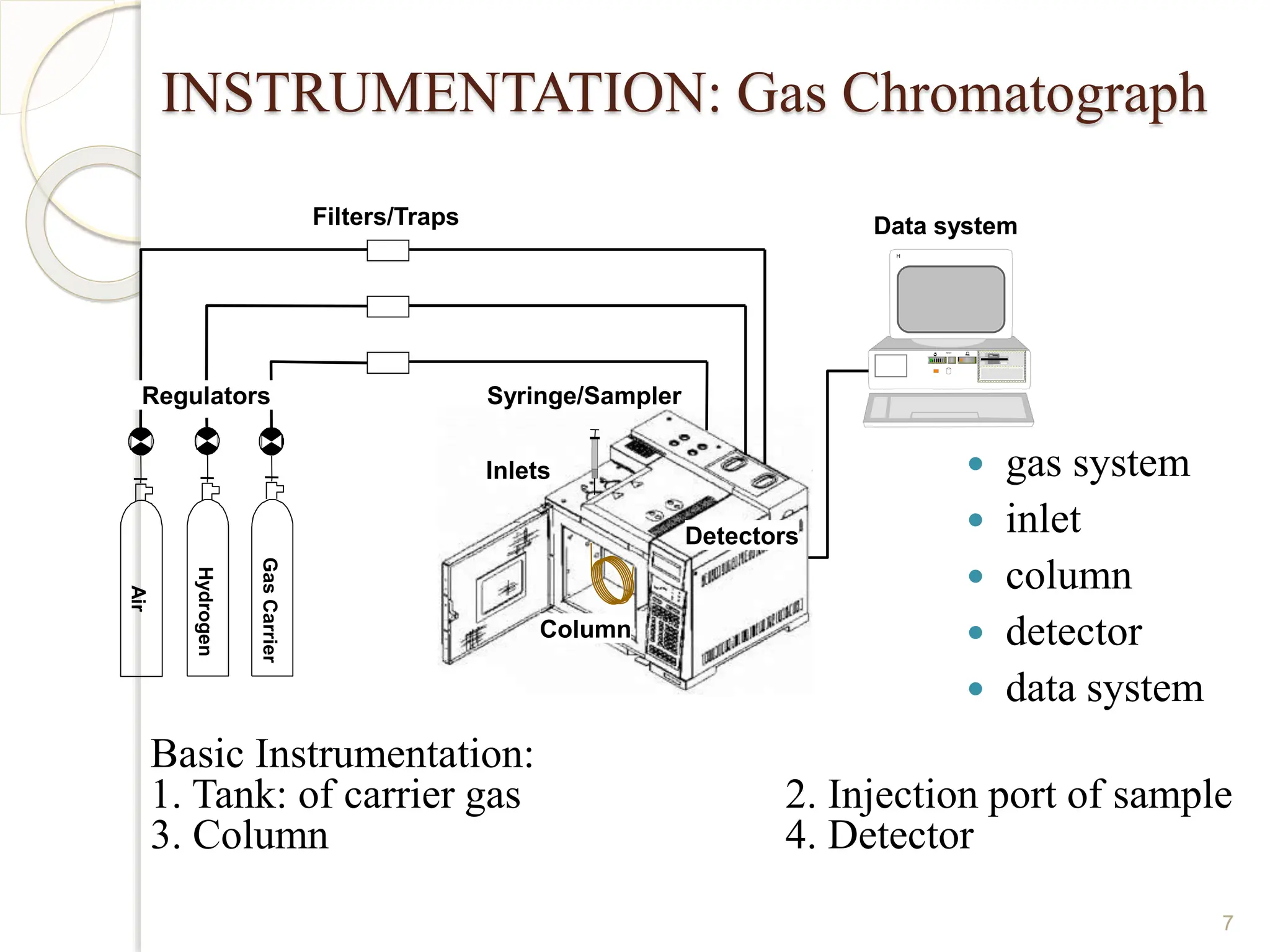
Filters/Traps
Air
Hydrogen
Gas
Carrier
Column
INSTRUMENTATION: Gas Chromatograph
 gas system
 inlet
 column
 detector
 data system
7
Data system
Syringe/Sampler
Inlets
Detectors
Regulators
H
RESET
Basic Instrumentation:
1. Tank: of carrier gas 2. Injection port of sample
3. Column 4. Detector
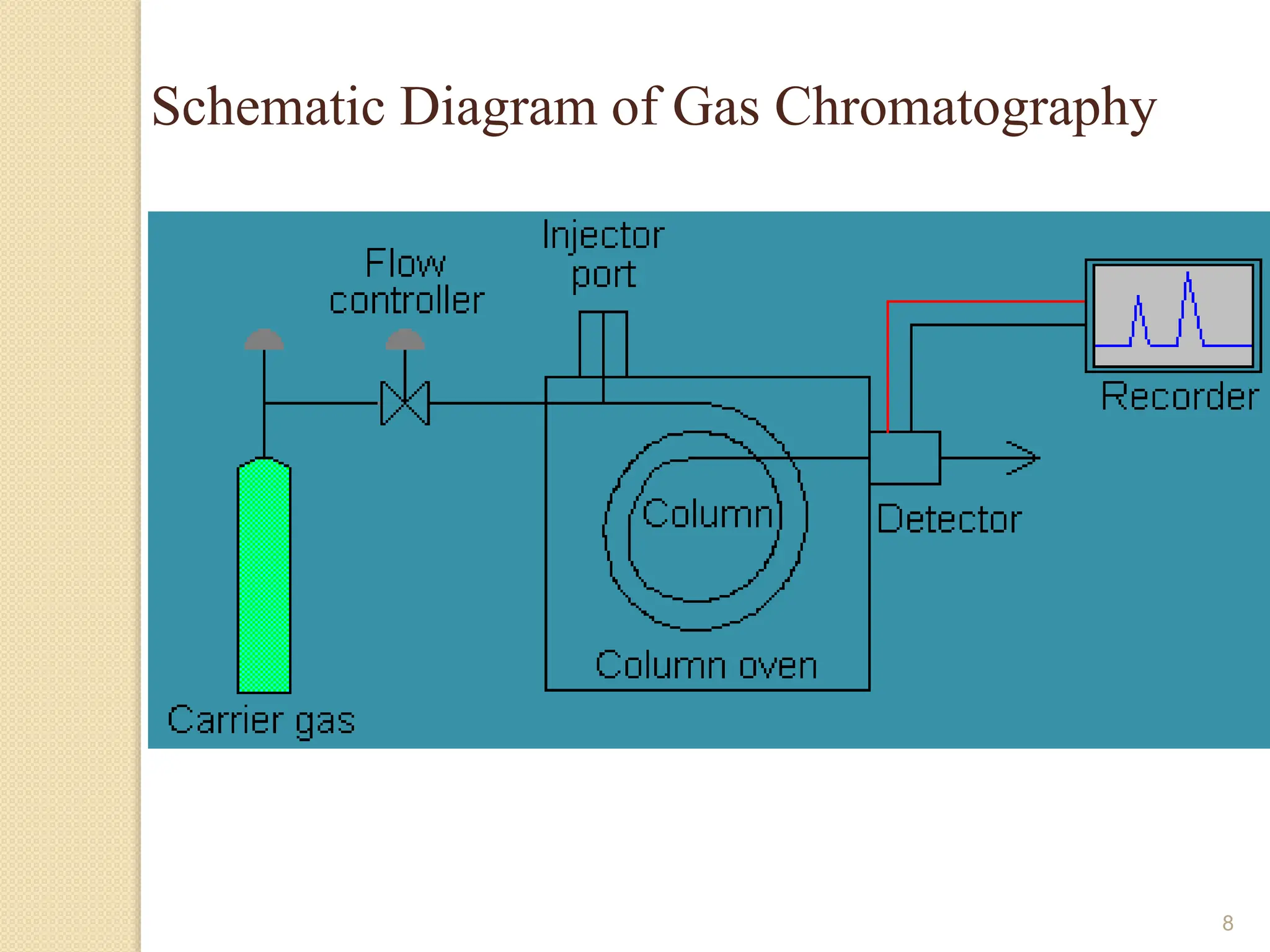
Schematic Diagram of Gas Chromatography
8
Carrier gas:
 He, H, N, Choice of gas-type of detector.
 Additional regulating valves-for good control of pressure in
inlet of column.
 Gas- inert, available at low cost, should be suitable for
detector & type of sample analysed, available in high purity,
should not cause risk of fire or explosion hazard.
 H- dangerous to use, better T.C., Low density, but may react
with unsaturated compds & create a fire or explosive
hazard.
 He- 2nd best but explosive, gen used, good T.C. Inert, Low
density, great flow rates.
 N- inexpensive but low sensitivity
 Air- used only when O in air is useful to the detector or
separation.
 Ex. H or He gives highest sensitivity with TCD because of
difference in TC between organic mol. & H/He is greater
than other gases 9
Gas cylinder
 High pressure gas cylinder (gas in compressed) –
carrier gas reservoir.
 Pressure regulator- To ↓ & control gas flow.
 Soap bubble meter- To reproduce the rate of carrier
gas.
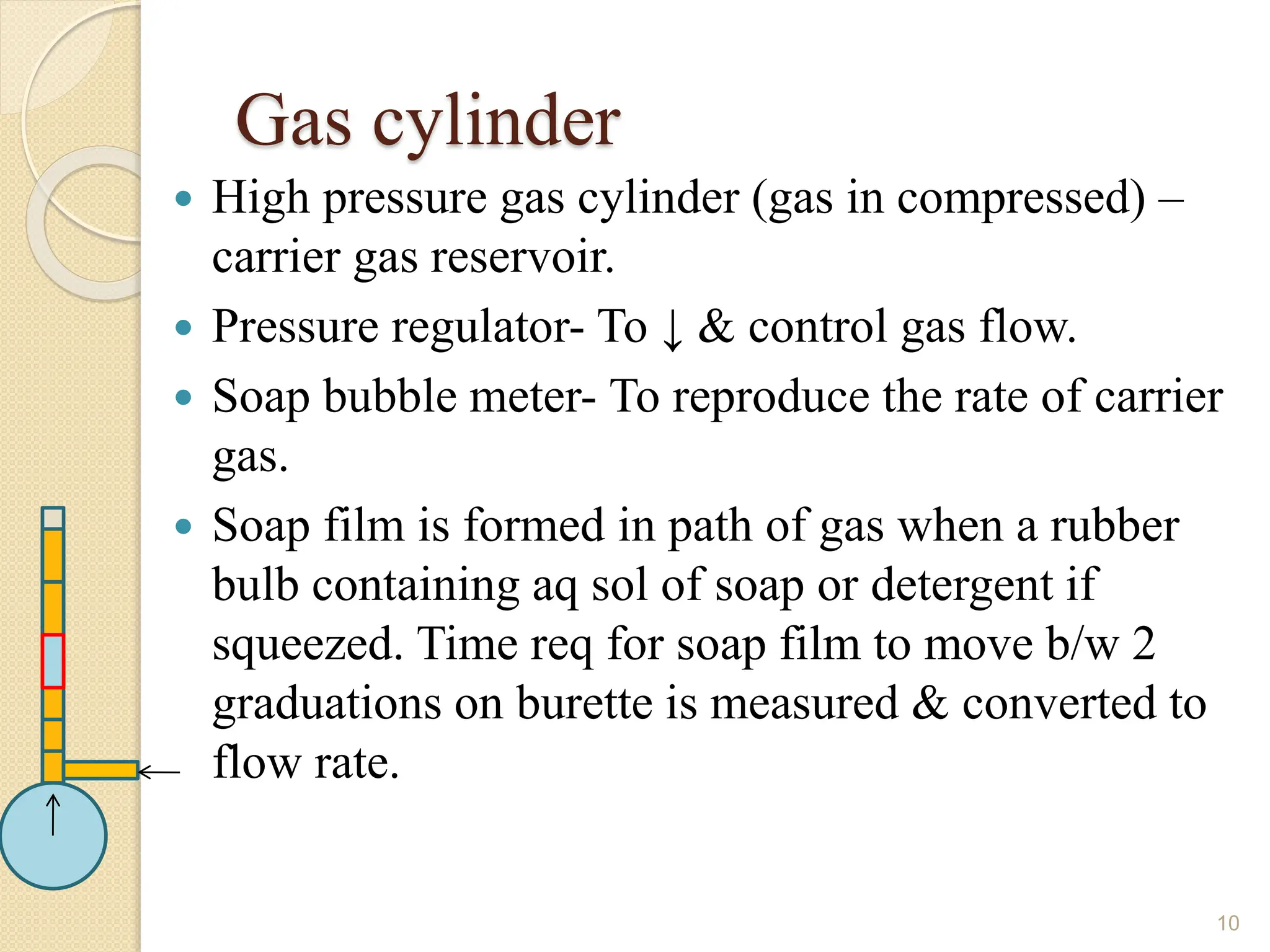
 Soap film is formed in path of gas when a rubber
bulb containing aq sol of soap or detergent if
squeezed. Time req for soap film to move b/w 2
graduations on burette is measured & converted to
flow rate.
10
Sample Introduction
 Column inlet-sample port injector. Solute-chrom-Vapor
state. Inj port is heated to temp-rapid vaporization, but no
thermal degradation of solute
 Construction of port- Heavy mass, maint at ↑Temp.
Sample should be intro immediately into column.
 Liq/gas sample- inj by syringe-0.1-100µL. Rapid inj. into
gas stream.
 Liq- injected- near- as solutions with syringe-0.5-10 µL.
 Solid- dissolved in suitable solvent-injected as solution.
 Injection of samples which can’t be vaporised at operating
temp. are avoided. B’cos compds not move appreciably in
liq or solid form may clog the port & damage the column.
11
12
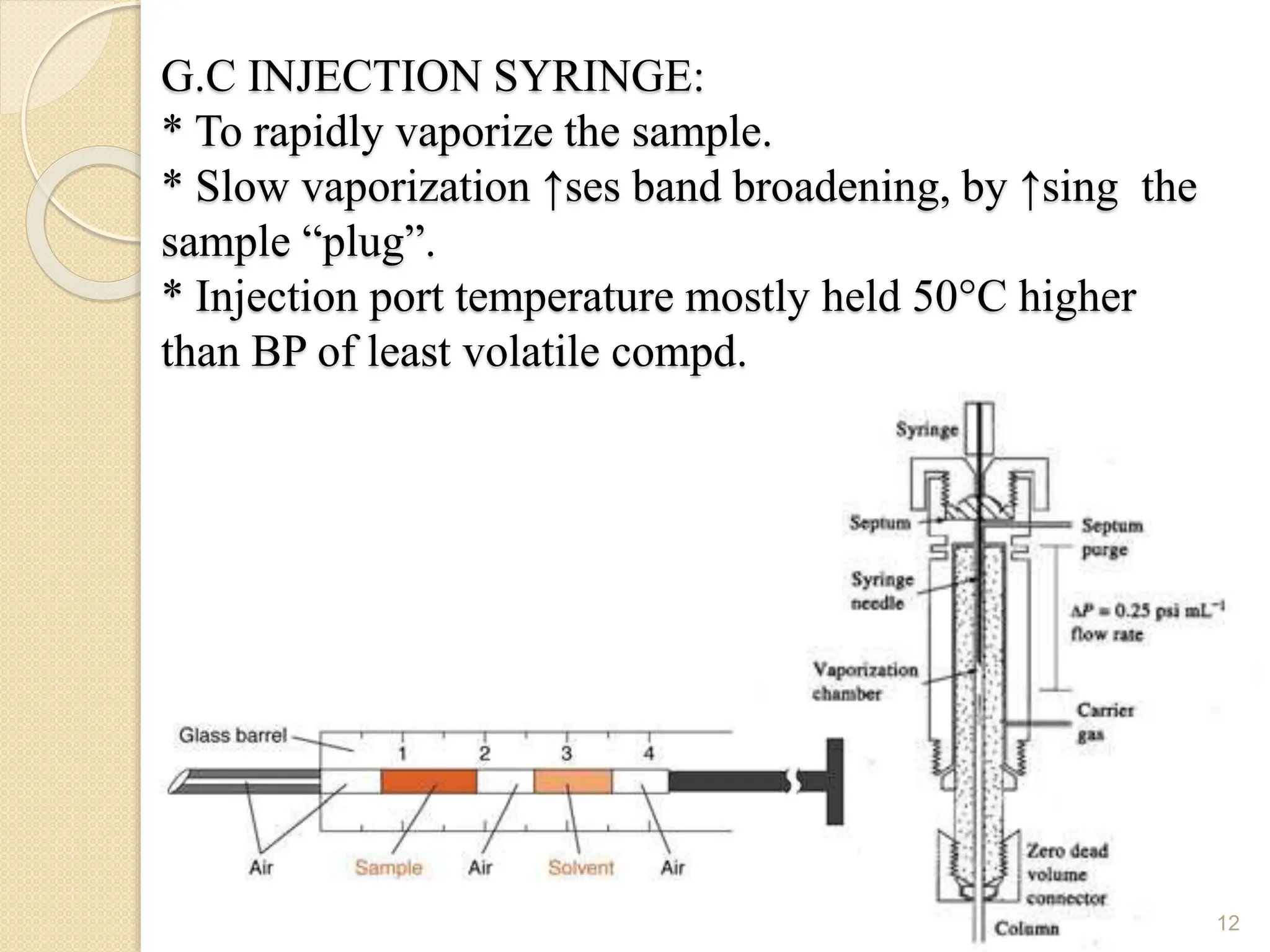
G.C INJECTION SYRINGE:
* To rapidly vaporize the sample.
* Slow vaporization ↑ses band broadening, by ↑sing the
sample “plug”.
* Injection port temperature mostly held 50°C higher
than BP of least volatile compd.

1-Lecture-on-GC-IntroPrinciple-Instrumentation.pptx

  • 1.
    7th Semester Unit –IVGas Chromatography Introduction, theory, instrumentation, derivatization, Temperature programming, advantages, disadvantages and applications 1 Dr. Nisha Sharma, Associate Professor, Pharmacy, C.S.J.M. University
  • 2.
    INTRODUCTION: GAS CHROMATOGRAPHY Origin of gas chromatography: 1905, W. Ramsey  Separated mixture of gases and vapors  Used solid adsorbent: activated charcoal.  Gas used as mobile phase: introduced in 1952 by James and Martin. The technique was based on a suggestion made 11 years earlier by Martin and Synge on partition chromatography  Martin and Synge were presented the Nobel Prize in chemistry in 1952. Used to analyse volatile substances 2
  • 3.
     Partition takesplace b/w gas & solid or gas & liq.  Nature of stationary phase– Fixed stat. phase-solid mat. like granular silica/alumina/C.---GSC  Fixed phase. Non vol. liq. Held as thin layer on solid support- (diatomacious earth or keisulguhr)-- - GLC  GSC- limited application. Difficult to reproduce surface areas, excessive retention of active gases on solid surfaces which reduce available area, tailing of elution peaks.  GLC- Most imp. Widely used.  Principle: liq. Partition chrom. Mobile phase in gas liq. Chrom. is gas rather than liquid. 3
  • 4.
  • 5.
    TENTATIVE IDENTIFICATION OFUNKNOWN COMPOUNDS Response GC Retention Time on Carbowax-20 (min) Mixture of known compounds Hexane Octane Decane 1.6 min = RT Response Unknown compound may be Hexane 1.6 min = RT Retention Time on Carbowax-20 (min) 5
  • 6.
    Response GC Retention Timeon SE-30 Unknown compound RT= 4 min on SE-30 Response GC Retention Time on SE-30 Hexane RT= 4.0 min on SE-30 6 Retention Times
  • 7.
    Filters/Traps Air Hydrogen Gas Carrier Column INSTRUMENTATION: Gas Chromatograph gas system  inlet  column  detector  data system 7 Data system Syringe/Sampler Inlets Detectors Regulators H RESET Basic Instrumentation: 1. Tank: of carrier gas 2. Injection port of sample 3. Column 4. Detector
  • 8.
    Schematic Diagram ofGas Chromatography 8
  • 9.
    Carrier gas:  He,H, N, Choice of gas-type of detector.  Additional regulating valves-for good control of pressure in inlet of column.  Gas- inert, available at low cost, should be suitable for detector & type of sample analysed, available in high purity, should not cause risk of fire or explosion hazard.  H- dangerous to use, better T.C., Low density, but may react with unsaturated compds & create a fire or explosive hazard.  He- 2nd best but explosive, gen used, good T.C. Inert, Low density, great flow rates.  N- inexpensive but low sensitivity  Air- used only when O in air is useful to the detector or separation.  Ex. H or He gives highest sensitivity with TCD because of difference in TC between organic mol. & H/He is greater than other gases 9
  • 10.
    Gas cylinder  Highpressure gas cylinder (gas in compressed) – carrier gas reservoir.  Pressure regulator- To ↓ & control gas flow.  Soap bubble meter- To reproduce the rate of carrier gas.  Soap film is formed in path of gas when a rubber bulb containing aq sol of soap or detergent if squeezed. Time req for soap film to move b/w 2 graduations on burette is measured & converted to flow rate. 10
  • 11.
    Sample Introduction  Columninlet-sample port injector. Solute-chrom-Vapor state. Inj port is heated to temp-rapid vaporization, but no thermal degradation of solute  Construction of port- Heavy mass, maint at ↑Temp. Sample should be intro immediately into column.  Liq/gas sample- inj by syringe-0.1-100µL. Rapid inj. into gas stream.  Liq- injected- near- as solutions with syringe-0.5-10 µL.  Solid- dissolved in suitable solvent-injected as solution.  Injection of samples which can’t be vaporised at operating temp. are avoided. B’cos compds not move appreciably in liq or solid form may clog the port & damage the column. 11
  • 12.
    12 G.C INJECTION SYRINGE: *To rapidly vaporize the sample. * Slow vaporization ↑ses band broadening, by ↑sing the sample “plug”. * Injection port temperature mostly held 50°C higher than BP of least volatile compd.