THANKSGIVING DAY
HISTOR
ANDREA MARQUEZ
CRISTINA DE JUAN
DANIEL GURUCIUC
ALVARO PASCUAL
HISTORY
l It is a traditional celebration in the United States and Canada.
In the United States it is celebrated on the fourth Thursday of
November. In Canada, meanwhile, it is celebrated on the
second Monday of October. Usually in this festival they gather
around a family and friends to share a banquet table.
Although it is religious in origin, it is considered a secular
holiday.
HISTORY
• On Thanksgiving in North America has its origins in a mixture
of European and South American traditions .In Europe,
festivals were held before and after harvest cycles to give
thanks for a good harvest, and celebrate after Hard work
along with the rest of the community. Native Americans also
celebrated the end of the harvest .When Europeans arrived in
what would become America for the first time, they brought
their own traditions.
HISTORY
• On Thanksgiving Day (Thanksgiving Day) is like the day that
marks the kick off Christmas in USA. In fact, the big shopping
day is just a day known as Black Friday, where large chains pull
the house out the window and put a sale madness unleashed
among Americans.
• President Roosevelt who proposed in 1941 that the
Thanksgiving Day every fourth Thursday of November to be
held, although the party is dated 19 February 1975. This is the
most important family celebration in the US and serves for
families whole, gathered around a large roasted turkey, give
thanks for all they have in life, being with family, having a
home and food ...
IN CANADA
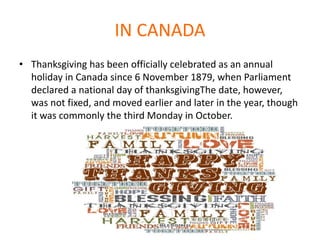
• Thanksgiving has been officially celebrated as an annual
holiday in Canada since 6 November 1879, when Parliament
declared a national day of thanksgivingThe date, however,
was not fixed, and moved earlier and later in the year, though
it was commonly the third Monday in October.
IN CANADA
• For many years before it was declared a national holiday in
1879, Thanksgiving was celebrated in either late October or
early November. From 1879 onward, Thanksgiving Day has
been observed every year, the date initially being a Thursday
in November. The date of celebration changed several times
until, in 1957, it was officially declared to be the second
Monday in October.The theme of the Thanksgiving holiday
also changed each year to reflect an important event to be
thankful for. In its early years it was for an abundant harvest
and occasionally for a special anniversary.
IN CANADA
• After the Seven Years' War ended in 1763, with New France
handed over to the British, the citizens of Halifax held a
special day of Thanksgiving. Thanksgiving days were observed
beginning in 1799 but did not occur every year.
• During and after the American Revolution, American refugees
who remained loyal to Great Britain moved from the newly
independent United States to Canada. They brought the
customs and practices of the American Thanksgiving to
Canada, such as the turkey, pumpkin, and squash.
IN CANADA
• For many years before it was declared a national holiday in
1879, Thanksgiving was celebrated in either late October or
early November. From 1879 onward, Thanksgiving Day has
been observed every year, the date initially being a Thursday
in November. The date of celebration changed several times
until, in 1957, it was officially declared to be the second
Monday in October.The theme of the Thanksgiving holiday
also changed each year to reflect an important event to be
thankful for. In its early years it was for an abundant harvest
and occasionally for a special anniversary.
IN CANADA
• It is a traditional celebration in the United States and Canada. In the
United States it is celebrated on the fourth Thursday of November.
In Canada, meanwhile, it is celebrated on the second Monday of
October. Usually in this festival they gather around a family and
friends to share a banquet table. Although it is religious in origin, it
is considered a secular holiday.
• On Thanksgiving in North America has its origins in a mixture of
European and South American traditions .In Europe, festivals were
held before and after harvest cycles to give thanks for a good
harvest, and celebrate after Hard work along with the rest of the
community. Native Americans also celebrated the end of the
harvest .When Europeans arrived in what would become America
for the first time, they brought their own traditions.
IN USA
• Thanksgiving Day in the United States is a holiday on the
fourth Thursday of November. It precedes Black Friday.
• Thanksgiving Day is a federal holiday in the United States.
• Thanksgiving Day is traditionally a day for families and friends
to get together for a special meal. The meal often includes a
turkey, stuffing, potatoes, cranberry sauce, gravy, pumpkin
pie, and vegetables. Thanksgiving Day is a time for many
people to give thanks for what they have.
IN USA
• Thanksgiving Day parades are held in some cities and towns
on or around Thanksgiving Day. Some parades or festivities
also mark the opening of the Christmas shopping season.
Some people have a four-day weekend so it is a popular time
for trips and to visit family and friends.
• Most government offices, businesses, schools and other
organizations are closed on Thanksgiving Day. Many offices
and businesses allow staff to have a four-day weekend so
these offices and businesses are also closed on the Friday
after Thanksgiving Day. Public transit systems do not usually
operate on their regular timetables.
IN USA
• Thanksgiving Day it is one of the busiest periods for travel in
the USA. This can cause congestion and overcrowding.
Seasonal parades and busy football games can cause
disruption to local traffic.
• Thanksgiving Day has been an annual holiday in the United
States since 1863. Not everyone sees Thanksgiving Day as a
cause for celebration. Each year since 1970, a group of Native
Americans and their supporters have staged a protest for a
National Day of Mourning at Plymouth Rock in Plymouth,
Massachusetts on Thanksgiving Day. American Indian Heritage
Day is also observed at this time of the year.
IN USA
• There are claims that the first Thanksgiving Day was
held in the city of El Paso, Texas in 1598. Another early
event was held in 1619 in the Virginia Colony. Many
people trace the origins of the modern Thanksgiving Day
to the harvest celebration that the Pilgrims held in
Plymouth, Massachusetts in 1621. However, their first
true thanksgiving was in 1623, when they gave thanks
for rain that ended a drought. These early thanksgivings
took the form of a special church service, rather than a
feast.
1 history

1 history

  • 1.
    THANKSGIVING DAY HISTOR ANDREA MARQUEZ CRISTINADE JUAN DANIEL GURUCIUC ALVARO PASCUAL
  • 2.
    HISTORY l It isa traditional celebration in the United States and Canada. In the United States it is celebrated on the fourth Thursday of November. In Canada, meanwhile, it is celebrated on the second Monday of October. Usually in this festival they gather around a family and friends to share a banquet table. Although it is religious in origin, it is considered a secular holiday.
  • 3.
    HISTORY • On Thanksgivingin North America has its origins in a mixture of European and South American traditions .In Europe, festivals were held before and after harvest cycles to give thanks for a good harvest, and celebrate after Hard work along with the rest of the community. Native Americans also celebrated the end of the harvest .When Europeans arrived in what would become America for the first time, they brought their own traditions.
  • 4.
    HISTORY • On ThanksgivingDay (Thanksgiving Day) is like the day that marks the kick off Christmas in USA. In fact, the big shopping day is just a day known as Black Friday, where large chains pull the house out the window and put a sale madness unleashed among Americans. • President Roosevelt who proposed in 1941 that the Thanksgiving Day every fourth Thursday of November to be held, although the party is dated 19 February 1975. This is the most important family celebration in the US and serves for families whole, gathered around a large roasted turkey, give thanks for all they have in life, being with family, having a home and food ...
  • 5.
    IN CANADA • Thanksgivinghas been officially celebrated as an annual holiday in Canada since 6 November 1879, when Parliament declared a national day of thanksgivingThe date, however, was not fixed, and moved earlier and later in the year, though it was commonly the third Monday in October.
  • 6.
    IN CANADA • Formany years before it was declared a national holiday in 1879, Thanksgiving was celebrated in either late October or early November. From 1879 onward, Thanksgiving Day has been observed every year, the date initially being a Thursday in November. The date of celebration changed several times until, in 1957, it was officially declared to be the second Monday in October.The theme of the Thanksgiving holiday also changed each year to reflect an important event to be thankful for. In its early years it was for an abundant harvest and occasionally for a special anniversary.
  • 7.
    IN CANADA • Afterthe Seven Years' War ended in 1763, with New France handed over to the British, the citizens of Halifax held a special day of Thanksgiving. Thanksgiving days were observed beginning in 1799 but did not occur every year. • During and after the American Revolution, American refugees who remained loyal to Great Britain moved from the newly independent United States to Canada. They brought the customs and practices of the American Thanksgiving to Canada, such as the turkey, pumpkin, and squash.
  • 8.
    IN CANADA • Formany years before it was declared a national holiday in 1879, Thanksgiving was celebrated in either late October or early November. From 1879 onward, Thanksgiving Day has been observed every year, the date initially being a Thursday in November. The date of celebration changed several times until, in 1957, it was officially declared to be the second Monday in October.The theme of the Thanksgiving holiday also changed each year to reflect an important event to be thankful for. In its early years it was for an abundant harvest and occasionally for a special anniversary.
  • 9.
    IN CANADA • Itis a traditional celebration in the United States and Canada. In the United States it is celebrated on the fourth Thursday of November. In Canada, meanwhile, it is celebrated on the second Monday of October. Usually in this festival they gather around a family and friends to share a banquet table. Although it is religious in origin, it is considered a secular holiday. • On Thanksgiving in North America has its origins in a mixture of European and South American traditions .In Europe, festivals were held before and after harvest cycles to give thanks for a good harvest, and celebrate after Hard work along with the rest of the community. Native Americans also celebrated the end of the harvest .When Europeans arrived in what would become America for the first time, they brought their own traditions.
  • 10.
    IN USA • ThanksgivingDay in the United States is a holiday on the fourth Thursday of November. It precedes Black Friday. • Thanksgiving Day is a federal holiday in the United States. • Thanksgiving Day is traditionally a day for families and friends to get together for a special meal. The meal often includes a turkey, stuffing, potatoes, cranberry sauce, gravy, pumpkin pie, and vegetables. Thanksgiving Day is a time for many people to give thanks for what they have.
  • 11.
    IN USA • ThanksgivingDay parades are held in some cities and towns on or around Thanksgiving Day. Some parades or festivities also mark the opening of the Christmas shopping season. Some people have a four-day weekend so it is a popular time for trips and to visit family and friends. • Most government offices, businesses, schools and other organizations are closed on Thanksgiving Day. Many offices and businesses allow staff to have a four-day weekend so these offices and businesses are also closed on the Friday after Thanksgiving Day. Public transit systems do not usually operate on their regular timetables.
  • 12.
    IN USA • ThanksgivingDay it is one of the busiest periods for travel in the USA. This can cause congestion and overcrowding. Seasonal parades and busy football games can cause disruption to local traffic. • Thanksgiving Day has been an annual holiday in the United States since 1863. Not everyone sees Thanksgiving Day as a cause for celebration. Each year since 1970, a group of Native Americans and their supporters have staged a protest for a National Day of Mourning at Plymouth Rock in Plymouth, Massachusetts on Thanksgiving Day. American Indian Heritage Day is also observed at this time of the year.
  • 13.
    IN USA • Thereare claims that the first Thanksgiving Day was held in the city of El Paso, Texas in 1598. Another early event was held in 1619 in the Virginia Colony. Many people trace the origins of the modern Thanksgiving Day to the harvest celebration that the Pilgrims held in Plymouth, Massachusetts in 1621. However, their first true thanksgiving was in 1623, when they gave thanks for rain that ended a drought. These early thanksgivings took the form of a special church service, rather than a feast.