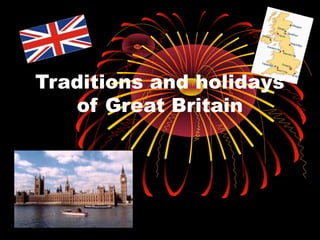
Traditions and holidays
of Great Britain
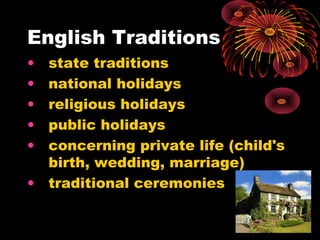
English Traditions
• state traditions
• national holidays
• religious holidays
• public holidays
• concerning private life (child's
birth, wedding, marriage)
• traditional ceremonies
Holidays
New Year
• The most common type of
celebration is a New Year party
New Year
• Every year the people of Norway
give the city of London a present –
a big Christmas tree
• Some people make New Year
Resolutions:
 I'll get up early every morning next year.
 I'll clean, my shoes every day.
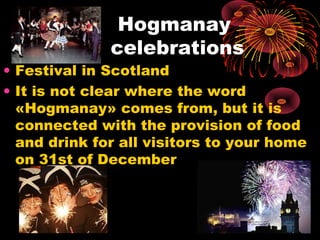
Hogmanay
celebrations
• Festival in Scotland
• It is not clear where the word
«Hogmanay» comes from, but it is
connected with the provision of food
and drink for all visitors to your home
on 31st of December
First Footing
The first visitor who comes into a
house in the New Year morning
is called the First Foot
ST. VALENTINE’S DAY –
FEBRUARY 14
On this day, people send Valentine
cards to their husbands, wives,
girlfriends and boyfriends. You can
also send a card to a person you do
not know.
PANCAKE DAY
It takes place in spring and
people not only eat
pancakes everywhere but
run with them.
ST. DAVID’S DAY
On the 1st of March each
year one can see people
walking around London with
leeks pinned to their coats.
А leek is the national
emblem of Wales.
A leek
MOTHERS’ DAY
People visit their mothers if
possible and give them flowers
and small presents. If they
cannot go they send a “Mothers’
Day card”.
ST. PARTRICK`S DAY
• It is not a national holiday.
• It’s an Irish religious holiday.
• St. Patrick is the patron of
Ireland.
• Irish and Irish Americans
celebrate the day.
EASTER
• Many modern Easter symbols
come from ancient time.
• The egg was a symbol long
before the Christian era.
• The Easter bunny is also
originated in pre-Christian time.
APRIL FOOLS’ DAY
• This is a very old
tradition from the Middle
Ages. At that time the
servants were masters
for one day of the year.
• Now April Fool’s Day is
different. It is a day for
jokes and tricks.
MAY DAY IN GREAT
BRITAIN
• May 1st is not a public holiday
in Great Britain
• On May Sunday workers march
through the streets and hold
meetings.
TROOPING OF ТНE
COLOUR
On the Queen’s
official birthday,
there is a
traditional
ceremony called
the Trooping of the
Colour. It is a big
parade with brass
bands and
hundreds of
soldiers at Horse
Guard’s Parade in
London.
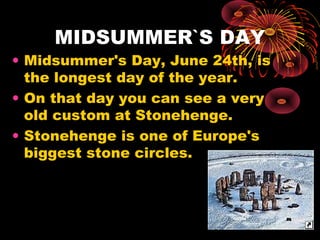
MIDSUMMER`S DAY
• Midsummer's Day, June 24th, is
the longest day of the year.
• On that day you can see a very
old custom at Stonehenge.
• Stonehenge is one of Europe's
biggest stone circles.
HALLOWEEN
• On October 31st British
people celebrate
Halloween. It is the most
colourful and exciting
holiday of the year.
• Halloween is a time for
fun.
National costumes of
England
National costumes of
Scotland
National costumes of
Wales
National costumes of
Ireland

Traditions

  • 1.
  • 2.
    English Traditions • statetraditions • national holidays • religious holidays • public holidays • concerning private life (child's birth, wedding, marriage) • traditional ceremonies
  • 3.
    Holidays New Year • Themost common type of celebration is a New Year party
  • 4.
    New Year • Everyyear the people of Norway give the city of London a present – a big Christmas tree • Some people make New Year Resolutions:  I'll get up early every morning next year.  I'll clean, my shoes every day.
  • 5.
    Hogmanay celebrations • Festival inScotland • It is not clear where the word «Hogmanay» comes from, but it is connected with the provision of food and drink for all visitors to your home on 31st of December
  • 6.
    First Footing The firstvisitor who comes into a house in the New Year morning is called the First Foot
  • 7.
    ST. VALENTINE’S DAY– FEBRUARY 14 On this day, people send Valentine cards to their husbands, wives, girlfriends and boyfriends. You can also send a card to a person you do not know.
  • 8.
    PANCAKE DAY It takesplace in spring and people not only eat pancakes everywhere but run with them.
  • 9.
    ST. DAVID’S DAY Onthe 1st of March each year one can see people walking around London with leeks pinned to their coats. А leek is the national emblem of Wales. A leek
  • 10.
    MOTHERS’ DAY People visittheir mothers if possible and give them flowers and small presents. If they cannot go they send a “Mothers’ Day card”.
  • 11.
    ST. PARTRICK`S DAY •It is not a national holiday. • It’s an Irish religious holiday. • St. Patrick is the patron of Ireland. • Irish and Irish Americans celebrate the day.
  • 12.
    EASTER • Many modernEaster symbols come from ancient time. • The egg was a symbol long before the Christian era. • The Easter bunny is also originated in pre-Christian time.
  • 13.
    APRIL FOOLS’ DAY •This is a very old tradition from the Middle Ages. At that time the servants were masters for one day of the year. • Now April Fool’s Day is different. It is a day for jokes and tricks.
  • 14.
    MAY DAY INGREAT BRITAIN • May 1st is not a public holiday in Great Britain • On May Sunday workers march through the streets and hold meetings.
  • 15.
    TROOPING OF ТНE COLOUR Onthe Queen’s official birthday, there is a traditional ceremony called the Trooping of the Colour. It is a big parade with brass bands and hundreds of soldiers at Horse Guard’s Parade in London.
  • 16.
    MIDSUMMER`S DAY • Midsummer'sDay, June 24th, is the longest day of the year. • On that day you can see a very old custom at Stonehenge. • Stonehenge is one of Europe's biggest stone circles.
  • 17.
    HALLOWEEN • On October31st British people celebrate Halloween. It is the most colourful and exciting holiday of the year. • Halloween is a time for fun.
  • 18.
  • 19.
  • 20.
  • 21.