4
The myth of ‘win-
win’ negotiations in
purchasing
: : Artin Vaqari
20
Tell us what works
best for your company
: : Omar Khan
37
Financing the future of
procurement
: : Jon Hansen
50
Head in the cloud
: : Sean Kolenko
8
‘Business staying in
business’ is a responsibility
of the procurement function
: : Alis Sindbjerg Hemmingsen
24
Back to school:
Charles Dominick
& Doug Turner
40
BuildDirect: Breaking
down tradition supply
chains...... and delivering
heavy stuff
: : Sean Kolenko
54
The last mile
: : Sean Kolenko
12
Business is not B2B or
B2C – but H2H!
: : Bertrand Maltaverne
30
A few thoughts on
public sector
procurement
: : Jerome Benedict
42
Is nuclear power the
answer to shipping
sustainability?
: : Angus Chak
56
How one skin care company
is using their supply chain to
build their brand
: : Brittany Whitmore
16
The business systems
challenge facing SMEs
: : Robert O’Carroll
32
The case for future proofing
the supply chain with
sustainable procurement
: : Michael Fournier
46
Procurify: Re-writing
business processes
58
Tips on doing
business in China
62
How technology changes
everything in business
: : Herman Chandi
Senior Editor
Sean Kolenko 	
Art Directors
Alice Chan, Kitty Chan
// masthead
Contributing Editors
Alis Sindbjerg Hemmingsen,
Angus Chak, Artin Vaqari,
Bertrand Maltaverne, Brittany Whitmore,
Herman Chandi, Jerome Benedict,
Jon Hansen, Michael Fournier,
Omar Khan, Robert O’Carroll
CONTENTS
issue one : apr 2015
Read the online magazine at 	
procurementsense.com
5Dispatches - state of the industry
The myth
of ‘win-win’
negotiations
in purchasing
ARTIN VAQARI
The ‘win-win’ principle used in purchasing negotiations
today looks a lot like Larry David in the episode of Curb
Your Enthusiasm where David, in an argument with a female
character, struggles to reach a compromise. David said:
“ I know, look, listen, you’re unhappy,
I’m unhappy too. That’s what a good
compromise is all about. A good
compromise is when both parties
are dissatisfied and I think
that’s what we have here.”
This quote illustrates the prevailing myth in procurement
today — that everything has to be a compromise and
each negotiation ends with both parties splitting the deal
in question down the middle. However, the end result
of splitting the pie as such is actually a ‘lose-lose’ because
neither party gets what they want.
Myth – splitting the pie down
the middle is a good compromise
Rookie negotiators see only one pie: price. And each party,
at the end of the day, gets half of that pie. Of course, both
parties wanted the whole thing, but are forced to walk away
with half in this dynamic.
As a procurement professional, if you go into negotiations
assuming the only thing of value for the supplier is price,
guess what you will be negotiating? You’ll be negotiating
price and the only option left to you is to budge on price and
to make your supplier happy. That is a rookie strategy that a
true pro needs to get out of the business of doing.
Reality – rookie negotiators see
only one pie and that’s the price pie
‘Win-win’ negotiations have been talked about so much that
such scenarios have lost all meaning. But we can’t forget
that ‘win-win’ means meeting your high value objectives and
ensuring the vendor feels good about the deal. This is the art
and science of negotiations.
When you achieve each of your biggest TCO (total cost
of ownership) objectives and still have the vendor feel
good about it, then you can say that you’ve arrived as a
procurement professional. It is critical that you understand
what the other party’s interests are before you can do this.
The antiquated methods of negotiations out there – the
methods that focus on getting the upper hand and painting a
supplier into a corner – don’t work. That is a 1950’s approach
and it has no business being used in today’s procurement
business model.
6 Dispatches - State of the Industry
If you do employ those techniques, you’ll have bitter
vendors. And bitter vendors can, and will, find ways to
increase their revenue. They’ll get their money back and
every time you pick up the phone – which will happen many
times after the contract is signed – they’ll send you a big bill.
When vendors are happy, you’ll hear a simple, “sure, we’re
all over it…we’ll be there…we’ll fly somebody out.” That’s
the difference – and it is a big one.
If you try and established an unfair playing field and take
advantage of suppliers by using antiquated techniques,
they’re still going to get their money and you’ll end up
paying more overall.
Allowing a vendor to win, while still meeting your objectives,
is an art form. What you want to do is learn how to create
multiple pies. In fact, we want to make as many pies as
possible ­– pies that have substantial value to the supplier
and below TCO impact to you. We want to try and give as
many pies as we can to the supplier to make them feel so
enriched from the deal, while you have not impacted your
TCO proposition.
So, what other pies are there other than the price pie? For
instance, free training, warranty, spare parts.
But... what else?
Myth – getting the upper hand and
painting the supplier into a corner
gets results
Reality - suppliers will be bitter and you’ll
spend more money
Learn more about negotiating contracts at
procurementsense.com
‘Business staying
in business’ is a
responsibility of the
procurement function
Organizations have complex supply chains with a range of customers
and suppliers that influence the way it operates. While customers set
specifications and standards that suppliers must meet, suppliers constantly
strive to improve the efficiency and profitability of their operations, while
simultaneously seeking to delight their customers. Therefore, successful
businesses must always be looking for ways to stay competitive.
At the same time, we have to open our eyes and start acknowledging
and acting on the fact that our resources are threatened. Our economies
motivate people and businesses to consume to such a degree that the
planet cannot regenerate itself.
We have the opportunity to re-think the way we do business.
9Dispatches - state of the industry
alis sindbjerg hemmingsen
OUR RESOURCES ARE THREATENED
Many natural resources are threatened. Some
are more obvious than others and, subsequently,
there are some we are more aware of. But they
all – regardless of how well-known the scarcity of
the particular resource may be – pose a threat to
companies with supply chains.
Responsible Procurement is an approach that
allows you to influence your supply chain. It can
help you make informed purchasing choices by
knowing more about where the products and
services you purchase are made
so their environmental impact
is minimized.
For instance, if you regularly buy
from the same supplier, why
not do a bit of research into
their environmental policies and
practices? If every business did
this there would be demand for
companies to green their practices
and take on responsibility in order
to remain competitive.
TAKE RESPONSIBILITY
The requirement to take responsibility for society is
not indicative of some passing trend, but rather a
cultural shift. It is a backlash to the western world’s
disposable culture and an evolution of Milton
Friedman’s phrase “the business of business is
business” to “the business of business is staying
in business”. Taking responsibility for the impact
of your own operations is no longer enough. The
world demands more of you. You are now also
held accountable for what goes on in your supply
chain – from working conditions to corruption
to environmental impacts. Your procurement of
products and services is under scrutiny.
Your challenge is to understand the impact your
procurement decisions have on local communities,
workers and the environment. And, then, you
must take action to make sure that you create a
positive impact. At the end of the day, that is what
Responsible Procurement is all about. If you plan
it well, it can promote sustainability, provide you
with cost savings and protect and
enhance your brand.
VALUE CREATION
Ensuring that your procurement
strategy is based on a responsible-
decision making approach has
become an important business
parameter. Additionally, it is
essential for you to understand
that Responsible Procurement, in
its optimal format, can be a value creating process.
Responsible Procurement can have a fundamental
strategic and operational impact. It can promote
competitiveness and innovation. Responsible
Procurement is a strategic tool, which can help
minimize your company’s negative impact on
people, society and the environment while
maintaining or enhancing value for customers,
business partners and shareholders.
The business
of business
is staying in
business
REVOLUTIONIZE THE
PROCUREMENT STRATEGY
I typically define Responsible Procurement in
the following way: ”Responsible Procurement
integrates requirements, specifications and
criteria that are compatible and in favour of the
protection of the environment, of social progress
and in support of economic development by
seeking resource efficiency, improving the quality
of products and ultimately optimizing costs”.
However, some companies see their Responsible
Procurement initiatives as pure risk management
and use it for compliance purposes. The strategic
and operational impact is then, typically, medium
to high, though it mitigates operational risks.
Improving efficiency, reducing demand for
materials and cutting waste all reduce your
costs and are good for the business and for
the environment. Maximizing these benefits
requires you to manage your supply chain and
integrate business activities to create value for
your customers.
Responsible Procurement is about increasing a
company’s profit, improving strategic supplier
relationships and strengthening the brand while
remaining vigilant towards competitors and
revolutionizing the procurement strategy to fit
the current business landscape.
And, of course, at the end of the day: ensuring
that “business stays in business”.
11Dispatches - state of the industry
BUSINESS
IS NOT
B2B
OR B2C -
BUT H2H!
The heart of business is people
– it is “human to human.”
This is something that is too often forgotten
in P2P projects, where the focus is on
capabilities, features etc. Because of the
human aspect of business, all projects must
start with meaning – defining why a P2P
project should proceed is critical.
In my personal experience, organizations
often cannot explain why they want to put
in place P2P technologies. It is no wonder
that they face adoption and compliance
challenges. At the end of the day, the “Holy
Grail” is providing a tool that everyone can
use, even if customers only need that
tool occasionally.
This is why my current position ( consultant
/ provider ) is really interesting. I work
with procurement specialists to build their
vision / strategy, and then make that vision
/ strategy happen. This is the road that
procurement organizations should follow to
avoid the “trap of features.”
When you have the right approach, magic
happens and the big picture appears:
collaboration. Collaboration, though, is a
varied concept – it is collaboration between
both various internal functions and
collaboration across the supply chain.
Several projects I managed internally in the
past or that I now participate in are all about
these collaborative aspects and I believe that
integrated P2P suites such as POOL4TOOL
are the means to restoring the link between:
1.	 R&D, procurement, manufacturing,
quality, and suppliers at the early stage
of product development.
2.	 Procurement and finance – traditional
silos that transactional solutions can
help break.
3.	 Procurement and its internal customers
– a very important relationship in the
world of indirect procurement.
At the end of the day, the goal should not
be to get this feature or that feature, but
to improve collaboration and therefore
increase the effectiveness and efficiency of
the organization.
For example, one key player in the
automotive industry I am currently working
with has an information system that was not
designed for people but for functions. This
produced wasted energy, created barriers
between people and developed mistrust.
This situation can be fixed with the right
technology and the right approach.
The program we built with this customer
is centered around a vision of a collaboration
platform that supports business processes
and provides all stakeholders with the
information they need to execute
these processes.
This includes areas such as:
•	 Program/project management,
commodity strategy, strategic sourcing,
contract management, request
management and ordering.
The benefits of this design are:
•	 Information flows end-to-end in a
transparent manner increasing the
agility of the organization and making
processes leaner.
•	 Decision makers have more, and
better, inputs in terms of accuracy and
completeness, improving time-to-market
and reducing risks.
•	 Strategy is embedded in execution
increasing compliance and removing the
need for internal validation committees.
•	 Execution continuously feeds strategy
fostering continuous improvements.
By removing the strenuous administrative
work and restoring trust, people are able to
make a difference by seeing the big picture
and the common goal.
Procurement has a unique and central
position in organizations and, if it wants to
reinforce or keep its strategic role, it must be
at the forefront of this collaborative / holistic
approach. This is a critical condition to bring
innovations to the organization.
This is the time to focus on value, to build a
strategy and then to act because “strategy is
not what you say, it is what you do.”
bertrand maltaverne
Strategy
is not what
you say, it is
what you do.
We are a group of easygoing, seasoned professionals.
With combined experience of more than 100 years, you
could say, procurement is part of our DNA.
We specialize in cost reduction and we are passionate
about helping our clients. We work hard to earn your
trust and we are easy to work with. If we can not
reduce your procurement costs, you don’t owe us a
dime. Period. It’s simple as that!
Contact us for a Free, No obligation, Spend Analysis.
PO Box No. 1961 , Oxnard, CA 93032
Ph. No. 805-487-5308
Email: info@procurementsolutionsgroup.com
www.procurementsolutionsgroup.com
procurement solutions group
Procurement
it’s part of our dna...
17Dispatches - state of the industry
h
A
L
L
E
N
G E
C
robert o’carroll
The business
systems challenge
facing SMEs
Late on a recent Friday afternoon our sales
manager walked briskly into my office.
“Can you check the materials for this?” he
asked, upon handing me a purchase order.
The rush order had just arrived by fax, but
what was more remarkable to me was the
handwritten order lines. This event triggered
all sorts of thoughts for me, not least of which
is how is this multi-million dollar business
achieving profitability if hand-written orders
are representative of its business systems?
My own experience in manufacturing provided
me with somewhat of an explanation of how
work practices fail to move with the times. In
my previous job - working for a multinational
company with blue-chip OEMs as customers
- I was exposed to a constantly evolving work
landscape,especiallyintermsofITandsoftware.
Training and investment accompanied each
new installation we experienced.
Now, working for a small business with a
disparate customer base of predominantly
SMEs, my experience is very different. In a small
business, each person covers multiple roles
and in doing so can compromise maintaining
advanced level knowledge in specific areas.
For the business, it is very difficult to remain
abreast of industry trends and developments
not having a subject expert on staff. With
increasing complexity, the norm for IT network
infrastructure and key software such as an ERP
system, as well as other areas, the need for
subject matter experts continues to grow. Also,
creating the time to critically evaluate existing
practices and research the next steps is an
ever-present challenge.
18 Dispatches - state of the industry
These challenges present a significant market and
opportunity for businesses that can provide solutions.
A win-win scenario is conceivable whereby SMEs
improve their profitability and agility by modernizing
their business practices and availing themselves
of the ever growing range of products available.
Vendors of software and other products oriented
towards streamlining business processes have a
large, relatively untapped market.
That said, accessing this market will not be easy. Many
SMEs do not recognize that their processes are dated
and are often focused primarily on manufacturing
and shipping their own product. The awareness that
improving business processes can boost profitability
at a faster rate than iterative product development
frequently does not exist. Also, change often comes
slowly. If a process works... why change it?
For example, payments by cheque are more
common than wire transfer or electronic
transactions (transaction charges and cash
flow management, though, may influence this).
Additionally, when sourcing a service or product the
range of offerings can be daunting. Determining
which products meet the requirements or even which
of the many vendors will be around in five years’ time,
requires a significant procurement effort for a topic
that for many is not a priority.
For most of us in manufacturing there will be
increased competition and erosion of margins, which
will be a catalyst for change. Not all businesses
can afford to wait that long. For vendors, the first
challenge is to assist the customer to realize that
they have a problem and to articulate it in terms of
a real impact to their bottom line. Providers who can
effectively present and breakdown solutions into
simple terms will have an advantage. The ability to
implement and demonstrate success quickly will be
a differentiator.
SMEs, free of the bureaucracy of larger companies,
have the capacity to adopt new systems quickly, but
can have resource and skill constraints. Vendors will
likely lead installation activities and customer support
will need to be strong.
There must be awareness that the needs of an SME
customer are very different from those of larger
businesses with mature IT organizations internally.
For the provider who can convince the business
owner that handwriting PO lines is a scenario he
needs to move beyond, who can explain in simple
terms the alternative, and implement and support a
user-friendly solution the market potential is huge.
Strategic sourcing is a systematic, long-term
and holistic approach to acquiring current and
future needs of an organization at the lowest
total cost of ownership (TCO) and lowest risk to
the supply line. This process creates a closed
loop link between customer and the supplier
to ensure continuous improvement in quality,
delivery, cost and service while providing
the means to achieve optimal efficiencies in
both customer and supplier organizations.
There are three very important components
of strategic sourcing: spend analysis, market
research and supplier evaluation / selection
and relationship management. When we look
at these components closely, there are several
steps to each component. A flawless execution
of these steps requires human resources with
specific skill sets and expensive ERP technology
to achieve desired results.
Tactical sourcing, on the other hand, is a short
term, transactional activity, commonly practiced
in small-to medium-sized manufacturing
organizations. Tactical sourcing takes a routine
and sometimes reactive approach to purchasing
materials and supplies using quick quotes and
order processes to support the production
operations. It is, however, proactively managed
within the purchasing organization to ensure
the organization has the right material at the
right price, at the right time. Unlike strategic
sourcing, a purchasing organization doesn’t
particularly focus on the requirements of the
entire organization, nor does it strive to deeply
understand a vendors’ core capabilities to
support a company’s broader needs.
Before we discuss the merits of these
answers, let’s examine both sourcing
strategies briefly. This will establish
a baseline to better understand how
procurement professionals justify
adopting one sourcing strategy
versus another. Later, we will further
analyze these answers in light of
organizational environment to
determine if the evidence supports
the strategy.
Strategic sourcing
TACTICAL sourcing
Tell us
what works
best for your
company
omar khan
If you ask this question to a group
of procurement professionals from
different organizations, you will probably
get the following answers:
3/ It depends1/ Strategic Sourcing 2/ Tactical Sourcing
23Dispatches - state of the industry
Based on the above explanation, one would agree that
strategic sourcing is the best known practice when
compared to tactical sourcing within procurement
organizations.
Why, then, do some companies choose to use the sub-
optimal sourcing processes instead of embracing the
best practice of strategic sourcing?
Let’s take a look at a couple of examples to better
understand the impetus for such decisions.
Consider the example of a medium-sized manufacturing
company where the purchasing organization has the
flexibility to use just about any one of the suppliers in
the supply base. Typically, buyers in these situations
will use their best judgment to place the order with the
supplier that offers lowest price and best delivery dates.
This scenario plays out in many purchasing organizations
where buyers do not have the luxury of ample time
on their hands. Managing day-to-day manufacturing
operations are quite different from managing long-term
strategic responsibilities. Sometimes, these buyers do
not have the procurement technology (ERP) platform or
the skill set necessary to shift from tactical to strategic
purchasing. Their number one priority is to keep the
production lines running and tactical sourcing is the best
choice in such operational environments. Essentially,
tactical sourcing is the appropriate approach by “doing
things right” at these companies.
Now, compare this to another organizational environment
where the procurement organization has access to a
full suite of ERP technology and dedicated commodity
teams. Procurement would have downsized the vendor
base by selecting a small number of “preferred suppliers”
after evaluating their core capabilities and alignment of
mutual expectations. A procurement organization in this
scenario has the appropriate information technology
(IT) support to run enterprise-wise spend reports,
perform spend analysis and conduct market research on
various commodities to understand supply and demand
dynamics. With these tools and talents at its disposal,
procurement would have negotiated the lowest total cost
of ownership (TCO), taking into consideration quality,
delivery, lead times and other critical terms. Here, buyers
would use only the approved suppliers based on a
deeper understanding of the organization’s overall needs
and requirements. Needless to say, strategic sourcing is
“doing the right thing” for this purchasing organization.
A third approach would be a hybrid procurement system
supported by “affordable ERP technology” and a small
team of two or three commodity specialists. Separation
of responsibilities will ensure adequate operational
support as well as a strategic focus on a small number of
key commodities.
By “doing things right” or “doing the right thing” depending
on the situation, this procurement organization will find
the right balance between both strategies. While both
approaches are critical to success, tell us what works best
for your organization.
By “doing
things right”
or “doing the
right thing”
depending
on the
situation, this
procurement
organization
will find the
right balance
between both
strategies.Read more best practice at procurementsense.com
25Education
More and more procurement professionals
are returning to the classroom to upgrade
their skills and achieve certification in the field.
We caught up with two leading supply chain
instructors to talk about supply chain education,
industry issues and trends.
Here’s what they had to say.
backto
school
Charles Dominick
President and Chief Procurement Officer at
Next Level Purchasing, Inc. in Pennsylvania.
Can you describe what Next Level
Purchasing does? And, can you give us
a glimpse of the history of Next Level
Purchasing?
Next Level Purchasing was founded in 2000. Since
then, we have gone on to provide procurement
training and certification to procurement
departments and procurement professionals in
more than 150 countries worldwide.
We introduced the SPSM Certification 10 years
ago. SPSM stands for “Senior Professional in
Supply Management.”
Who uses / attends Next Level Purchasing?
And, how do those clients find your
organization?
Our member base is very, very broad. We have
customers who are Fortune 100 size companies
– companies that enrol their procurement staff
members into our training and certification
programs. Their goals are, basically, to get better
results from their procurement department in the
workplace. These companies, some of the biggest
in the world, are on one side of the spectrum.
On the other end of the spectrum are individuals.
We also have a healthy share of individuals at
Next level Purchasing. For these individuals,
maybe their employers do not sponsor their
training, or they maybe unemployed and are
trying to enter, or re-enter, the workforce. Their
goals are, basically, to have a more rewarding
career. If they are unemployed their goal is to get
a better job, if they are employed their job is to get
the skills to do their jobs better.
What does Next Level Purchasing offer?
Can you elaborate on the specifics of the
curriculum?
At the base of our family of certifications is our
SPSM Certification. We currently have three –
soon to be four – levels of certification. We have
the SPSM, the SPSM II, the SPSM III and the SPSM
IV. They are completed in succession, if you
choose to go to that level of certification. All of our
courses are done online.
To become certified, individuals will take, for the
SPSM Certification, six of our online courses. Once
they pass, they are eligible to take the SPSM exam
and, once they pass the exam, they submit their
application for certification.
This level is the essential procurement skills. We
feel anyone holding a professional procurement
position should have, at a minimum, these
essential skills. These skills range from basic,
tactical purchasing competency, up through
analysis and spreadsheets and contract law and
so on. Each level gets more complex – at SPSM
II, for instance, people will be learning what we
broadly call global procurement management.
What benefit does Next Level
Purchasing provide to its
clients/students? Why should
people seek you out?
That is a multi-faceted answer. Most importantly,
perhaps, we give people the skills to apply in the
workplace for real-world results. That’s the bottom
line. Our clients are able to use what we teach them,
apply it and succeed.
26 Education
Doug Turner
A veteran supply chain professional, noted speaker and instructor in the Supply
Chain Management Association certification program in British Columbia.
Let’s start on the education issue. What
is the certification from the Supply Chain
Management Association and why should
professionals want it?
So, first a little history. The acronym used to be
CPP, Certified Professional Purchaser. That’s been
around for a long time. The organization that gave
the designation was the Purchasing Management
Association of Canada. So, the only thing that’s
changed are the names. Now, the organization
that gives the certification is the Supply Chain
Management Association and the designation
is now called the Supply Chain Management
Professional.
If you want a job in the supply chain realm, in any
major procurement area now, most companies
are requesting you have the designation or that
you be working on it. Or, companies want people
to have a purchasing designation. The training is
substantial – you learn everything there is to know
about procurement, in a manner of speaking.
I teach a course in global sourcing, which is all
about outsourcing. You may or may not end up in
a company that does that, but you’ll learn about it.
You describe supply chain management as
a discipline. Why?
I put it in the realm of accounting as
a discipline. There are a whole
variety of skills needed because
there are so many job titles – sometimes
you’re called a buyer, sometimes a purchaser,
an inventory control person or you could be a
logistics specialist.
This work is going on and supply chain activities
are going on. It is happening in every company as a
function, whether it is identified with a title or not.
That’s why I think of it as a discipline.
With all of your experience in mind,
what do you think is the most commonly
misunderstood aspect of the supply chain
discipline?
I would say that the supply chain is thought of
only as buyers. Also, many think only in terms of
commodity, they usually overlook the services.
People often think anyone can buy services, and
there is no need for a buyer for that. A buyer buys
pencils, not services.
Also, many in an organization, particularly small
organizations, think they can buy pencils as well.
That misses the competitive aspect, the commercial
aspect and the strategic aspect of purchasing. Sure,
people can buy pencils, but you have to understand
why, what kind and why they fit in the function.
There are many nuanced issues to
purchasing.
Beyond that, certification serves as a badge
of honour. It serves as a qualification or a
validation that someone has indeed mastered
the qualifications they need to master. That’s
very powerful when presented on a resume or
discussed with an employer. Anyone can say they
have 15-20-25 years of experience, but those years
of experience don’t mean that they’ve done the job
or that they know anything. They could have been
making things up for 25 years. What a certification
says is ‘this person knows the best practices to get
real-world results.’
How big is your member base? Where do
you rank amongst similar associations or
professional bodies?
Our member base has more than 276,000 members.
We are, by far, the largest procurement association
in the world. We offer a free membership – other
organizations will charge up to $250 just for the right
to print a membership card and very little else. We
focus on making our membership free and work
across the world. Some of the countries we work in
can’t afford memberships and the education, so we
see it as a philanthropic mission of ours to give those
people access to education.
Now, let’s switch to more general topics.
In your experience in the purchasing/
procurement/supply chain worlds – how
have things changed? What issues have
you excited?
I think things have become more intricate. For
example, in the past, procurement professionals
would have only been involved in what we teach
at level one – strategic sourcing, technology or risk
management.
But now you look over the next 10 years, things
have evolved. Very specific management and leader
techniques are now important; we are looking at
sourcing in a global environment. A decade ago,
everyone didn’t source internationally, or didn’t think
it was important to them. Now, the world is our
oyster for where we can find suppliers.
Finally, external procurement influence is looking at
procurement decisions having an effect well beyond
the enterprise. You are looking at procurement
decisions having an effect on the community and
utilizing local businesses, for instance. You are also
looking at social responsibility – conflict minerals are
a great example. Today, procurement professionals
have to look to the cradle of every component,
service and material that ends up in their supply
chain. It has been an amazing evolution.
And the opposite – are there any trends
that you are worried about? Or, maybe, any
trends that you feel are overblown?
One thing I am hoping doesn’t develop – I see it
on the horizon but I hope against it – is the broad
use of the term supply chain management. I hope
procurement doesn’t get sucked into the supply
chain management concept. I hope procurement
doesn’t get viewed as simply part of that because we
will lose a lot of the details, the arts, the science and
the best practices of procurement. Those pieces will
be overshadowed.
As trends develop, we need to be very careful we
don’t lose all of the wonderful details that go into
successful procurement.
28 Education
TRUST = PROFIT
Are you spending too much,
managing your spending?
Do you trust your supply chain?
We can show you where the savings are
when you focus on trust.
Discover
What Trust really is•	
How to dramatically reduce costs•	
How to streamline business deals•	
How to increase Vendor Engagement and Innovation•	
Doug Turner, MBA
info@truebalancecoaching.com
604.868.1182
What about industry issues? What are the critical issues
being dealt with by supply chain professionals?
I recently taught a four-day negotiation workshop. It was
enlightening. A lot of the students remarked they never understood
the importance of relationships when dealing with people in the
supply chain. And these are reasonably experienced supply chain
people. Younger professionals are starting to view this as a purely
paper exercise – using a purchase order, a contract and placing an
order. That’s what it is all about to them.
As a result, we are losing the skill of understanding what you are
really doing. It depends on your ability to negotiate and it depends
on your ability to come to an arrangement with somebody. That is
being overlooked. There is a tendency to forget about learning how
to interact with people and come to a deal. That is what I’m seeing.
Relationships and trust are critical. The ability to deal with people will
remain an important future issue as well.
Can you talk about the intricate role logistics plays in
the supply chain?
Logistics is a subset of supply chain. Logistics is the oil that makes
the gears go around. So, I may negotiate with an offshore company
a contract to acquire a bunch of chairs from China. I can negotiate all
the terms but between getting the stuff from there to here, I would
normally hand that off to my transportation department – they’re the
experts. Transportation is one of the biggest factors.
And logistics is responsible for getting things to their destinations
in predictable ways. If I’m ordering something, the guy I’m ordering
from should tell me I can’t have my stuff for, say, three weeks. But it’ll
be there on the 21st day. So, now I know not to expect anything on
the 14th day, it just won’t be there. That’s on time and predictable. I
think that is the key. I think everybody would be perfectly happy if,
even if transportation times are slower than they might like, times
that “were” predictable.
A few thoughts on public
sector procurement
Those working in the realm
of public procurement
– such as universities –
must master customer
satisfaction and
government expectation
Public sector procurement is a balancing act, with
requirements to follow federal, provincial and
organizational policies and regulations. Timelines
and paper work, as a result, can lead to an unhappy
client and an angry vendor.
As a procurement professional working at a public
sector university, being able to balance the needs
of the client while satisfying government regulation
and ensuring the vendor is paid within acceptable
payment terms can lead to early onset hair loss.
Guidance is sometimes hard to find and defining
the path you want to take in procuring products
or services for universities is a complex network of
policy and regulation.
It’s a difficult task making sure that your client is
happy and the product they are looking to source
arrives in a timely manner, at a cost that is within
their budgeted requirements. There are many
factors that can affect the overall mood when
procuring products or services in the public sector
– clients have their own requirements that may
not align to procurement standards set up by the
government and vendors may have payment terms
that are against the standard payment terms of
various organizations. Government regulation
could prohibit a sole source, if multiple vendors
with similar products are available.
jerome benedict
I work within the procurement department at a large
university. A number of our team members are not
aware of government regulations that promote
transparency and fairness in the market. That’s
critical information, as those regulations are designed
to ensure taxpayer funds are spent in the most
efficient way and yield the greatest returns possible.
For example, purchases of more than $50,000 must
come in with either three quotes from qualified
vendors that provide similar products, or with a sole
source form outlining why the purchase must be
made from this sole vendor. The sole source form
is used if no other vendor can provide the requisite
product or service. Interestingly, we are seeing an
influx of groups using the form to avoid having to
provide multiple quotes for substantial purchases.
This is a big no no for us in the procurement
department, but researchers or grant holders are,
sometimes, not particularly concerned with how they
get their products – they just want the goods to meet
their scientific requirements, come in under budget
and arrive as soon as possible.
Researchers or grant holders are,
sometimes, not particularly concerned
with how they get their products –
they just want the goods to meet their
scientific requirements.
At the university I work for, we use standard KPIs
to ensure purchases are made within seven to nine
business days of receiving a request. We pay vendors
Net45 on receipt of approved invoices. Based on
the complexity of the purchase – price, timeline,
approvals, logistics and customs issues can be factors
in a purchase – it could take, potentially, between six
weeks to a year to complete a purchase.
Unrealistic expectations are a big
problem and individuals are under
the impression that the item they
are purchasing is the only important
purchase being made.
This lack of commitment from clients can be hard
when trying to help them source a product or service.
Unrealistic expectations are a big problem and
individuals are under the impression that the item
they are purchasing is the only important purchase
being made. Building strong relationships with vendors,
when given the option, can lead to discounts and even
operational efficiencies.
We as procurement professionals are there to help our
clients make the best decisions when spending their
allocated funds and ensure that taxpayers are receiving
the most bang for their buck. The best we can do is
teach. Continuous learning and sharing of new practices
and policies with the purchasing community – other
departments – is key to building a better understanding
of the nature of procurement. My department works
relentlessly to help teach the proper process and
educate all users down the supply chain. Through
continuous development we can hope to achieve new
operational efficiencies and a potential cost savings.
A Procurements Clerks thoughts
Jerome Benedict
Kudos Consulting Group
UBC Procurement Clerk
31EDUCATION
Sustainable sourcing is evolving into the most
important function of supply chain management.
And the impetus for this evolution is how
sustainable sourcing grounds itself in the future-
proofing of supply chains.
What does it mean to future-proof supply chains?
Future-proofing supply chains means protecting
your organization’s future performance against
a multitude of potential problems. Whether the
future involves the loss of access to key production
ingredients or logistics providers, future-proofing
attempts to mitigate potential dangers.
Trending in the environment of future-proofing
supply chains is sustainable procurement.
Sustainable procurement has proven that
it improves efficiency, effectiveness and
transparency for organizations. Furthermore,
sustainable sourcing not only improves employee
and supplier relationships, it also improves an
organization’s reputation among the community
and its customers. Lastly, sustainable sourcing
can dismantle poor waste disposal practices and
reduce energy waste, which improves company
spend management.
Of course, beyond the business case for
sustainable sourcing, ecologically friendly
procurement practices are necessary for
maintaining our environment.
This article will first begin with an overview of the
benefits provided through sustainable sourcing
and how e-procurement impacts sustainable
supply chain management. Following that, the
article will offer a brief analysis of how sustainable
sourcing is achieved in Germany. The article
will then conclude with a brief capstone from
an interview with Ben Seaman, Eartheasy CEO,
an e-commerce website that promotes an
environmentally sound way of living.
What benefits can sustainable
sourcing provide?
Amongst the numerous benefits sustainable
supply chain management (SSCM) can provide,
the most important benefits include aligning
with a green strategy and improving market
competitiveness.
A green strategy involves reducing waste
management costs, trading ethically to attract
ethically-conscious customers and reducing
resource waste.
Improving market competitiveness involves
reducing procurement delays by adequately
projecting future sourcing activities against
potential environmental hazards, government
regulations, a shift in customer attitudes towards
environmental concerns, as well as changes in
supplier relationships.
In fact, sustainable sourcing practices can
enhance buyer-supplier relationships through
increased transparency.
It’s easy to label sustainable procurement as nothing
more than a buzzword. But does sustainable procurement
hold the key to mitigating risk for your company?
33THE FUTURE
The case
for future
proofing
the supply
chain with
sustainable
procurement
michael fournier
Why is e-procurement
often considered the best
step towards SSCM?
Before we get into why most organizations are
choosing to optimize their supply chain consider
this single piece of info: “One manual purchase
order can cost a company as much as $150 to
process, even if the purchase order was issued to
buy a $25 part.”
The cost of issuing manual purchase orders adds
up when one considers the time spent sending
documents back and forth between approvers,
buyers and receivers. E-procurement systems have
become significantly more popular as a means
of removing the tedious and costly travel time of
documents.
In fact, according to Tony Chien & Daniel Ahrens
there are three significant ways that e-procurement
improves the purchasing process.
Goodbye paperwork: e-procurement systems
eliminate paperwork by generating electronic
purchase orders that can be immediately routed
to the appropriate person. This system results in a
reduction in paper costs, as well as less time spent
by key personnel.
Commitment to vendors: e-procurement systems
can be used as a means of compelling end users
to only purchase from company-approved vendors.
This commitment to approved vendors is one way
of mitigating the possibility of corporate fraud
within the organization.
Spend visibility: although spend visibility may
sound like a generic buzzword, spend visibility is
an important result of e-procurement systems.
Spend visibility gives managers full control of their
company and department spending.
So how are we currently tackling SSCM in Germany?
German Sustainable
Development Strategy
The German government has made a formal
commitment towards SSCM through the German
Sustainable Development Strategy (GSDS).
The purpose of the GSDS was to classify
procurement activities and find a means of
attaching measurable aspects to them. The five
procurement activities that are accountable within
the GSDS are:
1.	 Reducing logistics and freight intensity;
2.	 Reducing land use;
3.	 Implications against partners because of
sustainable aspects;
4.	 Quality of employee working conditions;
5.	 Enhancing quality of employment.
Within reducing logistics and freight intensity, the
GSDS measures greenhouse gas emissions, use
and disposal of truck tires and measuring driver
behaviour according to environmentally conscious
driving standards.
The purpose of measuring land use falls within the
dimensions of reducing energy waste, increasing
renewable energy for warehouses and factories,
as well as actively considering the environment in
property choices.
Under the GSDS, sustainable partner activities
measurable include whether partners use rail
or choose to ship cargo, whether partners use
environmentally friendly transport services, which
does fall into the first activity above, and whether
partners use combined transport to reduce freight
intensity.
For a long time, supply chains were overrun with
allegations of poor working conditions and low
access to essential services. However, through
the GSDS, German firms are observing whether
employees are given services during the day and
on weekends. German firms are also attempting to
maintain a standard level of pay and minimize the
use of temporary workers.
And the final measurable dimension under the
GSDS involves education and enhancing qualified
employment in all levels of supply chain operations.
The GSDS is indeed a highly ambitious effort in
attempting to measure sustainable practices within
the German procurement industry.
Eartheasy was built on the philosophy that we
need to protect our natural environment if we
want to keep the things we love. Eartheasy is
a go-to website that focuses on providing eco-
friendly products, guides and articles to its
visitors. Eartheasy is a case where sustainable
sourcing and procurement became an
important enough issue, prompting the
founders to share their culture with
their customers.
Sustainable procurement is incredibly
important for the future success of an
organization’s supply chain, but also for our
environment and planet. The difficulties are
not unheard of when considering green
procurement strategies, however, the
strategic advantage that one could attain can
last well into the future.
And that’s what they mean when someone
talks about future-proofing their supply chain.
The
Eartheasy
STORY
Read more by Michael at procurementsense.com
One in five families in our community lives in poverty.
Putting more money in the hands of working families by paying a living
wage is one of the best economic development strategies we can
employ. It’s also an important way to solve family and child poverty.
In 2011, Vancity made the commitment to become a Living Wage
Employer and we want to share what we’ve learned with other
employers. The more employers who join us in paying a living wage, the
more we change the lives for workers and families in our communities.
To join us or to learn more, visit vancity.com/LivingWage.
Make Good Money (TM) is a trademark of Vancouver City Savings Credit Union.
Because work should lift you out
of poverty, not keep you there.
Have you ever noticed that when you tune into a
particular topic, it seems to pop up in conversations
everywhere?
Since announcing that I would be teaming up with
Buyers Meeting Point’s Kelly Barner to co-write The
Future of Procurement book – slated for release in
early 2015 – everywhere I turn
someone is talking about the
future of our industry.
Don’t get me wrong, as a
subject that is garnering a
great deal of attention as of
late, it bodes very well for
potential book sales down the
road. Beyond literary interests, however, it is perhaps
the underlying reasons for everyone’s interest that has
peaked my curiosity the most.
Having covered the procurement world through my
Procurement Insights blog since May 2007, it is very
clear that we are in the midst of a major shift in terms
of where our industry is headed.
This shift, as I will call it, is largely driven by the
recognition that procurement or purchasing, as it’s
poorer cousin is known, is going through a major
transformation from being an
adjunct function to a strategic
imperative.
What this basically means is that
we, as well as others, no longer
view what we do through a “just
get me the best price” edict that
for far too long has defined the
industry mindset. We are now instead challenging the
barbed perceptions of those senior executives from the
2006 CPO Agenda Roundtable discussion – specifically
the assertion that they would take one strategic thinker
over 12 run-of-the-mill everyday buyers.
Financing the future
of procurement
Can procurement evolve into
the role of new enterprise
bankers over the next decade?
37THE FUTURE
Quite simply,we
have to start “financing”
our own future if we hope
to finally secure a seat at
the executive table.
JON HANSEN
38 Education
Of course, to become truly strategic, we have to start
changing the way in which we view our contribution to
an organization.
For me personally, this means addressing an Aberdeen
CFO survey. In the survey, the majority of CFOs felt that
procurement made very little meaningful contribution
to a company’s bottom line. In fact, CFOs went so far
as to suggest that they discounted more than 80% of
the savings claimed by the procurement department
as being irrelevant. If you were a batter in major league
baseball, that kind of average would get you sent down
to the farm team pretty quick. Not surprisingly, the
“minor leagues” is where most procurement people
feel they have been relegated from a corporate
presence standpoint.
So what does this all mean?
Quite simply, we have to start “financing” our own
future if we hope to finally secure a seat at the
executive table. And this, of course, is why of all the
topics involved in the future of procurement I have
chosen to write about financing here.
Now I am sure that everyone who is reading this
article is already familiar with recent announcements
regarding Washington’s launch of the SupplierPays
initiative. I also have no doubt that you have been
following industry news, in which P2P vendors are
beginning to team-up with non-traditional finance
companies. The goal of these pairings is to provide a
mutually beneficial buyer/supplier service centered
around timely payments.
The fact that a 2013 Institution of Financial
Operations survey disclosed that only 5% of the
organizations that participated had offered trade
financing to their suppliers means that it is a
largely untapped service area with huge upside
benefits. In other words, it is one of the main game
changers in how our industry, and the business
world in general, will view procurement’s importance
going forward.
Withinthecontextoftheaforementioneddevelopments,
it would not be unreasonable for procurement to
evolve into the role of new enterprise bankers over the
next decade.
Think about it for a moment. Everything we do as
procurement professionals ultimately touches all
areas of the global enterprise. From keeping the
lights on in the office, to the manufacturing of a
product for end-user consumption, procurement,
at some point in the process, has a hand in
everything. It only makes sense that this reach
should now include the ability to incorporate a
financing model that ensures timely payments
to suppliers.
Once again, this is the reason why non-traditional
financing within the procurement process is one of
the areas I will be watching over the coming months
and years.
The irony, of course, is that in the previously referenced
CPO Agenda Roundtable discussion the same
executives also indicated that the best person to
run a purchasing department is not someone with a
purchasing background. Who did they choose as the
ideal candidate? Someone from finance.
I wonder if there is ever a CFO Roundtable that those
executives will conclude that the best person to run
a finance department is not someone with a finance
background? Note to all procurement professionals . . .
time to update your resumes.
Learn
Complete the required courses online at your convenience
and learn the processes needed to achieve measurable results.
Prove
Pass the SPSM Exam to prove that you’ve met
third-party standards for excellence in procurement.
WWin
Apply what you’ve learned in the
workplace to deliver great procurement results!
®
®
41THE FUTURE
BuildDirect:
Breaking down traditional
supply chains...…
and delivering heavy stuff
We’re fascinated with BuildDirect. So, let’s start with a
description of BuildDirect as a company – can you describe the
company, its mandate, vision and market?
What we’re trying to achieve here with BuildDirect is develop
a platform for heavyweight goods – more than 150 pounds.
Right now, if you look at a lot of e-commerce companies
they are working with UPS and Federal Express. That’s a
great way to work because they get their planes and their
warehouses – those companies can deliver.
What is difficult to deliver, however, is heavy stuff. That’s
where we think there is an opportunity for us to develop a
new supply chain, a new platform that we can deliver that
either directly to the home or to the project site.
We’re going to stay fairly asset-light, we are going to be
the enabler of the network. We will be able to plug in and
leverage the different types of things that we’ll need to
supply these heavyweight goods. So, you’re going to need
a truck with a lift gate on the back to deliver heavy stuff.
There may be needs for flat beds. We also do roofing, so
we’re going to have to have trucks with cranes.
Behind the scenes with Jim Hourigan, Chief Operating Officer at BuildDirect
SEAN KOLENKO
The foundation of your company,
in many ways, is built upon a
robust, well-oiled supply chain.
Can you describe how that supply
chain was designed and built?
Originally it was Rob Banks (co-
founder; executive officer) and Jeff
Booth (co-founder; CEO) that pulled
it together. Essentially, what they
did at the time was build a website
to deliver from manufacturers
to a customer. Back when they
started, because they didn’t have
warehouses, they were doing it at
a container level. When the credit
crunch came and the housing
recession in the U.S. came they had
to figure out a different way.
That’s when they came up with the
warehouses. Of course, you had
to have enough warehouses with
enough heavy stuff – if you had one
warehouse in California but you
have demand in Massachusetts the
cost is going to be very, very high.
So, the other thing that we’ve done
is analytics. We’ve been able to
use those analytics in supply chain
to determine where we put our
warehouses, what inventory needs
to be stocked there. We’re actually
out in the front of where demand is
going to be. So, we can actually help
a supplier manage their production.
That’s where it gets really exciting.
How does that differ from a
“traditional” supply chain?
It is a huge, fundamental difference.
I like to use Wal Mart as an example.
If I was out of stock with Wal Mart,
they’d say ‘Hey, you’re 10% out of
stock.’ And I would make sure we
got up to 95% or 98%. But, it was
tough to really quantify what you
were missing. What we’ve been able
to do with our analytics is we can
actually tell a supplier how much
they are missing in sales before it
actually happens.
And with our warehouse structure,
we bring everything in. Everything in
our warehouse is on consignment.
One of our best suppliers has more
than $1 million in product in a
warehouse. They do that because
they trust that we will be their sales
and marketing in North America.
And we tell them how many
containers to ship and where to ship
it and we give them all the analytics.
For a smaller company, they would
never get those analytics on their
own, for instance.
Lastly, I wanted to touch on the
idea of Supply Chain 2.0. Can you
elaborate on what that is?
We’re not exactly sure, but we’ve
got some ideas. We see the supply
chain has been more of a push.
When we’re trying to do ­– along
with others – is develop the right
way of both push and pull. We don’t
have all of the answers yet, but one
of things we’ve just kicked off is a
supply chain advisory board.
The level of people we have on that
board is equal to, or perhaps even
greater, than the people we have on
our corporate board. We’ve got the
ex-CEO of Descartes, the ex-CEO of
Red Prairie, a professor of supply
chain at Stanford graduate school
– they are all at the heart of this.
And they are going to help us get to
Supply Chain 2.0.
What we think the overarching
vision will be is that we want to
build an “end trust.” The “end trust”
is customers trust us, suppliers
trust us and we will give credentials
to the suppliers – so they all get a
rating and it is very transparent.
Essentially, we become the toll
booth and we’re making money on
the transactions because we are
making it possible for these guys to
connect. It’s very dynamic.
43The Future
More than 70% of our planet’s surface is covered
in water and, yet, few people concern themselves
with anything past the first couple miles off the
beaches. Even fewer, still, are aware that 90% of all
the world’s products are transported on massive
container ships – the length of multiple football
fields – that travel the oceans.
Maersk’s new Triple-E vessel is advertised to carry
up to 18,000 TEU (Twenty Foot Equivalent Units)
containers, with each container generating only
three grams of CO2 per kilometre en route from
Europe to Asia. This is incredibly efficient: the
same products would generate 560 grams of CO2
if it were transported by air.
In the aggregate, however, marine transportation is
one of the world’s heaviest polluters, contributing
4% of the world’s total annual greenhouse gas
emissions. A 2009 study found that the 15 largest
ships in service – of the more than 10,000 total –
produced emissions equal to that of 760 million
cars. In context: that is more than the number
of registered cars in Canada, USA and China
combined. If marine shipping were ranked among
nations, it would be the sixth heaviest polluter in
the world.
Faced with all these statistics, the question is:
What can be done to change the industry to
be more environmentally sustainable while
maintaining profitability?
The alternative I propose is nuclear powered
container ships. This alternative comes with
immense challenges, granted, but I believe may
lead to a future of sustainable transportation.
Before you start imagining thousands of floating
Chernobyl and Fukushima disasters waiting
to happen, what I am advocating for is not an
unprecedented concept. In fact, there have
been 13 nuclear powered cargo ships and ice
breakers commissioned, half of which are still
active. Moreover, it is not uncommon for military
submarines to be nuclear powered. A July 2014
BBC article about the USA’s decommissioned
nuclear cargo-passenger vessel, the NS Savannah,
even quoted the chief engineer stating: “In due
time it will happen, the prospects are reasonable
for a resurgence of nuclear power, there is a future
for nuclear power ships, it’s just a matter of time.”
The sentiment behind his statement is that more
of the public will eventually start to notice the
environmental problems of ocean shipping and
the industry will be forced to change. With nuclear
powered vessels, the industry can progress
towards ships that contribute zero CO2 and
produce zero greenhouse emissions.
There is a future for
nuclear power ships, it’s
just a matter of time
Is nuclear
power the
answer to
shipping
sustainability?
The future of marine transportation
should include nuclear-powered vessels
ANGUS CHAK
FEEL THE XEN.
MEET YOUR VIRTUAL ACCOUNTANTS.
Visit us at www.xenaccounting.com
Aside from the environmental benefits, a corporation’s
bottom line will also benefit greatly. A medium-sized
container ship uses 260 tons of heavy fuel oils to
power 51,480 kilowatts from a diesel engine. This
results in a daily cost of $52,000. The same amount of
nuclear powered energy would cost slightly less than
$9,000. While it is undeniable that nuclear-powered
ships would have a substantially greater initial cost, it
is realistic to believe a corporation would eventually
profit over a ship’s average 26-year lifespan.
In addition to the direct benefits, this change would
also inject vast amounts of investment dollars into
the nuclear physics community resulting in further
innovation, cheaper and safer reactors and netting
greater benefits.
As I stated earlier, this change would come with
immense challenges and strong opposition. With the
Fukushima disaster still vivid in much of the public’s
mind, nuclear power has a bad reputation. Germany,
for instance, is vowing to close all of its nuclear
power plants by 2022. And, there have been multiple
events where the reactors on container ships have
forced the dump of mildly radioactive water into the
ocean, none of which have come remotely close to a
catastrophe in the vein of the Fukushima event. Finally,
there would, likely, be substantial lobbying efforts
by oil corporations, as such changes would result
in the loss of collective sales of one billion tons of
fuel annually.
Without a doubt, it is only a matter of time before the
marine transportation industry will be forced to answer
the question of how to become more environmentally
sustainable. Of the alternative modes of energy
available, I believe nuclear to be the only one powerful
enough to transport 90% of the world’s goods across
vast oceans. Only time will tell, of course, whether
the industry agrees and adopts nuclear power as the
solution, but it must warrant considerable discussion.
47The Future
Re-writing
business
processes
Noted venture capital firm Nexus Venture Partners makes
first Canadian investment in Vancouver’s Procurify
To the uninitiated, the world of technology startups can appear
an electrifying world – a youthful realm defined by rapid
growth, breakneck innovation and headline-grabbing IPOs.
But for those working in startups, the opposite of that
mythologized oasis is often the reality: endless days full of fits
and stops, more traffic jam than rat race.
47The Future
49The Future
“I couldn’t have worked out better,” said Mann, adding
Procurify is Nexus’ first Canadian investment.
“At Procurify, our vision for a better future for businesses
and the importance of team culture is paramount. With
Nexus and Anand Periasamy, we have found investors
that believe in our team and the power of our vision.
They are working right along with us, helping us realize
our dream.”
At a recent visit to Procurify’s head office in Vancouver,
B.C., Ankur Jain and Jishnu Bhattacharjee, both of
Nexus Venture partners, stressed the opportunity
for technology to re-invent tired yet vital business
processes such as procurement. Procurement isn’t
always considered a “sexy” space, but it is an inescapable
practice for organizations large and small.
“Businesses want simplicity,” said Jain, a former
vice–president at Blumberg Capital, a venture capital
firm that has invested in successful startups such
as Hootsuite.
“But that simplicity must not compromise agility.”
Bhattacharjee, echoing Jain’s sentiments, added that
technology, in both the social and enterprise spaces,
truly has the power to change the world.
And it is that power that keeps Nexus Venture Partners
excited about the future.
“We are watching companies capable of true disruption
in various verticals,” said Bhattacharjee. “We believe
Procurify is capable of that disruption and in the right
space to do so.”
That vote of confidence from early investors reinforces
for Mann the importance of partnering with the
investors that understand your goals.
“Our vision is big,
I’m honoured
that they see that
and support it.”
- Aman Mann
For Aman Mann, co-founder and chief executive
officer of Procurify, a tech startup offering a cloud-
based procurement software solution, his day of
starts and stops used to begin from the moment he
climbed into his car.
In those days – late 2012 and early 2013 – Procurify
was just a budding company participating in Growlab,
an intensive Vancouver-based startup accelerator. A
condition of attending Growlab was to attend every
session and every meeting the accelerator scheduled.
At the time, Mann was living in suburban Abbottsford.
Growlab, however, is based in downtown Vancouver,
about 70 kilometres to the west. On a good day, Mann
would spend two hours behind the wheel, getting to
and from a packed roster of appointments. On a bad
day it was three hours, maybe more.
“It was intense,” says Mann, with a laugh. “But I was
committed, I had to do it.”
That devotion to the company pushed Mann to
make a major southbound move. Mere months after
completing Growlab, Mann, with Procurify’s vice
president of business development Herman Chandi,
travelled to San Francisco to meet investors.
The company had generated some buzz with an early
investment from billionaire Mark Cuban, owner of the
National Basketball Association’s Dallas Mavericks,
but they had no Bay Area connections and no
meetings set up.
Luckily, the pair knew the story they wanted to tell:
Procurify was a company that would overhaul – and
subsequently solve – the outdated procurement and
purchasing processes that plagued the enterprise
space. No more paper, no more double billing, no
more wasted money.
But would they get the chance
to tell their story?
Enter Nexus Venture Partners – India’s most
successful venture capital fund, with longtime offices
in Silicon Valley. Nexus has more than $700 million
under management and a portfolio that spans the
technology, media and business service sectors.
A chance conversation over coffee with Anand Babu
Periasamy, a Nexus associate and noted founder of
open-source cloud storage platform Gluster, led to a
meeting with Nexus. Nexus and Periasamy are now
both investors.
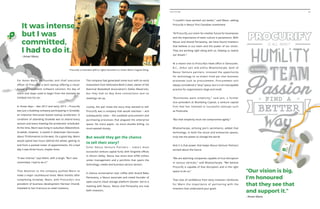
Procurify co-founders (left to right): Kenneth Loi, Aman Mann, Eugene Dong.
It was intense,
but I was
committed,
I had to do it.
- Aman Mann.
51The Future
Menlo Park’s Jeff Epstein, operating partner at Bessemer Venture
Partners, knows his way around a startup. As an investor, he’s tasked
with finding, evaluating and supporting some of the world’s most
promising companies.
And, as the former chief financial officer and executive vice president
at Oracle, Epstein knows a thing or two about running a massive
corporation.
An impressive and varied resume, to be sure.
In addition to his day-to-day responsibilities in the venture capital world,
Epstein uses experience in the classroom as well.
Along with Steve Blank, noted creator of the Lean Startup movement,
and Steve Weinstein, chief technology officer at Deluxe Services
Entertainment Group, Epstein teaches an entrepreneurial course, The
Lean Launchpad, at Stanford University. The course is designed for
graduate engineering students to “get their hands dirty” and “test the
business model” of the startups they’re designing.
We caught up with Epstein recently to talk startups, the procurement
space and why he invested in Procurify.
Head
in the
cloudNoted investor and businessman Jeff Epstein
talks cloud technology, the procurement space
and the classroom in our exclusive interview.
SEAN KOLENKO
53The Future
As an investor in Procurify,
what excites you about the
company?
Every category of software in the on-premise world
is migrating to cloud. It is very difficult for the legacy
companies to come up with a new cloud version
because, typically, the cloud version is better, faster
and more expensive. It is a very rare company that
will tell its customers that they will move them to a
new product and charge them half the price.
In every category of enterprise software, new, fast-
moving companies are building products that are
better, faster and cheaper – Procurify is clearly one
of those companies. I think it is very easy to use,
intuitive and the people who use it love it. When you
look at a product like that and you see how effective
it is, that is a company I want to be involved with.
What is your advice for
startups/companies in the
business space? What lessons,
for example, do you teach?
The class that we teach is very experiential. What
we teach them is that even though they have an
idea of what their product should be and what
their customers want, they’re probably not going
to be right. So, what we teach is that you have a
hypothesis about what customers want and you
need to collect data to test that hypothesis. We
require, for example, that students speak with 100
people during the three months they are in class –
customers, partners, suppliers or distributors.
Then, midway through the course you build and
advertise your product and see if you get any
feedback. And, based on that, you constantly iterate.
Technology, rightly or wrongly,
is associated with social - but
what about enterprise? Are
more people actively tackling
the enterprise space today?
The consumer press follows consumer products
because consumers understand it and use it. In
contrast, enterprise software companies are selling
to companies and the consumer doesn’t see it.
In the technology press, on the other hand, it is
pretty well split. A huge part of spend is spent by
enterprise and not consumers, so it gets press. JP
Morgan spends $10 billion on technology and you
can bet there are a lot of people who want to know
what JP Morgan is thinking.
With students – people coming right out of college
or grad school – they are interested in the things
they know. But as they get older, they start having
problems at work and they begin to think of
products to help that environment.
Let’s start at the beginning,
with a bit of an involved
question: what trends, in your
opinion, defined the business
software of the past? And, what
will define the future?
For the last 20 years, the biggest, most influential part
of enterprise software has been on-premise software
from major companies. In the last five to eight years,
the biggest trend has been cloud software.
There are three very important trends. The first is, if
you were buying a lot of software products in an on-
premise world, you may have 20 different products
from 20 different vendors. The cost of integrating all of
this stuff together is enormous. What that lead to was
suites of products by very large companies such as
Oracle and SAP and IBM. As a result, companies would
end up becoming an all Oracle shop or an all SAP shop.
They had this phrase, “one throat to choke,” because
something always went wrong and people wanted
“one throat to choke” when it did.
In the cloud world, it is very different. If you are buying
cloud software, you have no software and no hardware
in your own building – it’s all online and delivered
through the Internet. The major cloud software
companies have all built easy-to-use integrations with
each other. So, it’s pretty easy to buy 20 cloud software
products from 20 different vendors and have them all
work well together. As a result, the optimal choice has
moved from a suite to best of breed.
Now, we’ve all used consumer applications such as
Gmail or shopped on Amazon. These applications are
beautiful, easy-to-use and don’t require any training
classes. Enterprise software was always the exact
opposite. The new world of cloud is taking consumer
ease-of-use to the enterprise.
Nimbleness is the final big trend – nimbleness for the
company and the user. So, in the on-premise world
you would have small updates to the software once
a quarter and big updates once every three or four
years. The big updates, too, required an expensive
re-implementation. In the cloud world, those
updates happen everyday and users don’t have to do
anything, the updates are there when they turn on
their computers.
What excites him about the
Procurement space?
The thing that excites me most about it is the
leverage. Let’s say that a white-collar worker buys a
piece of software to make him or her more efficient.
And let’s say a company has 50 of those employees,
each of whom is going to be 20% more efficient. As
a result, it is as if you had 10 more people. There is
some value there.
But in procurement, those 50 employees might buy
$5 billion worth of products. If you could be 20% more
efficient, you could save the salaries of 10 people.
Because each procurement professional is dealing
with, potentially, hundreds of millions of dollars in
spend, if you can make the procurement person more
effective and efficient, the value is not just saving that
person’s salary, the value is being more effective on
the money the company is spending. Procurement is
a unique sector where the leverage is, literally, 10 to 1
or 100 to 1.
55News
For example: a brand such as Converse shoes is using
the Gaxsys platform. Someone from Vancouver visits
converse.com and orders a pair of shoes. To find a local
supplier to complete that transaction, Converse pushes
the order to all the retailers in the Vancouver area. The
first retailer that has the shoes in stock and wants the
order fulfills it.
In the case there aren’t any retailers in the Vancouver
area, Converse can then open the request up to all
applicable retailers in British Columbia. If, by chance,
no one claims the order, the geographical region can be
widened once again.
Let’s say the shoes cost $100. The shopper pays
Converse $100 and Converse then pays the retailer
$100, less any fees. Gaxsys takes a small cut of
each transaction (a couple percentage points) but
arranges the shipping.
So, why would a local retailer agree to sell a pair of shoes
for a less than they would to a customer that walks in
their doors?
According to Gaxsys’ David Levine, the reasons are many.
Maybe a retailer has excess inventory and wants to rid
itself of shoes it hasn’t sold. Or, maybe, an order falls
down from far enough away that the retailer decides
to make a sale it never would have due to location. Or,
maybe the order came in at a time of day (say, 11 a.m.)
when the store isn’t busy and can use a sale.
A retailer can decide when they will fulfill orders through
Gaxsys. For instance, if a shop is busy on the weekends, it
can decide to ignore all Gaxsys orders.
“Maybe the brand can decide when they open the
exchange, when they push orders out. The retailer
can say they will accept all orders that come in at
10 a.m. because people aren’t doing much anyhow,”
said Levine.
“For them, they are capitalizing on periods that they
aren’t busy.”
Mathias Thomas, chief executive officer at Gaxsys, added
that the ability to fulfill orders a local retailer wouldn’t
have seen otherwise will help keep independent, unique
shops alive.
“In Germany (Thomas’ native country), we are losing
many, many retailers. Independent retailers,” he said.
“We used to have small, independent retailers and now
we only have chains.”
And what’s in it for a brand? Why would a brand want
to allow a local retailer, which already purchased the
shoes, fulfill the order rather than ship it from their own
warehouse?
The brand, said Levine, takes advantage of short delivery
routes, direct contact to the consumer and is able better
manage its inventory.
And, of course, it still makes it margins on the
wholesale price.
For more on Gaxsys, visit gaxsys.com.
Gaxsys Meets Healthcare
Retail isn’t the only world Gaxsys is looking
to take over.
Earlier this year, Gaxsys announced the U.S.
launch of GPX Healthcare, an online marketplace
that allows patients to receive their respective
prescriptions from their local pharmacy.
“GPX Healthcare is the first online marketplace for
hospitals that leverages the hospital’s digital assets
and combines these assets with the healthcare
product inventory at the retail location, pharmacy
or DME closest to the patient,” said the company, in
a statement.
The Last Mile
Growing international fulfillment company
Gaxsys looks to local retailers to complete
your online shopping needs
The proliferation of online shopping, molded by
e-commerce goliath Amazon, has fundamentally
changed the shopping experience. A once age-old
tradition – going to the mall, trying on clothes, haggling
for deals on electronics – is becoming more and more
scarce with each passing year.
And why shouldn’t it?
Amazon is an efficient, easy way to shop: countless
goods at your fingertips, delivered to your doorstep the
next day if you so wish.
To support such a machine – the infrastructure needed
is vast, of course – e-commerce sites such as Amazon
require the construction of distribution centres,
stocked to the ceiling with myriad products.
A dependable system, right? Almost.
Enter burgeoning fulfillment company Gaxsys. Founded
in Germany in 2008, Gaxsys has developed an online
platform that integrates online stores and marketplaces,
and local retailers to further facilitate and support the
ever-popular online shopping experience.
It’s local shopping meets e-commerce.
Instead of relying solely on giants such as Amazon
to supply the products purchased online – products
sent from those aforementioned distribution centres
– Gaxsys includes small local retailers, all of which are
able to fulfill orders if they have the desired product.
SEAN KOLENKO
57News
1. What is Riversol?
Riversol Skin Care Solutions is a dermatologist-developed,
Canadian skin care line that uses beta-thujaplicin, derived
from the western red cedar tree as its key ingredient. This
unique molecule was chosen for its many natural healing
properties, touted historically by both Japanese and First
Nations peoples.
2. What are you doing differently with your supply
chain and distribution?
Riversol intends on minimizing packaging – our products
are made with professional-medical grade ingredients, but
the packaging is not flashy and is the same for both men
and women. We have also eliminated the use of boxes and
now list all ingredients directly on the labels.
By getting rid of boxes and additional packaging, we have
simplified our supply chain and integrated it into the value
chain of what we offer. Our packaging is now in line with
company values: our founder, dermatologist Dr. Rivers,
believes in giving the customer exactly what they need and
nothing more or less.
The supply-chain can be more than just an exercise in
logistics – it can be an exercise in marketing and brand-
building as well.
3. What about your channel strategy – how do your
products get into the hands of your customers?
There are now two different lines replacing the original
Riversol: Riversol MD and Riversol MD Clean.
Riversol MD is sold exclusively through physicians’ offices,
through medical and laser distributors who are currently
introducing the line to a variety of cosmetic physicians and
medi-spas across North America.
Riversol MD Clean has been formulated for an additional,
consumer-focused market that includes e-commerce
sites, home shopping networks and bricks and mortar
department stores. We believe in supporting our
distributors and wholesale accounts by not allowing mass
e-commerce sites to participate.
We are also distributing the Riversol MD Clean brand as
amenities for airlines, cruise ships and hotels through
Hunter Amenities. The amenities line will help to introduce
new potential customers to the brand and allow them to
try it out effortlessly. All packaging and fills are currently
done in Vancouver, B.C., but will soon be moved to Ontario
where Hunter Amenities will manufacture all lines.
This strategy will enable our product line to remain simple,
but penetrate both consumer channels and medical
channels, creating a forward-thinking, multi-channel
distribution strategy that positions the brands favorably
for future acquisition by both pharmaceutical and
cosmetic industry giants.
4. Will this innovative distribution strategy help to
give Riversol an edge as the brand goes global?
So often, a distribution strategy is developed in an ad-hoc
way. By designing a channel strategy on equal footing as
the business and marketing strategy, we have created a
sustainable competitive advantage that goes beyond the
innovative and unique aspects of the products offered.
Consideration of the future and current state of the
supply chain:
BykeepingourheadofficeinBritishColumbia,weareableto
be hands-on managing negotiations related to the Western
Red Cedar trees from which our key ingredient is derived.
B.C. has the largest population of these trees in the world
and we intend to work toward maintaining this status quo.
Our give-back initiatives also focus on sustainable forestry
(www.sfiprogram.org).
Cost to deliver the product to customers and generate
demand versus market potential:
Rosacea is a very niche market and many companies are
actively looking for doctor-developed brands to assist
with sensitive skin, rosacea and adult acne. While the
consumer market is also demanding natural, eco-friendly
alternatives that will help to treat sensitive skin and clear
their skin naturally.
Basically, we want to make it easier for people to get their
hands on our products and our dual-pronged approach
and forward-thinking distribution strategy will help us to
achieve that.
More than just logistics:
How one
skin care
company is
using their
supply chain
to build
their brand
Interview with Sandi Lesueur, CEO of Riversol
Skin Care Solutions Inc.
Brittany Whitmore
Read more by Brittany at procurementsense.com
Sam Miller is the man behind The East Asia Company – a consulting firm
with extensive experience helping various clients do business in China.
The East Asia Company has assisted its clients in everything from sourcing
products, inspections, trade shows and vendor visits. For more on the East
Asia Company, visit theeastasiaco.com.
We caught up with Mr. Miller to talk about, you guessed it, doing business in
China. Here’s what he had to say.
First things first – can you tell us a bit about yourself? What’s your
professional background? Who do you work for? And, what is your
area of expertise?
I was lucky in that I had the opportunity to go to China and live there just ten
years after Deng Xiao Ping’s reforms. That was a time in China when there
was so much excitement and entrepreneurship. I lived in Pudong, across the
river from Shanghai proper. I was one of three foreigners living there at the
time. Now there are more than 50,000 ex-pats in Pudong. So, I like to think
of myself as a pioneer. I have worked in myriad industries over the years,
but most of my experience is in home décor sourcing.
You run a very informative blog where you touch on topics such as small
businesses beginning to work in, and source products from, China. Can
you expand on this issue for us? In particular, what do new companies
need to know about beginning to source products from China?
When they think about sourcing in China, I think the most useful thing for
small companies and startups to remember is that they have to be patient.
It is going to be a long and tough road that will try your patience. But patient
you have to be if you want it to be in China long-term and profit from its
large pool of skilled labor. There was an American who lived in China in the
1930s, George Kates, who said than in his seven years in China what he
learned most was to be patient. I also spent seven years in China and that
is the same lesson I learned.
Why can China be so difficult to do business in?
I think China is difficult to do business in because we expect the Chinese to
play by our rules and they usually do not. But who can blame them. Theirs is
a unique culture that has its own rules. I would add that China for 30 years
shut itself off from the outside world and it is racing to catch up. When you
are behind you take a lot of shortcuts and don’t pay attention to the rules
and this is what has happened in China since Deng’s reforms. This makes it
hard to do business there, not only for foreigners but for Chinese as well.
Tips on
doing
business
in China
Before taking the plunge and beginning work with Chinese
suppliers there is a lot one must learn – including patience
59Asia Pacific
cut costs. cut carbon.
“Our partnership with Climate Smart provided a platform from which to measure our
successes and identify environmental cost savings. They helped enhanced our technical expertise,
environmental innovation and web based sustainable procurement services.” -Nikos Kallas, President
MET FINE PRINTERS
COPORATE CLIENTS
LOCAL GOVERNMENT
FINANCIAL INSTITUTIONS & UTILITIES
Certified Business Since 2010
MEC TED
Vancity Fortis BC
Tourism Vancouver Official Printer of 2010 Olympic Games
Email
Visit
Twitter
info@clientsmartbusiness.com
www.climatesmartbusiness.com
@climatesmart
Working with Climate Smart has helped MET Fine Printers to provide
innovative, sustainable, procurement print and communications to
many of British Columbia’s Environmental Business Leaders.
What is the most misunderstood
issue or factor about doing business
in China (in particular sourcing
products in China)?
The biggest misconception about doing
business in China is that it is easy. Many
small companies or start-ups that I deal
with just have no idea how difficult
it can be. They are led into believing
China sourcing is easy because they
see a long list of vendors on Alibaba.
com that give them great quotes and
maybe a few decent samples. And then
they think they are in business. But they
find out sooner or later, in the form of
skyrocketing prices or shoddy quality,
that it just is not that easy.
So much has been – and still is –
written about the “slowing” of the
Chinese economy. But even a more
sluggish Chinese economy is
growing in large order. What does
this mean for firms wanting to do
business in China?
China had a “slow” economy in 2013
but GDP growth was still 7.7%. If we
had 7.7 % GDP growth here in the U.S.
I think we would be very happy. The
point is, don’t believe all you hear about
China’s slowing economy. For the next
generationIbelieveChinawillremainthe
best place to source low cost consumer
goods items. What other country has
the labor pool and infrastructure? India?
Labor pool, yes, infrastructure no. If
you are a small business thinking about
China, don’t be discouraged by these
stories when you see them. I am not. 
What do you see as the future of the
China “growth” story?
I remember going to a small business
association meeting in Tokyo a few years
ago. All those in attendance – and the
hall was packed – were small business
owners who were either doing business
or wanted to do business in China. On
the panel that night was a professor of
economics from Hitsubashi University
in Tokyo, a very prestigious university in
Japan. He said that he had been going
to China for 30 years and that it was his
assessment that China would be the
top global manufacturer for at least the
next 25 years. And the same sentiment
was echoed by the UK Chancellor of the
Exchecquer, George Osborne, after one
of his many visits to China last year. I
cannot disagree with them after having
seen China’s growth first hand.
In a more general, macro sense – can
you talk about your views on issues
facing supply chain functions? What
do you see as the pressing issues/
trends/topics in the sector?
The bar for product quality worldwide
continues to be raised. Companies
here in the U.S. and in other developed
countries are year after year expected
to deliver higher quality product to
their customers. A case in point is
the automobile industry. Many AUTO
companies now have a standard of 0
defects PPM for their suppliers. This
puts more pressure on the supplier
who must, in turn, put more pressure
on their vendor in China. Ensuring that
quality is maintained at every link in the
supply chain is a challenge, especially
in a country like China where so much
production is sub-contracted. Another
problem that overseas companies
that source in China face nowadays is
employee turnover at the local level.
The turnover rate in some industries
can be as high as 30% as employees
look for positions that promise more
job satisfaction.
What needed changes aren’t being
addressed? Why?
I think, overall, the Chinese government
has done a good job of addressing many
of the issues that overseas companies
face when they source in China e.g. IP,
product safety etc.
This is not to say that things are great
now. They are not. But they are much
better than they used to be.
Well, we’ve covered just about
everything. Any last thoughts/ideas/
insights you wish to share?
Henry Kissinger refers to China’s growth,
from a very poor country to one of the
world’s richest countries, as one of
the miracles of our time. Kissinger has
seen the growth first hand and I have
seen it as well over the past 26 years.
I encourage anyone who has not been
to China to go and see that growth for
themselves because it has not stopped,
and in some places it is happening at
breakneck speed.
63Asia Pacific
It’s the year 2020 and you are a manager on a
project site for your company – a small 50- person
organization. You need to buy something to complete
the project, so you hop on your smartphone or tablet
and spend 10 seconds with an application. Your goods
arrive the next day. You take a picture of the goods
and packing slip. Voila, your project is done on time
and, most importantly, on budget.
So... what’s going on behind the scenes?
Your order was already approved by an executive at
head office, a purchase order was sent electronically
and recorded automatically in your accounting
system, and your supplier has sent an electronic
invoice with a shipping notification.
Sound too good to be true?
If you already own a smartphone and you have an
iPad at home, you surely have an inkling that this kind
of enterprise reality should already exist. And not just
for the large corporations that can afford multi-million
dollar systems – but for companies of all sizes. If you
can go on Amazon and buy goods that are shipped
free in seconds, or book your travel plans within
minutes on your phone, why can’t you get the same
software experience at your office?
The proliferation of handheld devices and the
popular acceptance of cloud services are two
monster trends that have finally reached an inflection
point in our society, and not just for consumers or
households. Combined with the next generation
of workers growing up on these devices around
the world, and the expected massive baby boomer
retirement wave, we are in for a wholesale change
in both workforce composition and expectations
of what the future worker will do. The very idea of
treating software on the cloud as a public utility,
where you just flick on the lights, is revolutionary in
this space.
This will be a both scary and disruptive time for some,
and a great opportunity for others.
Job titles such as administrators and coordinators
will be under threat as simple, affordable and
easy-to-use software products proliferate across
web browsers and mobile devices, allowing
companies to automate many mundane tasks.
Quite simply, if your role today is simply filling out
spreadsheets or photocopying paper and stapling
it to invoices, those manual tasks will be a thing
of the past.
For those that see the change coming and are
opportunistic, this presents an opportunity to spend
time on more value added activities in a company
and improve their skills to be top contributors in the
workforce.
Unfortunately, some companies may lock in these
productivity improvements to the bottom line, but
the smarter ones will take those savings and reinvest
them in a smarter, well-trained workforce that can use
those same technologies to increase revenues and
innovate across the organization.
That 2020 scenario is starting to happen today, and
the impact of these changes will be felt for many years
to come. Whether you are a business owner, a working
professional or a new entrant to the workforce, we
are all entering a period of disruption. The one’s that
are prepared for it will the one’s that will have the
greatest opportunities.
How technology
changes everything
in business
Notifications
Your order #3190
has arrived!
A new order has
been created.
A new order has
been created.
3 Reminders
herman chandi
Read more by Herman at procurementsense.com
604.683.6991
This magazine is printed by:
samcoprinters.com
Providing businesses with effective print
solutions for more than 35 years!
3rd Floor, 830 West Pender Street, Vancouver, BC V6C 1J8
sales@samcoprinters.com Fax: 604.681.1775
Procurement Sense believes in smart spending and finding a
better way. This magazine is crafted with 10% post-consumer
waste (PCW). Share this magazine with your friends and recycle.

Procurement-Sense-Magazine

  • 2.
    4 The myth of‘win- win’ negotiations in purchasing : : Artin Vaqari 20 Tell us what works best for your company : : Omar Khan 37 Financing the future of procurement : : Jon Hansen 50 Head in the cloud : : Sean Kolenko 8 ‘Business staying in business’ is a responsibility of the procurement function : : Alis Sindbjerg Hemmingsen 24 Back to school: Charles Dominick & Doug Turner 40 BuildDirect: Breaking down tradition supply chains...... and delivering heavy stuff : : Sean Kolenko 54 The last mile : : Sean Kolenko 12 Business is not B2B or B2C – but H2H! : : Bertrand Maltaverne 30 A few thoughts on public sector procurement : : Jerome Benedict 42 Is nuclear power the answer to shipping sustainability? : : Angus Chak 56 How one skin care company is using their supply chain to build their brand : : Brittany Whitmore 16 The business systems challenge facing SMEs : : Robert O’Carroll 32 The case for future proofing the supply chain with sustainable procurement : : Michael Fournier 46 Procurify: Re-writing business processes 58 Tips on doing business in China 62 How technology changes everything in business : : Herman Chandi Senior Editor Sean Kolenko Art Directors Alice Chan, Kitty Chan // masthead Contributing Editors Alis Sindbjerg Hemmingsen, Angus Chak, Artin Vaqari, Bertrand Maltaverne, Brittany Whitmore, Herman Chandi, Jerome Benedict, Jon Hansen, Michael Fournier, Omar Khan, Robert O’Carroll CONTENTS issue one : apr 2015 Read the online magazine at procurementsense.com
  • 3.
    5Dispatches - stateof the industry The myth of ‘win-win’ negotiations in purchasing ARTIN VAQARI The ‘win-win’ principle used in purchasing negotiations today looks a lot like Larry David in the episode of Curb Your Enthusiasm where David, in an argument with a female character, struggles to reach a compromise. David said: “ I know, look, listen, you’re unhappy, I’m unhappy too. That’s what a good compromise is all about. A good compromise is when both parties are dissatisfied and I think that’s what we have here.” This quote illustrates the prevailing myth in procurement today — that everything has to be a compromise and each negotiation ends with both parties splitting the deal in question down the middle. However, the end result of splitting the pie as such is actually a ‘lose-lose’ because neither party gets what they want. Myth – splitting the pie down the middle is a good compromise Rookie negotiators see only one pie: price. And each party, at the end of the day, gets half of that pie. Of course, both parties wanted the whole thing, but are forced to walk away with half in this dynamic. As a procurement professional, if you go into negotiations assuming the only thing of value for the supplier is price, guess what you will be negotiating? You’ll be negotiating price and the only option left to you is to budge on price and to make your supplier happy. That is a rookie strategy that a true pro needs to get out of the business of doing. Reality – rookie negotiators see only one pie and that’s the price pie ‘Win-win’ negotiations have been talked about so much that such scenarios have lost all meaning. But we can’t forget that ‘win-win’ means meeting your high value objectives and ensuring the vendor feels good about the deal. This is the art and science of negotiations. When you achieve each of your biggest TCO (total cost of ownership) objectives and still have the vendor feel good about it, then you can say that you’ve arrived as a procurement professional. It is critical that you understand what the other party’s interests are before you can do this. The antiquated methods of negotiations out there – the methods that focus on getting the upper hand and painting a supplier into a corner – don’t work. That is a 1950’s approach and it has no business being used in today’s procurement business model.
  • 4.
    6 Dispatches -State of the Industry If you do employ those techniques, you’ll have bitter vendors. And bitter vendors can, and will, find ways to increase their revenue. They’ll get their money back and every time you pick up the phone – which will happen many times after the contract is signed – they’ll send you a big bill. When vendors are happy, you’ll hear a simple, “sure, we’re all over it…we’ll be there…we’ll fly somebody out.” That’s the difference – and it is a big one. If you try and established an unfair playing field and take advantage of suppliers by using antiquated techniques, they’re still going to get their money and you’ll end up paying more overall. Allowing a vendor to win, while still meeting your objectives, is an art form. What you want to do is learn how to create multiple pies. In fact, we want to make as many pies as possible ­– pies that have substantial value to the supplier and below TCO impact to you. We want to try and give as many pies as we can to the supplier to make them feel so enriched from the deal, while you have not impacted your TCO proposition. So, what other pies are there other than the price pie? For instance, free training, warranty, spare parts. But... what else? Myth – getting the upper hand and painting the supplier into a corner gets results Reality - suppliers will be bitter and you’ll spend more money Learn more about negotiating contracts at procurementsense.com
  • 5.
    ‘Business staying in business’is a responsibility of the procurement function Organizations have complex supply chains with a range of customers and suppliers that influence the way it operates. While customers set specifications and standards that suppliers must meet, suppliers constantly strive to improve the efficiency and profitability of their operations, while simultaneously seeking to delight their customers. Therefore, successful businesses must always be looking for ways to stay competitive. At the same time, we have to open our eyes and start acknowledging and acting on the fact that our resources are threatened. Our economies motivate people and businesses to consume to such a degree that the planet cannot regenerate itself. We have the opportunity to re-think the way we do business. 9Dispatches - state of the industry alis sindbjerg hemmingsen
  • 6.
    OUR RESOURCES ARETHREATENED Many natural resources are threatened. Some are more obvious than others and, subsequently, there are some we are more aware of. But they all – regardless of how well-known the scarcity of the particular resource may be – pose a threat to companies with supply chains. Responsible Procurement is an approach that allows you to influence your supply chain. It can help you make informed purchasing choices by knowing more about where the products and services you purchase are made so their environmental impact is minimized. For instance, if you regularly buy from the same supplier, why not do a bit of research into their environmental policies and practices? If every business did this there would be demand for companies to green their practices and take on responsibility in order to remain competitive. TAKE RESPONSIBILITY The requirement to take responsibility for society is not indicative of some passing trend, but rather a cultural shift. It is a backlash to the western world’s disposable culture and an evolution of Milton Friedman’s phrase “the business of business is business” to “the business of business is staying in business”. Taking responsibility for the impact of your own operations is no longer enough. The world demands more of you. You are now also held accountable for what goes on in your supply chain – from working conditions to corruption to environmental impacts. Your procurement of products and services is under scrutiny. Your challenge is to understand the impact your procurement decisions have on local communities, workers and the environment. And, then, you must take action to make sure that you create a positive impact. At the end of the day, that is what Responsible Procurement is all about. If you plan it well, it can promote sustainability, provide you with cost savings and protect and enhance your brand. VALUE CREATION Ensuring that your procurement strategy is based on a responsible- decision making approach has become an important business parameter. Additionally, it is essential for you to understand that Responsible Procurement, in its optimal format, can be a value creating process. Responsible Procurement can have a fundamental strategic and operational impact. It can promote competitiveness and innovation. Responsible Procurement is a strategic tool, which can help minimize your company’s negative impact on people, society and the environment while maintaining or enhancing value for customers, business partners and shareholders. The business of business is staying in business REVOLUTIONIZE THE PROCUREMENT STRATEGY I typically define Responsible Procurement in the following way: ”Responsible Procurement integrates requirements, specifications and criteria that are compatible and in favour of the protection of the environment, of social progress and in support of economic development by seeking resource efficiency, improving the quality of products and ultimately optimizing costs”. However, some companies see their Responsible Procurement initiatives as pure risk management and use it for compliance purposes. The strategic and operational impact is then, typically, medium to high, though it mitigates operational risks. Improving efficiency, reducing demand for materials and cutting waste all reduce your costs and are good for the business and for the environment. Maximizing these benefits requires you to manage your supply chain and integrate business activities to create value for your customers. Responsible Procurement is about increasing a company’s profit, improving strategic supplier relationships and strengthening the brand while remaining vigilant towards competitors and revolutionizing the procurement strategy to fit the current business landscape. And, of course, at the end of the day: ensuring that “business stays in business”. 11Dispatches - state of the industry
  • 7.
    BUSINESS IS NOT B2B OR B2C- BUT H2H! The heart of business is people – it is “human to human.” This is something that is too often forgotten in P2P projects, where the focus is on capabilities, features etc. Because of the human aspect of business, all projects must start with meaning – defining why a P2P project should proceed is critical. In my personal experience, organizations often cannot explain why they want to put in place P2P technologies. It is no wonder that they face adoption and compliance challenges. At the end of the day, the “Holy Grail” is providing a tool that everyone can use, even if customers only need that tool occasionally. This is why my current position ( consultant / provider ) is really interesting. I work with procurement specialists to build their vision / strategy, and then make that vision / strategy happen. This is the road that procurement organizations should follow to avoid the “trap of features.” When you have the right approach, magic happens and the big picture appears: collaboration. Collaboration, though, is a varied concept – it is collaboration between both various internal functions and collaboration across the supply chain. Several projects I managed internally in the past or that I now participate in are all about these collaborative aspects and I believe that integrated P2P suites such as POOL4TOOL are the means to restoring the link between: 1. R&D, procurement, manufacturing, quality, and suppliers at the early stage of product development. 2. Procurement and finance – traditional silos that transactional solutions can help break. 3. Procurement and its internal customers – a very important relationship in the world of indirect procurement. At the end of the day, the goal should not be to get this feature or that feature, but to improve collaboration and therefore increase the effectiveness and efficiency of the organization. For example, one key player in the automotive industry I am currently working with has an information system that was not designed for people but for functions. This produced wasted energy, created barriers between people and developed mistrust. This situation can be fixed with the right technology and the right approach. The program we built with this customer is centered around a vision of a collaboration platform that supports business processes and provides all stakeholders with the information they need to execute these processes. This includes areas such as: • Program/project management, commodity strategy, strategic sourcing, contract management, request management and ordering. The benefits of this design are: • Information flows end-to-end in a transparent manner increasing the agility of the organization and making processes leaner. • Decision makers have more, and better, inputs in terms of accuracy and completeness, improving time-to-market and reducing risks. • Strategy is embedded in execution increasing compliance and removing the need for internal validation committees. • Execution continuously feeds strategy fostering continuous improvements. By removing the strenuous administrative work and restoring trust, people are able to make a difference by seeing the big picture and the common goal. Procurement has a unique and central position in organizations and, if it wants to reinforce or keep its strategic role, it must be at the forefront of this collaborative / holistic approach. This is a critical condition to bring innovations to the organization. This is the time to focus on value, to build a strategy and then to act because “strategy is not what you say, it is what you do.” bertrand maltaverne Strategy is not what you say, it is what you do.
  • 8.
    We are agroup of easygoing, seasoned professionals. With combined experience of more than 100 years, you could say, procurement is part of our DNA. We specialize in cost reduction and we are passionate about helping our clients. We work hard to earn your trust and we are easy to work with. If we can not reduce your procurement costs, you don’t owe us a dime. Period. It’s simple as that! Contact us for a Free, No obligation, Spend Analysis. PO Box No. 1961 , Oxnard, CA 93032 Ph. No. 805-487-5308 Email: info@procurementsolutionsgroup.com www.procurementsolutionsgroup.com procurement solutions group Procurement it’s part of our dna...
  • 9.
    17Dispatches - stateof the industry h A L L E N G E C robert o’carroll The business systems challenge facing SMEs Late on a recent Friday afternoon our sales manager walked briskly into my office. “Can you check the materials for this?” he asked, upon handing me a purchase order. The rush order had just arrived by fax, but what was more remarkable to me was the handwritten order lines. This event triggered all sorts of thoughts for me, not least of which is how is this multi-million dollar business achieving profitability if hand-written orders are representative of its business systems? My own experience in manufacturing provided me with somewhat of an explanation of how work practices fail to move with the times. In my previous job - working for a multinational company with blue-chip OEMs as customers - I was exposed to a constantly evolving work landscape,especiallyintermsofITandsoftware. Training and investment accompanied each new installation we experienced. Now, working for a small business with a disparate customer base of predominantly SMEs, my experience is very different. In a small business, each person covers multiple roles and in doing so can compromise maintaining advanced level knowledge in specific areas. For the business, it is very difficult to remain abreast of industry trends and developments not having a subject expert on staff. With increasing complexity, the norm for IT network infrastructure and key software such as an ERP system, as well as other areas, the need for subject matter experts continues to grow. Also, creating the time to critically evaluate existing practices and research the next steps is an ever-present challenge.
  • 10.
    18 Dispatches -state of the industry These challenges present a significant market and opportunity for businesses that can provide solutions. A win-win scenario is conceivable whereby SMEs improve their profitability and agility by modernizing their business practices and availing themselves of the ever growing range of products available. Vendors of software and other products oriented towards streamlining business processes have a large, relatively untapped market. That said, accessing this market will not be easy. Many SMEs do not recognize that their processes are dated and are often focused primarily on manufacturing and shipping their own product. The awareness that improving business processes can boost profitability at a faster rate than iterative product development frequently does not exist. Also, change often comes slowly. If a process works... why change it? For example, payments by cheque are more common than wire transfer or electronic transactions (transaction charges and cash flow management, though, may influence this). Additionally, when sourcing a service or product the range of offerings can be daunting. Determining which products meet the requirements or even which of the many vendors will be around in five years’ time, requires a significant procurement effort for a topic that for many is not a priority. For most of us in manufacturing there will be increased competition and erosion of margins, which will be a catalyst for change. Not all businesses can afford to wait that long. For vendors, the first challenge is to assist the customer to realize that they have a problem and to articulate it in terms of a real impact to their bottom line. Providers who can effectively present and breakdown solutions into simple terms will have an advantage. The ability to implement and demonstrate success quickly will be a differentiator. SMEs, free of the bureaucracy of larger companies, have the capacity to adopt new systems quickly, but can have resource and skill constraints. Vendors will likely lead installation activities and customer support will need to be strong. There must be awareness that the needs of an SME customer are very different from those of larger businesses with mature IT organizations internally. For the provider who can convince the business owner that handwriting PO lines is a scenario he needs to move beyond, who can explain in simple terms the alternative, and implement and support a user-friendly solution the market potential is huge.
  • 11.
    Strategic sourcing isa systematic, long-term and holistic approach to acquiring current and future needs of an organization at the lowest total cost of ownership (TCO) and lowest risk to the supply line. This process creates a closed loop link between customer and the supplier to ensure continuous improvement in quality, delivery, cost and service while providing the means to achieve optimal efficiencies in both customer and supplier organizations. There are three very important components of strategic sourcing: spend analysis, market research and supplier evaluation / selection and relationship management. When we look at these components closely, there are several steps to each component. A flawless execution of these steps requires human resources with specific skill sets and expensive ERP technology to achieve desired results. Tactical sourcing, on the other hand, is a short term, transactional activity, commonly practiced in small-to medium-sized manufacturing organizations. Tactical sourcing takes a routine and sometimes reactive approach to purchasing materials and supplies using quick quotes and order processes to support the production operations. It is, however, proactively managed within the purchasing organization to ensure the organization has the right material at the right price, at the right time. Unlike strategic sourcing, a purchasing organization doesn’t particularly focus on the requirements of the entire organization, nor does it strive to deeply understand a vendors’ core capabilities to support a company’s broader needs. Before we discuss the merits of these answers, let’s examine both sourcing strategies briefly. This will establish a baseline to better understand how procurement professionals justify adopting one sourcing strategy versus another. Later, we will further analyze these answers in light of organizational environment to determine if the evidence supports the strategy. Strategic sourcing TACTICAL sourcing Tell us what works best for your company omar khan If you ask this question to a group of procurement professionals from different organizations, you will probably get the following answers: 3/ It depends1/ Strategic Sourcing 2/ Tactical Sourcing
  • 12.
    23Dispatches - stateof the industry Based on the above explanation, one would agree that strategic sourcing is the best known practice when compared to tactical sourcing within procurement organizations. Why, then, do some companies choose to use the sub- optimal sourcing processes instead of embracing the best practice of strategic sourcing? Let’s take a look at a couple of examples to better understand the impetus for such decisions. Consider the example of a medium-sized manufacturing company where the purchasing organization has the flexibility to use just about any one of the suppliers in the supply base. Typically, buyers in these situations will use their best judgment to place the order with the supplier that offers lowest price and best delivery dates. This scenario plays out in many purchasing organizations where buyers do not have the luxury of ample time on their hands. Managing day-to-day manufacturing operations are quite different from managing long-term strategic responsibilities. Sometimes, these buyers do not have the procurement technology (ERP) platform or the skill set necessary to shift from tactical to strategic purchasing. Their number one priority is to keep the production lines running and tactical sourcing is the best choice in such operational environments. Essentially, tactical sourcing is the appropriate approach by “doing things right” at these companies. Now, compare this to another organizational environment where the procurement organization has access to a full suite of ERP technology and dedicated commodity teams. Procurement would have downsized the vendor base by selecting a small number of “preferred suppliers” after evaluating their core capabilities and alignment of mutual expectations. A procurement organization in this scenario has the appropriate information technology (IT) support to run enterprise-wise spend reports, perform spend analysis and conduct market research on various commodities to understand supply and demand dynamics. With these tools and talents at its disposal, procurement would have negotiated the lowest total cost of ownership (TCO), taking into consideration quality, delivery, lead times and other critical terms. Here, buyers would use only the approved suppliers based on a deeper understanding of the organization’s overall needs and requirements. Needless to say, strategic sourcing is “doing the right thing” for this purchasing organization. A third approach would be a hybrid procurement system supported by “affordable ERP technology” and a small team of two or three commodity specialists. Separation of responsibilities will ensure adequate operational support as well as a strategic focus on a small number of key commodities. By “doing things right” or “doing the right thing” depending on the situation, this procurement organization will find the right balance between both strategies. While both approaches are critical to success, tell us what works best for your organization. By “doing things right” or “doing the right thing” depending on the situation, this procurement organization will find the right balance between both strategies.Read more best practice at procurementsense.com
  • 13.
    25Education More and moreprocurement professionals are returning to the classroom to upgrade their skills and achieve certification in the field. We caught up with two leading supply chain instructors to talk about supply chain education, industry issues and trends. Here’s what they had to say. backto school Charles Dominick President and Chief Procurement Officer at Next Level Purchasing, Inc. in Pennsylvania. Can you describe what Next Level Purchasing does? And, can you give us a glimpse of the history of Next Level Purchasing? Next Level Purchasing was founded in 2000. Since then, we have gone on to provide procurement training and certification to procurement departments and procurement professionals in more than 150 countries worldwide. We introduced the SPSM Certification 10 years ago. SPSM stands for “Senior Professional in Supply Management.” Who uses / attends Next Level Purchasing? And, how do those clients find your organization? Our member base is very, very broad. We have customers who are Fortune 100 size companies – companies that enrol their procurement staff members into our training and certification programs. Their goals are, basically, to get better results from their procurement department in the workplace. These companies, some of the biggest in the world, are on one side of the spectrum. On the other end of the spectrum are individuals. We also have a healthy share of individuals at Next level Purchasing. For these individuals, maybe their employers do not sponsor their training, or they maybe unemployed and are trying to enter, or re-enter, the workforce. Their goals are, basically, to have a more rewarding career. If they are unemployed their goal is to get a better job, if they are employed their job is to get the skills to do their jobs better. What does Next Level Purchasing offer? Can you elaborate on the specifics of the curriculum? At the base of our family of certifications is our SPSM Certification. We currently have three – soon to be four – levels of certification. We have the SPSM, the SPSM II, the SPSM III and the SPSM IV. They are completed in succession, if you choose to go to that level of certification. All of our courses are done online. To become certified, individuals will take, for the SPSM Certification, six of our online courses. Once they pass, they are eligible to take the SPSM exam and, once they pass the exam, they submit their application for certification. This level is the essential procurement skills. We feel anyone holding a professional procurement position should have, at a minimum, these essential skills. These skills range from basic, tactical purchasing competency, up through analysis and spreadsheets and contract law and so on. Each level gets more complex – at SPSM II, for instance, people will be learning what we broadly call global procurement management. What benefit does Next Level Purchasing provide to its clients/students? Why should people seek you out? That is a multi-faceted answer. Most importantly, perhaps, we give people the skills to apply in the workplace for real-world results. That’s the bottom line. Our clients are able to use what we teach them, apply it and succeed.
  • 14.
    26 Education Doug Turner Aveteran supply chain professional, noted speaker and instructor in the Supply Chain Management Association certification program in British Columbia. Let’s start on the education issue. What is the certification from the Supply Chain Management Association and why should professionals want it? So, first a little history. The acronym used to be CPP, Certified Professional Purchaser. That’s been around for a long time. The organization that gave the designation was the Purchasing Management Association of Canada. So, the only thing that’s changed are the names. Now, the organization that gives the certification is the Supply Chain Management Association and the designation is now called the Supply Chain Management Professional. If you want a job in the supply chain realm, in any major procurement area now, most companies are requesting you have the designation or that you be working on it. Or, companies want people to have a purchasing designation. The training is substantial – you learn everything there is to know about procurement, in a manner of speaking. I teach a course in global sourcing, which is all about outsourcing. You may or may not end up in a company that does that, but you’ll learn about it. You describe supply chain management as a discipline. Why? I put it in the realm of accounting as a discipline. There are a whole variety of skills needed because there are so many job titles – sometimes you’re called a buyer, sometimes a purchaser, an inventory control person or you could be a logistics specialist. This work is going on and supply chain activities are going on. It is happening in every company as a function, whether it is identified with a title or not. That’s why I think of it as a discipline. With all of your experience in mind, what do you think is the most commonly misunderstood aspect of the supply chain discipline? I would say that the supply chain is thought of only as buyers. Also, many think only in terms of commodity, they usually overlook the services. People often think anyone can buy services, and there is no need for a buyer for that. A buyer buys pencils, not services. Also, many in an organization, particularly small organizations, think they can buy pencils as well. That misses the competitive aspect, the commercial aspect and the strategic aspect of purchasing. Sure, people can buy pencils, but you have to understand why, what kind and why they fit in the function. There are many nuanced issues to purchasing. Beyond that, certification serves as a badge of honour. It serves as a qualification or a validation that someone has indeed mastered the qualifications they need to master. That’s very powerful when presented on a resume or discussed with an employer. Anyone can say they have 15-20-25 years of experience, but those years of experience don’t mean that they’ve done the job or that they know anything. They could have been making things up for 25 years. What a certification says is ‘this person knows the best practices to get real-world results.’ How big is your member base? Where do you rank amongst similar associations or professional bodies? Our member base has more than 276,000 members. We are, by far, the largest procurement association in the world. We offer a free membership – other organizations will charge up to $250 just for the right to print a membership card and very little else. We focus on making our membership free and work across the world. Some of the countries we work in can’t afford memberships and the education, so we see it as a philanthropic mission of ours to give those people access to education. Now, let’s switch to more general topics. In your experience in the purchasing/ procurement/supply chain worlds – how have things changed? What issues have you excited? I think things have become more intricate. For example, in the past, procurement professionals would have only been involved in what we teach at level one – strategic sourcing, technology or risk management. But now you look over the next 10 years, things have evolved. Very specific management and leader techniques are now important; we are looking at sourcing in a global environment. A decade ago, everyone didn’t source internationally, or didn’t think it was important to them. Now, the world is our oyster for where we can find suppliers. Finally, external procurement influence is looking at procurement decisions having an effect well beyond the enterprise. You are looking at procurement decisions having an effect on the community and utilizing local businesses, for instance. You are also looking at social responsibility – conflict minerals are a great example. Today, procurement professionals have to look to the cradle of every component, service and material that ends up in their supply chain. It has been an amazing evolution. And the opposite – are there any trends that you are worried about? Or, maybe, any trends that you feel are overblown? One thing I am hoping doesn’t develop – I see it on the horizon but I hope against it – is the broad use of the term supply chain management. I hope procurement doesn’t get sucked into the supply chain management concept. I hope procurement doesn’t get viewed as simply part of that because we will lose a lot of the details, the arts, the science and the best practices of procurement. Those pieces will be overshadowed. As trends develop, we need to be very careful we don’t lose all of the wonderful details that go into successful procurement.
  • 15.
    28 Education TRUST =PROFIT Are you spending too much, managing your spending? Do you trust your supply chain? We can show you where the savings are when you focus on trust. Discover What Trust really is• How to dramatically reduce costs• How to streamline business deals• How to increase Vendor Engagement and Innovation• Doug Turner, MBA info@truebalancecoaching.com 604.868.1182 What about industry issues? What are the critical issues being dealt with by supply chain professionals? I recently taught a four-day negotiation workshop. It was enlightening. A lot of the students remarked they never understood the importance of relationships when dealing with people in the supply chain. And these are reasonably experienced supply chain people. Younger professionals are starting to view this as a purely paper exercise – using a purchase order, a contract and placing an order. That’s what it is all about to them. As a result, we are losing the skill of understanding what you are really doing. It depends on your ability to negotiate and it depends on your ability to come to an arrangement with somebody. That is being overlooked. There is a tendency to forget about learning how to interact with people and come to a deal. That is what I’m seeing. Relationships and trust are critical. The ability to deal with people will remain an important future issue as well. Can you talk about the intricate role logistics plays in the supply chain? Logistics is a subset of supply chain. Logistics is the oil that makes the gears go around. So, I may negotiate with an offshore company a contract to acquire a bunch of chairs from China. I can negotiate all the terms but between getting the stuff from there to here, I would normally hand that off to my transportation department – they’re the experts. Transportation is one of the biggest factors. And logistics is responsible for getting things to their destinations in predictable ways. If I’m ordering something, the guy I’m ordering from should tell me I can’t have my stuff for, say, three weeks. But it’ll be there on the 21st day. So, now I know not to expect anything on the 14th day, it just won’t be there. That’s on time and predictable. I think that is the key. I think everybody would be perfectly happy if, even if transportation times are slower than they might like, times that “were” predictable.
  • 16.
    A few thoughtson public sector procurement Those working in the realm of public procurement – such as universities – must master customer satisfaction and government expectation Public sector procurement is a balancing act, with requirements to follow federal, provincial and organizational policies and regulations. Timelines and paper work, as a result, can lead to an unhappy client and an angry vendor. As a procurement professional working at a public sector university, being able to balance the needs of the client while satisfying government regulation and ensuring the vendor is paid within acceptable payment terms can lead to early onset hair loss. Guidance is sometimes hard to find and defining the path you want to take in procuring products or services for universities is a complex network of policy and regulation. It’s a difficult task making sure that your client is happy and the product they are looking to source arrives in a timely manner, at a cost that is within their budgeted requirements. There are many factors that can affect the overall mood when procuring products or services in the public sector – clients have their own requirements that may not align to procurement standards set up by the government and vendors may have payment terms that are against the standard payment terms of various organizations. Government regulation could prohibit a sole source, if multiple vendors with similar products are available. jerome benedict I work within the procurement department at a large university. A number of our team members are not aware of government regulations that promote transparency and fairness in the market. That’s critical information, as those regulations are designed to ensure taxpayer funds are spent in the most efficient way and yield the greatest returns possible. For example, purchases of more than $50,000 must come in with either three quotes from qualified vendors that provide similar products, or with a sole source form outlining why the purchase must be made from this sole vendor. The sole source form is used if no other vendor can provide the requisite product or service. Interestingly, we are seeing an influx of groups using the form to avoid having to provide multiple quotes for substantial purchases. This is a big no no for us in the procurement department, but researchers or grant holders are, sometimes, not particularly concerned with how they get their products – they just want the goods to meet their scientific requirements, come in under budget and arrive as soon as possible. Researchers or grant holders are, sometimes, not particularly concerned with how they get their products – they just want the goods to meet their scientific requirements. At the university I work for, we use standard KPIs to ensure purchases are made within seven to nine business days of receiving a request. We pay vendors Net45 on receipt of approved invoices. Based on the complexity of the purchase – price, timeline, approvals, logistics and customs issues can be factors in a purchase – it could take, potentially, between six weeks to a year to complete a purchase. Unrealistic expectations are a big problem and individuals are under the impression that the item they are purchasing is the only important purchase being made. This lack of commitment from clients can be hard when trying to help them source a product or service. Unrealistic expectations are a big problem and individuals are under the impression that the item they are purchasing is the only important purchase being made. Building strong relationships with vendors, when given the option, can lead to discounts and even operational efficiencies. We as procurement professionals are there to help our clients make the best decisions when spending their allocated funds and ensure that taxpayers are receiving the most bang for their buck. The best we can do is teach. Continuous learning and sharing of new practices and policies with the purchasing community – other departments – is key to building a better understanding of the nature of procurement. My department works relentlessly to help teach the proper process and educate all users down the supply chain. Through continuous development we can hope to achieve new operational efficiencies and a potential cost savings. A Procurements Clerks thoughts Jerome Benedict Kudos Consulting Group UBC Procurement Clerk 31EDUCATION
  • 17.
    Sustainable sourcing isevolving into the most important function of supply chain management. And the impetus for this evolution is how sustainable sourcing grounds itself in the future- proofing of supply chains. What does it mean to future-proof supply chains? Future-proofing supply chains means protecting your organization’s future performance against a multitude of potential problems. Whether the future involves the loss of access to key production ingredients or logistics providers, future-proofing attempts to mitigate potential dangers. Trending in the environment of future-proofing supply chains is sustainable procurement. Sustainable procurement has proven that it improves efficiency, effectiveness and transparency for organizations. Furthermore, sustainable sourcing not only improves employee and supplier relationships, it also improves an organization’s reputation among the community and its customers. Lastly, sustainable sourcing can dismantle poor waste disposal practices and reduce energy waste, which improves company spend management. Of course, beyond the business case for sustainable sourcing, ecologically friendly procurement practices are necessary for maintaining our environment. This article will first begin with an overview of the benefits provided through sustainable sourcing and how e-procurement impacts sustainable supply chain management. Following that, the article will offer a brief analysis of how sustainable sourcing is achieved in Germany. The article will then conclude with a brief capstone from an interview with Ben Seaman, Eartheasy CEO, an e-commerce website that promotes an environmentally sound way of living. What benefits can sustainable sourcing provide? Amongst the numerous benefits sustainable supply chain management (SSCM) can provide, the most important benefits include aligning with a green strategy and improving market competitiveness. A green strategy involves reducing waste management costs, trading ethically to attract ethically-conscious customers and reducing resource waste. Improving market competitiveness involves reducing procurement delays by adequately projecting future sourcing activities against potential environmental hazards, government regulations, a shift in customer attitudes towards environmental concerns, as well as changes in supplier relationships. In fact, sustainable sourcing practices can enhance buyer-supplier relationships through increased transparency. It’s easy to label sustainable procurement as nothing more than a buzzword. But does sustainable procurement hold the key to mitigating risk for your company? 33THE FUTURE The case for future proofing the supply chain with sustainable procurement michael fournier
  • 18.
    Why is e-procurement oftenconsidered the best step towards SSCM? Before we get into why most organizations are choosing to optimize their supply chain consider this single piece of info: “One manual purchase order can cost a company as much as $150 to process, even if the purchase order was issued to buy a $25 part.” The cost of issuing manual purchase orders adds up when one considers the time spent sending documents back and forth between approvers, buyers and receivers. E-procurement systems have become significantly more popular as a means of removing the tedious and costly travel time of documents. In fact, according to Tony Chien & Daniel Ahrens there are three significant ways that e-procurement improves the purchasing process. Goodbye paperwork: e-procurement systems eliminate paperwork by generating electronic purchase orders that can be immediately routed to the appropriate person. This system results in a reduction in paper costs, as well as less time spent by key personnel. Commitment to vendors: e-procurement systems can be used as a means of compelling end users to only purchase from company-approved vendors. This commitment to approved vendors is one way of mitigating the possibility of corporate fraud within the organization. Spend visibility: although spend visibility may sound like a generic buzzword, spend visibility is an important result of e-procurement systems. Spend visibility gives managers full control of their company and department spending. So how are we currently tackling SSCM in Germany? German Sustainable Development Strategy The German government has made a formal commitment towards SSCM through the German Sustainable Development Strategy (GSDS). The purpose of the GSDS was to classify procurement activities and find a means of attaching measurable aspects to them. The five procurement activities that are accountable within the GSDS are: 1. Reducing logistics and freight intensity; 2. Reducing land use; 3. Implications against partners because of sustainable aspects; 4. Quality of employee working conditions; 5. Enhancing quality of employment. Within reducing logistics and freight intensity, the GSDS measures greenhouse gas emissions, use and disposal of truck tires and measuring driver behaviour according to environmentally conscious driving standards. The purpose of measuring land use falls within the dimensions of reducing energy waste, increasing renewable energy for warehouses and factories, as well as actively considering the environment in property choices. Under the GSDS, sustainable partner activities measurable include whether partners use rail or choose to ship cargo, whether partners use environmentally friendly transport services, which does fall into the first activity above, and whether partners use combined transport to reduce freight intensity. For a long time, supply chains were overrun with allegations of poor working conditions and low access to essential services. However, through the GSDS, German firms are observing whether employees are given services during the day and on weekends. German firms are also attempting to maintain a standard level of pay and minimize the use of temporary workers. And the final measurable dimension under the GSDS involves education and enhancing qualified employment in all levels of supply chain operations. The GSDS is indeed a highly ambitious effort in attempting to measure sustainable practices within the German procurement industry. Eartheasy was built on the philosophy that we need to protect our natural environment if we want to keep the things we love. Eartheasy is a go-to website that focuses on providing eco- friendly products, guides and articles to its visitors. Eartheasy is a case where sustainable sourcing and procurement became an important enough issue, prompting the founders to share their culture with their customers. Sustainable procurement is incredibly important for the future success of an organization’s supply chain, but also for our environment and planet. The difficulties are not unheard of when considering green procurement strategies, however, the strategic advantage that one could attain can last well into the future. And that’s what they mean when someone talks about future-proofing their supply chain. The Eartheasy STORY Read more by Michael at procurementsense.com
  • 19.
    One in fivefamilies in our community lives in poverty. Putting more money in the hands of working families by paying a living wage is one of the best economic development strategies we can employ. It’s also an important way to solve family and child poverty. In 2011, Vancity made the commitment to become a Living Wage Employer and we want to share what we’ve learned with other employers. The more employers who join us in paying a living wage, the more we change the lives for workers and families in our communities. To join us or to learn more, visit vancity.com/LivingWage. Make Good Money (TM) is a trademark of Vancouver City Savings Credit Union. Because work should lift you out of poverty, not keep you there. Have you ever noticed that when you tune into a particular topic, it seems to pop up in conversations everywhere? Since announcing that I would be teaming up with Buyers Meeting Point’s Kelly Barner to co-write The Future of Procurement book – slated for release in early 2015 – everywhere I turn someone is talking about the future of our industry. Don’t get me wrong, as a subject that is garnering a great deal of attention as of late, it bodes very well for potential book sales down the road. Beyond literary interests, however, it is perhaps the underlying reasons for everyone’s interest that has peaked my curiosity the most. Having covered the procurement world through my Procurement Insights blog since May 2007, it is very clear that we are in the midst of a major shift in terms of where our industry is headed. This shift, as I will call it, is largely driven by the recognition that procurement or purchasing, as it’s poorer cousin is known, is going through a major transformation from being an adjunct function to a strategic imperative. What this basically means is that we, as well as others, no longer view what we do through a “just get me the best price” edict that for far too long has defined the industry mindset. We are now instead challenging the barbed perceptions of those senior executives from the 2006 CPO Agenda Roundtable discussion – specifically the assertion that they would take one strategic thinker over 12 run-of-the-mill everyday buyers. Financing the future of procurement Can procurement evolve into the role of new enterprise bankers over the next decade? 37THE FUTURE Quite simply,we have to start “financing” our own future if we hope to finally secure a seat at the executive table. JON HANSEN
  • 20.
    38 Education Of course,to become truly strategic, we have to start changing the way in which we view our contribution to an organization. For me personally, this means addressing an Aberdeen CFO survey. In the survey, the majority of CFOs felt that procurement made very little meaningful contribution to a company’s bottom line. In fact, CFOs went so far as to suggest that they discounted more than 80% of the savings claimed by the procurement department as being irrelevant. If you were a batter in major league baseball, that kind of average would get you sent down to the farm team pretty quick. Not surprisingly, the “minor leagues” is where most procurement people feel they have been relegated from a corporate presence standpoint. So what does this all mean? Quite simply, we have to start “financing” our own future if we hope to finally secure a seat at the executive table. And this, of course, is why of all the topics involved in the future of procurement I have chosen to write about financing here. Now I am sure that everyone who is reading this article is already familiar with recent announcements regarding Washington’s launch of the SupplierPays initiative. I also have no doubt that you have been following industry news, in which P2P vendors are beginning to team-up with non-traditional finance companies. The goal of these pairings is to provide a mutually beneficial buyer/supplier service centered around timely payments. The fact that a 2013 Institution of Financial Operations survey disclosed that only 5% of the organizations that participated had offered trade financing to their suppliers means that it is a largely untapped service area with huge upside benefits. In other words, it is one of the main game changers in how our industry, and the business world in general, will view procurement’s importance going forward. Withinthecontextoftheaforementioneddevelopments, it would not be unreasonable for procurement to evolve into the role of new enterprise bankers over the next decade. Think about it for a moment. Everything we do as procurement professionals ultimately touches all areas of the global enterprise. From keeping the lights on in the office, to the manufacturing of a product for end-user consumption, procurement, at some point in the process, has a hand in everything. It only makes sense that this reach should now include the ability to incorporate a financing model that ensures timely payments to suppliers. Once again, this is the reason why non-traditional financing within the procurement process is one of the areas I will be watching over the coming months and years. The irony, of course, is that in the previously referenced CPO Agenda Roundtable discussion the same executives also indicated that the best person to run a purchasing department is not someone with a purchasing background. Who did they choose as the ideal candidate? Someone from finance. I wonder if there is ever a CFO Roundtable that those executives will conclude that the best person to run a finance department is not someone with a finance background? Note to all procurement professionals . . . time to update your resumes. Learn Complete the required courses online at your convenience and learn the processes needed to achieve measurable results. Prove Pass the SPSM Exam to prove that you’ve met third-party standards for excellence in procurement. WWin Apply what you’ve learned in the workplace to deliver great procurement results! ® ®
  • 21.
    41THE FUTURE BuildDirect: Breaking downtraditional supply chains...… and delivering heavy stuff We’re fascinated with BuildDirect. So, let’s start with a description of BuildDirect as a company – can you describe the company, its mandate, vision and market? What we’re trying to achieve here with BuildDirect is develop a platform for heavyweight goods – more than 150 pounds. Right now, if you look at a lot of e-commerce companies they are working with UPS and Federal Express. That’s a great way to work because they get their planes and their warehouses – those companies can deliver. What is difficult to deliver, however, is heavy stuff. That’s where we think there is an opportunity for us to develop a new supply chain, a new platform that we can deliver that either directly to the home or to the project site. We’re going to stay fairly asset-light, we are going to be the enabler of the network. We will be able to plug in and leverage the different types of things that we’ll need to supply these heavyweight goods. So, you’re going to need a truck with a lift gate on the back to deliver heavy stuff. There may be needs for flat beds. We also do roofing, so we’re going to have to have trucks with cranes. Behind the scenes with Jim Hourigan, Chief Operating Officer at BuildDirect SEAN KOLENKO The foundation of your company, in many ways, is built upon a robust, well-oiled supply chain. Can you describe how that supply chain was designed and built? Originally it was Rob Banks (co- founder; executive officer) and Jeff Booth (co-founder; CEO) that pulled it together. Essentially, what they did at the time was build a website to deliver from manufacturers to a customer. Back when they started, because they didn’t have warehouses, they were doing it at a container level. When the credit crunch came and the housing recession in the U.S. came they had to figure out a different way. That’s when they came up with the warehouses. Of course, you had to have enough warehouses with enough heavy stuff – if you had one warehouse in California but you have demand in Massachusetts the cost is going to be very, very high. So, the other thing that we’ve done is analytics. We’ve been able to use those analytics in supply chain to determine where we put our warehouses, what inventory needs to be stocked there. We’re actually out in the front of where demand is going to be. So, we can actually help a supplier manage their production. That’s where it gets really exciting. How does that differ from a “traditional” supply chain? It is a huge, fundamental difference. I like to use Wal Mart as an example. If I was out of stock with Wal Mart, they’d say ‘Hey, you’re 10% out of stock.’ And I would make sure we got up to 95% or 98%. But, it was tough to really quantify what you were missing. What we’ve been able to do with our analytics is we can actually tell a supplier how much they are missing in sales before it actually happens. And with our warehouse structure, we bring everything in. Everything in our warehouse is on consignment. One of our best suppliers has more than $1 million in product in a warehouse. They do that because they trust that we will be their sales and marketing in North America. And we tell them how many containers to ship and where to ship it and we give them all the analytics. For a smaller company, they would never get those analytics on their own, for instance. Lastly, I wanted to touch on the idea of Supply Chain 2.0. Can you elaborate on what that is? We’re not exactly sure, but we’ve got some ideas. We see the supply chain has been more of a push. When we’re trying to do ­– along with others – is develop the right way of both push and pull. We don’t have all of the answers yet, but one of things we’ve just kicked off is a supply chain advisory board. The level of people we have on that board is equal to, or perhaps even greater, than the people we have on our corporate board. We’ve got the ex-CEO of Descartes, the ex-CEO of Red Prairie, a professor of supply chain at Stanford graduate school – they are all at the heart of this. And they are going to help us get to Supply Chain 2.0. What we think the overarching vision will be is that we want to build an “end trust.” The “end trust” is customers trust us, suppliers trust us and we will give credentials to the suppliers – so they all get a rating and it is very transparent. Essentially, we become the toll booth and we’re making money on the transactions because we are making it possible for these guys to connect. It’s very dynamic.
  • 22.
    43The Future More than70% of our planet’s surface is covered in water and, yet, few people concern themselves with anything past the first couple miles off the beaches. Even fewer, still, are aware that 90% of all the world’s products are transported on massive container ships – the length of multiple football fields – that travel the oceans. Maersk’s new Triple-E vessel is advertised to carry up to 18,000 TEU (Twenty Foot Equivalent Units) containers, with each container generating only three grams of CO2 per kilometre en route from Europe to Asia. This is incredibly efficient: the same products would generate 560 grams of CO2 if it were transported by air. In the aggregate, however, marine transportation is one of the world’s heaviest polluters, contributing 4% of the world’s total annual greenhouse gas emissions. A 2009 study found that the 15 largest ships in service – of the more than 10,000 total – produced emissions equal to that of 760 million cars. In context: that is more than the number of registered cars in Canada, USA and China combined. If marine shipping were ranked among nations, it would be the sixth heaviest polluter in the world. Faced with all these statistics, the question is: What can be done to change the industry to be more environmentally sustainable while maintaining profitability? The alternative I propose is nuclear powered container ships. This alternative comes with immense challenges, granted, but I believe may lead to a future of sustainable transportation. Before you start imagining thousands of floating Chernobyl and Fukushima disasters waiting to happen, what I am advocating for is not an unprecedented concept. In fact, there have been 13 nuclear powered cargo ships and ice breakers commissioned, half of which are still active. Moreover, it is not uncommon for military submarines to be nuclear powered. A July 2014 BBC article about the USA’s decommissioned nuclear cargo-passenger vessel, the NS Savannah, even quoted the chief engineer stating: “In due time it will happen, the prospects are reasonable for a resurgence of nuclear power, there is a future for nuclear power ships, it’s just a matter of time.” The sentiment behind his statement is that more of the public will eventually start to notice the environmental problems of ocean shipping and the industry will be forced to change. With nuclear powered vessels, the industry can progress towards ships that contribute zero CO2 and produce zero greenhouse emissions. There is a future for nuclear power ships, it’s just a matter of time Is nuclear power the answer to shipping sustainability? The future of marine transportation should include nuclear-powered vessels ANGUS CHAK
  • 23.
    FEEL THE XEN. MEETYOUR VIRTUAL ACCOUNTANTS. Visit us at www.xenaccounting.com Aside from the environmental benefits, a corporation’s bottom line will also benefit greatly. A medium-sized container ship uses 260 tons of heavy fuel oils to power 51,480 kilowatts from a diesel engine. This results in a daily cost of $52,000. The same amount of nuclear powered energy would cost slightly less than $9,000. While it is undeniable that nuclear-powered ships would have a substantially greater initial cost, it is realistic to believe a corporation would eventually profit over a ship’s average 26-year lifespan. In addition to the direct benefits, this change would also inject vast amounts of investment dollars into the nuclear physics community resulting in further innovation, cheaper and safer reactors and netting greater benefits. As I stated earlier, this change would come with immense challenges and strong opposition. With the Fukushima disaster still vivid in much of the public’s mind, nuclear power has a bad reputation. Germany, for instance, is vowing to close all of its nuclear power plants by 2022. And, there have been multiple events where the reactors on container ships have forced the dump of mildly radioactive water into the ocean, none of which have come remotely close to a catastrophe in the vein of the Fukushima event. Finally, there would, likely, be substantial lobbying efforts by oil corporations, as such changes would result in the loss of collective sales of one billion tons of fuel annually. Without a doubt, it is only a matter of time before the marine transportation industry will be forced to answer the question of how to become more environmentally sustainable. Of the alternative modes of energy available, I believe nuclear to be the only one powerful enough to transport 90% of the world’s goods across vast oceans. Only time will tell, of course, whether the industry agrees and adopts nuclear power as the solution, but it must warrant considerable discussion.
  • 24.
    47The Future Re-writing business processes Noted venturecapital firm Nexus Venture Partners makes first Canadian investment in Vancouver’s Procurify To the uninitiated, the world of technology startups can appear an electrifying world – a youthful realm defined by rapid growth, breakneck innovation and headline-grabbing IPOs. But for those working in startups, the opposite of that mythologized oasis is often the reality: endless days full of fits and stops, more traffic jam than rat race. 47The Future
  • 25.
    49The Future “I couldn’thave worked out better,” said Mann, adding Procurify is Nexus’ first Canadian investment. “At Procurify, our vision for a better future for businesses and the importance of team culture is paramount. With Nexus and Anand Periasamy, we have found investors that believe in our team and the power of our vision. They are working right along with us, helping us realize our dream.” At a recent visit to Procurify’s head office in Vancouver, B.C., Ankur Jain and Jishnu Bhattacharjee, both of Nexus Venture partners, stressed the opportunity for technology to re-invent tired yet vital business processes such as procurement. Procurement isn’t always considered a “sexy” space, but it is an inescapable practice for organizations large and small. “Businesses want simplicity,” said Jain, a former vice–president at Blumberg Capital, a venture capital firm that has invested in successful startups such as Hootsuite. “But that simplicity must not compromise agility.” Bhattacharjee, echoing Jain’s sentiments, added that technology, in both the social and enterprise spaces, truly has the power to change the world. And it is that power that keeps Nexus Venture Partners excited about the future. “We are watching companies capable of true disruption in various verticals,” said Bhattacharjee. “We believe Procurify is capable of that disruption and in the right space to do so.” That vote of confidence from early investors reinforces for Mann the importance of partnering with the investors that understand your goals. “Our vision is big, I’m honoured that they see that and support it.” - Aman Mann For Aman Mann, co-founder and chief executive officer of Procurify, a tech startup offering a cloud- based procurement software solution, his day of starts and stops used to begin from the moment he climbed into his car. In those days – late 2012 and early 2013 – Procurify was just a budding company participating in Growlab, an intensive Vancouver-based startup accelerator. A condition of attending Growlab was to attend every session and every meeting the accelerator scheduled. At the time, Mann was living in suburban Abbottsford. Growlab, however, is based in downtown Vancouver, about 70 kilometres to the west. On a good day, Mann would spend two hours behind the wheel, getting to and from a packed roster of appointments. On a bad day it was three hours, maybe more. “It was intense,” says Mann, with a laugh. “But I was committed, I had to do it.” That devotion to the company pushed Mann to make a major southbound move. Mere months after completing Growlab, Mann, with Procurify’s vice president of business development Herman Chandi, travelled to San Francisco to meet investors. The company had generated some buzz with an early investment from billionaire Mark Cuban, owner of the National Basketball Association’s Dallas Mavericks, but they had no Bay Area connections and no meetings set up. Luckily, the pair knew the story they wanted to tell: Procurify was a company that would overhaul – and subsequently solve – the outdated procurement and purchasing processes that plagued the enterprise space. No more paper, no more double billing, no more wasted money. But would they get the chance to tell their story? Enter Nexus Venture Partners – India’s most successful venture capital fund, with longtime offices in Silicon Valley. Nexus has more than $700 million under management and a portfolio that spans the technology, media and business service sectors. A chance conversation over coffee with Anand Babu Periasamy, a Nexus associate and noted founder of open-source cloud storage platform Gluster, led to a meeting with Nexus. Nexus and Periasamy are now both investors. Procurify co-founders (left to right): Kenneth Loi, Aman Mann, Eugene Dong. It was intense, but I was committed, I had to do it. - Aman Mann.
  • 26.
    51The Future Menlo Park’sJeff Epstein, operating partner at Bessemer Venture Partners, knows his way around a startup. As an investor, he’s tasked with finding, evaluating and supporting some of the world’s most promising companies. And, as the former chief financial officer and executive vice president at Oracle, Epstein knows a thing or two about running a massive corporation. An impressive and varied resume, to be sure. In addition to his day-to-day responsibilities in the venture capital world, Epstein uses experience in the classroom as well. Along with Steve Blank, noted creator of the Lean Startup movement, and Steve Weinstein, chief technology officer at Deluxe Services Entertainment Group, Epstein teaches an entrepreneurial course, The Lean Launchpad, at Stanford University. The course is designed for graduate engineering students to “get their hands dirty” and “test the business model” of the startups they’re designing. We caught up with Epstein recently to talk startups, the procurement space and why he invested in Procurify. Head in the cloudNoted investor and businessman Jeff Epstein talks cloud technology, the procurement space and the classroom in our exclusive interview. SEAN KOLENKO
  • 27.
    53The Future As aninvestor in Procurify, what excites you about the company? Every category of software in the on-premise world is migrating to cloud. It is very difficult for the legacy companies to come up with a new cloud version because, typically, the cloud version is better, faster and more expensive. It is a very rare company that will tell its customers that they will move them to a new product and charge them half the price. In every category of enterprise software, new, fast- moving companies are building products that are better, faster and cheaper – Procurify is clearly one of those companies. I think it is very easy to use, intuitive and the people who use it love it. When you look at a product like that and you see how effective it is, that is a company I want to be involved with. What is your advice for startups/companies in the business space? What lessons, for example, do you teach? The class that we teach is very experiential. What we teach them is that even though they have an idea of what their product should be and what their customers want, they’re probably not going to be right. So, what we teach is that you have a hypothesis about what customers want and you need to collect data to test that hypothesis. We require, for example, that students speak with 100 people during the three months they are in class – customers, partners, suppliers or distributors. Then, midway through the course you build and advertise your product and see if you get any feedback. And, based on that, you constantly iterate. Technology, rightly or wrongly, is associated with social - but what about enterprise? Are more people actively tackling the enterprise space today? The consumer press follows consumer products because consumers understand it and use it. In contrast, enterprise software companies are selling to companies and the consumer doesn’t see it. In the technology press, on the other hand, it is pretty well split. A huge part of spend is spent by enterprise and not consumers, so it gets press. JP Morgan spends $10 billion on technology and you can bet there are a lot of people who want to know what JP Morgan is thinking. With students – people coming right out of college or grad school – they are interested in the things they know. But as they get older, they start having problems at work and they begin to think of products to help that environment. Let’s start at the beginning, with a bit of an involved question: what trends, in your opinion, defined the business software of the past? And, what will define the future? For the last 20 years, the biggest, most influential part of enterprise software has been on-premise software from major companies. In the last five to eight years, the biggest trend has been cloud software. There are three very important trends. The first is, if you were buying a lot of software products in an on- premise world, you may have 20 different products from 20 different vendors. The cost of integrating all of this stuff together is enormous. What that lead to was suites of products by very large companies such as Oracle and SAP and IBM. As a result, companies would end up becoming an all Oracle shop or an all SAP shop. They had this phrase, “one throat to choke,” because something always went wrong and people wanted “one throat to choke” when it did. In the cloud world, it is very different. If you are buying cloud software, you have no software and no hardware in your own building – it’s all online and delivered through the Internet. The major cloud software companies have all built easy-to-use integrations with each other. So, it’s pretty easy to buy 20 cloud software products from 20 different vendors and have them all work well together. As a result, the optimal choice has moved from a suite to best of breed. Now, we’ve all used consumer applications such as Gmail or shopped on Amazon. These applications are beautiful, easy-to-use and don’t require any training classes. Enterprise software was always the exact opposite. The new world of cloud is taking consumer ease-of-use to the enterprise. Nimbleness is the final big trend – nimbleness for the company and the user. So, in the on-premise world you would have small updates to the software once a quarter and big updates once every three or four years. The big updates, too, required an expensive re-implementation. In the cloud world, those updates happen everyday and users don’t have to do anything, the updates are there when they turn on their computers. What excites him about the Procurement space? The thing that excites me most about it is the leverage. Let’s say that a white-collar worker buys a piece of software to make him or her more efficient. And let’s say a company has 50 of those employees, each of whom is going to be 20% more efficient. As a result, it is as if you had 10 more people. There is some value there. But in procurement, those 50 employees might buy $5 billion worth of products. If you could be 20% more efficient, you could save the salaries of 10 people. Because each procurement professional is dealing with, potentially, hundreds of millions of dollars in spend, if you can make the procurement person more effective and efficient, the value is not just saving that person’s salary, the value is being more effective on the money the company is spending. Procurement is a unique sector where the leverage is, literally, 10 to 1 or 100 to 1.
  • 28.
    55News For example: abrand such as Converse shoes is using the Gaxsys platform. Someone from Vancouver visits converse.com and orders a pair of shoes. To find a local supplier to complete that transaction, Converse pushes the order to all the retailers in the Vancouver area. The first retailer that has the shoes in stock and wants the order fulfills it. In the case there aren’t any retailers in the Vancouver area, Converse can then open the request up to all applicable retailers in British Columbia. If, by chance, no one claims the order, the geographical region can be widened once again. Let’s say the shoes cost $100. The shopper pays Converse $100 and Converse then pays the retailer $100, less any fees. Gaxsys takes a small cut of each transaction (a couple percentage points) but arranges the shipping. So, why would a local retailer agree to sell a pair of shoes for a less than they would to a customer that walks in their doors? According to Gaxsys’ David Levine, the reasons are many. Maybe a retailer has excess inventory and wants to rid itself of shoes it hasn’t sold. Or, maybe, an order falls down from far enough away that the retailer decides to make a sale it never would have due to location. Or, maybe the order came in at a time of day (say, 11 a.m.) when the store isn’t busy and can use a sale. A retailer can decide when they will fulfill orders through Gaxsys. For instance, if a shop is busy on the weekends, it can decide to ignore all Gaxsys orders. “Maybe the brand can decide when they open the exchange, when they push orders out. The retailer can say they will accept all orders that come in at 10 a.m. because people aren’t doing much anyhow,” said Levine. “For them, they are capitalizing on periods that they aren’t busy.” Mathias Thomas, chief executive officer at Gaxsys, added that the ability to fulfill orders a local retailer wouldn’t have seen otherwise will help keep independent, unique shops alive. “In Germany (Thomas’ native country), we are losing many, many retailers. Independent retailers,” he said. “We used to have small, independent retailers and now we only have chains.” And what’s in it for a brand? Why would a brand want to allow a local retailer, which already purchased the shoes, fulfill the order rather than ship it from their own warehouse? The brand, said Levine, takes advantage of short delivery routes, direct contact to the consumer and is able better manage its inventory. And, of course, it still makes it margins on the wholesale price. For more on Gaxsys, visit gaxsys.com. Gaxsys Meets Healthcare Retail isn’t the only world Gaxsys is looking to take over. Earlier this year, Gaxsys announced the U.S. launch of GPX Healthcare, an online marketplace that allows patients to receive their respective prescriptions from their local pharmacy. “GPX Healthcare is the first online marketplace for hospitals that leverages the hospital’s digital assets and combines these assets with the healthcare product inventory at the retail location, pharmacy or DME closest to the patient,” said the company, in a statement. The Last Mile Growing international fulfillment company Gaxsys looks to local retailers to complete your online shopping needs The proliferation of online shopping, molded by e-commerce goliath Amazon, has fundamentally changed the shopping experience. A once age-old tradition – going to the mall, trying on clothes, haggling for deals on electronics – is becoming more and more scarce with each passing year. And why shouldn’t it? Amazon is an efficient, easy way to shop: countless goods at your fingertips, delivered to your doorstep the next day if you so wish. To support such a machine – the infrastructure needed is vast, of course – e-commerce sites such as Amazon require the construction of distribution centres, stocked to the ceiling with myriad products. A dependable system, right? Almost. Enter burgeoning fulfillment company Gaxsys. Founded in Germany in 2008, Gaxsys has developed an online platform that integrates online stores and marketplaces, and local retailers to further facilitate and support the ever-popular online shopping experience. It’s local shopping meets e-commerce. Instead of relying solely on giants such as Amazon to supply the products purchased online – products sent from those aforementioned distribution centres – Gaxsys includes small local retailers, all of which are able to fulfill orders if they have the desired product. SEAN KOLENKO
  • 29.
    57News 1. What isRiversol? Riversol Skin Care Solutions is a dermatologist-developed, Canadian skin care line that uses beta-thujaplicin, derived from the western red cedar tree as its key ingredient. This unique molecule was chosen for its many natural healing properties, touted historically by both Japanese and First Nations peoples. 2. What are you doing differently with your supply chain and distribution? Riversol intends on minimizing packaging – our products are made with professional-medical grade ingredients, but the packaging is not flashy and is the same for both men and women. We have also eliminated the use of boxes and now list all ingredients directly on the labels. By getting rid of boxes and additional packaging, we have simplified our supply chain and integrated it into the value chain of what we offer. Our packaging is now in line with company values: our founder, dermatologist Dr. Rivers, believes in giving the customer exactly what they need and nothing more or less. The supply-chain can be more than just an exercise in logistics – it can be an exercise in marketing and brand- building as well. 3. What about your channel strategy – how do your products get into the hands of your customers? There are now two different lines replacing the original Riversol: Riversol MD and Riversol MD Clean. Riversol MD is sold exclusively through physicians’ offices, through medical and laser distributors who are currently introducing the line to a variety of cosmetic physicians and medi-spas across North America. Riversol MD Clean has been formulated for an additional, consumer-focused market that includes e-commerce sites, home shopping networks and bricks and mortar department stores. We believe in supporting our distributors and wholesale accounts by not allowing mass e-commerce sites to participate. We are also distributing the Riversol MD Clean brand as amenities for airlines, cruise ships and hotels through Hunter Amenities. The amenities line will help to introduce new potential customers to the brand and allow them to try it out effortlessly. All packaging and fills are currently done in Vancouver, B.C., but will soon be moved to Ontario where Hunter Amenities will manufacture all lines. This strategy will enable our product line to remain simple, but penetrate both consumer channels and medical channels, creating a forward-thinking, multi-channel distribution strategy that positions the brands favorably for future acquisition by both pharmaceutical and cosmetic industry giants. 4. Will this innovative distribution strategy help to give Riversol an edge as the brand goes global? So often, a distribution strategy is developed in an ad-hoc way. By designing a channel strategy on equal footing as the business and marketing strategy, we have created a sustainable competitive advantage that goes beyond the innovative and unique aspects of the products offered. Consideration of the future and current state of the supply chain: BykeepingourheadofficeinBritishColumbia,weareableto be hands-on managing negotiations related to the Western Red Cedar trees from which our key ingredient is derived. B.C. has the largest population of these trees in the world and we intend to work toward maintaining this status quo. Our give-back initiatives also focus on sustainable forestry (www.sfiprogram.org). Cost to deliver the product to customers and generate demand versus market potential: Rosacea is a very niche market and many companies are actively looking for doctor-developed brands to assist with sensitive skin, rosacea and adult acne. While the consumer market is also demanding natural, eco-friendly alternatives that will help to treat sensitive skin and clear their skin naturally. Basically, we want to make it easier for people to get their hands on our products and our dual-pronged approach and forward-thinking distribution strategy will help us to achieve that. More than just logistics: How one skin care company is using their supply chain to build their brand Interview with Sandi Lesueur, CEO of Riversol Skin Care Solutions Inc. Brittany Whitmore Read more by Brittany at procurementsense.com
  • 30.
    Sam Miller isthe man behind The East Asia Company – a consulting firm with extensive experience helping various clients do business in China. The East Asia Company has assisted its clients in everything from sourcing products, inspections, trade shows and vendor visits. For more on the East Asia Company, visit theeastasiaco.com. We caught up with Mr. Miller to talk about, you guessed it, doing business in China. Here’s what he had to say. First things first – can you tell us a bit about yourself? What’s your professional background? Who do you work for? And, what is your area of expertise? I was lucky in that I had the opportunity to go to China and live there just ten years after Deng Xiao Ping’s reforms. That was a time in China when there was so much excitement and entrepreneurship. I lived in Pudong, across the river from Shanghai proper. I was one of three foreigners living there at the time. Now there are more than 50,000 ex-pats in Pudong. So, I like to think of myself as a pioneer. I have worked in myriad industries over the years, but most of my experience is in home décor sourcing. You run a very informative blog where you touch on topics such as small businesses beginning to work in, and source products from, China. Can you expand on this issue for us? In particular, what do new companies need to know about beginning to source products from China? When they think about sourcing in China, I think the most useful thing for small companies and startups to remember is that they have to be patient. It is going to be a long and tough road that will try your patience. But patient you have to be if you want it to be in China long-term and profit from its large pool of skilled labor. There was an American who lived in China in the 1930s, George Kates, who said than in his seven years in China what he learned most was to be patient. I also spent seven years in China and that is the same lesson I learned. Why can China be so difficult to do business in? I think China is difficult to do business in because we expect the Chinese to play by our rules and they usually do not. But who can blame them. Theirs is a unique culture that has its own rules. I would add that China for 30 years shut itself off from the outside world and it is racing to catch up. When you are behind you take a lot of shortcuts and don’t pay attention to the rules and this is what has happened in China since Deng’s reforms. This makes it hard to do business there, not only for foreigners but for Chinese as well. Tips on doing business in China Before taking the plunge and beginning work with Chinese suppliers there is a lot one must learn – including patience 59Asia Pacific
  • 31.
    cut costs. cutcarbon. “Our partnership with Climate Smart provided a platform from which to measure our successes and identify environmental cost savings. They helped enhanced our technical expertise, environmental innovation and web based sustainable procurement services.” -Nikos Kallas, President MET FINE PRINTERS COPORATE CLIENTS LOCAL GOVERNMENT FINANCIAL INSTITUTIONS & UTILITIES Certified Business Since 2010 MEC TED Vancity Fortis BC Tourism Vancouver Official Printer of 2010 Olympic Games Email Visit Twitter info@clientsmartbusiness.com www.climatesmartbusiness.com @climatesmart Working with Climate Smart has helped MET Fine Printers to provide innovative, sustainable, procurement print and communications to many of British Columbia’s Environmental Business Leaders. What is the most misunderstood issue or factor about doing business in China (in particular sourcing products in China)? The biggest misconception about doing business in China is that it is easy. Many small companies or start-ups that I deal with just have no idea how difficult it can be. They are led into believing China sourcing is easy because they see a long list of vendors on Alibaba. com that give them great quotes and maybe a few decent samples. And then they think they are in business. But they find out sooner or later, in the form of skyrocketing prices or shoddy quality, that it just is not that easy. So much has been – and still is – written about the “slowing” of the Chinese economy. But even a more sluggish Chinese economy is growing in large order. What does this mean for firms wanting to do business in China? China had a “slow” economy in 2013 but GDP growth was still 7.7%. If we had 7.7 % GDP growth here in the U.S. I think we would be very happy. The point is, don’t believe all you hear about China’s slowing economy. For the next generationIbelieveChinawillremainthe best place to source low cost consumer goods items. What other country has the labor pool and infrastructure? India? Labor pool, yes, infrastructure no. If you are a small business thinking about China, don’t be discouraged by these stories when you see them. I am not.  What do you see as the future of the China “growth” story? I remember going to a small business association meeting in Tokyo a few years ago. All those in attendance – and the hall was packed – were small business owners who were either doing business or wanted to do business in China. On the panel that night was a professor of economics from Hitsubashi University in Tokyo, a very prestigious university in Japan. He said that he had been going to China for 30 years and that it was his assessment that China would be the top global manufacturer for at least the next 25 years. And the same sentiment was echoed by the UK Chancellor of the Exchecquer, George Osborne, after one of his many visits to China last year. I cannot disagree with them after having seen China’s growth first hand. In a more general, macro sense – can you talk about your views on issues facing supply chain functions? What do you see as the pressing issues/ trends/topics in the sector? The bar for product quality worldwide continues to be raised. Companies here in the U.S. and in other developed countries are year after year expected to deliver higher quality product to their customers. A case in point is the automobile industry. Many AUTO companies now have a standard of 0 defects PPM for their suppliers. This puts more pressure on the supplier who must, in turn, put more pressure on their vendor in China. Ensuring that quality is maintained at every link in the supply chain is a challenge, especially in a country like China where so much production is sub-contracted. Another problem that overseas companies that source in China face nowadays is employee turnover at the local level. The turnover rate in some industries can be as high as 30% as employees look for positions that promise more job satisfaction. What needed changes aren’t being addressed? Why? I think, overall, the Chinese government has done a good job of addressing many of the issues that overseas companies face when they source in China e.g. IP, product safety etc. This is not to say that things are great now. They are not. But they are much better than they used to be. Well, we’ve covered just about everything. Any last thoughts/ideas/ insights you wish to share? Henry Kissinger refers to China’s growth, from a very poor country to one of the world’s richest countries, as one of the miracles of our time. Kissinger has seen the growth first hand and I have seen it as well over the past 26 years. I encourage anyone who has not been to China to go and see that growth for themselves because it has not stopped, and in some places it is happening at breakneck speed.
  • 32.
    63Asia Pacific It’s theyear 2020 and you are a manager on a project site for your company – a small 50- person organization. You need to buy something to complete the project, so you hop on your smartphone or tablet and spend 10 seconds with an application. Your goods arrive the next day. You take a picture of the goods and packing slip. Voila, your project is done on time and, most importantly, on budget. So... what’s going on behind the scenes? Your order was already approved by an executive at head office, a purchase order was sent electronically and recorded automatically in your accounting system, and your supplier has sent an electronic invoice with a shipping notification. Sound too good to be true? If you already own a smartphone and you have an iPad at home, you surely have an inkling that this kind of enterprise reality should already exist. And not just for the large corporations that can afford multi-million dollar systems – but for companies of all sizes. If you can go on Amazon and buy goods that are shipped free in seconds, or book your travel plans within minutes on your phone, why can’t you get the same software experience at your office? The proliferation of handheld devices and the popular acceptance of cloud services are two monster trends that have finally reached an inflection point in our society, and not just for consumers or households. Combined with the next generation of workers growing up on these devices around the world, and the expected massive baby boomer retirement wave, we are in for a wholesale change in both workforce composition and expectations of what the future worker will do. The very idea of treating software on the cloud as a public utility, where you just flick on the lights, is revolutionary in this space. This will be a both scary and disruptive time for some, and a great opportunity for others. Job titles such as administrators and coordinators will be under threat as simple, affordable and easy-to-use software products proliferate across web browsers and mobile devices, allowing companies to automate many mundane tasks. Quite simply, if your role today is simply filling out spreadsheets or photocopying paper and stapling it to invoices, those manual tasks will be a thing of the past. For those that see the change coming and are opportunistic, this presents an opportunity to spend time on more value added activities in a company and improve their skills to be top contributors in the workforce. Unfortunately, some companies may lock in these productivity improvements to the bottom line, but the smarter ones will take those savings and reinvest them in a smarter, well-trained workforce that can use those same technologies to increase revenues and innovate across the organization. That 2020 scenario is starting to happen today, and the impact of these changes will be felt for many years to come. Whether you are a business owner, a working professional or a new entrant to the workforce, we are all entering a period of disruption. The one’s that are prepared for it will the one’s that will have the greatest opportunities. How technology changes everything in business Notifications Your order #3190 has arrived! A new order has been created. A new order has been created. 3 Reminders herman chandi Read more by Herman at procurementsense.com
  • 33.
    604.683.6991 This magazine isprinted by: samcoprinters.com Providing businesses with effective print solutions for more than 35 years! 3rd Floor, 830 West Pender Street, Vancouver, BC V6C 1J8 sales@samcoprinters.com Fax: 604.681.1775 Procurement Sense believes in smart spending and finding a better way. This magazine is crafted with 10% post-consumer waste (PCW). Share this magazine with your friends and recycle.