Procurement Transformation
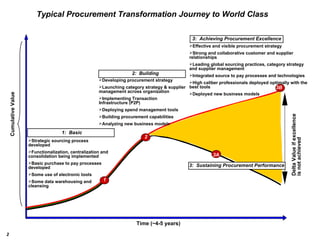
Time (~4-5 years) 1 3:  Achieving Procurement Excellence 2 1:  Basic 2:  Building Strategic sourcing process developed  Functionalization, centralization and consolidation being implemented Basic purchase to pay processes developed  Some use of electronic tools Some data warehousing and cleansing Developing procurement strategy Launching category strategy & supplier management across organization Implementing Transaction Infrastructure (P2P) Deploying spend management tools Building procurement capabilities  Analyzing new business models Effective and visible procurement strategy  Strong and collaborative customer and supplier relationships Leading global sourcing practices, category strategy and supplier management Integrated source to pay processes and technologies High caliber professionals deployed optimally with the best tools Deployed new business models 3B 3A 3:  Sustaining Procurement Performance Typical Procurement Transformation Journey to World Class Cumulative Value Delta Value if excellence  is not achieved
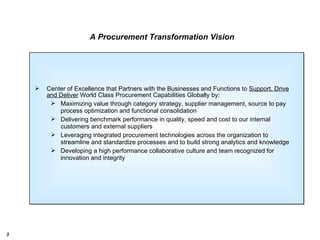
A Procurement Transformation Vision Center of Excellence that Partners with the Businesses and Functions to  Support, Drive and Deliver  World Class Procurement Capabilities Globally by: Maximizing value through category strategy, supplier management, source to pay process optimization and functional consolidation Delivering benchmark performance in quality, speed and cost to our internal customers and external suppliers Leveraging integrated procurement technologies across the organization to streamline and standardize processes and to build strong analytics and knowledge Developing a high performance collaborative culture and team recognized for innovation and integrity
Procurement Transformation Strategy Enablement:   How will we make it happen and sustain it? Innovation:   What do we need to do to raise our level of performance? Direction:   How do we want to procure materials and services? Category Strategy P2P New Business  Models Best  Practices eSolutions Organizational  Effectiveness Desired Practices and Behaviors to Achieve Results and High Performance P2P Category Strategy
World Class Category Strategies and Supplier Relationships for Direct and Indirect Materials and Services Category Strategies Integrated with Product/Market Strategies and Value Chain and Effectively Executed Across all Regions (including ER) World Class Organization and Cost Structure at 0.6% of Spend that Delivers Value Consistently at 10% of Total Materials and Services Spend Streamlined and Automated Purchase to Pay Processes for 95% of Our Spend in a Virtually No Touch Environment One Set of Spend and Supplier Data  Globally Supported by Exceptional Data Analysis and Decision Making Tools A High Performing Collaborative Team and Culture that is Recognized for Innovation and Integrity Customer Service Fulfillment Procurement Transformation End-State Model Analyze spend Assess demand & market Develop sourcing strategy Evaluate & select suppliers Implement agreement & manage suppliers Spend Analysis Sourcing Invoicing eProcurement Contract Mgt Communications/ Knowledge Learning/ Development Organization  Alignment Measurements/ Rewards Category Manager Sustain  Innovate  SCM Planning/ Forecasting HR, Finance, IT, Legal, Real Estate, Security, HSE Marketing & Sales Product Development and Engineering Procurement Manufacturing Value Chain Recognize buying need Create requisition Raise purchase order Receive  goods/service match invoice Settle payment End-State Operating  Model
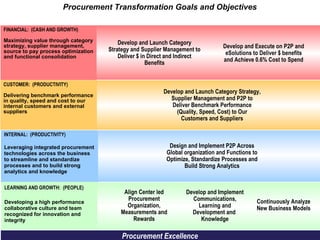
FINANCIAL:  (CASH AND GROWTH) Maximizing value through category strategy, supplier management, source to pay process optimization and functional consolidation Develop and Launch Category Strategy and Supplier Management to Deliver $ in Direct and Indirect Benefits CUSTOMER:  (PRODUCTIVITY) Delivering benchmark performance in quality, speed and cost to our internal customers and external suppliers INTERNAL:  (PRODUCTIVITY) Leveraging integrated procurement technologies across the business to streamline and standardize processes and to build strong analytics and knowledge LEARNING AND GROWTH:  (PEOPLE) Developing a high performance collaborative culture and team recognized for innovation and integrity Develop and Execute on P2P and eSolutions to Deliver $ benefits and Achieve 0.6% Cost to Spend Procurement Excellence Develop and Launch Category Strategy, Supplier Management and P2P to Deliver Benchmark Performance (Quality, Speed, Cost) to Our Customers and Suppliers Design and Implement P2P Across Global organization and Functions to Optimize, Standardize Processes and Build Strong Analytics Align Center led Procurement Organization, Measurements and Rewards Develop and Implement Communications, Learning and Development and  Knowledge Continuously Analyze New Business Models Procurement Transformation Goals and Objectives
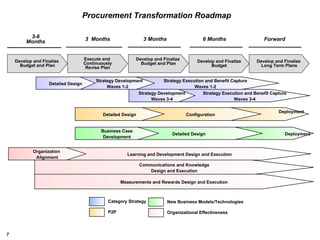
Strategy Execution and Benefit Capture Waves 3-4 Strategy Execution and Benefit Capture Waves 1-2 Strategy Development Waves 3-4 Strategy Development  Waves 1-2 Develop and Finalize  Long Term Plans 3-6 Months 3  Months 6 Months Forward Execute and  Continuously Revise Plan Develop and Finalize  Budget and Plan Develop and Finalize  Budget and Plan Develop and Finalize Budget Procurement Transformation Roadmap Detailed Design Deployment Detailed Design Deployment  Business Case Development Configuration Detailed Design Communications and Knowledge Design and Execution Learning and Development Design and Execution Organization  Alignment Measurements and Rewards Design and Execution Category Strategy P2P New Business Models/Technologies Organizational Effectiveness 3 Months
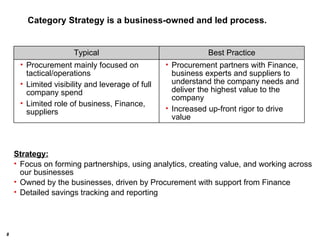
Category Strategy is a business-owned and led process. Strategy: Focus on forming partnerships, using analytics, creating value, and working across our businesses Owned by the businesses, driven by Procurement with support from Finance Detailed savings tracking and reporting Procurement partners with Finance, business experts and suppliers to understand the company needs and deliver the highest value to the company Increased up-front rigor to drive value Best Practice Procurement mainly focused on tactical/operations Limited visibility and leverage of full company spend Limited role of business, Finance, suppliers Typical
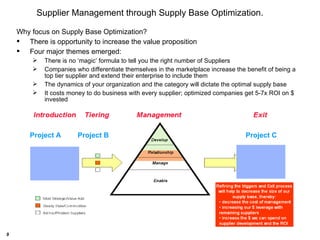
Supplier Management through Supply Base Optimization. Why focus on Supply Base Optimization? There is opportunity to increase the value proposition Four major themes emerged: There is no ‘magic’ formula to tell you the right number of Suppliers Companies who differentiate themselves in the marketplace increase the benefit of being a top tier supplier and extend their enterprise to include them The dynamics of your organization and the category will dictate the optimal supply base It costs money to do business with every supplier; optimized companies get 5-7x ROI on $ invested Project A Project B Project C
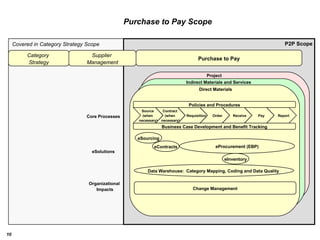
Purchase to Pay Scope Category  Strategy Purchase to Pay Supplier  Management Source  (when  necessary) Contract  (when  necessary) Requisition Order Receive Pay Report Policies and Procedures Business Case Development and Benefit Tracking Change Management eSourcing eContracts eProcurement (EBP) eInventory Data Warehouse:  Category Mapping, Coding and Data Quality  Direct Materials Indirect Materials and Services Project P2P Scope Core Processes eSolutions Organizational  Impacts Covered in Category Strategy Scope
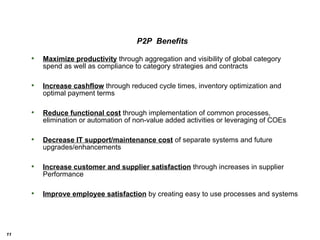
Maximize productivity  through aggregation and visibility of global category spend as well as compliance to category strategies and contracts Increase cashflow  through reduced cycle times, inventory optimization and optimal payment terms Reduce functional cost  through implementation of common processes, elimination or automation of non-value added activities or leveraging of COEs Decrease IT support/maintenance cost  of separate systems and future upgrades/enhancements Increase customer and supplier satisfaction  through increases in supplier Performance Improve employee satisfaction  by creating easy to use processes and systems P2P  Benefits
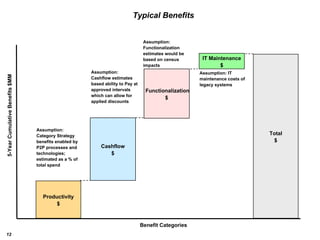
Productivity $ Cashflow $ Functionalization $ Total $ 5-Year Cumulative Benefits $MM Benefit Categories Typical Benefits Assumption: Category Strategy benefits enabled by P2P processes and technologies; estimated as a % of total spend  Assumption: Cashflow estimates based ability to Pay at approved intervals which can allow for applied discounts Assumption: Functionalization estimates would be based on census impacts IT Maintenance $ Assumption: IT maintenance costs of legacy systems
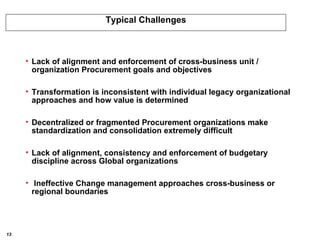
Typical Challenges Lack of alignment and enforcement of cross-business unit / organization Procurement goals and objectives Transformation is inconsistent with individual legacy organizational approaches and how value is determined Decentralized or fragmented Procurement organizations make standardization and consolidation extremely difficult Lack of alignment, consistency and enforcement of budgetary discipline across Global organizations Ineffective Change management approaches cross-business or regional boundaries

Procurement Ft Sample

  • 1.
  • 2.
    Time (~4-5 years)1 3: Achieving Procurement Excellence 2 1: Basic 2: Building Strategic sourcing process developed Functionalization, centralization and consolidation being implemented Basic purchase to pay processes developed Some use of electronic tools Some data warehousing and cleansing Developing procurement strategy Launching category strategy & supplier management across organization Implementing Transaction Infrastructure (P2P) Deploying spend management tools Building procurement capabilities Analyzing new business models Effective and visible procurement strategy Strong and collaborative customer and supplier relationships Leading global sourcing practices, category strategy and supplier management Integrated source to pay processes and technologies High caliber professionals deployed optimally with the best tools Deployed new business models 3B 3A 3: Sustaining Procurement Performance Typical Procurement Transformation Journey to World Class Cumulative Value Delta Value if excellence is not achieved
  • 3.
    A Procurement TransformationVision Center of Excellence that Partners with the Businesses and Functions to Support, Drive and Deliver World Class Procurement Capabilities Globally by: Maximizing value through category strategy, supplier management, source to pay process optimization and functional consolidation Delivering benchmark performance in quality, speed and cost to our internal customers and external suppliers Leveraging integrated procurement technologies across the organization to streamline and standardize processes and to build strong analytics and knowledge Developing a high performance collaborative culture and team recognized for innovation and integrity
  • 4.
    Procurement Transformation StrategyEnablement: How will we make it happen and sustain it? Innovation: What do we need to do to raise our level of performance? Direction: How do we want to procure materials and services? Category Strategy P2P New Business Models Best Practices eSolutions Organizational Effectiveness Desired Practices and Behaviors to Achieve Results and High Performance P2P Category Strategy
  • 5.
    World Class CategoryStrategies and Supplier Relationships for Direct and Indirect Materials and Services Category Strategies Integrated with Product/Market Strategies and Value Chain and Effectively Executed Across all Regions (including ER) World Class Organization and Cost Structure at 0.6% of Spend that Delivers Value Consistently at 10% of Total Materials and Services Spend Streamlined and Automated Purchase to Pay Processes for 95% of Our Spend in a Virtually No Touch Environment One Set of Spend and Supplier Data Globally Supported by Exceptional Data Analysis and Decision Making Tools A High Performing Collaborative Team and Culture that is Recognized for Innovation and Integrity Customer Service Fulfillment Procurement Transformation End-State Model Analyze spend Assess demand & market Develop sourcing strategy Evaluate & select suppliers Implement agreement & manage suppliers Spend Analysis Sourcing Invoicing eProcurement Contract Mgt Communications/ Knowledge Learning/ Development Organization Alignment Measurements/ Rewards Category Manager Sustain Innovate SCM Planning/ Forecasting HR, Finance, IT, Legal, Real Estate, Security, HSE Marketing & Sales Product Development and Engineering Procurement Manufacturing Value Chain Recognize buying need Create requisition Raise purchase order Receive goods/service match invoice Settle payment End-State Operating Model
  • 6.
    FINANCIAL: (CASHAND GROWTH) Maximizing value through category strategy, supplier management, source to pay process optimization and functional consolidation Develop and Launch Category Strategy and Supplier Management to Deliver $ in Direct and Indirect Benefits CUSTOMER: (PRODUCTIVITY) Delivering benchmark performance in quality, speed and cost to our internal customers and external suppliers INTERNAL: (PRODUCTIVITY) Leveraging integrated procurement technologies across the business to streamline and standardize processes and to build strong analytics and knowledge LEARNING AND GROWTH: (PEOPLE) Developing a high performance collaborative culture and team recognized for innovation and integrity Develop and Execute on P2P and eSolutions to Deliver $ benefits and Achieve 0.6% Cost to Spend Procurement Excellence Develop and Launch Category Strategy, Supplier Management and P2P to Deliver Benchmark Performance (Quality, Speed, Cost) to Our Customers and Suppliers Design and Implement P2P Across Global organization and Functions to Optimize, Standardize Processes and Build Strong Analytics Align Center led Procurement Organization, Measurements and Rewards Develop and Implement Communications, Learning and Development and Knowledge Continuously Analyze New Business Models Procurement Transformation Goals and Objectives
  • 7.
    Strategy Execution andBenefit Capture Waves 3-4 Strategy Execution and Benefit Capture Waves 1-2 Strategy Development Waves 3-4 Strategy Development Waves 1-2 Develop and Finalize Long Term Plans 3-6 Months 3 Months 6 Months Forward Execute and Continuously Revise Plan Develop and Finalize Budget and Plan Develop and Finalize Budget and Plan Develop and Finalize Budget Procurement Transformation Roadmap Detailed Design Deployment Detailed Design Deployment Business Case Development Configuration Detailed Design Communications and Knowledge Design and Execution Learning and Development Design and Execution Organization Alignment Measurements and Rewards Design and Execution Category Strategy P2P New Business Models/Technologies Organizational Effectiveness 3 Months
  • 8.
    Category Strategy isa business-owned and led process. Strategy: Focus on forming partnerships, using analytics, creating value, and working across our businesses Owned by the businesses, driven by Procurement with support from Finance Detailed savings tracking and reporting Procurement partners with Finance, business experts and suppliers to understand the company needs and deliver the highest value to the company Increased up-front rigor to drive value Best Practice Procurement mainly focused on tactical/operations Limited visibility and leverage of full company spend Limited role of business, Finance, suppliers Typical
  • 9.
    Supplier Management throughSupply Base Optimization. Why focus on Supply Base Optimization? There is opportunity to increase the value proposition Four major themes emerged: There is no ‘magic’ formula to tell you the right number of Suppliers Companies who differentiate themselves in the marketplace increase the benefit of being a top tier supplier and extend their enterprise to include them The dynamics of your organization and the category will dictate the optimal supply base It costs money to do business with every supplier; optimized companies get 5-7x ROI on $ invested Project A Project B Project C
  • 10.
    Purchase to PayScope Category Strategy Purchase to Pay Supplier Management Source (when necessary) Contract (when necessary) Requisition Order Receive Pay Report Policies and Procedures Business Case Development and Benefit Tracking Change Management eSourcing eContracts eProcurement (EBP) eInventory Data Warehouse: Category Mapping, Coding and Data Quality Direct Materials Indirect Materials and Services Project P2P Scope Core Processes eSolutions Organizational Impacts Covered in Category Strategy Scope
  • 11.
    Maximize productivity through aggregation and visibility of global category spend as well as compliance to category strategies and contracts Increase cashflow through reduced cycle times, inventory optimization and optimal payment terms Reduce functional cost through implementation of common processes, elimination or automation of non-value added activities or leveraging of COEs Decrease IT support/maintenance cost of separate systems and future upgrades/enhancements Increase customer and supplier satisfaction through increases in supplier Performance Improve employee satisfaction by creating easy to use processes and systems P2P Benefits
  • 12.
    Productivity $ Cashflow$ Functionalization $ Total $ 5-Year Cumulative Benefits $MM Benefit Categories Typical Benefits Assumption: Category Strategy benefits enabled by P2P processes and technologies; estimated as a % of total spend Assumption: Cashflow estimates based ability to Pay at approved intervals which can allow for applied discounts Assumption: Functionalization estimates would be based on census impacts IT Maintenance $ Assumption: IT maintenance costs of legacy systems
  • 13.
    Typical Challenges Lackof alignment and enforcement of cross-business unit / organization Procurement goals and objectives Transformation is inconsistent with individual legacy organizational approaches and how value is determined Decentralized or fragmented Procurement organizations make standardization and consolidation extremely difficult Lack of alignment, consistency and enforcement of budgetary discipline across Global organizations Ineffective Change management approaches cross-business or regional boundaries