

How will legislation
shape procurement
in the future
PfH Live
24 June 2014
Andrew Millross, Partner
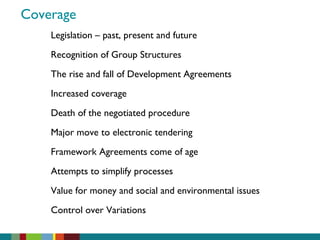
Coverage
Legislation – past, present and future
Recognition of Group Structures
The rise and fall of Development Agreements
Increased coverage
Death of the negotiated procedure
Major move to electronic tendering
Framework Agreements come of age
Attempts to simplify processes
Value for money and social and environmental issues
Control over Variations
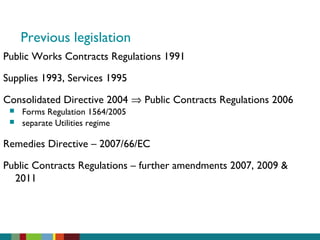
Previous legislation
Public Works Contracts Regulations 1991
Supplies 1993, Services 1995
Consolidated Directive 2004 ⇒ Public Contracts Regulations 2006
 Forms Regulation 1564/2005
 separate Utilities regime
Remedies Directive – 2007/66/EC
Public Contracts Regulations – further amendments 2007, 2009 &
2011
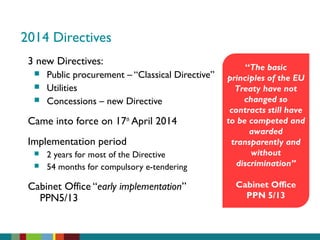
2014 Directives
3 new Directives:
 Public procurement – “Classical Directive”
 Utilities
 Concessions – new Directive
Came into force on 17th
April 2014
Implementation period
 2 years for most of the Directive
 54 months for compulsory e-tendering
Cabinet Office “early implementation”
PPN5/13
“The basic
principles of the EU
Treaty have not
changed so
contracts still have
to be competed and
awarded
transparently and
without
discrimination”
Cabinet Office
PPN 5/13
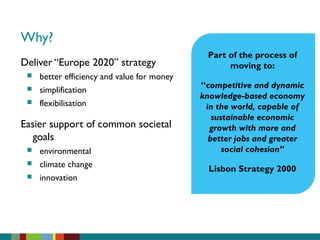
Why?
Deliver “Europe 2020” strategy
 better efficiency and value for money
 simplification
 flexibilisation
Easier support of common societal
goals
 environmental
 climate change
 innovation
Part of the process of
moving to:
“competitive and dynamic
knowledge-based economy
in the world, capable of
sustainable economic
growth with more and
better jobs and greater
social cohesion”
Lisbon Strategy 2000
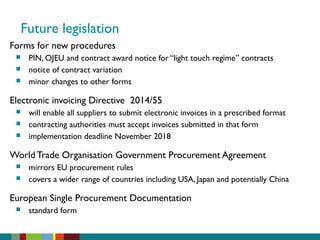
Future legislation
Forms for new procedures
 PIN, OJEU and contract award notice for “light touch regime” contracts
 notice of contract variation
 minor changes to other forms
Electronic invoicing Directive 2014/55
 will enable all suppliers to submit electronic invoices in a prescribed format
 contracting authorities must accept invoices submitted in that form
 implementation deadline November 2018
World Trade Organisation Government Procurement Agreement
 mirrors EU procurement rules
 covers a wider range of countries including USA, Japan and potentially China
European Single Procurement Documentation
 standard form
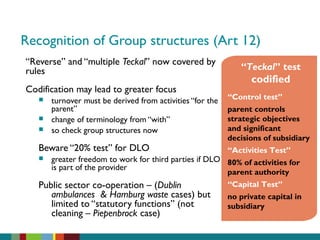
Recognition of Group structures (Art 12)
“Reverse” and “multiple Teckal” now covered by
rules
Codification may lead to greater focus
 turnover must be derived from activities “for the
parent”
 change of terminology from “with”
 so check group structures now
Beware “20% test” for DLO
 greater freedom to work for third parties if DLO
is part of the provider
Public sector co-operation – (Dublin
ambulances & Hamburg waste cases) but
limited to “statutory functions” (not
cleaning – Piepenbrock case)
“Teckal” test
codified
“Control test”
parent controls
strategic objectives
and significant
decisions of subsidiary
“Activities Test”
80% of activities for
parent authority
“Capital Test”
no private capital in
subsidiary
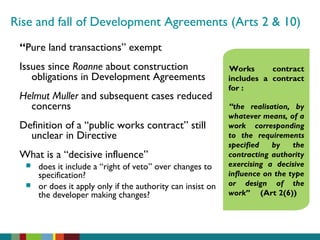
Rise and fall of Development Agreements (Arts 2 & 10)
“Pure land transactions” exempt
Issues since Roanne about construction
obligations in Development Agreements
Helmut Muller and subsequent cases reduced
concerns
Definition of a “public works contract” still
unclear in Directive
What is a “decisive influence”
 does it include a “right of veto” over changes to
specification?
 or does it apply only if the authority can insist on
the developer making changes?
 
Works contract
includes a contract
for :
“the realisation, by
whatever means, of a
work corresponding
to the requirements
specified by the
contracting authority
exercising a decisive
influence on the type
or design of the
work” (Art 2(6))
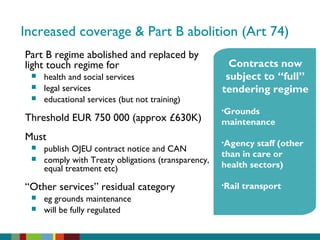
Increased coverage & Part B abolition (Art 74)
Part B regime abolished and replaced by
light touch regime for
 health and social services
 legal services
 educational services (but not training)
Threshold EUR 750 000 (approx £630K)
Must
 publish OJEU contract notice and CAN
 comply with Treaty obligations (transparency,
equal treatment etc)
“Other services” residual category
 eg grounds maintenance
 will be fully regulated
Contracts now
subject to “full”
tendering regime
•Grounds
maintenance
•Agency staff (other
than in care or
health sectors)
•Rail transport
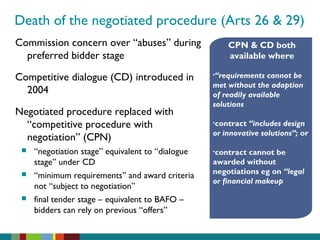
Death of the negotiated procedure (Arts 26 & 29)
Commission concern over “abuses” during
preferred bidder stage
Competitive dialogue (CD) introduced in
2004
Negotiated procedure replaced with
“competitive procedure with
negotiation” (CPN)
 “negotiation stage” equivalent to “dialogue
stage” under CD
 “minimum requirements” and award criteria
not “subject to negotiation”
 final tender stage – equivalent to BAFO –
bidders can rely on previous “offers”
CPN & CD both
available where
•“requirements cannot be
met without the adaption
of readily available
solutions
•contract “includes design
or innovative solutions”; or
•contract cannot be
awarded without
negotiations eg on “legal
or financial makeup
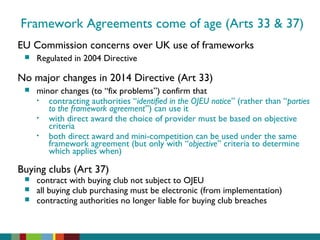
Framework Agreements come of age (Arts 33 & 37)
EU Commission concerns over UK use of frameworks
 Regulated in 2004 Directive
No major changes in 2014 Directive (Art 33)
 minor changes (to “fix problems”) confirm that
• contracting authorities “identified in the OJEU notice” (rather than “parties
to the framework agreement”) can use it
• with direct award the choice of provider must be based on objective
criteria
• both direct award and mini-competition can be used under the same
framework agreement (but only with “objective” criteria to determine
which applies when)
Buying clubs (Art 37)
 contract with buying club not subject to OJEU
 all buying club purchasing must be electronic (from implementation)
 contracting authorities no longer liable for buying club breaches
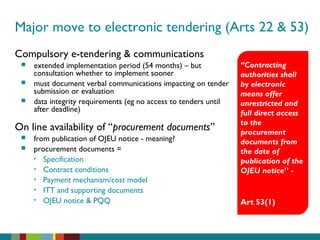
Major move to electronic tendering (Arts 22 & 53)
Compulsory e-tendering & communications
 extended implementation period (54 months) – but
consultation whether to implement sooner
 must document verbal communications impacting on tender
submission or evaluation
 data integrity requirements (eg no access to tenders until
after deadline)
On line availability of “procurement documents”
 from publication of OJEU notice - meaning?
 procurement documents =
• Specification
• Contract conditions
• Payment mechanism/cost model
• ITT and supporting documents
• OJEU notice & PQQ
“Contracting
authorities shall
by electronic
means offer
unrestricted and
full direct access
to the
procurement
documents from
the date of
publication of the
OJEU notice” -
Art 53(1)
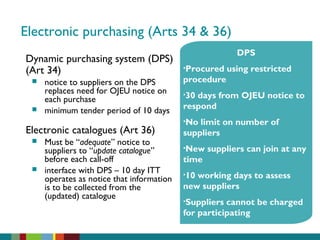
Electronic purchasing (Arts 34 & 36)
Dynamic purchasing system (DPS)
(Art 34)
 notice to suppliers on the DPS
replaces need for OJEU notice on
each purchase
 minimum tender period of 10 days
Electronic catalogues (Art 36)
 Must be “adequate” notice to
suppliers to “update catalogue”
before each call-off
 interface with DPS – 10 day ITT
operates as notice that information
is to be collected from the
(updated) catalogue
DPS
•Procured using restricted
procedure
•30 days from OJEU notice to
respond
•No limit on number of
suppliers
•New suppliers can join at any
time
•10 working days to assess
new suppliers
•Suppliers cannot be charged
for participating
Attempts to simplify procedures (Arts 46 & 48)
Single aggregated PIN covering several procurements over 12
months
 at start of each procurement bidders that “express an interest” are
sent a “notice to confirm interest”
Lots
 will be able to limit the number of Lots a tenderer
• can bid for, and/or
• can win
 must divide procurement into Lots or explain why not in the
procurement documents
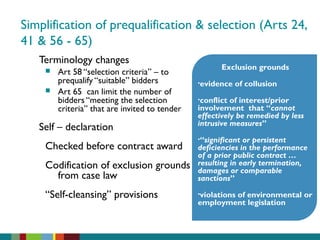
Simplification of prequalification & selection (Arts 24,
41 & 56 - 65)
Terminology changes
 Art 58 “selection criteria” – to
prequalify “suitable” bidders
 Art 65 can limit the number of
bidders “meeting the selection
criteria” that are invited to tender
Self – declaration
Checked before contract award
Codification of exclusion grounds
from case law
“Self-cleansing” provisions
Exclusion grounds
•evidence of collusion
•conflict of interest/prior
involvement that “cannot
effectively be remedied by less
intrusive measures”
•“significant or persistent
deficiencies in the performance
of a prior public contract …
resulting in early termination,
damages or comparable
sanctions”
•violations of environmental or
employment legislation
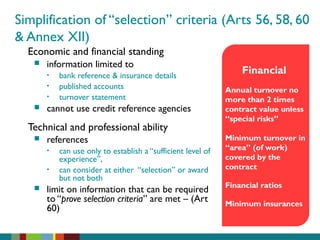
Simplification of “selection” criteria (Arts 56, 58, 60
& Annex XII)
Economic and financial standing
 information limited to
• bank reference & insurance details
• published accounts
• turnover statement
 cannot use credit reference agencies
Technical and professional ability
 references
• can use only to establish a “sufficient level of
experience”,
• can consider at either “selection” or award
but not both
 limit on information that can be required
to “prove selection criteria” are met – (Art
60)
Financial
Annual turnover no
more than 2 times
contract value unless
“special risks”
Minimum turnover in
“area” (of work)
covered by the
contract
Financial ratios
Minimum insurances
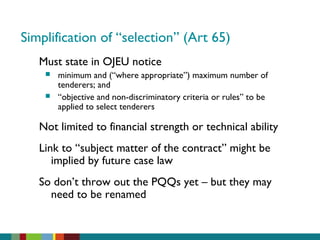
Simplification of “selection” (Art 65)
Must state in OJEU notice
 minimum and (“where appropriate”) maximum number of
tenderers; and
 “objective and non-discriminatory criteria or rules” to be
applied to select tenderers
Not limited to financial strength or technical ability
Link to “subject matter of the contract” might be
implied by future case law
So don’t throw out the PQQs yet – but they may
need to be renamed
Value for money (Arts 40, 67, 68 &
71)Soft market testing specifically permitted (Art 40)
 but must ensure it does not distort competition (Art 41)
Award criteria (Arts 67 & 68)
 MEAT can now specifically include cost to the authority/lifecycle
costs
 Government consulting on banning “lowest price”
 can consider “organisation, qualification and experience of staff
assigned to the contract”
Direct payment of subcontractors (subject to national
law) (Art 71)
Sustainability (Arts 42, 43 67 & 70)
Technical specifications (Art 42)
 can now include “method of production” if proportionate to contract value
and objectives
 must include accessibility criteria for people with disabilities
Labels (Art 43)
 can specify environmental, social eg “fair trade” labels, if “label” is
• “objectively and independently verified”
• “international”
• “linked to subject matter of contract” and
• “equivalent labels” are accepted
Award Criteria (Art 67)
 can include “qualitative, environmental and/or social aspects” provided “linked
to the subject matter of the contract”
Contract performance conditions (Art 70)
 can include “environmental, social or employment-related considerations” if
“linked to the subject matter of the contract”
Regulation ofVariations (Art 72)
Permitted where variation:
 is provided for in contract
• “in clear precise and unequivocal review
clauses…
• stating the scope and nature of possible
modifications or options
• and the conditions under which they may be
used”
• may not “alter the overall nature of the contract”
 is a new contractor “following corporate
restructuring including takeover, merger, acquisition or
insolvency” including “step-in” to subcontracts
 has a value below both
• applicable EU tendering threshold; and
• 10% of initial contract value for services/supplies
or 15% of original contract value for works (plus
inflation, if contract includes an inflation clauses)
– value assessed cumulatively
 is not “substantial” within Pressetext (see box)
“Substantial”
changes – Pressetext
Changed contract would
have attracted other
tenderers or changed the
tender result
Variation “changes the
economic balance of the
contract in favour of the
contractor in a way not
provided for”
“Considerable” extension
to scope
New contractor (other
than as left)
Questions
Free e-briefings:
www.anthonycollings.com/news-
and-events/briefings.aspx
Advice:
andrew.millross@anthonycollins.com
0121 212 7473

How will legislation shape procurement in the coming years?

  • 1.
    How will legislation shapeprocurement in the future PfH Live 24 June 2014 Andrew Millross, Partner
  • 2.
    Coverage Legislation – past,present and future Recognition of Group Structures The rise and fall of Development Agreements Increased coverage Death of the negotiated procedure Major move to electronic tendering Framework Agreements come of age Attempts to simplify processes Value for money and social and environmental issues Control over Variations
  • 3.
    Previous legislation Public WorksContracts Regulations 1991 Supplies 1993, Services 1995 Consolidated Directive 2004 ⇒ Public Contracts Regulations 2006  Forms Regulation 1564/2005  separate Utilities regime Remedies Directive – 2007/66/EC Public Contracts Regulations – further amendments 2007, 2009 & 2011
  • 4.
    2014 Directives 3 newDirectives:  Public procurement – “Classical Directive”  Utilities  Concessions – new Directive Came into force on 17th April 2014 Implementation period  2 years for most of the Directive  54 months for compulsory e-tendering Cabinet Office “early implementation” PPN5/13 “The basic principles of the EU Treaty have not changed so contracts still have to be competed and awarded transparently and without discrimination” Cabinet Office PPN 5/13
  • 5.
    Why? Deliver “Europe 2020”strategy  better efficiency and value for money  simplification  flexibilisation Easier support of common societal goals  environmental  climate change  innovation Part of the process of moving to: “competitive and dynamic knowledge-based economy in the world, capable of sustainable economic growth with more and better jobs and greater social cohesion” Lisbon Strategy 2000
  • 6.
    Future legislation Forms fornew procedures  PIN, OJEU and contract award notice for “light touch regime” contracts  notice of contract variation  minor changes to other forms Electronic invoicing Directive 2014/55  will enable all suppliers to submit electronic invoices in a prescribed format  contracting authorities must accept invoices submitted in that form  implementation deadline November 2018 World Trade Organisation Government Procurement Agreement  mirrors EU procurement rules  covers a wider range of countries including USA, Japan and potentially China European Single Procurement Documentation  standard form
  • 7.
    Recognition of Groupstructures (Art 12) “Reverse” and “multiple Teckal” now covered by rules Codification may lead to greater focus  turnover must be derived from activities “for the parent”  change of terminology from “with”  so check group structures now Beware “20% test” for DLO  greater freedom to work for third parties if DLO is part of the provider Public sector co-operation – (Dublin ambulances & Hamburg waste cases) but limited to “statutory functions” (not cleaning – Piepenbrock case) “Teckal” test codified “Control test” parent controls strategic objectives and significant decisions of subsidiary “Activities Test” 80% of activities for parent authority “Capital Test” no private capital in subsidiary
  • 8.
    Rise and fallof Development Agreements (Arts 2 & 10) “Pure land transactions” exempt Issues since Roanne about construction obligations in Development Agreements Helmut Muller and subsequent cases reduced concerns Definition of a “public works contract” still unclear in Directive What is a “decisive influence”  does it include a “right of veto” over changes to specification?  or does it apply only if the authority can insist on the developer making changes?   Works contract includes a contract for : “the realisation, by whatever means, of a work corresponding to the requirements specified by the contracting authority exercising a decisive influence on the type or design of the work” (Art 2(6))
  • 9.
    Increased coverage &Part B abolition (Art 74) Part B regime abolished and replaced by light touch regime for  health and social services  legal services  educational services (but not training) Threshold EUR 750 000 (approx £630K) Must  publish OJEU contract notice and CAN  comply with Treaty obligations (transparency, equal treatment etc) “Other services” residual category  eg grounds maintenance  will be fully regulated Contracts now subject to “full” tendering regime •Grounds maintenance •Agency staff (other than in care or health sectors) •Rail transport
  • 10.
    Death of thenegotiated procedure (Arts 26 & 29) Commission concern over “abuses” during preferred bidder stage Competitive dialogue (CD) introduced in 2004 Negotiated procedure replaced with “competitive procedure with negotiation” (CPN)  “negotiation stage” equivalent to “dialogue stage” under CD  “minimum requirements” and award criteria not “subject to negotiation”  final tender stage – equivalent to BAFO – bidders can rely on previous “offers” CPN & CD both available where •“requirements cannot be met without the adaption of readily available solutions •contract “includes design or innovative solutions”; or •contract cannot be awarded without negotiations eg on “legal or financial makeup
  • 11.
    Framework Agreements comeof age (Arts 33 & 37) EU Commission concerns over UK use of frameworks  Regulated in 2004 Directive No major changes in 2014 Directive (Art 33)  minor changes (to “fix problems”) confirm that • contracting authorities “identified in the OJEU notice” (rather than “parties to the framework agreement”) can use it • with direct award the choice of provider must be based on objective criteria • both direct award and mini-competition can be used under the same framework agreement (but only with “objective” criteria to determine which applies when) Buying clubs (Art 37)  contract with buying club not subject to OJEU  all buying club purchasing must be electronic (from implementation)  contracting authorities no longer liable for buying club breaches
  • 12.
    Major move toelectronic tendering (Arts 22 & 53) Compulsory e-tendering & communications  extended implementation period (54 months) – but consultation whether to implement sooner  must document verbal communications impacting on tender submission or evaluation  data integrity requirements (eg no access to tenders until after deadline) On line availability of “procurement documents”  from publication of OJEU notice - meaning?  procurement documents = • Specification • Contract conditions • Payment mechanism/cost model • ITT and supporting documents • OJEU notice & PQQ “Contracting authorities shall by electronic means offer unrestricted and full direct access to the procurement documents from the date of publication of the OJEU notice” - Art 53(1)
  • 13.
    Electronic purchasing (Arts34 & 36) Dynamic purchasing system (DPS) (Art 34)  notice to suppliers on the DPS replaces need for OJEU notice on each purchase  minimum tender period of 10 days Electronic catalogues (Art 36)  Must be “adequate” notice to suppliers to “update catalogue” before each call-off  interface with DPS – 10 day ITT operates as notice that information is to be collected from the (updated) catalogue DPS •Procured using restricted procedure •30 days from OJEU notice to respond •No limit on number of suppliers •New suppliers can join at any time •10 working days to assess new suppliers •Suppliers cannot be charged for participating
  • 14.
    Attempts to simplifyprocedures (Arts 46 & 48) Single aggregated PIN covering several procurements over 12 months  at start of each procurement bidders that “express an interest” are sent a “notice to confirm interest” Lots  will be able to limit the number of Lots a tenderer • can bid for, and/or • can win  must divide procurement into Lots or explain why not in the procurement documents
  • 15.
    Simplification of prequalification& selection (Arts 24, 41 & 56 - 65) Terminology changes  Art 58 “selection criteria” – to prequalify “suitable” bidders  Art 65 can limit the number of bidders “meeting the selection criteria” that are invited to tender Self – declaration Checked before contract award Codification of exclusion grounds from case law “Self-cleansing” provisions Exclusion grounds •evidence of collusion •conflict of interest/prior involvement that “cannot effectively be remedied by less intrusive measures” •“significant or persistent deficiencies in the performance of a prior public contract … resulting in early termination, damages or comparable sanctions” •violations of environmental or employment legislation
  • 16.
    Simplification of “selection”criteria (Arts 56, 58, 60 & Annex XII) Economic and financial standing  information limited to • bank reference & insurance details • published accounts • turnover statement  cannot use credit reference agencies Technical and professional ability  references • can use only to establish a “sufficient level of experience”, • can consider at either “selection” or award but not both  limit on information that can be required to “prove selection criteria” are met – (Art 60) Financial Annual turnover no more than 2 times contract value unless “special risks” Minimum turnover in “area” (of work) covered by the contract Financial ratios Minimum insurances
  • 17.
    Simplification of “selection”(Art 65) Must state in OJEU notice  minimum and (“where appropriate”) maximum number of tenderers; and  “objective and non-discriminatory criteria or rules” to be applied to select tenderers Not limited to financial strength or technical ability Link to “subject matter of the contract” might be implied by future case law So don’t throw out the PQQs yet – but they may need to be renamed
  • 18.
    Value for money(Arts 40, 67, 68 & 71)Soft market testing specifically permitted (Art 40)  but must ensure it does not distort competition (Art 41) Award criteria (Arts 67 & 68)  MEAT can now specifically include cost to the authority/lifecycle costs  Government consulting on banning “lowest price”  can consider “organisation, qualification and experience of staff assigned to the contract” Direct payment of subcontractors (subject to national law) (Art 71)
  • 19.
    Sustainability (Arts 42,43 67 & 70) Technical specifications (Art 42)  can now include “method of production” if proportionate to contract value and objectives  must include accessibility criteria for people with disabilities Labels (Art 43)  can specify environmental, social eg “fair trade” labels, if “label” is • “objectively and independently verified” • “international” • “linked to subject matter of contract” and • “equivalent labels” are accepted Award Criteria (Art 67)  can include “qualitative, environmental and/or social aspects” provided “linked to the subject matter of the contract” Contract performance conditions (Art 70)  can include “environmental, social or employment-related considerations” if “linked to the subject matter of the contract”
  • 20.
    Regulation ofVariations (Art72) Permitted where variation:  is provided for in contract • “in clear precise and unequivocal review clauses… • stating the scope and nature of possible modifications or options • and the conditions under which they may be used” • may not “alter the overall nature of the contract”  is a new contractor “following corporate restructuring including takeover, merger, acquisition or insolvency” including “step-in” to subcontracts  has a value below both • applicable EU tendering threshold; and • 10% of initial contract value for services/supplies or 15% of original contract value for works (plus inflation, if contract includes an inflation clauses) – value assessed cumulatively  is not “substantial” within Pressetext (see box) “Substantial” changes – Pressetext Changed contract would have attracted other tenderers or changed the tender result Variation “changes the economic balance of the contract in favour of the contractor in a way not provided for” “Considerable” extension to scope New contractor (other than as left)
  • 21.