Locating the Epicenter of an
Earthquake
The Triangulation
Method
Earthquake
In an earthquake, stored energy is suddenly
released through a movement along a fault.
A fault is a fracture or zone of fractures in
rock along which the two sides have been
displaced relative to each other parallel to
the fracture
Earthquake
Most earthquakes can be explained by
plate tectonics and the elastic rebound
theory. The theory was proposed by
H.F. Reid of Johns Hopkins University
in 1906. It says that the constant motion
of rocks along one side of a fault
boundary causes the rocks on the
opposite side to bend.
Earthquake: Seismic Waves
Seismic waves emanating from the focus can travel
as body waves or surface waves.
Body waves travel in all directions from the focus
through the body of the Earth
Surface waves are different from body waves
because they don’t travel through the Earth;
instead they are constrained to travel along the
surface of the Earth from the epicenter.
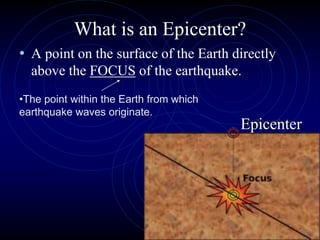
What is an Epicenter?
• A point on the surface of the Earth directly
above the FOCUS of the earthquake.
•The point within the Earth from which
earthquake waves originate.
Epicenter
Properties of Seismic Waves
There are two types of body waves; the
compressional or P waves and the shear or S
waves.
P waves (or primary waves) travel with a velocity
that depends on the elastic properties of the rock
that they travel through.?
S waves (or secondary waves) are shear waves.
Locating the Epicenter
In order to determine the location of an
earthquake, the earthquake needs to be
recorded on three different seismographs
that are at significantly different locations.
The other piece of information needed is the
time it takes for P-waves and S-waves to
travel through the Earth and arrive at a
seismographic station.
The Triangulation Method
Triangulation
A mathematical method for locating the
epicenter of an earthquake using three
or more data sets from seismic stations.
This data is collected using earthquake
monitoring instruments called seismographs
which record the seismic waves of the
earthquake.
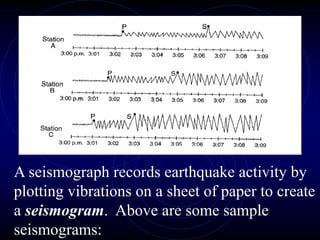
A seismograph records earthquake activity by
plotting vibrations on a sheet of paper to create
a seismogram. Above are some sample
seismograms:
Triangulation
If three arrival times are available at three
different seismic stations then triangulation
can be used to find the location of the focus
or epicenter and the time of occurrence of
the earthquake.
The distance between the beginning of the
first P wave and the first S wave tells you
how many seconds the waves are apart.
Triangulation
P waves move about 5.5 kilometers per second
(k/s) through granite, whereas the slower S waves
move only about 3 k/s through granite.
Imagine that at station A a P wave is detected and
the S wave follows 42.8 seconds later. Since the S
wave is 2.5 k/s slower than the P wave, difference
in speed multiplied by the time difference will
give the distance to the source. Thus, the
earthquake epicenter is 107 km away from station
A (42.8 s times 2.5 k/s= 107 km). Although we
can determine the distance, we still don't know the
direction, which is why we need data from the
other stations.
Triangulation
Since the P (or “primary”) waves travel faster than
the S (or “secondary”) waves, P waves will arrive
at a given seismograph station sooner than S
waves. In other words, the S waves lag behind the
P waves. In fact, the time difference between
when the P waves arrive at a seismograph station
and when the S waves arrive at the same station is
called Time Lag. Knowing the time lag for a
number of seismograph stations is essential in
pinpointing the location of the epicenter of an
earthquake.
Collecting data from the recording
stations:
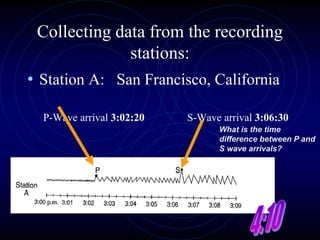
• Station A: San Francisco, California
P-Wave arrival 3:02:20 S-Wave arrival 3:06:30
What is the time
difference between P and
S wave arrivals?
Collecting data from the recording
stations:
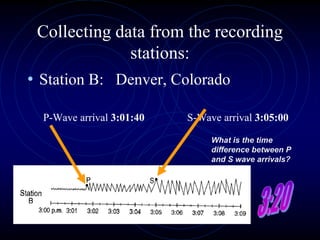
• Station B: Denver, Colorado
P-Wave arrival 3:01:40 S-Wave arrival 3:05:00
What is the time
difference between P
and S wave arrivals?
Collecting data from the recording
stations:
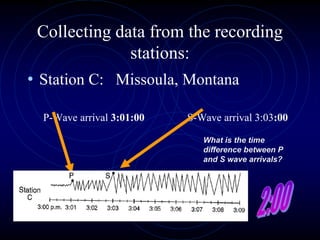
• Station C: Missoula, Montana
P-Wave arrival 3:01:00 S-Wave arrival 3:03:00
What is the time
difference between P
and S wave arrivals?
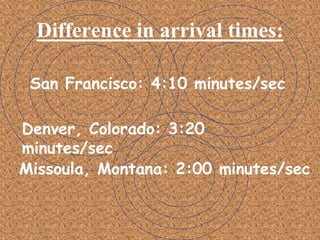
Difference in arrival times:
San Francisco: 4:10 minutes/sec
Denver, Colorado: 3:20
minutes/sec
Missoula, Montana: 2:00 minutes/sec
Locating the Epicenter
Finally we plot the P and S wave travel-
time curves to find the distance from
each station to the earthquake
epicenter. We do this by finding the
unique epicenter distance where the
difference in the P and S wave travel
times is exactly equal to the difference
you calculated from the seismogram.
(we use a time/distance curve plot)
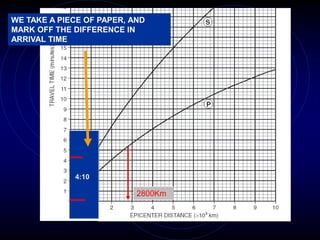
WE TAKE A PIECE OF PAPER, AND
MARK OFF THE DIFFERENCE IN
ARRIVAL TIME
2800Km
4:10
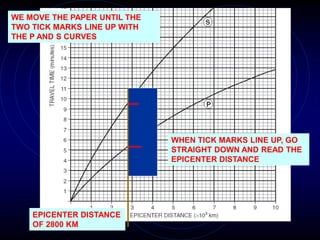
WE MOVE THE PAPER UNTIL THE
TWO TICK MARKS LINE UP WITH
THE P AND S CURVES
WHEN TICK MARKS LINE UP, GO
STRAIGHT DOWN AND READ THE
EPICENTER DISTANCE
EPICENTER DISTANCE
OF 2800 KM
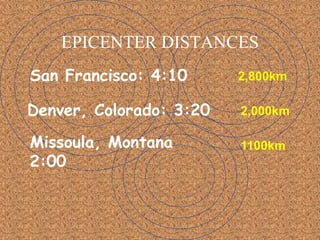
EPICENTER DISTANCES
San Francisco: 4:10
Denver, Colorado: 3:20
Missoula, Montana
2:00
2,800km
1100km
2,000km
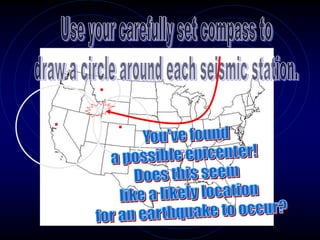
Epicenter Distances
Using the map scale, and a drafting
compass we set it to the appropriate
length for the distance from the first
location to the epicenter. Place the
compass point at this location and draw
an arc using the distance as the radius.
Repeat for the other two locations. The
intersection of the three arcs identifies
the epicenter of the earthquake.
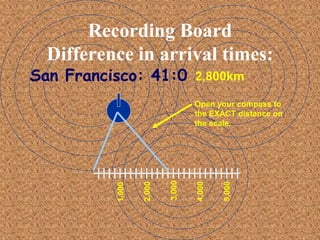
Recording Board
Difference in arrival times:
San Francisco: 41:0 2,800km
1,000
2,000
3,000
4,000
5,000
Open your compass to
the EXACT distance on
the scale.
. .
.
Good luck on the lab!
I hope you took notes!

LocatingEpicenterEarthquake.ppt

  • 1.
    Locating the Epicenterof an Earthquake The Triangulation Method
  • 2.
    Earthquake In an earthquake,stored energy is suddenly released through a movement along a fault. A fault is a fracture or zone of fractures in rock along which the two sides have been displaced relative to each other parallel to the fracture
  • 3.
    Earthquake Most earthquakes canbe explained by plate tectonics and the elastic rebound theory. The theory was proposed by H.F. Reid of Johns Hopkins University in 1906. It says that the constant motion of rocks along one side of a fault boundary causes the rocks on the opposite side to bend.
  • 4.
    Earthquake: Seismic Waves Seismicwaves emanating from the focus can travel as body waves or surface waves. Body waves travel in all directions from the focus through the body of the Earth Surface waves are different from body waves because they don’t travel through the Earth; instead they are constrained to travel along the surface of the Earth from the epicenter.
  • 5.
    What is anEpicenter? • A point on the surface of the Earth directly above the FOCUS of the earthquake. •The point within the Earth from which earthquake waves originate. Epicenter
  • 6.
    Properties of SeismicWaves There are two types of body waves; the compressional or P waves and the shear or S waves. P waves (or primary waves) travel with a velocity that depends on the elastic properties of the rock that they travel through.? S waves (or secondary waves) are shear waves.
  • 7.
    Locating the Epicenter Inorder to determine the location of an earthquake, the earthquake needs to be recorded on three different seismographs that are at significantly different locations. The other piece of information needed is the time it takes for P-waves and S-waves to travel through the Earth and arrive at a seismographic station.
  • 8.
    The Triangulation Method Triangulation Amathematical method for locating the epicenter of an earthquake using three or more data sets from seismic stations. This data is collected using earthquake monitoring instruments called seismographs which record the seismic waves of the earthquake.
  • 9.
    A seismograph recordsearthquake activity by plotting vibrations on a sheet of paper to create a seismogram. Above are some sample seismograms:
  • 10.
    Triangulation If three arrivaltimes are available at three different seismic stations then triangulation can be used to find the location of the focus or epicenter and the time of occurrence of the earthquake. The distance between the beginning of the first P wave and the first S wave tells you how many seconds the waves are apart.
  • 11.
    Triangulation P waves moveabout 5.5 kilometers per second (k/s) through granite, whereas the slower S waves move only about 3 k/s through granite. Imagine that at station A a P wave is detected and the S wave follows 42.8 seconds later. Since the S wave is 2.5 k/s slower than the P wave, difference in speed multiplied by the time difference will give the distance to the source. Thus, the earthquake epicenter is 107 km away from station A (42.8 s times 2.5 k/s= 107 km). Although we can determine the distance, we still don't know the direction, which is why we need data from the other stations.
  • 12.
    Triangulation Since the P(or “primary”) waves travel faster than the S (or “secondary”) waves, P waves will arrive at a given seismograph station sooner than S waves. In other words, the S waves lag behind the P waves. In fact, the time difference between when the P waves arrive at a seismograph station and when the S waves arrive at the same station is called Time Lag. Knowing the time lag for a number of seismograph stations is essential in pinpointing the location of the epicenter of an earthquake.
  • 13.
    Collecting data fromthe recording stations: • Station A: San Francisco, California P-Wave arrival 3:02:20 S-Wave arrival 3:06:30 What is the time difference between P and S wave arrivals?
  • 14.
    Collecting data fromthe recording stations: • Station B: Denver, Colorado P-Wave arrival 3:01:40 S-Wave arrival 3:05:00 What is the time difference between P and S wave arrivals?
  • 15.
    Collecting data fromthe recording stations: • Station C: Missoula, Montana P-Wave arrival 3:01:00 S-Wave arrival 3:03:00 What is the time difference between P and S wave arrivals?
  • 16.
    Difference in arrivaltimes: San Francisco: 4:10 minutes/sec Denver, Colorado: 3:20 minutes/sec Missoula, Montana: 2:00 minutes/sec
  • 17.
    Locating the Epicenter Finallywe plot the P and S wave travel- time curves to find the distance from each station to the earthquake epicenter. We do this by finding the unique epicenter distance where the difference in the P and S wave travel times is exactly equal to the difference you calculated from the seismogram. (we use a time/distance curve plot)
  • 18.
    WE TAKE APIECE OF PAPER, AND MARK OFF THE DIFFERENCE IN ARRIVAL TIME 2800Km 4:10
  • 19.
    WE MOVE THEPAPER UNTIL THE TWO TICK MARKS LINE UP WITH THE P AND S CURVES WHEN TICK MARKS LINE UP, GO STRAIGHT DOWN AND READ THE EPICENTER DISTANCE EPICENTER DISTANCE OF 2800 KM
  • 20.
    EPICENTER DISTANCES San Francisco:4:10 Denver, Colorado: 3:20 Missoula, Montana 2:00 2,800km 1100km 2,000km
  • 21.
    Epicenter Distances Using themap scale, and a drafting compass we set it to the appropriate length for the distance from the first location to the epicenter. Place the compass point at this location and draw an arc using the distance as the radius. Repeat for the other two locations. The intersection of the three arcs identifies the epicenter of the earthquake.
  • 22.
    Recording Board Difference inarrival times: San Francisco: 41:0 2,800km 1,000 2,000 3,000 4,000 5,000 Open your compass to the EXACT distance on the scale.
  • 23.
  • 24.
    Good luck onthe lab! I hope you took notes!