制約解消(と機械学習)による
プログラム検証・合成
海野 広志(うんの ひろし)
筑波大学 / 理研AIP
www.cs.tsukuba.ac.jp/~uhiro
自己紹介
2009 東京大学大学院 情報理工学系研究科
コンピュータ科学専攻 博士課程修了
博士(情報理工学)
指導教員:米澤 明憲 教授(現千葉工業大学)
小林 直樹 教授(現東京大学)
2012~2017 筑波大学 情報工学域 助教
2017~現在 同准教授
2018~現在 理化学研究所 革新知能統合研究センター
客員研究員
2020~現在 国立情報学研究所 客員准教授
2020/12/18 STAIR Lab Software Technology Seminar 2
Research Interests
• Formal specification, verification, and synthesis
of (mainly but not limited to) higher-order functional programs
by AI techniques such as constraint solving and machine learning
• Ongoing projects
• Synthesis of High-Level Programs from Temporal and Relational
Specifications (PI: Hiroshi Unno)
• Program Verification Techniques for the AI Era
(PI: Naoki Kobayashi)
• AI Security and Privacy (PI: Jun Sakuma)
• Metamathematics for Systems Design Project (PI: Ichiro Hasuo)
• …
2020/12/18 STAIR Lab Software Technology Seminar 3
This Talk
• Tutorial of program verification and synthesis based
on constraint solving and machine learning
2020/12/18 STAIR Lab Software Technology Seminar 4
Background
• Our society heavily relies on computer systems
• Failure or malfunction of safety-critical systems would lead
to human, social, economic, and environmental damage
• 1985-1987 – Therac-25 medical accelerator delivered lethal
radiation doses to patients
• June 4, 1996 – Ariane 5 Flight 501 exploded
• February, 2014 – 1.9 million Prius cars recalled
• April, 2014 – OpenSSL Heartbleed vulnerability disclosed
• June 17, 2016 – Ethereum DAO attacked, over $55M stolen
• Reliability assurance of safety-critical systems is crucial
2020/12/18 STAIR Lab Software Technology Seminar 5
Program Verification
• Formally prove or disprove a mathematical proposition 𝑄:
“The given program satisfies its formal specification”
• Great attentions from industry and academia
• Microsoft’s SLAM & Everest projects, Facebook’s Infer, AWS
• Turing awards to Hoare logic, temporal logic, model checking, …
2020/12/18 STAIR Lab Software Technology Seminar 6
Program & Spec.
let rec mc x =
if x > 100 then
x – 10
else
mc (mc (x + 11))
in
let n = randi() in
if n ≤ 101 then
assert (mc n = 91)
Program Verifier
A proof of 𝑄
or
A counterexample to 𝑄
(e.g., a program input
leading to a spec. violation)
or
Unknown
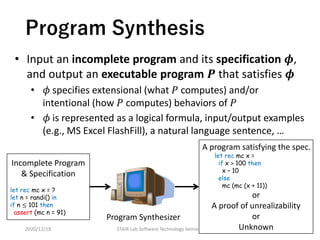
Program Synthesis
• Input an incomplete program and its specification 𝝓,
and output an executable program 𝑷 that satisfies 𝝓
• 𝜙 specifies extensional (what 𝑃 computes) and/or
intentional (how 𝑃 computes) behaviors of 𝑃
• 𝜙 is represented as a logical formula, input/output examples
(e.g., MS Excel FlashFill), a natural language sentence, …
2020/12/18 7STAIR Lab Software Technology Seminar
Incomplete Program
& Specification
let rec mc x = ?
let n = randi() in
if n ≤ 101 then
assert (mc n = 91)
Program Synthesizer
A program satisfying the spec.
let rec mc x =
if x > 100 then
x – 10
else
mc (mc (x + 11))
or
A proof of unrealizability
or
Unknown
Enabling Technologies
• Program logics for mechanizing verification & synthesis
• Hoare logic for proving Hoare triples 𝑃 𝑐 𝑄 meaning that:
For any initial state 𝜎 that satisfies the precondition 𝑃, if the execution
of the program 𝑐 under 𝜎 terminates, the postcondition 𝑄 is satisfied by
the resulting state
• Separation logic
• Dependent refinement type system
• Graded modal type system
• Constraint solvers for automating verification & synthesis
• SAT solvers: satisfiability checker for propositional formulas
• SMT solvers: satisfiability checker for predicate formulas over
first-order theories on integers, reals, lists, arrays, …
2020/12/18 STAIR Lab Software Technology Seminar 8
What about functions (that represent inductive invariants,
ranking functions, recurrent sets, Skolem functions, …)?
This Talk
• Tutorial of program verification and synthesis based on
constraint solving and machine learning over functions
• First part: How to reduce program verification and
synthesis to constraint solving
• Second part: How to solve constraints via integrated
deductive and inductive reasoning
• Deductive reasoning by theorem proving (e.g., SAT, SMT)
• Inductive reasoning by machine learning (e.g., decision tree
learning, reinforcement learning)
2020/12/18 STAIR Lab Software Technology Seminar 9
This Talk
• Tutorial of program verification and synthesis based on
constraint solving and machine learning over functions
• First part: How to reduce program verification and
synthesis to constraint solving
• Second part: How to solve constraints via integrated
deductive and inductive reasoning
• Deductive reasoning by theorem proving (e.g., SAT, SMT)
• Inductive reasoning by machine learning (e.g., decision tree
learning, reinforcement learning)
2020/12/18 STAIR Lab Software Technology Seminar 10
Program Verification via
Constraint Solving
2020/12/18 STAIR Lab Software Technology Seminar
Constraint
Generation
𝓒 is Sat (𝑷 satisfies 𝝍),
𝓒 is Unsat (𝑷 violates 𝝍),
or Unknown
Constraint
Solving
Constraints 𝓒 on Function Variables
Target Program 𝑷 & Specification 𝝍
11
Verification Intermediary
Independent of Particular
Target and Method 
Program Verification via
Constrained Horn Clauses (CHCs)
2020/12/18 STAIR Lab Software Technology Seminar
Constraint
Generation
𝓒 is Sat (𝑷 satisfies 𝝍),
𝓒 is Unsat (𝑷 violates 𝝍),
or Unknown
Constraint
Solving
Target Program 𝑷 & Specification 𝝍
CHCs Constraints 𝓒 on Predicate Variables
JayHorn for Java [Kahsai+ ’16]
SeaHorn for C [Gurfinkel+ ’15]
RCaml for OCaml [Unno+ ’09]
SPACER [Komuravelli+ ’14]
Hoice [Champion+ ’18]
Eldarica [Hojjat+ ’18]
12
CHCs: Constrained Horn Clauses
(see e.g., [Bjørner+ ’15] )
• A finite set 𝓒 of Horn-clauses of either form:
where 𝑋0, 𝑋1 … , 𝑋 𝑚 are predicate variables,
𝑡0, … , 𝑡 𝑚 are sequences of terms of a 1st-order theory 𝑇,
𝜙 is a formula of 𝑇 without predicate variables.
• 𝓒 is satisfiable (modulo 𝑇) if there is an interpretation 𝜌 of
predicate variables such that 𝜌 ⊨ ⋀𝓒
2020/12/18 STAIR Lab Software Technology Seminar
𝑋0 𝑡0 ⟸ 𝑋1 𝑡1 ∧ ⋯ ∧ 𝑋 𝑚 𝑡 𝑚 ∧ 𝜙
13
⊥ ⟸ 𝑋1 𝑡1 ∧ ⋯ ∧ 𝑋 𝑚 𝑡 𝑚 ∧ 𝜙or
𝑥 = 𝑥0
𝑦 = 0;
𝐰𝐡𝐢𝐥𝐞 𝑥 ≠ 0 𝐝𝐨
𝑦 ← 𝑦 + 1;
𝑥 ← 𝑥 − 1
𝐝𝐨𝐧𝐞
𝑦 = 𝑥0
2020/12/18 STAIR Lab Software Technology Seminar
If the initial state satisfies
the pre-condition 𝑥 = 𝑥0
and the loop terminates
the post-condition 𝑦 = 𝑥0 is
satisfied by the resulting state
Prog. & Spec. CHCs SAT or UNSAT
Constraint Generation Constraint Solving
Example Program and Partial Correctness Specification:
Pre-
condition
Post-
condition
14
Input:
𝑥 = 𝑥0
𝑦 = 0;
𝐰𝐡𝐢𝐥𝐞 𝑥 ≠ 0 𝐝𝐨
𝑦 ← 𝑦 + 1;
𝑥 ← 𝑥 − 1
𝐝𝐨𝐧𝐞
𝑦 = 𝑥0
2020/12/18 STAIR Lab Software Technology Seminar
Output 𝓒:
① 𝐼 𝑥0, 𝑥, 𝑦 ⟸ 𝑥 = 𝑥0 ∧ 𝑦 = 0,
② 𝐼 𝑥0, 𝑥 − 1, 𝑦 + 1
⟸ 𝐼 𝑥0, 𝑥, 𝑦 ∧ 𝑥 ≠ 0,
③ 𝑦 = 𝑥0 ⟸ 𝐼 𝑥0, 𝑥, 𝑦 ∧ 𝑥 = 0
Prog. & Spec. CHCs SAT or UNSAT
Constraint Generation Constraint Solving
represents a loop invariant
𝓒 is satisfiable, witnessed by a
solution 𝐼 𝑥0, 𝑥, 𝑦 ≡ 𝑥0 = 𝑥 + 𝑦
15
Program Verification via
Constrained Horn Clauses (CHCs)
2020/12/18 STAIR Lab Software Technology Seminar
Constraint
Generation
𝓒 is Sat (𝑷 satisfies 𝝍),
𝓒 is Unsat (𝑷 violates 𝝍),
or Unknown
Constraint
Solving
Target Program 𝑷 & Specification 𝝍
CHCs Constraints 𝓒 on Predicate Variables
Limited to Linear-Time
Safety Verification 
16
pCSP Constraints 𝓒 on Predicate Variables
Target Program 𝑷 & Specification 𝝍
Program Verification via Predicate
Constraint Satisfaction [Satake+ ’20]
2020/12/18 STAIR Lab Software Technology Seminar
Constraint
Generation
𝓒 is Sat (𝑷 satisfies 𝝍),
𝓒 is Unsat (𝑷 violates 𝝍),
or Unknown
Constraint
Solving
Applicable to (Finitely-)
Branching-Time Safety
Verification 
17
PCSat [Satake+ ’20, Unno+ ’20]
Linear-Time vs. Branching-Time
Verification of Non-det. Programs
• The target program 𝑷 may exhibit non-determinism
caused by user input, network comm., scheduling, …
• Linear-time verification concerns properties of
the execution traces of 𝑷
• Branching-time verification concerns properties of the
computation tree of 𝑷
• Subsumes linear-time verification
• Example: Non-termination verification of deciding whether
there is an infinite execution of 𝑷
(cf. termination verification decides whether all execution of
𝑷 is finite)
2020/12/18 STAIR Lab Software Technology Seminar 18
pCSP: Predicate Constraint
Satisfaction Problem[Satake+ ’20]
• A finite set 𝓒 of clauses of the form:
where 𝑋1, … , 𝑋 𝑚 are predicate variables,
𝑡1, … , 𝑡 𝑚 are sequences of terms of a 1st-order theory 𝑇,
𝜙 is a formula of 𝑇 without predicate variables.
• 𝓒 is satisfiable (modulo 𝑇) if there is an interpretation 𝜌 of
predicate variables such that 𝜌 ⊨ ⋀𝓒
• 𝓒 is CHCs if ℓ ≤ 1 for all clause in 𝓒
2020/12/18 STAIR Lab Software Technology Seminar
𝑋1 𝑡1 ∨ ⋯ ∨ 𝑋ℓ 𝑡ℓ ⟸
𝑋ℓ+1 𝑡ℓ+1 ∧ ⋯ ∧ 𝑋 𝑚 𝑡 𝑚 ∧ 𝜙
19
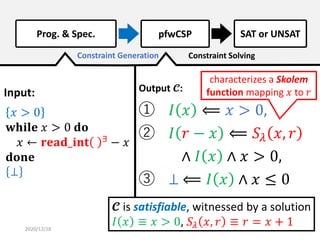
𝑥 > 0
𝐰𝐡𝐢𝐥𝐞 𝑥 ≠ 0 𝐝𝐨
𝐢𝐟 𝐫𝐞𝐚𝐝_𝐛𝐨𝐨𝐥 ∃
𝐭𝐡𝐞𝐧
𝑥 ← 𝑥 − 1
𝐞𝐥𝐬𝐞
𝑥 ← 𝑥 + 1
𝐝𝐨𝐧𝐞
⊥
2020/12/18 STAIR Lab Software Technology Seminar
If the initial state satisfies
the pre-condition 𝑥 > 0
there is an execution of
the program such that
the post-condition ⊥ is
satisfied when the while
loop terminates
Prog. & Spec. pCSP SAT or UNSAT
Constraint Generation Constraint Solving
Example Program and Specification:
Non-det.
branching
Contradiction
Pre-
condition
Post-
condition
20
𝑥 > 0
𝐰𝐡𝐢𝐥𝐞 𝑥 ≠ 0 𝐝𝐨
𝐢𝐟 𝐫𝐞𝐚𝐝_𝐛𝐨𝐨𝐥 ∃
𝐭𝐡𝐞𝐧
𝑥 ← 𝑥 − 1
𝐞𝐥𝐬𝐞
𝑥 ← 𝑥 + 1
𝐝𝐨𝐧𝐞
⊥
2020/12/18 STAIR Lab Software Technology Seminar
If the initial state satisfies
the pre-condition 𝑥 > 0
there is an execution of
the program such that
the while loop
never terminates
Prog. & Spec. pCSP SAT or UNSAT
Constraint Generation Constraint Solving
Example Program and Specification:
Non-det.
branching
Contradiction
Pre-
condition
Post-
condition
21
Input:
𝑥 > 0
𝐰𝐡𝐢𝐥𝐞 𝑥 ≠ 0 𝐝𝐨
𝐢𝐟 𝐫𝐞𝐚𝐝_𝐛𝐨𝐨𝐥 ∃ 𝐭𝐡𝐞𝐧
𝑥 ← 𝑥 − 1
𝐞𝐥𝐬𝐞
𝑥 ← 𝑥 + 1
𝐝𝐨𝐧𝐞
⊥
2020/12/18 STAIR Lab Software Technology Seminar
Output 𝓒:
① 𝐼 𝑥 ⟸ 𝑥 > 0,
② 𝐼 𝑥 − 1 ∨ 𝐼 𝑥 + 1
⟸ 𝐼 𝑥 ∧ 𝑥 ≠ 0,
③ ⊥ ⟸ 𝐼 𝑥 ∧ 𝑥 = 0
Prog. & Spec. pCSP SAT or UNSAT
Constraint Generation Constraint Solving
represents a loop invariant
preserved by some execution
(i.e., recurrent set)
𝓒 is beyond
CHCs!
𝓒 is satisfiable, witnessed by
a solution 𝐼 𝑥 ≡ 𝑥 > 0 22
pfwCSP Constraints 𝓒 on Predicate Variables
Target Program 𝑷 & Specification 𝝍
Program Verification via Extended
Predicate Constraint Satisfaction [Unno+ ’20]
2020/12/18 STAIR Lab Software Technology Seminar
Constraint
Generation
𝓒 is Sat (𝑷 satisfies 𝝍),
𝓒 is Unsat (𝑷 violates 𝝍),
or Unknown
Constraint
Solving
Applicable to (Infinitely-)
Branching-Time Safety &
Liveness Verification 
23
PCSat [Satake+ ’20, Unno+ ’20]
Safety vs. Liveness Verification
• Safety is a class of properties of the form
“something bad will never happen”
• Examples (absence of): assertion failure, division-by-zero,
array boundary violation, …
• Liveness is a class of properties of the form
“something good will eventually happen”
• Examples: termination, deadlock freedom, …
2020/12/18 STAIR Lab Software Technology Seminar 24
pfwCSP: Extension of pCSP with Functional
and Well-founded Predicates [Unno+ ’20]
(cf. ∀∃CHCs with dwf [Beyene+ ’13])
• A finite set 𝓒 of pCSP clauses equipped with
a map 𝓚 from predicate variable 𝑋 in 𝓒 to ⋆, 𝜆, ⇓
• 𝑋 is ordinary predicate if 𝓚 𝑋 = ⋆
• 𝑋 is functional predicate if 𝓚 𝑋 = 𝜆
• 𝑋 is well-founded predicate if 𝓚 𝑋 = ⇓
• 𝓒 is satisfiable (modulo 𝑇) if there is an interpretation
𝜌 of predicate variables such that
• 𝜌 ⊨ ⋀𝓒
• ∀𝑋. 𝓚 𝑋 = 𝜆 ⟹ 𝜌 𝑋 characterizes a total function
• ∀𝑋. 𝓚 𝑋 = ⇓ ⟹ 𝜌 𝑋 represents a well-founded relation
2020/12/18 STAIR Lab Software Technology Seminar 25
𝑥 > 0
𝐰𝐡𝐢𝐥𝐞 𝑥 > 0 𝐝𝐨
𝑥 ← 𝐫𝐞𝐚𝐝_𝐢𝐧𝐭 ∃ − 𝑥
𝐝𝐨𝐧𝐞
⊥
2020/12/18 STAIR Lab Software Technology Seminar
If the initial state satisfies
the pre-condition 𝑥 > 0
there is an execution of
the program such that
the while loop
never terminates
Prog. & Spec. pfwCSP SAT or UNSAT
Constraint Generation Constraint Solving
Example Program and Specification:
Non-det.
integer
Contradiction
Pre-
condition
Post-
condition
26
Input:
𝑥 > 0
𝐰𝐡𝐢𝐥𝐞 𝑥 > 0 𝐝𝐨
𝑥 ← 𝐫𝐞𝐚𝐝_𝐢𝐧𝐭 ∃ − 𝑥
𝐝𝐨𝐧𝐞
⊥
2020/12/18 STAIR Lab Software Technology Seminar
Output 𝓒:
① 𝐼 𝑥 ⟸ 𝑥 > 0,
② ∃𝑟. 𝐼 𝑟 − 𝑥
⟸ 𝐼 𝑥 ∧ 𝑥 > 0,
③ ⊥ ⟸ 𝐼 𝑥 ∧ 𝑥 ≤ 0
Prog. & Spec. pfwCSP SAT or UNSAT
Constraint Generation Constraint Solving
represents a loop invariant
preserved by some execution
(i.e., recurrent set)
𝓒 is beyond pCSP but can
be encoded in pfwCSP
using a functional pred.
var. that characterizes
a Skolem function for 𝒓
27
Input:
𝑥 > 0
𝐰𝐡𝐢𝐥𝐞 𝑥 > 0 𝐝𝐨
𝑥 ← 𝐫𝐞𝐚𝐝_𝐢𝐧𝐭 ∃ − 𝑥
𝐝𝐨𝐧𝐞
⊥
2020/12/18 STAIR Lab Software Technology Seminar
Output 𝓒:
① 𝐼 𝑥 ⟸ 𝑥 > 0,
② 𝐼 𝑟 − 𝑥 ⟸ 𝑆𝜆 𝑥, 𝑟
∧ 𝐼 𝑥 ∧ 𝑥 > 0,
③ ⊥ ⟸ 𝐼 𝑥 ∧ 𝑥 ≤ 0
Prog. & Spec. pfwCSP SAT or UNSAT
Constraint Generation Constraint Solving
characterizes a Skolem
function mapping 𝑥 to 𝑟
28
𝓒 is satisfiable, witnessed by a solution
𝐼 𝑥 ≡ 𝑥 > 0, 𝑆𝜆 𝑥, 𝑟 ≡ 𝑟 = 𝑥 + 1
𝑥 ≠ 0
𝐰𝐡𝐢𝐥𝐞 𝑥 ≠ 0 𝐝𝐨
𝐢𝐟 𝑥 > 0 𝐭𝐡𝐞𝐧
𝑥 ← 𝑥 − 1
𝐞𝐥𝐬𝐞
𝑥 ← 𝑥 + 1
𝐝𝐨𝐧𝐞
⊤
2020/12/18 STAIR Lab Software Technology Seminar
If the initial state satisfies
the pre-condition 𝑥 ≠ 0
the loop always terminates
and the post-condition ⊤ is
satisfied by the resulting state
Prog. & Spec. pfwCSP SAT or UNSAT
Constraint Generation Constraint Solving
Example Program and Total Correctness Specification:
Pre-
condition
Post-
condition
29
Tautology
Input:
𝑥 ≠ 0
𝐰𝐡𝐢𝐥𝐞 𝑥 ≠ 0 𝐝𝐨
𝐢𝐟 𝑥 > 0 𝐭𝐡𝐞𝐧
𝑥 ← 𝑥 − 1
𝐞𝐥𝐬𝐞
𝑥 ← 𝑥 + 1
𝐝𝐨𝐧𝐞
⊤
2020/12/18 STAIR Lab Software Technology Seminar
Output 𝓒:
① 𝐼 𝑥 ⟸ 𝑥 = 0,
② 𝐼 𝑥 − 1 ⟸ 𝐼 𝑥 ∧ 𝑥 > 0,
③ 𝐼 𝑥 + 1 ⟸ 𝐼 𝑥 ∧ 𝑥 < 0,
④ 𝑇⇓ 𝑥, 𝑥 − 1 ⟸ 𝐼 𝑥 ∧ 𝑥 > 0,
⑤ 𝑇⇓ 𝑥, 𝑥 + 1 ⟸ 𝐼 𝑥 ∧ 𝑥 < 0,
Prog. & Spec. pfwCSP SAT or UNSAT
Constraint Generation Constraint Solving
represents a loop invariant
30
represents a well-
founded relation for
termination of the loop
𝓒 is satisfiable, witnessed by a solution
𝐼 𝑥 ≡ ⊤, 𝑇⇓ 𝑥, 𝑥′ ≡ 𝑥 > 𝑥′
≥ 0
Further Applications of pfwCSP
• Refinement type inference [Unno+ ’09,’13,’18, Nanjo’18, Katsura+ ’20]
• Validity checking of fixpoint logic formulas
• LTL, CTL, CTL*, modal-mu calculus model checking
• Infinite-state infinite-duration game solving
• Bisimulation and bisimilarity verification
• Hyperproperties verification
• Program synthesis
• …
2020/12/18 STAIR Lab Software Technology Seminar 31
(see [Unno+ ’20] and upcoming papers)
Program Synthesis via
Constraint Solving
2020/12/18 STAIR Lab Software Technology Seminar
Constraint
Generation
𝓒 is Sat (some 𝑷 ∈ 𝓛 satisfies 𝝍),
𝓒 is Unsat (all 𝑷 ∈ 𝓛 violates 𝝍),
or Unknown
Constraint
Solving
Constraints 𝓒 on Function Variables
Language 𝓛 & Specification 𝝍
32
Synthesis Intermediary
Independent of Particular
Target and Method 
Program Synthesis via
Syntax-Guided Synthesis (SyGuS)
2020/12/18 STAIR Lab Software Technology Seminar
Constraint
Generation
𝓒 is Sat (some 𝑷 ∈ 𝓛 satisfies 𝝍),
𝓒 is Unsat (all 𝑷 ∈ 𝓛 violates 𝝍),
or Unknown
Constraint
Solving
SyGuS Constraints 𝓒 on Function Variables
Language 𝓛 & Specification 𝝍
33
CVC4 [Reynolds+ ’15,’19]
DryadSynth [Huang+ ’20]
PCSat [Satake+ ’20, Unno+ ’20]
SyGuS: Syntax-Guided
Synthesis [Alur+ ’15]
• Fix a first-order background theory 𝑇 such as:
• Linear integer arithmetic (LIA)
• Strings (for FlashFill benchmarks)
• Bit-vectors (for Hackers' Delight benchmarks)
• Given
• Specification: 𝑇-formula 𝜙 over a function variable 𝑓
• Language: context-free grammar 𝐺 characterizing the
set ℒ 𝐺 of allowed 𝑇-terms
• Find a term 𝑡 ∈ ℒ 𝐺 such that ⊨ 𝑡/𝑓 𝜙
2020/12/18 STAIR Lab Software Technology Seminar 34
Example LIA SyGuS Constraints 𝓒:
• Language: 𝐺 that generates any term of LIA
• Specification: 𝜙 ≡
𝑓 𝑥, 𝑦 ≥ 𝑥 ∧ 𝑓 𝑥, 𝑦 ≥ 𝑦 ∧
𝑓 𝑥, 𝑦 = 𝑥 ∨ 𝑓 𝑥, 𝑦 = 𝑦
𝓒 is satisfied by 𝑓 𝑥, 𝑦 ≡ if 𝑥 > 𝑦 then 𝑥 else 𝑦
𝓒 can be reduced to the pfwCSP:
𝑟 ≥ 𝑥 ∧ 𝑟 ≥ 𝑦 ∧ 𝑟 = 𝑥 ∨ 𝑟 = 𝑦 ⟸ 𝐹𝜆 𝑥, 𝑦, 𝑟
In general, SyGuS constraints 𝓒 can be converted to
a pfwCSP using a predicate that characterizes ℒ 𝐺
2020/12/18 STAIR Lab Software Technology Seminar 35
This Talk
• Tutorial of program verification and synthesis based on
constraint solving and machine learning over functions
• First part: How to reduce program verification and
synthesis to constraint solving
• Second part: How to solve constraints via integrated
deductive and inductive reasoning
• Deductive reasoning by theorem proving (e.g., SAT, SMT)
• Inductive reasoning by machine learning (e.g., decision tree
learning, reinforcement learning)
2020/12/18 STAIR Lab Software Technology Seminar 36
pfwCSP Constraints 𝓒 on Predicate Variables
Target Program 𝑷 &
Specification 𝝍
Program Verification and Synthesis via
Predicate Constraint Satisfaction
2020/12/18 STAIR Lab Software Technology Seminar
Constraint
Generation
𝓒 is Sat, 𝓒 is Unsat, or Unknown
Constraint
Solving
37
Language 𝓛 &
Specification 𝝍
Challenges in Constraint Solving
• Undecidable in general even for decidable theories
• The search space of solutions is often very large
(or unbounded), high-dimensional, and non-smooth
2020/12/18 STAIR Lab Software Technology Seminar
To address these challenges, researchers are
integrating deductive & inductive reasoning
techniques within the framework of
CounterExample Guided Inductive Synthesis
(CEGIS) [Solar-Lezama+ ’06]
38
CounterExample Guided
Inductive Synthesis (CEGIS)
• Iteratively accumulate example instances 𝓔 of the
given 𝓒 through the two phases for each iteration:
• Synthesis Phase by Learner
• Find a candidate solution 𝜌 that satisfies 𝓔
• Validation Phase by Teacher
• Check if the candidate 𝜌 also satisfies 𝓒 (with an SMT solver)
• If yes, return 𝜌 as a genuine solution of 𝓒
• If no, repeat the procedure with new example instances
witnessing non-satisfaction of 𝓒 by 𝜌 added
2020/12/18 STAIR Lab Software Technology Seminar 39
Example Run of CEGIS
Learner
Example Instances 𝓔:
∅
Teacher
Constraints 𝓒:
• 𝐼 𝑥 ⟸ 𝑥 > 0
• 𝐼 𝑥 − 1 ∨ 𝐼 𝑥 + 1
⟸ 𝐼 𝑥 ∧ 𝑥 ≠ 0
• ⊥ ⟸ 𝐼 𝑥 ∧ 𝑥 = 0
2020/12/18 STAIR Lab Software Technology Seminar
Starting from
the empty set
(𝓒 is a black box)
Is the candidate 𝐼 𝑥 ↦ ⊤ genuine?
40
Example Run of CEGIS
Learner
Example Instances 𝓔:
∅
Teacher
Constraints 𝓒:
• 𝐼 𝑥 ⟸ 𝑥 > 0
• 𝐼 𝑥 − 1 ∨ 𝐼 𝑥 + 1
⟸ 𝐼 𝑥 ∧ 𝑥 ≠ 0
• ⊥ ⟸ 𝐼 𝑥 ∧ 𝑥 = 0
2020/12/18 STAIR Lab Software Technology Seminar
No. 𝐼 𝑥 ↦ ⊤ is not.
The 3rd clause is violated when 𝑥 = 0
⊥ ⟸ 𝐼 0 ∧ 0 = 0
41
Example Run of CEGIS
Learner
Example Instances 𝓔:
¬𝐼 0
Teacher
Constraints 𝓒:
• 𝐼 𝑥 ⟸ 𝑥 > 0
• 𝐼 𝑥 − 1 ∨ 𝐼 𝑥 + 1
⟸ 𝐼 𝑥 ∧ 𝑥 ≠ 0
• ⊥ ⟸ 𝐼 𝑥 ∧ 𝑥 = 0
2020/12/18 STAIR Lab Software Technology Seminar
Is the cand. 𝐼 𝑥 ↦ 𝑥 < 0 genuine?
42
Example Run of CEGIS
Learner
Example Instances 𝓔:
¬𝐼 0
Teacher
Constraints 𝓒:
• 𝐼 𝑥 ⟸ 𝑥 > 0
• 𝐼 𝑥 − 1 ∨ 𝐼 𝑥 + 1
⟸ 𝐼 𝑥 ∧ 𝑥 ≠ 0
• ⊥ ⟸ 𝐼 𝑥 ∧ 𝑥 = 0
2020/12/18 STAIR Lab Software Technology Seminar
No. 𝐼 𝑥 ↦ 𝑥 < 0 is not.
The 1st clause is violated when 𝑥 = 1
𝐼 1 ⟸ 1 > 0
43
Example Run of CEGIS
Learner
Example Instances 𝓔:
¬𝐼 0
𝐼 1
Teacher
Constraints 𝓒:
• 𝐼 𝑥 ⟸ 𝑥 > 0
• 𝐼 𝑥 − 1 ∨ 𝐼 𝑥 + 1
⟸ 𝐼 𝑥 ∧ 𝑥 ≠ 0
• ⊥ ⟸ 𝐼 𝑥 ∧ 𝑥 = 0
2020/12/18 STAIR Lab Software Technology Seminar
Is the cand. 𝐼 𝑥 ↦ 𝑥 = 1 genuine?
44
Example Run of CEGIS
Learner
Example Instances 𝓔:
¬𝐼 0
𝐼 0 ∨ 𝐼 2 ⟸ 𝐼 1
𝐼 1
Teacher
Constraints 𝓒:
• 𝐼 𝑥 ⟸ 𝑥 > 0
• 𝐼 𝑥 − 1 ∨ 𝐼 𝑥 + 1
⟸ 𝐼 𝑥 ∧ 𝑥 ≠ 0
• ⊥ ⟸ 𝐼 𝑥 ∧ 𝑥 = 0
2020/12/18 STAIR Lab Software Technology Seminar 45
No. 𝐼 𝑥 ↦ 𝑥 = 1 is not.
The 2nd clause is violated when 𝑥 = 1
Example Run of CEGIS
Learner
Example Instances 𝓔:
¬𝐼 0
𝐼 0 ∨ 𝐼 2 ⟸ 𝐼 1
𝐼 1
Teacher
Constraints 𝓒:
• 𝐼 𝑥 ⟸ 𝑥 > 0
• 𝐼 𝑥 − 1 ∨ 𝐼 𝑥 + 1
⟸ 𝐼 𝑥 ∧ 𝑥 ≠ 0
• ⊥ ⟸ 𝐼 𝑥 ∧ 𝑥 = 0
2020/12/18 STAIR Lab Software Technology Seminar
Is the cand. 𝐼 𝑥 ↦ 𝑥 ≥ 1 genuine?
46
Example Run of CEGIS
Learner
Example Instances 𝓔:
¬𝐼 0
𝐼 0 ∨ 𝐼 2 ⟸ 𝐼 1
𝐼 1
Teacher
Constraints 𝓒:
• 𝐼 𝑥 ⟸ 𝑥 > 0
• 𝐼 𝑥 − 1 ∨ 𝐼 𝑥 + 1
⟸ 𝐼 𝑥 ∧ 𝑥 ≠ 0
• ⊥ ⟸ 𝐼 𝑥 ∧ 𝑥 = 0
2020/12/18 STAIR Lab Software Technology Seminar
Yes. 𝐼 𝑥 ↦ 𝑥 ≥ 1 satisfies 𝓒!
47
Is CEGIS just (Online) Supervised
Learning of Classification?
• Similarities
• Learner trains a model to fit examples 𝓔 and obtain 𝜌
• Teacher requires 𝜌 to generalize to 𝓒 (𝜌 shouldn’t overfit 𝓔)
• Differences
• 𝓔 is usually assumed to have no noise & 𝓒 is hard constraints
• 𝜌 is required to exactly satisfy 𝓔 (or has no chance to satisfy 𝓒)
• 𝜌 should be efficiently handled by Teacher (i.e., an SMT solver)
• Sampling of 𝓔 from 𝓒 is not i.i.d (depends on 𝜌 and Teacher)
• 𝓔 may contain not only positive/negative examples but also
arbitrary clause ones (cf. constrained semi-supervised learning)
2020/12/18 STAIR Lab Software Technology Seminar 48
Despite the differences, machine learning
techniques turned out to be quite useful!
Machine Learning for CEGIS
• Adapt ML models and algorithms to implement Learner
• Piecewise linear classifiers [Sharma+ ’13a, Garg+ ’14, Unno+ ’20]
• Decision trees [Krishna+ ’15, Garg+ ’16, Champion+ ’18, Ezudheen+ ’18, Zhu+ ’18]
• Neural networks [Chang+ ’19, Zhao+ ’20, Abate+ ’21]
• Greedy set covering w/ logic minimization [Padhi+ ’16, Sharma+ ’13b]
• Metropolis Hastings MCMC sampler [Sharma+ ’14]
• Probabilistic inference, survey propagation [Satake+ ’20]
• Ensemble learning [Padhi+ ’20]
• Learning to learn
• Reinforcement learning of NNs to generate candidates [Si ’18]
• Reinforcement learning of strategy to adjust classification models used
by Learner (joint work w/ Tsukada, Sekiyama, Suenaga)
2020/12/18 STAIR Lab Software Technology Seminar 49
SMT-based Piecewise Linear Classification
(aka Template-based Synthesis)
1. Prepare a solution template with unknown coefficients,
2. Generate constraints on them, and
3. Solve them using an SMT solver
2020/12/18 STAIR Lab Software Technology Seminar
Examples: 𝓔 ≡ 𝐼 0 , 𝐼 0 ⇒ 𝐼 1 , ¬𝐼 −1
Solution Template: 𝐼 𝑥 ↦ 𝑐1 ⋅ 𝑥 + 𝑐2 ≥ 0
Coeff. Constraints: 𝑐2 ≥ 0, 𝑐2 ≥ 0 ⇒ 𝑐1 + 𝑐2 ≥ 0, −𝑐1 + 𝑐2 < 0
A Candidate Solution: 𝜌 ≡ 𝐼 𝑥 ↦ 𝑥 ≥ 0
Satisfying Assignment: 𝑐1 ↦ 1, 𝑐2 ↦ 0
50
Decision Tree Learning
1. Consistently label atoms in 𝓔 with +/− using a SAT solver
2. Generate a set 𝑄 of predicates used in classification
3. Classify atoms in 𝓔 with 𝑄 using a decision tree learner
2020/12/18 STAIR Lab Software Technology Seminar
Examples: 𝓔 ≡ 𝐼 0 , 𝐼 0 ⇒ 𝐼 1 , ¬𝐼 −1
Labeling: 𝐼 0 ↦ +, 𝐼 1 ↦ +, 𝐼 −1 ↦ −
Classifier: 𝜌 ≡ 𝐼 𝑥 ↦ 𝑥 ≥ 0
Predicates: 𝑄 ≡
𝑥 ≥ 0, 𝑥 ≤ 0, 𝑥 ≥ 1,
𝑥 ≥ −1, 𝑥 ≤ 1, 𝑥 ≤ −1
51
Template-based Synthesis
vs Decision Tree Learning
• Template-based Synthesis (TB)
•  Fixes the shape of solution (updated upon failure)
•  Flexibly find necessary predicates via SMT solving
•  Atoms in 𝓔 are consistently labeled using 𝓔 as an SMT formula
• Decision Tree Learning (DT)
•  Fixes the predicates of solution (updated upon failure)
•  Flexibly adjust the shape based on information gain
•  Atoms are consistently labeled using 𝓔 as a SAT formula
• Evaluation on SyGuS-Comp’19 Inv track XC benchmarks
• TB solved 228 instances (out of 276) and DT solved 180 instances
2020/12/18 STAIR Lab Software Technology Seminar 52
Future Research Directions
• Efficient synthesis of complex and large functions
from complex and large constraints
• (Co)Inductive functions
• Functions over (linked, (co)algebraic, array) data structures
• Improve labeling, sampling and filtering of examples, and
generation and ranking of predicates
• Convergence theory of CEGIS
• More applications
2020/12/18 STAIR Lab Software Technology Seminar 53
Summary
• Various program verification and synthesis problems
can be reduced to constraint solving problems
• The separation of constraint generation and solving
facilitate tool development
• CEGIS-based constraint solving integrates deductive
and inductive reasoning to address challenges
• Deductive reasoning by theorem proving (e.g., SAT, SMT)
• Inductive reasoning by machine learning (e.g., decision
tree learning, reinforcement learning)
2020/12/18 STAIR Lab Software Technology Seminar 54

制約解消によるプログラム検証・合成 (第1回ステアラボソフトウェア技術セミナー)

  • 1.
  • 2.
    自己紹介 2009 東京大学大学院 情報理工学系研究科 コンピュータ科学専攻博士課程修了 博士(情報理工学) 指導教員:米澤 明憲 教授(現千葉工業大学) 小林 直樹 教授(現東京大学) 2012~2017 筑波大学 情報工学域 助教 2017~現在 同准教授 2018~現在 理化学研究所 革新知能統合研究センター 客員研究員 2020~現在 国立情報学研究所 客員准教授 2020/12/18 STAIR Lab Software Technology Seminar 2
  • 3.
    Research Interests • Formalspecification, verification, and synthesis of (mainly but not limited to) higher-order functional programs by AI techniques such as constraint solving and machine learning • Ongoing projects • Synthesis of High-Level Programs from Temporal and Relational Specifications (PI: Hiroshi Unno) • Program Verification Techniques for the AI Era (PI: Naoki Kobayashi) • AI Security and Privacy (PI: Jun Sakuma) • Metamathematics for Systems Design Project (PI: Ichiro Hasuo) • … 2020/12/18 STAIR Lab Software Technology Seminar 3
  • 4.
    This Talk • Tutorialof program verification and synthesis based on constraint solving and machine learning 2020/12/18 STAIR Lab Software Technology Seminar 4
  • 5.
    Background • Our societyheavily relies on computer systems • Failure or malfunction of safety-critical systems would lead to human, social, economic, and environmental damage • 1985-1987 – Therac-25 medical accelerator delivered lethal radiation doses to patients • June 4, 1996 – Ariane 5 Flight 501 exploded • February, 2014 – 1.9 million Prius cars recalled • April, 2014 – OpenSSL Heartbleed vulnerability disclosed • June 17, 2016 – Ethereum DAO attacked, over $55M stolen • Reliability assurance of safety-critical systems is crucial 2020/12/18 STAIR Lab Software Technology Seminar 5
  • 6.
    Program Verification • Formallyprove or disprove a mathematical proposition 𝑄: “The given program satisfies its formal specification” • Great attentions from industry and academia • Microsoft’s SLAM & Everest projects, Facebook’s Infer, AWS • Turing awards to Hoare logic, temporal logic, model checking, … 2020/12/18 STAIR Lab Software Technology Seminar 6 Program & Spec. let rec mc x = if x > 100 then x – 10 else mc (mc (x + 11)) in let n = randi() in if n ≤ 101 then assert (mc n = 91) Program Verifier A proof of 𝑄 or A counterexample to 𝑄 (e.g., a program input leading to a spec. violation) or Unknown
  • 7.
    Program Synthesis • Inputan incomplete program and its specification 𝝓, and output an executable program 𝑷 that satisfies 𝝓 • 𝜙 specifies extensional (what 𝑃 computes) and/or intentional (how 𝑃 computes) behaviors of 𝑃 • 𝜙 is represented as a logical formula, input/output examples (e.g., MS Excel FlashFill), a natural language sentence, … 2020/12/18 7STAIR Lab Software Technology Seminar Incomplete Program & Specification let rec mc x = ? let n = randi() in if n ≤ 101 then assert (mc n = 91) Program Synthesizer A program satisfying the spec. let rec mc x = if x > 100 then x – 10 else mc (mc (x + 11)) or A proof of unrealizability or Unknown
  • 8.
    Enabling Technologies • Programlogics for mechanizing verification & synthesis • Hoare logic for proving Hoare triples 𝑃 𝑐 𝑄 meaning that: For any initial state 𝜎 that satisfies the precondition 𝑃, if the execution of the program 𝑐 under 𝜎 terminates, the postcondition 𝑄 is satisfied by the resulting state • Separation logic • Dependent refinement type system • Graded modal type system • Constraint solvers for automating verification & synthesis • SAT solvers: satisfiability checker for propositional formulas • SMT solvers: satisfiability checker for predicate formulas over first-order theories on integers, reals, lists, arrays, … 2020/12/18 STAIR Lab Software Technology Seminar 8 What about functions (that represent inductive invariants, ranking functions, recurrent sets, Skolem functions, …)?
  • 9.
    This Talk • Tutorialof program verification and synthesis based on constraint solving and machine learning over functions • First part: How to reduce program verification and synthesis to constraint solving • Second part: How to solve constraints via integrated deductive and inductive reasoning • Deductive reasoning by theorem proving (e.g., SAT, SMT) • Inductive reasoning by machine learning (e.g., decision tree learning, reinforcement learning) 2020/12/18 STAIR Lab Software Technology Seminar 9
  • 10.
    This Talk • Tutorialof program verification and synthesis based on constraint solving and machine learning over functions • First part: How to reduce program verification and synthesis to constraint solving • Second part: How to solve constraints via integrated deductive and inductive reasoning • Deductive reasoning by theorem proving (e.g., SAT, SMT) • Inductive reasoning by machine learning (e.g., decision tree learning, reinforcement learning) 2020/12/18 STAIR Lab Software Technology Seminar 10
  • 11.
    Program Verification via ConstraintSolving 2020/12/18 STAIR Lab Software Technology Seminar Constraint Generation 𝓒 is Sat (𝑷 satisfies 𝝍), 𝓒 is Unsat (𝑷 violates 𝝍), or Unknown Constraint Solving Constraints 𝓒 on Function Variables Target Program 𝑷 & Specification 𝝍 11 Verification Intermediary Independent of Particular Target and Method 
  • 12.
    Program Verification via ConstrainedHorn Clauses (CHCs) 2020/12/18 STAIR Lab Software Technology Seminar Constraint Generation 𝓒 is Sat (𝑷 satisfies 𝝍), 𝓒 is Unsat (𝑷 violates 𝝍), or Unknown Constraint Solving Target Program 𝑷 & Specification 𝝍 CHCs Constraints 𝓒 on Predicate Variables JayHorn for Java [Kahsai+ ’16] SeaHorn for C [Gurfinkel+ ’15] RCaml for OCaml [Unno+ ’09] SPACER [Komuravelli+ ’14] Hoice [Champion+ ’18] Eldarica [Hojjat+ ’18] 12
  • 13.
    CHCs: Constrained HornClauses (see e.g., [Bjørner+ ’15] ) • A finite set 𝓒 of Horn-clauses of either form: where 𝑋0, 𝑋1 … , 𝑋 𝑚 are predicate variables, 𝑡0, … , 𝑡 𝑚 are sequences of terms of a 1st-order theory 𝑇, 𝜙 is a formula of 𝑇 without predicate variables. • 𝓒 is satisfiable (modulo 𝑇) if there is an interpretation 𝜌 of predicate variables such that 𝜌 ⊨ ⋀𝓒 2020/12/18 STAIR Lab Software Technology Seminar 𝑋0 𝑡0 ⟸ 𝑋1 𝑡1 ∧ ⋯ ∧ 𝑋 𝑚 𝑡 𝑚 ∧ 𝜙 13 ⊥ ⟸ 𝑋1 𝑡1 ∧ ⋯ ∧ 𝑋 𝑚 𝑡 𝑚 ∧ 𝜙or
  • 14.
    𝑥 = 𝑥0 𝑦= 0; 𝐰𝐡𝐢𝐥𝐞 𝑥 ≠ 0 𝐝𝐨 𝑦 ← 𝑦 + 1; 𝑥 ← 𝑥 − 1 𝐝𝐨𝐧𝐞 𝑦 = 𝑥0 2020/12/18 STAIR Lab Software Technology Seminar If the initial state satisfies the pre-condition 𝑥 = 𝑥0 and the loop terminates the post-condition 𝑦 = 𝑥0 is satisfied by the resulting state Prog. & Spec. CHCs SAT or UNSAT Constraint Generation Constraint Solving Example Program and Partial Correctness Specification: Pre- condition Post- condition 14
  • 15.
    Input: 𝑥 = 𝑥0 𝑦= 0; 𝐰𝐡𝐢𝐥𝐞 𝑥 ≠ 0 𝐝𝐨 𝑦 ← 𝑦 + 1; 𝑥 ← 𝑥 − 1 𝐝𝐨𝐧𝐞 𝑦 = 𝑥0 2020/12/18 STAIR Lab Software Technology Seminar Output 𝓒: ① 𝐼 𝑥0, 𝑥, 𝑦 ⟸ 𝑥 = 𝑥0 ∧ 𝑦 = 0, ② 𝐼 𝑥0, 𝑥 − 1, 𝑦 + 1 ⟸ 𝐼 𝑥0, 𝑥, 𝑦 ∧ 𝑥 ≠ 0, ③ 𝑦 = 𝑥0 ⟸ 𝐼 𝑥0, 𝑥, 𝑦 ∧ 𝑥 = 0 Prog. & Spec. CHCs SAT or UNSAT Constraint Generation Constraint Solving represents a loop invariant 𝓒 is satisfiable, witnessed by a solution 𝐼 𝑥0, 𝑥, 𝑦 ≡ 𝑥0 = 𝑥 + 𝑦 15
  • 16.
    Program Verification via ConstrainedHorn Clauses (CHCs) 2020/12/18 STAIR Lab Software Technology Seminar Constraint Generation 𝓒 is Sat (𝑷 satisfies 𝝍), 𝓒 is Unsat (𝑷 violates 𝝍), or Unknown Constraint Solving Target Program 𝑷 & Specification 𝝍 CHCs Constraints 𝓒 on Predicate Variables Limited to Linear-Time Safety Verification  16
  • 17.
    pCSP Constraints 𝓒on Predicate Variables Target Program 𝑷 & Specification 𝝍 Program Verification via Predicate Constraint Satisfaction [Satake+ ’20] 2020/12/18 STAIR Lab Software Technology Seminar Constraint Generation 𝓒 is Sat (𝑷 satisfies 𝝍), 𝓒 is Unsat (𝑷 violates 𝝍), or Unknown Constraint Solving Applicable to (Finitely-) Branching-Time Safety Verification  17 PCSat [Satake+ ’20, Unno+ ’20]
  • 18.
    Linear-Time vs. Branching-Time Verificationof Non-det. Programs • The target program 𝑷 may exhibit non-determinism caused by user input, network comm., scheduling, … • Linear-time verification concerns properties of the execution traces of 𝑷 • Branching-time verification concerns properties of the computation tree of 𝑷 • Subsumes linear-time verification • Example: Non-termination verification of deciding whether there is an infinite execution of 𝑷 (cf. termination verification decides whether all execution of 𝑷 is finite) 2020/12/18 STAIR Lab Software Technology Seminar 18
  • 19.
    pCSP: Predicate Constraint SatisfactionProblem[Satake+ ’20] • A finite set 𝓒 of clauses of the form: where 𝑋1, … , 𝑋 𝑚 are predicate variables, 𝑡1, … , 𝑡 𝑚 are sequences of terms of a 1st-order theory 𝑇, 𝜙 is a formula of 𝑇 without predicate variables. • 𝓒 is satisfiable (modulo 𝑇) if there is an interpretation 𝜌 of predicate variables such that 𝜌 ⊨ ⋀𝓒 • 𝓒 is CHCs if ℓ ≤ 1 for all clause in 𝓒 2020/12/18 STAIR Lab Software Technology Seminar 𝑋1 𝑡1 ∨ ⋯ ∨ 𝑋ℓ 𝑡ℓ ⟸ 𝑋ℓ+1 𝑡ℓ+1 ∧ ⋯ ∧ 𝑋 𝑚 𝑡 𝑚 ∧ 𝜙 19
  • 20.
    𝑥 > 0 𝐰𝐡𝐢𝐥𝐞𝑥 ≠ 0 𝐝𝐨 𝐢𝐟 𝐫𝐞𝐚𝐝_𝐛𝐨𝐨𝐥 ∃ 𝐭𝐡𝐞𝐧 𝑥 ← 𝑥 − 1 𝐞𝐥𝐬𝐞 𝑥 ← 𝑥 + 1 𝐝𝐨𝐧𝐞 ⊥ 2020/12/18 STAIR Lab Software Technology Seminar If the initial state satisfies the pre-condition 𝑥 > 0 there is an execution of the program such that the post-condition ⊥ is satisfied when the while loop terminates Prog. & Spec. pCSP SAT or UNSAT Constraint Generation Constraint Solving Example Program and Specification: Non-det. branching Contradiction Pre- condition Post- condition 20
  • 21.
    𝑥 > 0 𝐰𝐡𝐢𝐥𝐞𝑥 ≠ 0 𝐝𝐨 𝐢𝐟 𝐫𝐞𝐚𝐝_𝐛𝐨𝐨𝐥 ∃ 𝐭𝐡𝐞𝐧 𝑥 ← 𝑥 − 1 𝐞𝐥𝐬𝐞 𝑥 ← 𝑥 + 1 𝐝𝐨𝐧𝐞 ⊥ 2020/12/18 STAIR Lab Software Technology Seminar If the initial state satisfies the pre-condition 𝑥 > 0 there is an execution of the program such that the while loop never terminates Prog. & Spec. pCSP SAT or UNSAT Constraint Generation Constraint Solving Example Program and Specification: Non-det. branching Contradiction Pre- condition Post- condition 21
  • 22.
    Input: 𝑥 > 0 𝐰𝐡𝐢𝐥𝐞𝑥 ≠ 0 𝐝𝐨 𝐢𝐟 𝐫𝐞𝐚𝐝_𝐛𝐨𝐨𝐥 ∃ 𝐭𝐡𝐞𝐧 𝑥 ← 𝑥 − 1 𝐞𝐥𝐬𝐞 𝑥 ← 𝑥 + 1 𝐝𝐨𝐧𝐞 ⊥ 2020/12/18 STAIR Lab Software Technology Seminar Output 𝓒: ① 𝐼 𝑥 ⟸ 𝑥 > 0, ② 𝐼 𝑥 − 1 ∨ 𝐼 𝑥 + 1 ⟸ 𝐼 𝑥 ∧ 𝑥 ≠ 0, ③ ⊥ ⟸ 𝐼 𝑥 ∧ 𝑥 = 0 Prog. & Spec. pCSP SAT or UNSAT Constraint Generation Constraint Solving represents a loop invariant preserved by some execution (i.e., recurrent set) 𝓒 is beyond CHCs! 𝓒 is satisfiable, witnessed by a solution 𝐼 𝑥 ≡ 𝑥 > 0 22
  • 23.
    pfwCSP Constraints 𝓒on Predicate Variables Target Program 𝑷 & Specification 𝝍 Program Verification via Extended Predicate Constraint Satisfaction [Unno+ ’20] 2020/12/18 STAIR Lab Software Technology Seminar Constraint Generation 𝓒 is Sat (𝑷 satisfies 𝝍), 𝓒 is Unsat (𝑷 violates 𝝍), or Unknown Constraint Solving Applicable to (Infinitely-) Branching-Time Safety & Liveness Verification  23 PCSat [Satake+ ’20, Unno+ ’20]
  • 24.
    Safety vs. LivenessVerification • Safety is a class of properties of the form “something bad will never happen” • Examples (absence of): assertion failure, division-by-zero, array boundary violation, … • Liveness is a class of properties of the form “something good will eventually happen” • Examples: termination, deadlock freedom, … 2020/12/18 STAIR Lab Software Technology Seminar 24
  • 25.
    pfwCSP: Extension ofpCSP with Functional and Well-founded Predicates [Unno+ ’20] (cf. ∀∃CHCs with dwf [Beyene+ ’13]) • A finite set 𝓒 of pCSP clauses equipped with a map 𝓚 from predicate variable 𝑋 in 𝓒 to ⋆, 𝜆, ⇓ • 𝑋 is ordinary predicate if 𝓚 𝑋 = ⋆ • 𝑋 is functional predicate if 𝓚 𝑋 = 𝜆 • 𝑋 is well-founded predicate if 𝓚 𝑋 = ⇓ • 𝓒 is satisfiable (modulo 𝑇) if there is an interpretation 𝜌 of predicate variables such that • 𝜌 ⊨ ⋀𝓒 • ∀𝑋. 𝓚 𝑋 = 𝜆 ⟹ 𝜌 𝑋 characterizes a total function • ∀𝑋. 𝓚 𝑋 = ⇓ ⟹ 𝜌 𝑋 represents a well-founded relation 2020/12/18 STAIR Lab Software Technology Seminar 25
  • 26.
    𝑥 > 0 𝐰𝐡𝐢𝐥𝐞𝑥 > 0 𝐝𝐨 𝑥 ← 𝐫𝐞𝐚𝐝_𝐢𝐧𝐭 ∃ − 𝑥 𝐝𝐨𝐧𝐞 ⊥ 2020/12/18 STAIR Lab Software Technology Seminar If the initial state satisfies the pre-condition 𝑥 > 0 there is an execution of the program such that the while loop never terminates Prog. & Spec. pfwCSP SAT or UNSAT Constraint Generation Constraint Solving Example Program and Specification: Non-det. integer Contradiction Pre- condition Post- condition 26
  • 27.
    Input: 𝑥 > 0 𝐰𝐡𝐢𝐥𝐞𝑥 > 0 𝐝𝐨 𝑥 ← 𝐫𝐞𝐚𝐝_𝐢𝐧𝐭 ∃ − 𝑥 𝐝𝐨𝐧𝐞 ⊥ 2020/12/18 STAIR Lab Software Technology Seminar Output 𝓒: ① 𝐼 𝑥 ⟸ 𝑥 > 0, ② ∃𝑟. 𝐼 𝑟 − 𝑥 ⟸ 𝐼 𝑥 ∧ 𝑥 > 0, ③ ⊥ ⟸ 𝐼 𝑥 ∧ 𝑥 ≤ 0 Prog. & Spec. pfwCSP SAT or UNSAT Constraint Generation Constraint Solving represents a loop invariant preserved by some execution (i.e., recurrent set) 𝓒 is beyond pCSP but can be encoded in pfwCSP using a functional pred. var. that characterizes a Skolem function for 𝒓 27
  • 28.
    Input: 𝑥 > 0 𝐰𝐡𝐢𝐥𝐞𝑥 > 0 𝐝𝐨 𝑥 ← 𝐫𝐞𝐚𝐝_𝐢𝐧𝐭 ∃ − 𝑥 𝐝𝐨𝐧𝐞 ⊥ 2020/12/18 STAIR Lab Software Technology Seminar Output 𝓒: ① 𝐼 𝑥 ⟸ 𝑥 > 0, ② 𝐼 𝑟 − 𝑥 ⟸ 𝑆𝜆 𝑥, 𝑟 ∧ 𝐼 𝑥 ∧ 𝑥 > 0, ③ ⊥ ⟸ 𝐼 𝑥 ∧ 𝑥 ≤ 0 Prog. & Spec. pfwCSP SAT or UNSAT Constraint Generation Constraint Solving characterizes a Skolem function mapping 𝑥 to 𝑟 28 𝓒 is satisfiable, witnessed by a solution 𝐼 𝑥 ≡ 𝑥 > 0, 𝑆𝜆 𝑥, 𝑟 ≡ 𝑟 = 𝑥 + 1
  • 29.
    𝑥 ≠ 0 𝐰𝐡𝐢𝐥𝐞𝑥 ≠ 0 𝐝𝐨 𝐢𝐟 𝑥 > 0 𝐭𝐡𝐞𝐧 𝑥 ← 𝑥 − 1 𝐞𝐥𝐬𝐞 𝑥 ← 𝑥 + 1 𝐝𝐨𝐧𝐞 ⊤ 2020/12/18 STAIR Lab Software Technology Seminar If the initial state satisfies the pre-condition 𝑥 ≠ 0 the loop always terminates and the post-condition ⊤ is satisfied by the resulting state Prog. & Spec. pfwCSP SAT or UNSAT Constraint Generation Constraint Solving Example Program and Total Correctness Specification: Pre- condition Post- condition 29 Tautology
  • 30.
    Input: 𝑥 ≠ 0 𝐰𝐡𝐢𝐥𝐞𝑥 ≠ 0 𝐝𝐨 𝐢𝐟 𝑥 > 0 𝐭𝐡𝐞𝐧 𝑥 ← 𝑥 − 1 𝐞𝐥𝐬𝐞 𝑥 ← 𝑥 + 1 𝐝𝐨𝐧𝐞 ⊤ 2020/12/18 STAIR Lab Software Technology Seminar Output 𝓒: ① 𝐼 𝑥 ⟸ 𝑥 = 0, ② 𝐼 𝑥 − 1 ⟸ 𝐼 𝑥 ∧ 𝑥 > 0, ③ 𝐼 𝑥 + 1 ⟸ 𝐼 𝑥 ∧ 𝑥 < 0, ④ 𝑇⇓ 𝑥, 𝑥 − 1 ⟸ 𝐼 𝑥 ∧ 𝑥 > 0, ⑤ 𝑇⇓ 𝑥, 𝑥 + 1 ⟸ 𝐼 𝑥 ∧ 𝑥 < 0, Prog. & Spec. pfwCSP SAT or UNSAT Constraint Generation Constraint Solving represents a loop invariant 30 represents a well- founded relation for termination of the loop 𝓒 is satisfiable, witnessed by a solution 𝐼 𝑥 ≡ ⊤, 𝑇⇓ 𝑥, 𝑥′ ≡ 𝑥 > 𝑥′ ≥ 0
  • 31.
    Further Applications ofpfwCSP • Refinement type inference [Unno+ ’09,’13,’18, Nanjo’18, Katsura+ ’20] • Validity checking of fixpoint logic formulas • LTL, CTL, CTL*, modal-mu calculus model checking • Infinite-state infinite-duration game solving • Bisimulation and bisimilarity verification • Hyperproperties verification • Program synthesis • … 2020/12/18 STAIR Lab Software Technology Seminar 31 (see [Unno+ ’20] and upcoming papers)
  • 32.
    Program Synthesis via ConstraintSolving 2020/12/18 STAIR Lab Software Technology Seminar Constraint Generation 𝓒 is Sat (some 𝑷 ∈ 𝓛 satisfies 𝝍), 𝓒 is Unsat (all 𝑷 ∈ 𝓛 violates 𝝍), or Unknown Constraint Solving Constraints 𝓒 on Function Variables Language 𝓛 & Specification 𝝍 32 Synthesis Intermediary Independent of Particular Target and Method 
  • 33.
    Program Synthesis via Syntax-GuidedSynthesis (SyGuS) 2020/12/18 STAIR Lab Software Technology Seminar Constraint Generation 𝓒 is Sat (some 𝑷 ∈ 𝓛 satisfies 𝝍), 𝓒 is Unsat (all 𝑷 ∈ 𝓛 violates 𝝍), or Unknown Constraint Solving SyGuS Constraints 𝓒 on Function Variables Language 𝓛 & Specification 𝝍 33 CVC4 [Reynolds+ ’15,’19] DryadSynth [Huang+ ’20] PCSat [Satake+ ’20, Unno+ ’20]
  • 34.
    SyGuS: Syntax-Guided Synthesis [Alur+’15] • Fix a first-order background theory 𝑇 such as: • Linear integer arithmetic (LIA) • Strings (for FlashFill benchmarks) • Bit-vectors (for Hackers' Delight benchmarks) • Given • Specification: 𝑇-formula 𝜙 over a function variable 𝑓 • Language: context-free grammar 𝐺 characterizing the set ℒ 𝐺 of allowed 𝑇-terms • Find a term 𝑡 ∈ ℒ 𝐺 such that ⊨ 𝑡/𝑓 𝜙 2020/12/18 STAIR Lab Software Technology Seminar 34
  • 35.
    Example LIA SyGuSConstraints 𝓒: • Language: 𝐺 that generates any term of LIA • Specification: 𝜙 ≡ 𝑓 𝑥, 𝑦 ≥ 𝑥 ∧ 𝑓 𝑥, 𝑦 ≥ 𝑦 ∧ 𝑓 𝑥, 𝑦 = 𝑥 ∨ 𝑓 𝑥, 𝑦 = 𝑦 𝓒 is satisfied by 𝑓 𝑥, 𝑦 ≡ if 𝑥 > 𝑦 then 𝑥 else 𝑦 𝓒 can be reduced to the pfwCSP: 𝑟 ≥ 𝑥 ∧ 𝑟 ≥ 𝑦 ∧ 𝑟 = 𝑥 ∨ 𝑟 = 𝑦 ⟸ 𝐹𝜆 𝑥, 𝑦, 𝑟 In general, SyGuS constraints 𝓒 can be converted to a pfwCSP using a predicate that characterizes ℒ 𝐺 2020/12/18 STAIR Lab Software Technology Seminar 35
  • 36.
    This Talk • Tutorialof program verification and synthesis based on constraint solving and machine learning over functions • First part: How to reduce program verification and synthesis to constraint solving • Second part: How to solve constraints via integrated deductive and inductive reasoning • Deductive reasoning by theorem proving (e.g., SAT, SMT) • Inductive reasoning by machine learning (e.g., decision tree learning, reinforcement learning) 2020/12/18 STAIR Lab Software Technology Seminar 36
  • 37.
    pfwCSP Constraints 𝓒on Predicate Variables Target Program 𝑷 & Specification 𝝍 Program Verification and Synthesis via Predicate Constraint Satisfaction 2020/12/18 STAIR Lab Software Technology Seminar Constraint Generation 𝓒 is Sat, 𝓒 is Unsat, or Unknown Constraint Solving 37 Language 𝓛 & Specification 𝝍
  • 38.
    Challenges in ConstraintSolving • Undecidable in general even for decidable theories • The search space of solutions is often very large (or unbounded), high-dimensional, and non-smooth 2020/12/18 STAIR Lab Software Technology Seminar To address these challenges, researchers are integrating deductive & inductive reasoning techniques within the framework of CounterExample Guided Inductive Synthesis (CEGIS) [Solar-Lezama+ ’06] 38
  • 39.
    CounterExample Guided Inductive Synthesis(CEGIS) • Iteratively accumulate example instances 𝓔 of the given 𝓒 through the two phases for each iteration: • Synthesis Phase by Learner • Find a candidate solution 𝜌 that satisfies 𝓔 • Validation Phase by Teacher • Check if the candidate 𝜌 also satisfies 𝓒 (with an SMT solver) • If yes, return 𝜌 as a genuine solution of 𝓒 • If no, repeat the procedure with new example instances witnessing non-satisfaction of 𝓒 by 𝜌 added 2020/12/18 STAIR Lab Software Technology Seminar 39
  • 40.
    Example Run ofCEGIS Learner Example Instances 𝓔: ∅ Teacher Constraints 𝓒: • 𝐼 𝑥 ⟸ 𝑥 > 0 • 𝐼 𝑥 − 1 ∨ 𝐼 𝑥 + 1 ⟸ 𝐼 𝑥 ∧ 𝑥 ≠ 0 • ⊥ ⟸ 𝐼 𝑥 ∧ 𝑥 = 0 2020/12/18 STAIR Lab Software Technology Seminar Starting from the empty set (𝓒 is a black box) Is the candidate 𝐼 𝑥 ↦ ⊤ genuine? 40
  • 41.
    Example Run ofCEGIS Learner Example Instances 𝓔: ∅ Teacher Constraints 𝓒: • 𝐼 𝑥 ⟸ 𝑥 > 0 • 𝐼 𝑥 − 1 ∨ 𝐼 𝑥 + 1 ⟸ 𝐼 𝑥 ∧ 𝑥 ≠ 0 • ⊥ ⟸ 𝐼 𝑥 ∧ 𝑥 = 0 2020/12/18 STAIR Lab Software Technology Seminar No. 𝐼 𝑥 ↦ ⊤ is not. The 3rd clause is violated when 𝑥 = 0 ⊥ ⟸ 𝐼 0 ∧ 0 = 0 41
  • 42.
    Example Run ofCEGIS Learner Example Instances 𝓔: ¬𝐼 0 Teacher Constraints 𝓒: • 𝐼 𝑥 ⟸ 𝑥 > 0 • 𝐼 𝑥 − 1 ∨ 𝐼 𝑥 + 1 ⟸ 𝐼 𝑥 ∧ 𝑥 ≠ 0 • ⊥ ⟸ 𝐼 𝑥 ∧ 𝑥 = 0 2020/12/18 STAIR Lab Software Technology Seminar Is the cand. 𝐼 𝑥 ↦ 𝑥 < 0 genuine? 42
  • 43.
    Example Run ofCEGIS Learner Example Instances 𝓔: ¬𝐼 0 Teacher Constraints 𝓒: • 𝐼 𝑥 ⟸ 𝑥 > 0 • 𝐼 𝑥 − 1 ∨ 𝐼 𝑥 + 1 ⟸ 𝐼 𝑥 ∧ 𝑥 ≠ 0 • ⊥ ⟸ 𝐼 𝑥 ∧ 𝑥 = 0 2020/12/18 STAIR Lab Software Technology Seminar No. 𝐼 𝑥 ↦ 𝑥 < 0 is not. The 1st clause is violated when 𝑥 = 1 𝐼 1 ⟸ 1 > 0 43
  • 44.
    Example Run ofCEGIS Learner Example Instances 𝓔: ¬𝐼 0 𝐼 1 Teacher Constraints 𝓒: • 𝐼 𝑥 ⟸ 𝑥 > 0 • 𝐼 𝑥 − 1 ∨ 𝐼 𝑥 + 1 ⟸ 𝐼 𝑥 ∧ 𝑥 ≠ 0 • ⊥ ⟸ 𝐼 𝑥 ∧ 𝑥 = 0 2020/12/18 STAIR Lab Software Technology Seminar Is the cand. 𝐼 𝑥 ↦ 𝑥 = 1 genuine? 44
  • 45.
    Example Run ofCEGIS Learner Example Instances 𝓔: ¬𝐼 0 𝐼 0 ∨ 𝐼 2 ⟸ 𝐼 1 𝐼 1 Teacher Constraints 𝓒: • 𝐼 𝑥 ⟸ 𝑥 > 0 • 𝐼 𝑥 − 1 ∨ 𝐼 𝑥 + 1 ⟸ 𝐼 𝑥 ∧ 𝑥 ≠ 0 • ⊥ ⟸ 𝐼 𝑥 ∧ 𝑥 = 0 2020/12/18 STAIR Lab Software Technology Seminar 45 No. 𝐼 𝑥 ↦ 𝑥 = 1 is not. The 2nd clause is violated when 𝑥 = 1
  • 46.
    Example Run ofCEGIS Learner Example Instances 𝓔: ¬𝐼 0 𝐼 0 ∨ 𝐼 2 ⟸ 𝐼 1 𝐼 1 Teacher Constraints 𝓒: • 𝐼 𝑥 ⟸ 𝑥 > 0 • 𝐼 𝑥 − 1 ∨ 𝐼 𝑥 + 1 ⟸ 𝐼 𝑥 ∧ 𝑥 ≠ 0 • ⊥ ⟸ 𝐼 𝑥 ∧ 𝑥 = 0 2020/12/18 STAIR Lab Software Technology Seminar Is the cand. 𝐼 𝑥 ↦ 𝑥 ≥ 1 genuine? 46
  • 47.
    Example Run ofCEGIS Learner Example Instances 𝓔: ¬𝐼 0 𝐼 0 ∨ 𝐼 2 ⟸ 𝐼 1 𝐼 1 Teacher Constraints 𝓒: • 𝐼 𝑥 ⟸ 𝑥 > 0 • 𝐼 𝑥 − 1 ∨ 𝐼 𝑥 + 1 ⟸ 𝐼 𝑥 ∧ 𝑥 ≠ 0 • ⊥ ⟸ 𝐼 𝑥 ∧ 𝑥 = 0 2020/12/18 STAIR Lab Software Technology Seminar Yes. 𝐼 𝑥 ↦ 𝑥 ≥ 1 satisfies 𝓒! 47
  • 48.
    Is CEGIS just(Online) Supervised Learning of Classification? • Similarities • Learner trains a model to fit examples 𝓔 and obtain 𝜌 • Teacher requires 𝜌 to generalize to 𝓒 (𝜌 shouldn’t overfit 𝓔) • Differences • 𝓔 is usually assumed to have no noise & 𝓒 is hard constraints • 𝜌 is required to exactly satisfy 𝓔 (or has no chance to satisfy 𝓒) • 𝜌 should be efficiently handled by Teacher (i.e., an SMT solver) • Sampling of 𝓔 from 𝓒 is not i.i.d (depends on 𝜌 and Teacher) • 𝓔 may contain not only positive/negative examples but also arbitrary clause ones (cf. constrained semi-supervised learning) 2020/12/18 STAIR Lab Software Technology Seminar 48 Despite the differences, machine learning techniques turned out to be quite useful!
  • 49.
    Machine Learning forCEGIS • Adapt ML models and algorithms to implement Learner • Piecewise linear classifiers [Sharma+ ’13a, Garg+ ’14, Unno+ ’20] • Decision trees [Krishna+ ’15, Garg+ ’16, Champion+ ’18, Ezudheen+ ’18, Zhu+ ’18] • Neural networks [Chang+ ’19, Zhao+ ’20, Abate+ ’21] • Greedy set covering w/ logic minimization [Padhi+ ’16, Sharma+ ’13b] • Metropolis Hastings MCMC sampler [Sharma+ ’14] • Probabilistic inference, survey propagation [Satake+ ’20] • Ensemble learning [Padhi+ ’20] • Learning to learn • Reinforcement learning of NNs to generate candidates [Si ’18] • Reinforcement learning of strategy to adjust classification models used by Learner (joint work w/ Tsukada, Sekiyama, Suenaga) 2020/12/18 STAIR Lab Software Technology Seminar 49
  • 50.
    SMT-based Piecewise LinearClassification (aka Template-based Synthesis) 1. Prepare a solution template with unknown coefficients, 2. Generate constraints on them, and 3. Solve them using an SMT solver 2020/12/18 STAIR Lab Software Technology Seminar Examples: 𝓔 ≡ 𝐼 0 , 𝐼 0 ⇒ 𝐼 1 , ¬𝐼 −1 Solution Template: 𝐼 𝑥 ↦ 𝑐1 ⋅ 𝑥 + 𝑐2 ≥ 0 Coeff. Constraints: 𝑐2 ≥ 0, 𝑐2 ≥ 0 ⇒ 𝑐1 + 𝑐2 ≥ 0, −𝑐1 + 𝑐2 < 0 A Candidate Solution: 𝜌 ≡ 𝐼 𝑥 ↦ 𝑥 ≥ 0 Satisfying Assignment: 𝑐1 ↦ 1, 𝑐2 ↦ 0 50
  • 51.
    Decision Tree Learning 1.Consistently label atoms in 𝓔 with +/− using a SAT solver 2. Generate a set 𝑄 of predicates used in classification 3. Classify atoms in 𝓔 with 𝑄 using a decision tree learner 2020/12/18 STAIR Lab Software Technology Seminar Examples: 𝓔 ≡ 𝐼 0 , 𝐼 0 ⇒ 𝐼 1 , ¬𝐼 −1 Labeling: 𝐼 0 ↦ +, 𝐼 1 ↦ +, 𝐼 −1 ↦ − Classifier: 𝜌 ≡ 𝐼 𝑥 ↦ 𝑥 ≥ 0 Predicates: 𝑄 ≡ 𝑥 ≥ 0, 𝑥 ≤ 0, 𝑥 ≥ 1, 𝑥 ≥ −1, 𝑥 ≤ 1, 𝑥 ≤ −1 51
  • 52.
    Template-based Synthesis vs DecisionTree Learning • Template-based Synthesis (TB) •  Fixes the shape of solution (updated upon failure) •  Flexibly find necessary predicates via SMT solving •  Atoms in 𝓔 are consistently labeled using 𝓔 as an SMT formula • Decision Tree Learning (DT) •  Fixes the predicates of solution (updated upon failure) •  Flexibly adjust the shape based on information gain •  Atoms are consistently labeled using 𝓔 as a SAT formula • Evaluation on SyGuS-Comp’19 Inv track XC benchmarks • TB solved 228 instances (out of 276) and DT solved 180 instances 2020/12/18 STAIR Lab Software Technology Seminar 52
  • 53.
    Future Research Directions •Efficient synthesis of complex and large functions from complex and large constraints • (Co)Inductive functions • Functions over (linked, (co)algebraic, array) data structures • Improve labeling, sampling and filtering of examples, and generation and ranking of predicates • Convergence theory of CEGIS • More applications 2020/12/18 STAIR Lab Software Technology Seminar 53
  • 54.
    Summary • Various programverification and synthesis problems can be reduced to constraint solving problems • The separation of constraint generation and solving facilitate tool development • CEGIS-based constraint solving integrates deductive and inductive reasoning to address challenges • Deductive reasoning by theorem proving (e.g., SAT, SMT) • Inductive reasoning by machine learning (e.g., decision tree learning, reinforcement learning) 2020/12/18 STAIR Lab Software Technology Seminar 54