Using Clues
Social Studies for 8th. EBG – Teacher:
Mauricio Torres
Different kinds of Clues
 Since the first humans left almost no
technology behind, their remains are called
fossil remains.
 It is a part of something that was once
alive.
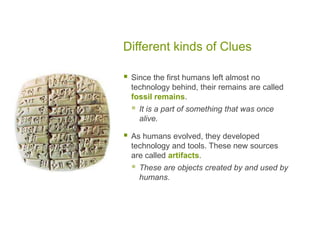
 As humans evolved, they developed
technology and tools. These new sources
are called artifacts.
 These are objects created by and used by
humans.
Sources
 Noun: person, place or thing from which
something comes or is acquired.
 For example:
 Archaeologists look at the tree rings in
order to find the age of a tree or the period
of time, something wooden was built.
Primary Sources
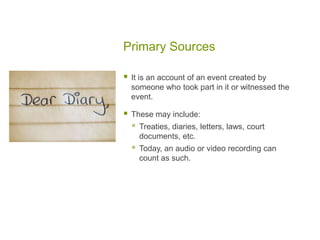
 It is an account of an event created by
someone who took part in it or witnessed the
event.
 These may include:
 Treaties, diaries, letters, laws, court
documents, etc.
 Today, an audio or video recording can
count as such.
Secondary Source
 It is information gathered by someone who
did not take part or witness an event.
 These may include:
 History books, articles, encyclopedias and
teachers.
When sources disagree
 Sometimes sources may disagree with each
other.
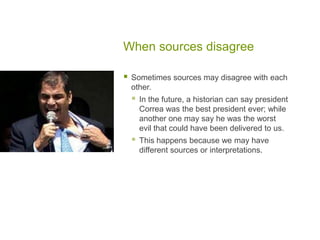
 In the future, a historian can say president
Correa was the best president ever; while
another one may say he was the worst
evil that could have been delivered to us.
 This happens because we may have
different sources or interpretations.
Case Study: Photography as a source of
historical information
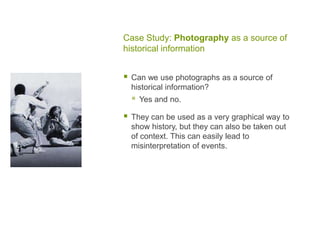
 Can we use photographs as a source of
historical information?
 Yes and no.
 They can be used as a very graphical way to
show history, but they can also be taken out
of context. This can easily lead to
misinterpretation of events.
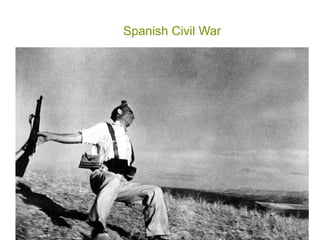
Robert Capa
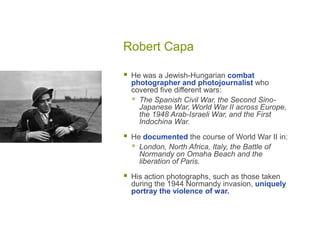
 He was a Jewish-Hungarian combat
photographer and photojournalist who
covered five different wars:
 The Spanish Civil War, the Second Sino-
Japanese War, World War II across Europe,
the 1948 Arab-Israeli War, and the First
Indochina War.
 He documented the course of World War II in:
 London, North Africa, Italy, the Battle of
Normandy on Omaha Beach and the
liberation of Paris.
 His action photographs, such as those taken
during the 1944 Normandy invasion, uniquely
portray the violence of war.
Spanish Civil War
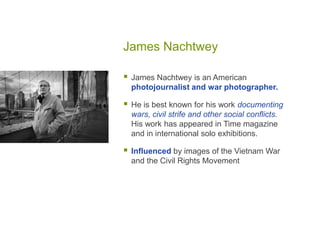
James Nachtwey
 James Nachtwey is an American
photojournalist and war photographer.
 He is best known for his work documenting
wars, civil strife and other social conflicts.
His work has appeared in Time magazine
and in international solo exhibitions.
 Influenced by images of the Vietnam War
and the Civil Rights Movement
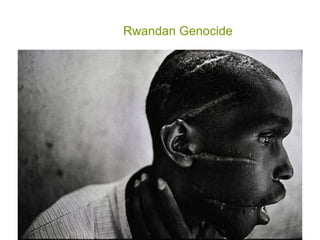
Rwandan Genocide
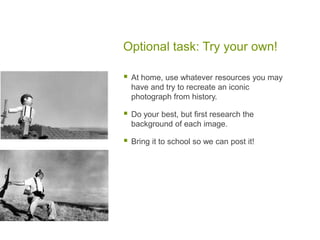
Optional task: Try your own!
 At home, use whatever resources you may
have and try to recreate an iconic
photograph from history.
 Do your best, but first research the
background of each image.
 Bring it to school so we can post it!
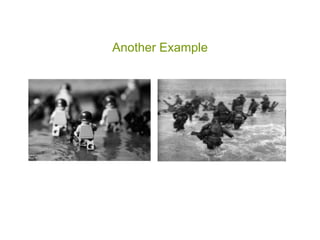
Another Example
Ask Yourself
 Define: What is a fossil?
 Draw conclusions: How do fossils and
artifacts help teach us about history?
 Evaluate: How can photography be used to
give us information?
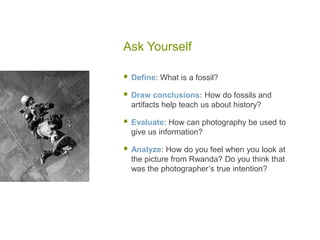
 Analyze: How do you feel when you look at
the picture from Rwanda? Do you think that
was the photographer’s true intention?
Bibliography
 Burstein, S. M., & Shek, R. (2012). World
History (Teacher´s Edition) (1st Edition ed.).
(H. McDougal, Ed.) Orlando, Florida, US.:
Houghton Mifflin Harcourt Publishing
Company.
 Images taken from www.google.com

1 1 clues and sources

  • 1.
    Using Clues Social Studiesfor 8th. EBG – Teacher: Mauricio Torres
  • 2.
    Different kinds ofClues  Since the first humans left almost no technology behind, their remains are called fossil remains.  It is a part of something that was once alive.  As humans evolved, they developed technology and tools. These new sources are called artifacts.  These are objects created by and used by humans.
  • 3.
    Sources  Noun: person,place or thing from which something comes or is acquired.  For example:  Archaeologists look at the tree rings in order to find the age of a tree or the period of time, something wooden was built.
  • 4.
    Primary Sources  Itis an account of an event created by someone who took part in it or witnessed the event.  These may include:  Treaties, diaries, letters, laws, court documents, etc.  Today, an audio or video recording can count as such.
  • 5.
    Secondary Source  Itis information gathered by someone who did not take part or witness an event.  These may include:  History books, articles, encyclopedias and teachers.
  • 6.
    When sources disagree Sometimes sources may disagree with each other.  In the future, a historian can say president Correa was the best president ever; while another one may say he was the worst evil that could have been delivered to us.  This happens because we may have different sources or interpretations.
  • 7.
    Case Study: Photographyas a source of historical information  Can we use photographs as a source of historical information?  Yes and no.  They can be used as a very graphical way to show history, but they can also be taken out of context. This can easily lead to misinterpretation of events.
  • 8.
    Robert Capa  Hewas a Jewish-Hungarian combat photographer and photojournalist who covered five different wars:  The Spanish Civil War, the Second Sino- Japanese War, World War II across Europe, the 1948 Arab-Israeli War, and the First Indochina War.  He documented the course of World War II in:  London, North Africa, Italy, the Battle of Normandy on Omaha Beach and the liberation of Paris.  His action photographs, such as those taken during the 1944 Normandy invasion, uniquely portray the violence of war.
  • 9.
  • 10.
    James Nachtwey  JamesNachtwey is an American photojournalist and war photographer.  He is best known for his work documenting wars, civil strife and other social conflicts. His work has appeared in Time magazine and in international solo exhibitions.  Influenced by images of the Vietnam War and the Civil Rights Movement
  • 11.
  • 12.
    Optional task: Tryyour own!  At home, use whatever resources you may have and try to recreate an iconic photograph from history.  Do your best, but first research the background of each image.  Bring it to school so we can post it!
  • 13.
  • 14.
    Ask Yourself  Define:What is a fossil?  Draw conclusions: How do fossils and artifacts help teach us about history?  Evaluate: How can photography be used to give us information?  Analyze: How do you feel when you look at the picture from Rwanda? Do you think that was the photographer’s true intention?
  • 15.
    Bibliography  Burstein, S.M., & Shek, R. (2012). World History (Teacher´s Edition) (1st Edition ed.). (H. McDougal, Ed.) Orlando, Florida, US.: Houghton Mifflin Harcourt Publishing Company.  Images taken from www.google.com