He wasn’t rich, but with his intelligence and his choice he could access
to an education, despite many obstacles that the American social and
legal system opposed to the full integration of black population.
After many years of work, in 1938, he won the degree of teacher at
Howard University and he joined a group to direct a report about black
population in USA.
As a prominent member of the USA diplomatic assembly, Bunche
attended to several international meetings: such as the Dumbarton
Oaks Conference (1944) and San Francisco Conference (1945), where the
United Nations was created. In 1945 he became the first black person
to access to the address of a ministerial division of the federal
government.
Later, he won the Nobel Peace Prize in recognition of its mediation in
the Arab-Israeli conflict.
In 1960, he participated in the pacification mission of UN, in the Congo
In 1963, President Kennedy gave him the Freedom Medal, the most
important civilian award in the United States.
Bunche was criticized by the organizations of the civil rights movement
of black people, who accused him of forgetting racial fight instead of
his public activity.
Since the early sixties, Bunche used his political influence in favour of
the black movement. In 1965, he participated in civil rights marches in
Selma and Montgomery (Alabama) and he worked with the National
Association for the advance of black people.
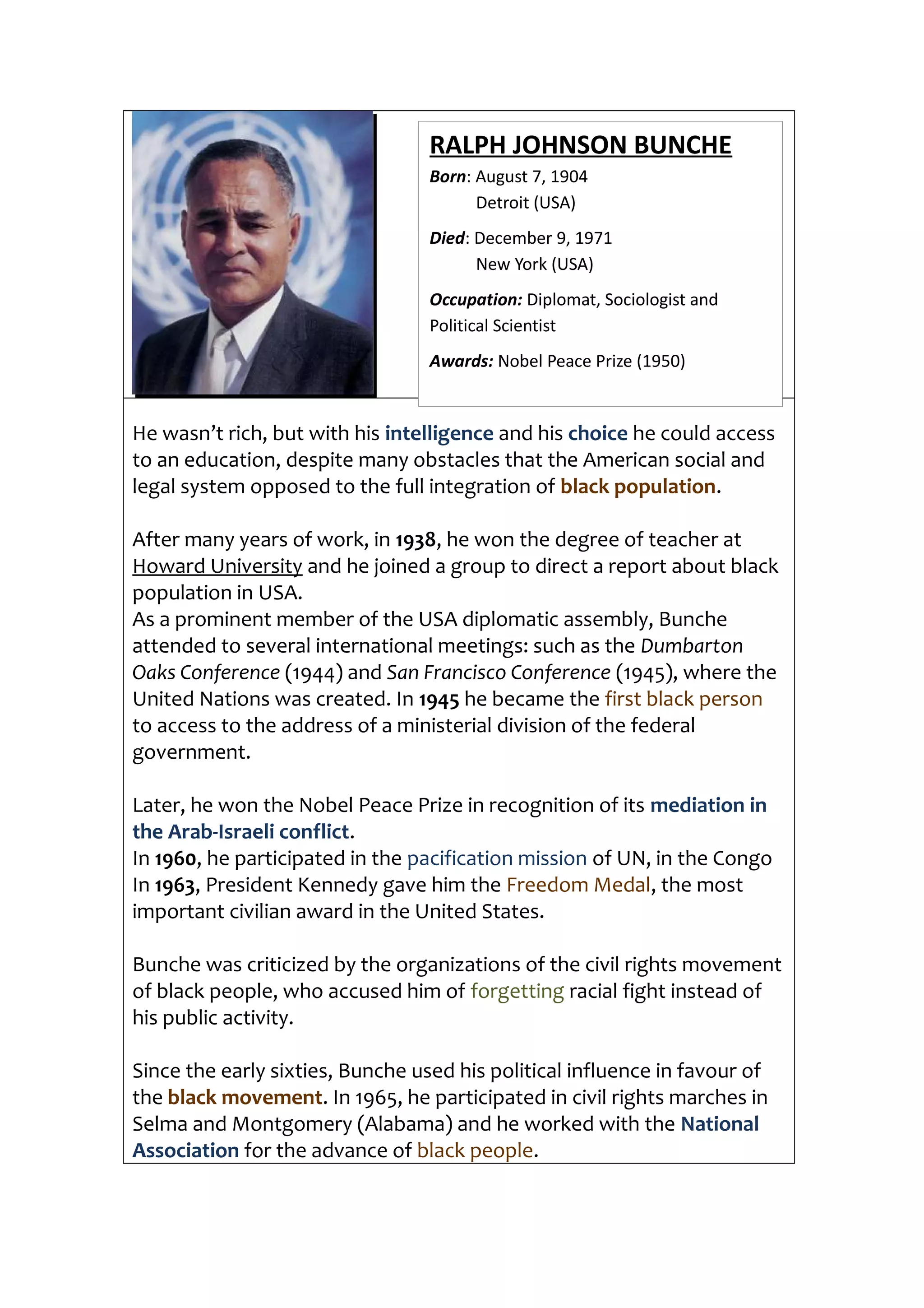
RALPH JOHNSON BUNCHE
Born: August 7, 1904
Detroit (USA)
Died: December 9, 1971
New York (USA)
Occupation: Diplomat, Sociologist and
Political Scientist
Awards: Nobel Peace Prize (1950)

Ralph Johnson Bunche

  • 1.
    He wasn’t rich,but with his intelligence and his choice he could access to an education, despite many obstacles that the American social and legal system opposed to the full integration of black population. After many years of work, in 1938, he won the degree of teacher at Howard University and he joined a group to direct a report about black population in USA. As a prominent member of the USA diplomatic assembly, Bunche attended to several international meetings: such as the Dumbarton Oaks Conference (1944) and San Francisco Conference (1945), where the United Nations was created. In 1945 he became the first black person to access to the address of a ministerial division of the federal government. Later, he won the Nobel Peace Prize in recognition of its mediation in the Arab-Israeli conflict. In 1960, he participated in the pacification mission of UN, in the Congo In 1963, President Kennedy gave him the Freedom Medal, the most important civilian award in the United States. Bunche was criticized by the organizations of the civil rights movement of black people, who accused him of forgetting racial fight instead of his public activity. Since the early sixties, Bunche used his political influence in favour of the black movement. In 1965, he participated in civil rights marches in Selma and Montgomery (Alabama) and he worked with the National Association for the advance of black people. RALPH JOHNSON BUNCHE Born: August 7, 1904 Detroit (USA) Died: December 9, 1971 New York (USA) Occupation: Diplomat, Sociologist and Political Scientist Awards: Nobel Peace Prize (1950)