1Heart, soul, mind and strength.
The answer leads to greater success in both
strategic decision-making and daily challenges.
A metaphor of organizational efficiency illustrated by brain dysfunction.
As an individual
and
as an organization?
Is it normal to obsess?
2
Heart, soul, mind and strength.
As with the human mind, an organization goes crazy
trying to process when and where it cannot.
“Help me, help me, please!”
How to abandon the distraction and waste of
obsessing over nothing
to requirement-driven relentlessness, which is about
obsessing over value
within well-managed cycles of analysis, work, rest and reward.
Heart, soul, mind and strength.A metaphor of organizational efficiency illustrated by brain dysfunction.
3
Heart, soul, mind and strength.
The answer to some of your most significant
organizational challenges
may be found in a study of nature’s complex processes…
What an organization can learn from the brain.
As with the mind, an organization goes crazy
trying to process when and where it cannot.
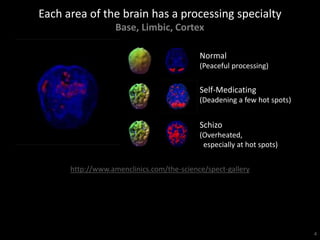
Each region of the brain has processing specialties
4
http://www.amenclinics.com/the-science/spect-gallery
Normal
(Peaceful processing)
Self-Medicating
(Deadening a few schizo hot spots)
Schizo
(Paranoid Schizophrenic –
overheated at hot spots)
including Base, Limbic, and Cortex. Hot spots seen in SPECT scans
increase when an area attempts to process outside of its specialty.
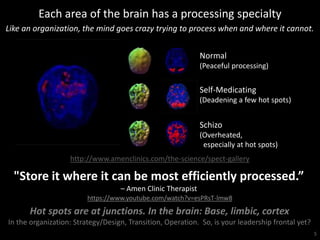
Each region of the brain has processing specialties.
5
http://www.amenclinics.com/the-science/spect-gallery
Hot spots are at junctions. In the brain: Base, limbic, cortex
In the organization: Strategy/Design, Transition, Operation. So, is your leadership frontal yet?
"Store it where it can be most efficiently processed.”
– Amen Clinic Therapist
https://www.youtube.com/watch?v=esPRsT-lmw8
Like an organization, the mind goes crazy trying to process when and where it cannot.
Normal
(Peaceful processing)
Self-Medicating
(Deadening a few schizo hot spots)
Schizo
(Paranoid Schizophrenic –
overheated at hot spots)
6
As in the mind and body, so it is in the organization.
*See “Gifted Individuals” presentation for details.
Twenty-six arenas of an organization - seemingly infinite areas of the brain.
Simple truisms of defining responsibility.
Move activity to where it is efficiently processed.
o Strategy and design cultures and specialties
• Budgeting – Political protocols
• Architecture – Knowledge and creativity
o Transitions cultures and specialties
• Projects – Task-management on timelines
• Major Releases – Build scripts (or drills) to run
later
o Operations cultures and specialties
• Daily Support – Action-oriented responses,
deployment activities (run scripts)
• Improvement Efforts – Pause for intellectual
exercises while improving daily operations
7
Products & Services
Governance Systems
Strategy Management
Engineering
& Knowledge
Relationships & Requirements
Master Scheduling
& Resource Management
ApplicationsPrograms
Ops Control
InfrastructureFulfillment
Projects
IncidentsDevelopment
Catalogs
&
Problems
&
Portfolios
&
Design
&
Maintenance
The Corporate Mind. Interdependent Functions. Hot Spots.
Action Agents
Attack assigned issues
Programs
Adjust to priorities
Service Reps
Ensure coverage of
all constituencies
(Customers/Channels)
1st Line Support
1st Response and
Points of Contact
(Support/Knowledge)
To align life to value, contact Greg@RoweServices.com
Click Pause to read.
Common conflicts and inefficiency
Obsess vs. Process
8
See the presentation "3 Life Process" for a more detailed description of the stages above.
The brain experiences dysfunction as hot spots between
regions fail to hand-off to each other.
The organization experiences pain points, inefficiency and
redundancy where outputs resist aligning to value.
So start at the end with valued outputs and work
backwards. Trace upstream to inputs that cross boundaries
and, ultimately, integrate the lifecycle of each service.
HOW IT WORKS
Process Flow 1-2-3-4
9
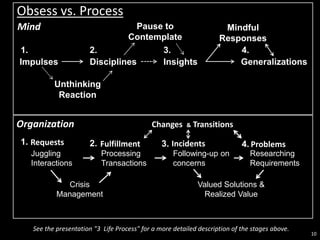
Obsess vs. Process
10
Impulses Disciplines Insights Generalizations
Mindful
Responses
1. 2. 3. 4.
Unthinking
Reaction
Mind Pause to
Contemplate
See the presentation "3 Life Process" for a more detailed description of the stages above.
Obsess vs. Process
11
Organization
Juggling
Interactions
Processing
Transactions
Following-up on
concerns
Researching
Requirements
Valued Solutions &
Realized Value
1. 2. 3. 4.
Crisis
Management
Impulses Disciplines Insights Generalizations
1. 2. 3. 4.
Requests Fulfillment Incidents Problems
Changes & Transitions
Pause to
Contemplate
Mindful
Responses
Unthinking
Reaction
Mind
See the presentation "3 Life Process" for a more detailed description of the stages above.
• Processing corporate activities at the most efficient place
by coordinating interactions between functions.
• Overcoming isolated specialties through collaboration
enabled by the integration of social networks.
• Building interdependent roles within leadership teams that
quickly adapt to changing circumstances.
12Heart, soul, mind and strength.
So it’s about…
What organizations can learn from the brain’s complex processes.
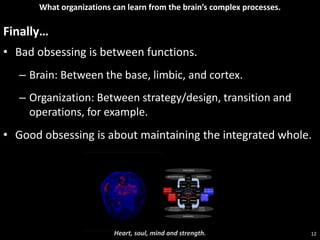
• Bad obsessing is about getting stuck between functions
instead of smoothly handing-off and then letting go.
– Brain: Between the base, limbic, and cortex.
– Organization: Between strategy/design, transition and
operations to name a few.
• Good obsessing is focusing well within an integrated whole.
13Heart, soul, mind and strength.
Finally…
What organizations can learn from the brain’s complex processes.
• Let processes flow freely across functions
– Deny the enablement of directive hierarchies with
wasteful obsessions on a single piece of the puzzle
– Expose fiscal realities to organizational silos that cause
corporate efforts to come out sideways
– Balance authority – formal, informal; matrix, hierarchy
• Achieve desired outcomes
14Heart, soul, mind and strength.
Happy Ending
Fini
A summary follows
To align you life and your work to what you value most, contact
Greg@RoweServices.com
Barrage of
Encounters
Intentional
Actions
Concerns to
Address
Long-Term
Issues to Solve
Projects to
Implement Changes
Inter-
nal
Exter-
nal
Project
Mgmt
Tech
Ops
Coord. Mgmt
Prog.,
Proj.
Tech
Mgmt
Gov.
HQ
Sched.
Infra.Apps.
BRM Svcs
Gov. Quality
Internal or
external
Transcend
Automating mindfulness?
1. Impulses buffered in a dualist team.
2. Emotions redirected in a triad evaluation team.
3. Self-contradictions eliminated in brainstorming team.
4. Inspired architecture emerges from project transition team.
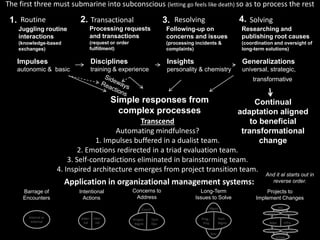
The first three must submarine into subconscious (letting go feels like death) so as to process the rest
Application in organizational management systems:
Simple responses from
complex processes
And it al starts out in
reverse order.
Impulses
autonomic & basic
Disciplines
training & experience
Insights
personality & chemistry
Generalizations
universal, strategic,
1. 2. 3. 4.Routine Transactional Resolving Solving
Juggling routine
interactions
(knowledge-based
exchanges)
Processing requests
and transactions
(request or order
fulfillment)
Following-up on
concerns and issues
(processing incidents &
complaints)
Researching and
publishing root causes
(coordination and oversight of
long-term solutions)
transformative
Continual
adaptation aligned
to beneficial
transformational
change
17
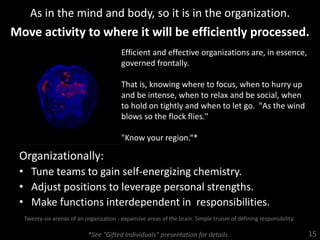
As in the mind and body, so it is in the organization.
*See “Gifted Individuals” presentation for details.
Twenty-six arenas of an organization - expansive areas of the brain. Simple truism of defining responsibility.
Organizationally:
• Tune teams to gain self-energizing chemistry.
• Adjust positions to leverage personal strengths.
• Make functions interdependent in responsibilities.
Move activity to where it will be efficiently processed.
Efficient and effective organizations are, in essence,
governed frontally.
That is, knowing where to focus, when to hurry up
and be intense, when to relax and be social, when
to hold on tightly and when to let go. "As the wind
blows so the flock flies."
"Know your region.“*

Is it normal to obsess - individually and corporately?

  • 1.
    1Heart, soul, mindand strength. The answer leads to greater success in both strategic decision-making and daily challenges. A metaphor of organizational efficiency illustrated by brain dysfunction. As an individual and as an organization? Is it normal to obsess?
  • 2.
    2 Heart, soul, mindand strength. As with the human mind, an organization goes crazy trying to process when and where it cannot. “Help me, help me, please!” How to abandon the distraction and waste of obsessing over nothing to requirement-driven relentlessness, which is about obsessing over value within well-managed cycles of analysis, work, rest and reward. Heart, soul, mind and strength.A metaphor of organizational efficiency illustrated by brain dysfunction.
  • 3.
    3 Heart, soul, mindand strength. The answer to some of your most significant organizational challenges may be found in a study of nature’s complex processes… What an organization can learn from the brain. As with the mind, an organization goes crazy trying to process when and where it cannot.
  • 4.
    Each region ofthe brain has processing specialties 4 http://www.amenclinics.com/the-science/spect-gallery Normal (Peaceful processing) Self-Medicating (Deadening a few schizo hot spots) Schizo (Paranoid Schizophrenic – overheated at hot spots) including Base, Limbic, and Cortex. Hot spots seen in SPECT scans increase when an area attempts to process outside of its specialty.
  • 5.
    Each region ofthe brain has processing specialties. 5 http://www.amenclinics.com/the-science/spect-gallery Hot spots are at junctions. In the brain: Base, limbic, cortex In the organization: Strategy/Design, Transition, Operation. So, is your leadership frontal yet? "Store it where it can be most efficiently processed.” – Amen Clinic Therapist https://www.youtube.com/watch?v=esPRsT-lmw8 Like an organization, the mind goes crazy trying to process when and where it cannot. Normal (Peaceful processing) Self-Medicating (Deadening a few schizo hot spots) Schizo (Paranoid Schizophrenic – overheated at hot spots)
  • 6.
    6 As in themind and body, so it is in the organization. *See “Gifted Individuals” presentation for details. Twenty-six arenas of an organization - seemingly infinite areas of the brain. Simple truisms of defining responsibility. Move activity to where it is efficiently processed. o Strategy and design cultures and specialties • Budgeting – Political protocols • Architecture – Knowledge and creativity o Transitions cultures and specialties • Projects – Task-management on timelines • Major Releases – Build scripts (or drills) to run later o Operations cultures and specialties • Daily Support – Action-oriented responses, deployment activities (run scripts) • Improvement Efforts – Pause for intellectual exercises while improving daily operations
  • 7.
    7 Products & Services GovernanceSystems Strategy Management Engineering & Knowledge Relationships & Requirements Master Scheduling & Resource Management ApplicationsPrograms Ops Control InfrastructureFulfillment Projects IncidentsDevelopment Catalogs & Problems & Portfolios & Design & Maintenance The Corporate Mind. Interdependent Functions. Hot Spots. Action Agents Attack assigned issues Programs Adjust to priorities Service Reps Ensure coverage of all constituencies (Customers/Channels) 1st Line Support 1st Response and Points of Contact (Support/Knowledge) To align life to value, contact Greg@RoweServices.com Click Pause to read. Common conflicts and inefficiency
  • 8.
    Obsess vs. Process 8 Seethe presentation "3 Life Process" for a more detailed description of the stages above. The brain experiences dysfunction as hot spots between regions fail to hand-off to each other. The organization experiences pain points, inefficiency and redundancy where outputs resist aligning to value. So start at the end with valued outputs and work backwards. Trace upstream to inputs that cross boundaries and, ultimately, integrate the lifecycle of each service.
  • 9.
    HOW IT WORKS ProcessFlow 1-2-3-4 9
  • 10.
    Obsess vs. Process 10 ImpulsesDisciplines Insights Generalizations Mindful Responses 1. 2. 3. 4. Unthinking Reaction Mind Pause to Contemplate See the presentation "3 Life Process" for a more detailed description of the stages above.
  • 11.
    Obsess vs. Process 11 Organization Juggling Interactions Processing Transactions Following-upon concerns Researching Requirements Valued Solutions & Realized Value 1. 2. 3. 4. Crisis Management Impulses Disciplines Insights Generalizations 1. 2. 3. 4. Requests Fulfillment Incidents Problems Changes & Transitions Pause to Contemplate Mindful Responses Unthinking Reaction Mind See the presentation "3 Life Process" for a more detailed description of the stages above.
  • 12.
    • Processing corporateactivities at the most efficient place by coordinating interactions between functions. • Overcoming isolated specialties through collaboration enabled by the integration of social networks. • Building interdependent roles within leadership teams that quickly adapt to changing circumstances. 12Heart, soul, mind and strength. So it’s about… What organizations can learn from the brain’s complex processes.
  • 13.
    • Bad obsessingis about getting stuck between functions instead of smoothly handing-off and then letting go. – Brain: Between the base, limbic, and cortex. – Organization: Between strategy/design, transition and operations to name a few. • Good obsessing is focusing well within an integrated whole. 13Heart, soul, mind and strength. Finally… What organizations can learn from the brain’s complex processes.
  • 14.
    • Let processesflow freely across functions – Deny the enablement of directive hierarchies with wasteful obsessions on a single piece of the puzzle – Expose fiscal realities to organizational silos that cause corporate efforts to come out sideways – Balance authority – formal, informal; matrix, hierarchy • Achieve desired outcomes 14Heart, soul, mind and strength. Happy Ending
  • 15.
    Fini A summary follows Toalign you life and your work to what you value most, contact Greg@RoweServices.com
  • 16.
    Barrage of Encounters Intentional Actions Concerns to Address Long-Term Issuesto Solve Projects to Implement Changes Inter- nal Exter- nal Project Mgmt Tech Ops Coord. Mgmt Prog., Proj. Tech Mgmt Gov. HQ Sched. Infra.Apps. BRM Svcs Gov. Quality Internal or external Transcend Automating mindfulness? 1. Impulses buffered in a dualist team. 2. Emotions redirected in a triad evaluation team. 3. Self-contradictions eliminated in brainstorming team. 4. Inspired architecture emerges from project transition team. The first three must submarine into subconscious (letting go feels like death) so as to process the rest Application in organizational management systems: Simple responses from complex processes And it al starts out in reverse order. Impulses autonomic & basic Disciplines training & experience Insights personality & chemistry Generalizations universal, strategic, 1. 2. 3. 4.Routine Transactional Resolving Solving Juggling routine interactions (knowledge-based exchanges) Processing requests and transactions (request or order fulfillment) Following-up on concerns and issues (processing incidents & complaints) Researching and publishing root causes (coordination and oversight of long-term solutions) transformative Continual adaptation aligned to beneficial transformational change
  • 17.
    17 As in themind and body, so it is in the organization. *See “Gifted Individuals” presentation for details. Twenty-six arenas of an organization - expansive areas of the brain. Simple truism of defining responsibility. Organizationally: • Tune teams to gain self-energizing chemistry. • Adjust positions to leverage personal strengths. • Make functions interdependent in responsibilities. Move activity to where it will be efficiently processed. Efficient and effective organizations are, in essence, governed frontally. That is, knowing where to focus, when to hurry up and be intense, when to relax and be social, when to hold on tightly and when to let go. "As the wind blows so the flock flies." "Know your region.“*