




Transfusion
Anthony Holley               Bedside Critical Care

Intensive Care
                                             2012


Royal Brisbane and Women’s
Hospital
Bedside Critical Care
                                                2012


Acknowlegdements
• National Blood Authority
• All our colleagues in the Clinical Reference
  Group
Bedside Critical Care 2012


A Sad Case

“Names and places have been changed to protect
 innocent practitioners involved”
Bedside Critical Care 2012


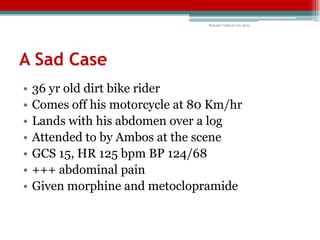
A Sad Case
•   36 yr old dirt bike rider
•   Comes off his motorcycle at 80 Km/hr
•   Lands with his abdomen over a log
•   Attended to by Ambos at the scene
•   GCS 15, HR 125 bpm BP 124/68
•   +++ abdominal pain
•   Given morphine and metoclopramide
Bedside Critical Care 2012


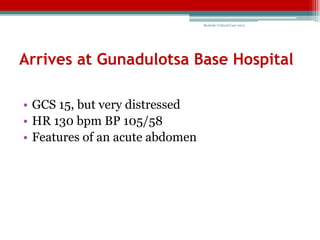
Arrives at Gunadulotsa Base Hospital

• GCS 15, but very distressed
• HR 130 bpm BP 105/58
• Features of an acute abdomen
Bedside Critical Care 2012


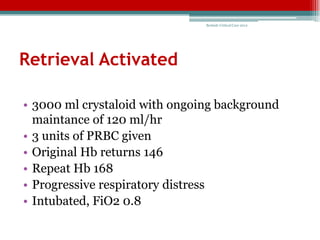
Retrieval Activated

• 3000 ml crystaloid with ongoing background
  maintance of 120 ml/hr
• 3 units of PRBC given
• Original Hb returns 146
• Repeat Hb 168
• Progressive respiratory distress
• Intubated, FiO2 0.8
Bedside Critical Care 2012


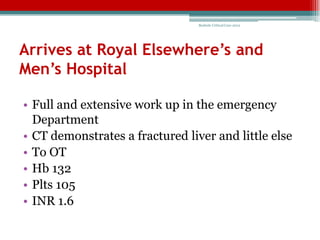
Arrives at Royal Elsewhere’s and
Men’s Hospital

• Full and extensive work up in the emergency
  Department
• CT demonstrates a fractured liver and little else
• To OT
• Hb 132
• Plts 105
• INR 1.6
Bedside Critical Care
                                               2012


On Return to Intensive Care
• Receives 6 units FFP
• Hb 103
• Transfused a further 2 units PRBC
• Post transfusion Hb 127
• Given tranexamic acid 1 g followed by an
  infusion of 1g over 8 hours
• Given 1 bag pooled Platelets
Bedside Critical Care
                                               2012


Progress
• Partial hepatectomy fast and effective
• But develops a fever, rising WBC, Bilateral
  pulmonary infiltrates and increasing ventilatory
  requirement
• Bilateral DVTs on U/S
• After a prolonged ICU admission with a difficult
  respiratory wean discharged to surgery with
  trauma team input.
Bedside Critical Care 2012


Mount Cockup
Bedside Critical Care
                                                     2012


Lessons from the Black Box

1.   Massive transfusion protocols
2.   Transfusion triggers
3.   Transfusion ratios
4.   The role of Tranexamic acid
Bedside Critical Care
                                                        2012


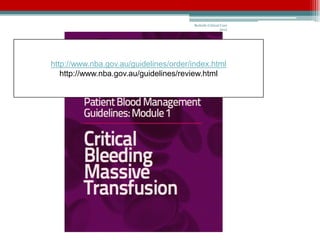
http://www.nba.gov.au/guidelines/order/index.html
   http://www.nba.gov.au/guidelines/review.html
Bedside Critical Care
                                                    2012


 National Blood Authority
2001 National Health and Medical Research Council/
 Australasian Society of Blood Transfusion
 (NHMRC/ASBT)

Clinical practice guidelines on the use of blood components

Now replaced by NBA:

Patient Blood Management Guidelines: Modules 1-6
Bedside Critical Care
                                                      2012


  Patient blood management aims to improve clinical
  outcomes by avoiding unnecessary exposure to blood
  components

  It includes the three pillars of:


1. Optimisation of blood volume
   and red cell mass
2. Minimisation of blood loss
3. Optimisation of the patient’s
   tolerance of anaemia.
Bedside Critical Care
                                     2012


So What is the Utility of Massive
transfusion Protocols?
Bedside Critical Care
                                               2012


Recommendation I
It is recommended that institutions develop an
  MTP that includes the dose, timing and ratio of
  blood component therapy for use in trauma
  patients with, or at risk of, critical bleeding
  requiring massive transfusion (Grade C)
Bedside Critical Care
                                               2012


Practice Point
In patients with critical bleeding requiring
  massive transfusion, the use of an MTP to
  facilitate timely and appropriate use of RBC and
  other blood components may reduce the risk of
  mortality and ARDS.
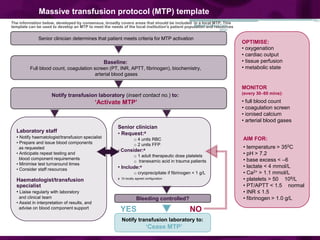
Massive transfusion protocol (MTP) template
The information below, developed by consensus, broadly covers areas that should be included in a local MTP. This
                                                                                                Bedside Critical Care
template can be used to develop an MTP to meet the needs of the local institution's patient population and resources
                                                                                                             2012

              Senior clinician determines that patient meets criteria for MTP activation
                                                                                                                        OPTIMISE:
                                                                                                                        • oxygenation
                                                                                                                        • cardiac output
                                                  Baseline:                                                             • tissue perfusion
         Full blood count, coagulation screen (PT, INR, APTT, fibrinogen), biochemistry,                                • metabolic state
                                        arterial blood gases

                                                                                                                        MONITOR
                     Notify transfusion laboratory (insert contact no.) to:                                             (every 30–60 mins):

                                               ‘Activate MTP’                                                           • full blood count
                                                                                                                        • coagulation screen
                                                                                                                        • ionised calcium
                                                                                                                        • arterial blood gases
                                                        Senior clinician
  Laboratory staff                                      • Request:a
  • Notify haematologist/transfusion specialist                    o 4 units RBC                                        AIM FOR:
  • Prepare and issue blood components                             o 2 units FFP
    as requested                                                                                                        • temperature > 350C
                                                        • Consider:a
  • Anticipate repeat testing and
                                                               o 1 adult therapeutic dose platelets                     • pH > 7.2
    blood component requirements
                                                               o tranexamic acid in trauma patients                     • base excess < –6
  • Minimise test turnaround times
                                                        • Include:a                                                     • lactate < 4 mmol/L
  • Consider staff resources
                                                                   o cryoprecipitate if fibrinogen < 1 g/L              • Ca2+ > 1.1 mmol/L
  Haematologist/transfusion                             a Or locally agreed configuration                               • platelets > 50 109/L
  specialist                                                                                                            • PT/APTT < 1.5 normal
  • Liaise regularly with laboratory                                                                                    • INR ≤ 1.5
    and clinical team                                                Bleeding controlled?                               • fibrinogen > 1.0 g/L
  • Assist in interpretation of results, and
    advise on blood component support
                                                         YES                                     NO
                                                          Notify transfusion laboratory to:
                                                                            ‘Cease MTP’
Bedside Critical Care
                                              2012


So in patients with critical bleeding requiring
massive transfusion, which parameters should
be measured early and frequently?
Bedside Critical Care 2012


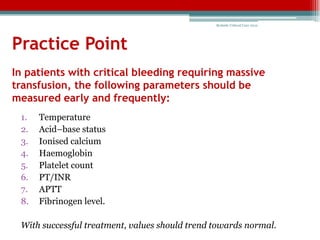
Practice Point
In patients with critical bleeding requiring massive
transfusion, the following parameters should be
measured early and frequently:
 1.   Temperature
 2.   Acid–base status
 3.   Ionised calcium
 4.   Haemoglobin
 5.   Platelet count
 6.   PT/INR
 7.   APTT
 8.   Fibrinogen level.

 With successful treatment, values should trend towards normal.
Bedside Critical Care 2012


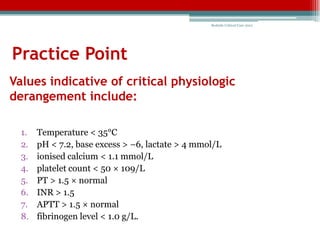
Practice Point
Values indicative of critical physiologic
derangement include:

  1.   Temperature < 35°C
  2.   pH < 7.2, base excess > –6, lactate > 4 mmol/L
  3.   ionised calcium < 1.1 mmol/L
  4.   platelet count < 50 × 109/L
  5.   PT > 1.5 × normal
  6.   INR > 1.5
  7.   APTT > 1.5 × normal
  8.   fibrinogen level < 1.0 g/L.
Bedside Critical Care 2012


So what product ratios should we be
using?
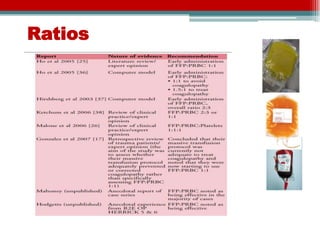
Ratios
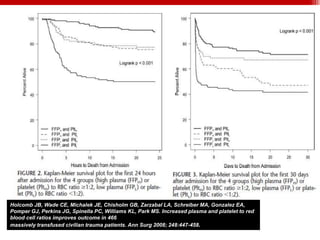
Holcomb JB, Wade CE, Michalek JE, Chisholm GB, Zarzabal LA, Schreiber MA, Gonzalez EA,
Pomper GJ, Perkins JG, Spinella PC, Williams KL, Park MS. Increased plasma and platelet to red
blood cell ratios improves outcome in 466
massively transfused civilian trauma patients. Ann Surg 2008; 248:447-458.
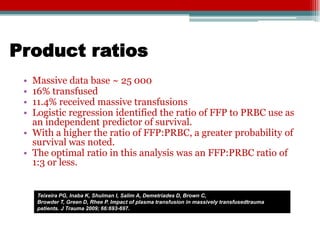
Product ratios
 • Massive data base ~ 25 000
 • 16% transfused
 • 11.4% received massive transfusions
 • Logistic regression identified the ratio of FFP to PRBC use as
   an independent predictor of survival.
 • With a higher the ratio of FFP:PRBC, a greater probability of
   survival was noted.
 • The optimal ratio in this analysis was an FFP:PRBC ratio of
   1:3 or less.


     Teixeira PG, Inaba K, Shulman I, Salim A, Demetriades D, Brown C,
     Browder T, Green D, Rhee P. Impact of plasma transfusion in massively transfusedtrauma
     patients. J Trauma 2009; 66:693-697.
Bedside Critical Care 2012


Practice Point

In patients with critical bleeding requiring
  massive transfusion, insufficient evidence was
  identified to support or refute the use of specific
  ratios of RBCs to blood components.
Bedside Critical Care
                                                2012


Practice Point
In patients with critical bleeding requiring
    massive transfusion, suggested doses of blood
    components are:

1. FFP: 15 mL/kg
2. platelets: 1 adult therapeutic dose
3. cryoprecipitate: 3–4 g.
Bedside Critical Care 2012


Haemoglobin trigger???
Bedside Critical Care
                                             2012


Practice Point
In patients with critical bleeding requiring
  massive transfusion, haemoglobin concentration
  should be interpreted in the context of
  haemodynamic status, organ perfusion and
  tissue oxygenation.
Bedside Critical Care
                                              2012


Practice Point
In patients with critical bleeding requiring
  massive transfusion, the use of RBC and other
  blood components may be life saving.

However, transfusion of increased volumes of
 RBC and other blood components may be
 independently associated with increased
 mortality and ARDS.
Bedside Critical Care
                                    2012


What Adjuctive Therapy should we
employ?
Bedside Critical Care 2012


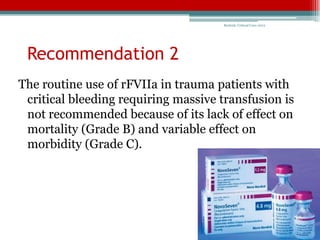
 Recommendation 2
The routine use of rFVIIa in trauma patients with
 critical bleeding requiring massive transfusion is
 not recommended because of its lack of effect on
 mortality (Grade B) and variable effect on
 morbidity (Grade C).
Bedside Critical Care 2012


Practice Point
1.   An MTP should include advice on the administration of rFVIIa
     when conventional measures – including surgical haemostasis
     and component therapy – have failed to control critical bleeding.

2.   NB: rFVIIa is not licensed for this use. Its use should only be
     considered in exceptional circumstances where survival is
     considered a credible outcome

3.   When rFVIIa is administered to patients with critical bleeding
     requiring massive transfusion, an initial dose of 90 μg/kg is
     reasonable.
Bedside Critical Care
                                                2012


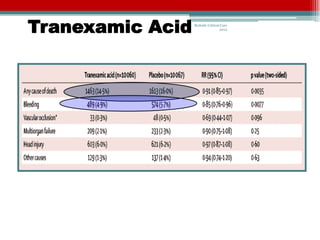
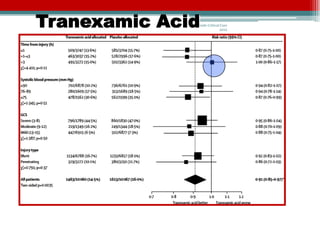
Crash 2
In trauma patients with or at risk of significant
  haemorrhage, tranexamic acid (loading dose 1 g
  over 10 minutes, followed by infusion of 1 g over
  8 hours) should be considered.

No systematic review was conducted on
  tranexamic acid in critical bleeding/massive
transfusion. The study population was not
  restricted to critical bleeding requiring massive
  transfusion.
Tranexamic Acid   Bedside Critical Care
                                  2012
Tranexamic Acid
              Bedside Critical Care
                              2012
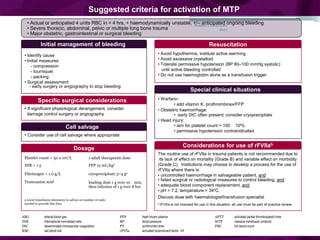
Suggested criteria for activation of MTP
  • Actual or anticipated 4 units RBC in < 4 hrs, + haemodynamically unstable, +/– anticipated ongoing bleeding
                                                                               Bedside Critical Care
  • Severe thoracic, abdominal, pelvic or multiple long bone trauma                            2012
  • Major obstetric, gastrointestinal or surgical bleeding

            Initial management of bleeding                                                                                         Resuscitation
 • Identify cause                                                                             • Avoid hypothermia, institute active warming
 • Initial measures:                                                                          • Avoid excessive crystalloid
     - compression                                                                            • Tolerate permissive hypotension (BP 80–100 mmHg systolic)
     - tourniquet                                                                               until active bleeding controlled
     - packing                                                                                • Do not use haemoglobin alone as a transfusion trigger
 • Surgical assessment:
    - early surgery or angiography to stop bleeding
                                                                                                                      Special clinical situations
          Specific surgical considerations                                                    • Warfarin:
                                                                                                      • add vitamin K, prothrombinex/FFP
 • If significant physiological derangement, consider                                         • Obstetric haemorrhage:
  damage control surgery or angiography                                                               • early DIC often present; consider cryoprecipitate
                                                                                              • Head injury:
                               Cell salvage                                                           • aim for platelet count > 100 109/L
                                                                                                      • permissive hypotension contraindicated
 • Consider use of cell salvage where appropriate

                                     Dosage                                                                      Considerations for use of rFVIIab
                                                                                              The routine use of rFVIIa in trauma patients is not recommended due to
 Platelet count < 50 x 109/L                    1 adult therapeutic dose                       its lack of effect on mortality (Grade B) and variable effect on morbidity
 INR > 1.5                                      FFP 15 mL/kga                                 (Grade C). Institutions may choose to develop a process for the use of
                                                                                              rFVIIa where there is:
 Fibrinogen < 1.0 g/L                           cryoprecipitate 3–4 ga                        • uncontrolled haemorrhage in salvageable patient, and
 Tranexamic acid                                                                              • failed surgical or radiological measures to control bleeding, and
                                                loading dose 1 g over 10 min,
                                                then infusion of 1 g over 8 hrs               • adequate blood component replacement, and
                                                                                              • pH > 7.2, temperature > 340C.
                                                                                              Discuss dose with haematologist/transfusion specialist
 a Local transfusion laboratory to advise on number of units
 needed to provide this dose                                                                  b rFVIIa   is not licensed for use in this situation; all use must be part of practice review.


ABG            arterial blood gas                                 FFP             fresh frozen plasma                                  APTT         activated partial thromboplastin time
INR            international normalised ratio                     BP              blood pressure                                       MTP          massive transfusion protocol
DIC            disseminated intravascular coagulation             PT              prothrombin time                                     FBC          full blood count
RBC            red blood cell                                     rFVlla          activated recombinant factor VII
Bedside Critical Care
                2012

Anthony Holley on Transfusion

  • 1.
    Transfusion Anthony Holley Bedside Critical Care Intensive Care 2012 Royal Brisbane and Women’s Hospital
  • 2.
    Bedside Critical Care 2012 Acknowlegdements • National Blood Authority • All our colleagues in the Clinical Reference Group
  • 3.
    Bedside Critical Care2012 A Sad Case “Names and places have been changed to protect innocent practitioners involved”
  • 4.
    Bedside Critical Care2012 A Sad Case • 36 yr old dirt bike rider • Comes off his motorcycle at 80 Km/hr • Lands with his abdomen over a log • Attended to by Ambos at the scene • GCS 15, HR 125 bpm BP 124/68 • +++ abdominal pain • Given morphine and metoclopramide
  • 5.
    Bedside Critical Care2012 Arrives at Gunadulotsa Base Hospital • GCS 15, but very distressed • HR 130 bpm BP 105/58 • Features of an acute abdomen
  • 6.
    Bedside Critical Care2012 Retrieval Activated • 3000 ml crystaloid with ongoing background maintance of 120 ml/hr • 3 units of PRBC given • Original Hb returns 146 • Repeat Hb 168 • Progressive respiratory distress • Intubated, FiO2 0.8
  • 7.
    Bedside Critical Care2012 Arrives at Royal Elsewhere’s and Men’s Hospital • Full and extensive work up in the emergency Department • CT demonstrates a fractured liver and little else • To OT • Hb 132 • Plts 105 • INR 1.6
  • 8.
    Bedside Critical Care 2012 On Return to Intensive Care • Receives 6 units FFP • Hb 103 • Transfused a further 2 units PRBC • Post transfusion Hb 127 • Given tranexamic acid 1 g followed by an infusion of 1g over 8 hours • Given 1 bag pooled Platelets
  • 9.
    Bedside Critical Care 2012 Progress • Partial hepatectomy fast and effective • But develops a fever, rising WBC, Bilateral pulmonary infiltrates and increasing ventilatory requirement • Bilateral DVTs on U/S • After a prolonged ICU admission with a difficult respiratory wean discharged to surgery with trauma team input.
  • 10.
  • 11.
    Bedside Critical Care2012 Mount Cockup
  • 12.
    Bedside Critical Care 2012 Lessons from the Black Box 1. Massive transfusion protocols 2. Transfusion triggers 3. Transfusion ratios 4. The role of Tranexamic acid
  • 13.
    Bedside Critical Care 2012 http://www.nba.gov.au/guidelines/order/index.html http://www.nba.gov.au/guidelines/review.html
  • 14.
    Bedside Critical Care 2012 National Blood Authority 2001 National Health and Medical Research Council/ Australasian Society of Blood Transfusion (NHMRC/ASBT) Clinical practice guidelines on the use of blood components Now replaced by NBA: Patient Blood Management Guidelines: Modules 1-6
  • 15.
    Bedside Critical Care 2012 Patient blood management aims to improve clinical outcomes by avoiding unnecessary exposure to blood components It includes the three pillars of: 1. Optimisation of blood volume and red cell mass 2. Minimisation of blood loss 3. Optimisation of the patient’s tolerance of anaemia.
  • 16.
    Bedside Critical Care 2012 So What is the Utility of Massive transfusion Protocols?
  • 17.
    Bedside Critical Care 2012 Recommendation I It is recommended that institutions develop an MTP that includes the dose, timing and ratio of blood component therapy for use in trauma patients with, or at risk of, critical bleeding requiring massive transfusion (Grade C)
  • 18.
    Bedside Critical Care 2012 Practice Point In patients with critical bleeding requiring massive transfusion, the use of an MTP to facilitate timely and appropriate use of RBC and other blood components may reduce the risk of mortality and ARDS.
  • 19.
    Massive transfusion protocol(MTP) template The information below, developed by consensus, broadly covers areas that should be included in a local MTP. This Bedside Critical Care template can be used to develop an MTP to meet the needs of the local institution's patient population and resources 2012 Senior clinician determines that patient meets criteria for MTP activation OPTIMISE: • oxygenation • cardiac output Baseline: • tissue perfusion Full blood count, coagulation screen (PT, INR, APTT, fibrinogen), biochemistry, • metabolic state arterial blood gases MONITOR Notify transfusion laboratory (insert contact no.) to: (every 30–60 mins): ‘Activate MTP’ • full blood count • coagulation screen • ionised calcium • arterial blood gases Senior clinician Laboratory staff • Request:a • Notify haematologist/transfusion specialist o 4 units RBC AIM FOR: • Prepare and issue blood components o 2 units FFP as requested • temperature > 350C • Consider:a • Anticipate repeat testing and o 1 adult therapeutic dose platelets • pH > 7.2 blood component requirements o tranexamic acid in trauma patients • base excess < –6 • Minimise test turnaround times • Include:a • lactate < 4 mmol/L • Consider staff resources o cryoprecipitate if fibrinogen < 1 g/L • Ca2+ > 1.1 mmol/L Haematologist/transfusion a Or locally agreed configuration • platelets > 50 109/L specialist • PT/APTT < 1.5 normal • Liaise regularly with laboratory • INR ≤ 1.5 and clinical team Bleeding controlled? • fibrinogen > 1.0 g/L • Assist in interpretation of results, and advise on blood component support YES NO Notify transfusion laboratory to: ‘Cease MTP’
  • 20.
    Bedside Critical Care 2012 So in patients with critical bleeding requiring massive transfusion, which parameters should be measured early and frequently?
  • 21.
    Bedside Critical Care2012 Practice Point In patients with critical bleeding requiring massive transfusion, the following parameters should be measured early and frequently: 1. Temperature 2. Acid–base status 3. Ionised calcium 4. Haemoglobin 5. Platelet count 6. PT/INR 7. APTT 8. Fibrinogen level. With successful treatment, values should trend towards normal.
  • 22.
    Bedside Critical Care2012 Practice Point Values indicative of critical physiologic derangement include: 1. Temperature < 35°C 2. pH < 7.2, base excess > –6, lactate > 4 mmol/L 3. ionised calcium < 1.1 mmol/L 4. platelet count < 50 × 109/L 5. PT > 1.5 × normal 6. INR > 1.5 7. APTT > 1.5 × normal 8. fibrinogen level < 1.0 g/L.
  • 23.
    Bedside Critical Care2012 So what product ratios should we be using?
  • 24.
  • 25.
    Holcomb JB, WadeCE, Michalek JE, Chisholm GB, Zarzabal LA, Schreiber MA, Gonzalez EA, Pomper GJ, Perkins JG, Spinella PC, Williams KL, Park MS. Increased plasma and platelet to red blood cell ratios improves outcome in 466 massively transfused civilian trauma patients. Ann Surg 2008; 248:447-458.
  • 26.
    Product ratios •Massive data base ~ 25 000 • 16% transfused • 11.4% received massive transfusions • Logistic regression identified the ratio of FFP to PRBC use as an independent predictor of survival. • With a higher the ratio of FFP:PRBC, a greater probability of survival was noted. • The optimal ratio in this analysis was an FFP:PRBC ratio of 1:3 or less. Teixeira PG, Inaba K, Shulman I, Salim A, Demetriades D, Brown C, Browder T, Green D, Rhee P. Impact of plasma transfusion in massively transfusedtrauma patients. J Trauma 2009; 66:693-697.
  • 27.
    Bedside Critical Care2012 Practice Point In patients with critical bleeding requiring massive transfusion, insufficient evidence was identified to support or refute the use of specific ratios of RBCs to blood components.
  • 28.
    Bedside Critical Care 2012 Practice Point In patients with critical bleeding requiring massive transfusion, suggested doses of blood components are: 1. FFP: 15 mL/kg 2. platelets: 1 adult therapeutic dose 3. cryoprecipitate: 3–4 g.
  • 29.
    Bedside Critical Care2012 Haemoglobin trigger???
  • 30.
    Bedside Critical Care 2012 Practice Point In patients with critical bleeding requiring massive transfusion, haemoglobin concentration should be interpreted in the context of haemodynamic status, organ perfusion and tissue oxygenation.
  • 31.
    Bedside Critical Care 2012 Practice Point In patients with critical bleeding requiring massive transfusion, the use of RBC and other blood components may be life saving. However, transfusion of increased volumes of RBC and other blood components may be independently associated with increased mortality and ARDS.
  • 32.
    Bedside Critical Care 2012 What Adjuctive Therapy should we employ?
  • 33.
    Bedside Critical Care2012 Recommendation 2 The routine use of rFVIIa in trauma patients with critical bleeding requiring massive transfusion is not recommended because of its lack of effect on mortality (Grade B) and variable effect on morbidity (Grade C).
  • 34.
    Bedside Critical Care2012 Practice Point 1. An MTP should include advice on the administration of rFVIIa when conventional measures – including surgical haemostasis and component therapy – have failed to control critical bleeding. 2. NB: rFVIIa is not licensed for this use. Its use should only be considered in exceptional circumstances where survival is considered a credible outcome 3. When rFVIIa is administered to patients with critical bleeding requiring massive transfusion, an initial dose of 90 μg/kg is reasonable.
  • 35.
    Bedside Critical Care 2012 Crash 2 In trauma patients with or at risk of significant haemorrhage, tranexamic acid (loading dose 1 g over 10 minutes, followed by infusion of 1 g over 8 hours) should be considered. No systematic review was conducted on tranexamic acid in critical bleeding/massive transfusion. The study population was not restricted to critical bleeding requiring massive transfusion.
  • 36.
    Tranexamic Acid Bedside Critical Care 2012
  • 37.
    Tranexamic Acid Bedside Critical Care 2012
  • 38.
    Suggested criteria foractivation of MTP • Actual or anticipated 4 units RBC in < 4 hrs, + haemodynamically unstable, +/– anticipated ongoing bleeding Bedside Critical Care • Severe thoracic, abdominal, pelvic or multiple long bone trauma 2012 • Major obstetric, gastrointestinal or surgical bleeding Initial management of bleeding Resuscitation • Identify cause • Avoid hypothermia, institute active warming • Initial measures: • Avoid excessive crystalloid - compression • Tolerate permissive hypotension (BP 80–100 mmHg systolic) - tourniquet until active bleeding controlled - packing • Do not use haemoglobin alone as a transfusion trigger • Surgical assessment: - early surgery or angiography to stop bleeding Special clinical situations Specific surgical considerations • Warfarin: • add vitamin K, prothrombinex/FFP • If significant physiological derangement, consider • Obstetric haemorrhage: damage control surgery or angiography • early DIC often present; consider cryoprecipitate • Head injury: Cell salvage • aim for platelet count > 100 109/L • permissive hypotension contraindicated • Consider use of cell salvage where appropriate Dosage Considerations for use of rFVIIab The routine use of rFVIIa in trauma patients is not recommended due to Platelet count < 50 x 109/L 1 adult therapeutic dose its lack of effect on mortality (Grade B) and variable effect on morbidity INR > 1.5 FFP 15 mL/kga (Grade C). Institutions may choose to develop a process for the use of rFVIIa where there is: Fibrinogen < 1.0 g/L cryoprecipitate 3–4 ga • uncontrolled haemorrhage in salvageable patient, and Tranexamic acid • failed surgical or radiological measures to control bleeding, and loading dose 1 g over 10 min, then infusion of 1 g over 8 hrs • adequate blood component replacement, and • pH > 7.2, temperature > 340C. Discuss dose with haematologist/transfusion specialist a Local transfusion laboratory to advise on number of units needed to provide this dose b rFVIIa is not licensed for use in this situation; all use must be part of practice review. ABG arterial blood gas FFP fresh frozen plasma APTT activated partial thromboplastin time INR international normalised ratio BP blood pressure MTP massive transfusion protocol DIC disseminated intravascular coagulation PT prothrombin time FBC full blood count RBC red blood cell rFVlla activated recombinant factor VII
  • 39.