The document discusses the development of a wireless sensor network (WSN) communication device for military operations, focusing on enhancing information dissemination among soldiers in challenging environments. It outlines the proposed system's capabilities, including real-time tracking of soldiers' health and location, and the prototype's applicability to search and rescue missions. The study emphasizes the need for mobile platforms to support effective communication in remote military areas and presents detailed research methods and outcomes of the smart device's design.
![International Journal of Informatics and Communication Technology (IJ-ICT)
Vol.7, No.2, August 2018, pp. 89~95
ISSN: 2252-8776, DOI: 10.11591/ijict.v7i2.pp89-95 89
Journal homepage: http://iaescore.com/journals/index.php/IJICT
Establishing a Soldier Wireless Sensor Network (WSN)
Communication for Military Operation Monitoring
Mohd Nazri Ismail*
, Mohd ‘Afizi Shukran, Mohd Rizal Mohd Isa, Mohd Adib, Omar Zakaria
Faculty of Defense Science and Technology, National Defence University of Malaysia (UPNM), Sungai Besi,
Kuala Lumpur, Malaysia
Article Info ABSTRACT
Article history:
Received Apr 13, 2018
Revised Jun 15, 2018
Accepted Jun 29, 2018
The study investigates and develops components for implementing an
effective and efficient military knowledge/information/communication in
closed network architecture. Since military personnel are always on the move,
the dissemination of knowledge/information/communication needs a mobile
platform to accommodate mobility of people. The mobile and wireless
network platform should be able to sustain the remoteness and seclusion of
military operation areas. Communication is one of key problems of a military
operation especially due to environmental constraints. This study proposes on
establishing a future soldier communication device with mobile Wireless
Sensor Network (WSN) and mobile network to suit the infantry operations in
the jungle. The operational areas are considered to restricted and challenging
locations. Wireless Sensor Network (WSN) will become inexpensive and
common over the next decade Thus, a thorough study is vital to develop the
most suitable smart equipment and network requirements for Malaysia’s
military eco-system. Finally, this study has successfully developed new smart
device prototype using WSN approach for Military operation. In addition, this
prototype can be used for Search and Rescue (SAR) operation. This prototype
is able to transmit death and location status, movement location status, health
monitoring and status to the base station.
Keywords:
Health
Knowledge
Military
Mobile
Prototype
Wireless sensor network (WSN)
Copyright © 2018 Institute of Advanced Engineering and Science.
All rights reserved.
Corresponding Author:
Mohd Nazri Ismail,
Faculty of Defense Science and Technology,
National Defence University of Malaysia (UPNM),
Sungai Besi, Kuala Lumpur, Malaysia.
Email: m.nazri@upnm.edu.my
1. INTRODUCTION
Cutting edge computer network technologies facilitates sharing knowledge and information among
personnel in many organizations. Knowledge and Information must now be treated as a critical resource to the
organization in addition to land and raw materials. In military, initiatives labeled as Knowledge Management
(KM), the focus is on learning and the sharing of tacit knowledge, particularly in the many areas of military
operations [1, 2]. Since military personnel are always on the move, the dissemination of knowledge and
information needs a mobile platform to accommodate mobility of people. The mobile and wireless network
platform should be able to sustain the remoteness and seclusion of military operation areas.
Future soldier is a concept of how the future Soldier might be equipped. The future Soldier shall be
tailored with design considerations for each technology area name below with special emphasis on cognitive
performance to improve Soldier effectiveness and an increase in operational tempo. There are seven major
areas within Future Soldier [3]: i) Human Performance & Training, ii) Soldier Protection; iii) Lethality; iv)
Mobility and Logistics, v) Soldier Network; vi) Soldier Sensors; vii) Soldier Power & Energy. The smart device
using Wireless Sensor Network (WSN) is developed based on four areas i) Lethality, ii) Mobility, iii) Soldier](https://image.slidesharecdn.com/07paperjournalwsneditsat-201019042640/85/07-paper-journal-wsn-edit-sat-1-320.jpg)
![International Journal of Informatics and Communication Technology (IJ-ICT)
Vol.7, No.2, August 2018, pp. 89~95
ISSN: 2252-8776, DOI: 10.11591/ijict.v7i2.pp89-95 89
Journal homepage: http://iaescore.com/journals/index.php/IJICT
Establishing a Soldier Wireless Sensor Network (WSN)
Communication for Military Operation Monitoring
Mohd Nazri Ismail*
, Mohd ‘Afizi Shukran, Mohd Rizal Mohd Isa, Mohd Adib, Omar Zakaria
Faculty of Defense Science and Technology, National Defence University of Malaysia (UPNM), Sungai Besi,
Kuala Lumpur, Malaysia
Article Info ABSTRACT
Article history:
Received Apr 13, 2018
Revised Jun 15, 2018
Accepted Jun 29, 2018
The study investigates and develops components for implementing an
effective and efficient military knowledge/information/communication in
closed network architecture. Since military personnel are always on the move,
the dissemination of knowledge/information/communication needs a mobile
platform to accommodate mobility of people. The mobile and wireless
network platform should be able to sustain the remoteness and seclusion of
military operation areas. Communication is one of key problems of a military
operation especially due to environmental constraints. This study proposes on
establishing a future soldier communication device with mobile Wireless
Sensor Network (WSN) and mobile network to suit the infantry operations in
the jungle. The operational areas are considered to restricted and challenging
locations. Wireless Sensor Network (WSN) will become inexpensive and
common over the next decade Thus, a thorough study is vital to develop the
most suitable smart equipment and network requirements for Malaysia’s
military eco-system. Finally, this study has successfully developed new smart
device prototype using WSN approach for Military operation. In addition, this
prototype can be used for Search and Rescue (SAR) operation. This prototype
is able to transmit death and location status, movement location status, health
monitoring and status to the base station.
Keywords:
Health
Knowledge
Military
Mobile
Prototype
Wireless sensor network (WSN)
Copyright © 2018 Institute of Advanced Engineering and Science.
All rights reserved.
Corresponding Author:
Mohd Nazri Ismail,
Faculty of Defense Science and Technology,
National Defence University of Malaysia (UPNM),
Sungai Besi, Kuala Lumpur, Malaysia.
Email: m.nazri@upnm.edu.my
1. INTRODUCTION
Cutting edge computer network technologies facilitates sharing knowledge and information among
personnel in many organizations. Knowledge and Information must now be treated as a critical resource to the
organization in addition to land and raw materials. In military, initiatives labeled as Knowledge Management
(KM), the focus is on learning and the sharing of tacit knowledge, particularly in the many areas of military
operations [1, 2]. Since military personnel are always on the move, the dissemination of knowledge and
information needs a mobile platform to accommodate mobility of people. The mobile and wireless network
platform should be able to sustain the remoteness and seclusion of military operation areas.
Future soldier is a concept of how the future Soldier might be equipped. The future Soldier shall be
tailored with design considerations for each technology area name below with special emphasis on cognitive
performance to improve Soldier effectiveness and an increase in operational tempo. There are seven major
areas within Future Soldier [3]: i) Human Performance & Training, ii) Soldier Protection; iii) Lethality; iv)
Mobility and Logistics, v) Soldier Network; vi) Soldier Sensors; vii) Soldier Power & Energy. The smart device
using Wireless Sensor Network (WSN) is developed based on four areas i) Lethality, ii) Mobility, iii) Soldier](https://image.slidesharecdn.com/07paperjournalwsneditsat-201019042640/75/07-paper-journal-wsn-edit-sat-1-2048.jpg)
![ ISSN: 2252-8776
IJ-ICT Vol. 7, No. 2, August 2018 : 89 – 95
90
Network, and iv) Soldier Sensors. This approach is not focusing on military information but it is also can be
applied to SAR (Search and Rescue) team unit.
Communication is one of key problems of a military operation especially i) there is no death
notification status mechanism, ii) unable to track the movement and location of soldier in real time, iii) unable
to monitor injured soldier from base station. Hence, this study proposes on establishing a future soldier
communication device embedded with wireless sensor network to suit the military operations in the jungle.
Thus, a thorough study is vital to develop the suitable equipment and network requirements for Malaysia’s
military eco-system. Thus, the objectives of this research are as follows:
i. Develop and execute processes that engage current soldiers and partners in the identification and analysis of
future Soldier.
ii. Create future operations and support future capability identification and analysis.
iii. Innovators in the research community to better understand how future science and technology can enable
future Soldier
iv. To develop a smart device communication (IoT) using radio frequency (RF) network and mobile network
for military HQ remote monitoring.
The rest of the paper is organized as follows: background and related work is presented in Section 2,
while Section 3 discusses on methodology. This is followed by Section 4 with a design and result of smart
device using wireless sensor network approach. Finally, in Section 5, the paper is concluded with a brief
summary and future research work.
2. BACKGROUND AND RELATED WORK
Infantry have always been inspired to the ideal of ‘one shot, one kill’ in the military training, but this
article proves that, especially in complex terrains such as the jungle area, infantry usually applies the ‘volume
of fire’ psychological approach to dominate their enemy. Only then the significant challenges of poor visibility
and fleeting engagement opportunities are successfully overcome and maneuver restored to the
light infantryman [4].
Communication is the key aspect in military operations [5]. Throughout the ages, man have used many
different modes of communication. Be it as pictography, sign languages, lights, smokes and many other
symbolic ways in such that some even encrypted to hide the actual data that is being relayed. With the creativity
of man to come up with many different ways of communicating, come challenges of making it much more
effective. But in terms of military operations, communications have to be brief, precise and relayed to the target
at pin point accuracy. The common mode of communicating has always been through voice radio. Soldiers of
the world are much more dependent on current electronic warfare technology to win the war. These new
emerging technology comes with a price, other than the value of money, the sum is weight is a major factor.
Compared to soldiers of the first world war, soldiers of today have to carry almost double the weight. There
are other methods being used in the history of military communication other than radio waves which are mainly
in electronic signals and optical signals. Examples for electronic signals are telephone where the telephone
converts the voice into electronic signal through the circuits in the telephone. Whereas for optical signals, it
will receive the converted signals in a form of lights to be transmitted into the fibre optic cable that will then
will be converted into electronic signals that will be convert into data via electronic devices,
such as computers [6].
A mesh network is a perfect fit for military operations because it is wireless and mobile rather than
the traditional hub-and-spoke networking model which requires a physical connectivity and a centralized
router. Instead, mesh networks transmits a relay system that lets each node act independently to receive and
disseminate information and then forward them to the other nodes. It does not only works with the forward-
operating units to collects data such as visual and sound on the surroundings of the required area that does not
facilitate with the networking infrastructure, but it can also be configured accordingly with a much more
efficient and quickly and considered as a much more reliable because it can bypass nodes that are operating
sub optimally automatically in favor of the much more quickest and most robust pathway. Example of
organization that has been using the mesh network is the United States Marines [7].
Based on the reviews, we can deduce that it is feasible to establish a wireless sensor network for
infantry personnel during military operations [8, 9, 10, 11]. The following sections describes further on the
research issues, objectives and the proposed network structure.](https://image.slidesharecdn.com/07paperjournalwsneditsat-201019042640/85/07-paper-journal-wsn-edit-sat-2-320.jpg)
![IJ-ICT ISSN: 2252-8776
Establishing a Soldier Wireless Sensor Network (WSN)… (Mohd Nazri Ismail)
91
3. THE PROPOSED WIRELESS SENSOR NETWORK STRUCTURE
The approach of this research will be conducted according to the objectives that have been stated as
above. Initial study would be concentrated in understanding the mechanics and characteristics of a wireless
sensor network and wireless mesh network. A handful of papers related to the research and development of the
wireless network will be studied [12, 13, 14]. A wireless sensor network is a group of network which usually
uses wireless or cabled network where each of the devices is connected from one to many. It needs to be
configured to allow connections to be rerouted by avoiding obstacle objects that may be block the signals from
being transmitted by hoping the nodes from one device to another until it reaches its destination. Wireless
sensor networks are self-healing and very reliable [15, 16, 17]. Figure 1 illustrates the proposed framework of
wireless sensor network structure for infantry operations [17, 18].
Figure 1. Framework of Wireless Sensor Network for Military Unit
4. RESEARCH METHODOLOGY
The following methods would be applied to complete the project objectives (refer to Figure 2):
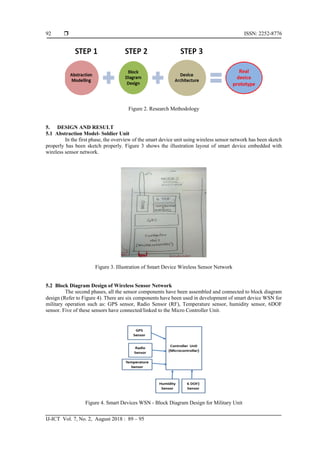
a. Abstraction Modelling: In the first step, it is required to design the smart device system which has a
communication component. The layout of smart device system with its components is designed on the
drawing paper (Abstraction Modelling)
b. Block Diagram Design: Next, from abstraction modelling the smart device communication will transform
to the Block diagram design. In this stage, the communication components need to arrange and link each
other’s. The Radio frequency (RF) sensor, GPS sensor, temperature & humidity sensor, 6DOF sensor and
Controller unit are used as communication unit.
c. Device Architecture: The next step, the block diagram design would be to transform into device
architecture. The smart device will then be integrated with activation programming communication
system. The smart device prototype will be tested and the best performance will be used on smart device
communication for military/SAR unit team.
d. Real Smart Device Communication: In the final stage of the project, it is expected to have a successful
communication on real network between smart device, wireless gateway and HQ base station. It helps to
enhance the driving experience to be safer by having an effective communication between them. After
that, the performance will be test and analyse in real operation monitoring and tracking situation.](https://image.slidesharecdn.com/07paperjournalwsneditsat-201019042640/85/07-paper-journal-wsn-edit-sat-3-320.jpg)
![IJ-ICT ISSN: 2252-8776
Establishing a Soldier Wireless Sensor Network (WSN)… (Mohd Nazri Ismail)
93
5.3 Device Architecture Layout
5.3.1 GPS Sensors
The GPS sensor is used for soldier position tracking and health indication status monitored from base
station (refer to Figure 5). The GPS receiver is used to log the longitude and latitude of military team unit,
which is stored in microcontroller memory. GPS Receiver receives and compares the signal from orbiting GPS
satellite to determine geographic position.
5.3.2 6DoF Sensor
Six degrees of freedom (6DoF) refers to the freedom of movement of a rigid body in three-dimensional
space. Specifically, the body is free to change position as forward/backward (surge), up/down (heave), left/right
(sway) translation in three perpendicular axes, combined with changes in orientation through rotation about
three perpendicular axes, often termed pitch, yaw, and roll [19]. In this research 6DoF is used to detect the
death status of the military (refer to Figure 5).
5.3.3 Temperature and Humidity Sensor
This temperature and humidity is used for health monitoring and death status. The humidity sensor
is used to measure the surrounding air. This temperature sensor is used to measure the military body
temperature (refer to Figure 5).
5.3.4 Radio Frequency (RF) Sensor
This RF sensor is used for communication between military team to Mobile Ad-Hoc Network
(MANET) gateway, then Mobile Ad-Hoc Network (MANET) gateway will be linked to the Base station (HQ)
for real time monitoring (refer to Figure 5).
Figure 5. Device Architecture Layout
5.4 Real Smart Device WSN Prototype
At the end of the research, we are finally successfully developed Real Smart Device Prototype using
Wireless Sensor Network (WSN) approach. Figure 6 shows the top view and side view of real smart device
prototype. Table 1 show the specification of the Radio Frequency (RF) [20] used in smart device development.
Table 1: Specification, Feature and Support
Specification/feature Support
Radio Frequency (RF) bands 433 MHz , 868 MHz
Output power +14 dBm (max.), adjustable
Modulation FSK, GFSK, Lora supported modulation
receiver sensitivity supports till -148 dBm
distance coverage >15Km (sub-urban), >5Km (urban)
Applications IoT, M2M etc.
Supply Voltage 2.1 V to 3.6 Volts
Temperature range -40 degree C to +85 degree C](https://image.slidesharecdn.com/07paperjournalwsneditsat-201019042640/85/07-paper-journal-wsn-edit-sat-5-320.jpg)
![ ISSN: 2252-8776
IJ-ICT Vol. 7, No. 2, August 2018 : 89 – 95
94
Figure 6. Real Smart Device Prototype using WSN Approach
6. SIGNIFICANT CONTRIBUTION AND FUTURE WORKS
Finally, this study has successfully developed new smart device prototype using Wireless Sensor
Network (WSN) approach for Military operation. In addition, this prototype can be used for Search and Rescue
(SAR) operation. This prototype is able to transmit death and location status, movement location status, health
monitoring and status to the base station. In general, the contribution of this research would benefit the
university and the military. At the university level, a broad field of study could emerge from this research.
The further enhancement of the wearable eco system that consists of a smart glass/goggles and also
smart clothing could be included into the eco system. With a smart glass, a heads up display could be provided
to the user thus saving precious time and could be coupled with augmented reality for further enhancement of
situational awareness. By having heads up display, mad and field can be integrated into augmented reality.
Clothes that collects physical parameters such as heart rate and perspiration rate would mean a whole new level
on the term of smart soldiers. Base situation could monitor infantry physical and mental condition, stress level
and provide the appropriate remedy or re-group if retreat is imminent.
Also, next future work needs to be focused on consumption of power energy and distance. The
architecture of this smart device can further extend to add display unit and motion detection
ACKNOWLEDGEMENTS
This research and funding was supported by KPT (Ministry of Higher Education). The area of study
is on military using NRGS grant.
REFERENCES
[1] W. Wong, “Military Battlefiled IT. FEDTECH”. (2012) http://www.fedtechmagazine.com/article/2012/08/how-
mesh-networks-extend-military-comm
[2] Puteri NE Nohuddin, M. Isa, M. Rizal, M.A. Mohd Shukran, “Information Technology Knowledge Management in
Malaysian Armed Forces”. Journal of Convergence Information Technology 7 vol. (6) (2012)
[3] G.G Casey, “Future Soldier”,2009, https://www.wired.com/images_blogs/dangerroom/2009/05/dplus2009_
11641-1.pdf
[4] Dr B. Hall, Dr A. Ross, “Bang on target? Infantry marksmanship and combat effectiveness in
Vietnam”, (2009)
[5] Maseng, T. et all., “Military Communications”, 2013 http://ieeexplore.ieee.org/xpls/abs_all.jsp?arnumber=6619562
[6] J. Hecht, “Understanding Fiber Optics”, Fifth Edition Revised, 2015](https://image.slidesharecdn.com/07paperjournalwsneditsat-201019042640/85/07-paper-journal-wsn-edit-sat-6-320.jpg)
![IJ-ICT ISSN: 2252-8776
Establishing a Soldier Wireless Sensor Network (WSN)… (Mohd Nazri Ismail)
95
[7] A. Weintrit, “Marine Navigation and Safety of Sea Transportation”, 2009.
[8] Kassim, M., C.K.H.C.K. Yahaya and Mohd.Nazri Ismail, 2010. “A prototype of web based temperature monitoring
system”. Proceedings of the IEEE, International Conference on Information and Network Technology, June 22-24,
2010, Shanghai, China, pp: 266-270.
[9] Kassim, M., C.K.H.C.K. Yahaya and Mohd.Nazri Ismail, 2010. “A study on automated, speech and remote
temperature monitoring for modeling web based temperature monitoring system”. Proceedings of the IEEE,
International Conference on Information and Network Technology, June 22-24, 2010, Shanghai, China, pp: 229-233.
[10] M. T. Ismail, M. N Ismail, S. S. Sameon, Z. M. Zin, N. Mohd, ‘Wireless Sensor Network: Smart greenhouse prototype
with smart design’, 2016 2nd International Symposium on Agent, Multi-Agent Systems and Robotics (ISAMSR),
2016, pp. 57-62. doi: 10.1109/ISAMSR.2016.7810003
[11] M. N. Ismail. “Early fire detection: development of temperature sensor device in smart home monitoring system
using mobile phone”. International Journal of Academic Research (IJAR), Part A; 4(5), 41-49, 2012
[12] Raniwala, A., Tzi-cker C., “Architecture and algorithms for an IEEE 802.11-based multi-channel wireless mesh
network”.http://ieeexplore.ieee.org/xpl/abstractAuthors.jsp?tp=&arnumber=1498497&url=http%3A%2F%2Fieeex
plore.ieee.org%2Fxpls%2Fabs_all.jsp%3Farnumber%3D1498497
[13] Aguayo, D et all., “Link-level measurements from an 802.11b mesh network”, 2004.
[14] Bicket. J et all., “Architecture and evaluation of an unplanned 802.11b mesh network”, 2005.
[15] Karrer, R et all., “Challenges in Second-Generation Wireless Mesh Networks”, 2008.
http://www.jwcn.eurasipjournals.com/content/2008/1/274790#sec5
[16] Russel, K., “Mesh Networks”, 2009. http://www.computerworld.com/article/2550305/mobile-wireless/mesh-
networks.html
[17] A.K.A. Ghani, M.N. Ismail, Z. Omar, Puteri N. E. Nohuddin, “Establishing mesh network amongst infantry personnel
during military operations: A preliminary study”. 2016 International Conference on Information and Communication
Technology (ICICTM), IEEE 16th - 17th May 2016, Kuala Lumpur, Malaysia.
[18] Nancy J. Wesenten, Gregory Belenky, Thomas J, Balkin, “Cognitive Readiness in Network-Centric Operations”,
Parameters, Spring 2005, pp, 94-105.
[19] Six Degrees of Freedom, https://en.wikipedia.org/wiki/Six_degrees_of_freedom
[20] LoRa Alliance, “A technical overview of LoRa and LoRaWAN”, https://www.lora
alliance.org/portals/0/documents/whitepapers/LoRaWAN101.pdf, 6 June 2017](https://image.slidesharecdn.com/07paperjournalwsneditsat-201019042640/85/07-paper-journal-wsn-edit-sat-7-320.jpg)


![Military, Defense and Public Safety Mesh Networks [MeshDynamics]](https://cdn.slidesharecdn.com/ss_thumbnails/mdmilitarymesh-130203031024-phpapp02-thumbnail.jpg?width=640&height=640&fit=bounds)


