www.jacobs.com | worldwide
Innovation that provides
sustainable solutions to
complex challenges worldwide
Indicators, Tracers, and Surrogates of
Chlorinated Vapor Intrusion – Potential for
Rain, Soil Moisture, Water Table, Snow and Ice
March 20, 2018 Presented at EPA Workshop at AEHS
State-of-the-Science for Indicators, Tracers, and Surrogates of
Chlorinated Vapor Intrusion: Supplemental Measurements for
Minimizing the Number of Chemical Indoor Air Samples Needed
Chris Lutes
CH2M is now Jacobs
Outline
1. Moisture’s role in the vapor intrusion conceptual site model
2. Physical processes by which easily observable weather factors can
influence vapor intrusion
3. Low cost data sources and measurement equipment available
4. Current guidance document language
5. Are these weather factors good indicators?
6. Suggestions for future data gathering and interim thoughts for
practitioners
2
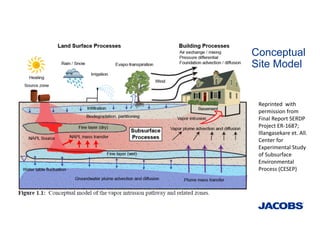
Reprinted  with 
permission from 
Final Report SERDP 
Project ER‐1687; 
Illangasekare et. All.
Center for 
Experimental Study 
of Subsurface 
Environmental 
Process (CESEP)
Conceptual
Site Model
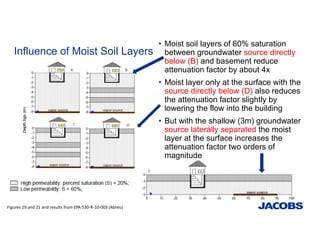
Influence of Moist Soil Layers
• Moist soil layers of 60% saturation
between groundwater source directly
below (B) and basement reduce
attenuation factor by about 4x
• Moist layer only at the surface with the
source directly below (D) also reduces
the attenuation factor slightly by
lowering the flow into the building
• But with the shallow (3m) groundwater
source laterally separated the moist
layer at the surface increases the
attenuation factor two orders of
magnitude
Figures 19 and 21 and results from EPA 530‐R‐10‐003 (Abreu)
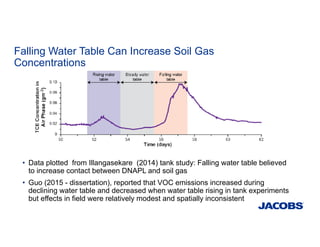
Falling Water Table Can Increase Soil Gas
Concentrations
• Data plotted from Illangasekare (2014) tank study: Falling water table believed
to increase contact between DNAPL and soil gas
• Guo (2015 - dissertation), reported that VOC emissions increased during
declining water table and decreased when water table rising in tank experiments
but effects in field were relatively modest and spatially inconsistent
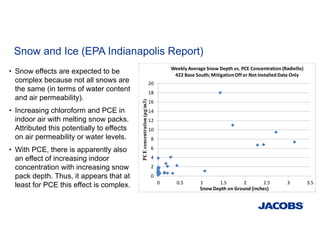
Snow and Ice (EPA Indianapolis Report)
• Snow effects are expected to be
complex because not all snows are
the same (in terms of water content
and air permeability).
• Increasing chloroform and PCE in
indoor air with melting snow packs.
Attributed this potentially to effects
on air permeability or water levels.
• With PCE, there is apparently also
an effect of increasing indoor
concentration with increasing snow
pack depth. Thus, it appears that at
least for PCE this effect is complex.
0
2
4
6
8
10
12
14
16
18
20
0 0.5 1 1.5 2 2.5 3 3.5
PCEconcentration(µg/m3)
Snow Depth on Ground (inches)
Weekly Average Snow Depth vs. PCE Concentration (Radiello)
422 Base South; Mitigation Off or Not Installed Data Only
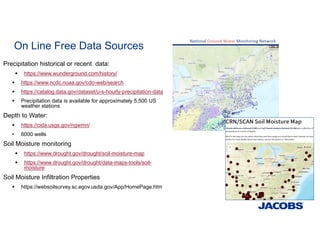
On Line Free Data Sources
Precipitation historical or recent data:
 https://www.wunderground.com/history/
 https://www.ncdc.noaa.gov/cdo-web/search
 https://catalog.data.gov/dataset/u-s-hourly-precipitation-data
 Precipitation data is available for approximately 5,500 US
weather stations
Depth to Water:
 https://cida.usgs.gov/ngwmn/
• 6000 wells
Soil Moisture monitoring
 https://www.drought.gov/drought/soil-moisture-map
 https://www.drought.gov/drought/data-maps-tools/soil-
moisture
Soil Moisture Infiltration Properties
 https://websoilsurvey.sc.egov.usda.gov/App/HomePage.htm
Low Cost Site Specific Data Acquisition
(no endorsement of brands intended, example pricing only)
Current Guidance Document Language – Precipitation Timing
• State guidance documents have varying provisions for sampling times based on rainfall
• In some cases requirements are only for weather observation before sampling events (MA, NJ,
NC), but in other cases provisions control when samples are to be taken, which effect the cost of
sampling.
• CA (2015) soil gas sampling should not occur during a significant rain event and should only
occur after five days without a significant rain event. A significant rain event is defined as 1/2 inch
or greater of rainfall during a 24-hour period…Irrigation or watering of soil should stop at least five
days prior to the sampling
• Ohio recommends indoor air and subslab sampling at times when the soil is “Saturated with rain
(1/2” of rain or more within 24 hours)” but calls for avoiding external soil gas sampling for 24 hours
after such a rain event (Ohio, May 2010).
• ITRC (2007) states with regard to indoor air: “Measurements made during or immediately after a
significant rain event (e.g., >1 inch) may not be representative of long-term average conditions.
For other sites, however, frequent rainfall is common, and testing soon after a rain event is both
representative and inevitable.”
• MI (2013) Show that “Site conditions have not been influenced by precipitation prior to sample
collection: •The waiting period will be dependent upon soil type, amount of rain, and previous soil
moisture content (e.g., longer for clays, longer for heavy rains, shorter for coarse sands, etc.).
Information should be provided showing justification of actual time elapsed between rain and
sampling events.”
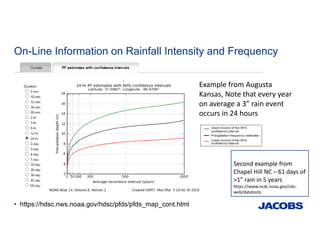
On-Line Information on Rainfall Intensity and Frequency
• https://hdsc.nws.noaa.gov/hdsc/pfds/pfds_map_cont.html
Example from Augusta 
Kansas, Note that every year 
on average a 3” rain event 
occurs in 24 hours 
Second example from 
Chapel Hill NC – 61 days of 
>1” rain in 5 years  
https://www.ncdc.noaa.gov/cdo‐
web/datatools
Literature – Temporal Prediction using Moisture Related
Variables is Difficult
• Indianapolis: no significant relationship between the measured soil moisture or depth to
water and indoor VOCs in time series analysis. Little evidence of a relationship between rain
events and VOCs.
• Sun Devil Manor; Guo (2015 - dissertation), reported that VOC emissions increased during
declining water table and decreased when water table rising.
• Steinmacher (2009) study at Hill AFB precipitation not significantly associated with
percentage detections of TCE.
• Illangeskare “Vapor intrusion will likely spike in the near term during a rain event due to gas
phase displacement from the initial infiltration front propagation. This observation is
supported on the basis of observations from multiple laboratory experiments, model scenario
simulations, and field-testing”.. “A “washout effect” due to the "cleaner water" of the
infiltration front diluting the "dirtier water" of the vadose was significant in the laboratory
experiment and corroborated by the model, but was not readily observed in the rainfall
scenarios…”.
• Shen (2012): Modeled effects – [VOC] go ↑ then ↓ a er rain event, effects weaker at 1 meter
• Infiltration rates vary from >1 inch per hour to <0.10 inches per hour
http://www.soil.ncsu.edu/certification/manual/slides/chapter5a/img14.html
Literature – Spatial Prediction Using Some Moisture
Related Variables Promising
• EPA Residential Database: the AF (normalized indoor air concentration) is 4.6 to 9x
higher for <1.5m water table depth then for 1.5m-3m; the 1.5m-3m depth group is about
2x higher then the 3-5m group, difference at >5m inconsistent.
• Johnston (2013) reanalysis of EPA database negative relationship between attenuation
factor and water table depth; p<0.01; mediated by soil type
• EPA CMS model report “As the source depth increases by a factor of six, the normalized
indoor air concentration decreases by a factor of three.“
• Hill AFB (EA, 2016) study n= 1968 buildings spread over an area approximately 5 miles x
4 miles. Shallow groundwater noted as a primary predictive variable for risk; depths to
groundwater vary from 100 ft down to 10 to 20 feet.
(http://afcec.publicadmin-record.us.af.mil/hcUqrfsGfjQqiPFW56ZmGume3PmymIRpXD2kwgF5_KI1/552693.pdf)
• Many documents caution against the use of default screening approaches with
groundwater more shallow then X. (MI < 3 meters; EPA 2015 <5 ft)
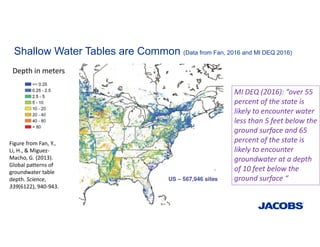
Shallow Water Tables are Common (Data from Fan, 2016 and MI DEQ 2016)
Depth in meters
Figure from Fan, Y., 
Li, H., & Miguez‐
Macho, G. (2013). 
Global patterns of 
groundwater table 
depth. Science, 
339(6122), 940‐943.
MI DEQ (2016): “over 55 
percent of the state is 
likely to encounter water 
less than 5 feet below the 
ground surface and 65 
percent of the state is 
likely to encounter 
groundwater at a depth 
of 10 feet below the 
ground surface “
Conclusions – Vapor Intrusion and Moisture
• There are sound theoretical, mechanistic relationships that connect vapor intrusion
processes to moisture related variables but “the dynamic processes of contaminant
vapor response to both single rain event and seasonal rain events can be observed to be
quite complex” (Shen 2012).
• Cost effective mechanisms monitoring have been developed for many fields
• Much on-line free data is available.
• Many state guidance documents call for considering precipitation in scheduling
• These variables are not good, generalizable, predictor variables for temporal indoor
concentrations, most likely because their influence is dependent on site specific factors.
• Precipitation and soil moisture is only one component of a long chain of events leading to
indoor concentration from VI
• Better correlations between water table depth and spatial VI risk exist
• Do you have other data available data sets and analyses, you can share in the Q&A?
www.jacobs.com | worldwideJanuary 11, 2020
© Copyright Jacobs
Thank you!
Christopher.Lutes@ch2m.com

07 lutes slides for epa 2018 workshop moisturev5

  • 1.
    www.jacobs.com | worldwide Innovationthat provides sustainable solutions to complex challenges worldwide Indicators, Tracers, and Surrogates of Chlorinated Vapor Intrusion – Potential for Rain, Soil Moisture, Water Table, Snow and Ice March 20, 2018 Presented at EPA Workshop at AEHS State-of-the-Science for Indicators, Tracers, and Surrogates of Chlorinated Vapor Intrusion: Supplemental Measurements for Minimizing the Number of Chemical Indoor Air Samples Needed Chris Lutes CH2M is now Jacobs
  • 2.
    Outline 1. Moisture’s rolein the vapor intrusion conceptual site model 2. Physical processes by which easily observable weather factors can influence vapor intrusion 3. Low cost data sources and measurement equipment available 4. Current guidance document language 5. Are these weather factors good indicators? 6. Suggestions for future data gathering and interim thoughts for practitioners 2
  • 3.
  • 4.
    Influence of MoistSoil Layers • Moist soil layers of 60% saturation between groundwater source directly below (B) and basement reduce attenuation factor by about 4x • Moist layer only at the surface with the source directly below (D) also reduces the attenuation factor slightly by lowering the flow into the building • But with the shallow (3m) groundwater source laterally separated the moist layer at the surface increases the attenuation factor two orders of magnitude Figures 19 and 21 and results from EPA 530‐R‐10‐003 (Abreu)
  • 5.
    Falling Water TableCan Increase Soil Gas Concentrations • Data plotted from Illangasekare (2014) tank study: Falling water table believed to increase contact between DNAPL and soil gas • Guo (2015 - dissertation), reported that VOC emissions increased during declining water table and decreased when water table rising in tank experiments but effects in field were relatively modest and spatially inconsistent
  • 6.
    Snow and Ice(EPA Indianapolis Report) • Snow effects are expected to be complex because not all snows are the same (in terms of water content and air permeability). • Increasing chloroform and PCE in indoor air with melting snow packs. Attributed this potentially to effects on air permeability or water levels. • With PCE, there is apparently also an effect of increasing indoor concentration with increasing snow pack depth. Thus, it appears that at least for PCE this effect is complex. 0 2 4 6 8 10 12 14 16 18 20 0 0.5 1 1.5 2 2.5 3 3.5 PCEconcentration(µg/m3) Snow Depth on Ground (inches) Weekly Average Snow Depth vs. PCE Concentration (Radiello) 422 Base South; Mitigation Off or Not Installed Data Only
  • 7.
    On Line FreeData Sources Precipitation historical or recent data:  https://www.wunderground.com/history/  https://www.ncdc.noaa.gov/cdo-web/search  https://catalog.data.gov/dataset/u-s-hourly-precipitation-data  Precipitation data is available for approximately 5,500 US weather stations Depth to Water:  https://cida.usgs.gov/ngwmn/ • 6000 wells Soil Moisture monitoring  https://www.drought.gov/drought/soil-moisture-map  https://www.drought.gov/drought/data-maps-tools/soil- moisture Soil Moisture Infiltration Properties  https://websoilsurvey.sc.egov.usda.gov/App/HomePage.htm
  • 8.
    Low Cost SiteSpecific Data Acquisition (no endorsement of brands intended, example pricing only)
  • 9.
    Current Guidance DocumentLanguage – Precipitation Timing • State guidance documents have varying provisions for sampling times based on rainfall • In some cases requirements are only for weather observation before sampling events (MA, NJ, NC), but in other cases provisions control when samples are to be taken, which effect the cost of sampling. • CA (2015) soil gas sampling should not occur during a significant rain event and should only occur after five days without a significant rain event. A significant rain event is defined as 1/2 inch or greater of rainfall during a 24-hour period…Irrigation or watering of soil should stop at least five days prior to the sampling • Ohio recommends indoor air and subslab sampling at times when the soil is “Saturated with rain (1/2” of rain or more within 24 hours)” but calls for avoiding external soil gas sampling for 24 hours after such a rain event (Ohio, May 2010). • ITRC (2007) states with regard to indoor air: “Measurements made during or immediately after a significant rain event (e.g., >1 inch) may not be representative of long-term average conditions. For other sites, however, frequent rainfall is common, and testing soon after a rain event is both representative and inevitable.” • MI (2013) Show that “Site conditions have not been influenced by precipitation prior to sample collection: •The waiting period will be dependent upon soil type, amount of rain, and previous soil moisture content (e.g., longer for clays, longer for heavy rains, shorter for coarse sands, etc.). Information should be provided showing justification of actual time elapsed between rain and sampling events.”
  • 10.
    On-Line Information onRainfall Intensity and Frequency • https://hdsc.nws.noaa.gov/hdsc/pfds/pfds_map_cont.html Example from Augusta  Kansas, Note that every year  on average a 3” rain event  occurs in 24 hours  Second example from  Chapel Hill NC – 61 days of  >1” rain in 5 years   https://www.ncdc.noaa.gov/cdo‐ web/datatools
  • 11.
    Literature – TemporalPrediction using Moisture Related Variables is Difficult • Indianapolis: no significant relationship between the measured soil moisture or depth to water and indoor VOCs in time series analysis. Little evidence of a relationship between rain events and VOCs. • Sun Devil Manor; Guo (2015 - dissertation), reported that VOC emissions increased during declining water table and decreased when water table rising. • Steinmacher (2009) study at Hill AFB precipitation not significantly associated with percentage detections of TCE. • Illangeskare “Vapor intrusion will likely spike in the near term during a rain event due to gas phase displacement from the initial infiltration front propagation. This observation is supported on the basis of observations from multiple laboratory experiments, model scenario simulations, and field-testing”.. “A “washout effect” due to the "cleaner water" of the infiltration front diluting the "dirtier water" of the vadose was significant in the laboratory experiment and corroborated by the model, but was not readily observed in the rainfall scenarios…”. • Shen (2012): Modeled effects – [VOC] go ↑ then ↓ a er rain event, effects weaker at 1 meter • Infiltration rates vary from >1 inch per hour to <0.10 inches per hour http://www.soil.ncsu.edu/certification/manual/slides/chapter5a/img14.html
  • 12.
    Literature – SpatialPrediction Using Some Moisture Related Variables Promising • EPA Residential Database: the AF (normalized indoor air concentration) is 4.6 to 9x higher for <1.5m water table depth then for 1.5m-3m; the 1.5m-3m depth group is about 2x higher then the 3-5m group, difference at >5m inconsistent. • Johnston (2013) reanalysis of EPA database negative relationship between attenuation factor and water table depth; p<0.01; mediated by soil type • EPA CMS model report “As the source depth increases by a factor of six, the normalized indoor air concentration decreases by a factor of three.“ • Hill AFB (EA, 2016) study n= 1968 buildings spread over an area approximately 5 miles x 4 miles. Shallow groundwater noted as a primary predictive variable for risk; depths to groundwater vary from 100 ft down to 10 to 20 feet. (http://afcec.publicadmin-record.us.af.mil/hcUqrfsGfjQqiPFW56ZmGume3PmymIRpXD2kwgF5_KI1/552693.pdf) • Many documents caution against the use of default screening approaches with groundwater more shallow then X. (MI < 3 meters; EPA 2015 <5 ft)
  • 13.
    Shallow Water Tablesare Common (Data from Fan, 2016 and MI DEQ 2016) Depth in meters Figure from Fan, Y.,  Li, H., & Miguez‐ Macho, G. (2013).  Global patterns of  groundwater table  depth. Science,  339(6122), 940‐943. MI DEQ (2016): “over 55  percent of the state is  likely to encounter water  less than 5 feet below the  ground surface and 65  percent of the state is  likely to encounter  groundwater at a depth  of 10 feet below the  ground surface “
  • 14.
    Conclusions – VaporIntrusion and Moisture • There are sound theoretical, mechanistic relationships that connect vapor intrusion processes to moisture related variables but “the dynamic processes of contaminant vapor response to both single rain event and seasonal rain events can be observed to be quite complex” (Shen 2012). • Cost effective mechanisms monitoring have been developed for many fields • Much on-line free data is available. • Many state guidance documents call for considering precipitation in scheduling • These variables are not good, generalizable, predictor variables for temporal indoor concentrations, most likely because their influence is dependent on site specific factors. • Precipitation and soil moisture is only one component of a long chain of events leading to indoor concentration from VI • Better correlations between water table depth and spatial VI risk exist • Do you have other data available data sets and analyses, you can share in the Q&A?
  • 15.
    www.jacobs.com | worldwideJanuary11, 2020 © Copyright Jacobs Thank you! Christopher.Lutes@ch2m.com