Future Testing: Combining 
External Soil‐Gas Concentrations 
With Indoor ITS to Minimize 
Indoor Sampling
Example Application Strategy – Combining 
External (Soil‐gas Concentration) With Indoor ITS 
Measurements to Target Sampling 
• Objective – can we target sampling efforts to minimize the occupant 
disturbance concerns of subslab/indoor sampling?
• Background on the problem – lots of evidence that VI impacts are spotty 
across a plume
• Understanding the predictive value of shallow and deep external soil gas in 
various release/transport scenarios – using the CSM
• Supplementing a shallow soil gas concentration map with an understanding 
of shallow soil types and building characteristics
• Using surrogates and building science to target sampling and validate 
inferences 
“Outside‐In” Strategy of VI Site Investigation 
Typical
• Starts with identification of a site, most often based on groundwater 
data, sometimes based on a known release to soil
• Typically progresses next to external soil gas:
• Often favored because it is seen as less invasive
• At some sites <50% of homeowners allow access for indoor sampling
• Can be done along streets with only one access agreement
• But shallow soil gas known to underpredict subslab concentrations
• Most attenuation occurs across the building envelope, which soil gas doesn’t 
tell you
• How to determine then if and where subslab and indoor air sampling 
is then required
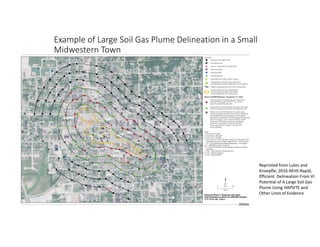
Example of Large Soil Gas Plume Delineation in a Small 
Midwestern Town
Reprinted from Lutes and 
Knoepfle, 2016 AEHS Rapid, 
Efficient  Delineation From VI 
Potential of A Large Soil Gas 
Plume Using HAPSITE and 
Other Lines of Evidence
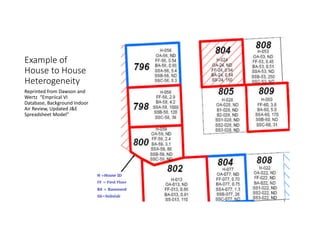
Example of 
House to House 
Heterogeneity
Reprinted from Dawson and 
Wertz  “Empriical VI 
Database, Background Indoor 
Air Review, Updated J&E
Spreadsheet Model”
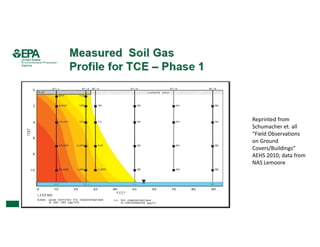
Reprinted from 
Schumacher et. all  
“Field Observations 
on Ground 
Covers/Buildings” 
AEHS 2010; data from 
NAS Lemoore
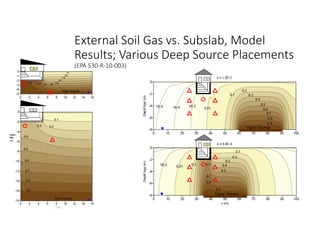
External Soil Gas vs. Subslab, Model 
Results; Various Deep Source Placements 
(EPA 530‐R‐10‐003)
External Soil Gas vs. Subslab, Model Results; 
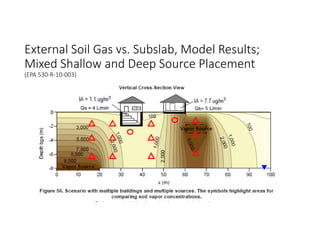
Mixed Shallow and Deep Source Placement 
(EPA 530‐R‐10‐003)
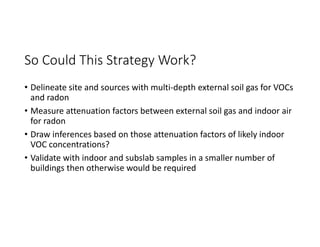
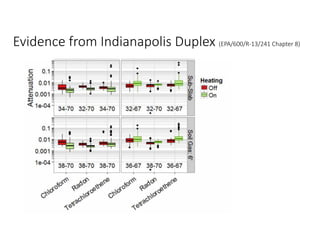
So Could This Strategy Work?
• Delineate site and sources with multi‐depth external soil gas for VOCs 
and radon
• Measure attenuation factors between external soil gas and indoor air 
for radon
• Draw inferences based on those attenuation factors of likely indoor 
VOC concentrations?
• Validate with indoor and subslab samples in a smaller number of 
buildings then otherwise would be required
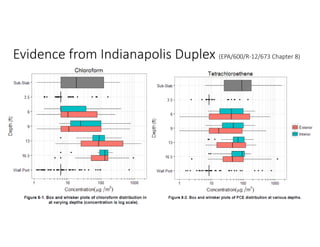
Evidence from Indianapolis Duplex (EPA/600/R‐12/673 Chapter 8)
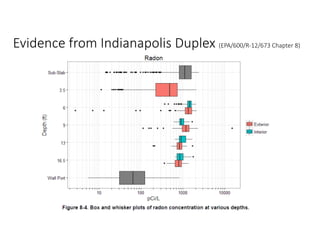
Evidence from Indianapolis Duplex (EPA/600/R‐13/241 Chapter 8)
Conclusion ‐ External Sampling Plus ITS
• This particular application is an attractive concept
• Needs much more testing, and the sooner the better! Your 
observations could add significantly to our understanding

08 future testing combining external