Time Capsule of 20th Century
    Advances in Science

       By Christopher Walker
              1/18/13
         World History V12
                5.04
The Top 5 Scientific Advances of the
     20th Century (In order of importance)


In this presentation, we will be putting images representing the top
five advances in science of the 20th century into a time capsule to
be buried and stored until opened many years in the future.
#1 – The Invention of the Atomic Bomb


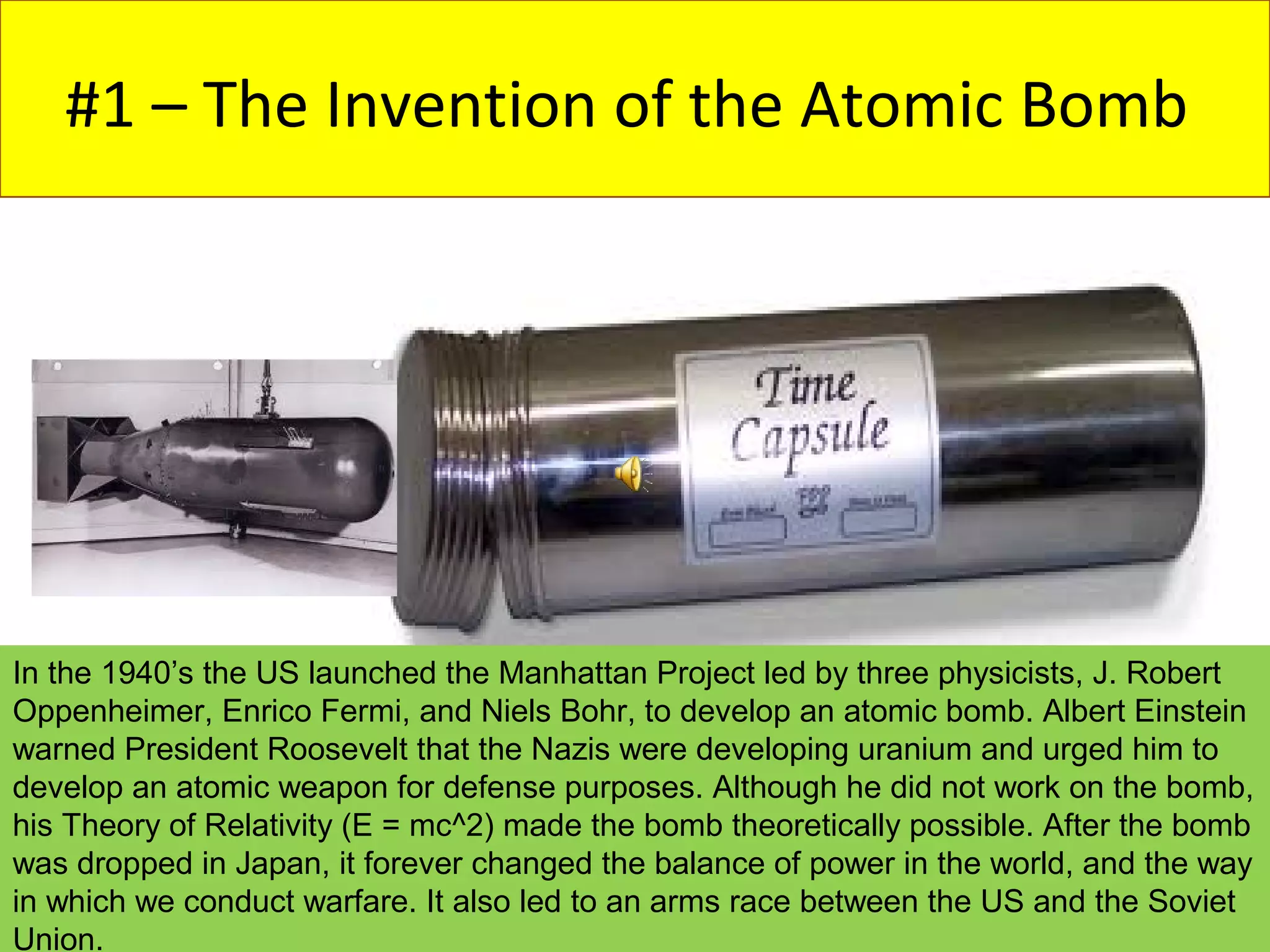
In the 1940’s the US launched the Manhattan Project led by three physicists, J. Robert
Oppenheimer, Enrico Fermi, and Niels Bohr, to develop an atomic bomb. Albert Einstein
warned President Roosevelt that the Nazis were developing uranium and urged him to
develop an atomic weapon for defense purposes. Although he did not work on the bomb,
his Theory of Relativity (E = mc^2) made the bomb theoretically possible. After the bomb
was dropped in Japan, it forever changed the balance of power in the world, and the way
in which we conduct warfare. It also led to an arms race between the US and the Soviet
Union.
#2 – Discovery of the Structure of DNA


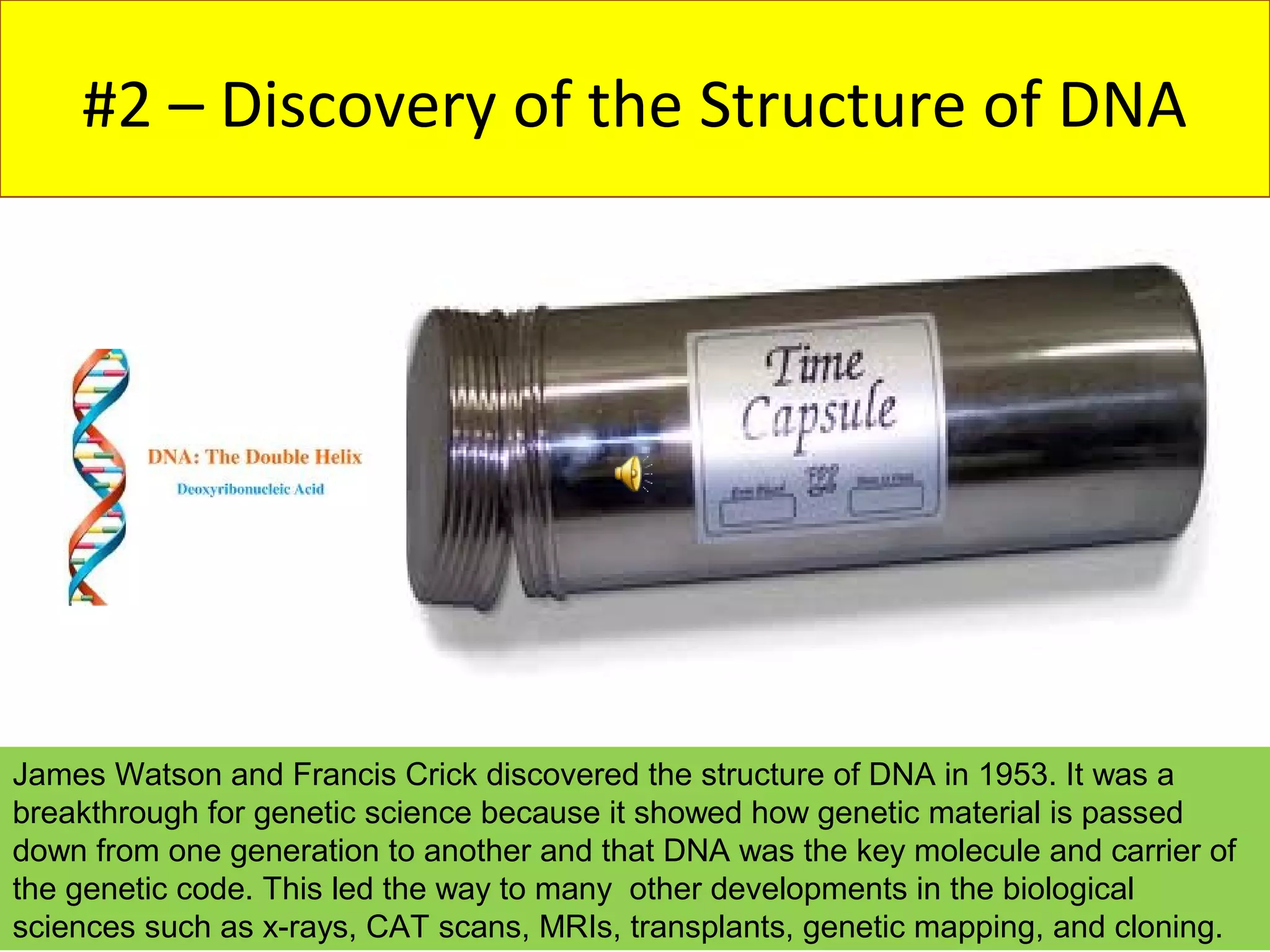
James Watson and Francis Crick discovered the structure of DNA in 1953. It was a
breakthrough for genetic science because it showed how genetic material is passed
down from one generation to another and that DNA was the key molecule and carrier of
the genetic code. This led the way to many other developments in the biological
sciences such as x-rays, CAT scans, MRIs, transplants, genetic mapping, and cloning.
#3 – The Popularity of Radio


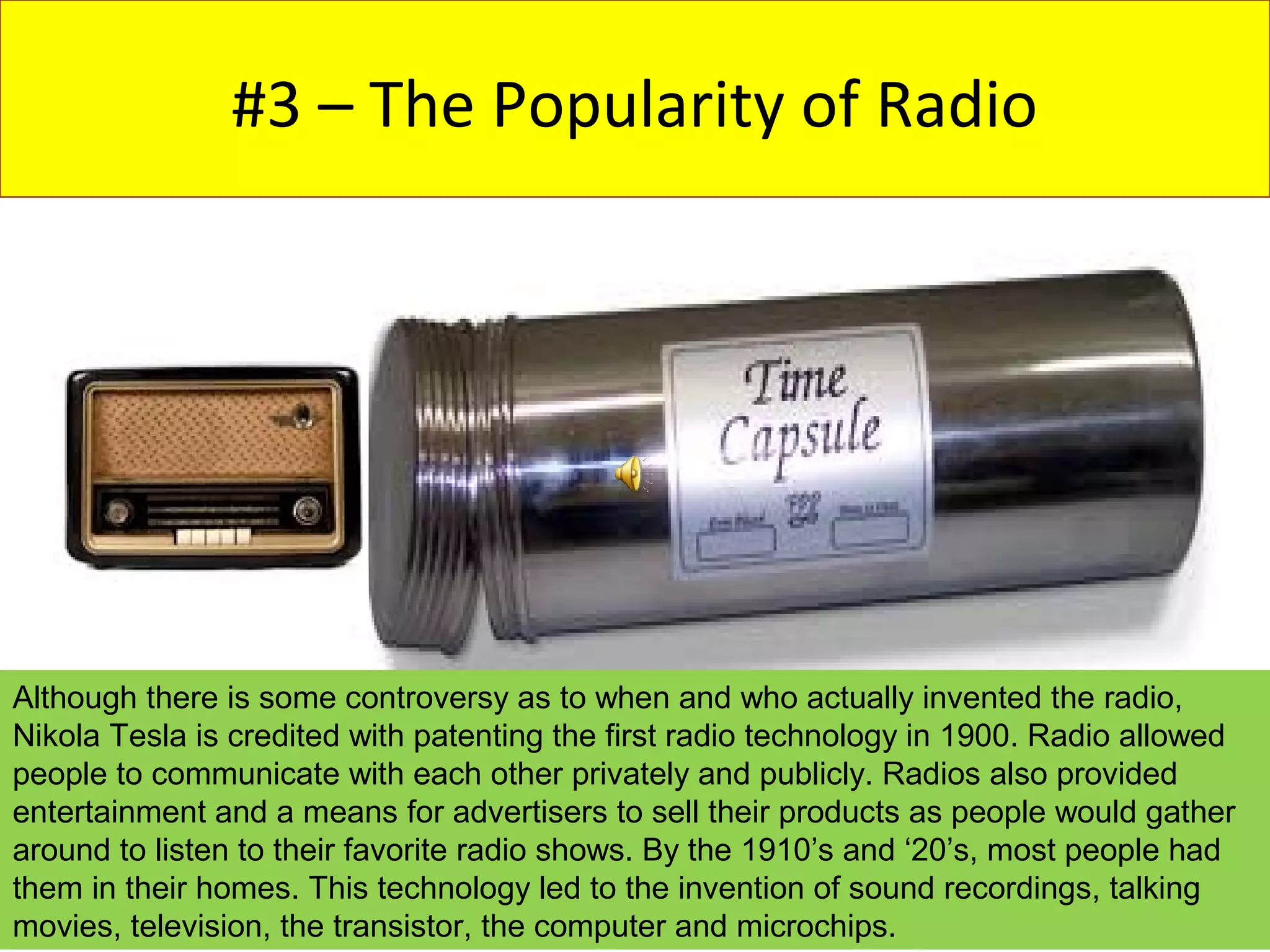
Although there is some controversy as to when and who actually invented the radio,
Nikola Tesla is credited with patenting the first radio technology in 1900. Radio allowed
people to communicate with each other privately and publicly. Radios also provided
entertainment and a means for advertisers to sell their products as people would gather
around to listen to their favorite radio shows. By the 1910’s and ‘20’s, most people had
them in their homes. This technology led to the invention of sound recordings, talking
movies, television, the transistor, the computer and microchips.
#4 – The Invention of the Airplane


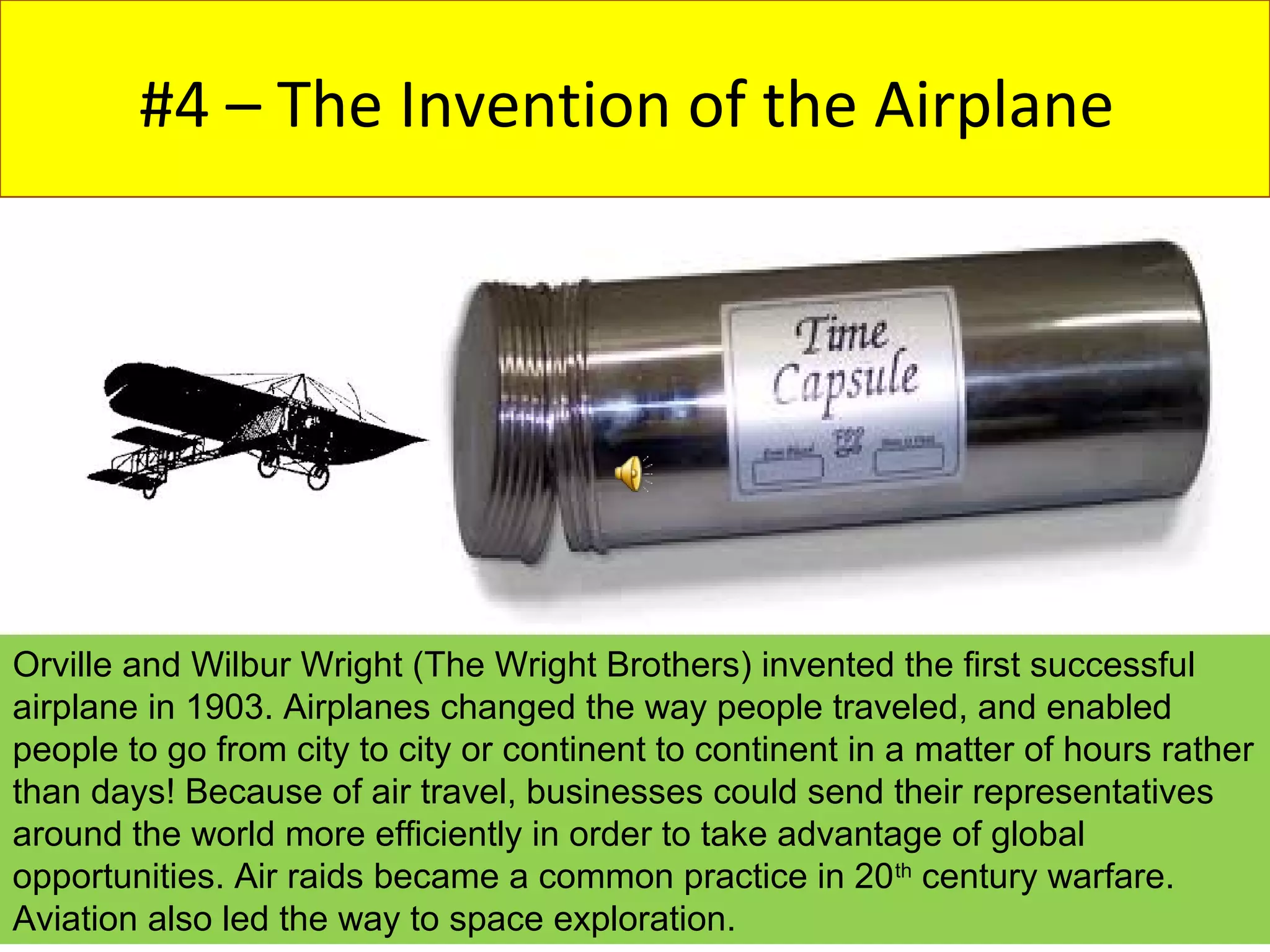
Orville and Wilbur Wright (The Wright Brothers) invented the first successful
airplane in 1903. Airplanes changed the way people traveled, and enabled
people to go from city to city or continent to continent in a matter of hours rather
than days! Because of air travel, businesses could send their representatives
around the world more efficiently in order to take advantage of global
opportunities. Air raids became a common practice in 20 th century warfare.
Aviation also led the way to space exploration.
#5 – The Development of the Computer


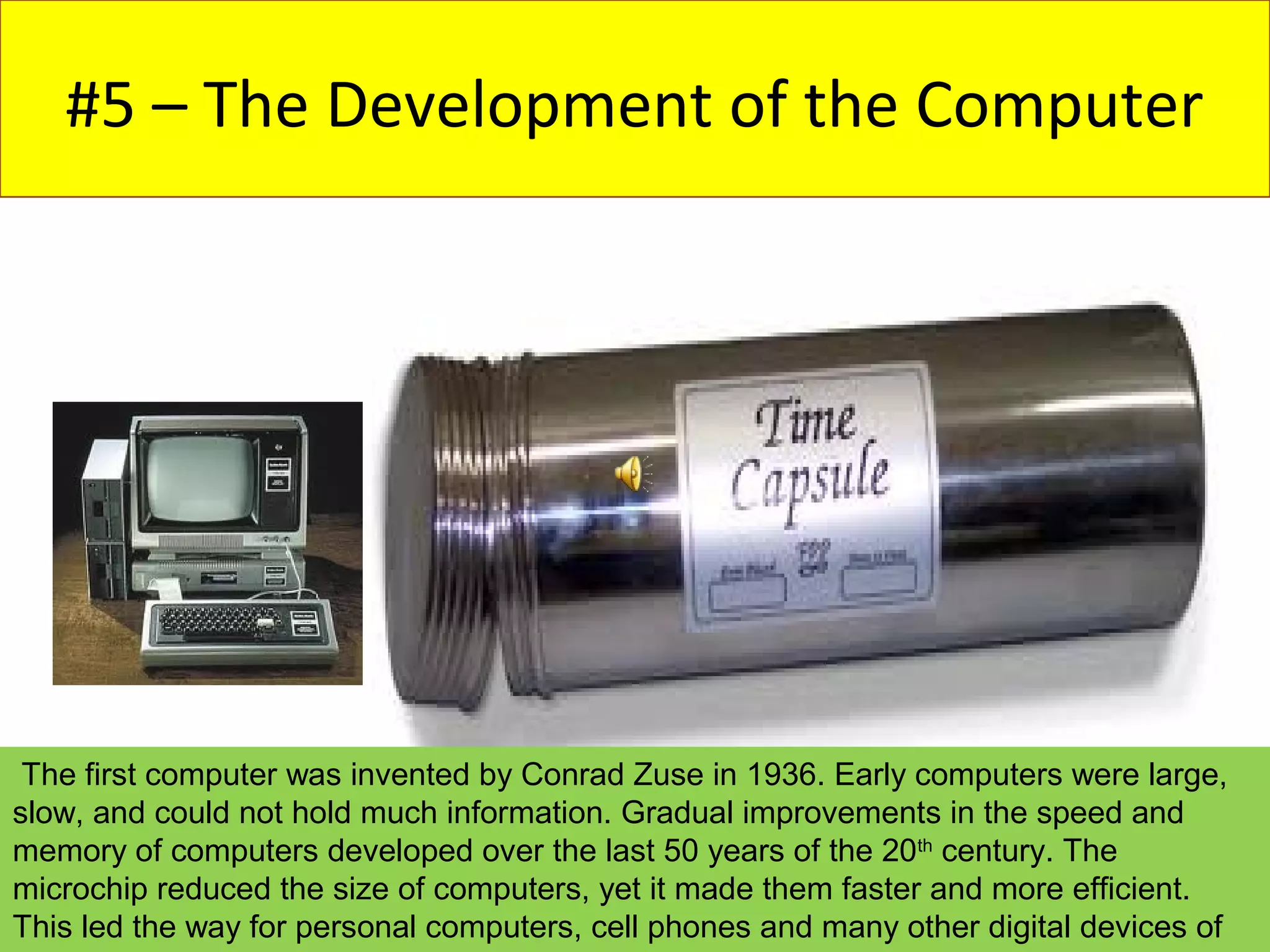
 The first computer was invented by Conrad Zuse in 1936. Early computers were large,
slow, and could not hold much information. Gradual improvements in the speed and
memory of computers developed over the last 50 years of the 20th century. The
microchip reduced the size of computers, yet it made them faster and more efficient.
This led the way for personal computers, cell phones and many other digital devices of
Explanation of the Order of Importance

 I chose the atomic bomb as the number one most important scientific
 development of the 20th century because it had the potential to destroy
 the planet. My second choice was the discovery of the structure of DNA
  because it paved the way for many other medical advances that keep
 human-kind alive. My third choice was the popularity of radio because it
 connected people all over the world. I put the invention of the airplane
 in fourth place because it promoted immigration and emigration, leisure
 travel, commerce, and paved the way to space exploration, making the
 world a more interesting place. My last choice was computers because
 although computers are an important tool in our everyday lives, we
 could live without them; however, life would just not be as much fun!
Resources

http://news.everestonline.edu/post/2009/07/invented-first-computer

http://www.nikolateslatour.com/blog/

http://130.242.18.21/educational/medicine/dna_double_helix/readmore.html
Resources

http://news.everestonline.edu/post/2009/07/invented-first-computer

http://www.nikolateslatour.com/blog/

http://130.242.18.21/educational/medicine/dna_double_helix/readmore.html

05 04 wh_chris_walker

  • 1.
    Time Capsule of20th Century Advances in Science By Christopher Walker 1/18/13 World History V12 5.04
  • 2.
    The Top 5Scientific Advances of the 20th Century (In order of importance) In this presentation, we will be putting images representing the top five advances in science of the 20th century into a time capsule to be buried and stored until opened many years in the future.
  • 3.
    #1 – TheInvention of the Atomic Bomb In the 1940’s the US launched the Manhattan Project led by three physicists, J. Robert Oppenheimer, Enrico Fermi, and Niels Bohr, to develop an atomic bomb. Albert Einstein warned President Roosevelt that the Nazis were developing uranium and urged him to develop an atomic weapon for defense purposes. Although he did not work on the bomb, his Theory of Relativity (E = mc^2) made the bomb theoretically possible. After the bomb was dropped in Japan, it forever changed the balance of power in the world, and the way in which we conduct warfare. It also led to an arms race between the US and the Soviet Union.
  • 4.
    #2 – Discoveryof the Structure of DNA James Watson and Francis Crick discovered the structure of DNA in 1953. It was a breakthrough for genetic science because it showed how genetic material is passed down from one generation to another and that DNA was the key molecule and carrier of the genetic code. This led the way to many other developments in the biological sciences such as x-rays, CAT scans, MRIs, transplants, genetic mapping, and cloning.
  • 5.
    #3 – ThePopularity of Radio Although there is some controversy as to when and who actually invented the radio, Nikola Tesla is credited with patenting the first radio technology in 1900. Radio allowed people to communicate with each other privately and publicly. Radios also provided entertainment and a means for advertisers to sell their products as people would gather around to listen to their favorite radio shows. By the 1910’s and ‘20’s, most people had them in their homes. This technology led to the invention of sound recordings, talking movies, television, the transistor, the computer and microchips.
  • 6.
    #4 – TheInvention of the Airplane Orville and Wilbur Wright (The Wright Brothers) invented the first successful airplane in 1903. Airplanes changed the way people traveled, and enabled people to go from city to city or continent to continent in a matter of hours rather than days! Because of air travel, businesses could send their representatives around the world more efficiently in order to take advantage of global opportunities. Air raids became a common practice in 20 th century warfare. Aviation also led the way to space exploration.
  • 7.
    #5 – TheDevelopment of the Computer The first computer was invented by Conrad Zuse in 1936. Early computers were large, slow, and could not hold much information. Gradual improvements in the speed and memory of computers developed over the last 50 years of the 20th century. The microchip reduced the size of computers, yet it made them faster and more efficient. This led the way for personal computers, cell phones and many other digital devices of
  • 8.
    Explanation of theOrder of Importance I chose the atomic bomb as the number one most important scientific development of the 20th century because it had the potential to destroy the planet. My second choice was the discovery of the structure of DNA because it paved the way for many other medical advances that keep human-kind alive. My third choice was the popularity of radio because it connected people all over the world. I put the invention of the airplane in fourth place because it promoted immigration and emigration, leisure travel, commerce, and paved the way to space exploration, making the world a more interesting place. My last choice was computers because although computers are an important tool in our everyday lives, we could live without them; however, life would just not be as much fun!
  • 9.
  • 10.