Attribution: Department of Neurology, 2009

License: Unless otherwise noted, this material is made available under the terms of the
Creative Commons Attribution–Non-commercial–Share Alike 3.0 License:
http://creativecommons.org/licenses/by-nc-sa/3.0/

We have reviewed this material in accordance with U.S. Copyright Law and have tried to maximize your ability to use,
share, and adapt it. The citation key on the following slide provides information about how you may share and adapt this
material.

Copyright holders of content included in this material should contact open.michigan@umich.edu with any questions,
corrections, or clarification regarding the use of content.

For more information about how to cite these materials visit http://open.umich.edu/education/about/terms-of-use.

Any medical information in this material is intended to inform and educate and is not a tool for self-diagnosis or a
replacement for medical evaluation, advice, diagnosis or treatment by a healthcare professional. Please speak to your
physician if you have questions about your medical condition.

Viewer discretion is advised: Some medical content is graphic and may not be suitable for all viewers.
Citation Key
                          for more information see: http://open.umich.edu/wiki/CitationPolicy


Use + Share + Adapt
  { Content the copyright holder, author, or law permits you to use, share and adapt. }
               Public Domain – Government: Works that are produced by the U.S. Government. (USC 17 § 105)
               Public Domain – Expired: Works that are no longer protected due to an expired copyright term.
               Public Domain – Self Dedicated: Works that a copyright holder has dedicated to the public domain.

               Creative Commons – Zero Waiver

               Creative Commons – Attribution License
               Creative Commons – Attribution Share Alike License
               Creative Commons – Attribution Noncommercial License
               Creative Commons – Attribution Noncommercial Share Alike License
               GNU – Free Documentation License

Make Your Own Assessment
  { Content Open.Michigan believes can be used, shared, and adapted because it is ineligible for copyright. }
               Public Domain – Ineligible: Works that are ineligible for copyright protection in the U.S. (USC 17 § 102(b)) *laws in
               your jurisdiction may differ
   { Content Open.Michigan has used under a Fair Use determination. }
               Fair Use: Use of works that is determined to be Fair consistent with the U.S. Copyright Act. (USC 17 § 107) *laws in
               your jurisdiction may differ
               Our determination DOES NOT mean that all uses of this 3rd-party content are Fair Uses and we DO NOT guarantee
               that your use of the content is Fair.
               To use this content you should do your own independent analysis to determine whether or not your use will be Fair.
Hypothalamus/Pituitary
    Development


   M1 CNS Head and Neck
        Winter 2009
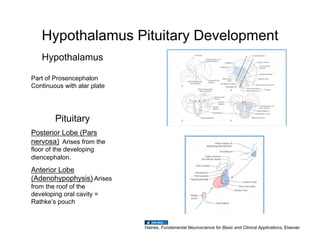
Hypothalamus Pituitary Development
   Hypothalamus

Part of Prosencephalon
Continuous with alar plate


        Pituitary
Posterior Lobe (Pars
nervosa) Arises from the
floor of the developing
diencephalon.
Anterior Lobe
(Adenohypophysis) Arises
from the roof of the
developing oral cavity =
Rathke’s pouch


                             Haines, Fundamental Neuroscience for Basic and Clinical Applications, Elsevier
Additional Source Information
                                  for more information see: http://open.umich.edu/wiki/CitationPolicy

Slide 5: Haines, Fundamental Neuroscience for Basic and Clinical Applications, Elsevier

03.18.09(a): Hypothalamus Pituitary Development

  • 1.
    Attribution: Department ofNeurology, 2009 License: Unless otherwise noted, this material is made available under the terms of the Creative Commons Attribution–Non-commercial–Share Alike 3.0 License: http://creativecommons.org/licenses/by-nc-sa/3.0/ We have reviewed this material in accordance with U.S. Copyright Law and have tried to maximize your ability to use, share, and adapt it. The citation key on the following slide provides information about how you may share and adapt this material. Copyright holders of content included in this material should contact open.michigan@umich.edu with any questions, corrections, or clarification regarding the use of content. For more information about how to cite these materials visit http://open.umich.edu/education/about/terms-of-use. Any medical information in this material is intended to inform and educate and is not a tool for self-diagnosis or a replacement for medical evaluation, advice, diagnosis or treatment by a healthcare professional. Please speak to your physician if you have questions about your medical condition. Viewer discretion is advised: Some medical content is graphic and may not be suitable for all viewers.
  • 2.
    Citation Key for more information see: http://open.umich.edu/wiki/CitationPolicy Use + Share + Adapt { Content the copyright holder, author, or law permits you to use, share and adapt. } Public Domain – Government: Works that are produced by the U.S. Government. (USC 17 § 105) Public Domain – Expired: Works that are no longer protected due to an expired copyright term. Public Domain – Self Dedicated: Works that a copyright holder has dedicated to the public domain. Creative Commons – Zero Waiver Creative Commons – Attribution License Creative Commons – Attribution Share Alike License Creative Commons – Attribution Noncommercial License Creative Commons – Attribution Noncommercial Share Alike License GNU – Free Documentation License Make Your Own Assessment { Content Open.Michigan believes can be used, shared, and adapted because it is ineligible for copyright. } Public Domain – Ineligible: Works that are ineligible for copyright protection in the U.S. (USC 17 § 102(b)) *laws in your jurisdiction may differ { Content Open.Michigan has used under a Fair Use determination. } Fair Use: Use of works that is determined to be Fair consistent with the U.S. Copyright Act. (USC 17 § 107) *laws in your jurisdiction may differ Our determination DOES NOT mean that all uses of this 3rd-party content are Fair Uses and we DO NOT guarantee that your use of the content is Fair. To use this content you should do your own independent analysis to determine whether or not your use will be Fair.
  • 3.
    Hypothalamus/Pituitary Development M1 CNS Head and Neck Winter 2009
  • 4.
    Hypothalamus Pituitary Development Hypothalamus Part of Prosencephalon Continuous with alar plate Pituitary Posterior Lobe (Pars nervosa) Arises from the floor of the developing diencephalon. Anterior Lobe (Adenohypophysis) Arises from the roof of the developing oral cavity = Rathke’s pouch Haines, Fundamental Neuroscience for Basic and Clinical Applications, Elsevier
  • 5.
    Additional Source Information for more information see: http://open.umich.edu/wiki/CitationPolicy Slide 5: Haines, Fundamental Neuroscience for Basic and Clinical Applications, Elsevier