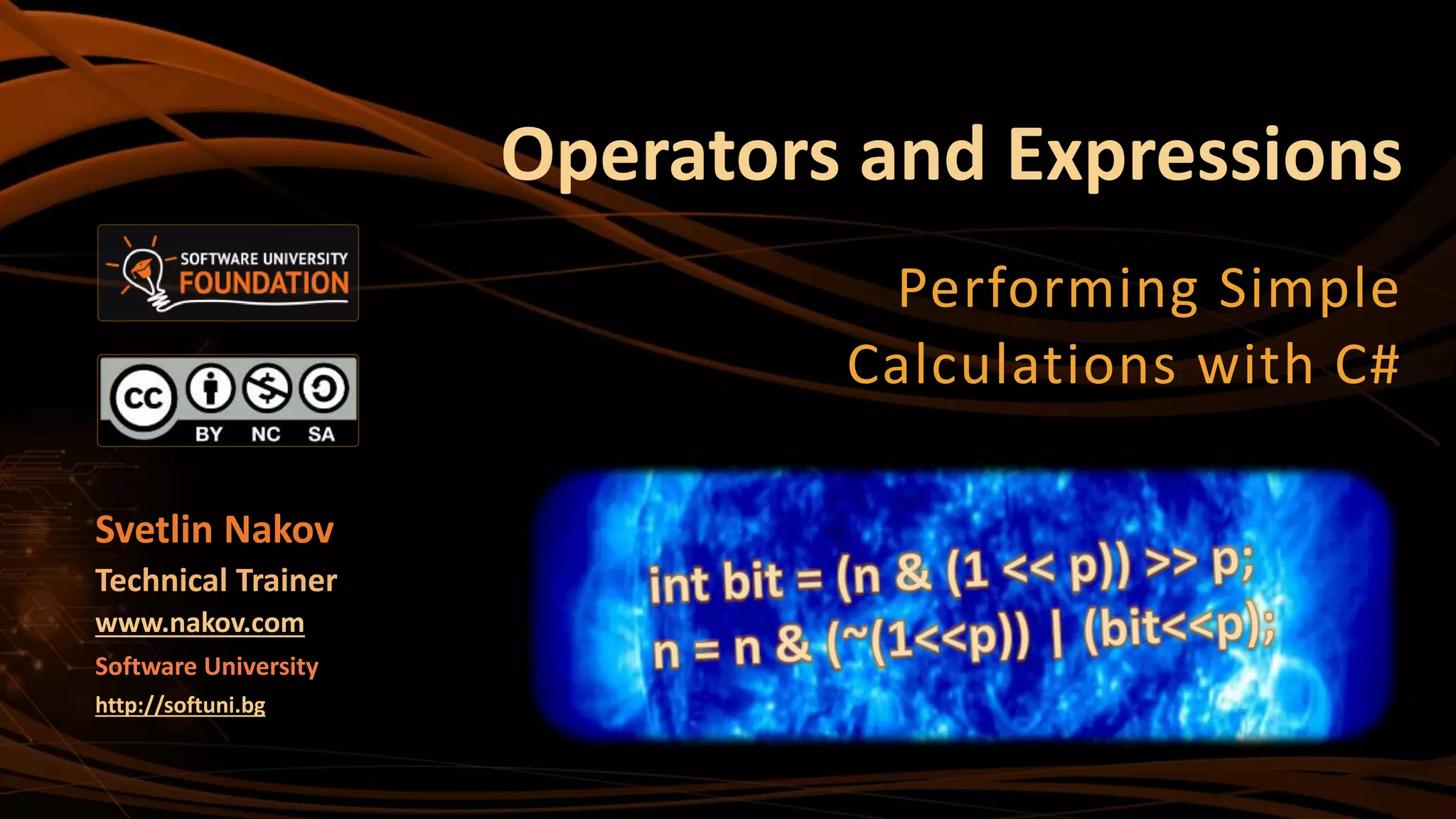
Operators and Expressions
Performing Simple
Calculations with C#
Svetlin Nakov
Technical Trainer
www.nakov.com
Software University
http://softuni.bg
2
1. Operators in C# and Operator Precedence
2. Arithmetic Operators
3. Logical Operators
4. Bitwise Operators
5. Comparison Operators
6. Assignment Operators
7. Other Operators
8. Implicit and Explicit Type Conversions
9. Expressions
Table of Contents
Operators in C#
Arithmetic, Logical, Comparison,
Assignment, Etc.
4
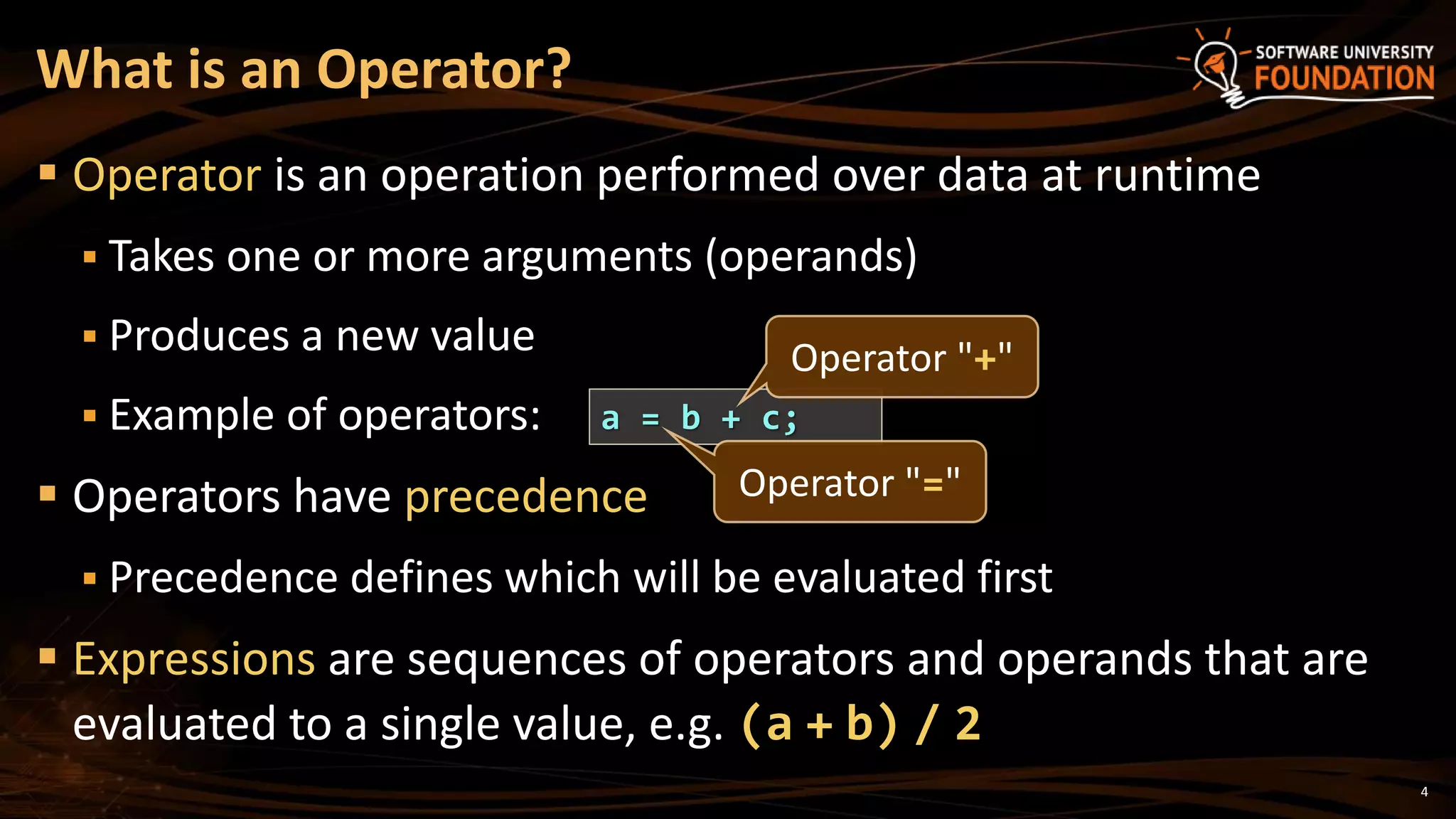
 Operator is an operation performed over data at runtime
 Takes one or more arguments (operands)
 Produces a new value
 Example of operators:
 Operators have precedence
 Precedence defines which will be evaluated first
 Expressions are sequences of operators and operands that are
evaluated to a single value, e.g. (a + b) / 2
What is an Operator?
a = b + c;
Operator "+"
Operator "="
5
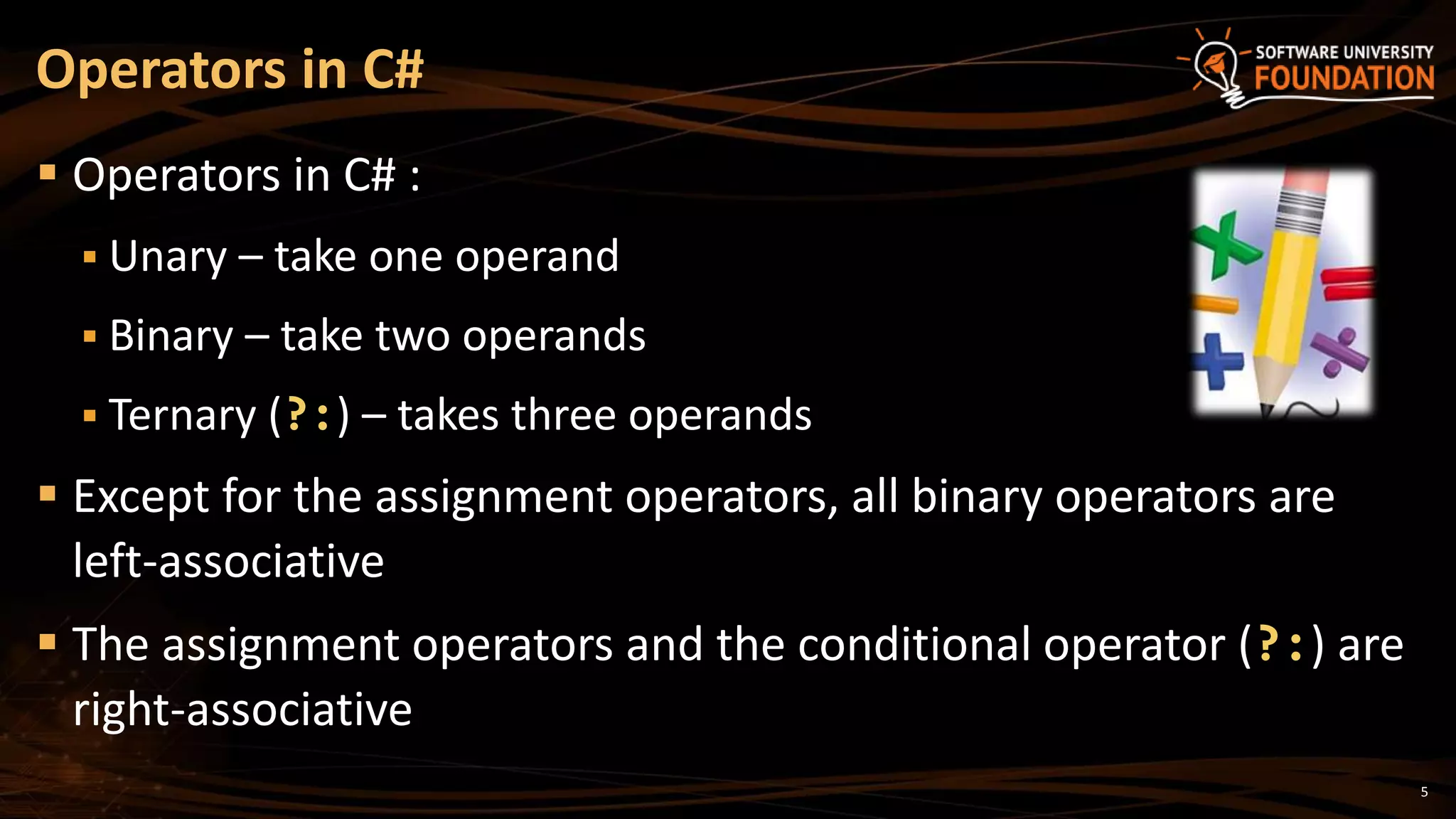
 Operators in C# :
 Unary – take one operand
 Binary – take two operands
 Ternary (?:) – takes three operands
 Except for the assignment operators, all binary operators are
left-associative
 The assignment operators and the conditional operator (?:) are
right-associative
Operators in C#
6
Category Operators
Arithmetic + - * / % ++ --
Logical && || ^ !
Binary & | ^ ~ << >>
Comparison == != < > <= >=
Assignment
= += -= *= /= %= &= |= ^= <<=
>>=
String concatenation +
Type conversion is as typeof
Other . [] () ?: new
Categories of Operators in C#
Operators Precedence
8
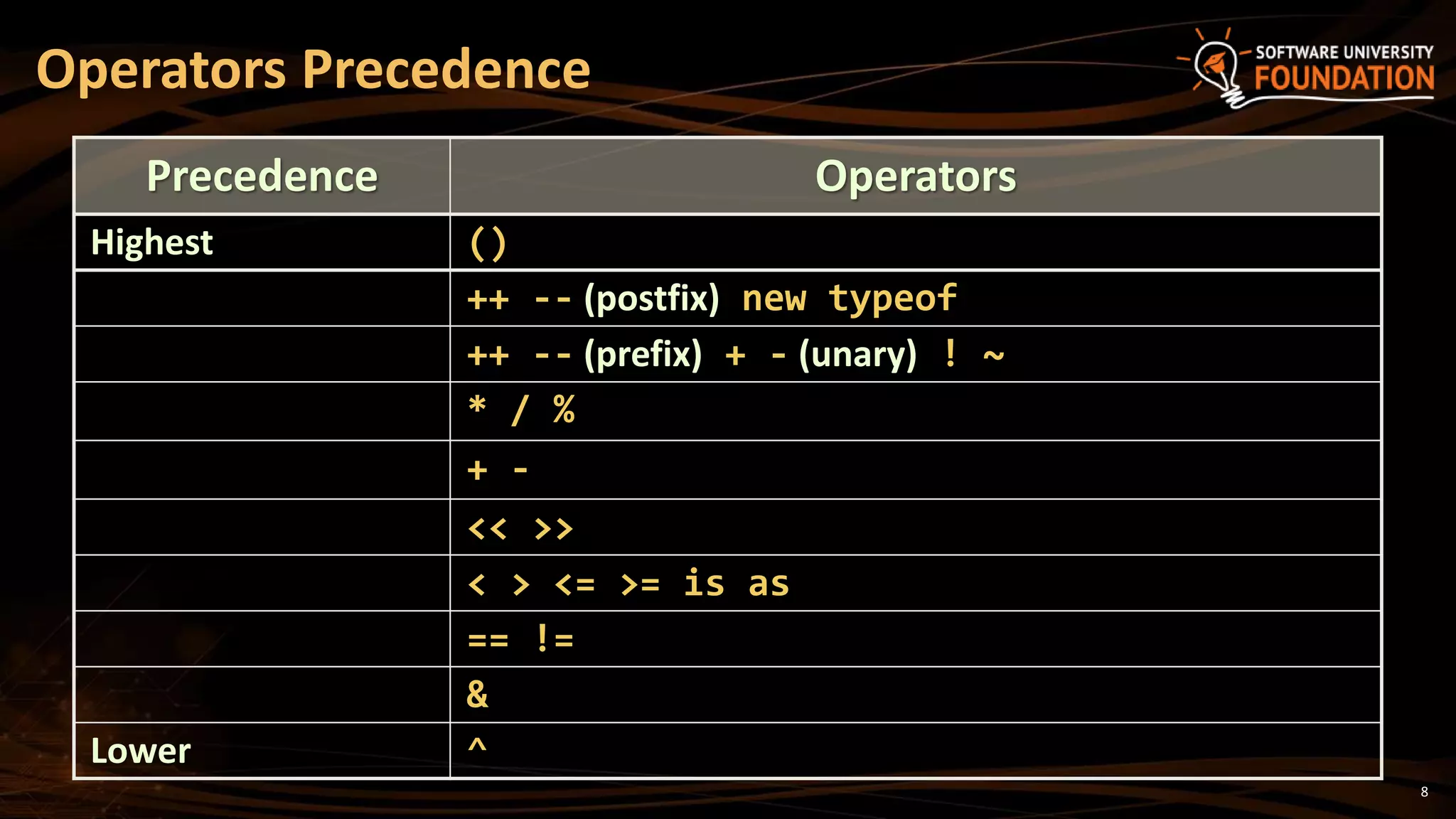
Precedence Operators
Highest ()
++ -- (postfix) new typeof
++ -- (prefix) + - (unary) ! ~
* / %
+ -
<< >>
< > <= >= is as
== !=
&
Lower ^
Operators Precedence
9
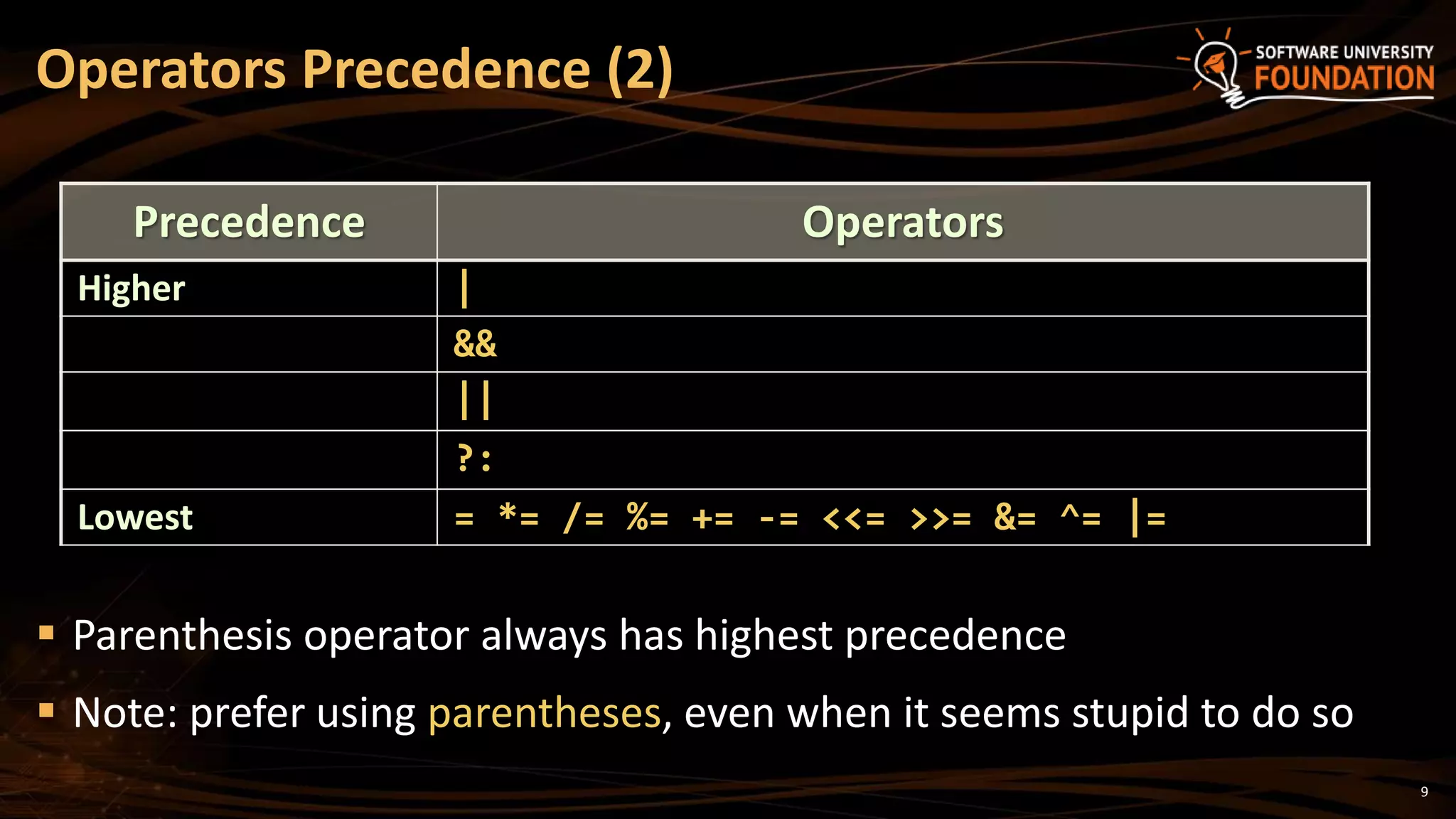
 Parenthesis operator always has highest precedence
 Note: prefer using parentheses, even when it seems stupid to do so
Operators Precedence (2)
Precedence Operators
Higher |
&&
||
?:
Lowest = *= /= %= += -= <<= >>= &= ^= |=
Arithmetic Operators
11
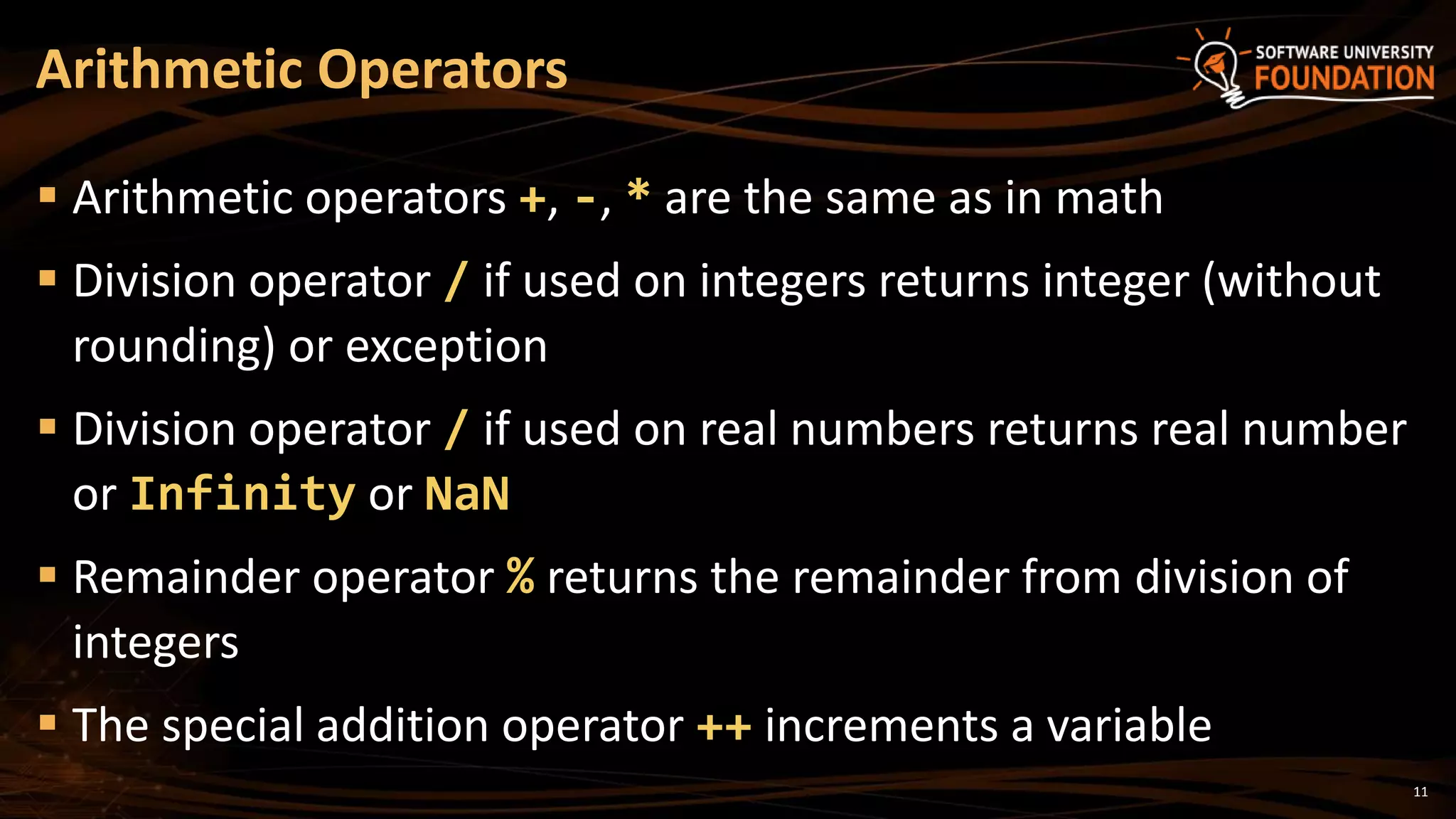
 Arithmetic operators +, -, * are the same as in math
 Division operator / if used on integers returns integer (without
rounding) or exception
 Division operator / if used on real numbers returns real number
or Infinity or NaN
 Remainder operator % returns the remainder from division of
integers
 The special addition operator ++ increments a variable
Arithmetic Operators
12
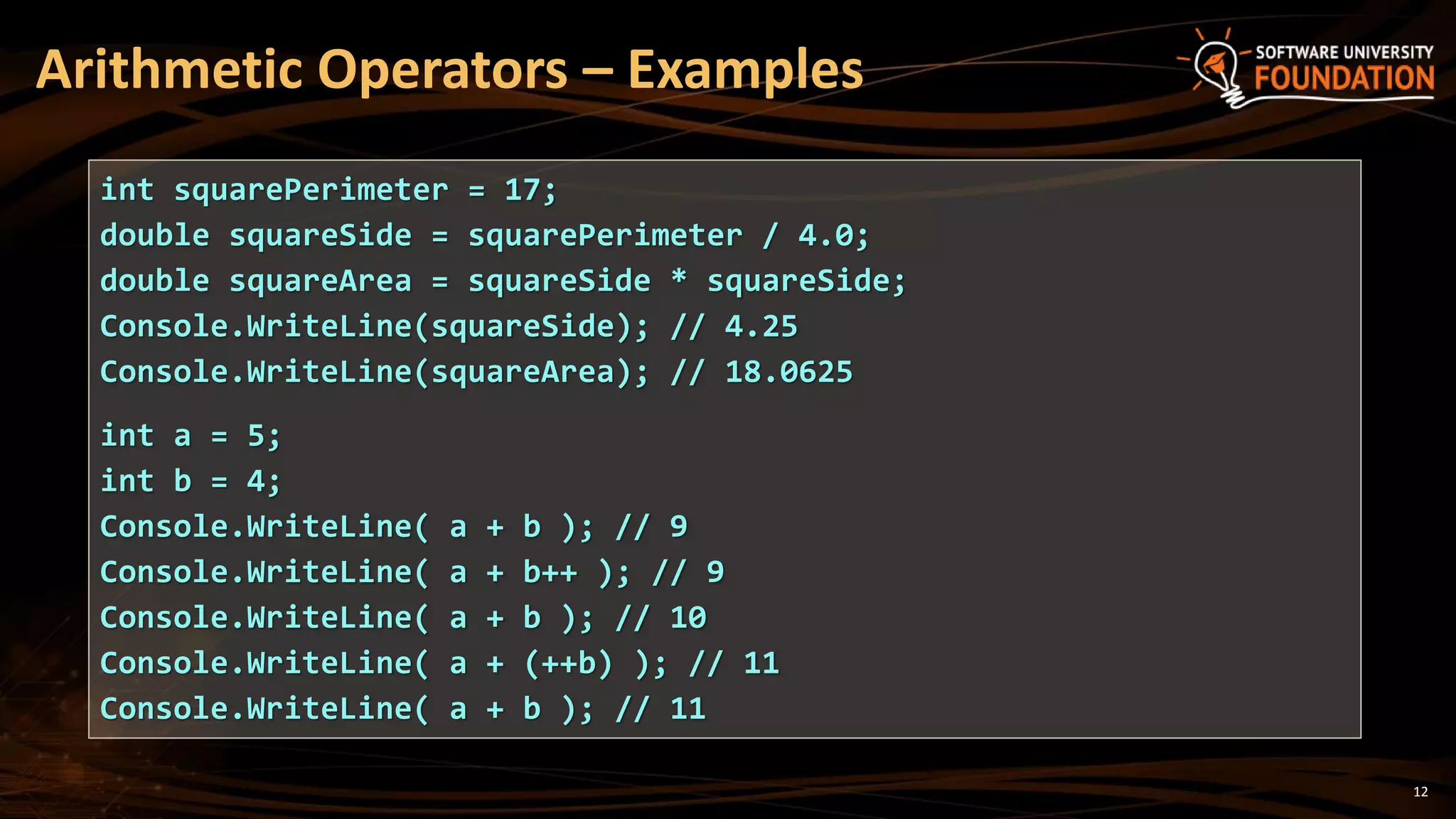
Arithmetic Operators – Examples
int squarePerimeter = 17;
double squareSide = squarePerimeter / 4.0;
double squareArea = squareSide * squareSide;
Console.WriteLine(squareSide); // 4.25
Console.WriteLine(squareArea); // 18.0625
int a = 5;
int b = 4;
Console.WriteLine( a + b ); // 9
Console.WriteLine( a + b++ ); // 9
Console.WriteLine( a + b ); // 10
Console.WriteLine( a + (++b) ); // 11
Console.WriteLine( a + b ); // 11
13
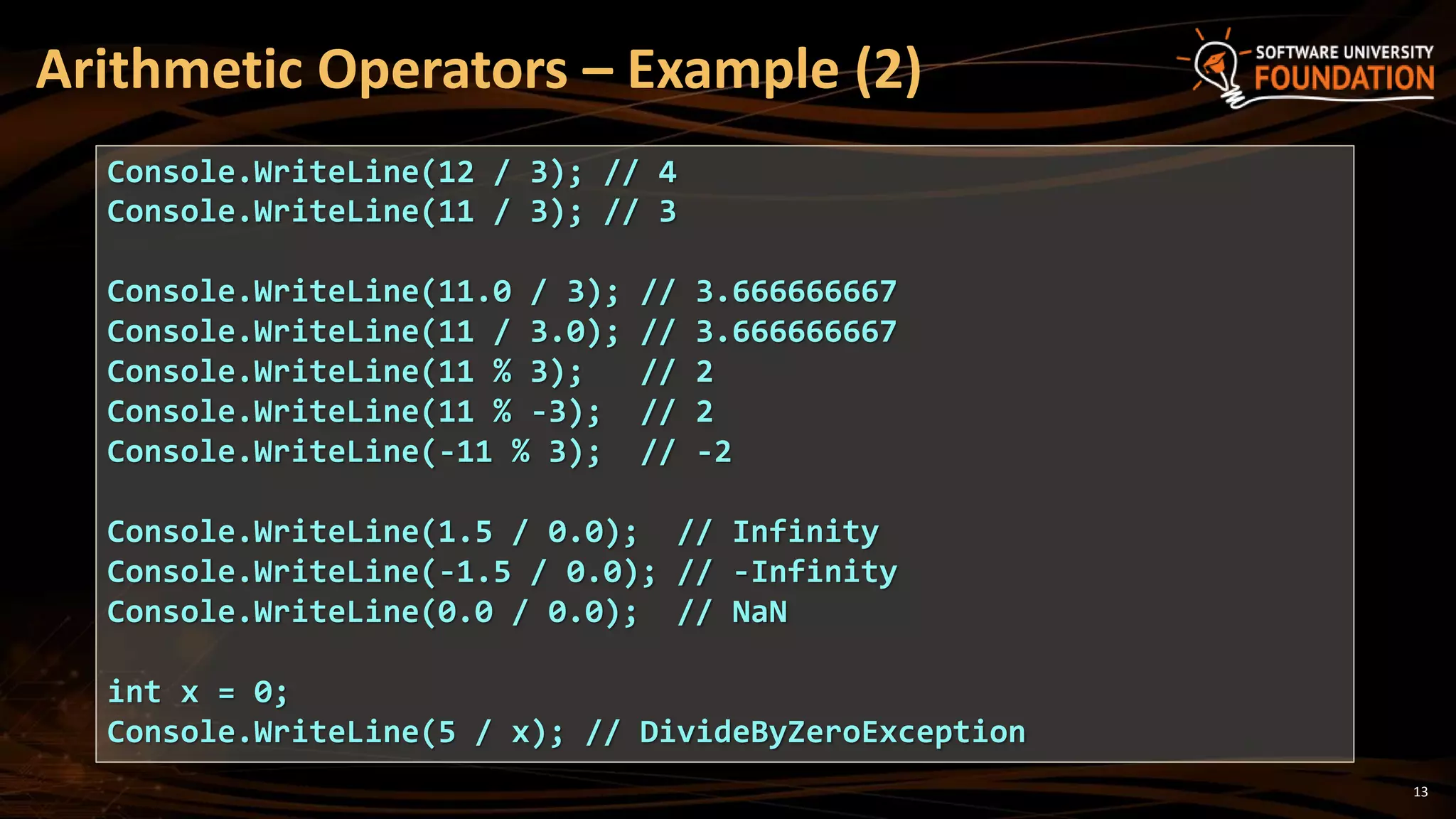
Arithmetic Operators – Example (2)
Console.WriteLine(12 / 3); // 4
Console.WriteLine(11 / 3); // 3
Console.WriteLine(11.0 / 3); // 3.666666667
Console.WriteLine(11 / 3.0); // 3.666666667
Console.WriteLine(11 % 3); // 2
Console.WriteLine(11 % -3); // 2
Console.WriteLine(-11 % 3); // -2
Console.WriteLine(1.5 / 0.0); // Infinity
Console.WriteLine(-1.5 / 0.0); // -Infinity
Console.WriteLine(0.0 / 0.0); // NaN
int x = 0;
Console.WriteLine(5 / x); // DivideByZeroException
14
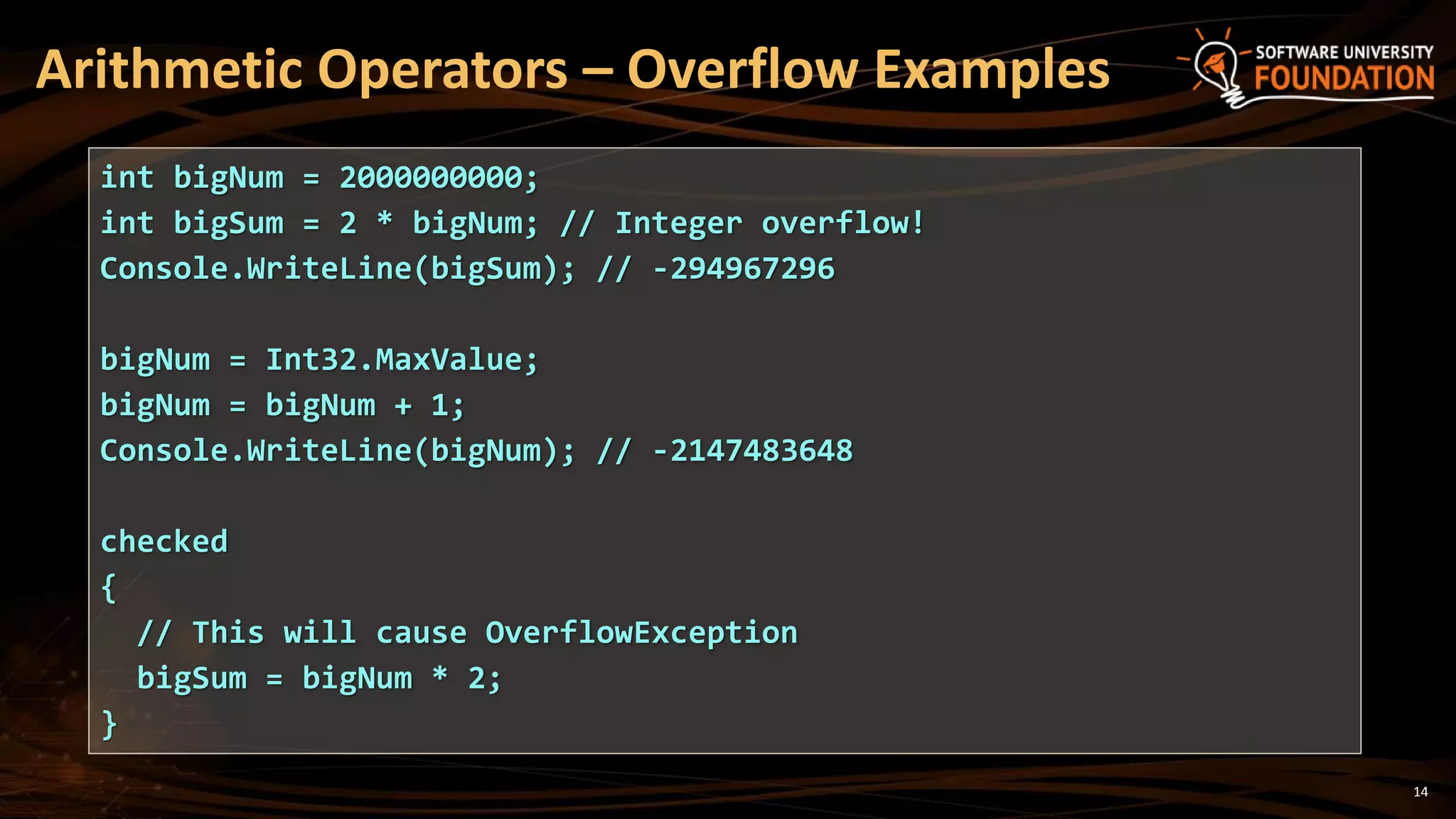
Arithmetic Operators – Overflow Examples
int bigNum = 2000000000;
int bigSum = 2 * bigNum; // Integer overflow!
Console.WriteLine(bigSum); // -294967296
bigNum = Int32.MaxValue;
bigNum = bigNum + 1;
Console.WriteLine(bigNum); // -2147483648
checked
{
// This will cause OverflowException
bigSum = bigNum * 2;
}
Arithmetic Operators
Live Demo
Logical Operators
17
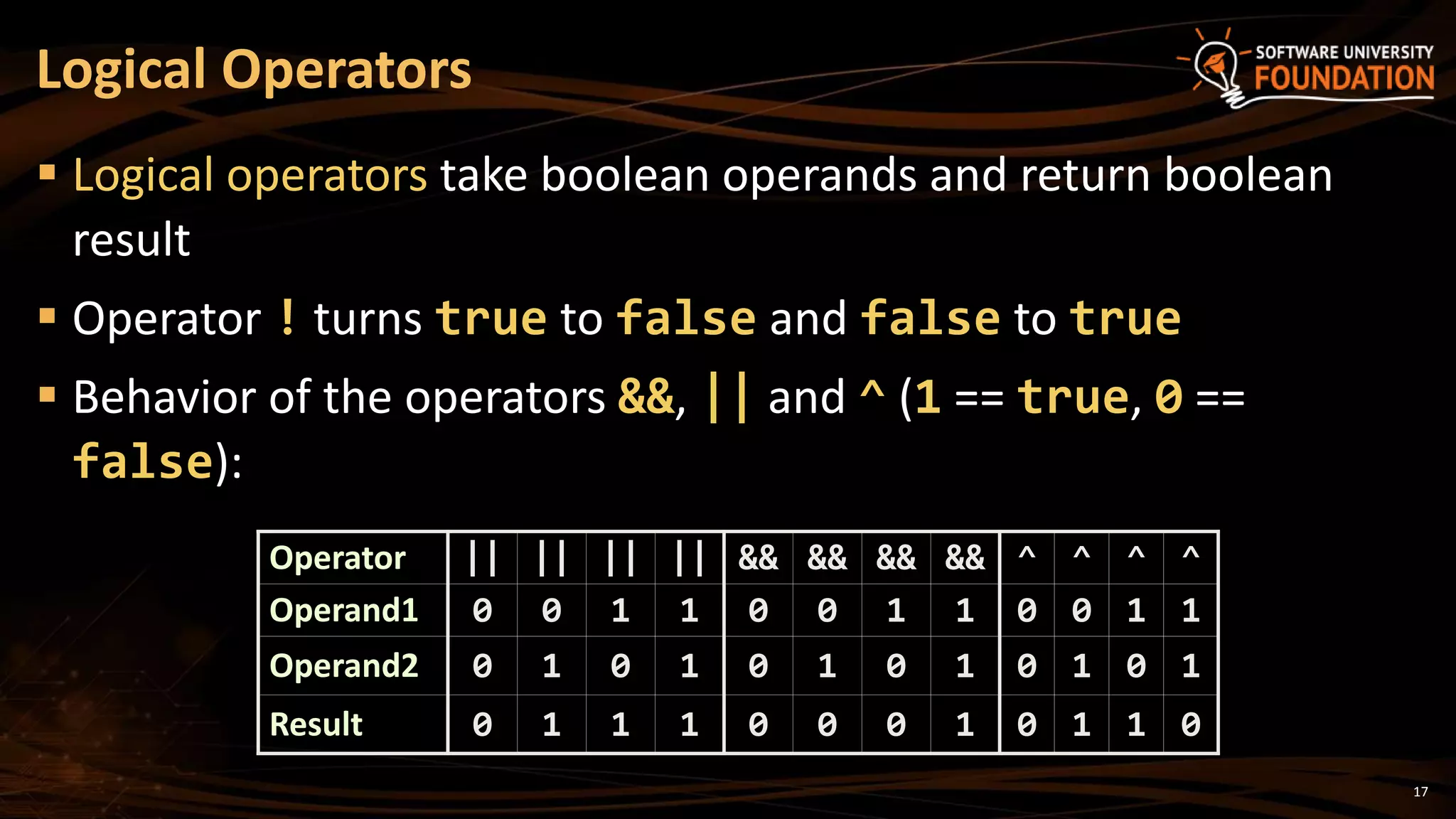
 Logical operators take boolean operands and return boolean
result
 Operator ! turns true to false and false to true
 Behavior of the operators &&, || and ^ (1 == true, 0 ==
false):
Logical Operators
Operator || || || || && && && && ^ ^ ^ ^
Operand1 0 0 1 1 0 0 1 1 0 0 1 1
Operand2 0 1 0 1 0 1 0 1 0 1 0 1
Result 0 1 1 1 0 0 0 1 0 1 1 0
18
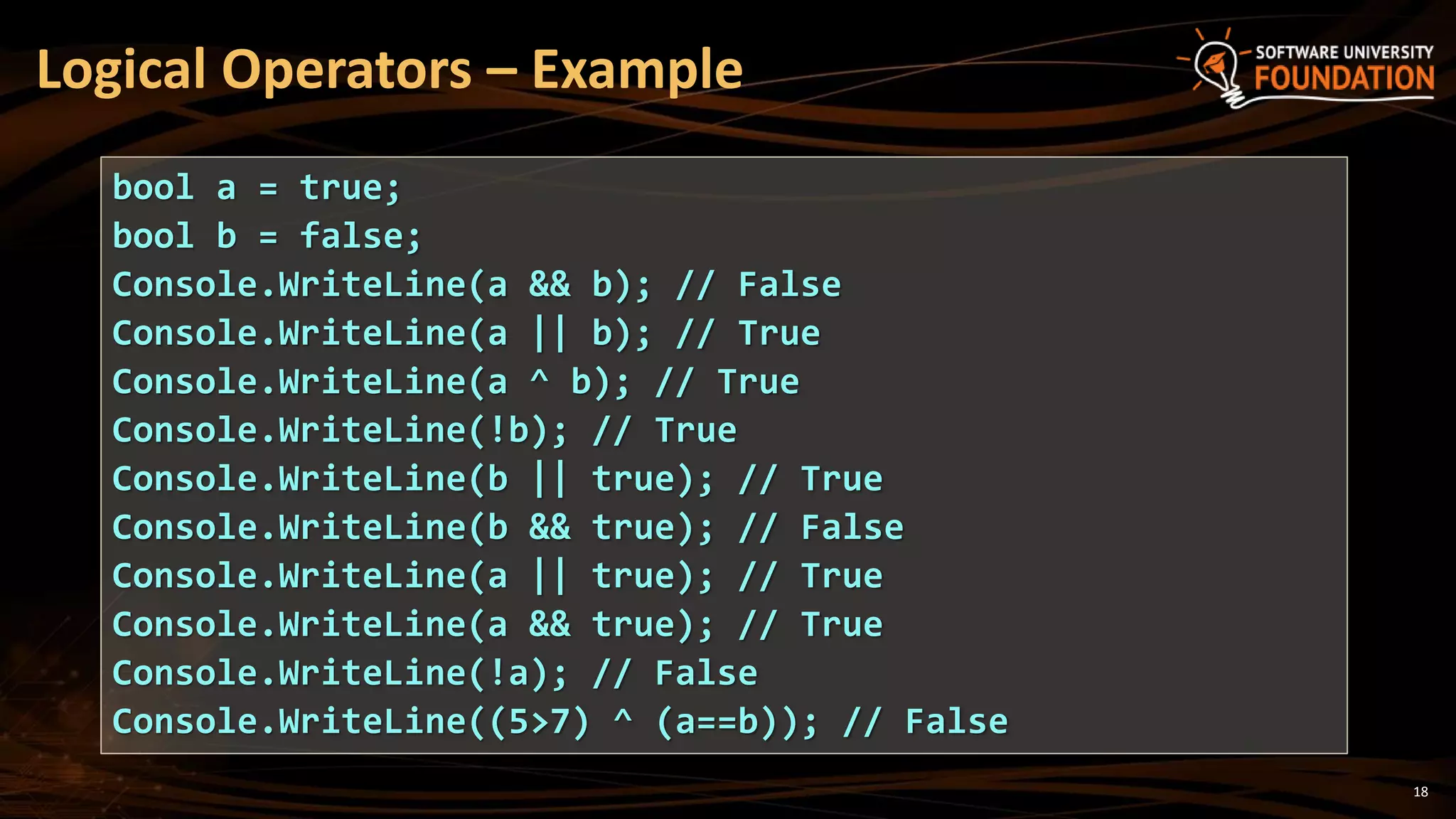
Logical Operators – Example
bool a = true;
bool b = false;
Console.WriteLine(a && b); // False
Console.WriteLine(a || b); // True
Console.WriteLine(a ^ b); // True
Console.WriteLine(!b); // True
Console.WriteLine(b || true); // True
Console.WriteLine(b && true); // False
Console.WriteLine(a || true); // True
Console.WriteLine(a && true); // True
Console.WriteLine(!a); // False
Console.WriteLine((5>7) ^ (a==b)); // False
Logical Operators
Live Demo
Bitwise Operators
21
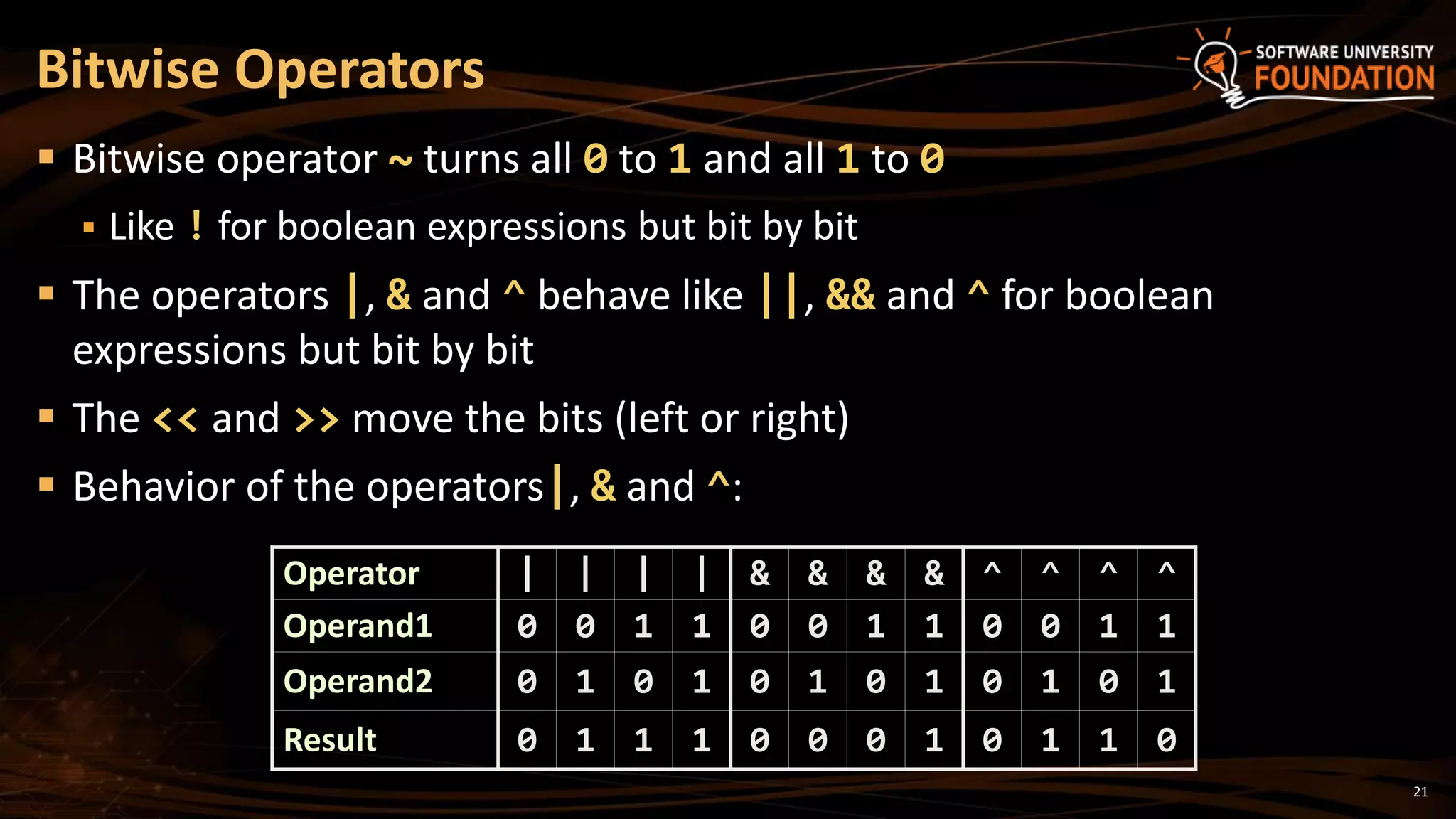
 Bitwise operator ~ turns all 0 to 1 and all 1 to 0
 Like ! for boolean expressions but bit by bit
 The operators |, & and ^ behave like ||, && and ^ for boolean
expressions but bit by bit
 The << and >> move the bits (left or right)
 Behavior of the operators|, & and ^:
Bitwise Operators
Operator | | | | & & & & ^ ^ ^ ^
Operand1 0 0 1 1 0 0 1 1 0 0 1 1
Operand2 0 1 0 1 0 1 0 1 0 1 0 1
Result 0 1 1 1 0 0 0 1 0 1 1 0
22
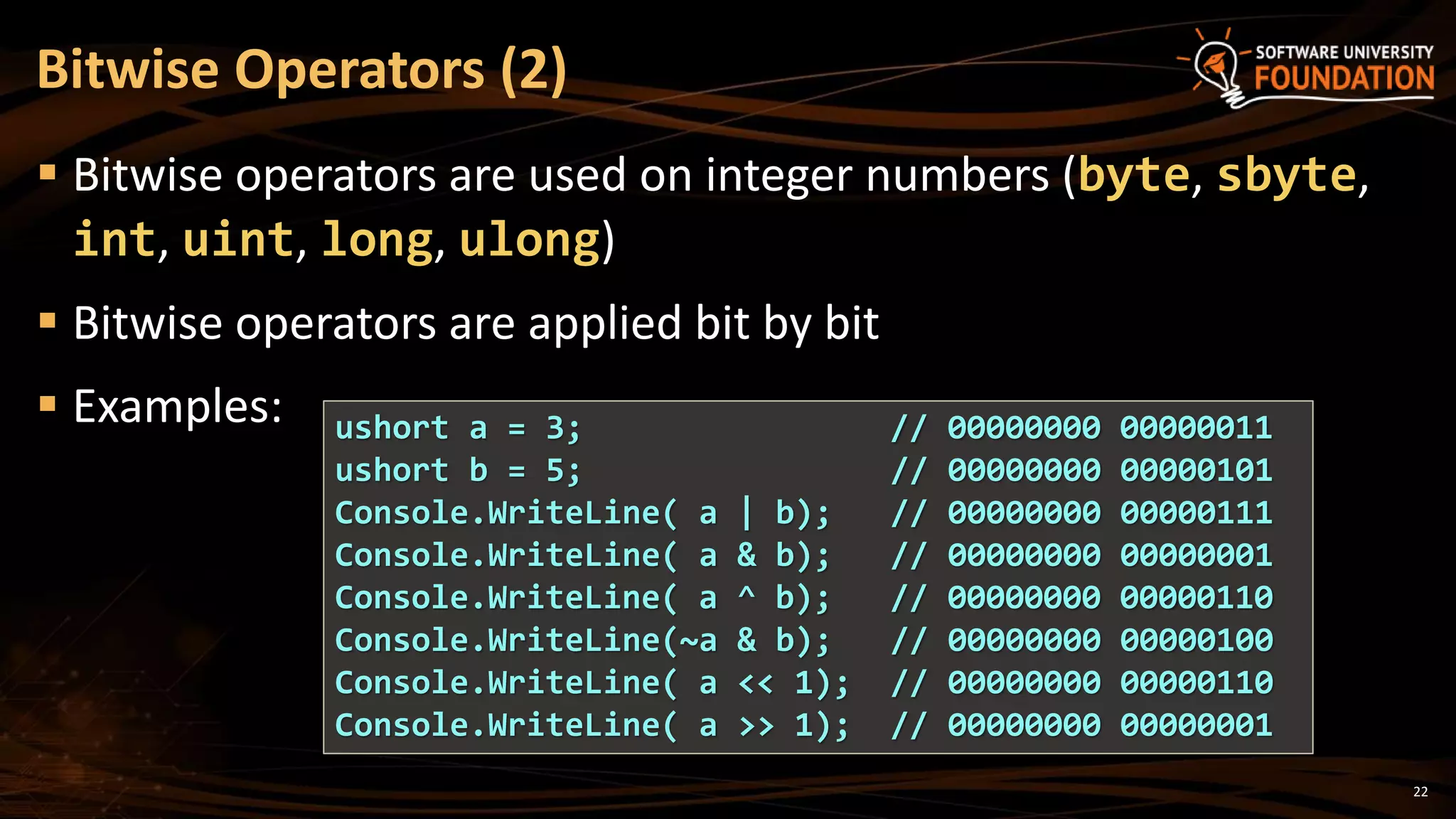
 Bitwise operators are used on integer numbers (byte, sbyte,
int, uint, long, ulong)
 Bitwise operators are applied bit by bit
 Examples:
Bitwise Operators (2)
ushort a = 3; // 00000000 00000011
ushort b = 5; // 00000000 00000101
Console.WriteLine( a | b); // 00000000 00000111
Console.WriteLine( a & b); // 00000000 00000001
Console.WriteLine( a ^ b); // 00000000 00000110
Console.WriteLine(~a & b); // 00000000 00000100
Console.WriteLine( a << 1); // 00000000 00000110
Console.WriteLine( a >> 1); // 00000000 00000001
23
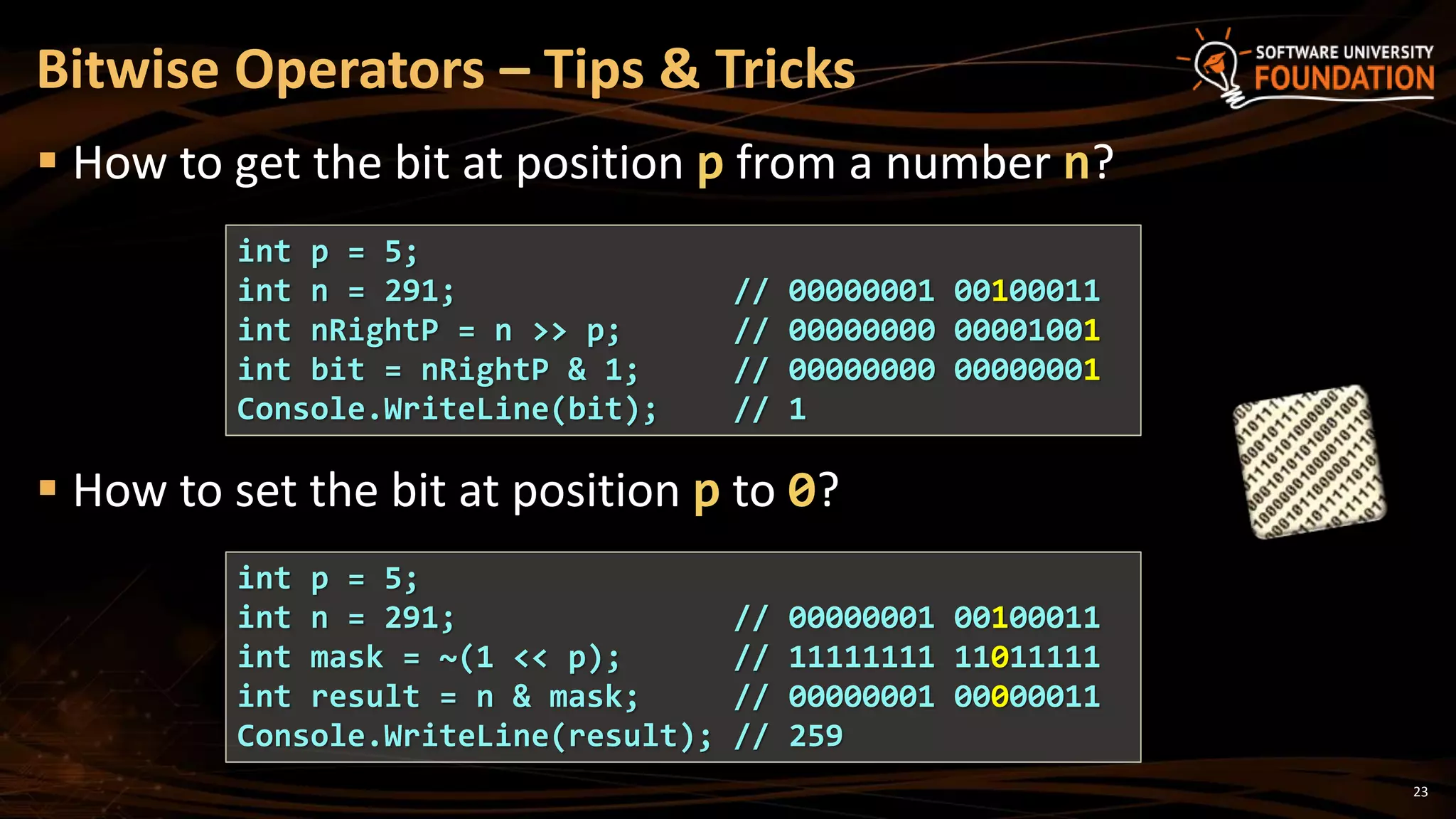
 How to get the bit at position p from a number n?
 How to set the bit at position p to 0?
Bitwise Operators – Tips & Tricks
int p = 5;
int n = 291; // 00000001 00100011
int nRightP = n >> p; // 00000000 00001001
int bit = nRightP & 1; // 00000000 00000001
Console.WriteLine(bit); // 1
int p = 5;
int n = 291; // 00000001 00100011
int mask = ~(1 << p); // 11111111 11011111
int result = n & mask; // 00000001 00000011
Console.WriteLine(result); // 259
24
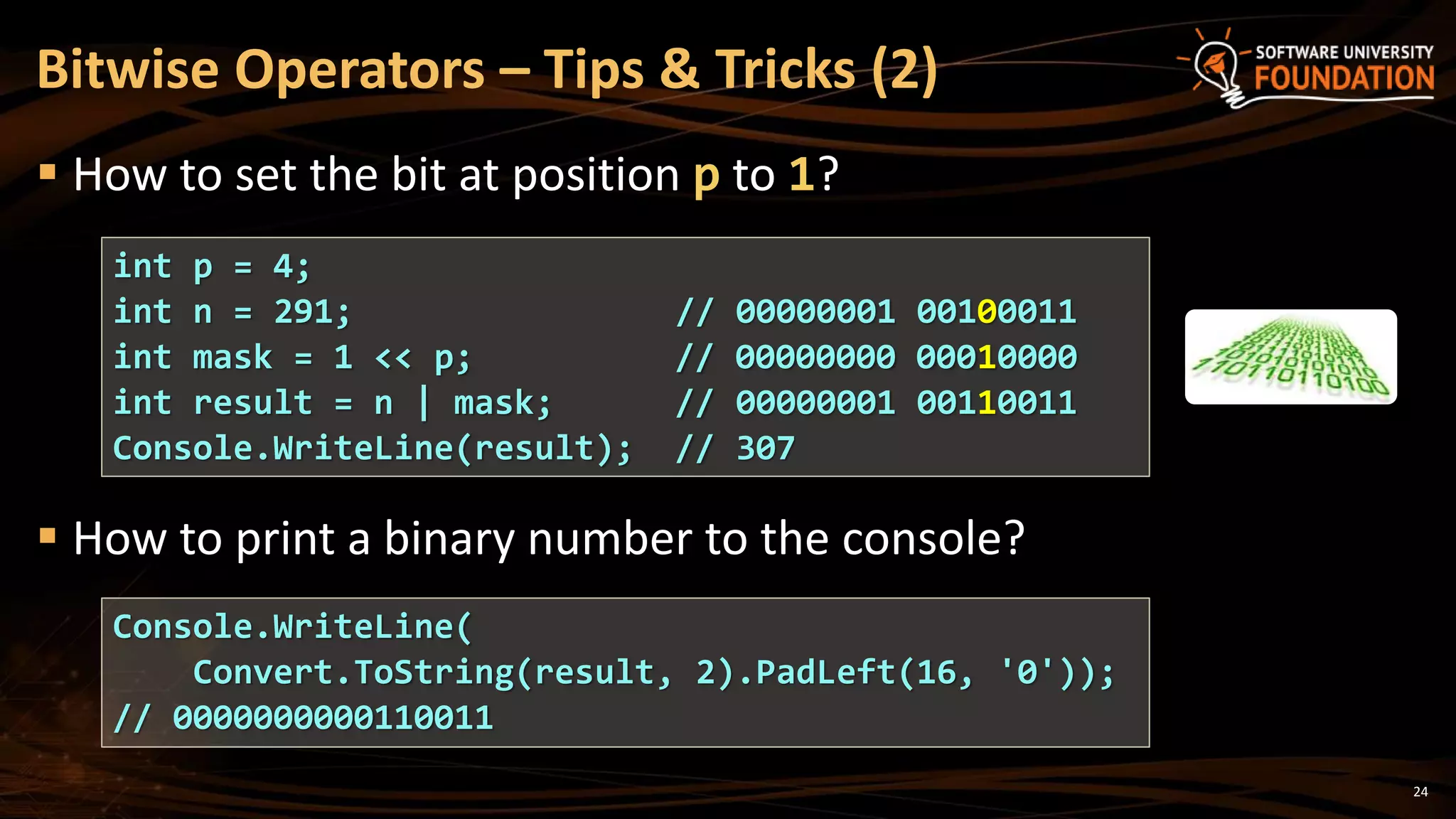
 How to set the bit at position p to 1?
 How to print a binary number to the console?
Bitwise Operators – Tips & Tricks (2)
int p = 4;
int n = 291; // 00000001 00100011
int mask = 1 << p; // 00000000 00010000
int result = n | mask; // 00000001 00110011
Console.WriteLine(result); // 307
Console.WriteLine(
Convert.ToString(result, 2).PadLeft(16, '0'));
// 0000000000110011
Bitwise Operators
Live Demo
Comparison and
Assignment Operators
27
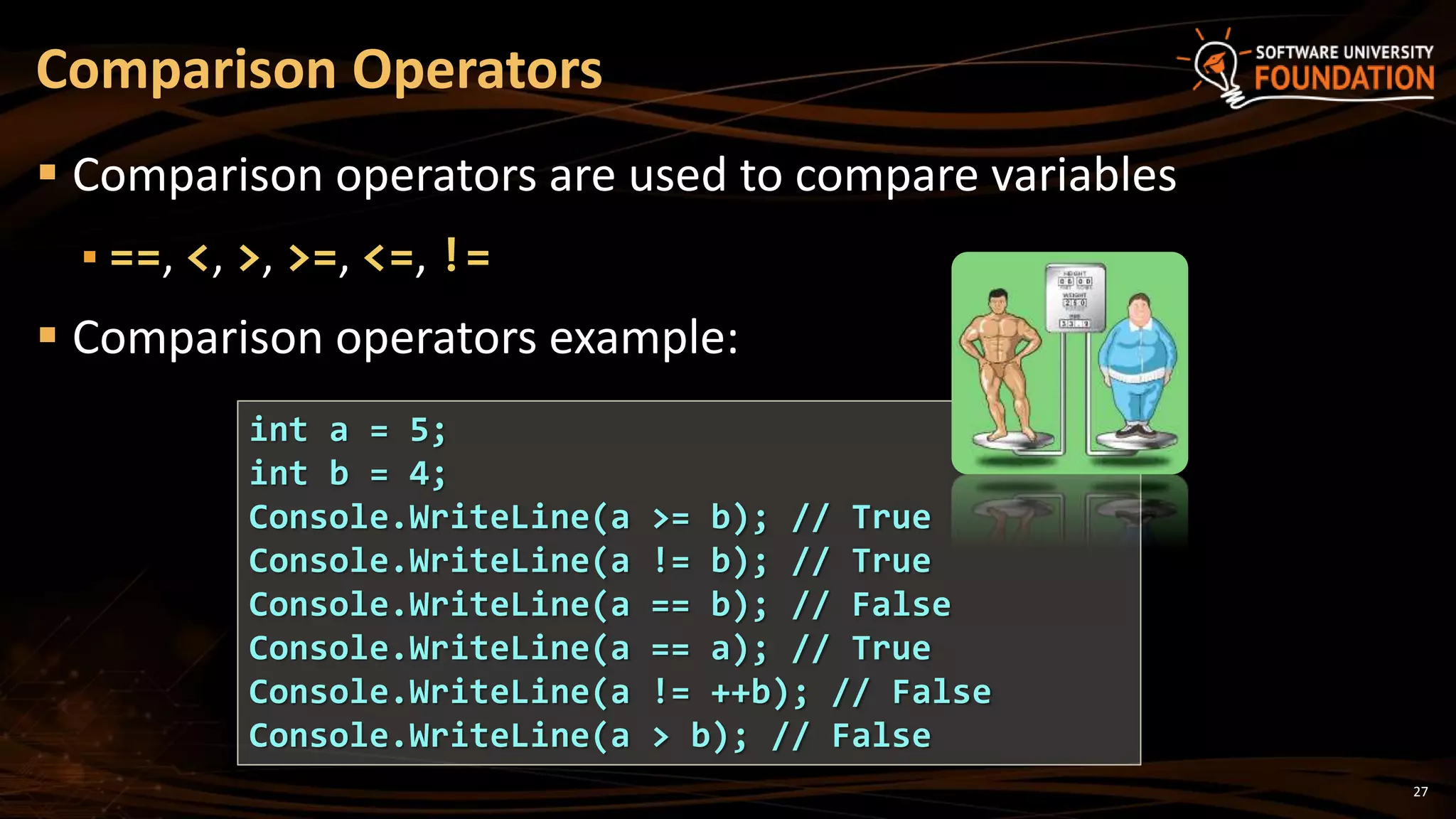
 Comparison operators are used to compare variables
 ==, <, >, >=, <=, !=
 Comparison operators example:
Comparison Operators
int a = 5;
int b = 4;
Console.WriteLine(a >= b); // True
Console.WriteLine(a != b); // True
Console.WriteLine(a == b); // False
Console.WriteLine(a == a); // True
Console.WriteLine(a != ++b); // False
Console.WriteLine(a > b); // False
28
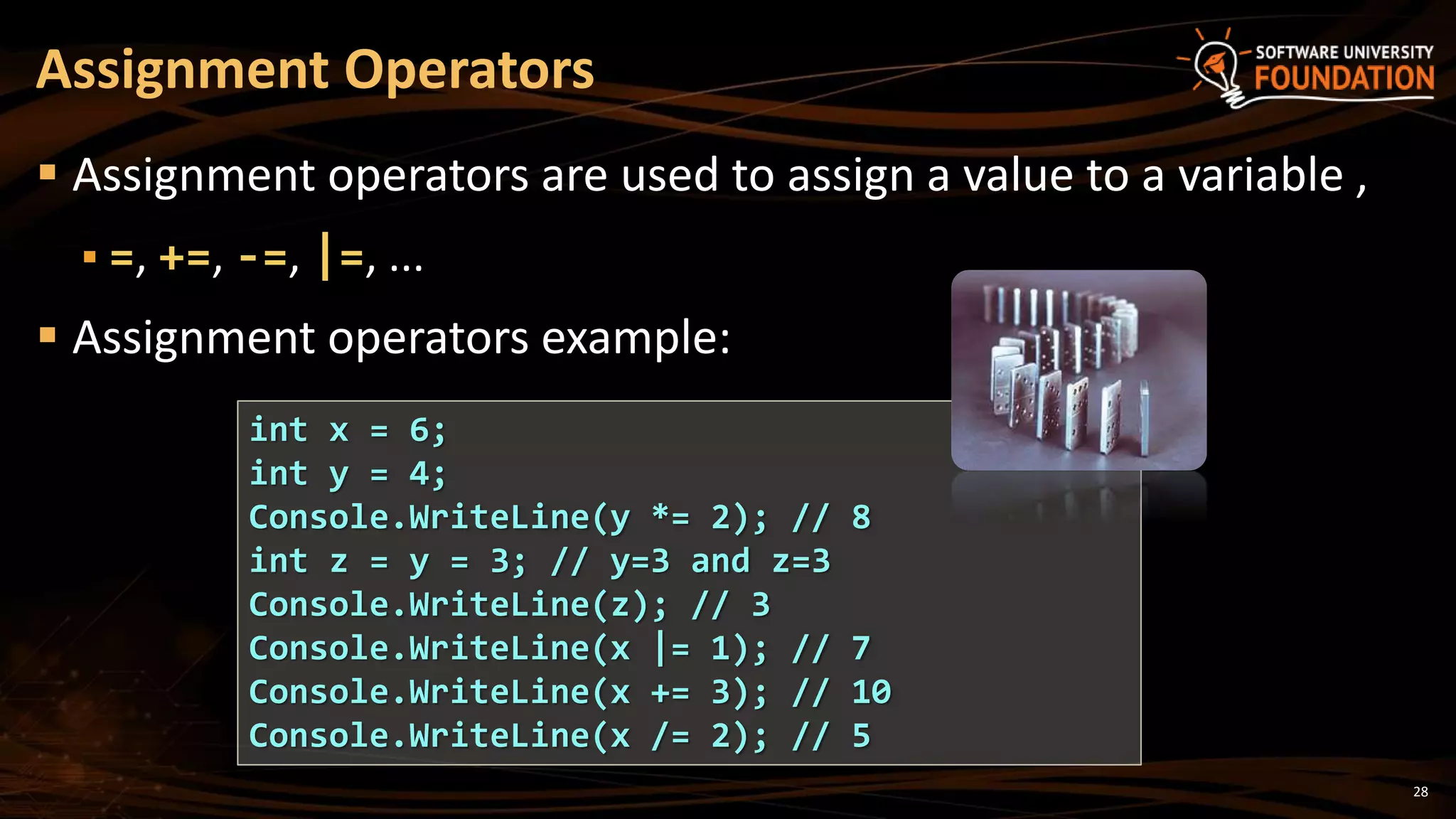
 Assignment operators are used to assign a value to a variable ,
 =, +=, -=, |=, ...
 Assignment operators example:
Assignment Operators
int x = 6;
int y = 4;
Console.WriteLine(y *= 2); // 8
int z = y = 3; // y=3 and z=3
Console.WriteLine(z); // 3
Console.WriteLine(x |= 1); // 7
Console.WriteLine(x += 3); // 10
Console.WriteLine(x /= 2); // 5
Comparison and
Assignment Operators
Live Demo
Other Operators
31
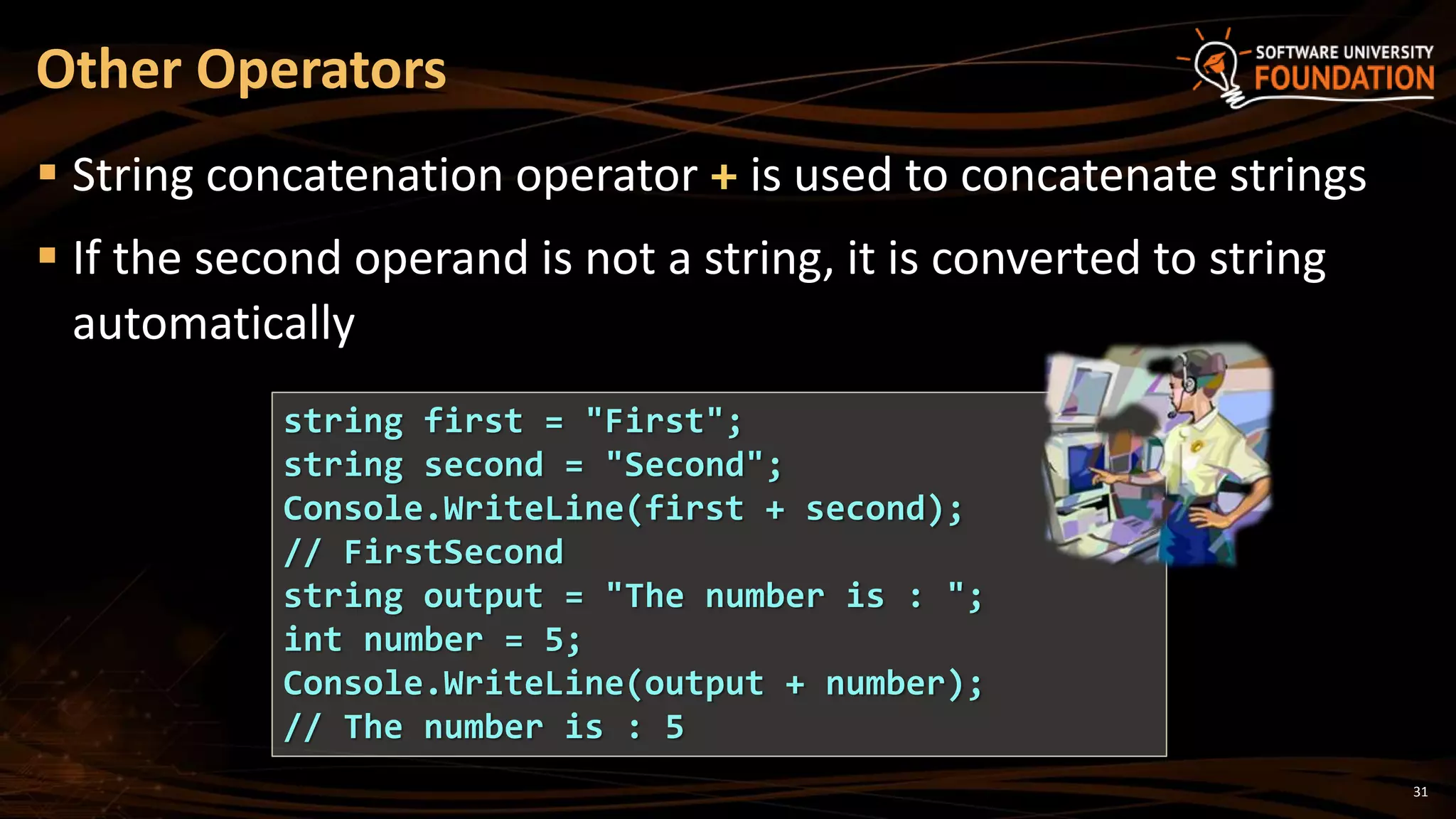
 String concatenation operator + is used to concatenate strings
 If the second operand is not a string, it is converted to string
automatically
Other Operators
string first = "First";
string second = "Second";
Console.WriteLine(first + second);
// FirstSecond
string output = "The number is : ";
int number = 5;
Console.WriteLine(output + number);
// The number is : 5
32
 Member access operator . is used to access object members
 E.g. DateTime.Now.DayOfWeek.ToString()
 Square brackets [] are used with arrays, indexers and attributes
 E.g. numbers[3], "Hello"[2]
 Parentheses ( ) are used to override the default operator
precedence, e.g. (a + b) / 2
 Class cast operator (type) is used to cast one compatible type
to another, e.g. (uint) -1
Other Operators (2)
33
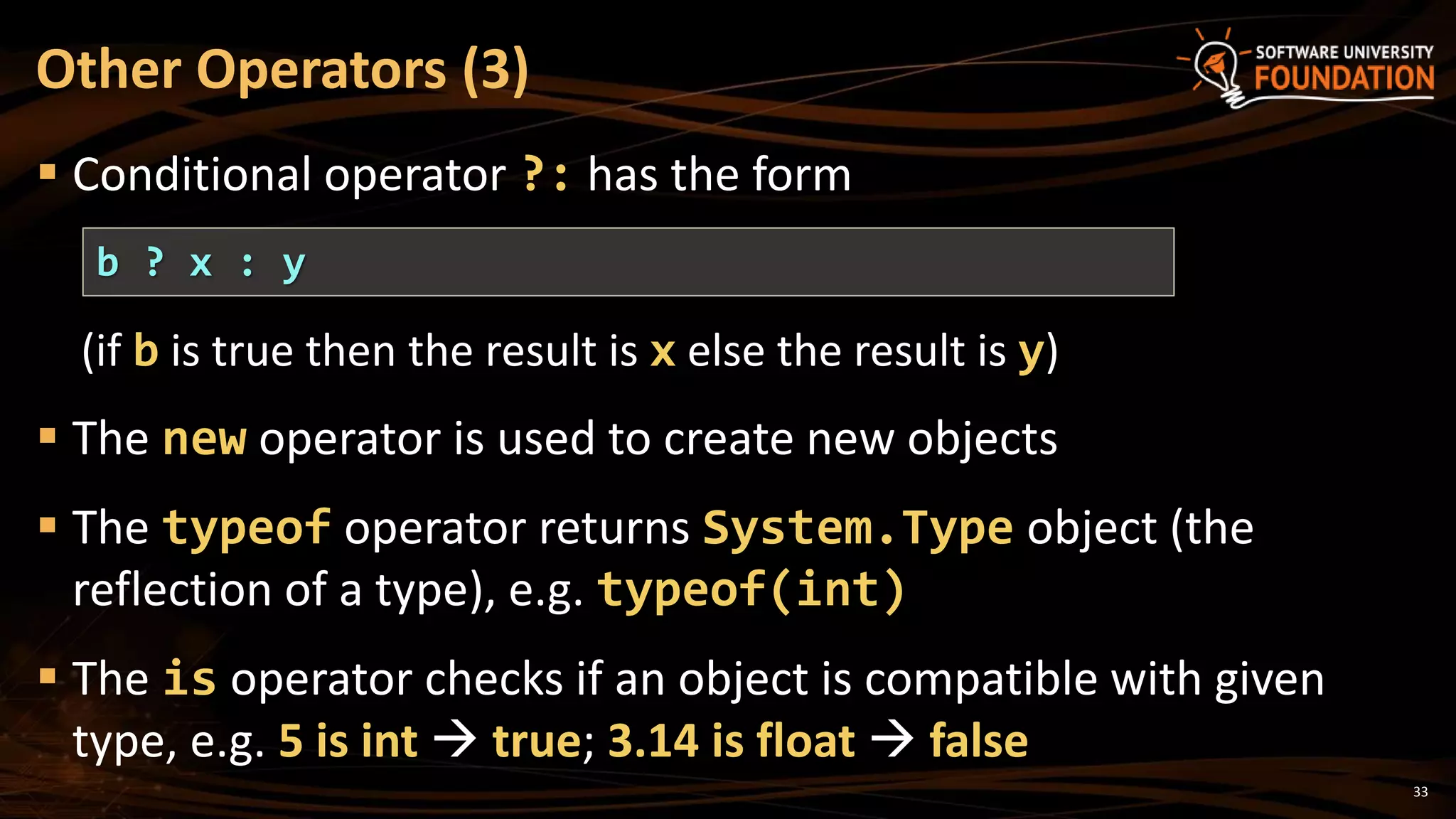
 Conditional operator ?: has the form
(if b is true then the result is x else the result is y)
 The new operator is used to create new objects
 The typeof operator returns System.Type object (the
reflection of a type), e.g. typeof(int)
 The is operator checks if an object is compatible with given
type, e.g. 5 is int  true; 3.14 is float  false
Other Operators (3)
b ? x : y
Other Operators (4)
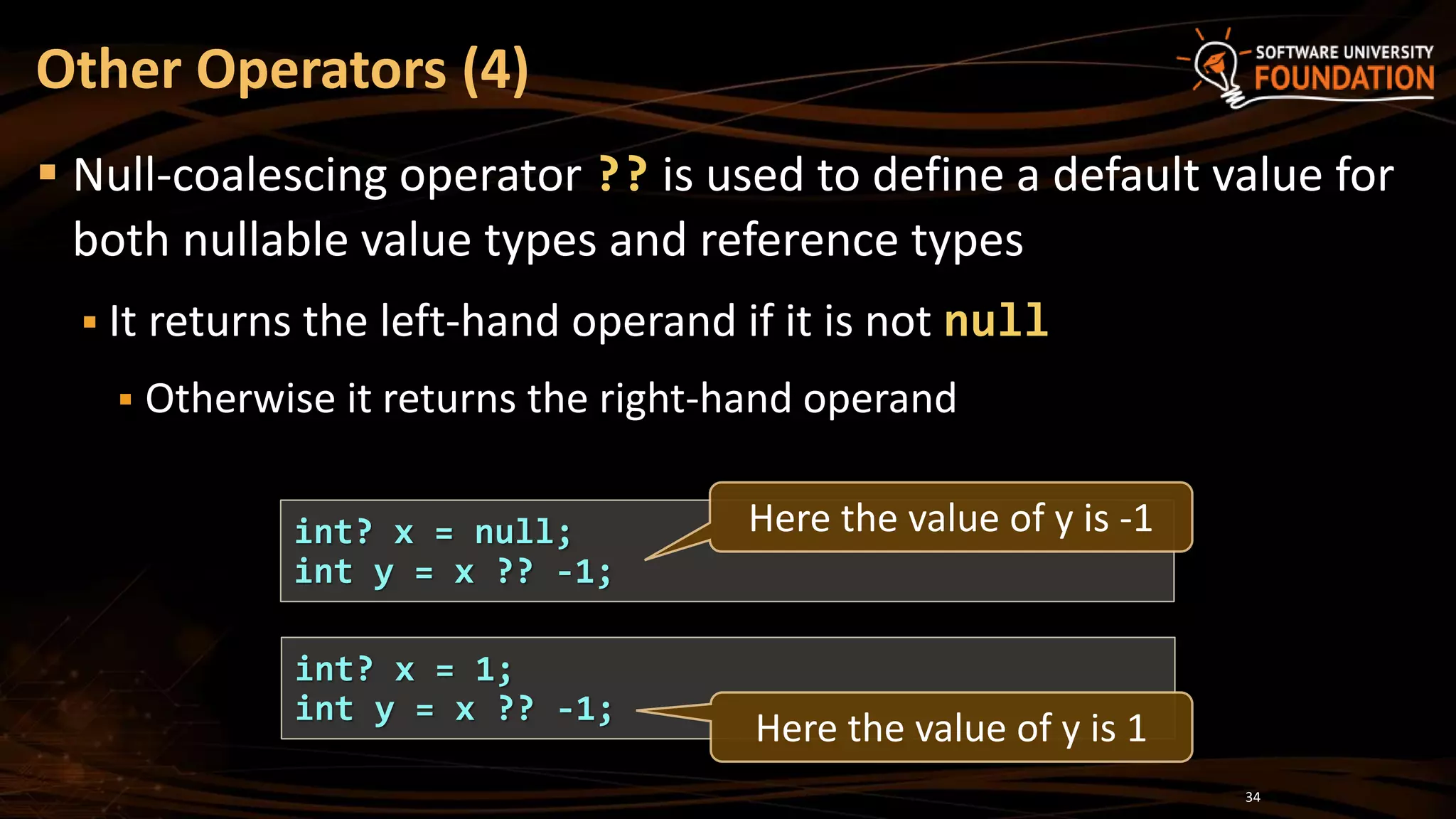
 Null-coalescing operator ?? is used to define a default value for
both nullable value types and reference types
 It returns the left-hand operand if it is not null
 Otherwise it returns the right-hand operand
34
int? x = null;
int y = x ?? -1;
int? x = 1;
int y = x ?? -1;
Here the value of y is -1
Here the value of y is 1
35
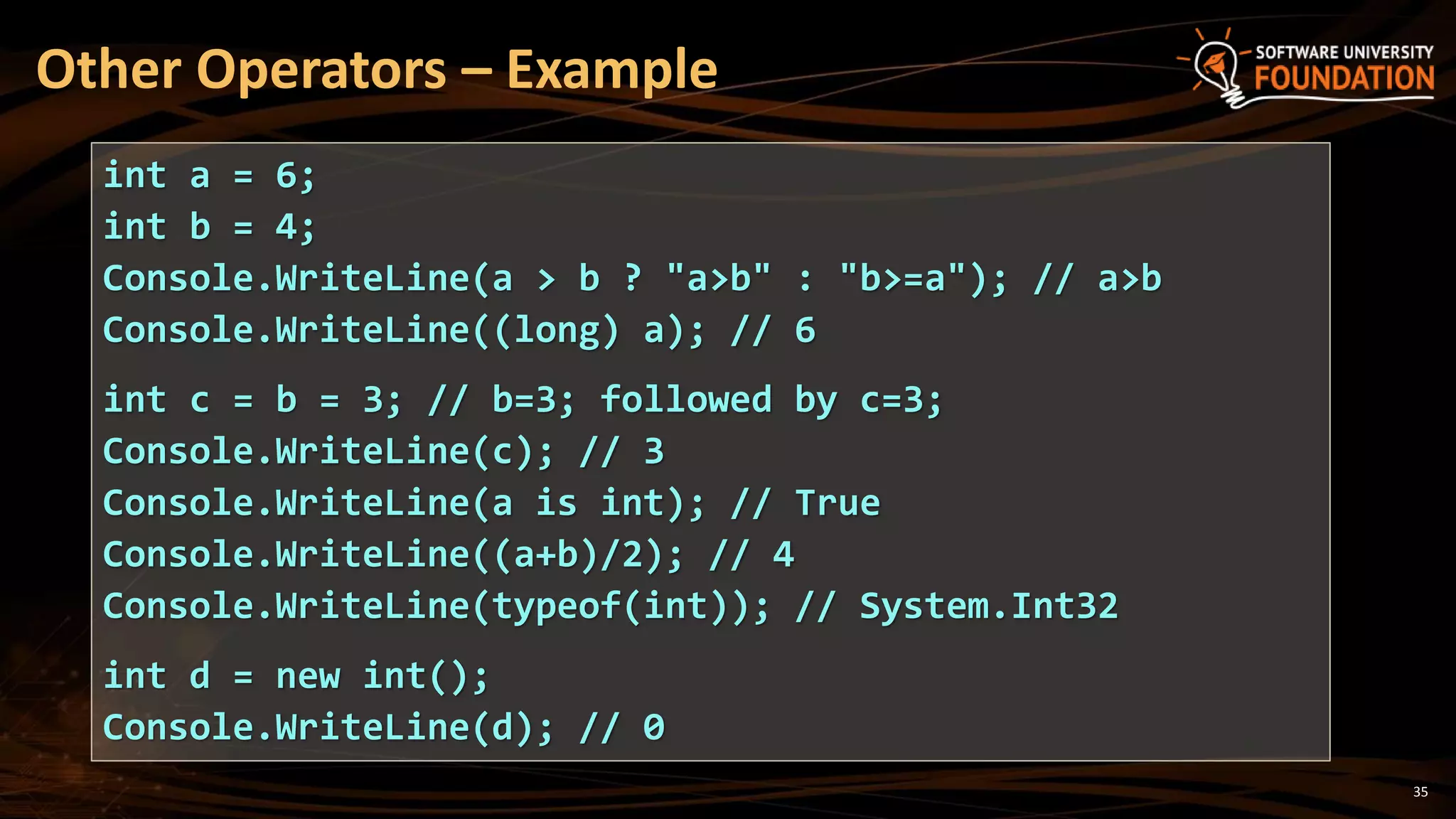
Other Operators – Example
int a = 6;
int b = 4;
Console.WriteLine(a > b ? "a>b" : "b>=a"); // a>b
Console.WriteLine((long) a); // 6
int c = b = 3; // b=3; followed by c=3;
Console.WriteLine(c); // 3
Console.WriteLine(a is int); // True
Console.WriteLine((a+b)/2); // 4
Console.WriteLine(typeof(int)); // System.Int32
int d = new int();
Console.WriteLine(d); // 0
Other Operators
Live Demo
Implicit and Explicit
Type Conversions
38
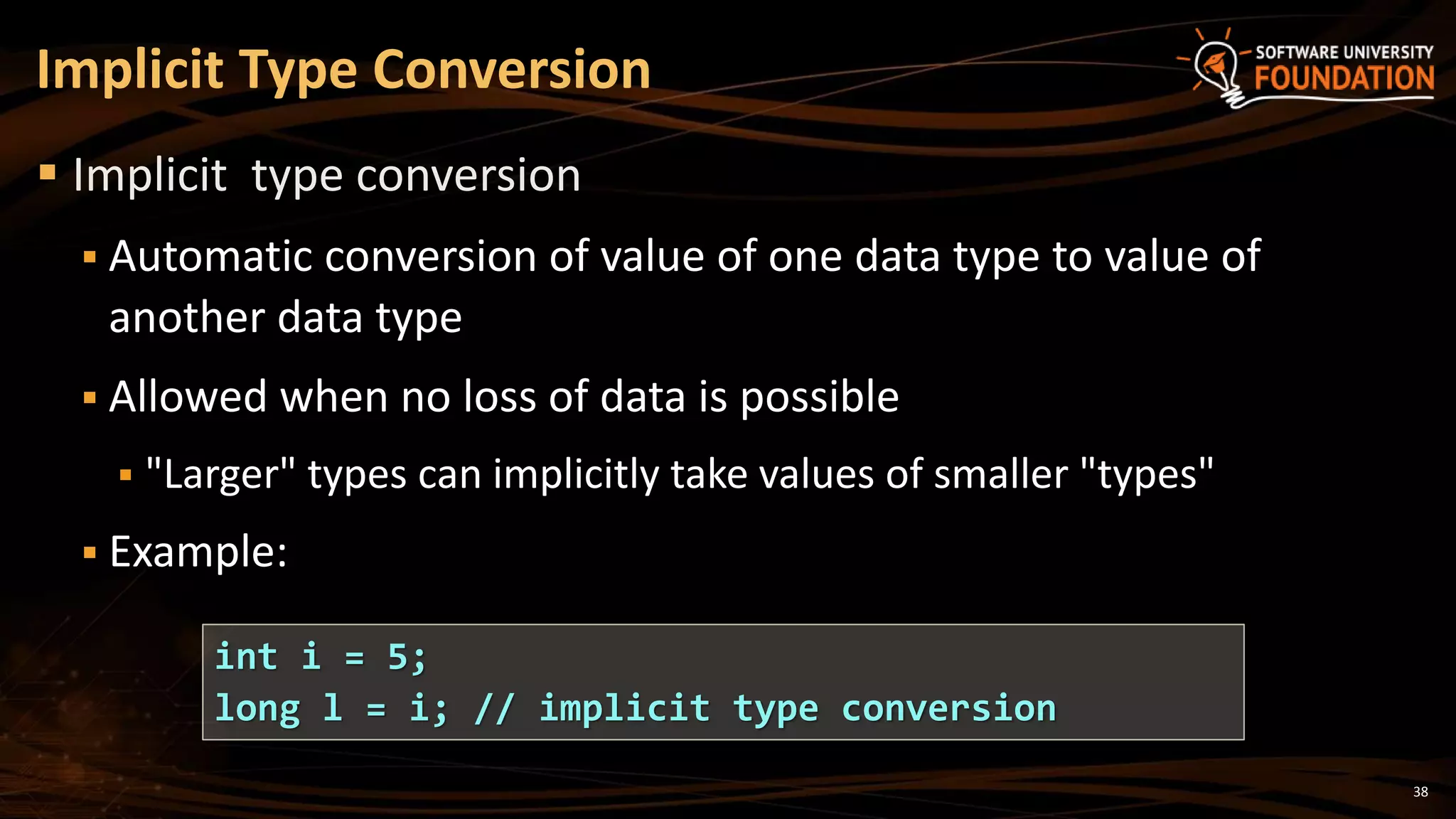
 Implicit type conversion
 Automatic conversion of value of one data type to value of
another data type
 Allowed when no loss of data is possible
 "Larger" types can implicitly take values of smaller "types"
 Example:
Implicit Type Conversion
int i = 5;
long l = i; // implicit type conversion
39
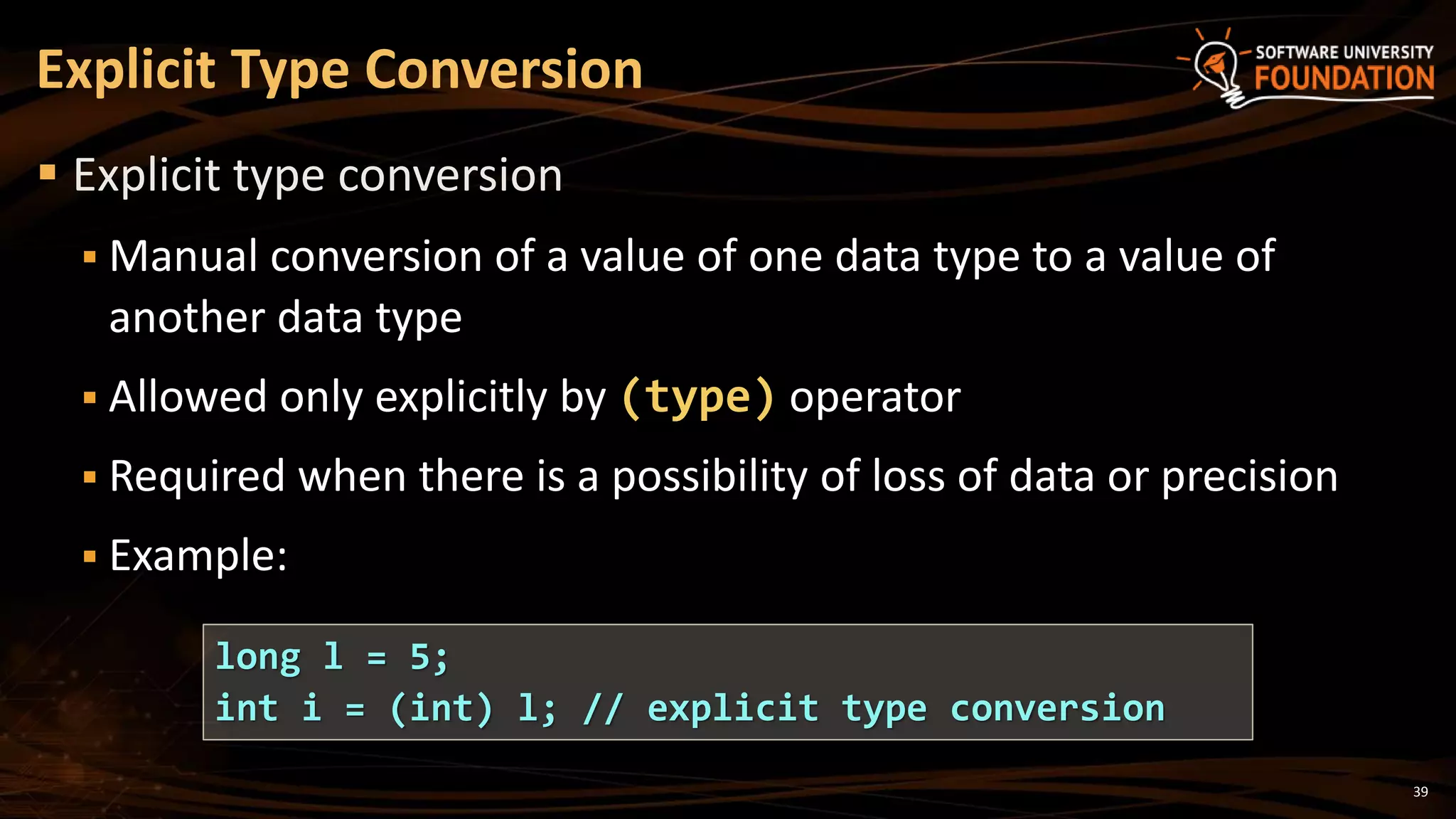
 Explicit type conversion
 Manual conversion of a value of one data type to a value of
another data type
 Allowed only explicitly by (type) operator
 Required when there is a possibility of loss of data or precision
 Example:
Explicit Type Conversion
long l = 5;
int i = (int) l; // explicit type conversion
40
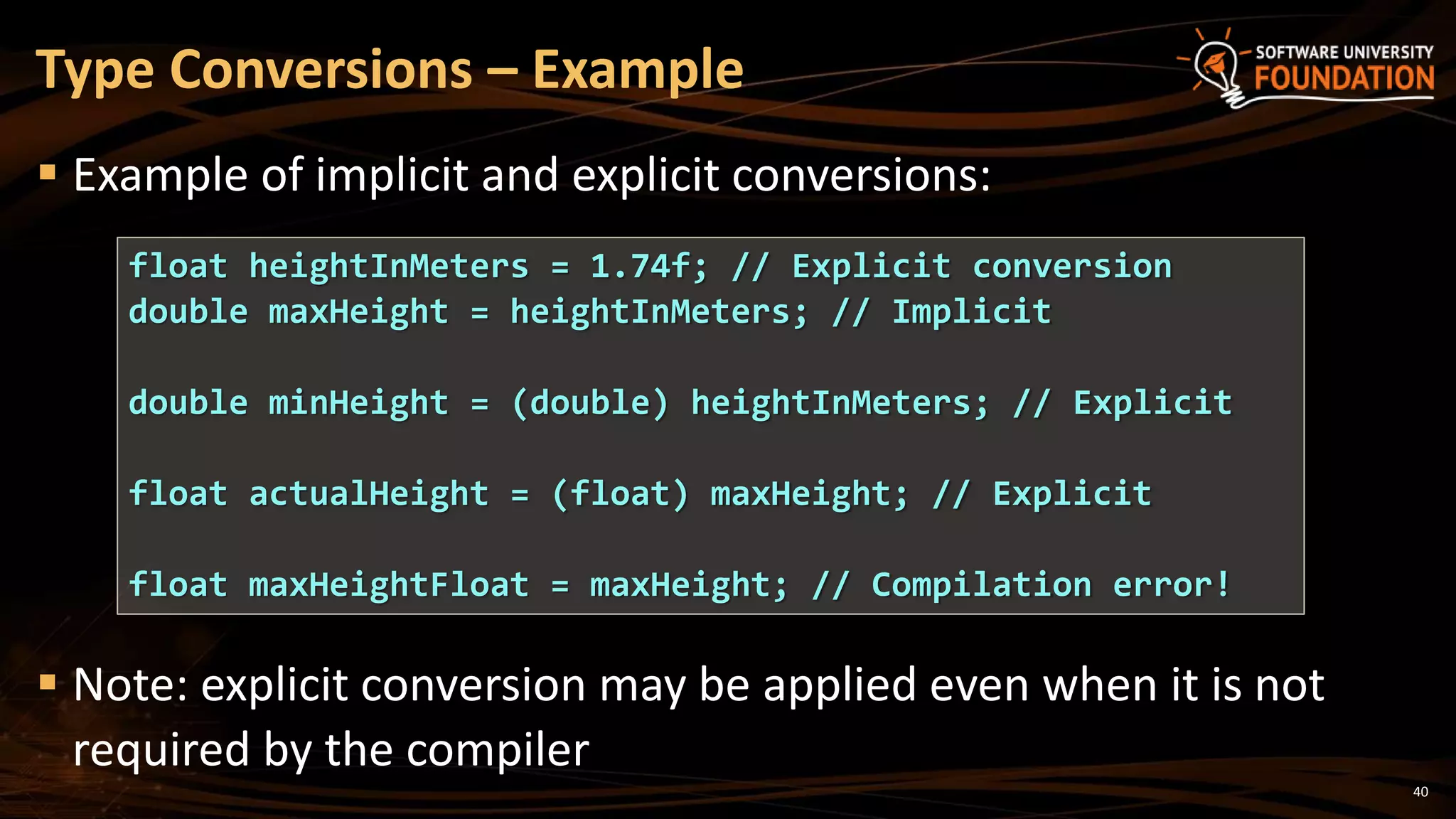
 Example of implicit and explicit conversions:
 Note: explicit conversion may be applied even when it is not
required by the compiler
Type Conversions – Example
float heightInMeters = 1.74f; // Explicit conversion
double maxHeight = heightInMeters; // Implicit
double minHeight = (double) heightInMeters; // Explicit
float actualHeight = (float) maxHeight; // Explicit
float maxHeightFloat = maxHeight; // Compilation error!
Type Conversions
Live Demo
Expressions
43
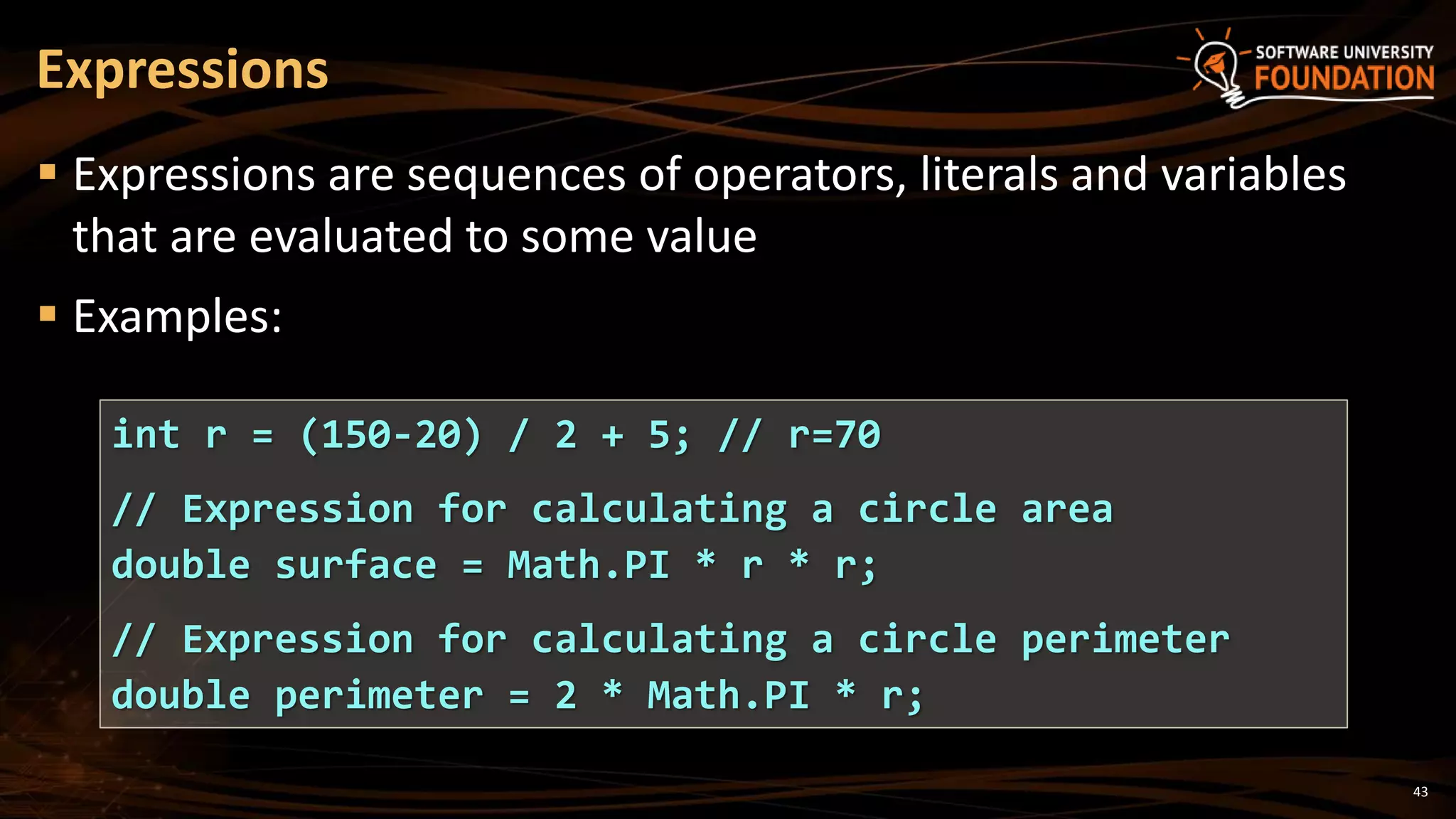
 Expressions are sequences of operators, literals and variables
that are evaluated to some value
 Examples:
Expressions
int r = (150-20) / 2 + 5; // r=70
// Expression for calculating a circle area
double surface = Math.PI * r * r;
// Expression for calculating a circle perimeter
double perimeter = 2 * Math.PI * r;
Expressions (2)
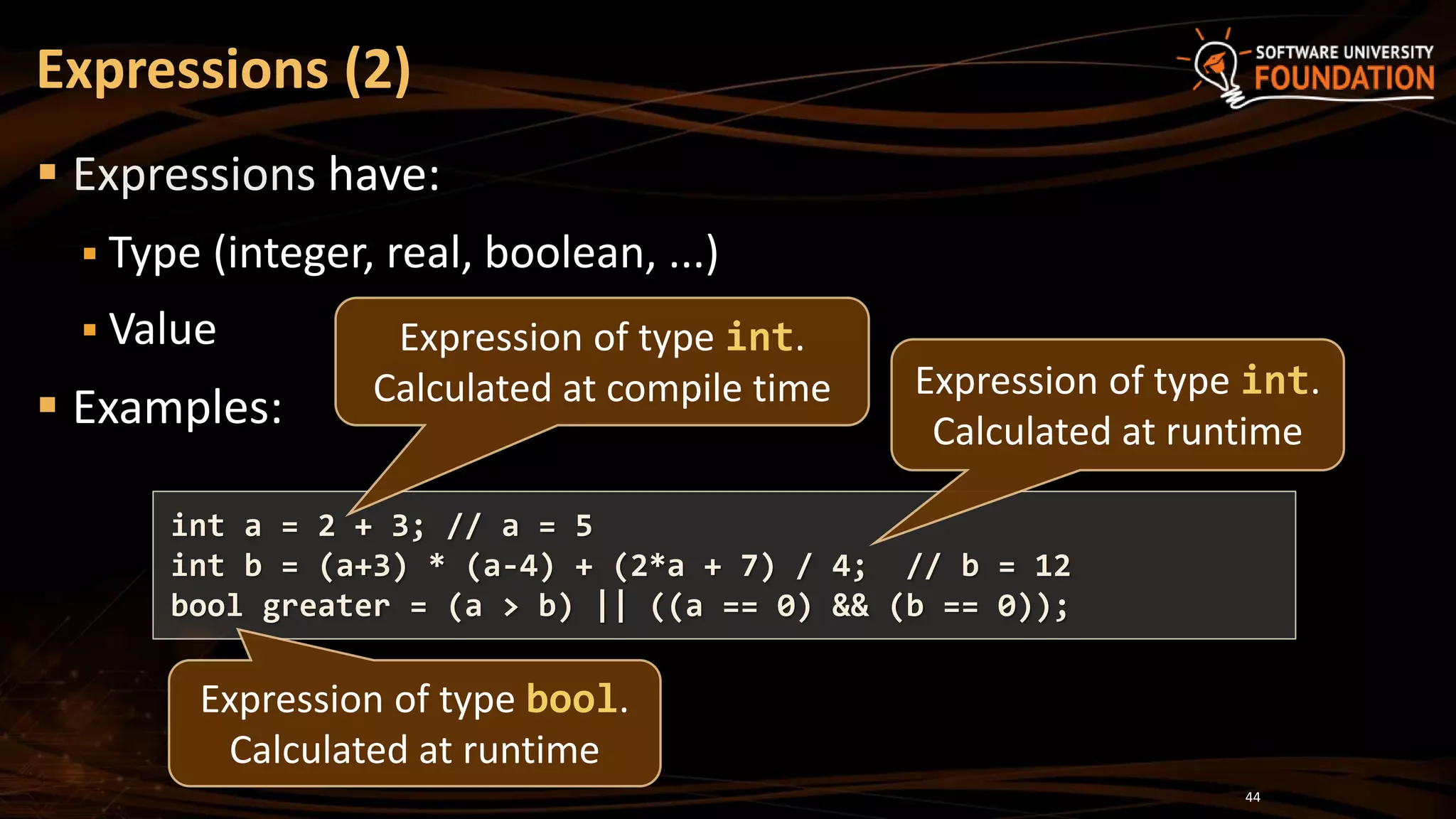
 Expressions have:
 Type (integer, real, boolean, ...)
 Value
 Examples:
44
int a = 2 + 3; // a = 5
int b = (a+3) * (a-4) + (2*a + 7) / 4; // b = 12
bool greater = (a > b) || ((a == 0) && (b == 0));
Expression of type int.
Calculated at compile time Expression of type int.
Calculated at runtime
Expression of type bool.
Calculated at runtime
Expressions
Live Demo
46
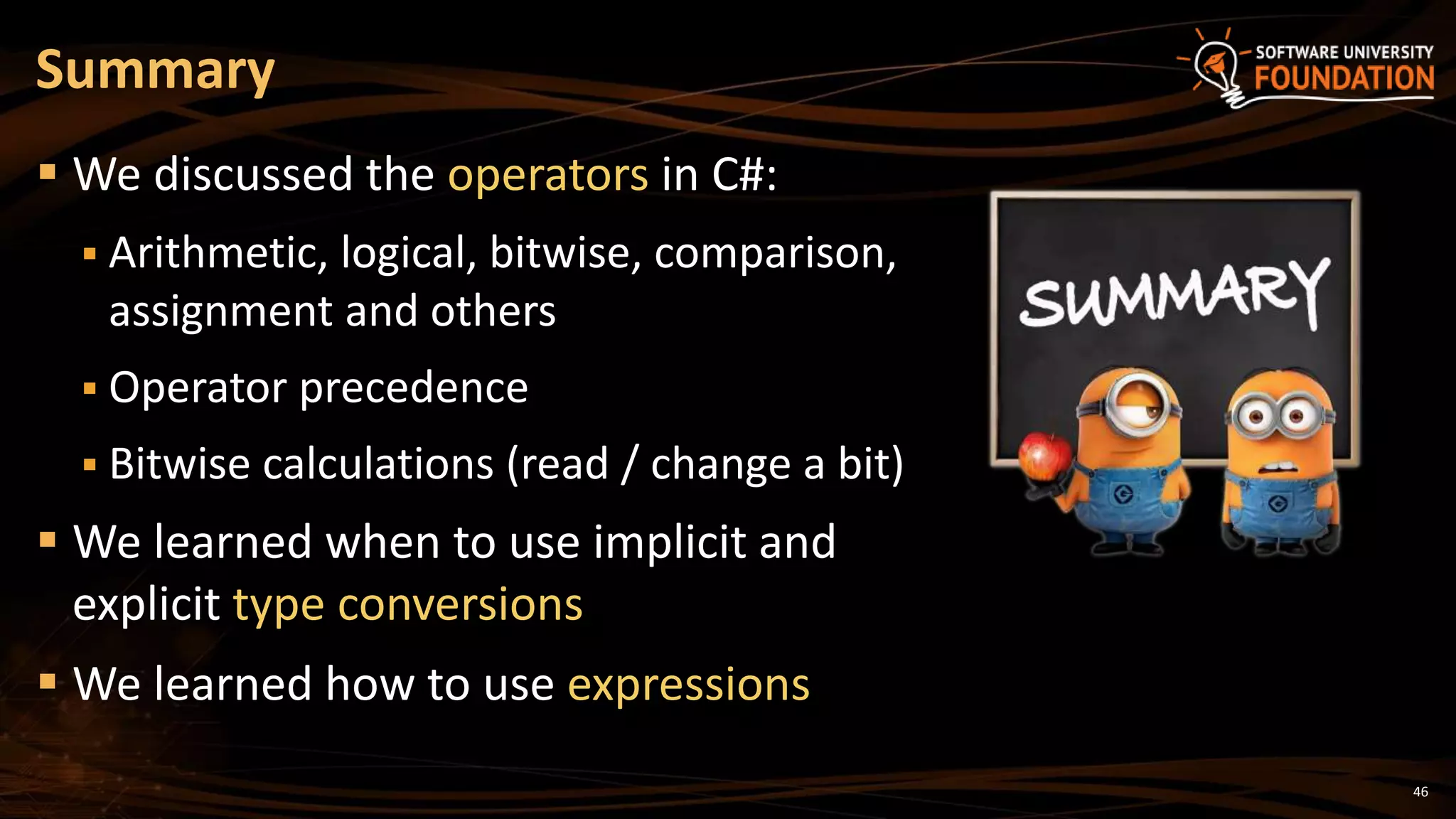
 We discussed the operators in C#:
 Arithmetic, logical, bitwise, comparison,
assignment and others
 Operator precedence
 Bitwise calculations (read / change a bit)
 We learned when to use implicit and
explicit type conversions
 We learned how to use expressions
Summary
?
http://softuni.bg/courses/csharp-basics
Operators and Expressions
48
 Boolean algebra (logic)
 http://en.wikipedia.org/wiki/Boolean_algebra_%28logic%29
 Bitwise mask
 http://en.wikipedia.org/wiki/Mask_%28computing%29
 Bitwise operation
 http://en.wikipedia.org/wiki/Bitwise_operation
 Bit hacks
 graphics.stanford.edu/~seander/bithacks.html
Resources
License
 This course (slides, examples, demos, videos, homework, etc.)
is licensed under the "Creative Commons Attribution-
NonCommercial-ShareAlike 4.0 International" license
49
 Attribution: this work may contain portions from
 "Fundamentals of Computer Programming with C#" book by Svetlin Nakov & Co. under CC-BY-SA license
 "C# Part I" course by Telerik Academy under CC-BY-NC-SA license
Free Trainings @ Software University
 Software University Foundation – softuni.org
 Software University – High-Quality Education,
Profession and Job for Software Developers
 softuni.bg
 Software University @ Facebook
 facebook.com/SoftwareUniversity
 Software University @ YouTube
 youtube.com/SoftwareUniversity
 Software University Forums – forum.softuni.bg

03. Operators Expressions and statements

  • 1.
    Operators and Expressions PerformingSimple Calculations with C# Svetlin Nakov Technical Trainer www.nakov.com Software University http://softuni.bg
  • 2.
    2 1. Operators inC# and Operator Precedence 2. Arithmetic Operators 3. Logical Operators 4. Bitwise Operators 5. Comparison Operators 6. Assignment Operators 7. Other Operators 8. Implicit and Explicit Type Conversions 9. Expressions Table of Contents
  • 3.
    Operators in C# Arithmetic,Logical, Comparison, Assignment, Etc.
  • 4.
    4  Operator isan operation performed over data at runtime  Takes one or more arguments (operands)  Produces a new value  Example of operators:  Operators have precedence  Precedence defines which will be evaluated first  Expressions are sequences of operators and operands that are evaluated to a single value, e.g. (a + b) / 2 What is an Operator? a = b + c; Operator "+" Operator "="
  • 5.
    5  Operators inC# :  Unary – take one operand  Binary – take two operands  Ternary (?:) – takes three operands  Except for the assignment operators, all binary operators are left-associative  The assignment operators and the conditional operator (?:) are right-associative Operators in C#
  • 6.
    6 Category Operators Arithmetic +- * / % ++ -- Logical && || ^ ! Binary & | ^ ~ << >> Comparison == != < > <= >= Assignment = += -= *= /= %= &= |= ^= <<= >>= String concatenation + Type conversion is as typeof Other . [] () ?: new Categories of Operators in C#
  • 7.
  • 8.
    8 Precedence Operators Highest () ++-- (postfix) new typeof ++ -- (prefix) + - (unary) ! ~ * / % + - << >> < > <= >= is as == != & Lower ^ Operators Precedence
  • 9.
    9  Parenthesis operatoralways has highest precedence  Note: prefer using parentheses, even when it seems stupid to do so Operators Precedence (2) Precedence Operators Higher | && || ?: Lowest = *= /= %= += -= <<= >>= &= ^= |=
  • 10.
  • 11.
    11  Arithmetic operators+, -, * are the same as in math  Division operator / if used on integers returns integer (without rounding) or exception  Division operator / if used on real numbers returns real number or Infinity or NaN  Remainder operator % returns the remainder from division of integers  The special addition operator ++ increments a variable Arithmetic Operators
  • 12.
    12 Arithmetic Operators –Examples int squarePerimeter = 17; double squareSide = squarePerimeter / 4.0; double squareArea = squareSide * squareSide; Console.WriteLine(squareSide); // 4.25 Console.WriteLine(squareArea); // 18.0625 int a = 5; int b = 4; Console.WriteLine( a + b ); // 9 Console.WriteLine( a + b++ ); // 9 Console.WriteLine( a + b ); // 10 Console.WriteLine( a + (++b) ); // 11 Console.WriteLine( a + b ); // 11
  • 13.
    13 Arithmetic Operators –Example (2) Console.WriteLine(12 / 3); // 4 Console.WriteLine(11 / 3); // 3 Console.WriteLine(11.0 / 3); // 3.666666667 Console.WriteLine(11 / 3.0); // 3.666666667 Console.WriteLine(11 % 3); // 2 Console.WriteLine(11 % -3); // 2 Console.WriteLine(-11 % 3); // -2 Console.WriteLine(1.5 / 0.0); // Infinity Console.WriteLine(-1.5 / 0.0); // -Infinity Console.WriteLine(0.0 / 0.0); // NaN int x = 0; Console.WriteLine(5 / x); // DivideByZeroException
  • 14.
    14 Arithmetic Operators –Overflow Examples int bigNum = 2000000000; int bigSum = 2 * bigNum; // Integer overflow! Console.WriteLine(bigSum); // -294967296 bigNum = Int32.MaxValue; bigNum = bigNum + 1; Console.WriteLine(bigNum); // -2147483648 checked { // This will cause OverflowException bigSum = bigNum * 2; }
  • 15.
  • 16.
  • 17.
    17  Logical operatorstake boolean operands and return boolean result  Operator ! turns true to false and false to true  Behavior of the operators &&, || and ^ (1 == true, 0 == false): Logical Operators Operator || || || || && && && && ^ ^ ^ ^ Operand1 0 0 1 1 0 0 1 1 0 0 1 1 Operand2 0 1 0 1 0 1 0 1 0 1 0 1 Result 0 1 1 1 0 0 0 1 0 1 1 0
  • 18.
    18 Logical Operators –Example bool a = true; bool b = false; Console.WriteLine(a && b); // False Console.WriteLine(a || b); // True Console.WriteLine(a ^ b); // True Console.WriteLine(!b); // True Console.WriteLine(b || true); // True Console.WriteLine(b && true); // False Console.WriteLine(a || true); // True Console.WriteLine(a && true); // True Console.WriteLine(!a); // False Console.WriteLine((5>7) ^ (a==b)); // False
  • 19.
  • 20.
  • 21.
    21  Bitwise operator~ turns all 0 to 1 and all 1 to 0  Like ! for boolean expressions but bit by bit  The operators |, & and ^ behave like ||, && and ^ for boolean expressions but bit by bit  The << and >> move the bits (left or right)  Behavior of the operators|, & and ^: Bitwise Operators Operator | | | | & & & & ^ ^ ^ ^ Operand1 0 0 1 1 0 0 1 1 0 0 1 1 Operand2 0 1 0 1 0 1 0 1 0 1 0 1 Result 0 1 1 1 0 0 0 1 0 1 1 0
  • 22.
    22  Bitwise operatorsare used on integer numbers (byte, sbyte, int, uint, long, ulong)  Bitwise operators are applied bit by bit  Examples: Bitwise Operators (2) ushort a = 3; // 00000000 00000011 ushort b = 5; // 00000000 00000101 Console.WriteLine( a | b); // 00000000 00000111 Console.WriteLine( a & b); // 00000000 00000001 Console.WriteLine( a ^ b); // 00000000 00000110 Console.WriteLine(~a & b); // 00000000 00000100 Console.WriteLine( a << 1); // 00000000 00000110 Console.WriteLine( a >> 1); // 00000000 00000001
  • 23.
    23  How toget the bit at position p from a number n?  How to set the bit at position p to 0? Bitwise Operators – Tips & Tricks int p = 5; int n = 291; // 00000001 00100011 int nRightP = n >> p; // 00000000 00001001 int bit = nRightP & 1; // 00000000 00000001 Console.WriteLine(bit); // 1 int p = 5; int n = 291; // 00000001 00100011 int mask = ~(1 << p); // 11111111 11011111 int result = n & mask; // 00000001 00000011 Console.WriteLine(result); // 259
  • 24.
    24  How toset the bit at position p to 1?  How to print a binary number to the console? Bitwise Operators – Tips & Tricks (2) int p = 4; int n = 291; // 00000001 00100011 int mask = 1 << p; // 00000000 00010000 int result = n | mask; // 00000001 00110011 Console.WriteLine(result); // 307 Console.WriteLine( Convert.ToString(result, 2).PadLeft(16, '0')); // 0000000000110011
  • 25.
  • 26.
  • 27.
    27  Comparison operatorsare used to compare variables  ==, <, >, >=, <=, !=  Comparison operators example: Comparison Operators int a = 5; int b = 4; Console.WriteLine(a >= b); // True Console.WriteLine(a != b); // True Console.WriteLine(a == b); // False Console.WriteLine(a == a); // True Console.WriteLine(a != ++b); // False Console.WriteLine(a > b); // False
  • 28.
    28  Assignment operatorsare used to assign a value to a variable ,  =, +=, -=, |=, ...  Assignment operators example: Assignment Operators int x = 6; int y = 4; Console.WriteLine(y *= 2); // 8 int z = y = 3; // y=3 and z=3 Console.WriteLine(z); // 3 Console.WriteLine(x |= 1); // 7 Console.WriteLine(x += 3); // 10 Console.WriteLine(x /= 2); // 5
  • 29.
  • 30.
  • 31.
    31  String concatenationoperator + is used to concatenate strings  If the second operand is not a string, it is converted to string automatically Other Operators string first = "First"; string second = "Second"; Console.WriteLine(first + second); // FirstSecond string output = "The number is : "; int number = 5; Console.WriteLine(output + number); // The number is : 5
  • 32.
    32  Member accessoperator . is used to access object members  E.g. DateTime.Now.DayOfWeek.ToString()  Square brackets [] are used with arrays, indexers and attributes  E.g. numbers[3], "Hello"[2]  Parentheses ( ) are used to override the default operator precedence, e.g. (a + b) / 2  Class cast operator (type) is used to cast one compatible type to another, e.g. (uint) -1 Other Operators (2)
  • 33.
    33  Conditional operator?: has the form (if b is true then the result is x else the result is y)  The new operator is used to create new objects  The typeof operator returns System.Type object (the reflection of a type), e.g. typeof(int)  The is operator checks if an object is compatible with given type, e.g. 5 is int  true; 3.14 is float  false Other Operators (3) b ? x : y
  • 34.
    Other Operators (4) Null-coalescing operator ?? is used to define a default value for both nullable value types and reference types  It returns the left-hand operand if it is not null  Otherwise it returns the right-hand operand 34 int? x = null; int y = x ?? -1; int? x = 1; int y = x ?? -1; Here the value of y is -1 Here the value of y is 1
  • 35.
    35 Other Operators –Example int a = 6; int b = 4; Console.WriteLine(a > b ? "a>b" : "b>=a"); // a>b Console.WriteLine((long) a); // 6 int c = b = 3; // b=3; followed by c=3; Console.WriteLine(c); // 3 Console.WriteLine(a is int); // True Console.WriteLine((a+b)/2); // 4 Console.WriteLine(typeof(int)); // System.Int32 int d = new int(); Console.WriteLine(d); // 0
  • 36.
  • 37.
  • 38.
    38  Implicit typeconversion  Automatic conversion of value of one data type to value of another data type  Allowed when no loss of data is possible  "Larger" types can implicitly take values of smaller "types"  Example: Implicit Type Conversion int i = 5; long l = i; // implicit type conversion
  • 39.
    39  Explicit typeconversion  Manual conversion of a value of one data type to a value of another data type  Allowed only explicitly by (type) operator  Required when there is a possibility of loss of data or precision  Example: Explicit Type Conversion long l = 5; int i = (int) l; // explicit type conversion
  • 40.
    40  Example ofimplicit and explicit conversions:  Note: explicit conversion may be applied even when it is not required by the compiler Type Conversions – Example float heightInMeters = 1.74f; // Explicit conversion double maxHeight = heightInMeters; // Implicit double minHeight = (double) heightInMeters; // Explicit float actualHeight = (float) maxHeight; // Explicit float maxHeightFloat = maxHeight; // Compilation error!
  • 41.
  • 42.
  • 43.
    43  Expressions aresequences of operators, literals and variables that are evaluated to some value  Examples: Expressions int r = (150-20) / 2 + 5; // r=70 // Expression for calculating a circle area double surface = Math.PI * r * r; // Expression for calculating a circle perimeter double perimeter = 2 * Math.PI * r;
  • 44.
    Expressions (2)  Expressionshave:  Type (integer, real, boolean, ...)  Value  Examples: 44 int a = 2 + 3; // a = 5 int b = (a+3) * (a-4) + (2*a + 7) / 4; // b = 12 bool greater = (a > b) || ((a == 0) && (b == 0)); Expression of type int. Calculated at compile time Expression of type int. Calculated at runtime Expression of type bool. Calculated at runtime
  • 45.
  • 46.
    46  We discussedthe operators in C#:  Arithmetic, logical, bitwise, comparison, assignment and others  Operator precedence  Bitwise calculations (read / change a bit)  We learned when to use implicit and explicit type conversions  We learned how to use expressions Summary
  • 47.
  • 48.
    48  Boolean algebra(logic)  http://en.wikipedia.org/wiki/Boolean_algebra_%28logic%29  Bitwise mask  http://en.wikipedia.org/wiki/Mask_%28computing%29  Bitwise operation  http://en.wikipedia.org/wiki/Bitwise_operation  Bit hacks  graphics.stanford.edu/~seander/bithacks.html Resources
  • 49.
    License  This course(slides, examples, demos, videos, homework, etc.) is licensed under the "Creative Commons Attribution- NonCommercial-ShareAlike 4.0 International" license 49  Attribution: this work may contain portions from  "Fundamentals of Computer Programming with C#" book by Svetlin Nakov & Co. under CC-BY-SA license  "C# Part I" course by Telerik Academy under CC-BY-NC-SA license
  • 50.
    Free Trainings @Software University  Software University Foundation – softuni.org  Software University – High-Quality Education, Profession and Job for Software Developers  softuni.bg  Software University @ Facebook  facebook.com/SoftwareUniversity  Software University @ YouTube  youtube.com/SoftwareUniversity  Software University Forums – forum.softuni.bg

Editor's Notes