Multiple Alleles
Multiple Alleles
• For each trait Mendel studied, there were
only two possible alleles. The dominant
allele controlled the trait. However, it is
possible to have more than two alleles,
this is called multiple alleles.
• Geneticists that study fruit flies (Drosophila
melanogaster), have seen many alleles for
one gene. They use numbers to indicate
which allele is dominant over another.
• In fruit flies the eye colors can be as
follows:
wild (E1E1), coral (E2E2), blood (E3E3),
easin (E4E4), cherry (E5E5), apricot (E6E6),
honey (E7E7), buff (E8E8), tinged (E9E9),
pearl (E10E10), ivory (E11E11), white
(E12E12)
* The smaller number is dominant over a
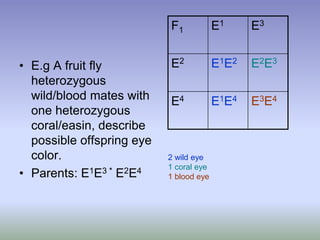
• E.g A fruit fly
heterozygous
wild/blood mates with
one heterozygous
coral/easin, describe
possible offspring eye
color.
• Parents: E1E3 * E2E4
F1 E1 E3
E2 E1E2 E2E3
E4 E1E4 E3E4
2 wild eye
1 coral eye
1 blood eye
Incomplete Dominance
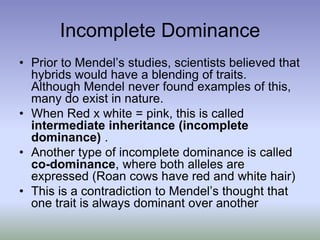
• Prior to Mendel’s studies, scientists believed that
hybrids would have a blending of traits.
Although Mendel never found examples of this,
many do exist in nature.
• When Red x white = pink, this is called
intermediate inheritance (incomplete
dominance) .
• Another type of incomplete dominance is called
co-dominance, where both alleles are
expressed (Roan cows have red and white hair)
• This is a contradiction to Mendel’s thought that
one trait is always dominant over another
Law of Incomplete Dominance
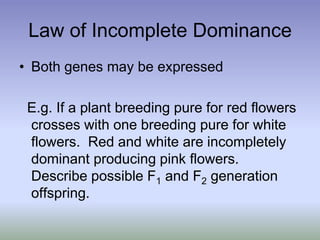
• Both genes may be expressed
E.g. If a plant breeding pure for red flowers
crosses with one breeding pure for white
flowers. Red and white are incompletely
dominant producing pink flowers.
Describe possible F1 and F2 generation
offspring.
Pure red and pure white mate (F1)
• Parents RR x WW = RW
F1 R R
W RW RW
W RW RW
Phenotype (what you see) – all pink
Pink and Pink mate (F2)
• Parents RW x RW
F1 R W
R RR RW
W RW WW
Phenotype (what you see) –
1 red
2 pink
1 white
1. If a plant breeding pure for green leaf and
pure for purple flower crosses with one
breeding pure for white leaf and pure for
white flower (green + white are
incompletely dominant producing striped
leaf and purple and white are incompletely
dominant producing mauve flowers).
Describe possible F1 and F2 generation
offspring.
F2 GP GP
WF WGPF WGPF
WF WGPF WGPF
GG PP x WW FF
Phenotype –
100% are striped leaf and mauve
flower
Genotype –
100% WGPF
G – green leaf
P - purple flower
W – white leaf
F – white flower
F2 WP WF GP GF
WP WW
PP
WW
PF
WG
PP
WG
PF
WF WW
PF
WW
FF
WG
PF
WG
FF
GP WG
PP
WG
PF
GG
PP
GG
PF
GF WG
PF
WG
FF
GG
PF
GG
FF
WG PF x WG PF
Phenotype –
1 / 16 white seed, purple flower
2 / 16 white seed, mauve flower
1 / 16 white seed, white flower
2 / 16 striped seed, purple flower
4 / 16 striped seed, mauve flower
2 / 16 striped seed, white flower
1 / 16 green seed, purple flower
2 / 16 green seed, mauve flower
1 / 16 green seed, white flower
Genotype –
1 / 16 WW PP
2 / 16 WW PF
1 / 16 WW FF
2 / 16 WG PP
4 / 16 WG PF
2 / 16 WG FF
1 / 16 GG PP
2 / 16 GG PF
1 / 16 GG FF
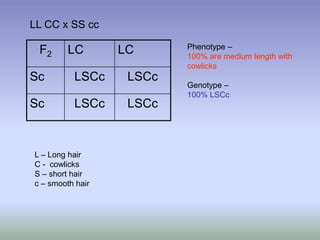
• A guinea pig breeding pure for long hair
and pure for cowlicks mates with one
breeding pure for short hair and smooth
coat (Long hair and short hair are
incompletely dominant producing medium
length hair, while cowlicks are dominant.
• Describe possible F1 and F2 generation
offspring.
F2 LC LC
Sc LSCc LSCc
Sc LSCc LSCc
LL CC x SS cc
Phenotype –
100% are medium length with
cowlicks
Genotype –
100% LSCc
L – Long hair
C - cowlicks
S – short hair
c – smooth hair
F2 LC Lc SC Sc
LC LL
CC
LL
Cc
LS
CC
LS
Cc
Lc LL
Cc
LL
cc
LS
Cc
LS
cc
SC LS
CC
LS
Cc
SS
CC
SS
Cc
Sc LS
Cc
LS
cc
SS
Cc
SS
cc
LSCc x LSCc
Phenotype –
3 / 16 long hair, cowlick
1 / 16 long hair, smooth
6 / 16 medium hair, cowlick
1 / 16 medium hair, smooth
3 / 16 short hair, cowlick
1 / 16 short hair, smooth
Genotype –
1 / 16 LL CC
2 / 16 LL Cc
1 / 16 LL cc
2 / 16 LS CC
4 / 16 LS Cc
2 / 16 LS cc
1 / 16 SS CC
1 / 16 SS cc
2 / 16 SS Cc
• A plant breeding pure tall, pure red flowers
and pure green leaf, crosses with one pure
short, pure white flower and pure yellow
leaf. Underlined traits are dominant.
Describe phenotype of possible F1 and F2
generation offspring.
• Tri-hybrid cross
F2 TRG TRG
trg Tt Rr
Gg
Tt Rr Gg
trg Tt Rr
Gg
Tt Rr Gg
TT RR GG x tt rr gg
Phenotype –
100% are tall with red flowers
and green leaves
Genotype –
100% Tt Rr Gg
T – tall , t – short
R – red flower, r – white flower
G – green leaf, g – yellow leaf
F2 TRG TRG
trg Tt Rr
Gg
Tt Rr Gg
trg Tt Rr
Gg
Tt Rr Gg
Tt Rr Gg x Tt Rr Gg Phenotype –
100% are tall
with red
flowers and
green leaves
Genotype –
100% Tt Rr Gg
T – tall , t – short
R – red flower, r – white flower
G – green leaf, g – yellow leaf

03. multiple alleles

  • 1.
  • 2.
    Multiple Alleles • Foreach trait Mendel studied, there were only two possible alleles. The dominant allele controlled the trait. However, it is possible to have more than two alleles, this is called multiple alleles. • Geneticists that study fruit flies (Drosophila melanogaster), have seen many alleles for one gene. They use numbers to indicate which allele is dominant over another.
  • 4.
    • In fruitflies the eye colors can be as follows: wild (E1E1), coral (E2E2), blood (E3E3), easin (E4E4), cherry (E5E5), apricot (E6E6), honey (E7E7), buff (E8E8), tinged (E9E9), pearl (E10E10), ivory (E11E11), white (E12E12) * The smaller number is dominant over a
  • 5.
    • E.g Afruit fly heterozygous wild/blood mates with one heterozygous coral/easin, describe possible offspring eye color. • Parents: E1E3 * E2E4 F1 E1 E3 E2 E1E2 E2E3 E4 E1E4 E3E4 2 wild eye 1 coral eye 1 blood eye
  • 6.
    Incomplete Dominance • Priorto Mendel’s studies, scientists believed that hybrids would have a blending of traits. Although Mendel never found examples of this, many do exist in nature. • When Red x white = pink, this is called intermediate inheritance (incomplete dominance) . • Another type of incomplete dominance is called co-dominance, where both alleles are expressed (Roan cows have red and white hair) • This is a contradiction to Mendel’s thought that one trait is always dominant over another
  • 7.
    Law of IncompleteDominance • Both genes may be expressed E.g. If a plant breeding pure for red flowers crosses with one breeding pure for white flowers. Red and white are incompletely dominant producing pink flowers. Describe possible F1 and F2 generation offspring.
  • 8.
    Pure red andpure white mate (F1) • Parents RR x WW = RW F1 R R W RW RW W RW RW Phenotype (what you see) – all pink
  • 9.
    Pink and Pinkmate (F2) • Parents RW x RW F1 R W R RR RW W RW WW Phenotype (what you see) – 1 red 2 pink 1 white
  • 10.
    1. If aplant breeding pure for green leaf and pure for purple flower crosses with one breeding pure for white leaf and pure for white flower (green + white are incompletely dominant producing striped leaf and purple and white are incompletely dominant producing mauve flowers). Describe possible F1 and F2 generation offspring.
  • 11.
    F2 GP GP WFWGPF WGPF WF WGPF WGPF GG PP x WW FF Phenotype – 100% are striped leaf and mauve flower Genotype – 100% WGPF G – green leaf P - purple flower W – white leaf F – white flower
  • 12.
    F2 WP WFGP GF WP WW PP WW PF WG PP WG PF WF WW PF WW FF WG PF WG FF GP WG PP WG PF GG PP GG PF GF WG PF WG FF GG PF GG FF WG PF x WG PF Phenotype – 1 / 16 white seed, purple flower 2 / 16 white seed, mauve flower 1 / 16 white seed, white flower 2 / 16 striped seed, purple flower 4 / 16 striped seed, mauve flower 2 / 16 striped seed, white flower 1 / 16 green seed, purple flower 2 / 16 green seed, mauve flower 1 / 16 green seed, white flower Genotype – 1 / 16 WW PP 2 / 16 WW PF 1 / 16 WW FF 2 / 16 WG PP 4 / 16 WG PF 2 / 16 WG FF 1 / 16 GG PP 2 / 16 GG PF 1 / 16 GG FF
  • 13.
    • A guineapig breeding pure for long hair and pure for cowlicks mates with one breeding pure for short hair and smooth coat (Long hair and short hair are incompletely dominant producing medium length hair, while cowlicks are dominant. • Describe possible F1 and F2 generation offspring.
  • 14.
    F2 LC LC ScLSCc LSCc Sc LSCc LSCc LL CC x SS cc Phenotype – 100% are medium length with cowlicks Genotype – 100% LSCc L – Long hair C - cowlicks S – short hair c – smooth hair
  • 15.
    F2 LC LcSC Sc LC LL CC LL Cc LS CC LS Cc Lc LL Cc LL cc LS Cc LS cc SC LS CC LS Cc SS CC SS Cc Sc LS Cc LS cc SS Cc SS cc LSCc x LSCc Phenotype – 3 / 16 long hair, cowlick 1 / 16 long hair, smooth 6 / 16 medium hair, cowlick 1 / 16 medium hair, smooth 3 / 16 short hair, cowlick 1 / 16 short hair, smooth Genotype – 1 / 16 LL CC 2 / 16 LL Cc 1 / 16 LL cc 2 / 16 LS CC 4 / 16 LS Cc 2 / 16 LS cc 1 / 16 SS CC 1 / 16 SS cc 2 / 16 SS Cc
  • 16.
    • A plantbreeding pure tall, pure red flowers and pure green leaf, crosses with one pure short, pure white flower and pure yellow leaf. Underlined traits are dominant. Describe phenotype of possible F1 and F2 generation offspring. • Tri-hybrid cross
  • 17.
    F2 TRG TRG trgTt Rr Gg Tt Rr Gg trg Tt Rr Gg Tt Rr Gg TT RR GG x tt rr gg Phenotype – 100% are tall with red flowers and green leaves Genotype – 100% Tt Rr Gg T – tall , t – short R – red flower, r – white flower G – green leaf, g – yellow leaf
  • 18.
    F2 TRG TRG trgTt Rr Gg Tt Rr Gg trg Tt Rr Gg Tt Rr Gg Tt Rr Gg x Tt Rr Gg Phenotype – 100% are tall with red flowers and green leaves Genotype – 100% Tt Rr Gg T – tall , t – short R – red flower, r – white flower G – green leaf, g – yellow leaf