Stat310
Conditional probability


    Hadley Wickham
Housekeeping
How many of you have a cellphone?
How many of you now have the textbook?
Office hours: after class, tomorrow 4-5pm
(location: TBA)
Mailing list: http://groups.google.com/group/
stat310
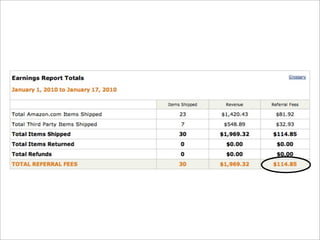
Class party earnings update
Events vs. outcomes
Events vs. outcomes
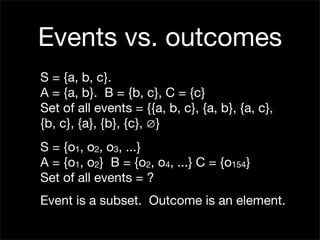
S = {a, b, c}.
A = {a, b}. B = {b, c}, C = {c}
Set of all events = {{a, b, c}, {a, b}, {a, c},
{b, c}, {a}, {b}, {c}, ∅}
S = {o1, o2, o3, ...}
A = {o1, o2} B = {o2, o4, ...} C = {o154}
Set of all events = ?
Event is a subset. Outcome is an element.
Motivation
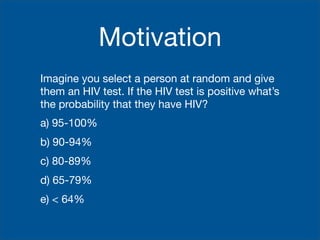
Imagine you select a person at random and give
them an HIV test. If the HIV test is positive what’s
the probability that they have HIV?
a) 95-100%
b) 90-94%
c) 80-89%
d) 65-79%
e) < 64%
It’s 50%!
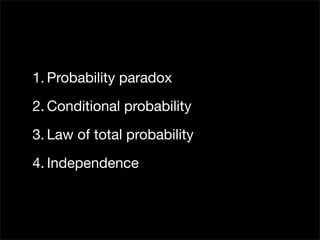
1. Probability paradox
2. Conditional probability
3. Law of total probability
4. Independence
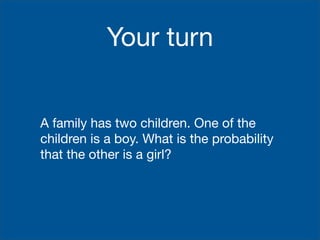
Your turn


A family has two children. One of the
children is a boy. What is the probability
that the other is a girl?
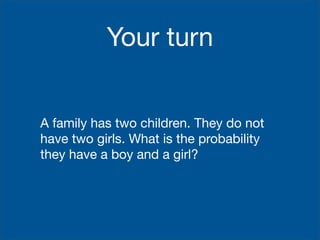
Your turn


A family has two children. They do not
have two girls. What is the probability
they have a boy and a girl?
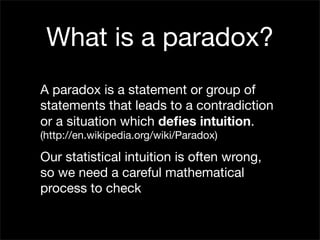
What is a paradox?
A paradox is a statement or group of
statements that leads to a contradiction
or a situation which defies intuition.
(http://en.wikipedia.org/wiki/Paradox)

Our statistical intuition is often wrong,
so we need a careful mathematical
process to check
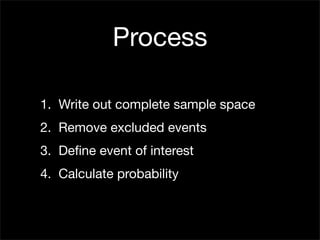
Process

1. Write out complete sample space
2. Remove excluded events
3. Define event of interest
4. Calculate probability
Conditional probability

Definition. Sample space interpretation.
Is the conditional probability a probability
function?
Multiplication “rule”
Example

             What is the probability that a randomly
             picked person out of this class is
             pregnant in a years time?
             (~1.7 million pregnancies to girls aged
             20-24, ~30 million girls)


http://www.cdc.gov/mmwr/preview/mmwrhtml/ss5806a1.htm?s_cid=ss5806a1_e#tab29
Steps
1. Define basic events.
2. Write problem as probability of
conditional event.
3. Think about the easiest way to
calculate that probability (complements?
intersection? conditioning?)
Law of total
probability
Example

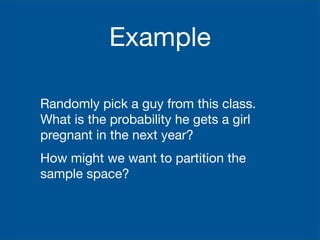
Randomly pick a guy from this class.
What is the probability he gets a girl
pregnant in the next year?
How might we want to partition the
sample space?
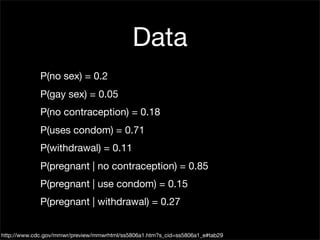
Data
             P(no sex) = 0.2
             P(gay sex) = 0.05
             P(no contraception) = 0.18
             P(uses condom) = 0.71
             P(withdrawal) = 0.11
             P(pregnant | no contraception) = 0.85
             P(pregnant | use condom) = 0.15
             P(pregnant | withdrawal) = 0.27


http://www.cdc.gov/mmwr/preview/mmwrhtml/ss5806a1.htm?s_cid=ss5806a1_e#tab29
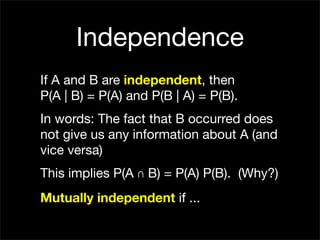
Independence
If A and B are independent, then
P(A | B) = P(A) and P(B | A) = P(B).
In words: The fact that B occurred does
not give us any information about A (and
vice versa)
This implies P(A ∩ B) = P(A) P(B). (Why?)
Mutually independent if ...
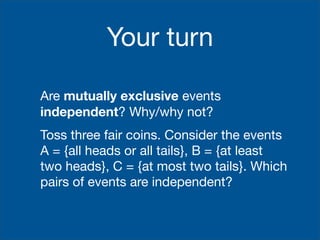
Your turn

Are mutually exclusive events
independent? Why/why not?
Toss three fair coins. Consider the events
A = {all heads or all tails}, B = {at least
two heads}, C = {at most two tails}. Which
pairs of events are independent?

03 Conditional

  • 1.
  • 2.
    Housekeeping How many ofyou have a cellphone? How many of you now have the textbook? Office hours: after class, tomorrow 4-5pm (location: TBA) Mailing list: http://groups.google.com/group/ stat310 Class party earnings update Events vs. outcomes
  • 5.
    Events vs. outcomes S= {a, b, c}. A = {a, b}. B = {b, c}, C = {c} Set of all events = {{a, b, c}, {a, b}, {a, c}, {b, c}, {a}, {b}, {c}, ∅} S = {o1, o2, o3, ...} A = {o1, o2} B = {o2, o4, ...} C = {o154} Set of all events = ? Event is a subset. Outcome is an element.
  • 6.
    Motivation Imagine you selecta person at random and give them an HIV test. If the HIV test is positive what’s the probability that they have HIV? a) 95-100% b) 90-94% c) 80-89% d) 65-79% e) < 64%
  • 7.
  • 8.
    1. Probability paradox 2.Conditional probability 3. Law of total probability 4. Independence
  • 9.
    Your turn A familyhas two children. One of the children is a boy. What is the probability that the other is a girl?
  • 10.
    Your turn A familyhas two children. They do not have two girls. What is the probability they have a boy and a girl?
  • 11.
    What is aparadox? A paradox is a statement or group of statements that leads to a contradiction or a situation which defies intuition. (http://en.wikipedia.org/wiki/Paradox) Our statistical intuition is often wrong, so we need a careful mathematical process to check
  • 12.
    Process 1. Write outcomplete sample space 2. Remove excluded events 3. Define event of interest 4. Calculate probability
  • 13.
    Conditional probability Definition. Samplespace interpretation. Is the conditional probability a probability function? Multiplication “rule”
  • 14.
    Example What is the probability that a randomly picked person out of this class is pregnant in a years time? (~1.7 million pregnancies to girls aged 20-24, ~30 million girls) http://www.cdc.gov/mmwr/preview/mmwrhtml/ss5806a1.htm?s_cid=ss5806a1_e#tab29
  • 15.
    Steps 1. Define basicevents. 2. Write problem as probability of conditional event. 3. Think about the easiest way to calculate that probability (complements? intersection? conditioning?)
  • 16.
  • 17.
    Example Randomly pick aguy from this class. What is the probability he gets a girl pregnant in the next year? How might we want to partition the sample space?
  • 18.
    Data P(no sex) = 0.2 P(gay sex) = 0.05 P(no contraception) = 0.18 P(uses condom) = 0.71 P(withdrawal) = 0.11 P(pregnant | no contraception) = 0.85 P(pregnant | use condom) = 0.15 P(pregnant | withdrawal) = 0.27 http://www.cdc.gov/mmwr/preview/mmwrhtml/ss5806a1.htm?s_cid=ss5806a1_e#tab29
  • 19.
    Independence If A andB are independent, then P(A | B) = P(A) and P(B | A) = P(B). In words: The fact that B occurred does not give us any information about A (and vice versa) This implies P(A ∩ B) = P(A) P(B). (Why?) Mutually independent if ...
  • 20.
    Your turn Are mutuallyexclusive events independent? Why/why not? Toss three fair coins. Consider the events A = {all heads or all tails}, B = {at least two heads}, C = {at most two tails}. Which pairs of events are independent?