HEALTH EFFECTS OF
TRAFFIC AIR POLLUTION: new
    findings for regulation
         Jordi Sunyer
           CREAL
          June 2010
Known adverse effects of airborne particles (PM)
on health WHO air quality guidelines - global update 2005
 - Mortality and hospital admissions in chronic obstructive pulmonary
   disease patients
 - Exacerbation of symptoms and increased use of therapy in asthma
 - Mortality and hospital admissions in cardiovascular disease patients
 - Mortality and hospital admissions in diabetes mellitus
 - Increased risk for myocardial infarction
 - Lung inflammation
 - Systemic inflammation
 - Endothelial and vascular dysfunction
 - Development of atherosclerosis
 - Increased incidence of infection
 - Respiratory cancer
Ultrafine particles promote early atherosclerosis
          and systemic oxidative stress
            Araujo et al. (Circ Research, 2008)
Southern California
Association between residential distance to busy roads
                and childhood asthma
                     1
    Asthma risk
                          RR=1.4
    s(big3dist, 3)

                     0


                                   RR=1.0
                     -1


                           0
                           0       100
                                    100     200
                                            200              300
                                                             300    400
                                                                    400      500 meters
                                                                               500

                                    Distance to busy road
                                                  big3dist


                                                                   McConnell et al, EHP2006
Novel evidence
             Traffic proximity and chronic disease
                          HEI report*

       Author                             Outomce                                  Exposure metric
Fickelstein,
Jerrett, & Sears               Cardiovascular mortality                   Distance from freeway or main
2005                           Cerebrovascular mortality                  road (50m)
Ontario, Canada
Hoffmann et al.
2009,                           Coronory Heart disease                    Living within 50m major roads
Germany
Morgenstern et al
2007 Munich,                         Asthma incidence                     Living ≤50m to major road
Germany

*Source: Health Effects Institute panel on the health effects of traffic-related air pollution. Traffic-related air
pollution: a critical review o the literature on emissions, exposure, and health effects.
New evidence
Traffic proximity and exposure


                       Beckerman et al. 2008
Particulate Matter and health effects
         Gaps of knowledge


 • What is causing health effects?

 • What are the sources of the most toxic
   agents?

 • What are the biological mechanisms of
   toxicity of agents?
Outline
• 1. Size of PMs

• 2. Coarse PM and Saharan dust

• 3. New effects early in life

• 4. Impact assesment
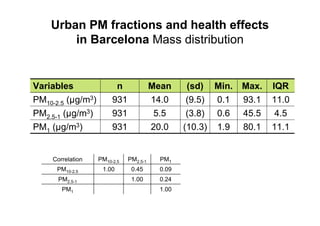
Urban PM fractions and health effects
        in Barcelona Mass distribution


Variables                n              Mean      (sd) Min.   Max.   IQR
PM10-2.5 (µg/m3)        931             14.0      (9.5) 0.1   93.1   11.0
PM2.5-1 (µg/m3)         931              5.5      (3.8) 0.6   45.5    4.5
PM1 (µg/m3)             931             20.0     (10.3) 1.9   80.1   11.1


    Correlation    PM10-2.5   PM2.5-1     PM1
      PM10-2.5      1.00       0.45       0.09
      PM2.5-1                  1.00       0.24
       PM1                                1.00
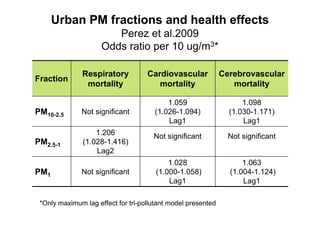
Urban PM fractions and health effects
                        Perez et al.2009
                     Odds ratio per 10 ug/m3*

               Respiratory          Cardiovascular            Cerebrovascular
Fraction
                mortality              mortality                 mortality

                                          1.059                     1.098
PM10-2.5      Not significant         (1.026-1.094)             (1.030-1.171)
                                          Lag1                      Lag1
                   1.206              Not significant           Not significant
PM2.5-1        (1.028-1.416)
                   Lag2
                                           1.028                    1.063
PM1           Not significant          (1.000-1.058)            (1.004-1.124)
                                           Lag1                     Lag1

 *Only maximum lag effect for tri-pollutant model presented
PM fraction composition in Barcelona
           Elemental carbon


             78%


                   Adapted from Perez et al. Atmos. Environ. 2008
PM fraction composition in Barcelona
                    Metals
       Combustion                 Break, tire and
                                  road erosion


                       Adapted Perez et al. Atmos. Environ. 2008
Saharan dust outbreaks in Barcelona


•Occur 7-15 times a year
•Predominant in spring and autumn
•On average, outbreak lasts 3-5 days   (Rodriguez et. al 2003)
Saharan dust and health effects
     Distribution daily mass concentrations (µg/m3)
Pollutant                     n     Mean (SD)       Min-Max     IQR
PM2.5
                All days    602     24.9 (11.7)     6.1-85.0    12.8
    Saharan dust days        90     29.9 (11.2)     9.8-65.2    12.2
    Non Saharan dust        512     24.0 (11.6)     6.1-85.0    11.5
               days
PM10-2.5
                All days    602      15.1 (9.7)     0.07-93.1   10.7
    Saharan dust days        90      16.4 (7.8)     1.6-36.7    11.0
    Non Saharan dust        512     14.9 (10.0)     0.07-93.1   10.7
               days
 R correlation PM2.5-PM10-2.5=0.34 (all days, Lag 1)
 R correlation PM2.5-PM10-2.5=0.22 (Saharan dust days, Lag 1)
Saharan dust and health effects
                     Results-Total mortality
                      Lag 1 per 10 µg/m3*

                     PM2.5              P         PM10-2.5             P
                                   interaction                    interaction

                      1.032                          1.016
All days                               --                             --
                   (1.015, 1.05)                 (0.996, 1.036)


By
Saharan               1.035                          1.013
dust days No      (1.016, 1.055)                 (0.992, 1.034)

                                    0.558                          0.052
                      1.050                          1.084
           Yes
                  (1.005, 1.097)                 (1.015, 1.158)

       *Two-pollutant model
Saharan dust and health effects
        Growing evidence
Chemical composition of PMs in Barcelona
Saharan dust days (n=9) vs Non-Saharan dust days (n=80)


    *: p <0.05 for comparision of mass adjusted concentrations
TRAFFIC, SUSCEPTIBILITY AND
   CHILDHOOD ASTHMA
   (McConell R; Env Health Persp 2006)
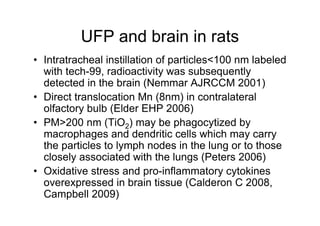
UFP and brain in rats
• Intratracheal instillation of particles<100 nm labeled
  with tech-99, radioactivity was subsequently
  detected in the brain (Nemmar AJRCCM 2001)
• Direct translocation Mn (8nm) in contralateral
  olfactory bulb (Elder EHP 2006)
• PM>200 nm (TiO2) may be phagocytized by
  macrophages and dendritic cells which may carry
  the particles to lymph nodes in the lung or to those
  closely associated with the lungs (Peters 2006)
• Oxidative stress and pro-inflammatory cytokines
  overexpressed in brain tissue (Calderon C 2008,
  Campbell 2009)
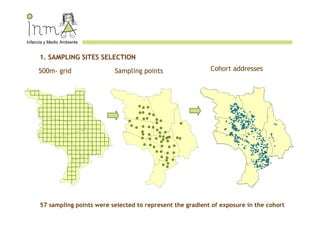
1. SAMPLING SITES SELECTION

500m- grid               Sampling points                  Cohort addresses


57 sampling points were selected to represent the gradient of exposure in the cohort
Sabadell
SPAIN
Longitudinal growth curves

                                      Head circumference                                                                     Estimated fetal weight
                                                                                                                3940
                          350
                                                                                                                3660
                          310                                                                                   3380
                                                                                                                3100


                                                                                  Estimated Fetal Weight (gr)
Head circumference (mm)


                          270                                                                                   2820
                                                                                                                2540
                          230
                                                                                                                2260
                          190                                                                                   1980
                                                                                                                1700
                          150                                                                                   1420
                                                                                                                1140
                          110
                                                                                                                860

                           70                                                                                   580
                                                                                                                300
                                                                  female   male                                                                          female   male
                           30                                                                                     20
                                10 12 14 16 18 20 22 24 26 28 30 32 34 36 38 40                                        10 12 14 16 18 20 22 24 26 28 30 32 34 36 38 40
                                               gestational age (weeks)                                                                gestational age (weeks)
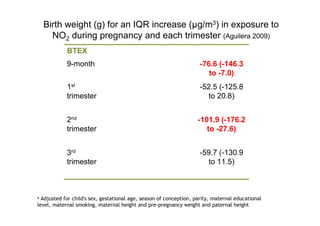
Birth weight (g) for an IQR increase (µg/m3) in exposure to
      NO2 during pregnancy and each trimester (Aguilera 2009)
            BTEX
            9-month                                                 -76.6 (-146.3
                                                                       to -7.0)
            1st                                                     -52.5 (-125.8
            trimester                                                 to 20.8)


            2nd                                                     -101.9 (-176.2
            trimester                                                  to -27.6)


            3rd                                                     -59.7 (-130.9
            trimester                                                 to 11.5)


a Adjusted for child's sex, gestational age, season of conception, parity, maternal educational
level, maternal smoking, maternal height and pre-pregnancy weight and paternal height
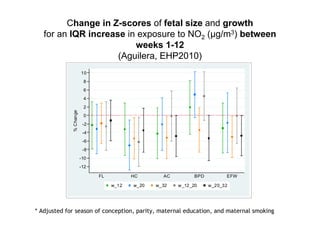
Change in Z-scores of fetal size and growth
   for an IQR increase in exposure to NO2 (µg/m3) between
                         weeks 1-12
                     (Aguilera, EHP2010)
                        10
                         8
                         6
                         4
                         2
             % Change


                         0
                         -2
                         -4
                         -6
                         -8
                        -10
                        -12

                              FL          HC       AC         BPD          EFW

                                   w_12   w_20   w_32   w_12_20     w _20_32


* Adjusted for season of conception, parity, maternal education, and maternal smoking
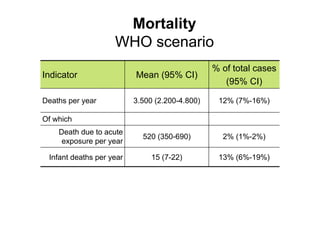
Mortality
                    WHO scenario
                                                % of total cases
Indicator                 Mean (95% CI)
                                                   (95% CI)

Deaths per year           3.500 (2.200-4.800)    12% (7%-16%)

Of which
    Death due to acute
                            520 (350-690)         2% (1%-2%)
     exposure per year

 Infant deaths per year        15 (7-22)         13% (6%-19%)
Morbidity per year
                      WHO scenario
                                                        % of total cases
        Indicator                  Mean (95% CI)
                                                           (95% CI)

Respiratory
   Chronic bronchitis adults     5.100 (550-8.500)      25% (3%-41%)

   Acute bronchitis children   31.100 (17.500-40.500)   49% (28%-64%)

     Asthma attacks adults     41.500 (21.000-60.500)   11% (6%-16%)

    Asthma attacks children    12.400 (6.400-15.200)    11% (6%-14%)

Hospitalizations

        Respiratory causes       1.150 (630-1.670))      3% (2%-5%)

     Cardiovascular causes         620 (310-930)         2% (1%-3%)
Estimating impact of traffic exposure
Population distribution from roads >10,000 vehicle/day
Conclusions: Particle Size

– In urban areas, all PM size fractions have health
  effects.

– PMs generated by both traffic-related combustion
  and non-combustion processes may increase
  mortality.

– PMs generated by both traffic-related combustion
  and non-combustion processes may share a
  common mechanism of action.
Conclusions
• Saharan dust
  – In some areas exposure to coarse PMs from
    natural sources such as Saharan dust may
    increase daily mortality.

• Early life exposure
  – Provides unexpected new effects due to air
    pollution

• Health impact assessment
  – Very likely have been underestimated
Thank you
jsunyer@creal.cat
Perera FP. Env Health Persp
        2006;114:1287-92.
• PAH in particulate mode—collected with
  individual pumps during two consecutive days in
  181 pregnant women from New York City
  (USA)— was associated to mental health
  measured at age 3 in the offspring
• Limitations: The short measurement of the
  exposure (only two days), their narrow variability
  (only low and high levels), and the poor
  specificity of PAH (the principal source is
  smoking)
Suglia SF. Am J Epidemiol
           2008;167:280-6.
• Average air pollution during childhood
  (carbon particles at home address derived
  by spatial modeling) to intelligence at age
  9 in 202 children from Boston (USA)
• Limitations: follows only 20% of those
  recruited and did not measure
  prospectively the variations in air pollution
  or the time-activity patterns of the
  participants. No adjustment for noise.
Non-combustion traffic related particles
  is an important source of health effects


Source                          % of PM10 emissions in
                                      Barcelona
Combustion                              56%
Brake erosion                               5%
Tire erosion                                3%
Pavement erosion                            6%
Soil resuspension                          30%
Total                                      100%

             Source: Departament de Mediambient i Habitatge, 2007
PM10 in Barcelona metropolitan
                area


                                                                     Media anual de PM10 indicador
                                                                     de la contaminació atmosfèrica


** Mapa elaborado por el Departamento de Medio Ambiente y Vivienda

Jordi Sunyer Deu - (Efectes sobre la salut de la contaminació per trànsit)

  • 1.
    HEALTH EFFECTS OF TRAFFICAIR POLLUTION: new findings for regulation Jordi Sunyer CREAL June 2010
  • 3.
    Known adverse effectsof airborne particles (PM) on health WHO air quality guidelines - global update 2005 - Mortality and hospital admissions in chronic obstructive pulmonary disease patients - Exacerbation of symptoms and increased use of therapy in asthma - Mortality and hospital admissions in cardiovascular disease patients - Mortality and hospital admissions in diabetes mellitus - Increased risk for myocardial infarction - Lung inflammation - Systemic inflammation - Endothelial and vascular dysfunction - Development of atherosclerosis - Increased incidence of infection - Respiratory cancer
  • 4.
    Ultrafine particles promoteearly atherosclerosis and systemic oxidative stress Araujo et al. (Circ Research, 2008)
  • 5.
    Southern California Association betweenresidential distance to busy roads and childhood asthma 1 Asthma risk RR=1.4 s(big3dist, 3) 0 RR=1.0 -1 0 0 100 100 200 200 300 300 400 400 500 meters 500 Distance to busy road big3dist McConnell et al, EHP2006
  • 6.
    Novel evidence Traffic proximity and chronic disease HEI report* Author Outomce Exposure metric Fickelstein, Jerrett, & Sears Cardiovascular mortality Distance from freeway or main 2005 Cerebrovascular mortality road (50m) Ontario, Canada Hoffmann et al. 2009, Coronory Heart disease Living within 50m major roads Germany Morgenstern et al 2007 Munich, Asthma incidence Living ≤50m to major road Germany *Source: Health Effects Institute panel on the health effects of traffic-related air pollution. Traffic-related air pollution: a critical review o the literature on emissions, exposure, and health effects.
  • 7.
    New evidence Traffic proximityand exposure Beckerman et al. 2008
  • 8.
    Particulate Matter andhealth effects Gaps of knowledge • What is causing health effects? • What are the sources of the most toxic agents? • What are the biological mechanisms of toxicity of agents?
  • 9.
    Outline • 1. Sizeof PMs • 2. Coarse PM and Saharan dust • 3. New effects early in life • 4. Impact assesment
  • 10.
    Urban PM fractionsand health effects in Barcelona Mass distribution Variables n Mean (sd) Min. Max. IQR PM10-2.5 (µg/m3) 931 14.0 (9.5) 0.1 93.1 11.0 PM2.5-1 (µg/m3) 931 5.5 (3.8) 0.6 45.5 4.5 PM1 (µg/m3) 931 20.0 (10.3) 1.9 80.1 11.1 Correlation PM10-2.5 PM2.5-1 PM1 PM10-2.5 1.00 0.45 0.09 PM2.5-1 1.00 0.24 PM1 1.00
  • 11.
    Urban PM fractionsand health effects Perez et al.2009 Odds ratio per 10 ug/m3* Respiratory Cardiovascular Cerebrovascular Fraction mortality mortality mortality 1.059 1.098 PM10-2.5 Not significant (1.026-1.094) (1.030-1.171) Lag1 Lag1 1.206 Not significant Not significant PM2.5-1 (1.028-1.416) Lag2 1.028 1.063 PM1 Not significant (1.000-1.058) (1.004-1.124) Lag1 Lag1 *Only maximum lag effect for tri-pollutant model presented
  • 12.
    PM fraction compositionin Barcelona Elemental carbon 78% Adapted from Perez et al. Atmos. Environ. 2008
  • 13.
    PM fraction compositionin Barcelona Metals Combustion Break, tire and road erosion Adapted Perez et al. Atmos. Environ. 2008
  • 14.
    Saharan dust outbreaksin Barcelona •Occur 7-15 times a year •Predominant in spring and autumn •On average, outbreak lasts 3-5 days (Rodriguez et. al 2003)
  • 15.
    Saharan dust andhealth effects Distribution daily mass concentrations (µg/m3) Pollutant n Mean (SD) Min-Max IQR PM2.5 All days 602 24.9 (11.7) 6.1-85.0 12.8 Saharan dust days 90 29.9 (11.2) 9.8-65.2 12.2 Non Saharan dust 512 24.0 (11.6) 6.1-85.0 11.5 days PM10-2.5 All days 602 15.1 (9.7) 0.07-93.1 10.7 Saharan dust days 90 16.4 (7.8) 1.6-36.7 11.0 Non Saharan dust 512 14.9 (10.0) 0.07-93.1 10.7 days R correlation PM2.5-PM10-2.5=0.34 (all days, Lag 1) R correlation PM2.5-PM10-2.5=0.22 (Saharan dust days, Lag 1)
  • 16.
    Saharan dust andhealth effects Results-Total mortality Lag 1 per 10 µg/m3* PM2.5 P PM10-2.5 P interaction interaction 1.032 1.016 All days -- -- (1.015, 1.05) (0.996, 1.036) By Saharan 1.035 1.013 dust days No (1.016, 1.055) (0.992, 1.034) 0.558 0.052 1.050 1.084 Yes (1.005, 1.097) (1.015, 1.158) *Two-pollutant model
  • 17.
    Saharan dust andhealth effects Growing evidence
  • 18.
    Chemical composition ofPMs in Barcelona Saharan dust days (n=9) vs Non-Saharan dust days (n=80) *: p <0.05 for comparision of mass adjusted concentrations
  • 19.
    TRAFFIC, SUSCEPTIBILITY AND CHILDHOOD ASTHMA (McConell R; Env Health Persp 2006)
  • 20.
    UFP and brainin rats • Intratracheal instillation of particles<100 nm labeled with tech-99, radioactivity was subsequently detected in the brain (Nemmar AJRCCM 2001) • Direct translocation Mn (8nm) in contralateral olfactory bulb (Elder EHP 2006) • PM>200 nm (TiO2) may be phagocytized by macrophages and dendritic cells which may carry the particles to lymph nodes in the lung or to those closely associated with the lungs (Peters 2006) • Oxidative stress and pro-inflammatory cytokines overexpressed in brain tissue (Calderon C 2008, Campbell 2009)
  • 21.
    1. SAMPLING SITESSELECTION 500m- grid Sampling points Cohort addresses 57 sampling points were selected to represent the gradient of exposure in the cohort
  • 22.
  • 23.
    Longitudinal growth curves Head circumference Estimated fetal weight 3940 350 3660 310 3380 3100 Estimated Fetal Weight (gr) Head circumference (mm) 270 2820 2540 230 2260 190 1980 1700 150 1420 1140 110 860 70 580 300 female male female male 30 20 10 12 14 16 18 20 22 24 26 28 30 32 34 36 38 40 10 12 14 16 18 20 22 24 26 28 30 32 34 36 38 40 gestational age (weeks) gestational age (weeks)
  • 24.
    Birth weight (g)for an IQR increase (µg/m3) in exposure to NO2 during pregnancy and each trimester (Aguilera 2009) BTEX 9-month -76.6 (-146.3 to -7.0) 1st -52.5 (-125.8 trimester to 20.8) 2nd -101.9 (-176.2 trimester to -27.6) 3rd -59.7 (-130.9 trimester to 11.5) a Adjusted for child's sex, gestational age, season of conception, parity, maternal educational level, maternal smoking, maternal height and pre-pregnancy weight and paternal height
  • 25.
    Change in Z-scoresof fetal size and growth for an IQR increase in exposure to NO2 (µg/m3) between weeks 1-12 (Aguilera, EHP2010) 10 8 6 4 2 % Change 0 -2 -4 -6 -8 -10 -12 FL HC AC BPD EFW w_12 w_20 w_32 w_12_20 w _20_32 * Adjusted for season of conception, parity, maternal education, and maternal smoking
  • 26.
    Mortality WHO scenario % of total cases Indicator Mean (95% CI) (95% CI) Deaths per year 3.500 (2.200-4.800) 12% (7%-16%) Of which Death due to acute 520 (350-690) 2% (1%-2%) exposure per year Infant deaths per year 15 (7-22) 13% (6%-19%)
  • 27.
    Morbidity per year WHO scenario % of total cases Indicator Mean (95% CI) (95% CI) Respiratory Chronic bronchitis adults 5.100 (550-8.500) 25% (3%-41%) Acute bronchitis children 31.100 (17.500-40.500) 49% (28%-64%) Asthma attacks adults 41.500 (21.000-60.500) 11% (6%-16%) Asthma attacks children 12.400 (6.400-15.200) 11% (6%-14%) Hospitalizations Respiratory causes 1.150 (630-1.670)) 3% (2%-5%) Cardiovascular causes 620 (310-930) 2% (1%-3%)
  • 28.
    Estimating impact oftraffic exposure Population distribution from roads >10,000 vehicle/day
  • 29.
    Conclusions: Particle Size –In urban areas, all PM size fractions have health effects. – PMs generated by both traffic-related combustion and non-combustion processes may increase mortality. – PMs generated by both traffic-related combustion and non-combustion processes may share a common mechanism of action.
  • 30.
    Conclusions • Saharan dust – In some areas exposure to coarse PMs from natural sources such as Saharan dust may increase daily mortality. • Early life exposure – Provides unexpected new effects due to air pollution • Health impact assessment – Very likely have been underestimated
  • 31.
  • 32.
    Perera FP. EnvHealth Persp 2006;114:1287-92. • PAH in particulate mode—collected with individual pumps during two consecutive days in 181 pregnant women from New York City (USA)— was associated to mental health measured at age 3 in the offspring • Limitations: The short measurement of the exposure (only two days), their narrow variability (only low and high levels), and the poor specificity of PAH (the principal source is smoking)
  • 33.
    Suglia SF. AmJ Epidemiol 2008;167:280-6. • Average air pollution during childhood (carbon particles at home address derived by spatial modeling) to intelligence at age 9 in 202 children from Boston (USA) • Limitations: follows only 20% of those recruited and did not measure prospectively the variations in air pollution or the time-activity patterns of the participants. No adjustment for noise.
  • 34.
    Non-combustion traffic relatedparticles is an important source of health effects Source % of PM10 emissions in Barcelona Combustion 56% Brake erosion 5% Tire erosion 3% Pavement erosion 6% Soil resuspension 30% Total 100% Source: Departament de Mediambient i Habitatge, 2007
  • 35.
    PM10 in Barcelonametropolitan area Media anual de PM10 indicador de la contaminació atmosfèrica ** Mapa elaborado por el Departamento de Medio Ambiente y Vivienda