1
Neural Networks:
Learning Process
Prof. Sven Lončarić
sven.loncaric@fer.hr
http://www.fer.hr/ipg
2
Overview of topics
l Introduction
l Error-correction learning
l Hebb learning
l Competitive learning
l Credit-assignment problem
l Supervised learning
l Reinforcement learning
l Unsupervised learning
3
Introduction
l One of the most important ANN features is ability to
learn from the environment
l ANN learns through an iterative process of synaptic
weights and threshold adaptation
l After each iteration ANN should have more
knowledge about the environment
4
Definition of learning
l Definition of learning in the ANN context:
l Learning is a process where unknown ANN parameters are
adapted through continuous process of stimulation from the
environment
l Learning is determined by the way how the change of
parameters takes place
l This definition implies the following events:
l The environment stimulates the ANN
l ANN changes due to environment
l ANN responds differently to the environment due to the
change
5
Notation
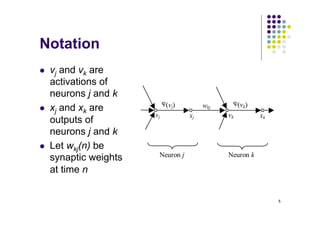
l vj and vk are
activations of
neurons j and k
l xj and xk are
outputs of
neurons j and k
l Let wkj(n) be
synaptic weights
at time n
Neuron j Neuron k
ϕ(vj) ϕ(vk)
vj vk
xj xk
wkj
6
Notation
l If in step n synaptic weight wkj(n) is changed
by Δwkj(n) we get the new weight:
wkj(n+1) = wkj(n) + Δwkj(n)
where wkj(n) and wkj(n+1) are old and new weights
between neurons k and j
l A set of rules that are solution to the learning
problem is called a learning algorithm
l There is no unique learning algorithm, but many
different learning algorithms, each with its
advantages and drawbacks
7
Algorithms and learning
paradigms
l Learning algorithms determine how weight
correction Δwkj(n) is computed
l Learning paradigms determine the relation of the
ANN to the environment
l Three basic learning paradigms are:
l Supervised learning
l Reinforcement learning
l Unsupervised learning
8
Basic learning approaches
l According to learning algorithm:
l Error-correction learning
l Hebb learning
l Competitive learning
l Boltzmann learning
l Thorndike learning
l According to learning paradigm:
• Supervised learning
• Reinforcement learning
• Unsupervised learning
9
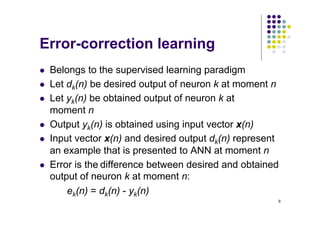
Error-correction learning
l Belongs to the supervised learning paradigm
l Let dk(n) be desired output of neuron k at moment n
l Let yk(n) be obtained output of neuron k at
moment n
l Output yk(n) is obtained using input vector x(n)
l Input vector x(n) and desired output dk(n) represent
an example that is presented to ANN at moment n
l Error is the difference between desired and obtained
output of neuron k at moment n:
ek(n) = dk(n) - yk(n)
10
Error-correction learning
l The goal of error-correction learning is to minimize
an error function derived from errors ek(n) so that the
obtained output of all neurons approximates the
desired output in some statistical sense
l A frequently used error function is mean square
error:
where E[.] is the statistical expectation operator, and
summation is for all neurons in the output layer
( )⎥
⎦
⎤
⎢
⎣
⎡
= ∑
k
k n
e
E
J 2
2
1
11
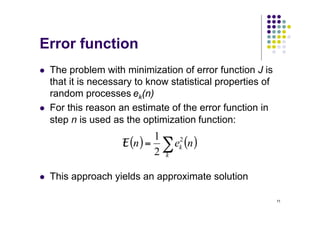
Error function
l The problem with minimization of error function J is
that it is necessary to know statistical properties of
random processes ek(n)
l For this reason an estimate of the error function in
step n is used as the optimization function:
l This approach yields an approximate solution
( ) ( )
∑
=
k
k n
e
n 2
2
1
E
12
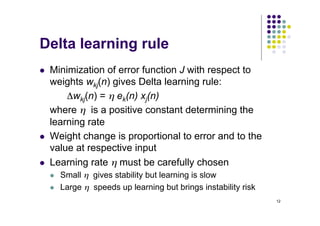
Delta learning rule
l Minimization of error function J with respect to
weights wkj(n) gives Delta learning rule:
Δwkj(n) = η ek(n) xj(n)
where η is a positive constant determining the
learning rate
l Weight change is proportional to error and to the
value at respective input
l Learning rate η must be carefully chosen
l Small η gives stability but learning is slow
l Large η speeds up learning but brings instability risk
13
Error surface
l If we draw error value J with respect to synaptic
weights we obtain a multidimensional error surface
l The learning problem consists of finding a point on
the error surface that has the smallest error (i.e. to
minimize the error)
14
Error surface
l Depending on the type of neurons there are two
possibilities:
l ANN consists of linear neurons – in this case the error
surface is a quadratic function with one global minimum
l ANN consists of nonlinear neurons – in this case the error
surface has one or more global minima and multiple local
minima
l Learning starts from an arbitrary point on the error
surface and through minimization process:
l In the first case it converges to the global minimum
l In the second case it can also converge to a local minimum
15
Hebb learning
l Hebbov principle of learning says (Hebb, The
Organization of Behavior, 1942):
l When axon of neuron A is close enough to activate neuron
B and it repeats this many times there will be metabolical
changes so that efficiency of neuron A in activating neuron
B is increased
l Extension of this principle (Stent, 1973):
l If one neuron does not influence (stimulate) another neuron
then the synapse between them becomes weaker or is
completely eliminated
16
Activity product rule
l According to Hebb principle weights are changed as
follows:
Δwkj(n) = F(yk(n), xj(n))
where yk(n) and xj(n) are the output and j-th input
of k-th neuron
l A special case of this prinicple is:
Δwkj(n) = η yk(n) xj(n)
where constant η determines the learning rate
l This rule is called activity product rule
17
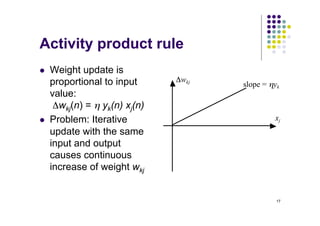
Activity product rule
l Weight update is
proportional to input
value:
Δwkj(n) = η yk(n) xj(n)
l Problem: Iterative
update with the same
input and output
causes continuous
increase of weight wkj
xj
Δwkj
slope = ηyk
18
Generalized activity product
rule
l To overcome the problem of weight saturation
modifications are porposed that are aimed at limiting
the increase of weight wkj
l Non-linear limiting factor (Kohonen, 1988):
Δwkj(n) = η yk(n) xj(n) - α yk(n) wkj(n)
where α is a positive constant
l This expression can be written as:
Δwkj(n) = α yk(n)[cxj(n) - wkj(n)]
where c = η/α
19
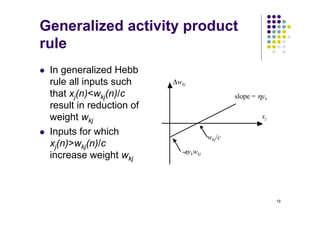
Generalized activity product
rule
l In generalized Hebb
rule all inputs such
that xj(n)<wkj(n)/c
result in reduction of
weight wkj
l Inputs for which
xj(n)>wkj(n)/c
increase weight wkj
xj
Δwkj
slope = ηyk
wkj/c
-aykwkj
20
Competitive learning
l Unsupervised learning
l Neurons compete to get opportunity to become
active
l Only one neuron can be active at any time
l Useful for classification problems
l Three elements of competitive learning:
l A set of neurons having randomly selected weights, so
they have different response for a given input
l Limited weight of each neuron
l Mechanism for competition of neurons so that only one
neuron is given at any single time (winner-takes-all neuron)
21
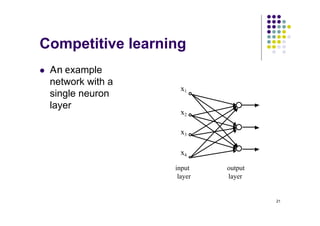
Competitive learning
l An example
network with a
single neuron
layer
input output
layer layer
x1
x2
x3
x4
22
Competitive learning
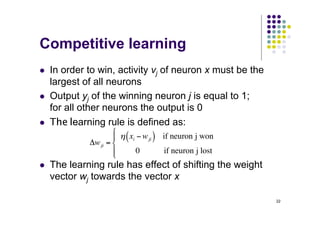
l In order to win, activity vj of neuron x must be the
largest of all neurons
l Output yj of the winning neuron j is equal to 1;
for all other neurons the output is 0
l The learning rule is defined as:
l The learning rule has effect of shifting the weight
vector wj towards the vector x
Δwji =
η xi − wji
( ) if neuron j won
0 if neuron j lost
⎧
⎨
⎪
⎩
⎪
23
An example of competitive
learning
l Let us assume that each input vector has norm
equal to one – so that the vector can be represented
as a point on N-dimensional unit sphere
l Let us assume that weight vectors have norm equal
to one – so they can also be represented as points
on unit N-dimensional sphere
l During training, input vectors are input to
the network and the winning neuron weight is
updated
24
An example of competitive
learning
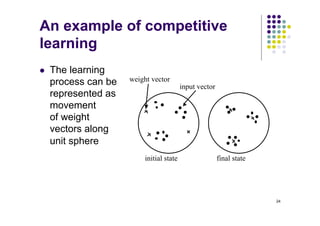
l The learning
process can be
represented as
movement
of weight
vectors along
unit sphere
initial state final state
weight vector
input vector
25
Credit-assignment problem
l Credit-assignment problem is an important issue in
learning algorithms
l Credit-assignment problem is in assignment of
credit/blame for the overall learning outcome that
depends on a large number of internal decisions of
the learning system
26
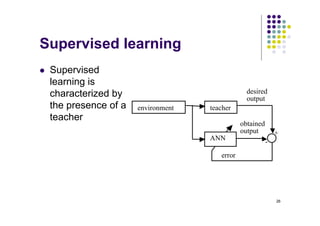
Supervised learning
l Supervised
learning is
characterized by
the presence of a
teacher
environment teacher
ANN
desired
output
error
obtained
output +
-
27
Supervised learning
l Teacher has knowledge in the form of input-output
pairs used for training
l Error is a difference between desired and obtained
output for a given input vector
l ANN parameters change under the influence of
input vectors and error values
l The learning process is repeated until ANN learns to
imitate the teacher
l After learning is completed, the teacher is no longer
required and ANN can work without supervision
28
Supervised learning
l Error function can be mean square error and it
depends on the free parameters (weights)
l Error function can be represented as a
multidimensional error surface
l Any ANN configuration is defined by weights
and corresponds to a point on the error surface
l Learning process can be viewed as movement of
the point down the error surface towards the global
minimum of the error surface
29
Supervised learning
l A point on error surface moves towards the
minimum based on gradient
l The gradient at any point on the surface is a vector
showing the direction of the steepest ascent
30
Supervised learning
l Examples of supervised learning algorithms are:
l LMS (least-mean-square) algorithm
l BP (back-propagation) algorithm
l A disadvantage of supervised learning is that
learning is not possible without a teacher
l ANN can only learn based on provided examples
31
Supervised learning
l Suppervised learning can be implemented to work
offline or online
l In offline learning:
l ANN learns first
l When learning is completed ANN does not change any
more
l In online learning:
l ANN learns during exploitation phase
l Learning is perfomed in real-time – ANN is dynamic
32
Reinforcement learning
l Reinforcement learning is of an online character
l Input-output learning mapping is learned through the
iterative process where a measure of learning
quality is maximized
l Reinforcement learning overcomes the problem of
supervised learning where training examples are
required
33
Reinforcement learning
l In reinforcement learning the teacher does not
present input-output training examples, but only
gives a grade representing a measure of learning
quality
l The grade is a scalar value (a number)
l Error function is unknown in reinforcement learning
l Learning algorithm must determine direction of
motion in the learning space through a trial-and-
error approach
34
Thorndike law of effect
l Reinforcement learning principle:
l If learning system actions result in positive grade then
there is higher likelihood that the system will take similar
actions in the future
l Otherwise the likelihood of taking such actions is reduced
35
Unsupervised learning
l In unsupervised learning there is no teacher
assisting the learning process
l Competitive learning is an example of unsupervised
learning
36
Unsupervised learning
l A layer of neurons compete for a chance to learn (to
modify their weights based on the input vector)
l In the simplest approach the winner-takes-all
strategy is used
37
Comparison of supervised and
unsupervised learning
l The most popular algorithm for supervised learning
is error-backpropagation algorithm
l A disadvantage of this algorithm is bad scaling –
learning complexity grows exponentially with the
number of layers
38
Problems
l Problem 2.1.
l Delta rule and Hebb rule are two different learning
algorithms. Describe differences between these rules.
l Problem 2.5.
l Input of value 1 is connected to the input of synaptic weight
with initial value equal to 1. Calculate weight update using:
l Basic Hebb rule with learning rate parametrom h=0.1
l modified Hebb rule with h=0.1 and c=0.1

02-LearningProcess[1].pdf

  • 1.
    1 Neural Networks: Learning Process Prof.Sven Lončarić sven.loncaric@fer.hr http://www.fer.hr/ipg
  • 2.
    2 Overview of topics lIntroduction l Error-correction learning l Hebb learning l Competitive learning l Credit-assignment problem l Supervised learning l Reinforcement learning l Unsupervised learning
  • 3.
    3 Introduction l One ofthe most important ANN features is ability to learn from the environment l ANN learns through an iterative process of synaptic weights and threshold adaptation l After each iteration ANN should have more knowledge about the environment
  • 4.
    4 Definition of learning lDefinition of learning in the ANN context: l Learning is a process where unknown ANN parameters are adapted through continuous process of stimulation from the environment l Learning is determined by the way how the change of parameters takes place l This definition implies the following events: l The environment stimulates the ANN l ANN changes due to environment l ANN responds differently to the environment due to the change
  • 5.
    5 Notation l vj andvk are activations of neurons j and k l xj and xk are outputs of neurons j and k l Let wkj(n) be synaptic weights at time n Neuron j Neuron k ϕ(vj) ϕ(vk) vj vk xj xk wkj
  • 6.
    6 Notation l If instep n synaptic weight wkj(n) is changed by Δwkj(n) we get the new weight: wkj(n+1) = wkj(n) + Δwkj(n) where wkj(n) and wkj(n+1) are old and new weights between neurons k and j l A set of rules that are solution to the learning problem is called a learning algorithm l There is no unique learning algorithm, but many different learning algorithms, each with its advantages and drawbacks
  • 7.
    7 Algorithms and learning paradigms lLearning algorithms determine how weight correction Δwkj(n) is computed l Learning paradigms determine the relation of the ANN to the environment l Three basic learning paradigms are: l Supervised learning l Reinforcement learning l Unsupervised learning
  • 8.
    8 Basic learning approaches lAccording to learning algorithm: l Error-correction learning l Hebb learning l Competitive learning l Boltzmann learning l Thorndike learning l According to learning paradigm: • Supervised learning • Reinforcement learning • Unsupervised learning
  • 9.
    9 Error-correction learning l Belongsto the supervised learning paradigm l Let dk(n) be desired output of neuron k at moment n l Let yk(n) be obtained output of neuron k at moment n l Output yk(n) is obtained using input vector x(n) l Input vector x(n) and desired output dk(n) represent an example that is presented to ANN at moment n l Error is the difference between desired and obtained output of neuron k at moment n: ek(n) = dk(n) - yk(n)
  • 10.
    10 Error-correction learning l Thegoal of error-correction learning is to minimize an error function derived from errors ek(n) so that the obtained output of all neurons approximates the desired output in some statistical sense l A frequently used error function is mean square error: where E[.] is the statistical expectation operator, and summation is for all neurons in the output layer ( )⎥ ⎦ ⎤ ⎢ ⎣ ⎡ = ∑ k k n e E J 2 2 1
  • 11.
    11 Error function l Theproblem with minimization of error function J is that it is necessary to know statistical properties of random processes ek(n) l For this reason an estimate of the error function in step n is used as the optimization function: l This approach yields an approximate solution ( ) ( ) ∑ = k k n e n 2 2 1 E
  • 12.
    12 Delta learning rule lMinimization of error function J with respect to weights wkj(n) gives Delta learning rule: Δwkj(n) = η ek(n) xj(n) where η is a positive constant determining the learning rate l Weight change is proportional to error and to the value at respective input l Learning rate η must be carefully chosen l Small η gives stability but learning is slow l Large η speeds up learning but brings instability risk
  • 13.
    13 Error surface l Ifwe draw error value J with respect to synaptic weights we obtain a multidimensional error surface l The learning problem consists of finding a point on the error surface that has the smallest error (i.e. to minimize the error)
  • 14.
    14 Error surface l Dependingon the type of neurons there are two possibilities: l ANN consists of linear neurons – in this case the error surface is a quadratic function with one global minimum l ANN consists of nonlinear neurons – in this case the error surface has one or more global minima and multiple local minima l Learning starts from an arbitrary point on the error surface and through minimization process: l In the first case it converges to the global minimum l In the second case it can also converge to a local minimum
  • 15.
    15 Hebb learning l Hebbovprinciple of learning says (Hebb, The Organization of Behavior, 1942): l When axon of neuron A is close enough to activate neuron B and it repeats this many times there will be metabolical changes so that efficiency of neuron A in activating neuron B is increased l Extension of this principle (Stent, 1973): l If one neuron does not influence (stimulate) another neuron then the synapse between them becomes weaker or is completely eliminated
  • 16.
    16 Activity product rule lAccording to Hebb principle weights are changed as follows: Δwkj(n) = F(yk(n), xj(n)) where yk(n) and xj(n) are the output and j-th input of k-th neuron l A special case of this prinicple is: Δwkj(n) = η yk(n) xj(n) where constant η determines the learning rate l This rule is called activity product rule
  • 17.
    17 Activity product rule lWeight update is proportional to input value: Δwkj(n) = η yk(n) xj(n) l Problem: Iterative update with the same input and output causes continuous increase of weight wkj xj Δwkj slope = ηyk
  • 18.
    18 Generalized activity product rule lTo overcome the problem of weight saturation modifications are porposed that are aimed at limiting the increase of weight wkj l Non-linear limiting factor (Kohonen, 1988): Δwkj(n) = η yk(n) xj(n) - α yk(n) wkj(n) where α is a positive constant l This expression can be written as: Δwkj(n) = α yk(n)[cxj(n) - wkj(n)] where c = η/α
  • 19.
    19 Generalized activity product rule lIn generalized Hebb rule all inputs such that xj(n)<wkj(n)/c result in reduction of weight wkj l Inputs for which xj(n)>wkj(n)/c increase weight wkj xj Δwkj slope = ηyk wkj/c -aykwkj
  • 20.
    20 Competitive learning l Unsupervisedlearning l Neurons compete to get opportunity to become active l Only one neuron can be active at any time l Useful for classification problems l Three elements of competitive learning: l A set of neurons having randomly selected weights, so they have different response for a given input l Limited weight of each neuron l Mechanism for competition of neurons so that only one neuron is given at any single time (winner-takes-all neuron)
  • 21.
    21 Competitive learning l Anexample network with a single neuron layer input output layer layer x1 x2 x3 x4
  • 22.
    22 Competitive learning l Inorder to win, activity vj of neuron x must be the largest of all neurons l Output yj of the winning neuron j is equal to 1; for all other neurons the output is 0 l The learning rule is defined as: l The learning rule has effect of shifting the weight vector wj towards the vector x Δwji = η xi − wji ( ) if neuron j won 0 if neuron j lost ⎧ ⎨ ⎪ ⎩ ⎪
  • 23.
    23 An example ofcompetitive learning l Let us assume that each input vector has norm equal to one – so that the vector can be represented as a point on N-dimensional unit sphere l Let us assume that weight vectors have norm equal to one – so they can also be represented as points on unit N-dimensional sphere l During training, input vectors are input to the network and the winning neuron weight is updated
  • 24.
    24 An example ofcompetitive learning l The learning process can be represented as movement of weight vectors along unit sphere initial state final state weight vector input vector
  • 25.
    25 Credit-assignment problem l Credit-assignmentproblem is an important issue in learning algorithms l Credit-assignment problem is in assignment of credit/blame for the overall learning outcome that depends on a large number of internal decisions of the learning system
  • 26.
    26 Supervised learning l Supervised learningis characterized by the presence of a teacher environment teacher ANN desired output error obtained output + -
  • 27.
    27 Supervised learning l Teacherhas knowledge in the form of input-output pairs used for training l Error is a difference between desired and obtained output for a given input vector l ANN parameters change under the influence of input vectors and error values l The learning process is repeated until ANN learns to imitate the teacher l After learning is completed, the teacher is no longer required and ANN can work without supervision
  • 28.
    28 Supervised learning l Errorfunction can be mean square error and it depends on the free parameters (weights) l Error function can be represented as a multidimensional error surface l Any ANN configuration is defined by weights and corresponds to a point on the error surface l Learning process can be viewed as movement of the point down the error surface towards the global minimum of the error surface
  • 29.
    29 Supervised learning l Apoint on error surface moves towards the minimum based on gradient l The gradient at any point on the surface is a vector showing the direction of the steepest ascent
  • 30.
    30 Supervised learning l Examplesof supervised learning algorithms are: l LMS (least-mean-square) algorithm l BP (back-propagation) algorithm l A disadvantage of supervised learning is that learning is not possible without a teacher l ANN can only learn based on provided examples
  • 31.
    31 Supervised learning l Suppervisedlearning can be implemented to work offline or online l In offline learning: l ANN learns first l When learning is completed ANN does not change any more l In online learning: l ANN learns during exploitation phase l Learning is perfomed in real-time – ANN is dynamic
  • 32.
    32 Reinforcement learning l Reinforcementlearning is of an online character l Input-output learning mapping is learned through the iterative process where a measure of learning quality is maximized l Reinforcement learning overcomes the problem of supervised learning where training examples are required
  • 33.
    33 Reinforcement learning l Inreinforcement learning the teacher does not present input-output training examples, but only gives a grade representing a measure of learning quality l The grade is a scalar value (a number) l Error function is unknown in reinforcement learning l Learning algorithm must determine direction of motion in the learning space through a trial-and- error approach
  • 34.
    34 Thorndike law ofeffect l Reinforcement learning principle: l If learning system actions result in positive grade then there is higher likelihood that the system will take similar actions in the future l Otherwise the likelihood of taking such actions is reduced
  • 35.
    35 Unsupervised learning l Inunsupervised learning there is no teacher assisting the learning process l Competitive learning is an example of unsupervised learning
  • 36.
    36 Unsupervised learning l Alayer of neurons compete for a chance to learn (to modify their weights based on the input vector) l In the simplest approach the winner-takes-all strategy is used
  • 37.
    37 Comparison of supervisedand unsupervised learning l The most popular algorithm for supervised learning is error-backpropagation algorithm l A disadvantage of this algorithm is bad scaling – learning complexity grows exponentially with the number of layers
  • 38.
    38 Problems l Problem 2.1. lDelta rule and Hebb rule are two different learning algorithms. Describe differences between these rules. l Problem 2.5. l Input of value 1 is connected to the input of synaptic weight with initial value equal to 1. Calculate weight update using: l Basic Hebb rule with learning rate parametrom h=0.1 l modified Hebb rule with h=0.1 and c=0.1