2. ALGORITHM ANALYSIS
‣computational tractability
‣ asymptotic order of growth
‣ implementing Gale–Shapley
‣ survey of common running times
SECTION 2.1
3.
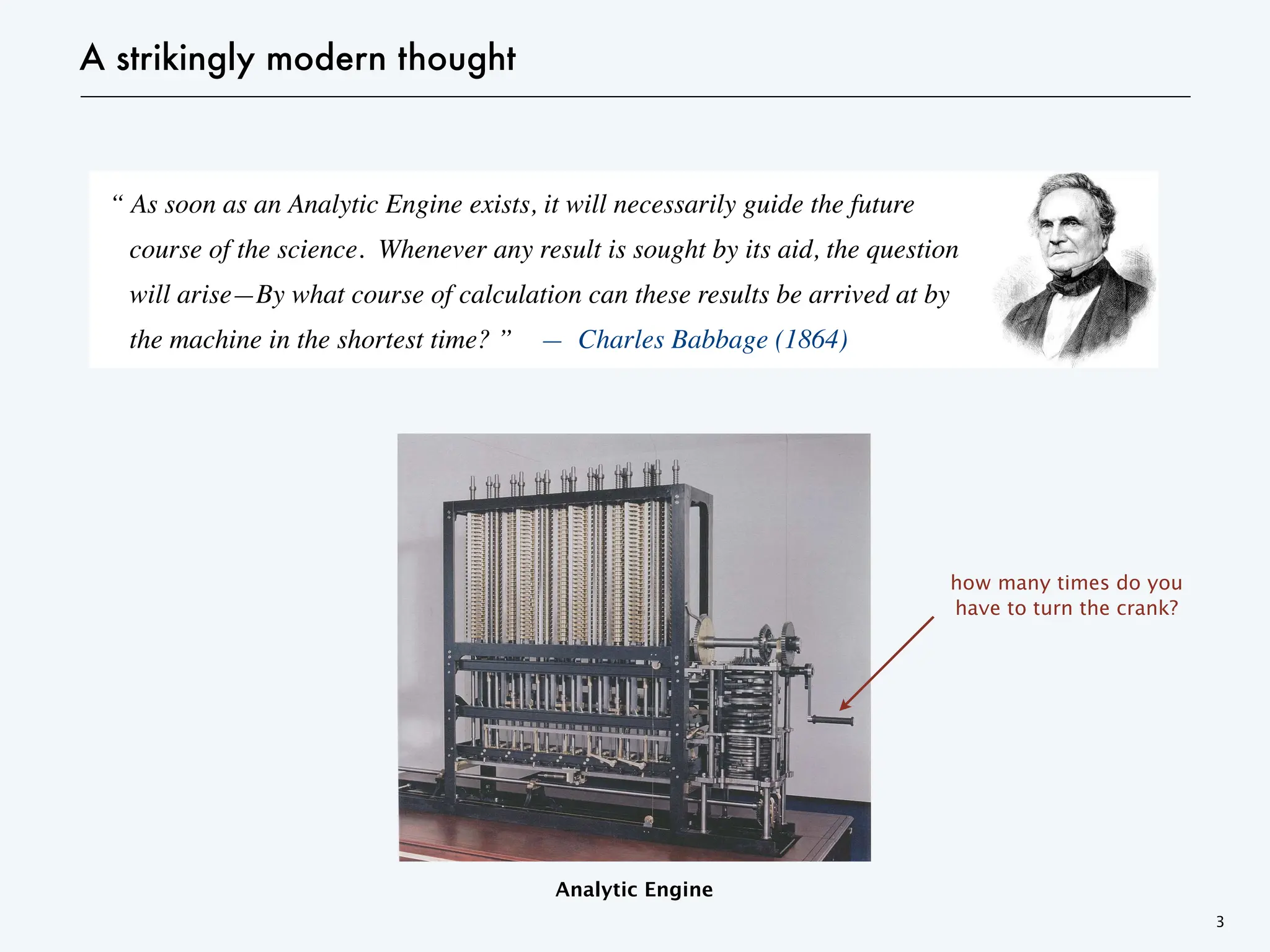
A strikingly modernthought
3
“ As soon as an Analytic Engine exists, it will necessarily guide the future
course of the science. Whenever any result is sought by its aid, the question
will arise—By what course of calculation can these results be arrived at by
the machine in the shortest time? ” — Charles Babbage (1864)
Analytic Engine
how many times do you
have to turn the crank?
4.
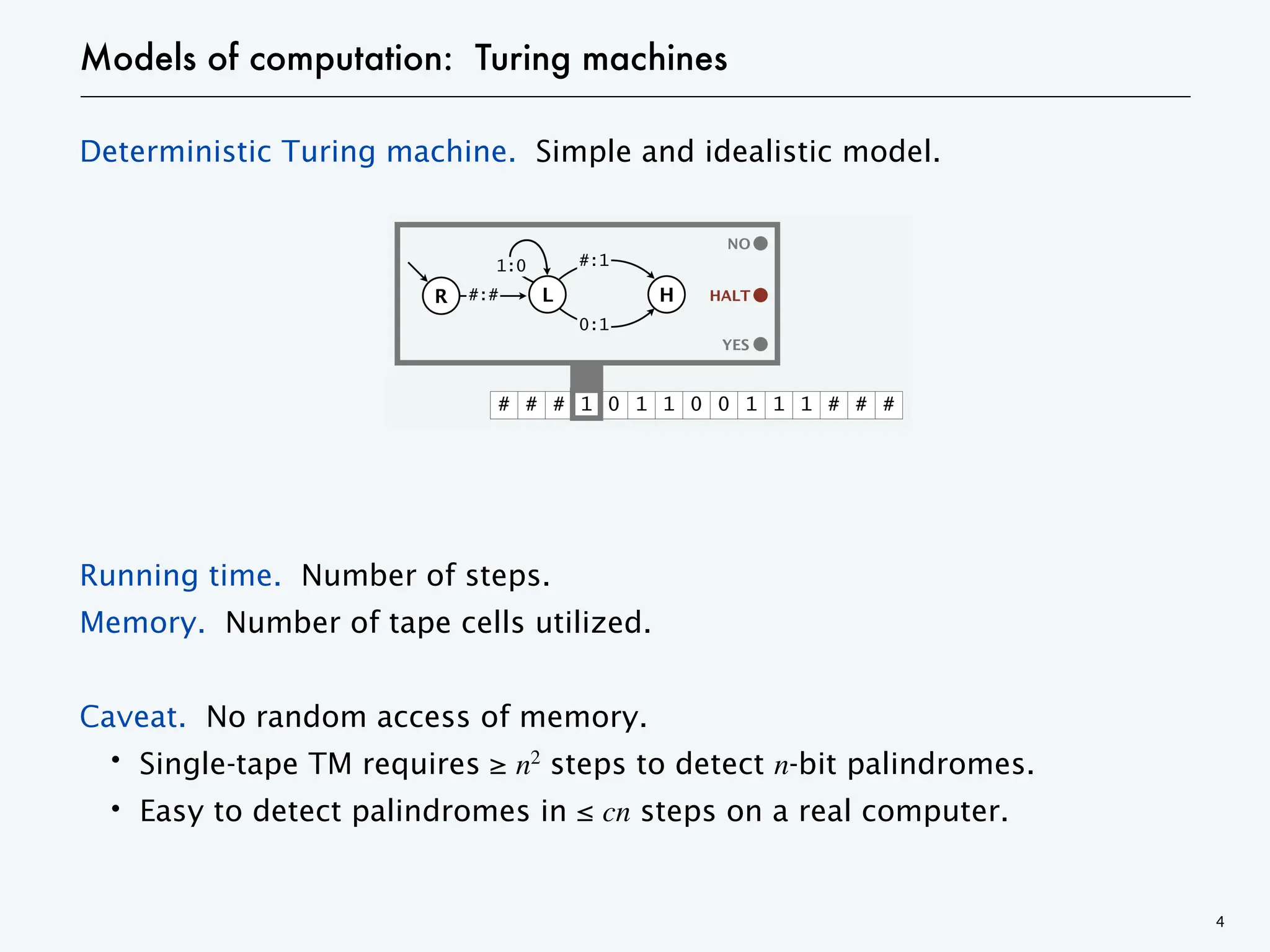
Models of computation:Turing machines
Deterministic Turing machine. Simple and idealistic model.
Running time. Number of steps.
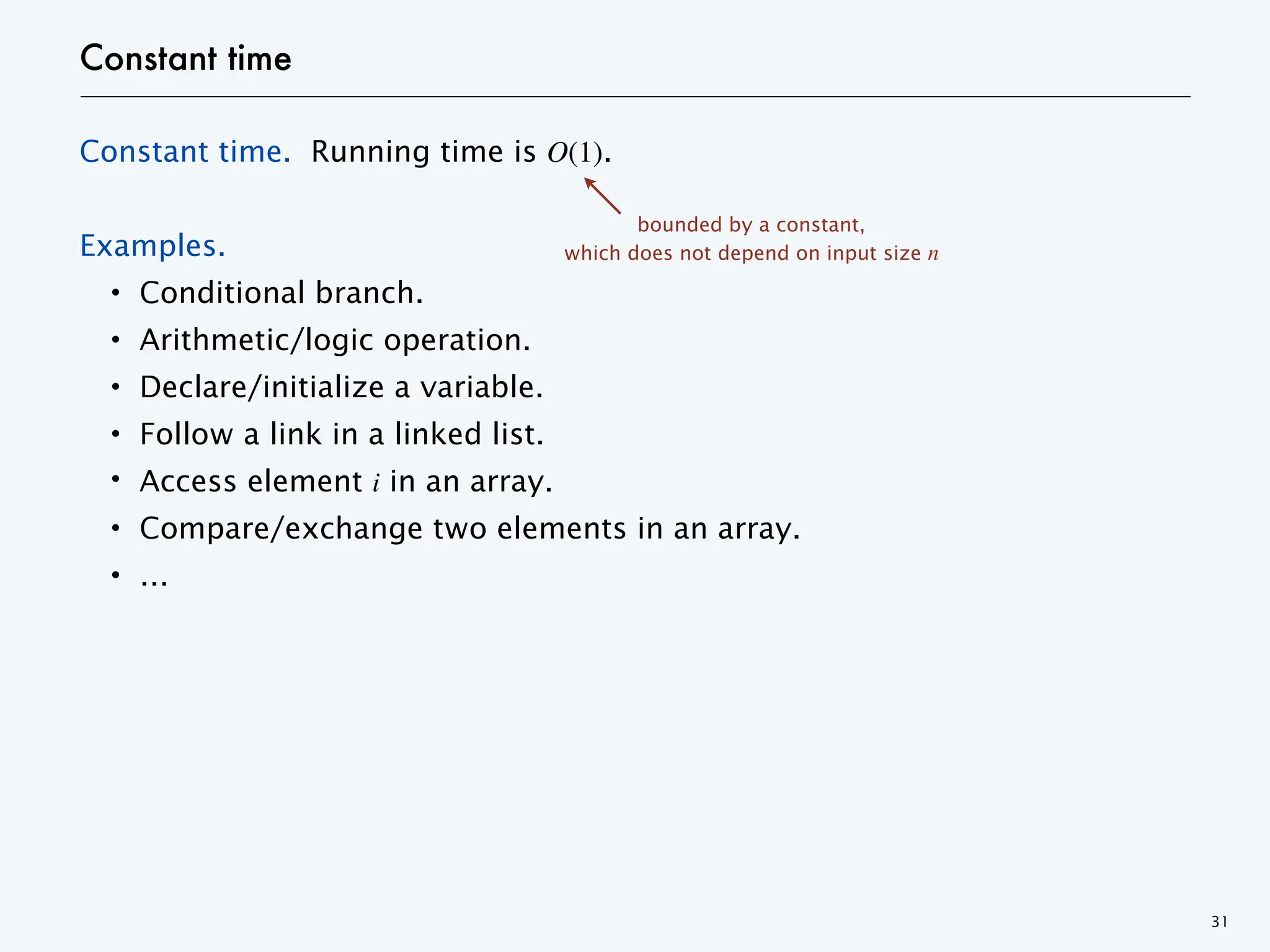
Memory. Number of tape cells utilized.
Caveat. No random access of memory.
・Single-tape TM requires ≥ n2
steps to detect n-bit palindromes.
・Easy to detect palindromes in ≤ cn steps on a real computer.
4
5.
Models of computation:word RAM
Word RAM.
・Each memory location and input/output cell stores a w-bit integer.
・Primitive operations: arithmetic/logic operations, read/write memory,
array indexing, following a pointer, conditional branch, …
Running time. Number of primitive operations.
Memory. Number of memory cells utilized.
Caveat. At times, need more refined model (e.g., multiplying n-bit integers). 5
…
input
output …
.
.
.
memory
program
assume w ≥ log2 n
i
a[i]
constant-time C-style operations
(w = 64)
6.
Brute force
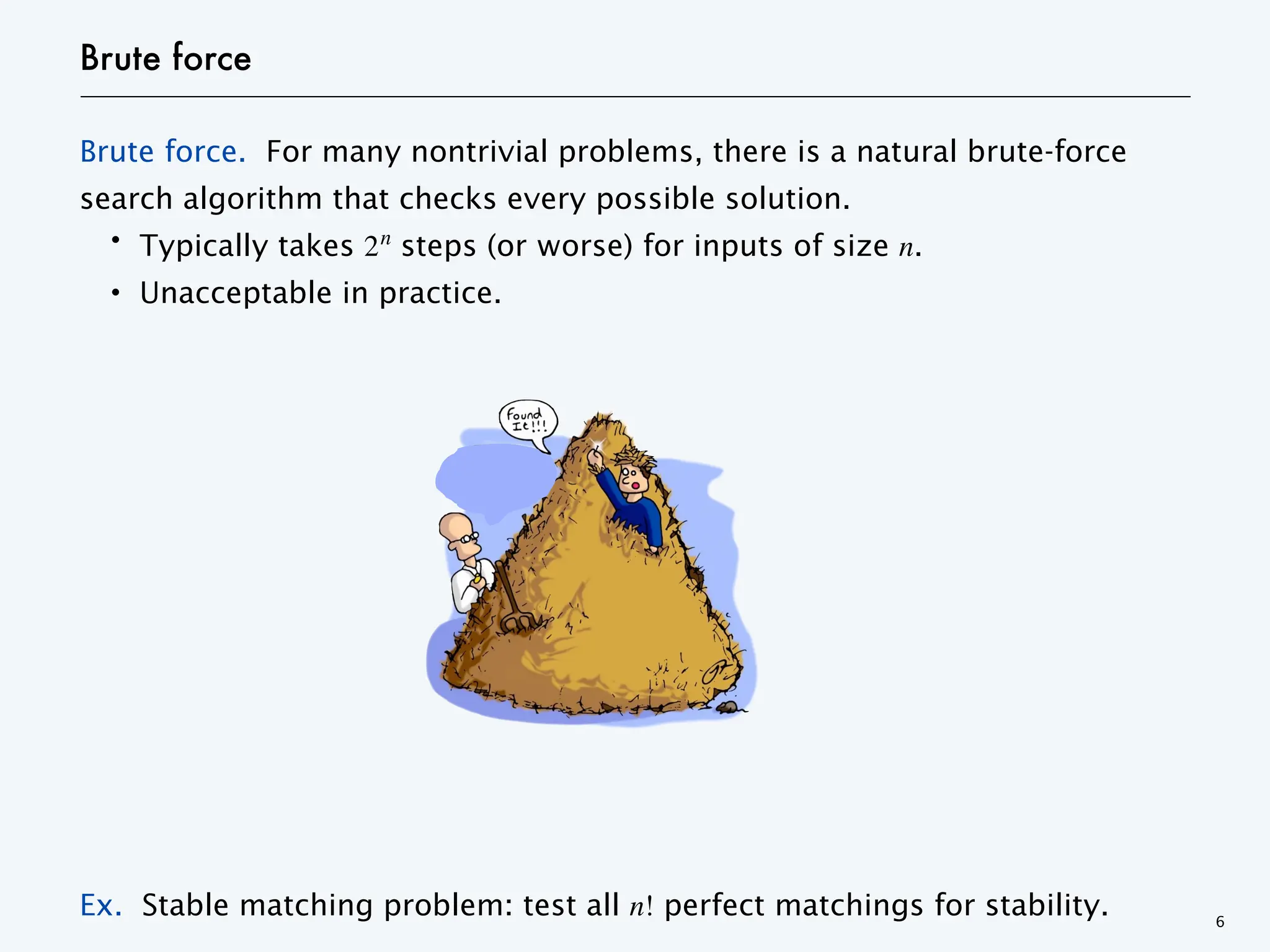
Brute force.For many nontrivial problems, there is a natural brute-force
search algorithm that checks every possible solution.
・Typically takes 2n
steps (or worse) for inputs of size n.
・Unacceptable in practice.
Ex. Stable matching problem: test all n! perfect matchings for stability. 6
7.
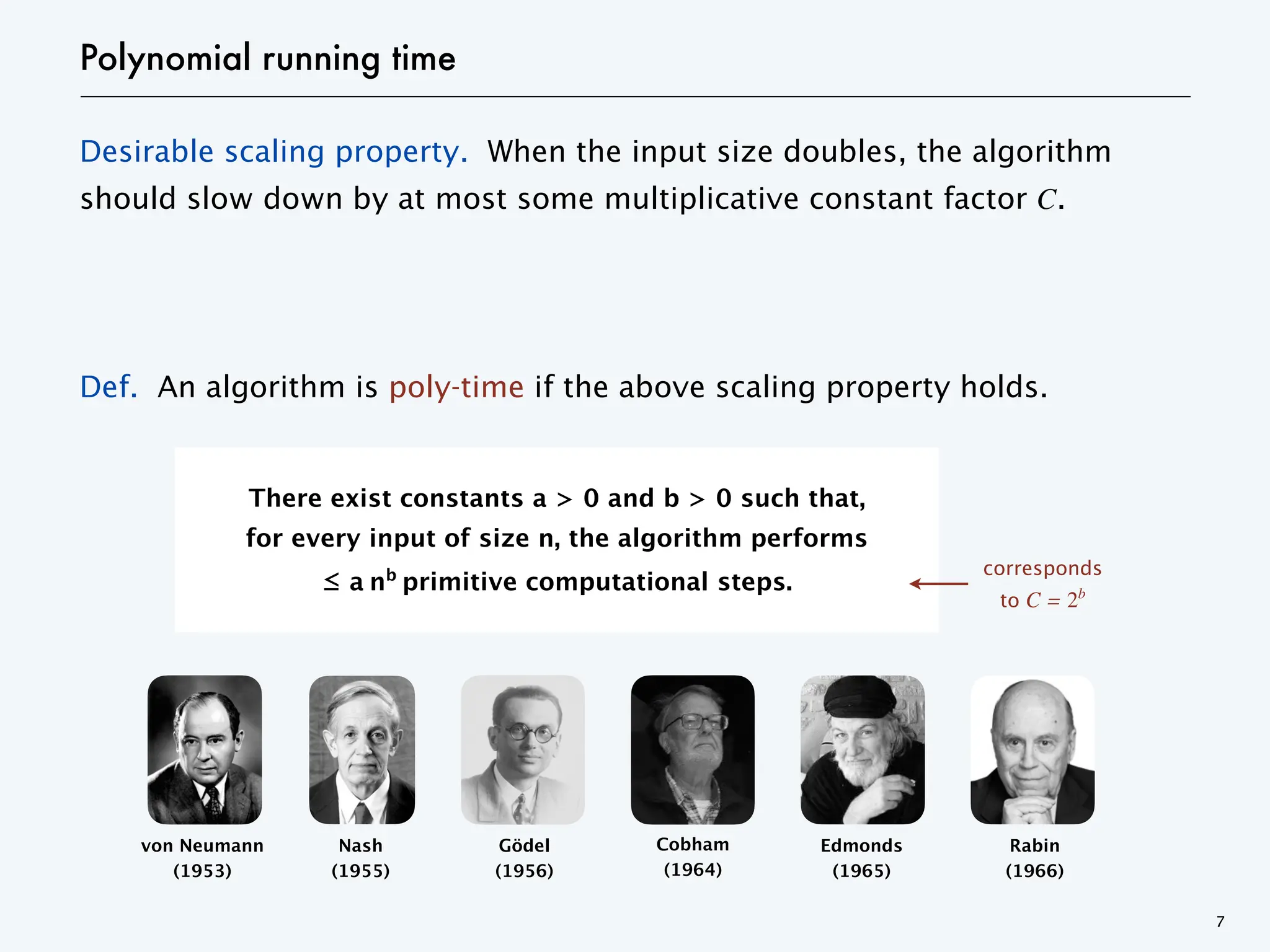
Desirable scaling property.When the input size doubles, the algorithm
should slow down by at most some multiplicative constant factor C.
Def. An algorithm is poly-time if the above scaling property holds.
von Neumann
(1953)
Gödel
(1956)
Edmonds
(1965)
Rabin
(1966)
Cobham
(1964)
Nash
(1955)
Polynomial running time
7
corresponds
to C = 2b
There exist constants a > 0 and b > 0 such that,
for every input of size n, the algorithm performs
≤ a nb
primitive computational steps.
8.
Polynomial running time
Wesay that an algorithm is efficient if it has a polynomial running time.
Theory. Definition is (relatively) insensitive to model of computation.
Practice. It really works!
・The poly-time algorithms that people develop have both
small constants and small exponents.
・Breaking through the exponential barrier of brute force typically
exposes some crucial structure of the problem.
Exceptions. Some poly-time algorithms in the wild
have galactic constants and/or huge exponents.
Q. Which would you prefer: 20 n120
or n1 + 0.02 ln n ?
8
Map graphs in polynomial time
Mikkel Thorup
Department of Computer Science, University of Copenhag
Universitetsparken 1, DK-2100 Copenhagen East, Denma
mthorup@diku.dk
Abstract
Chen,Grigni, andPapadimitriou(WADS’97andSTOC’98)
have introduced a modified notion of planarity, where two
faces are considered adjacent if they share at least one point.
The corresponding abstract graphs are called map graphs.
Chen et.al. raised the question of whether map graphs can be
recognized in polynomial time. They showed that the decision
problem is in NP and presented a polynomial time algorithm
for the special case where we allow at most 4 faces to intersect
in any point — if only 3 are allowed to intersect in a point, we
get the usual planar graphs.
Chen et.al. conjectured that map graphs can be recognized
in polynomial time, and in this paper, their conjectureis settled
affirmatively.
1. Introduction
Recently Chen, Grigni, and Papadimitriou [4, 5] suggested
the study of a modified notion of planarity. The basic frame-
Figure 1. Large
addition, the hamantach may h
touching all three corners. In
all the different types of large
showed that recognizing map
recognition can be done in sing
they conjectured that, in fact, m
polynomial time. They suppor
that if we allow at most 4 faces
resulting map graphs canbe rec
this paper, we settle the genera
a graph, we can decide in polyn
The algorithm can easily be m
Map graphs in polynomial time
Mikkel Thorup
Department of Computer Science, University of Copenhagen
Universitetsparken 1, DK-2100 Copenhagen East, Denmark
mthorup@diku.dk
Abstract
Chen,Grigni, andPapadimitriou(WADS’97andSTOC’98)
have introduced a modified notion of planarity, where two
faces are considered adjacent if they share at least one point.
The corresponding abstract graphs are called map graphs.
Chen et.al. raised the question of whether map graphs can be
recognized in polynomial time. They showed that the decision
problem is in NP and presented a polynomial time algorithm
for the special case where we allow at most 4 faces to intersect
in any point — if only 3 are allowed to intersect in a point, we
get the usual planar graphs.
Chen et.al. conjectured that map graphs can be recognized
in polynomial time, and in this paper, their conjectureis settled
affirmatively.
1. Introduction
Recently Chen, Grigni, and Papadimitriou [4, 5] suggested
Figure 1. Large cliques in maps
addition, the hamantach may have at most two triangle faces
touching all three corners. In [5] there is a classification of
all the different types of large cliques in maps. Chen et.al. [5]
showed that recognizing map graphs is in NP, hence that the
recognition can be done in singly exponential time. However,
they conjectured that, in fact, map graphs can be recognized in
polynomial time. They supported their conjecture by showing
that if we allow at most 4 faces to meet in any single point, the
resulting map graphs canbe recognizedin polynomial time. In
this paper, we settle the general conjecture, showing that given
n120
9.
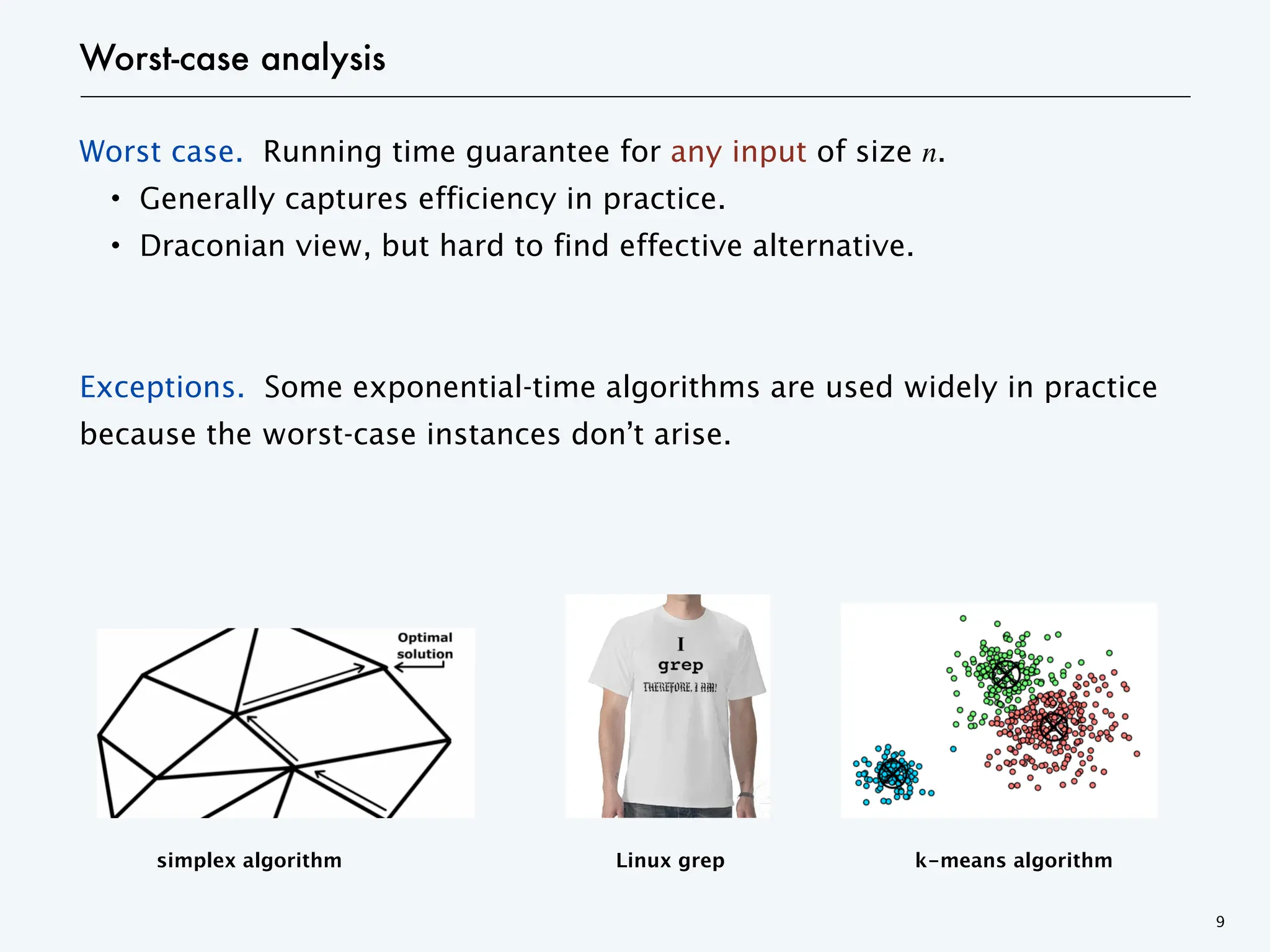
Worst-case analysis
Worst case.Running time guarantee for any input of size n.
・Generally captures efficiency in practice.
・Draconian view, but hard to find effective alternative.
Exceptions. Some exponential-time algorithms are used widely in practice
because the worst-case instances don’t arise.
9
simplex algorithm Linux grep k-means algorithm
10.
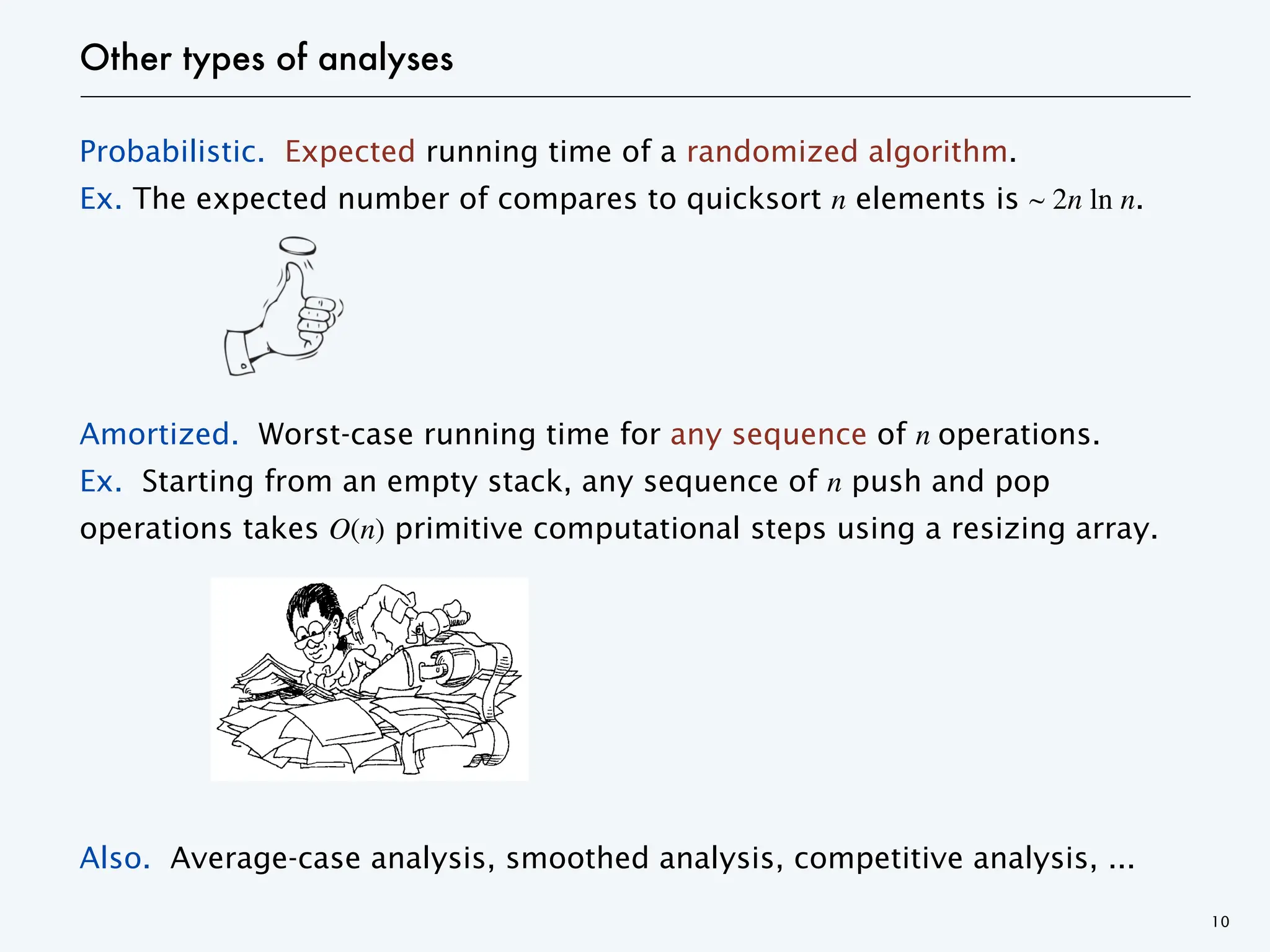
Other types ofanalyses
Probabilistic. Expected running time of a randomized algorithm.
Ex. The expected number of compares to quicksort n elements is ~ 2n ln n.
Amortized. Worst-case running time for any sequence of n operations.
Ex. Starting from an empty stack, any sequence of n push and pop
operations takes O(n) primitive computational steps using a resizing array.
Also. Average-case analysis, smoothed analysis, competitive analysis, ...
10
11.
2. ALGORITHM ANALYSIS
‣computational tractability
‣ asymptotic order of growth
‣ implementing Gale–Shapley
‣ survey of common running times
SECTION 2.2
12.
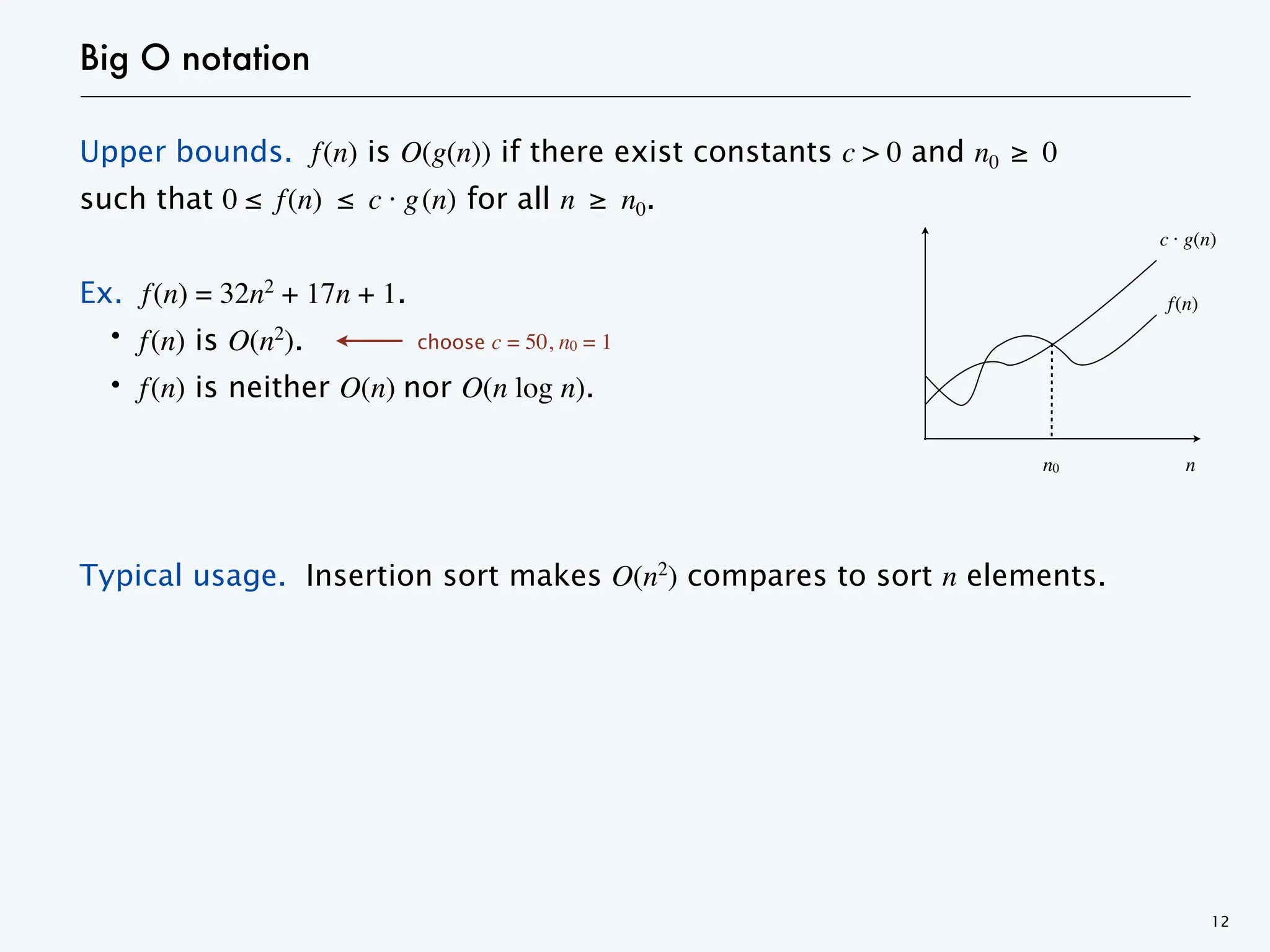
Big O notation
Upperbounds. f(n) is O(g(n)) if there exist constants c > 0 and n0 ≥ 0
such that 0 ≤ f(n) ≤ c · g(n) for all n ≥ n0.
Ex. f(n) = 32n2
+ 17n + 1.
・f(n) is O(n2
).
・f(n) is neither O(n) nor O(n log n).
Typical usage. Insertion sort makes O(n2
) compares to sort n elements.
12
choose c = 50, n0 = 1
c · g(n)
n
n0
f(n)
13.
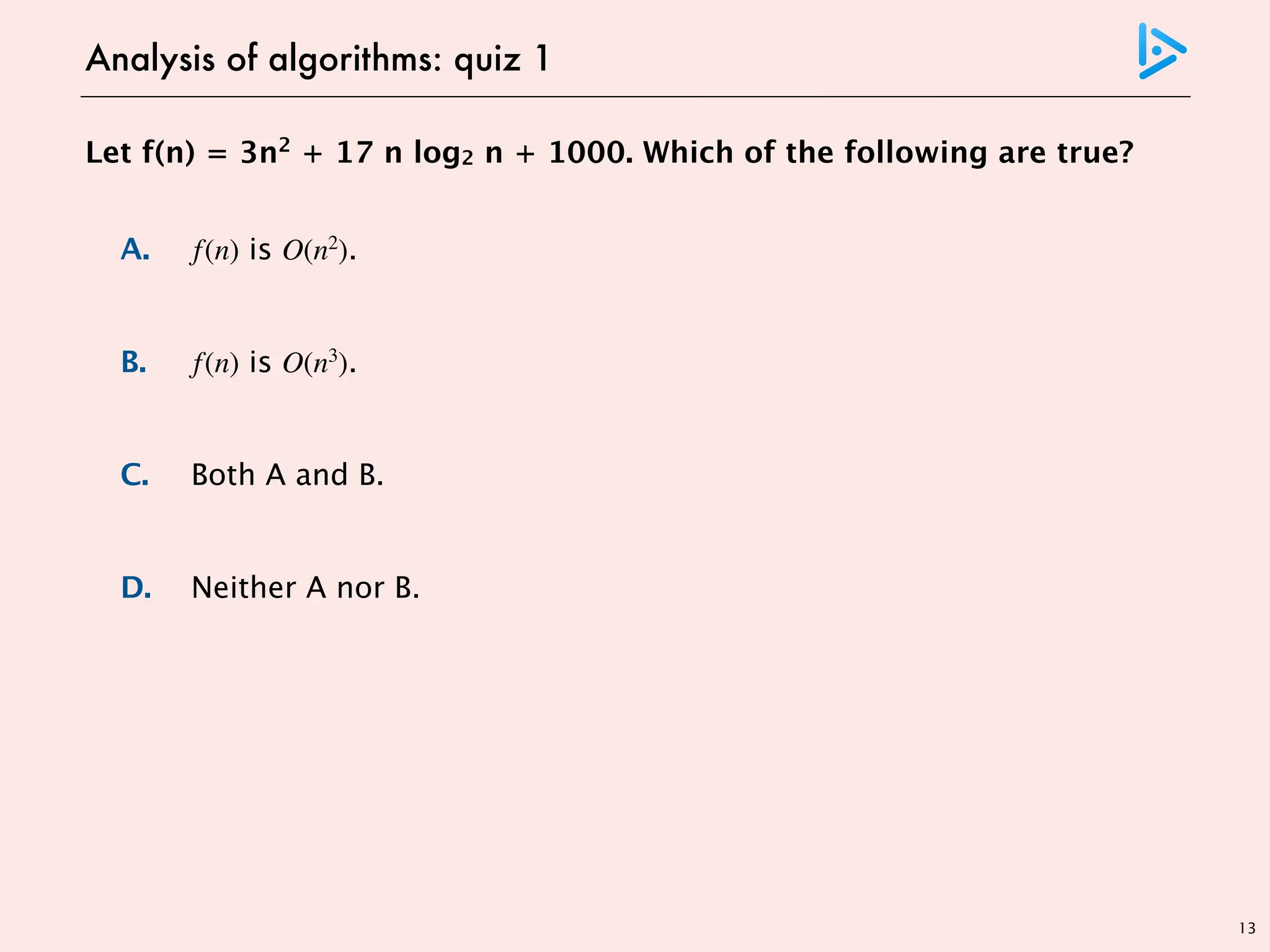
13
Let f(n) =3n2
+ 17 n log2 n + 1000. Which of the following are true?
A. f(n) is O(n2
).
B. f(n) is O(n3
).
C. Both A and B.
D. Neither A nor B.
Analysis of algorithms: quiz 1
choose c = 1020, n0 = 1
choose c = 1020, n0 = 1
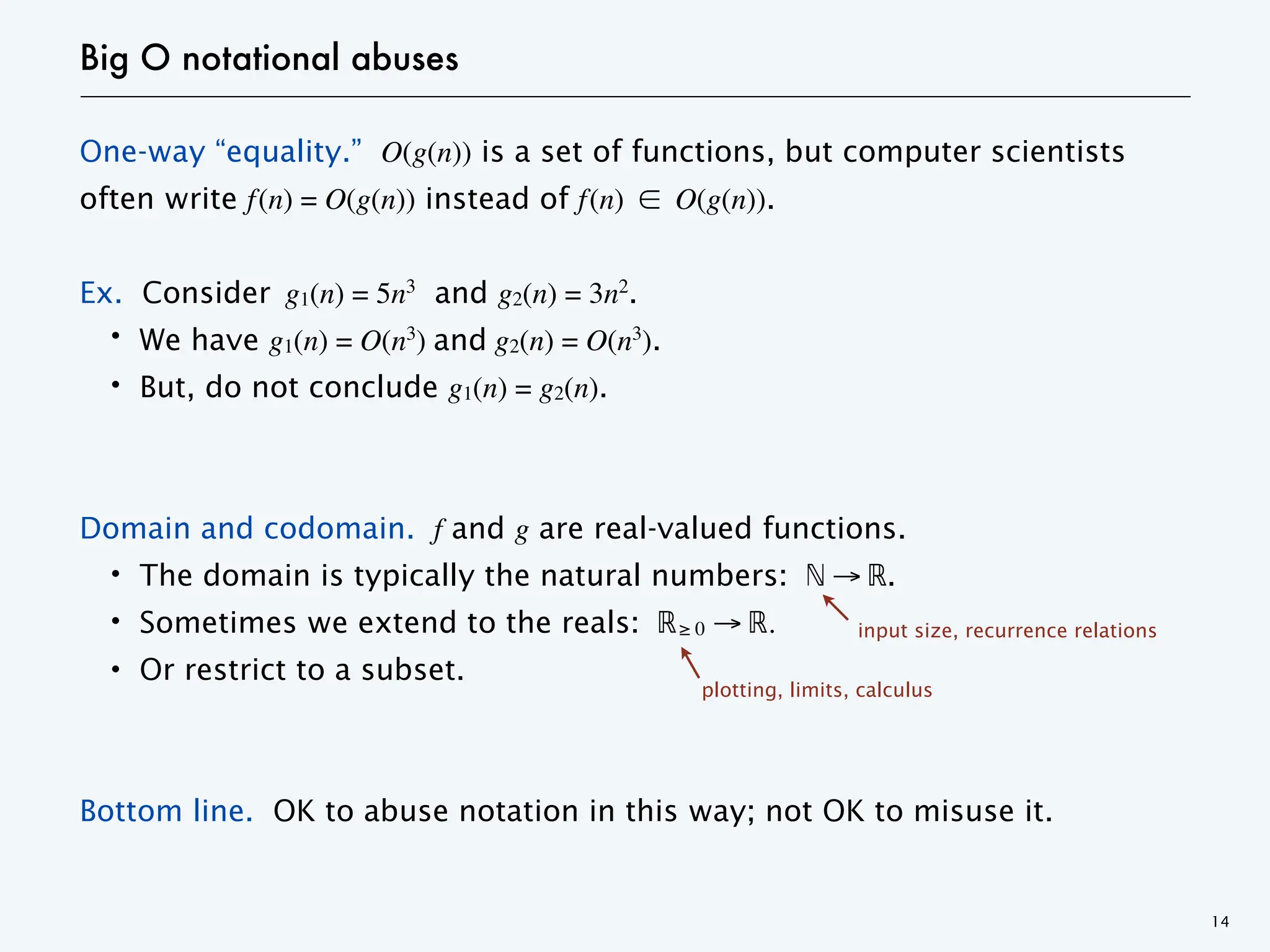
14.
Big O notationalabuses
One-way “equality.” O(g(n)) is a set of functions, but computer scientists
often write f(n) = O(g(n)) instead of f(n) ∈ O(g(n)).
Ex. Consider g1(n) = 5n3
and g2(n) = 3n2
.
・We have g1(n) = O(n3
) and g2(n) = O(n3
).
・But, do not conclude g1(n) = g2(n).
Domain and codomain. f and g are real-valued functions.
・The domain is typically the natural numbers: ℕ → ℝ.
・Sometimes we extend to the reals: ℝ≥ 0 → ℝ.
・Or restrict to a subset.
Bottom line. OK to abuse notation in this way; not OK to misuse it.
14
plotting, limits, calculus
input size, recurrence relations
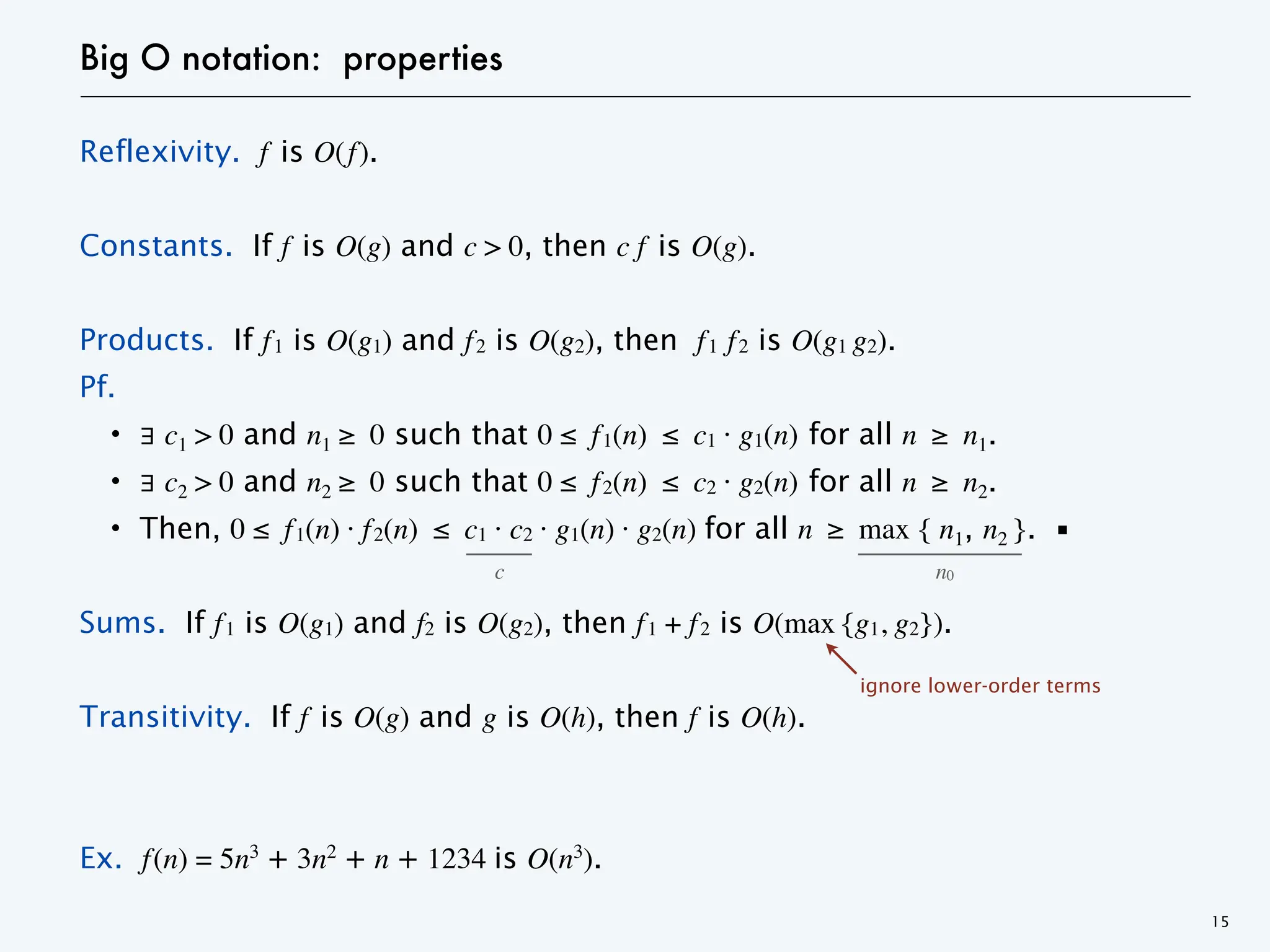
15.
Big O notation:properties
Reflexivity. f is O(f).
Constants. If f is O(g) and c > 0, then c f is O(g).
Products. If f1 is O(g1) and f2 is O(g2), then f1 f2 is O(g1 g2).
Pf.
・∃ c1 > 0 and n1 ≥ 0 such that 0 ≤ f1(n) ≤ c1 · g1(n) for all n ≥ n1.
・∃ c2 > 0 and n2 ≥ 0 such that 0 ≤ f2(n) ≤ c2 · g2(n) for all n ≥ n2.
・Then, 0 ≤ f1(n) · f2(n) ≤ c1 · c2 · g1(n) · g2(n) for all n ≥ max { n1, n2 }. ▪
Sums. If f1 is O(g1) and f2 is O(g2), then f1 + f2 is O(max {g1, g2}).
Transitivity. If f is O(g) and g is O(h), then f is O(h).
Ex. f(n) = 5n3
+ 3n2
+ n + 1234 is O(n3
).
15
c n0
ignore lower-order terms
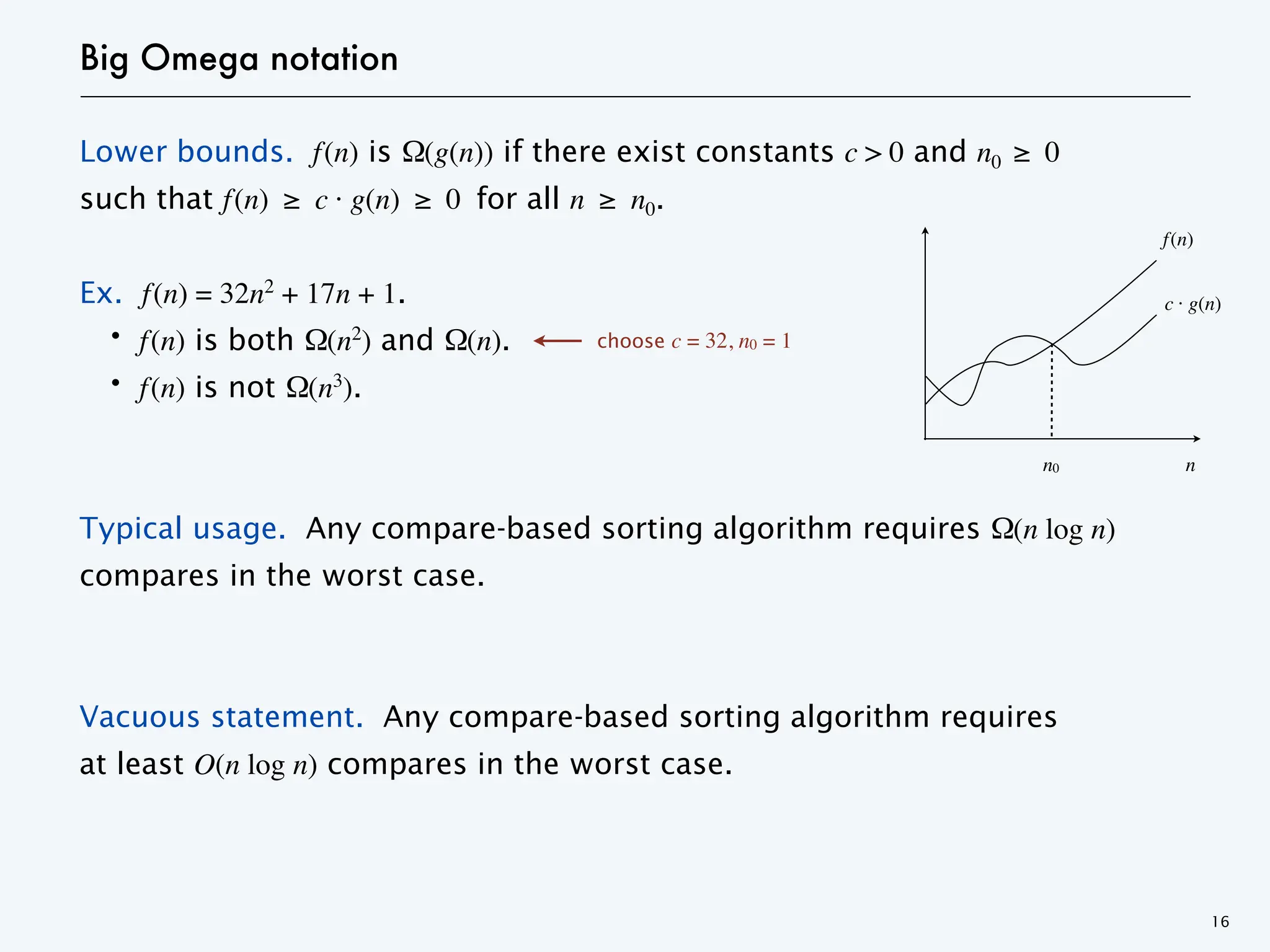
16.
Big Omega notation
Lowerbounds. f(n) is Ω(g(n)) if there exist constants c > 0 and n0 ≥ 0
such that f(n) ≥ c · g(n) ≥ 0 for all n ≥ n0.
Ex. f(n) = 32n2
+ 17n + 1.
・f(n) is both Ω(n2
) and Ω(n).
・f(n) is not Ω(n3
).
Typical usage. Any compare-based sorting algorithm requires Ω(n log n)
compares in the worst case.
Vacuous statement. Any compare-based sorting algorithm requires
at least O(n log n) compares in the worst case.
16
choose c = 32, n0 = 1
f(n)
n
n0
c · g(n)
17.
17
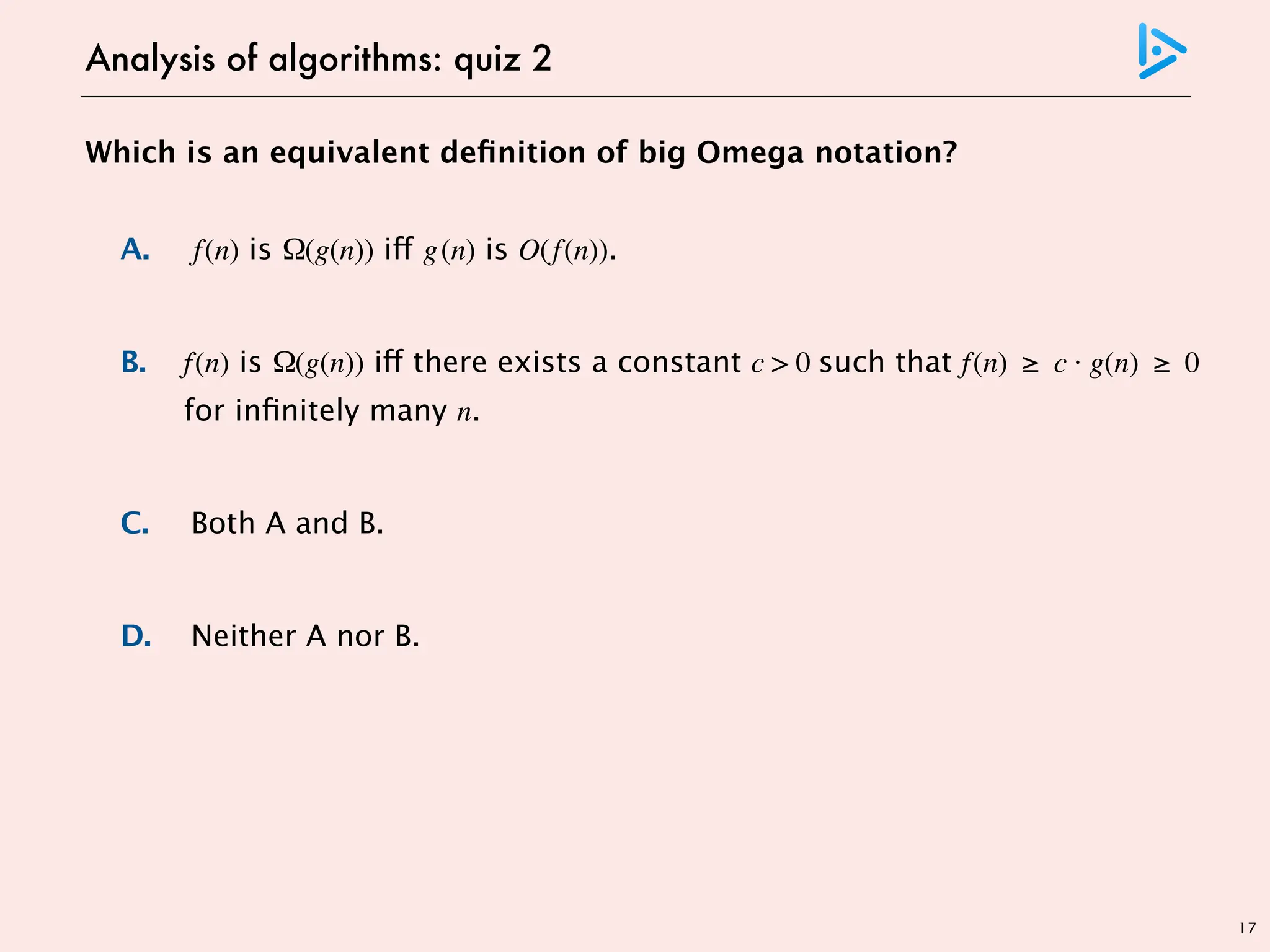
Which is anequivalent definition of big Omega notation?
A. f(n) is Ω(g(n)) iff g(n) is O(f(n)).
B. f(n) is Ω(g(n)) iff there exists a constant c > 0 such that f(n) ≥ c · g(n) ≥ 0
for infinitely many n.
C. Both A and B.
D. Neither A nor B.
Analysis of algorithms: quiz 2
18.
18
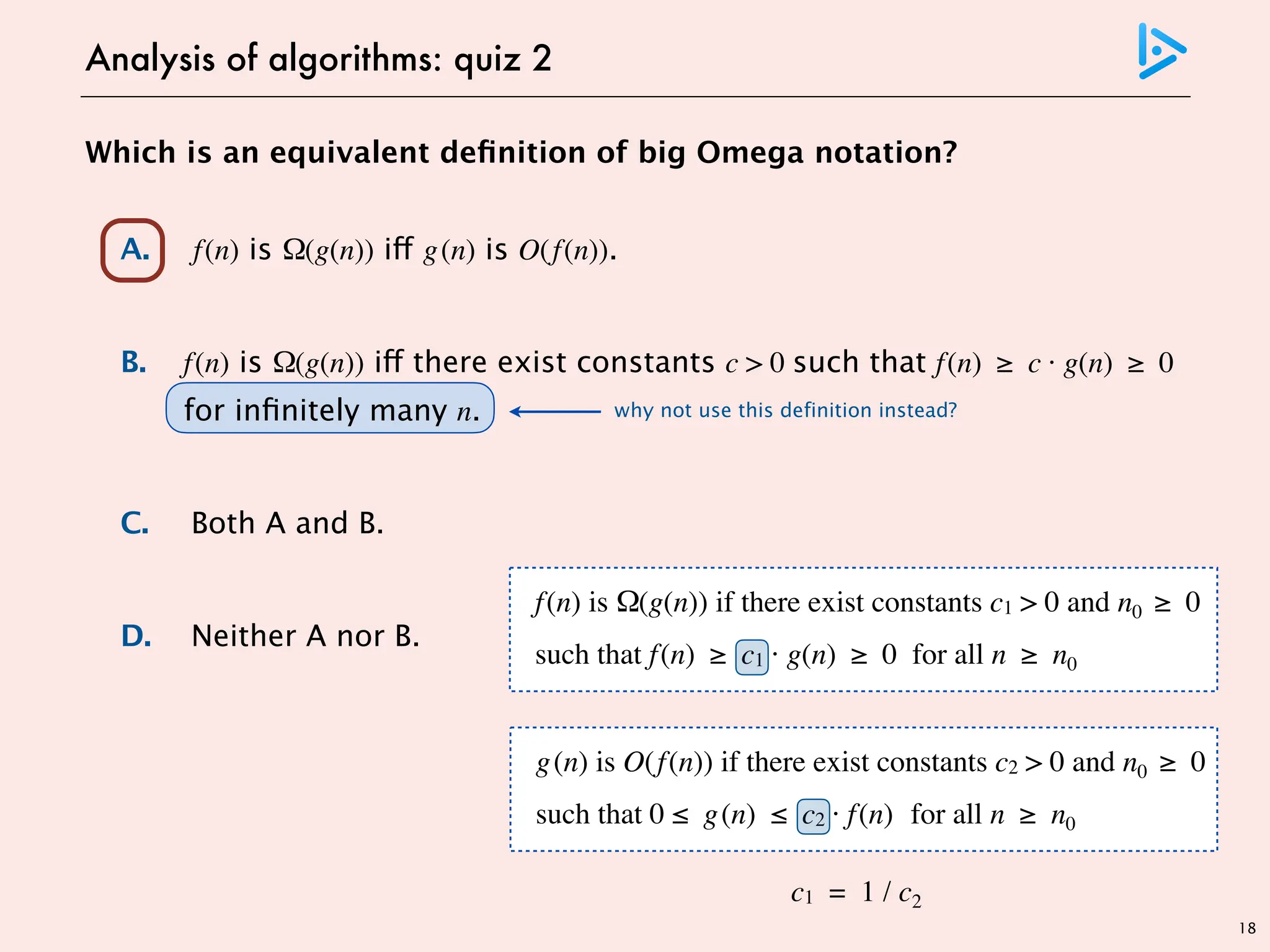
Which is anequivalent definition of big Omega notation?
A. f(n) is Ω(g(n)) iff g(n) is O(f(n)).
B. f(n) is Ω(g(n)) iff there exist constants c > 0 such that f(n) ≥ c · g(n) ≥ 0
for infinitely many n.
C. Both A and B.
D. Neither A nor B.
Analysis of algorithms: quiz 2
why not use this definition instead?
g(n) is O(f(n)) if there exist constants c2 > 0 and n0 ≥ 0
such that 0 ≤ g(n) ≤ c2 · f(n) for all n ≥ n0
f(n) is Ω(g(n)) if there exist constants c1 > 0 and n0 ≥ 0
such that f(n) ≥ c1 · g(n) ≥ 0 for all n ≥ n0
c1 = 1 / c2
19.
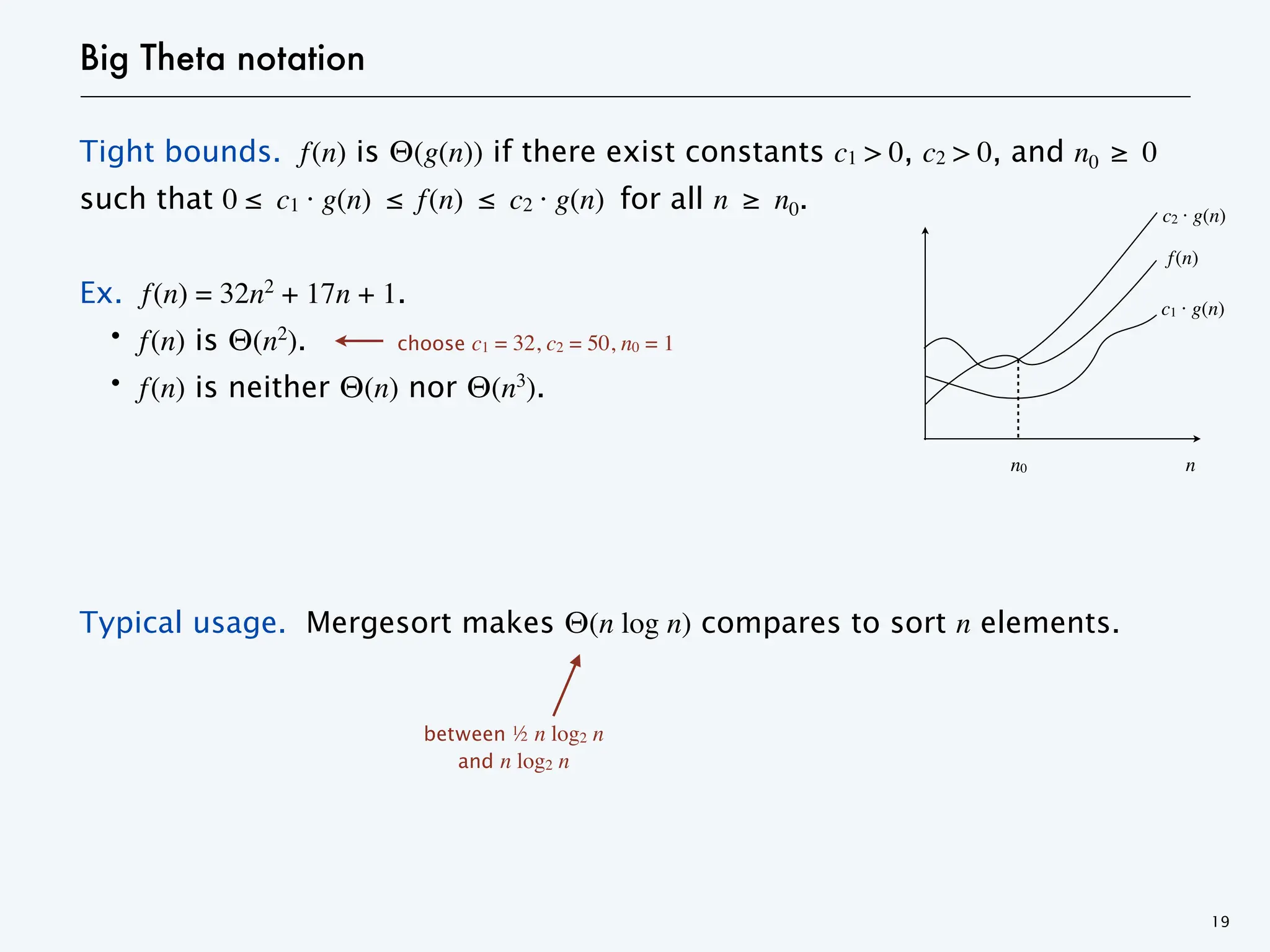
Big Theta notation
Tightbounds. f(n) is Θ(g(n)) if there exist constants c1 > 0, c2 > 0, and n0 ≥ 0
such that 0 ≤ c1 · g(n) ≤ f(n) ≤ c2 · g(n) for all n ≥ n0.
Ex. f(n) = 32n2
+ 17n + 1.
・f(n) is Θ(n2
).
・f(n) is neither Θ(n) nor Θ(n3
).
Typical usage. Mergesort makes Θ(n log n) compares to sort n elements.
19
choose c1 = 32, c2 = 50, n0 = 1
f(n)
n
n0
c1 · g(n)
c2 · g(n)
between ½ n log2 n
and n log2 n
20.
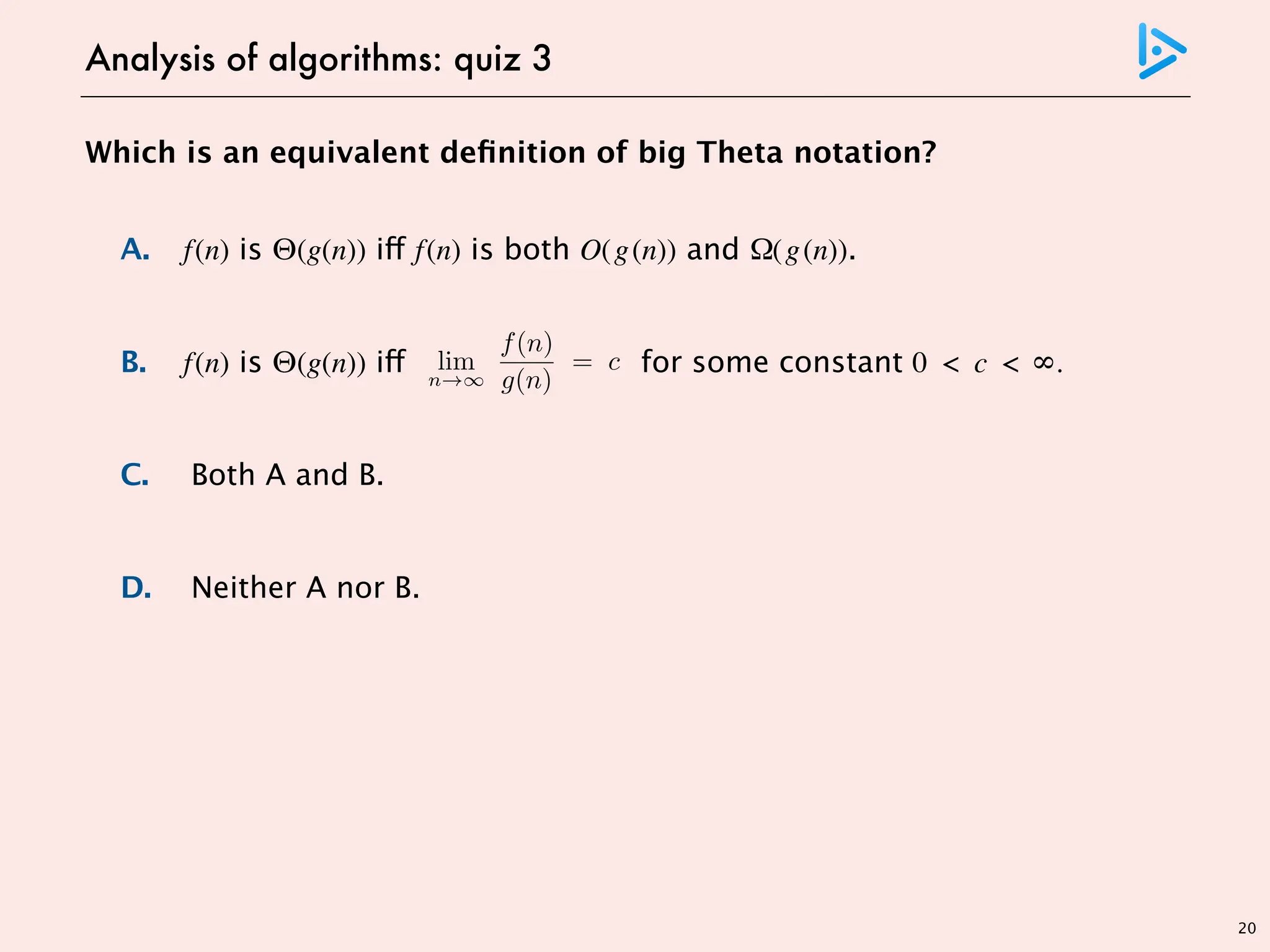
Which is anequivalent definition of big Theta notation?
A. f(n) is Θ(g(n)) iff f(n) is both O(g(n)) and Ω(g(n)).
B. f(n) is Θ(g(n)) iff for some constant 0 < c < ∞.
C. Both A and B.
D. Neither A nor B.
20
Analysis of algorithms: quiz 3
lim
n
f(n)
g(n)
= c > 0
f(n) =
2n B7 n Bb 2p2M
3n B7 n Bb Q//
g(n) = n
f(n) is O(n) but limit does not exist
counterexample
21.
Asymptotic bounds andlimits
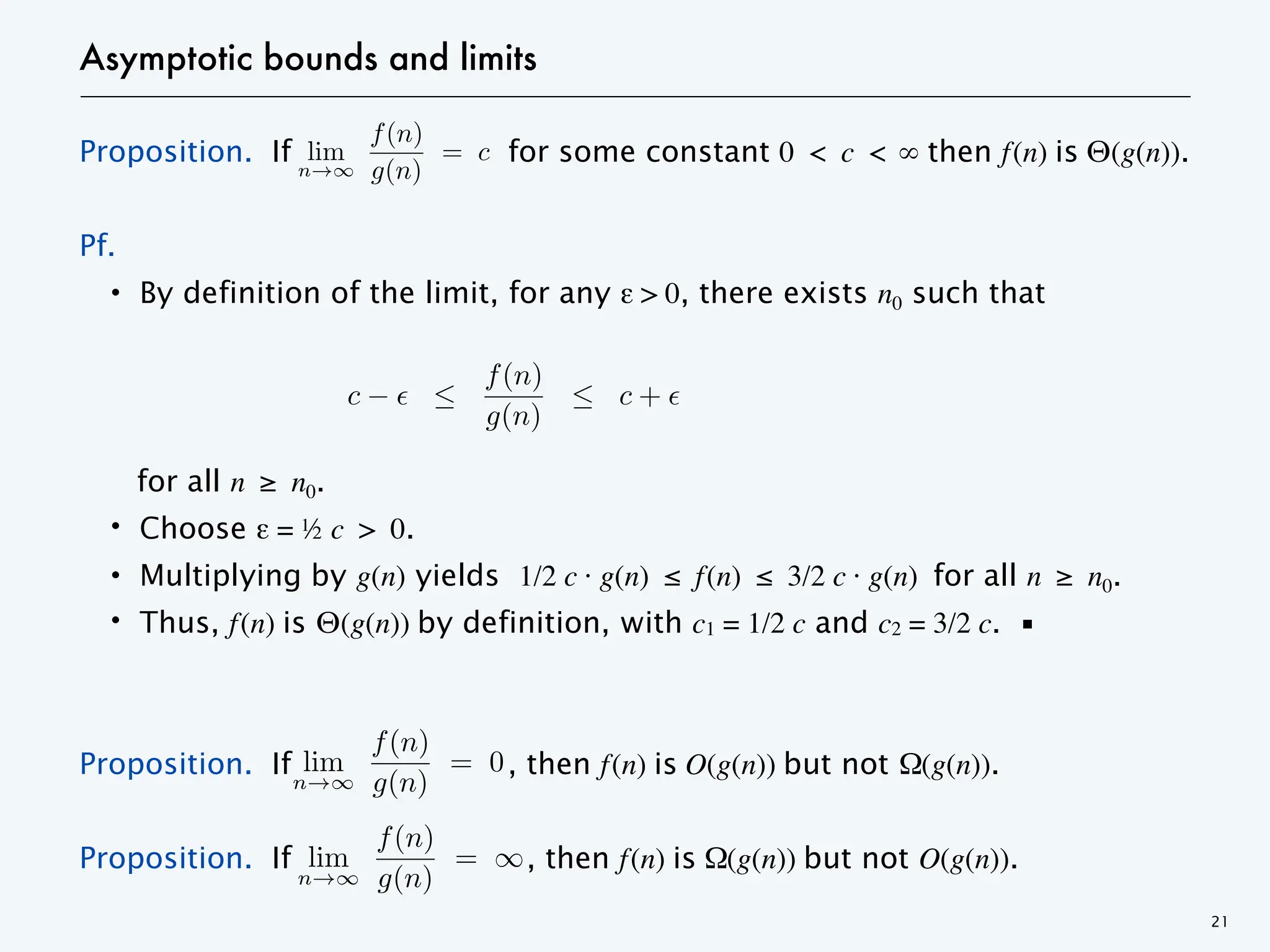
Proposition. If for some constant 0 < c < ∞ then f(n) is Θ(g(n)).
Pf.
・By definition of the limit, for any ε > 0, there exists n0 such that
for all n ≥ n0.
・Choose ε = ½ c > 0.
・Multiplying by g(n) yields 1/2 c · g(n) ≤ f(n) ≤ 3/2 c · g(n) for all n ≥ n0.
・Thus, f(n) is Θ(g(n)) by definition, with c1 = 1/2 c and c2 = 3/2 c. ▪
Proposition. If , then f(n) is O(g(n)) but not Ω(g(n)).
Proposition. If , then f(n) is Ω(g(n)) but not O(g(n)).
21
lim
n
f(n)
g(n)
= c > 0
c
f(n)
g(n)
c +
<latexit sha1_base64="4471u2rVjPFvRKTehhYE1ZF2UoY=">AAACbnicbVDRSiMxFE1HV7vdVas+7IOIYYtQEctUBJV9EZaFfXRhq0KnlMztnRrMJENyR1qGfpFf4+PqV/gHm6lFtnVvSHI4597c3BNnSjoKwz+VYGn5w8pq9WPt0+e19Y365taVM7kF7IBRxt7EwqGSGjskSeFNZlGkscLr+O57qV/fo3XS6N80zrCXiqGWiQRBnurXf3DgRzzCzEllNI+++aWwvHiUWAFF0tQHk2JYnnMq8MO3slq/3ghb4TT4e9CegQabxWV/s7IVDQzkKWoCJZzrtsOMeoWwJEHhpBblDjMBd2KIXQ+1SNH1ium8E77vmQFPjPVbE5+y/1YUInVunMY+MxV06xa1kvyf1s0pOesVUmc5oYbXRkmuOBlemscH0iKQGnsgwEr/Vw63wttE3uK5LtO3M4S5SYpRriWYAS6wikZkxcS72F707D3oHLfOW+Gvk8bF2czOKtthX1mTtdkpu2A/2SXrMGAP7JE9sefKS/Al2A32XlODyqxmm81F0PwL9Tm8EA==</latexit>
<latexit sha1_base64="4471u2rVjPFvRKTehhYE1ZF2UoY=">AAACbnicbVDRSiMxFE1HV7vdVas+7IOIYYtQEctUBJV9EZaFfXRhq0KnlMztnRrMJENyR1qGfpFf4+PqV/gHm6lFtnVvSHI4597c3BNnSjoKwz+VYGn5w8pq9WPt0+e19Y365taVM7kF7IBRxt7EwqGSGjskSeFNZlGkscLr+O57qV/fo3XS6N80zrCXiqGWiQRBnurXf3DgRzzCzEllNI+++aWwvHiUWAFF0tQHk2JYnnMq8MO3slq/3ghb4TT4e9CegQabxWV/s7IVDQzkKWoCJZzrtsOMeoWwJEHhpBblDjMBd2KIXQ+1SNH1ium8E77vmQFPjPVbE5+y/1YUInVunMY+MxV06xa1kvyf1s0pOesVUmc5oYbXRkmuOBlemscH0iKQGnsgwEr/Vw63wttE3uK5LtO3M4S5SYpRriWYAS6wikZkxcS72F707D3oHLfOW+Gvk8bF2czOKtthX1mTtdkpu2A/2SXrMGAP7JE9sefKS/Al2A32XlODyqxmm81F0PwL9Tm8EA==</latexit>
<latexit sha1_base64="4471u2rVjPFvRKTehhYE1ZF2UoY=">AAACbnicbVDRSiMxFE1HV7vdVas+7IOIYYtQEctUBJV9EZaFfXRhq0KnlMztnRrMJENyR1qGfpFf4+PqV/gHm6lFtnVvSHI4597c3BNnSjoKwz+VYGn5w8pq9WPt0+e19Y365taVM7kF7IBRxt7EwqGSGjskSeFNZlGkscLr+O57qV/fo3XS6N80zrCXiqGWiQRBnurXf3DgRzzCzEllNI+++aWwvHiUWAFF0tQHk2JYnnMq8MO3slq/3ghb4TT4e9CegQabxWV/s7IVDQzkKWoCJZzrtsOMeoWwJEHhpBblDjMBd2KIXQ+1SNH1ium8E77vmQFPjPVbE5+y/1YUInVunMY+MxV06xa1kvyf1s0pOesVUmc5oYbXRkmuOBlemscH0iKQGnsgwEr/Vw63wttE3uK5LtO3M4S5SYpRriWYAS6wikZkxcS72F707D3oHLfOW+Gvk8bF2czOKtthX1mTtdkpu2A/2SXrMGAP7JE9sefKS/Al2A32XlODyqxmm81F0PwL9Tm8EA==</latexit>
lim
n
f(n)
g(n)
=
<latexit sha1_base64="7KIVqEi//Gxt4Gr531t4InKKrao=">AAACaXicbVDRatswFFW8dk2zdkuzl7K+iIZB+xKcMVhHGQT20scU5iUQhyAr14moLBnpumsw/p1+TV9b6D/0Iyq7fmjSHZA4nHOvru6JUiks+v5jw3u3tf1+p7nb+rC3//FT+6Dz1+rMcAi4ltqMI2ZBCgUBCpQwTg2wJJIwiq5+l/7oGowVWv3BVQrThC2UiAVn6KRZexBKkcxyRUMjFktkxuh/NBQqxlVBw3MaxobxPD5Rp0W+KO9S/FU5VVFr1u76Pb8CfUv6NemSGsPZQaMTzjXPElDIJbN20vdTnObMoOASilaYWUgZv2ILmDiqWAJ2mlerFvSrU+Y01sYdhbRSX3fkLLF2lUSuMmG4tJteKf7Pm2QYn01zodIMQfGXQXEmKWpa5kbnwgBHuXKEcSPcXylfMhcOunTXplRvp8DXNslvMiW4nsOGKvEGDStciv3NzN6S4FvvZ8+//N4dnNVxNskROSYnpE9+kAG5IEMSEE5uyR25Jw+NJ6/jHXpfXkq9Rt3zmazB6z4DXwy7+A==</latexit>
<latexit sha1_base64="7KIVqEi//Gxt4Gr531t4InKKrao=">AAACaXicbVDRatswFFW8dk2zdkuzl7K+iIZB+xKcMVhHGQT20scU5iUQhyAr14moLBnpumsw/p1+TV9b6D/0Iyq7fmjSHZA4nHOvru6JUiks+v5jw3u3tf1+p7nb+rC3//FT+6Dz1+rMcAi4ltqMI2ZBCgUBCpQwTg2wJJIwiq5+l/7oGowVWv3BVQrThC2UiAVn6KRZexBKkcxyRUMjFktkxuh/NBQqxlVBw3MaxobxPD5Rp0W+KO9S/FU5VVFr1u76Pb8CfUv6NemSGsPZQaMTzjXPElDIJbN20vdTnObMoOASilaYWUgZv2ILmDiqWAJ2mlerFvSrU+Y01sYdhbRSX3fkLLF2lUSuMmG4tJteKf7Pm2QYn01zodIMQfGXQXEmKWpa5kbnwgBHuXKEcSPcXylfMhcOunTXplRvp8DXNslvMiW4nsOGKvEGDStciv3NzN6S4FvvZ8+//N4dnNVxNskROSYnpE9+kAG5IEMSEE5uyR25Jw+NJ6/jHXpfXkq9Rt3zmazB6z4DXwy7+A==</latexit>
<latexit sha1_base64="7KIVqEi//Gxt4Gr531t4InKKrao=">AAACaXicbVDRatswFFW8dk2zdkuzl7K+iIZB+xKcMVhHGQT20scU5iUQhyAr14moLBnpumsw/p1+TV9b6D/0Iyq7fmjSHZA4nHOvru6JUiks+v5jw3u3tf1+p7nb+rC3//FT+6Dz1+rMcAi4ltqMI2ZBCgUBCpQwTg2wJJIwiq5+l/7oGowVWv3BVQrThC2UiAVn6KRZexBKkcxyRUMjFktkxuh/NBQqxlVBw3MaxobxPD5Rp0W+KO9S/FU5VVFr1u76Pb8CfUv6NemSGsPZQaMTzjXPElDIJbN20vdTnObMoOASilaYWUgZv2ILmDiqWAJ2mlerFvSrU+Y01sYdhbRSX3fkLLF2lUSuMmG4tJteKf7Pm2QYn01zodIMQfGXQXEmKWpa5kbnwgBHuXKEcSPcXylfMhcOunTXplRvp8DXNslvMiW4nsOGKvEGDStciv3NzN6S4FvvZ8+//N4dnNVxNskROSYnpE9+kAG5IEMSEE5uyR25Jw+NJ6/jHXpfXkq9Rt3zmazB6z4DXwy7+A==</latexit>
lim
n
f(n)
g(n)
= 0
<latexit sha1_base64="a6Ox4O/LCYsW5EpcWyBdjU0iDhE=">AAACZHicbVDLSgMxFE3HV62vqrgSJFgE3ZSpCFZEKLhxqWBV6JSSSe+0wUwyJHfUMszH+DVudekX+Btmahe2eiCXw7mv3BMmUlj0/c+SNze/sLhUXq6srK6tb1Q3t+6sTg2HNtdSm4eQWZBCQRsFSnhIDLA4lHAfPl4W+fsnMFZodYujBLoxGygRCc7QSb3qeSBF3MsUDYwYDJEZo59pIFSEo5wG5zSIDONZdKiO8mxQxEK8KIJf6VVrft0fg/4ljQmpkQmue5ulraCveRqDQi6ZtZ2Gn2A3YwYFl5BXgtRCwvgjG0DHUcVisN1sfGVOD5zSp5E27imkY/V3R8Zia0dx6CpjhkM7myvE/3KdFKNmNxMqSREU/1kUpZKipoVltC8McJQjRxg3wv2V8iFzvqAzdmrLeHYCfOqS7CVVgus+zKgSX9Cw3LnYmPXsL2kf18/q/s1JrdWc2Fkmu2SfHJIGOSUtckWuSZtw8kreyDv5KH15a962t/NT6pUmPdtkCt7eNxcjuXA=</latexit>
<latexit sha1_base64="a6Ox4O/LCYsW5EpcWyBdjU0iDhE=">AAACZHicbVDLSgMxFE3HV62vqrgSJFgE3ZSpCFZEKLhxqWBV6JSSSe+0wUwyJHfUMszH+DVudekX+Btmahe2eiCXw7mv3BMmUlj0/c+SNze/sLhUXq6srK6tb1Q3t+6sTg2HNtdSm4eQWZBCQRsFSnhIDLA4lHAfPl4W+fsnMFZodYujBLoxGygRCc7QSb3qeSBF3MsUDYwYDJEZo59pIFSEo5wG5zSIDONZdKiO8mxQxEK8KIJf6VVrft0fg/4ljQmpkQmue5ulraCveRqDQi6ZtZ2Gn2A3YwYFl5BXgtRCwvgjG0DHUcVisN1sfGVOD5zSp5E27imkY/V3R8Zia0dx6CpjhkM7myvE/3KdFKNmNxMqSREU/1kUpZKipoVltC8McJQjRxg3wv2V8iFzvqAzdmrLeHYCfOqS7CVVgus+zKgSX9Cw3LnYmPXsL2kf18/q/s1JrdWc2Fkmu2SfHJIGOSUtckWuSZtw8kreyDv5KH15a962t/NT6pUmPdtkCt7eNxcjuXA=</latexit>
<latexit sha1_base64="a6Ox4O/LCYsW5EpcWyBdjU0iDhE=">AAACZHicbVDLSgMxFE3HV62vqrgSJFgE3ZSpCFZEKLhxqWBV6JSSSe+0wUwyJHfUMszH+DVudekX+Btmahe2eiCXw7mv3BMmUlj0/c+SNze/sLhUXq6srK6tb1Q3t+6sTg2HNtdSm4eQWZBCQRsFSnhIDLA4lHAfPl4W+fsnMFZodYujBLoxGygRCc7QSb3qeSBF3MsUDYwYDJEZo59pIFSEo5wG5zSIDONZdKiO8mxQxEK8KIJf6VVrft0fg/4ljQmpkQmue5ulraCveRqDQi6ZtZ2Gn2A3YwYFl5BXgtRCwvgjG0DHUcVisN1sfGVOD5zSp5E27imkY/V3R8Zia0dx6CpjhkM7myvE/3KdFKNmNxMqSREU/1kUpZKipoVltC8McJQjRxg3wv2V8iFzvqAzdmrLeHYCfOqS7CVVgus+zKgSX9Cw3LnYmPXsL2kf18/q/s1JrdWc2Fkmu2SfHJIGOSUtckWuSZtw8kreyDv5KH15a962t/NT6pUmPdtkCt7eNxcjuXA=</latexit>
22.
Asymptotic bounds forsome common functions
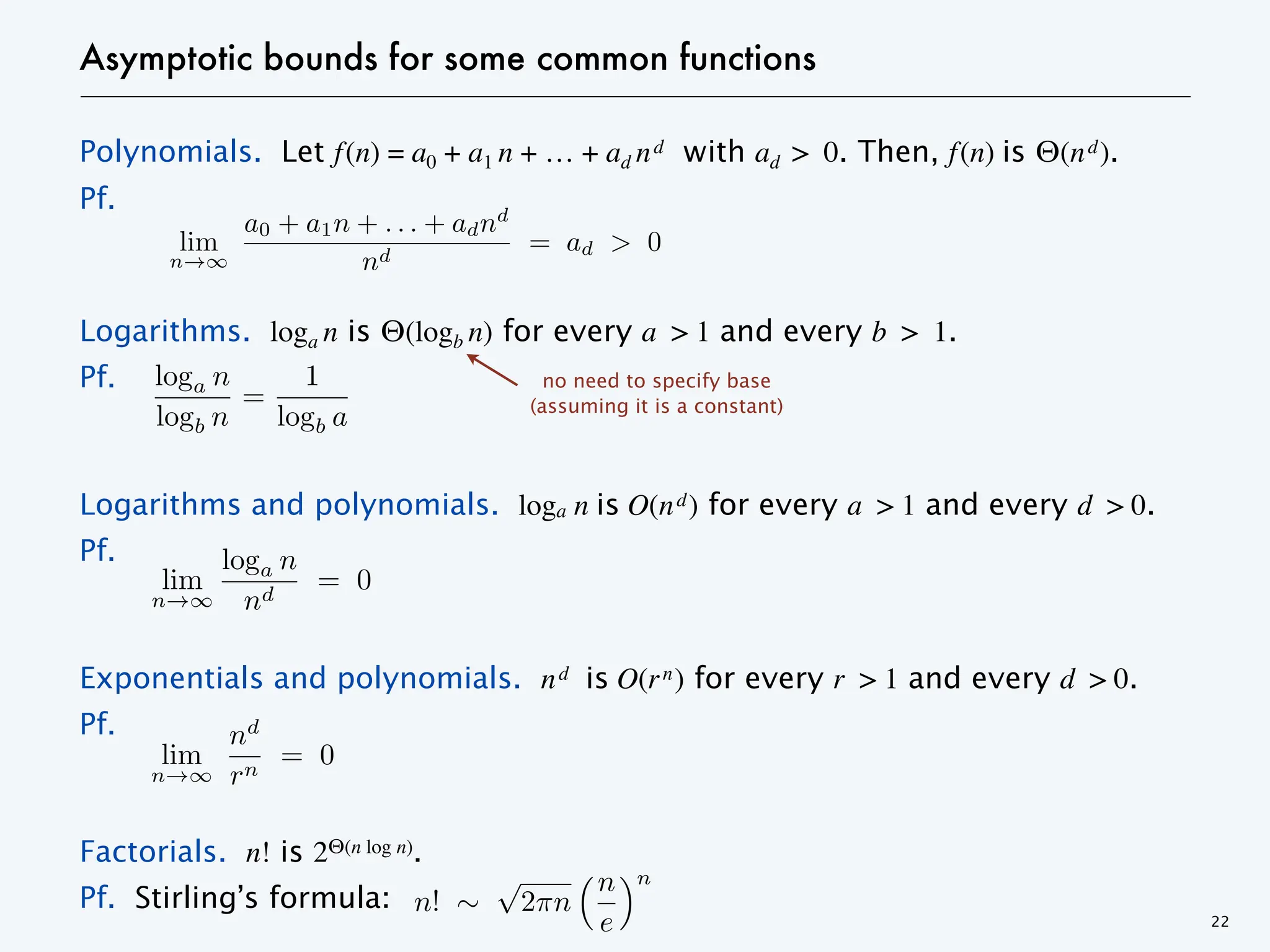
Polynomials. Let f(n) = a0 + a1 n + … + ad nd with ad > 0. Then, f(n) is Θ(nd).
Pf.
Logarithms. loga n is Θ(logb n) for every a > 1 and every b > 1.
Pf.
Logarithms and polynomials. loga n is O(nd) for every a > 1 and every d > 0.
Pf.
Exponentials and polynomials. nd is O(rn) for every r > 1 and every d > 0.
Pf.
Factorials. n! is 2Θ(n log n).
Pf. Stirling’s formula:
22
no need to specify base
(assuming it is a constant)
lim
n
a0 + a1n + . . . + adnd
nd
= ad > 0
lim
n
nd
rn
= 0
n! 2 n
n
e
n
lim
n
loga n
nd
= 0
loga n
logb n
=
1
logb a
<latexit sha1_base64="DQO+CMgFJE1qjJ2qgd/1EHNxfVE=">AAACWHicbZDbSiNBEIZ7Zj3E4ybx0pvGIHgVZ0TQvVgQvNlLBaNCEkJNpyY29nQP3TWLYZjH8Gm8dR9i8WXsHBATLWj4+P/qrq4/yZV0FEX/g/DHyuraem1jc2t7Z/dnvdG8daawAjvCKGPvE3CopMYOSVJ4n1uELFF4lzxeTvy7v2idNPqGxjn2MxhpmUoB5KVB/biXWhBlT5nRALiuZpR44r/5zIs/RKj4oN6K2tG0+FeI59Bi87oaNIJmb2hEkaEmocC5bhzl1C/BkhQKq81e4TAH8Qgj7HrUkKHrl9PNKn7olSFPjfVHE5+qn2+UkDk3zhLfmQE9uGVvIn7ndQtKz/ul1HlBqMVsUFooToZPYuJDaVGQGnsAYaX/KxcP4OMgH+bClOnbOYqFTcqnQkthhrikKnoiC5VPMV7O7Ct0Ttq/2tH1aevifB5nje2zA3bEYnbGLtgfdsU6TLBn9sJe2b/gLQzC9XBj1hoG8zt7bKHC5ju/4bZS</latexit>
<latexit sha1_base64="DQO+CMgFJE1qjJ2qgd/1EHNxfVE=">AAACWHicbZDbSiNBEIZ7Zj3E4ybx0pvGIHgVZ0TQvVgQvNlLBaNCEkJNpyY29nQP3TWLYZjH8Gm8dR9i8WXsHBATLWj4+P/qrq4/yZV0FEX/g/DHyuraem1jc2t7Z/dnvdG8daawAjvCKGPvE3CopMYOSVJ4n1uELFF4lzxeTvy7v2idNPqGxjn2MxhpmUoB5KVB/biXWhBlT5nRALiuZpR44r/5zIs/RKj4oN6K2tG0+FeI59Bi87oaNIJmb2hEkaEmocC5bhzl1C/BkhQKq81e4TAH8Qgj7HrUkKHrl9PNKn7olSFPjfVHE5+qn2+UkDk3zhLfmQE9uGVvIn7ndQtKz/ul1HlBqMVsUFooToZPYuJDaVGQGnsAYaX/KxcP4OMgH+bClOnbOYqFTcqnQkthhrikKnoiC5VPMV7O7Ct0Ttq/2tH1aevifB5nje2zA3bEYnbGLtgfdsU6TLBn9sJe2b/gLQzC9XBj1hoG8zt7bKHC5ju/4bZS</latexit>
<latexit sha1_base64="DQO+CMgFJE1qjJ2qgd/1EHNxfVE=">AAACWHicbZDbSiNBEIZ7Zj3E4ybx0pvGIHgVZ0TQvVgQvNlLBaNCEkJNpyY29nQP3TWLYZjH8Gm8dR9i8WXsHBATLWj4+P/qrq4/yZV0FEX/g/DHyuraem1jc2t7Z/dnvdG8daawAjvCKGPvE3CopMYOSVJ4n1uELFF4lzxeTvy7v2idNPqGxjn2MxhpmUoB5KVB/biXWhBlT5nRALiuZpR44r/5zIs/RKj4oN6K2tG0+FeI59Bi87oaNIJmb2hEkaEmocC5bhzl1C/BkhQKq81e4TAH8Qgj7HrUkKHrl9PNKn7olSFPjfVHE5+qn2+UkDk3zhLfmQE9uGVvIn7ndQtKz/ul1HlBqMVsUFooToZPYuJDaVGQGnsAYaX/KxcP4OMgH+bClOnbOYqFTcqnQkthhrikKnoiC5VPMV7O7Ct0Ttq/2tH1aevifB5nje2zA3bEYnbGLtgfdsU6TLBn9sJe2b/gLQzC9XBj1hoG8zt7bKHC5ju/4bZS</latexit>
23.
Big O notationwith multiple variables
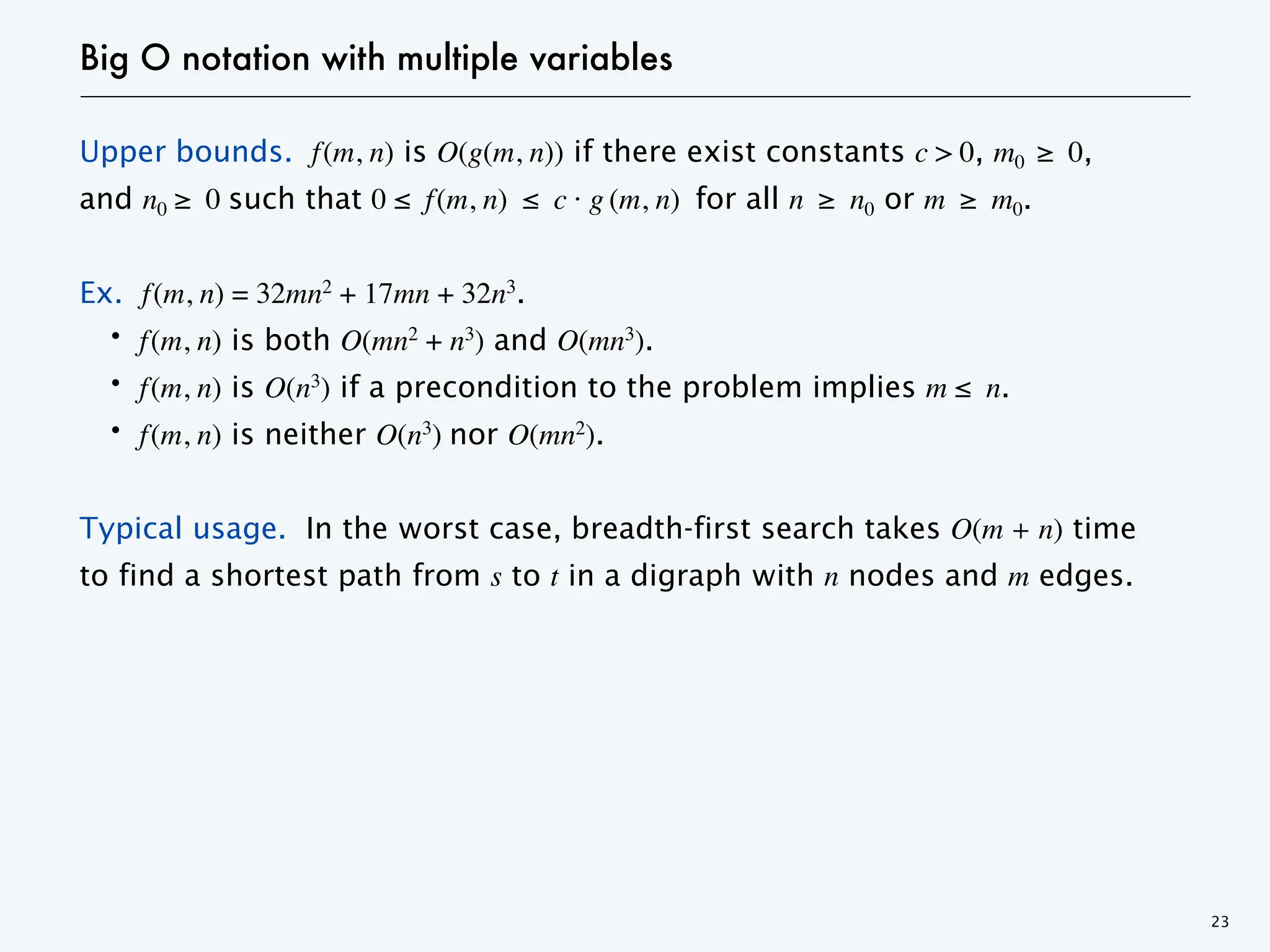
Upper bounds. f(m, n) is O(g(m, n)) if there exist constants c > 0, m0 ≥ 0,
and n0 ≥ 0 such that 0 ≤ f(m, n) ≤ c · g (m, n) for all n ≥ n0 or m ≥ m0.
Ex. f(m, n) = 32mn2 + 17mn + 32n3.
・f(m, n) is both O(mn2 + n3) and O(mn3).
・f(m, n) is O(n3) if a precondition to the problem implies m ≤ n.
・f(m, n) is neither O(n3) nor O(mn2).
Typical usage. In the worst case, breadth-first search takes O(m + n) time
to find a shortest path from s to t in a digraph with n nodes and m edges.
23
24.
2. ALGORITHM ANALYSIS
‣computational tractability
‣ asymptotic order of growth
‣ implementing Gale–Shapley
‣ survey of common running times
SECTION 2.3
25.
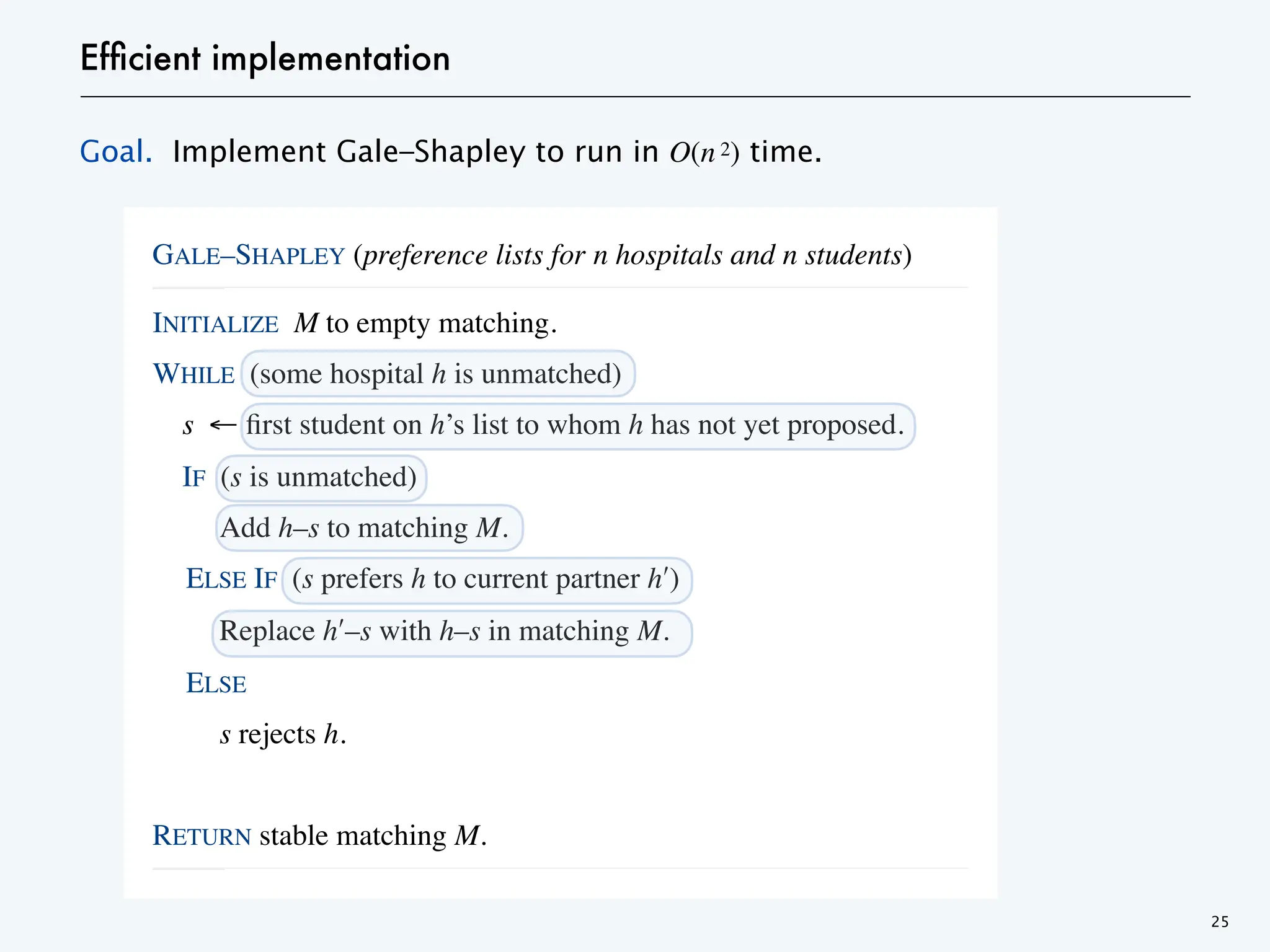
Efficient implementation
Goal. ImplementGale–Shapley to run in O(n 2) time.
25
GALE–SHAPLEY (preference lists for n hospitals and n students)
____________________________________________________________________________________________________________________________________________________________________________________________________________________________________________________________________________________________________________________________________________________________________________________________________________________________________________________________________________________________________________________________________________________________________________________________________________________________________________________________________________________________________________________________________________________________________________________________________________________________________________________________________________________________________________________________________________________________________________________________________________________________________________________________________________________________________________________________________________________________________________________________________________________________________________________________________________________________________________________________________________________________________
____________________________________________________________________________________________________________________
INITIALIZE M to empty matching.
WHILE (some hospital h is unmatched)
s ← first student on h’s list to whom h has not yet proposed.
IF (s is unmatched)
Add h–s to matching M.
ELSE IF (s prefers h to current partner hʹ)
Replace hʹ–s with h–s in matching M.
ELSE
s rejects h.
RETURN stable matching M.
____________________________________________________________________________________________________________________________________________________________________________________________________________________________________________________________________________________________________________________________________________________________________________________________________________________________________________________________________________________________________________________________________________________________________________________________________________________________________________________________________________________________________________________________________________________________________________________________________________________________________________________________________________________________________________________________________________________________________________________________________________________________________________________________________________________________________________________________________________________________________________________________________________________________________________________________________________________________________________________________________________________________________
____________________________________________________________________________________________________________________
26.
Efficient implementation
Goal. ImplementGale–Shapley to run in O(n 2) time.
Representing hospitals and students. Index hospitals and students 1, …, n.
Representing the matching.
・Maintain two arrays student[h] and hospital[s].
- if h matched to s, then student[h] = s and hospital[s] = h
- use value 0 to designate that hospital or student is unmatched
・Can add/remove a pair from matching in O(1) time.
・Maintain set of unmatched hospitals in a queue (or stack).
・Can find an unmatched hospital in O(1) time.
26
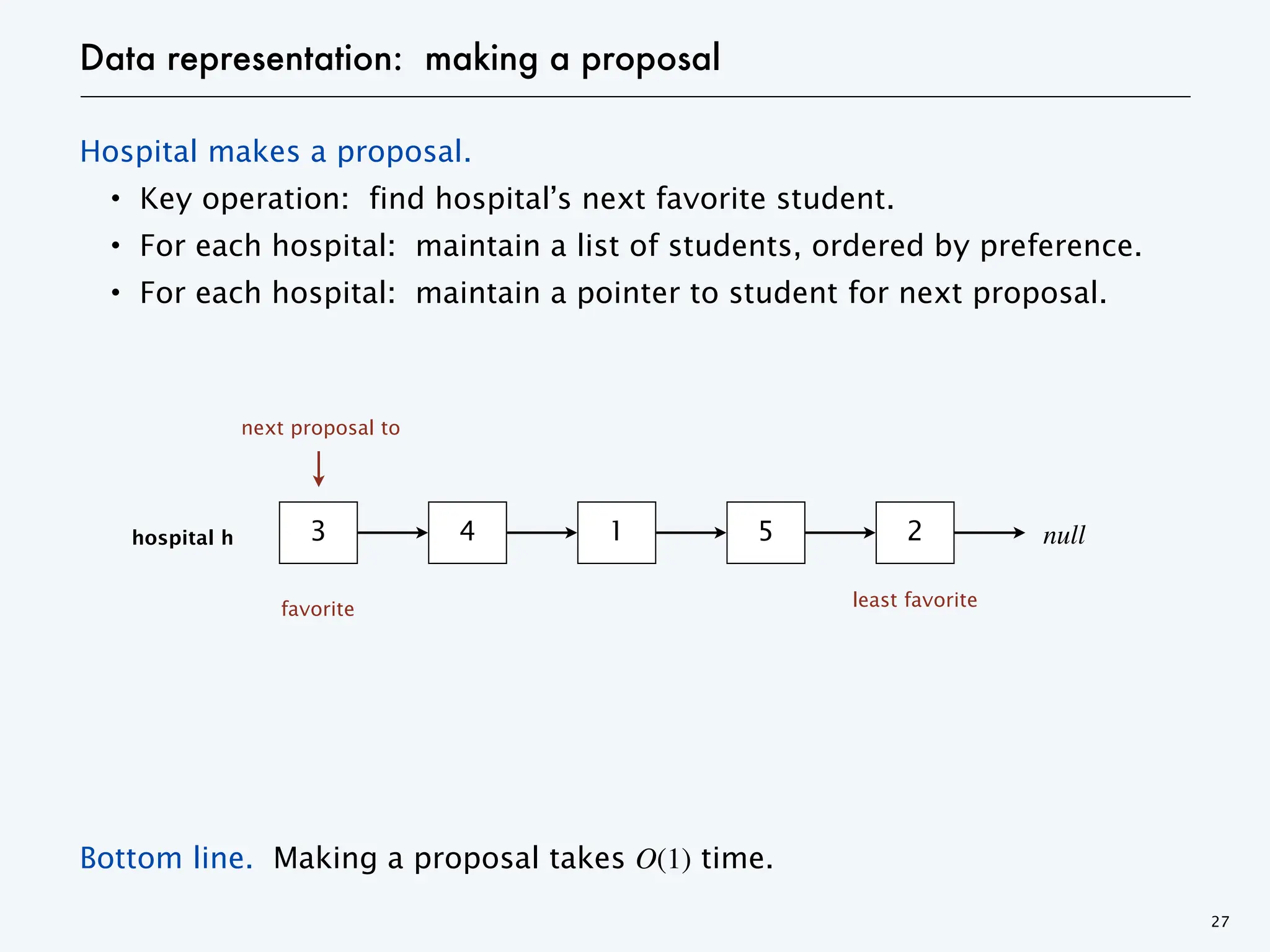
27.
Data representation: makinga proposal
Hospital makes a proposal.
・Key operation: find hospital’s next favorite student.
・For each hospital: maintain a list of students, ordered by preference.
・For each hospital: maintain a pointer to student for next proposal.
Bottom line. Making a proposal takes O(1) time.
27
next proposal to
3 4 1 5
hospital h 2 null
favorite least favorite
28.
Student accepts/rejects aproposal.
・Does student s prefer hospital h to hospital hʹ ?
・For each student, create inverse of preference list of hospitals.
Bottom line. After Θ(n2
) preprocessing time (to create the n ranking arrays),
it takes O(1) time to accept/reject a proposal.
1st 2nd 3rd 4th 5th 6th 7th 8th
8 3 7 1 4 5 6 2
pref[]
Data representation: accepting/rejecting a proposal
28
for i = 1 to n
rank[pref[i]] = i
student prefers hospital 4 to 6
1 2 3 4 5 6 7 8
4th 8th 2nd 5th 6th 7th 3rd 1st
rank[]
since rank[4] < rank[6]
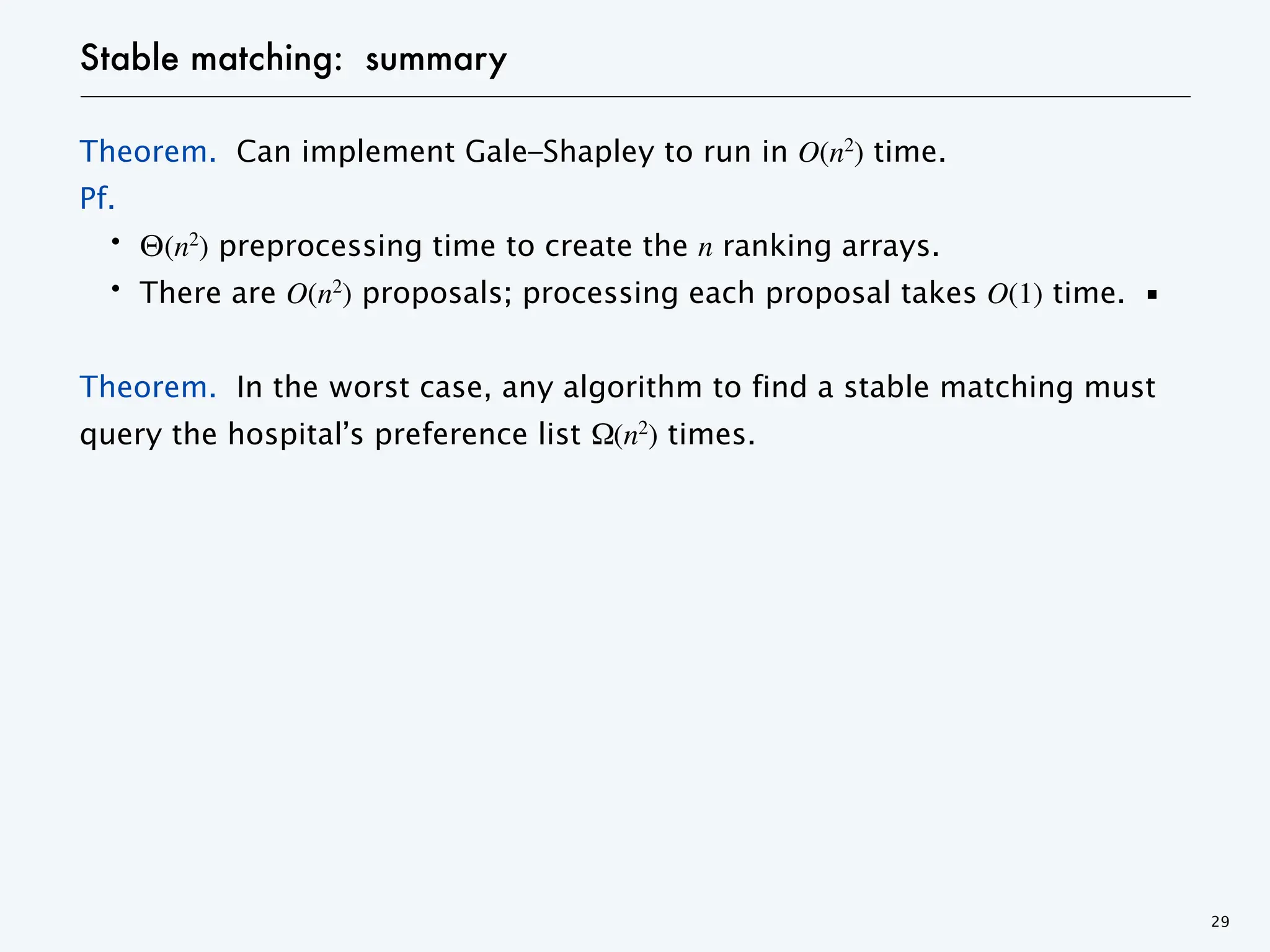
29.
Stable matching: summary
Theorem.Can implement Gale–Shapley to run in O(n2
) time.
Pf.
・Θ(n2
) preprocessing time to create the n ranking arrays.
・There are O(n2
) proposals; processing each proposal takes O(1) time. ▪
Theorem. In the worst case, any algorithm to find a stable matching must
query the hospital’s preference list Ω(n2
) times.
29
30.
2. ALGORITHM ANALYSIS
‣computational tractability
‣ asymptotic order of growth
‣ implementing Gale–Shapley
‣ survey of common running times
SECTION 2.4
31.
Constant time
Constant time.Running time is O(1).
Examples.
・Conditional branch.
・Arithmetic/logic operation.
・Declare/initialize a variable.
・Follow a link in a linked list.
・Access element i in an array.
・Compare/exchange two elements in an array.
・…
31
bounded by a constant,
which does not depend on input size n
32.
Linear time
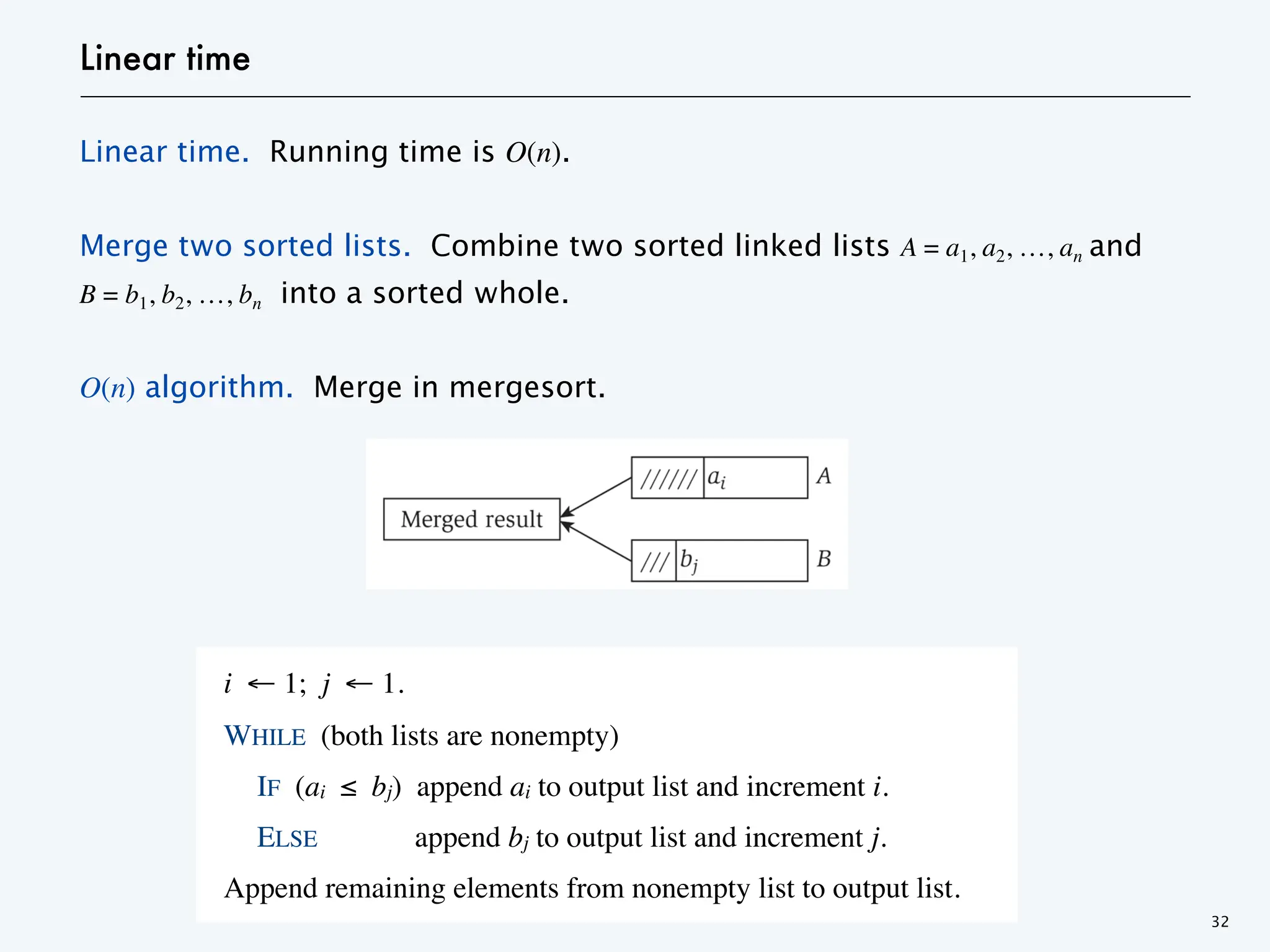
Linear time.Running time is O(n).
Merge two sorted lists. Combine two sorted linked lists A = a1, a2, …, an and
B = b1, b2, …, bn into a sorted whole.
O(n) algorithm. Merge in mergesort.
32
i ← 1; j ← 1.
WHILE (both lists are nonempty)
IF (ai ≤ bj) append ai to output list and increment i.
ELSE append bj to output list and increment j.
Append remaining elements from nonempty list to output list.
33.
33
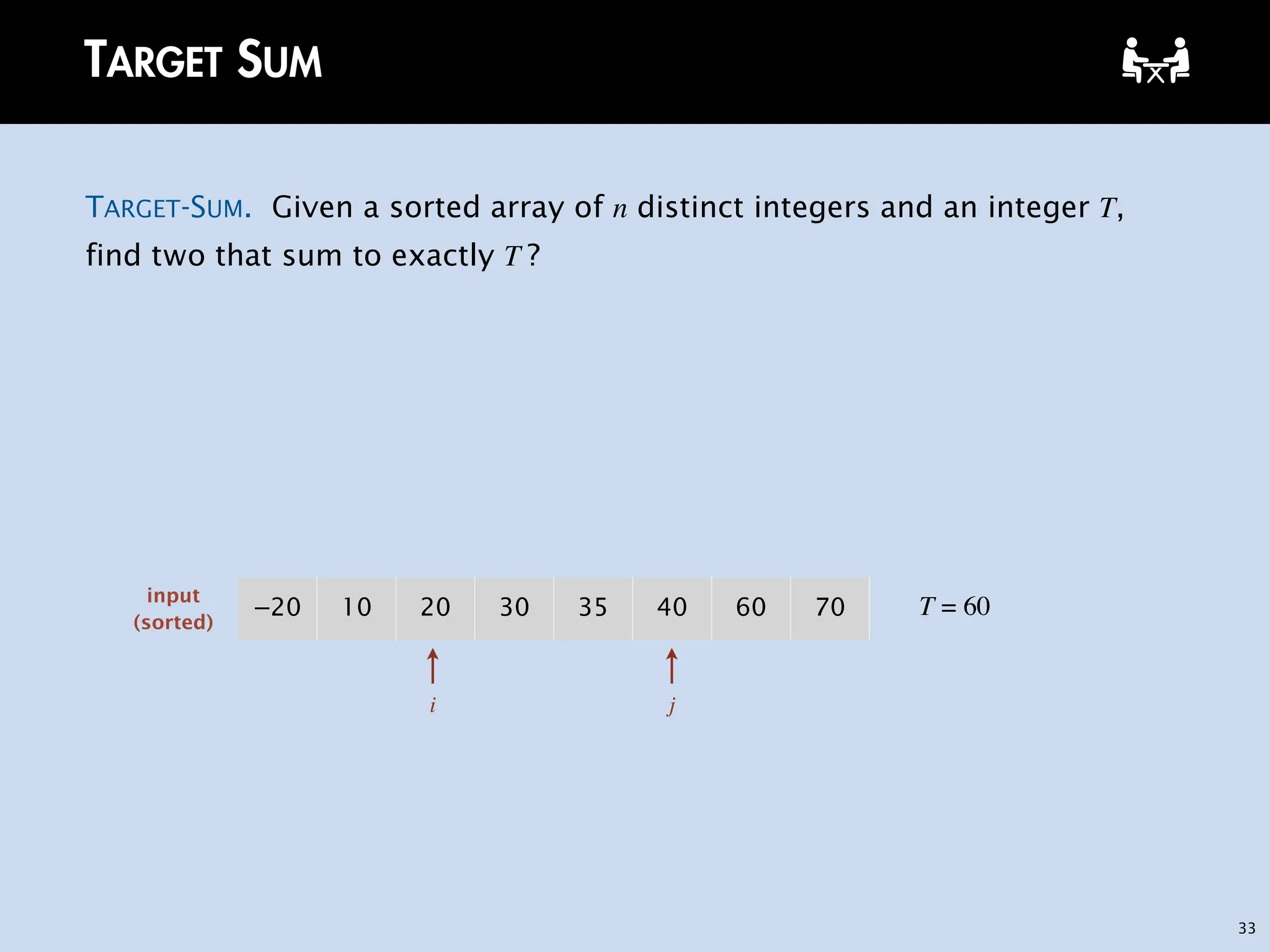
TARGET SUM
TARGET-SUM. Givena sorted array of n distinct integers and an integer T,
find two that sum to exactly T ?
−20 10 20 30 35 40 60 70 T = 60
i j
input
(sorted)
34.
34
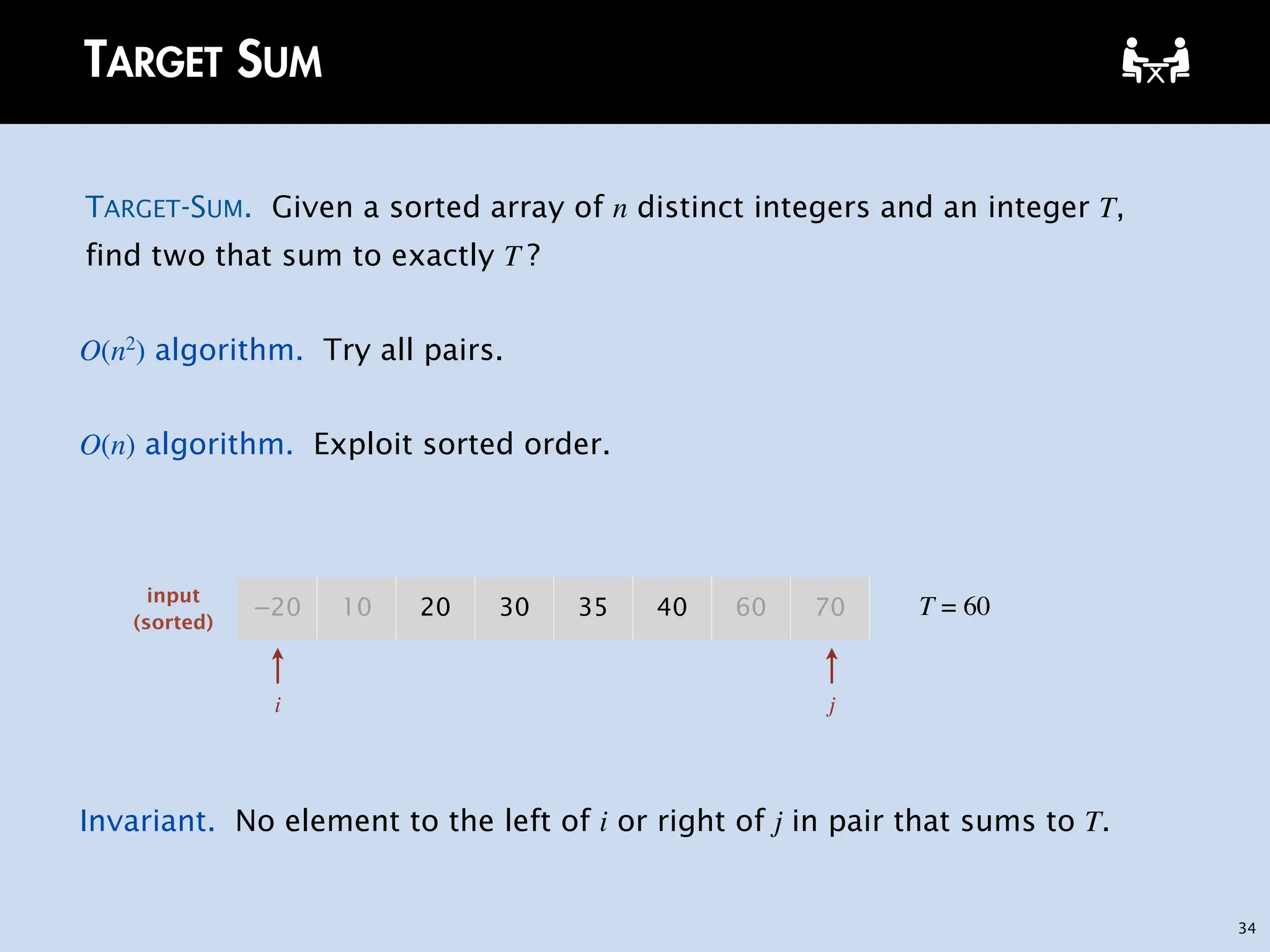
TARGET SUM
TARGET-SUM. Givena sorted array of n distinct integers and an integer T,
find two that sum to exactly T ?
O(n2
) algorithm. Try all pairs.
O(n) algorithm. Exploit sorted order.
Invariant. No element to the left of i or right of j in pair that sums to T.
−20 10 20 30 35 40 60 70
input
(sorted)
T = 60
i j
35.
Logarithmic time
Logarithmic time.Running time is O(log n).
Search in a sorted array. Given a sorted array A of n distinct integers and an
integer x, find index of x in array.
O(log n) algorithm. Binary search.
・Invariant: If x is in the array, then x is in A[lo .. hi].
・After k iterations of WHILE loop, (hi − lo + 1) ≤ n / 2k k ≤ 1 + log2 n.
35
lo ← 1; hi ← n.
WHILE (lo ≤ hi)
mid ← ⎣(lo + hi) / 2⎦.
IF (x < A[mid]) hi ← mid − 1.
ELSE IF (x > A[mid]) lo ← mid + 1.
ELSE RETURN mid.
RETURN −1.
remaining elements
37
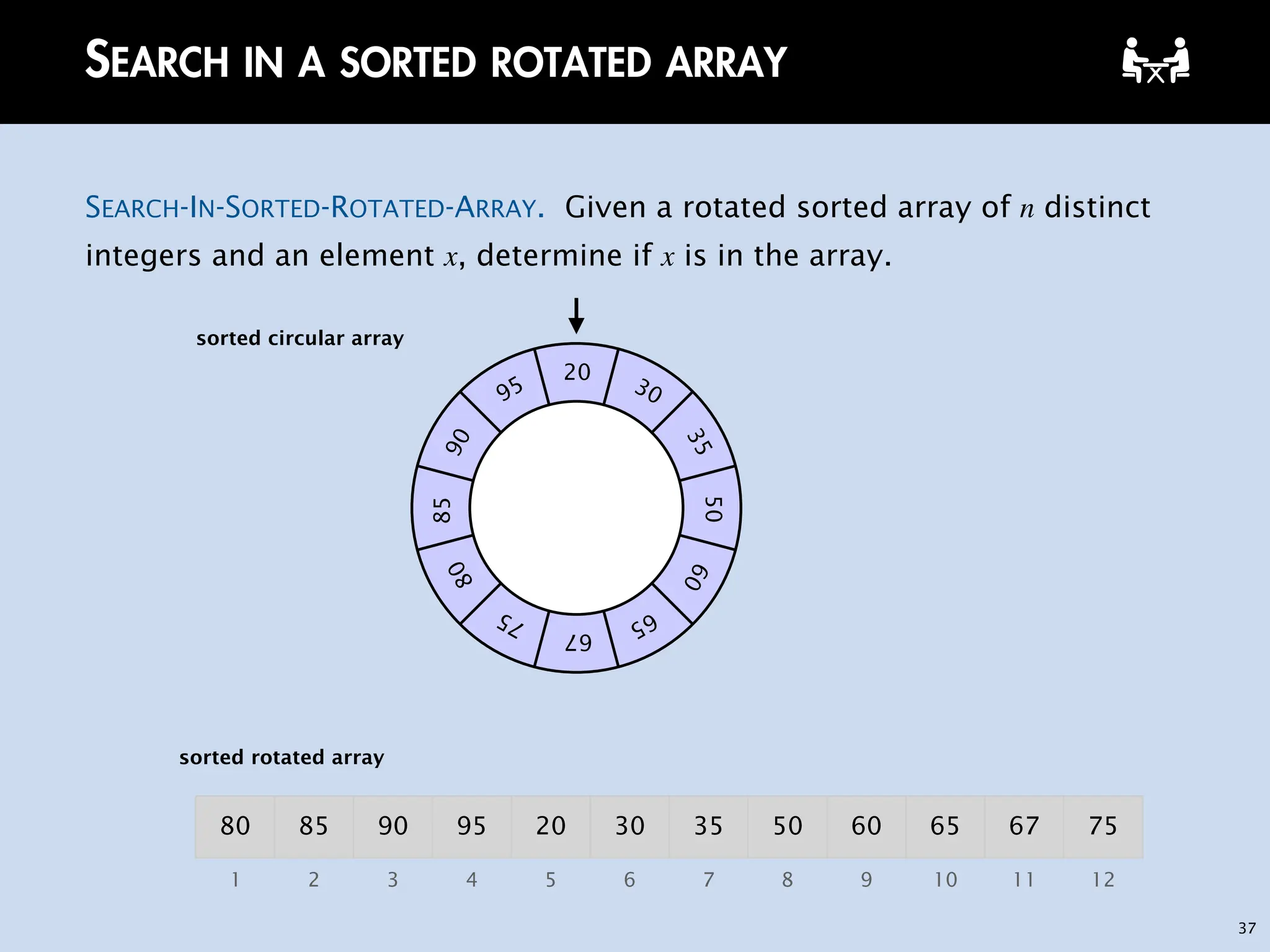
SEARCH IN ASORTED ROTATED ARRAY
SEARCH-IN-SORTED-ROTATED-ARRAY. Given a rotated sorted array of n distinct
integers and an element x, determine if x is in the array.
sorted circular array
80 85 90 95 20 30 35 50 60 65 67 75
1 2 3 4 5 6 7 8 9 10 11 12
sorted rotated array
20 30
3
5
50
6
0
6
5
67
7
5
8
0
85
9
0
95
38.
38
SEARCH IN ASORTED ROTATED ARRAY
SEARCH-IN-SORTED-ROTATED-ARRAY. Given a rotated sorted array of n distinct
integers and an element x, determine if x is in the array.
O(log n) algorithm.
・Find index k of smallest element.
・Binary search for x in either A[1 .. k−1] or A[k .. n].
lo ← 1; hi ← n.
IF (A[lo] ≤ A[hi]) RETURN 0
WHILE (lo + 2 ≤ hi)
mid ← ⎣(lo + hi) / 2⎦.
IF (A[mid] < A[hi]) hi ← mid.
ELSE IF (A[mid] > A[hi]) lo ← mid.
RETURN hi
loop invariant
A[lo] > A[hi]
at least 3 elements
find index of smallest element
sorted
39.
Linearithmic time
Linearithmic time.Running time is O(n log n).
Sorting. Given an array of n elements, rearrange them in ascending order.
O(n log n) algorithm. Mergesort.
39
Trace of merge results for top-down mergesort
a[]
0 1 2 3 4 5 6 7 8 9 10 11 12 13 14 15
M E R G E S O R T E X A M P L E
a, aux, 0, 0, 1) E M R G E S O R T E X A M P L E
a, aux, 2, 2, 3) E M G R E S O R T E X A M P L E
aux, 0, 1, 3) E G M R E S O R T E X A M P L E
a, aux, 4, 4, 5) E G M R E S O R T E X A M P L E
a, aux, 6, 6, 7) E G M R E S O R T E X A M P L E
aux, 4, 5, 7) E G M R E O R S T E X A M P L E
ux, 0, 3, 7) E E G M O R R S T E X A M P L E
a, aux, 8, 8, 9) E E G M O R R S E T X A M P L E
a, aux, 10, 10, 11) E E G M O R R S E T A X M P L E
aux, 8, 9, 11) E E G M O R R S A E T X M P L E
a, aux, 12, 12, 13) E E G M O R R S A E T X M P L E
a, aux, 14, 14, 15) E E G M O R R S A E T X M P E L
aux, 12, 13, 15) E E G M O R R S A E T X E L M P
ux, 8, 11, 15) E E G M O R R S A E E L M P T X
, 0, 7, 15) A E E E E G L M M O P R R S T X
lo hi
41
LARGEST EMPTY INTERVAL
LARGEST-EMPTY-INTERVAL.Given n timestamps x1, …, xn on which copies of a
file arrive at a server, what is largest interval when no copies of file arrive?
O(n log n) algorithm.
・Sort the array a.
・Scan the sorted list in order, identifying the maximum gap between
successive timestamps.
42.
Quadratic time
Quadratic time.Running time is O(n2).
Closest pair of points. Given a list of n points in the plane (x1, y1), …, (xn, yn),
find the pair that is closest to each other.
O(n2) algorithm. Enumerate all pairs of points (with i < j).
Remark. Ω(n2
) seems inevitable, but this is just an illusion. [see §5.4]
42
min ← ∞.
FOR i = 1 TO n
FOR j = i + 1 TO n
d ← (xi − xj)2 + (yi − yj)2.
IF (d < min)
min ← d.
43.
Cubic time
Cubic time.Running time is O(n3).
3-SUM. Given an array of n distinct integers, find three that sum to 0.
O(n3) algorithm. Enumerate all triples (with i < j < k).
Remark. Ω(n3
) seems inevitable, but O(n2
) is not hard. [see next slide]
43
FOR i = 1 TO n
FOR j = i + 1 TO n
FOR k = j + 1 TO n
IF (ai + aj + ak = 0)
RETURN (ai, aj, ak).
44.
44
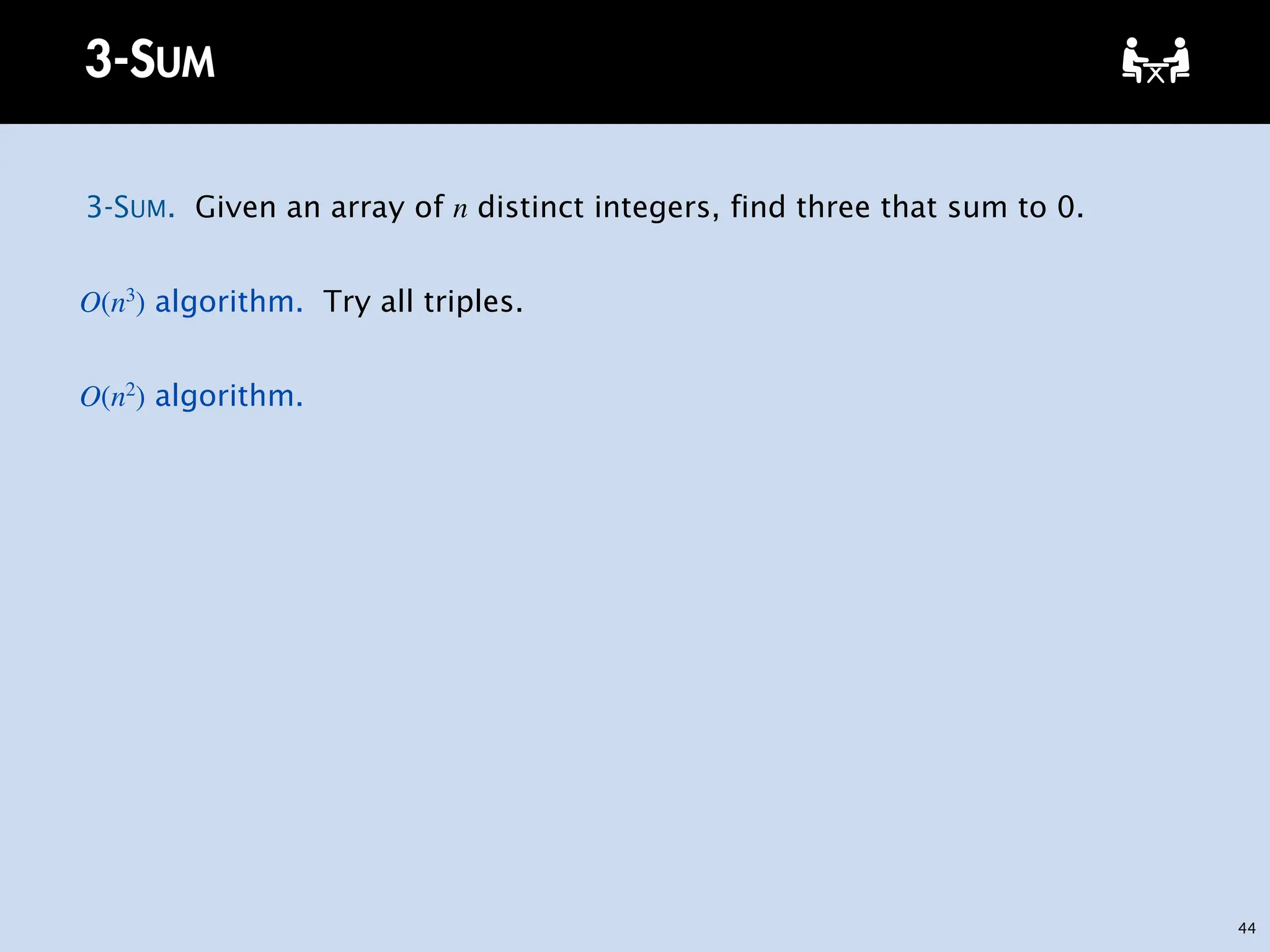
3-SUM
3-SUM. Given anarray of n distinct integers, find three that sum to 0.
O(n3
) algorithm. Try all triples.
O(n2
) algorithm.
45.
45
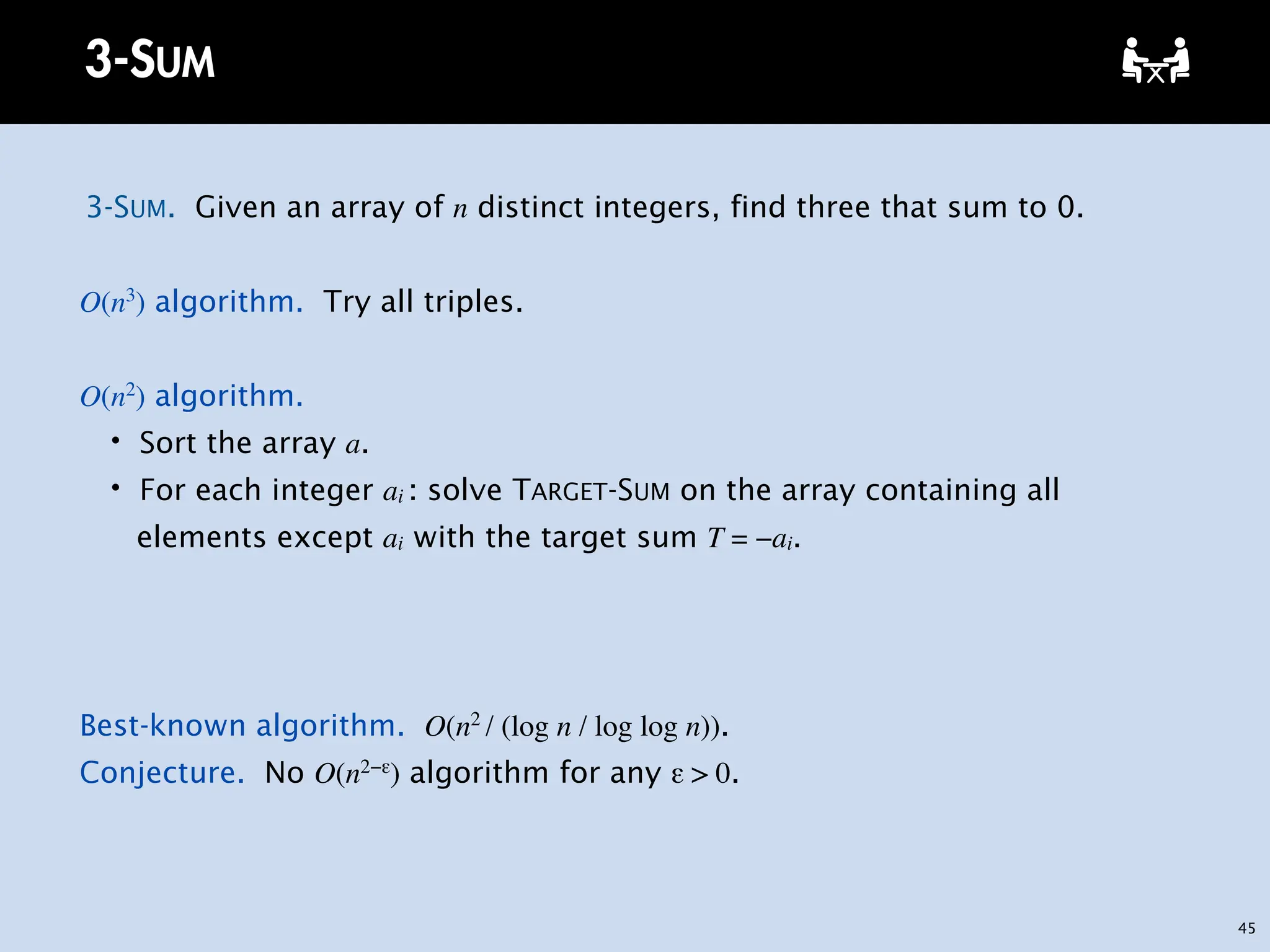
3-SUM
3-SUM. Given anarray of n distinct integers, find three that sum to 0.
O(n3
) algorithm. Try all triples.
O(n2
) algorithm.
・Sort the array a.
・For each integer ai : solve TARGET-SUM on the array containing all
elements except ai with the target sum T = −ai.
Best-known algorithm. O(n2
/ (log n / log log n)).
Conjecture. No O(n2−ε) algorithm for any ε > 0.
46.
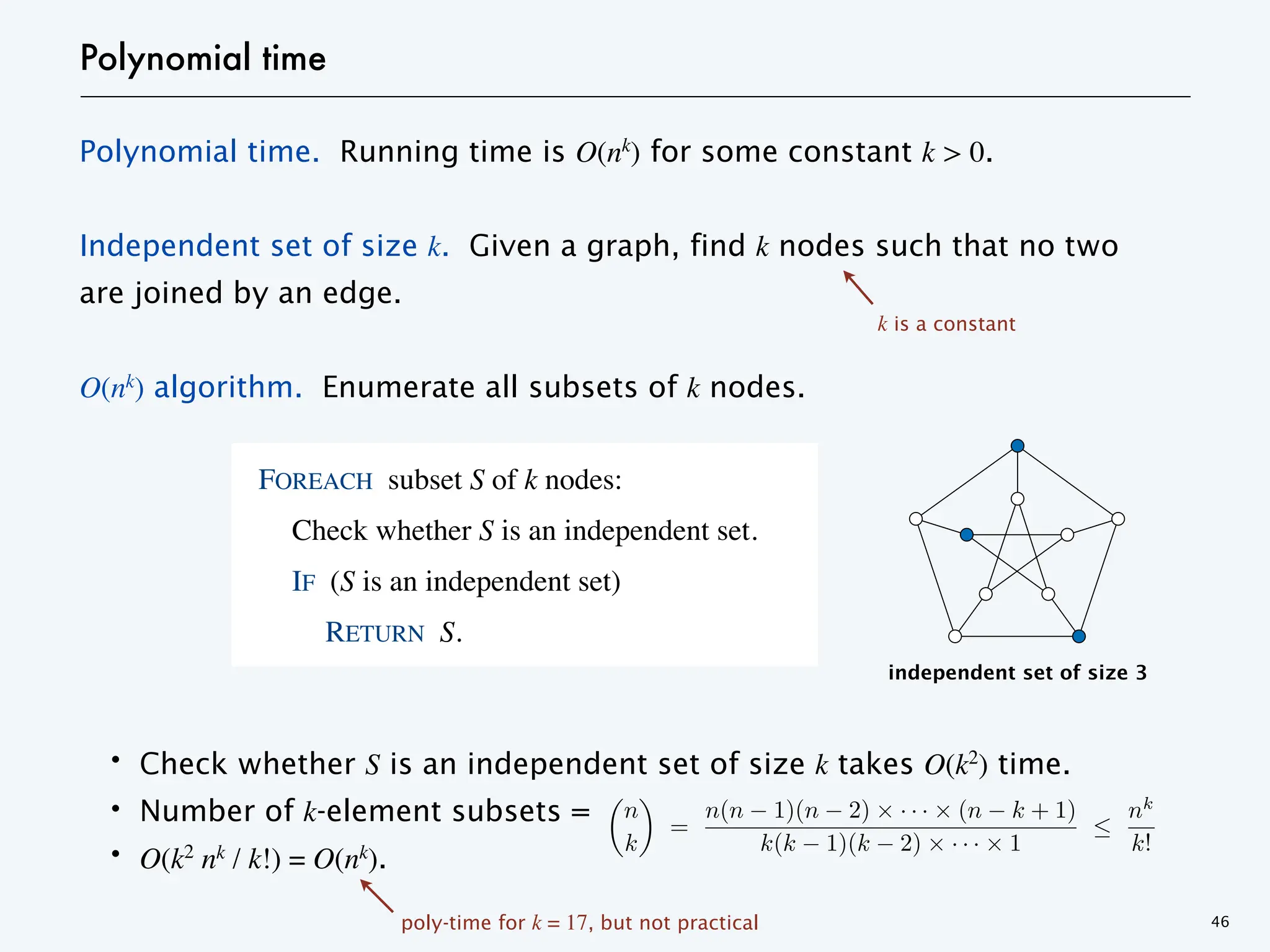
Polynomial time
Polynomial time.Running time is O(nk
) for some constant k > 0.
Independent set of size k. Given a graph, find k nodes such that no two
are joined by an edge.
O(nk) algorithm. Enumerate all subsets of k nodes.
・Check whether S is an independent set of size k takes O(k2
) time.
・Number of k-element subsets =
・O(k2
nk / k!) = O(nk).
46
poly-time for k = 17, but not practical
k is a constant
n
k
=
n(n 1)(n 2) · · · (n k + 1)
k(k 1)(k 2) · · · 1
nk
k!
FOREACH subset S of k nodes:
Check whether S is an independent set.
IF (S is an independent set)
RETURN S.
independent set of size 3
47.
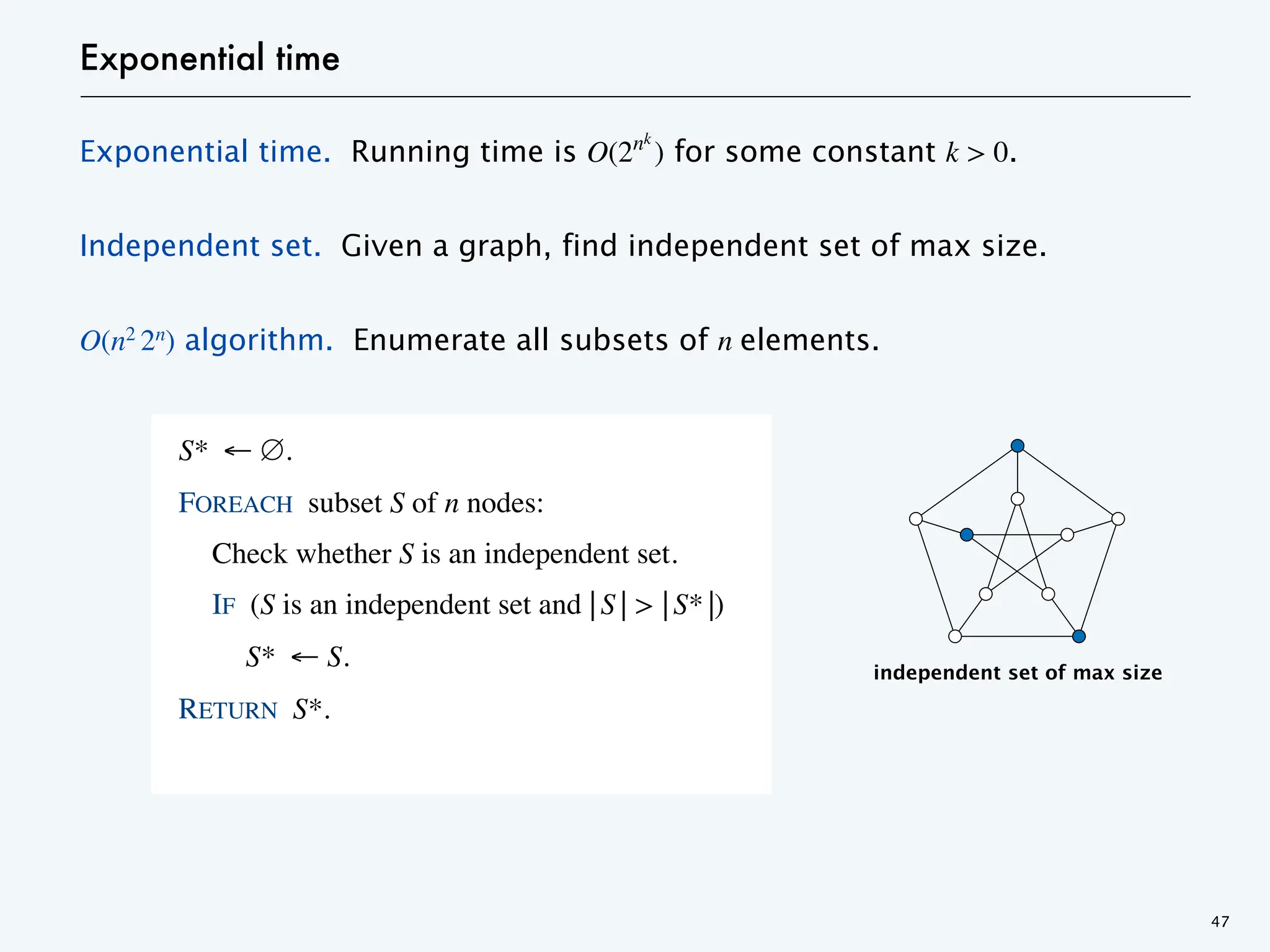
Exponential time
Exponential time.Running time is O(2nk
) for some constant k > 0.
Independent set. Given a graph, find independent set of max size.
O(n2 2n) algorithm. Enumerate all subsets of n elements.
47
S* ← ∅.
FOREACH subset S of n nodes:
Check whether S is an independent set.
IF (S is an independent set and ⎢S⎟ > ⎢S*⎟)
S* ← S.
RETURN S*.
independent set of max size
48.
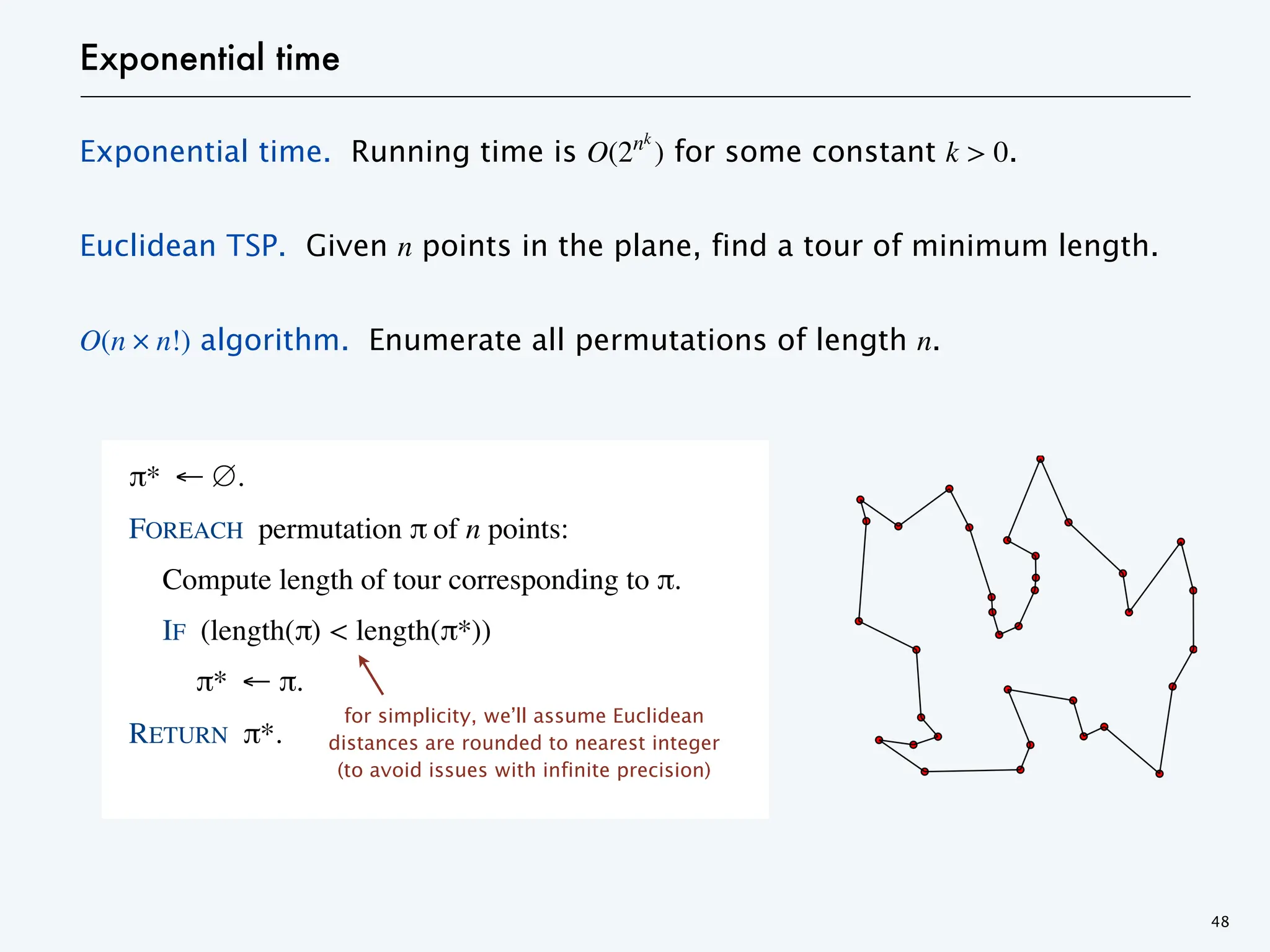
Exponential time
Exponential time.Running time is O(2nk
) for some constant k > 0.
Euclidean TSP. Given n points in the plane, find a tour of minimum length.
O(n 𐄂 n!) algorithm. Enumerate all permutations of length n.
48
π* ← ∅.
FOREACH permutation π of n points:
Compute length of tour corresponding to π.
IF (length(π) < length(π*))
π* ← π.
RETURN π*.
for simplicity, we’ll assume Euclidean
distances are rounded to nearest integer
(to avoid issues with infinite precision)
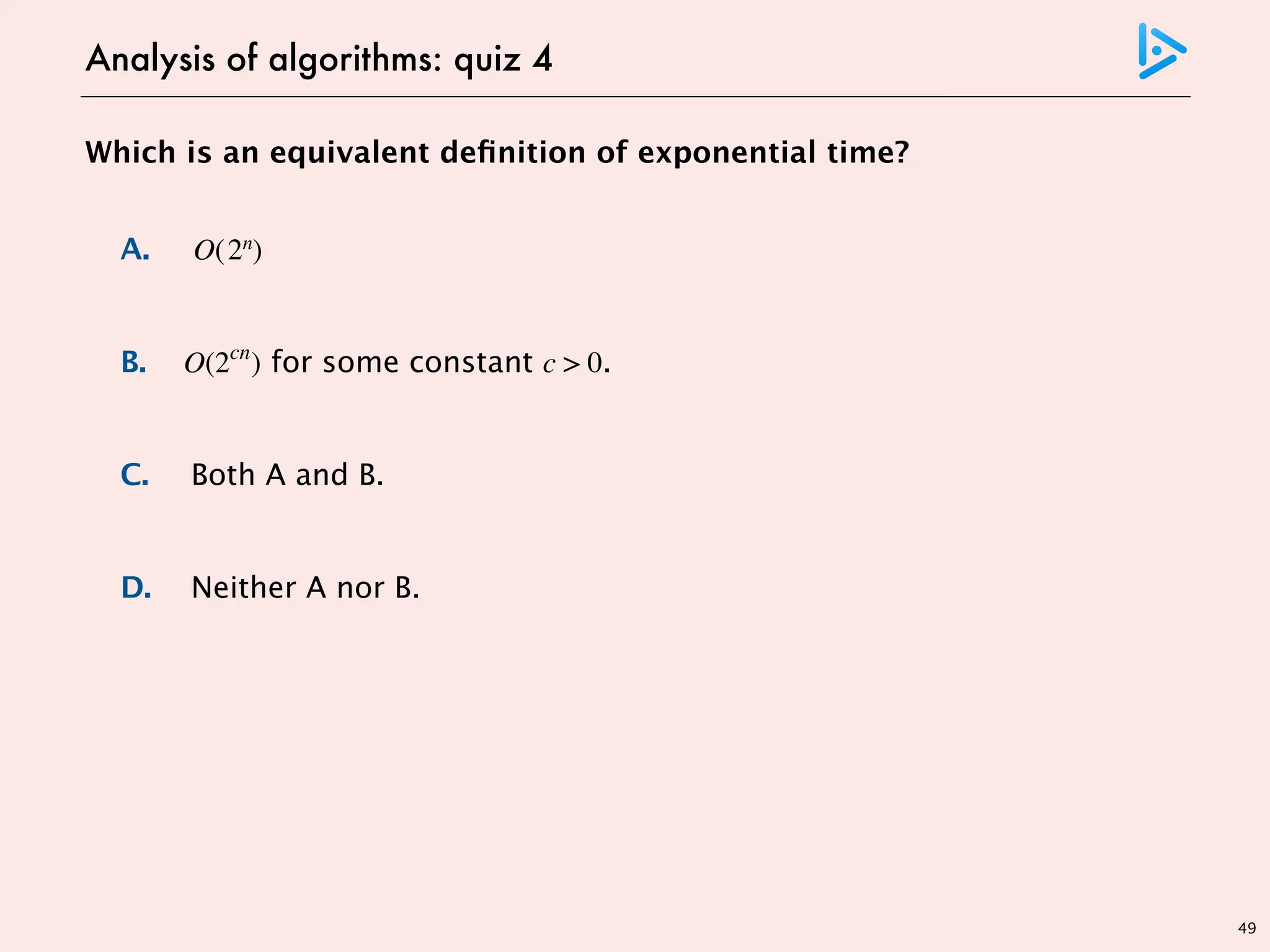
49.
49
Which is anequivalent definition of exponential time?
A. O(2n
)
B. O(2cn
) for some constant c > 0.
C. Both A and B.
D. Neither A nor B.
Analysis of algorithms: quiz 4
doesn’t include 3n
includes 3n but doesn’t include n! = 2Θ(n log n)
![Models of computation: word RAM
Word RAM.
・Each memory location and input/output cell stores a w-bit integer.
・Primitive operations: arithmetic/logic operations, read/write memory,
array indexing, following a pointer, conditional branch, …
Running time. Number of primitive operations.
Memory. Number of memory cells utilized.
Caveat. At times, need more refined model (e.g., multiplying n-bit integers). 5
…
input
output …
.
.
.
memory
program
assume w ≥ log2 n
i
a[i]
constant-time C-style operations
(w = 64)](https://image.slidesharecdn.com/02algorithmanalysis-250915081406-a8050609/75/02AlgorithmAnalysisbyJonKleinbergandEvaTardos-pdf-5-2048.jpg)
![Polynomial running time
We say that an algorithm is efficient if it has a polynomial running time.
Theory. Definition is (relatively) insensitive to model of computation.
Practice. It really works!
・The poly-time algorithms that people develop have both
small constants and small exponents.
・Breaking through the exponential barrier of brute force typically
exposes some crucial structure of the problem.
Exceptions. Some poly-time algorithms in the wild
have galactic constants and/or huge exponents.
Q. Which would you prefer: 20 n120
or n1 + 0.02 ln n ?
8
Map graphs in polynomial time
Mikkel Thorup
Department of Computer Science, University of Copenhag
Universitetsparken 1, DK-2100 Copenhagen East, Denma
mthorup@diku.dk
Abstract
Chen,Grigni, andPapadimitriou(WADS’97andSTOC’98)
have introduced a modified notion of planarity, where two
faces are considered adjacent if they share at least one point.
The corresponding abstract graphs are called map graphs.
Chen et.al. raised the question of whether map graphs can be
recognized in polynomial time. They showed that the decision
problem is in NP and presented a polynomial time algorithm
for the special case where we allow at most 4 faces to intersect
in any point — if only 3 are allowed to intersect in a point, we
get the usual planar graphs.
Chen et.al. conjectured that map graphs can be recognized
in polynomial time, and in this paper, their conjectureis settled
affirmatively.
1. Introduction
Recently Chen, Grigni, and Papadimitriou [4, 5] suggested
the study of a modified notion of planarity. The basic frame-
Figure 1. Large
addition, the hamantach may h
touching all three corners. In
all the different types of large
showed that recognizing map
recognition can be done in sing
they conjectured that, in fact, m
polynomial time. They suppor
that if we allow at most 4 faces
resulting map graphs canbe rec
this paper, we settle the genera
a graph, we can decide in polyn
The algorithm can easily be m
Map graphs in polynomial time
Mikkel Thorup
Department of Computer Science, University of Copenhagen
Universitetsparken 1, DK-2100 Copenhagen East, Denmark
mthorup@diku.dk
Abstract
Chen,Grigni, andPapadimitriou(WADS’97andSTOC’98)
have introduced a modified notion of planarity, where two
faces are considered adjacent if they share at least one point.
The corresponding abstract graphs are called map graphs.
Chen et.al. raised the question of whether map graphs can be
recognized in polynomial time. They showed that the decision
problem is in NP and presented a polynomial time algorithm
for the special case where we allow at most 4 faces to intersect
in any point — if only 3 are allowed to intersect in a point, we
get the usual planar graphs.
Chen et.al. conjectured that map graphs can be recognized
in polynomial time, and in this paper, their conjectureis settled
affirmatively.
1. Introduction
Recently Chen, Grigni, and Papadimitriou [4, 5] suggested
Figure 1. Large cliques in maps
addition, the hamantach may have at most two triangle faces
touching all three corners. In [5] there is a classification of
all the different types of large cliques in maps. Chen et.al. [5]
showed that recognizing map graphs is in NP, hence that the
recognition can be done in singly exponential time. However,
they conjectured that, in fact, map graphs can be recognized in
polynomial time. They supported their conjecture by showing
that if we allow at most 4 faces to meet in any single point, the
resulting map graphs canbe recognizedin polynomial time. In
this paper, we settle the general conjecture, showing that given
n120](https://image.slidesharecdn.com/02algorithmanalysis-250915081406-a8050609/75/02AlgorithmAnalysisbyJonKleinbergandEvaTardos-pdf-8-2048.jpg)
![Efficient implementation
Goal. Implement Gale–Shapley to run in O(n 2) time.
Representing hospitals and students. Index hospitals and students 1, …, n.
Representing the matching.
・Maintain two arrays student[h] and hospital[s].
- if h matched to s, then student[h] = s and hospital[s] = h
- use value 0 to designate that hospital or student is unmatched
・Can add/remove a pair from matching in O(1) time.
・Maintain set of unmatched hospitals in a queue (or stack).
・Can find an unmatched hospital in O(1) time.
26](https://image.slidesharecdn.com/02algorithmanalysis-250915081406-a8050609/75/02AlgorithmAnalysisbyJonKleinbergandEvaTardos-pdf-26-2048.jpg)
![Student accepts/rejects a proposal.
・Does student s prefer hospital h to hospital hʹ ?
・For each student, create inverse of preference list of hospitals.
Bottom line. After Θ(n2
) preprocessing time (to create the n ranking arrays),
it takes O(1) time to accept/reject a proposal.
1st 2nd 3rd 4th 5th 6th 7th 8th
8 3 7 1 4 5 6 2
pref[]
Data representation: accepting/rejecting a proposal
28
for i = 1 to n
rank[pref[i]] = i
student prefers hospital 4 to 6
1 2 3 4 5 6 7 8
4th 8th 2nd 5th 6th 7th 3rd 1st
rank[]
since rank[4] < rank[6]](https://image.slidesharecdn.com/02algorithmanalysis-250915081406-a8050609/75/02AlgorithmAnalysisbyJonKleinbergandEvaTardos-pdf-28-2048.jpg)
![Logarithmic time
Logarithmic time. Running time is O(log n).
Search in a sorted array. Given a sorted array A of n distinct integers and an
integer x, find index of x in array.
O(log n) algorithm. Binary search.
・Invariant: If x is in the array, then x is in A[lo .. hi].
・After k iterations of WHILE loop, (hi − lo + 1) ≤ n / 2k k ≤ 1 + log2 n.
35
lo ← 1; hi ← n.
WHILE (lo ≤ hi)
mid ← ⎣(lo + hi) / 2⎦.
IF (x < A[mid]) hi ← mid − 1.
ELSE IF (x > A[mid]) lo ← mid + 1.
ELSE RETURN mid.
RETURN −1.
remaining elements](https://image.slidesharecdn.com/02algorithmanalysis-250915081406-a8050609/75/02AlgorithmAnalysisbyJonKleinbergandEvaTardos-pdf-35-2048.jpg)
![38
SEARCH IN A SORTED ROTATED ARRAY
SEARCH-IN-SORTED-ROTATED-ARRAY. Given a rotated sorted array of n distinct
integers and an element x, determine if x is in the array.
O(log n) algorithm.
・Find index k of smallest element.
・Binary search for x in either A[1 .. k−1] or A[k .. n].
lo ← 1; hi ← n.
IF (A[lo] ≤ A[hi]) RETURN 0
WHILE (lo + 2 ≤ hi)
mid ← ⎣(lo + hi) / 2⎦.
IF (A[mid] < A[hi]) hi ← mid.
ELSE IF (A[mid] > A[hi]) lo ← mid.
RETURN hi
loop invariant
A[lo] > A[hi]
at least 3 elements
find index of smallest element
sorted](https://image.slidesharecdn.com/02algorithmanalysis-250915081406-a8050609/75/02AlgorithmAnalysisbyJonKleinbergandEvaTardos-pdf-38-2048.jpg)
![Linearithmic time
Linearithmic time. Running time is O(n log n).
Sorting. Given an array of n elements, rearrange them in ascending order.
O(n log n) algorithm. Mergesort.
39
Trace of merge results for top-down mergesort
a[]
0 1 2 3 4 5 6 7 8 9 10 11 12 13 14 15
M E R G E S O R T E X A M P L E
a, aux, 0, 0, 1) E M R G E S O R T E X A M P L E
a, aux, 2, 2, 3) E M G R E S O R T E X A M P L E
aux, 0, 1, 3) E G M R E S O R T E X A M P L E
a, aux, 4, 4, 5) E G M R E S O R T E X A M P L E
a, aux, 6, 6, 7) E G M R E S O R T E X A M P L E
aux, 4, 5, 7) E G M R E O R S T E X A M P L E
ux, 0, 3, 7) E E G M O R R S T E X A M P L E
a, aux, 8, 8, 9) E E G M O R R S E T X A M P L E
a, aux, 10, 10, 11) E E G M O R R S E T A X M P L E
aux, 8, 9, 11) E E G M O R R S A E T X M P L E
a, aux, 12, 12, 13) E E G M O R R S A E T X M P L E
a, aux, 14, 14, 15) E E G M O R R S A E T X M P E L
aux, 12, 13, 15) E E G M O R R S A E T X E L M P
ux, 8, 11, 15) E E G M O R R S A E E L M P T X
, 0, 7, 15) A E E E E G L M M O P R R S T X
lo hi](https://image.slidesharecdn.com/02algorithmanalysis-250915081406-a8050609/75/02AlgorithmAnalysisbyJonKleinbergandEvaTardos-pdf-39-2048.jpg)
![Quadratic time
Quadratic time. Running time is O(n2).
Closest pair of points. Given a list of n points in the plane (x1, y1), …, (xn, yn),
find the pair that is closest to each other.
O(n2) algorithm. Enumerate all pairs of points (with i < j).
Remark. Ω(n2
) seems inevitable, but this is just an illusion. [see §5.4]
42
min ← ∞.
FOR i = 1 TO n
FOR j = i + 1 TO n
d ← (xi − xj)2 + (yi − yj)2.
IF (d < min)
min ← d.](https://image.slidesharecdn.com/02algorithmanalysis-250915081406-a8050609/75/02AlgorithmAnalysisbyJonKleinbergandEvaTardos-pdf-42-2048.jpg)
![Cubic time
Cubic time. Running time is O(n3).
3-SUM. Given an array of n distinct integers, find three that sum to 0.
O(n3) algorithm. Enumerate all triples (with i < j < k).
Remark. Ω(n3
) seems inevitable, but O(n2
) is not hard. [see next slide]
43
FOR i = 1 TO n
FOR j = i + 1 TO n
FOR k = j + 1 TO n
IF (ai + aj + ak = 0)
RETURN (ai, aj, ak).](https://image.slidesharecdn.com/02algorithmanalysis-250915081406-a8050609/75/02AlgorithmAnalysisbyJonKleinbergandEvaTardos-pdf-43-2048.jpg)