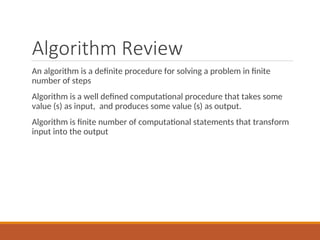
Algorithm Review
An algorithmis a definite procedure for solving a problem in finite
number of steps
Algorithm is a well defined computational procedure that takes some
value (s) as input, and produces some value (s) as output.
Algorithm is finite number of computational statements that transform
input into the output
3.
Good Algorithms?
Run inless time
Consume less memory
But computational resources (time complexity) is usually more
important
4.
Measuring Efficiency
The efficiencyof an algorithm is a measure of the
amount of resources consumed in solving a
problem of size n.
◦ The resource we are most interested in is time
◦ We can use the same techniques to analyze the consumption of
other resources, such as memory space.
It would seem that the most obvious way to
measure the efficiency of an algorithm is to run it
and measure how much processor time is needed
But is it correct???
Running Time ofan Algorithm
Depends upon
◦ Input Size
◦ Nature of Input
Generally time grows with size of input, so running time of an algorithm
is usually measured as function of input size.
Running time is measured in terms of number of steps/primitive
operations performed
Independent from machine, OS
7.
Finding running timeof an Algorithm /
Analyzing an Algorithm
Running time is measured by number of steps/primitive operations
performed
Steps means elementary operation like
◦ ,+, *,<, =, A[i] etc
We will measure number of steps taken in term of size of input
8.
Simple Example (1)
//Input: int A[N], array of N integers
// Output: Sum of all numbers in array A
int Sum(int A[], int N)
{
int s=0;
for (int i=0; i< N; i++)
s = s + A[i];
return s;
}
How should we analyse this?
9.
Simple Example (2)
//Input: int A[N], array of N integers
// Output: Sum of all numbers in array A
int Sum(int A[], int N){
int s=0;
for (int i=0; i< N; i++)
s = s + A[i];
return s;
}
1
2 3 4
5 6 7
8
1,2,8: Once
3,4,5,6,7: Once per each iteration
of for loop, N iteration
Total: 5N + 3
The complexity function of the
algorithm is : f(N) = 5N +3
10.
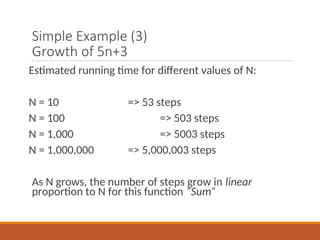
Simple Example (3)
Growthof 5n+3
Estimated running time for different values of N:
N = 10 => 53 steps
N = 100 => 503 steps
N = 1,000 => 5003 steps
N = 1,000,000 => 5,000,003 steps
As N grows, the number of steps grow in linear
proportion to N for this function “Sum”
11.
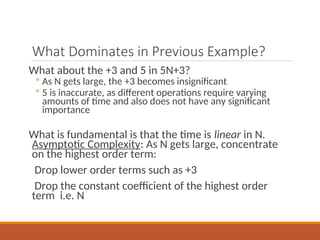
What Dominates inPrevious Example?
What about the +3 and 5 in 5N+3?
◦ As N gets large, the +3 becomes insignificant
◦ 5 is inaccurate, as different operations require varying
amounts of time and also does not have any significant
importance
What is fundamental is that the time is linear in N.
Asymptotic Complexity: As N gets large, concentrate
on the highest order term:
Drop lower order terms such as +3
Drop the constant coefficient of the highest order
term i.e. N
12.
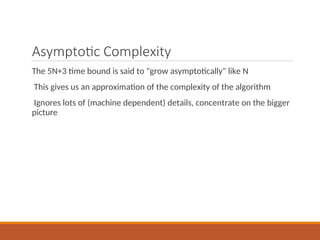
Asymptotic Complexity
The 5N+3time bound is said to "grow asymptotically" like N
This gives us an approximation of the complexity of the algorithm
Ignores lots of (machine dependent) details, concentrate on the bigger
picture
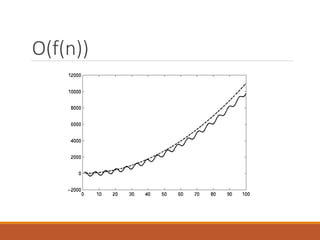
Big Oh Notation[1]
If f(N) and g(N) are two complexity functions, we say
f(N) = O(g(N))
(read "f(N) is order g(N)", or "f(N) is big-O of g(N)")
if there are constants c and N0 such that for N > N0,
f(N) ≤ c * g(N)
for all sufficiently large N.
15.
Big Oh Notation[2]
O(f(n)) =
{g(n) : there exists positive constants c and n0 such that 0 <= g(n) <= c f(n) }
O(f(n)) is a set of functions.
n = O(n2
) means that function n belongs to the set of functions O(n2
)
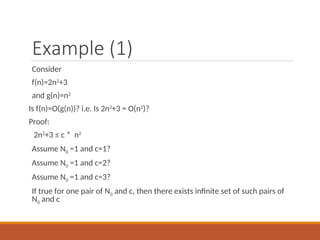
Example (1)
Consider
f(n)=2n2
+3
and g(n)=n2
Isf(n)=O(g(n))? i.e. Is 2n2
+3 = O(n2
)?
Proof:
2n2
+3 ≤ c * n2
Assume N0 =1 and c=1?
Assume N0 =1 and c=2?
Assume N0 =1 and c=3?
If true for one pair of N0 and c, then there exists infinite set of such pairs of
N0 and c
18.
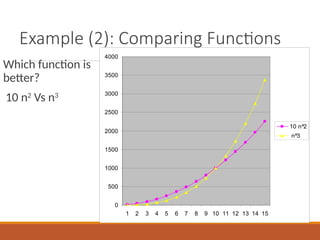
Example (2): ComparingFunctions
Which function is
better?
10 n2
Vs n3
0
500
1000
1500
2000
2500
3000
3500
4000
1 2 3 4 5 6 7 8 9 10 11 12 13 14 15
10 n^2
n^3
19.
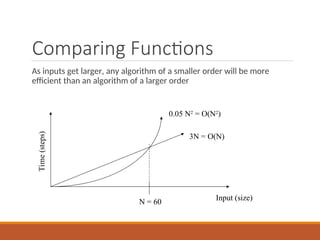
Comparing Functions
As inputsget larger, any algorithm of a smaller order will be more
efficient than an algorithm of a larger order
Time
(steps)
Input (size)
3N = O(N)
0.05 N2
= O(N2
)
N = 60
20.
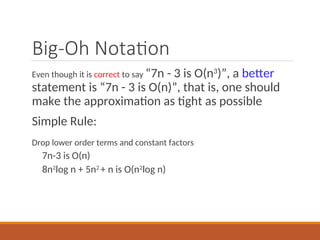
Big-Oh Notation
Even thoughit is correct to say “7n - 3 is O(n3
)”, a better
statement is “7n - 3 is O(n)”, that is, one should
make the approximation as tight as possible
Simple Rule:
Drop lower order terms and constant factors
7n-3 is O(n)
8n2
log n + 5n2
+ n is O(n2
log n)
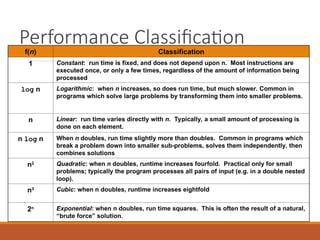
Performance Classification
f(n) Classification
1Constant: run time is fixed, and does not depend upon n. Most instructions are
executed once, or only a few times, regardless of the amount of information being
processed
log n Logarithmic: when n increases, so does run time, but much slower. Common in
programs which solve large problems by transforming them into smaller problems.
n Linear: run time varies directly with n. Typically, a small amount of processing is
done on each element.
n log n When n doubles, run time slightly more than doubles. Common in programs which
break a problem down into smaller sub-problems, solves them independently, then
combines solutions
n2 Quadratic: when n doubles, runtime increases fourfold. Practical only for small
problems; typically the program processes all pairs of input (e.g. in a double nested
loop).
n3 Cubic: when n doubles, runtime increases eightfold
2n Exponential: when n doubles, run time squares. This is often the result of a natural,
“brute force” solution.
Size does matter[2]
Supposea program has run time O(n!) and the run time for
n = 10 is 1 second
For n = 12, the run time is 2 minutes
For n = 14, the run time is 6 hours
For n = 16, the run time is 2 months
For n = 18, the run time is 50 years
For n = 20, the run time is 200 centuries
25.
Standard Analysis Techniques
Constanttime statements
Analyzing Loops
Analyzing Nested Loops
Analyzing Sequence of Statements
Analyzing Conditional Statements
26.
Constant time statements
Simplestcase: O(1) time statements
Assignment statements of simple data types
int x = y;
Arithmetic operations:
x = 5 * y + 4 - z;
Array referencing:
A[j] = 5;
Array assignment:
j, A[j] = 5;
Most conditional tests:
if (x < 12) ...
27.
Analyzing Loops[1]
Any loophas two parts:
◦ How many iterations are performed?
◦ How many steps per iteration?
int sum = 0,j;
for (j=0; j < N; j++)
sum = sum +j;
◦ Loop executes N times (0..N-1)
◦ 4 = O(1) steps per iteration
Total time is N * O(1) = O(N*1) = O(N)
28.
Analyzing Loops[2]
What aboutthis for loop?
int sum =0, j;
for (j=0; j < 100; j++)
sum = sum +j;
Loop executes 100 times
4 = O(1) steps per iteration
Total time is 100 * O(1) = O(100 * 1) = O(100) = O(1)
29.
Analyzing Nested Loops[1]
Treatjust like a single loop and evaluate each level of
nesting as needed:
int j,k;
for (j=0; j<N; j++)
for (k=N; k>0; k--)
sum += k+j;
Start with outer loop:
◦ How many iterations? N
◦ How much time per iteration? Need to evaluate inner loop
Inner loop uses O(N) time
Total time is N * O(N) = O(N*N) = O(N2
)
30.
Analyzing Nested Loops[2]
Whatif the number of iterations of one loop depends on the counter of
the other?
int j,k;
for (j=0; j < N; j++)
for (k=0; k < j; k++)
sum += k+j;
Analyze inner and outer loop together:
Number of iterations of the inner loop is:
0 + 1 + 2 + ... + (N-1) = O(N2
)
31.
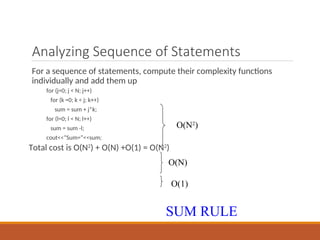
Analyzing Sequence ofStatements
For a sequence of statements, compute their complexity functions
individually and add them up
for (j=0; j < N; j++)
for (k =0; k < j; k++)
sum = sum + j*k;
for (l=0; l < N; l++)
sum = sum -l;
cout<<“Sum=”<<sum;
Total cost is O(N2
) + O(N) +O(1) = O(N2
)
SUM RULE
O(N2
)
O(N)
O(1)
32.
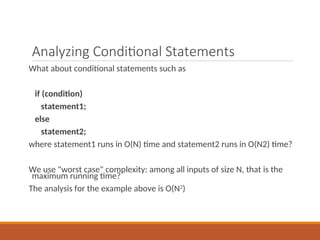
Analyzing Conditional Statements
Whatabout conditional statements such as
if (condition)
statement1;
else
statement2;
where statement1 runs in O(N) time and statement2 runs in O(N2) time?
We use "worst case" complexity: among all inputs of size N, that is the
maximum running time?
The analysis for the example above is O(N2
)
33.
Best Case
Best caseis defined as which input of size n is cheapest among all
inputs of size n.
“The best case for my algorithm is n=1 because that is the fastest.”
WRONG!
Misunderstanding
34.
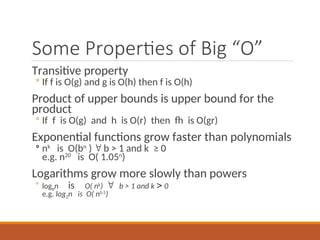
Some Properties ofBig “O”
Transitive property
◦ If f is O(g) and g is O(h) then f is O(h)
Product of upper bounds is upper bound for the
product
◦ If f is O(g) and h is O(r) then fh is O(gr)
Exponential functions grow faster than polynomials
◦ nk
is O(bn
) b > 1 and k ≥ 0
e.g. n20
is O( 1.05n
)
Logarithms grow more slowly than powers
◦ logbn isO( nk
) b > 1 and k 0
e.g. log2n is O( n0.5
)
![Finding running time of an Algorithm /
Analyzing an Algorithm
Running time is measured by number of steps/primitive operations
performed
Steps means elementary operation like
◦ ,+, *,<, =, A[i] etc
We will measure number of steps taken in term of size of input](https://image.slidesharecdn.com/lec-3timecomplexity-250823134012-0ed1afa8/85/Lec-3-Time-Complexity-OR-THW-STUDENTS-OF-7-320.jpg)
![Simple Example (1)
// Input: int A[N], array of N integers
// Output: Sum of all numbers in array A
int Sum(int A[], int N)
{
int s=0;
for (int i=0; i< N; i++)
s = s + A[i];
return s;
}
How should we analyse this?](https://image.slidesharecdn.com/lec-3timecomplexity-250823134012-0ed1afa8/85/Lec-3-Time-Complexity-OR-THW-STUDENTS-OF-8-320.jpg)
![Simple Example (2)
// Input: int A[N], array of N integers
// Output: Sum of all numbers in array A
int Sum(int A[], int N){
int s=0;
for (int i=0; i< N; i++)
s = s + A[i];
return s;
}
1
2 3 4
5 6 7
8
1,2,8: Once
3,4,5,6,7: Once per each iteration
of for loop, N iteration
Total: 5N + 3
The complexity function of the
algorithm is : f(N) = 5N +3](https://image.slidesharecdn.com/lec-3timecomplexity-250823134012-0ed1afa8/85/Lec-3-Time-Complexity-OR-THW-STUDENTS-OF-9-320.jpg)
![Big Oh Notation [1]
If f(N) and g(N) are two complexity functions, we say
f(N) = O(g(N))
(read "f(N) is order g(N)", or "f(N) is big-O of g(N)")
if there are constants c and N0 such that for N > N0,
f(N) ≤ c * g(N)
for all sufficiently large N.](https://image.slidesharecdn.com/lec-3timecomplexity-250823134012-0ed1afa8/85/Lec-3-Time-Complexity-OR-THW-STUDENTS-OF-14-320.jpg)
![Big Oh Notation [2]
O(f(n)) =
{g(n) : there exists positive constants c and n0 such that 0 <= g(n) <= c f(n) }
O(f(n)) is a set of functions.
n = O(n2
) means that function n belongs to the set of functions O(n2
)](https://image.slidesharecdn.com/lec-3timecomplexity-250823134012-0ed1afa8/85/Lec-3-Time-Complexity-OR-THW-STUDENTS-OF-15-320.jpg)
![Size does matter[1]
What happens if we double the input size N?
Nlog2N 5N N log2N N2
2N
8 3 40 24 64 256
16 4 80 64 256 65536
32 5 160 160 1024 ~109
64 6 320 384 4096 ~1019
128 7 640 896 16384 ~1038
256 8 1280 2048 65536 ~1076](https://image.slidesharecdn.com/lec-3timecomplexity-250823134012-0ed1afa8/85/Lec-3-Time-Complexity-OR-THW-STUDENTS-OF-23-320.jpg)
![Size does matter[2]
Suppose a program has run time O(n!) and the run time for
n = 10 is 1 second
For n = 12, the run time is 2 minutes
For n = 14, the run time is 6 hours
For n = 16, the run time is 2 months
For n = 18, the run time is 50 years
For n = 20, the run time is 200 centuries](https://image.slidesharecdn.com/lec-3timecomplexity-250823134012-0ed1afa8/85/Lec-3-Time-Complexity-OR-THW-STUDENTS-OF-24-320.jpg)
![Constant time statements
Simplest case: O(1) time statements
Assignment statements of simple data types
int x = y;
Arithmetic operations:
x = 5 * y + 4 - z;
Array referencing:
A[j] = 5;
Array assignment:
j, A[j] = 5;
Most conditional tests:
if (x < 12) ...](https://image.slidesharecdn.com/lec-3timecomplexity-250823134012-0ed1afa8/85/Lec-3-Time-Complexity-OR-THW-STUDENTS-OF-26-320.jpg)
![Analyzing Loops[1]
Any loop has two parts:
◦ How many iterations are performed?
◦ How many steps per iteration?
int sum = 0,j;
for (j=0; j < N; j++)
sum = sum +j;
◦ Loop executes N times (0..N-1)
◦ 4 = O(1) steps per iteration
Total time is N * O(1) = O(N*1) = O(N)](https://image.slidesharecdn.com/lec-3timecomplexity-250823134012-0ed1afa8/85/Lec-3-Time-Complexity-OR-THW-STUDENTS-OF-27-320.jpg)
![Analyzing Loops[2]
What about this for loop?
int sum =0, j;
for (j=0; j < 100; j++)
sum = sum +j;
Loop executes 100 times
4 = O(1) steps per iteration
Total time is 100 * O(1) = O(100 * 1) = O(100) = O(1)](https://image.slidesharecdn.com/lec-3timecomplexity-250823134012-0ed1afa8/85/Lec-3-Time-Complexity-OR-THW-STUDENTS-OF-28-320.jpg)
![Analyzing Nested Loops[1]
Treat just like a single loop and evaluate each level of
nesting as needed:
int j,k;
for (j=0; j<N; j++)
for (k=N; k>0; k--)
sum += k+j;
Start with outer loop:
◦ How many iterations? N
◦ How much time per iteration? Need to evaluate inner loop
Inner loop uses O(N) time
Total time is N * O(N) = O(N*N) = O(N2
)](https://image.slidesharecdn.com/lec-3timecomplexity-250823134012-0ed1afa8/85/Lec-3-Time-Complexity-OR-THW-STUDENTS-OF-29-320.jpg)
![Analyzing Nested Loops[2]
What if the number of iterations of one loop depends on the counter of
the other?
int j,k;
for (j=0; j < N; j++)
for (k=0; k < j; k++)
sum += k+j;
Analyze inner and outer loop together:
Number of iterations of the inner loop is:
0 + 1 + 2 + ... + (N-1) = O(N2
)](https://image.slidesharecdn.com/lec-3timecomplexity-250823134012-0ed1afa8/85/Lec-3-Time-Complexity-OR-THW-STUDENTS-OF-30-320.jpg)