Preliminaries

    Marko Schütz-Schmuck

 Department of Mathematical Sciences
 University of Puerto Rico at Mayagüez
             Mayagüez, PR


          24 August 2011


Marko Schütz-Schmuck   Preliminaries
Outline


          Marko Schütz-Schmuck   Preliminaries
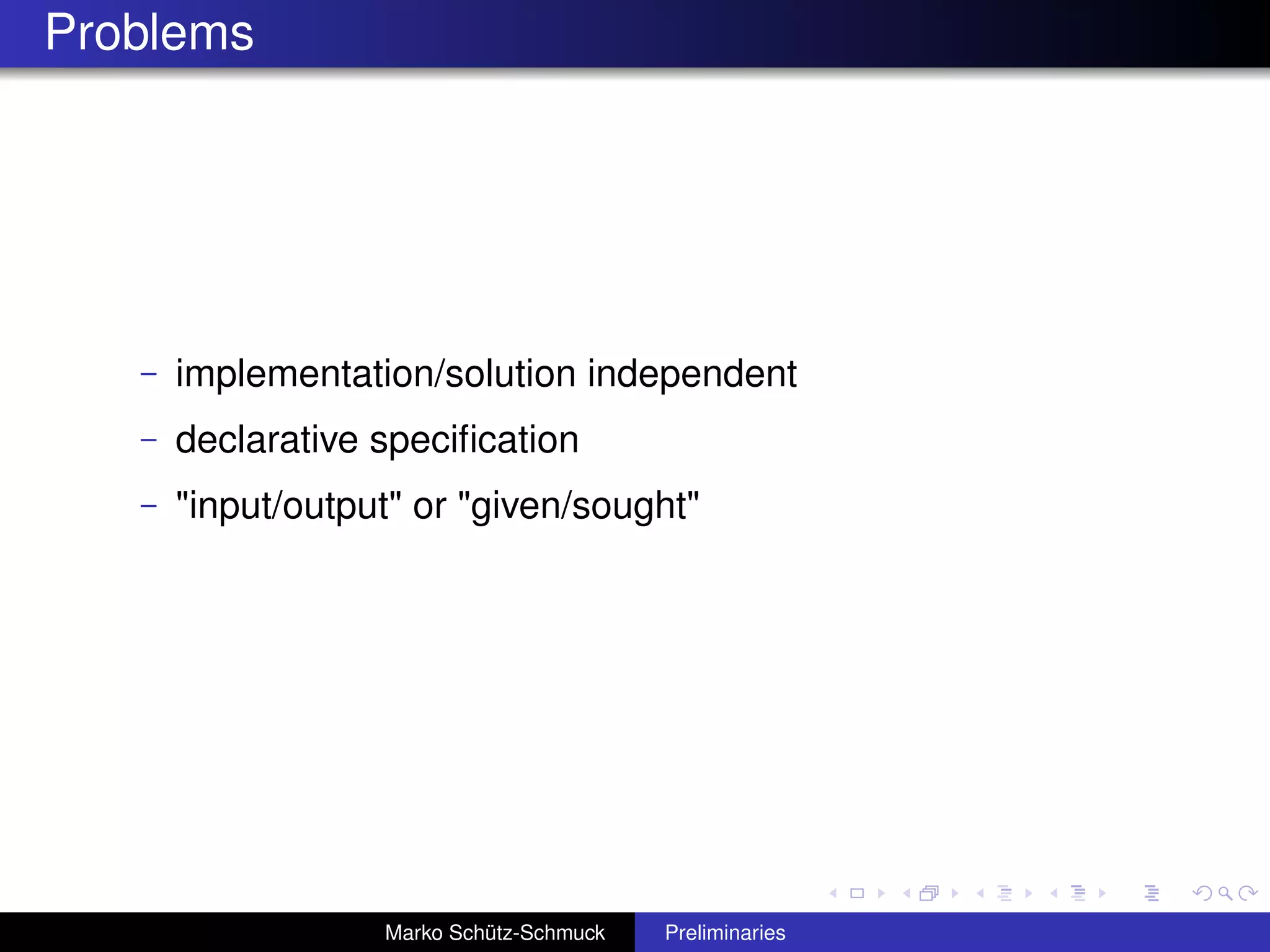
Problems


   –   implementation/solution independent
   –   declarative specification
   –   "input/output" or "given/sought"


                   Marko Schütz-Schmuck   Preliminaries
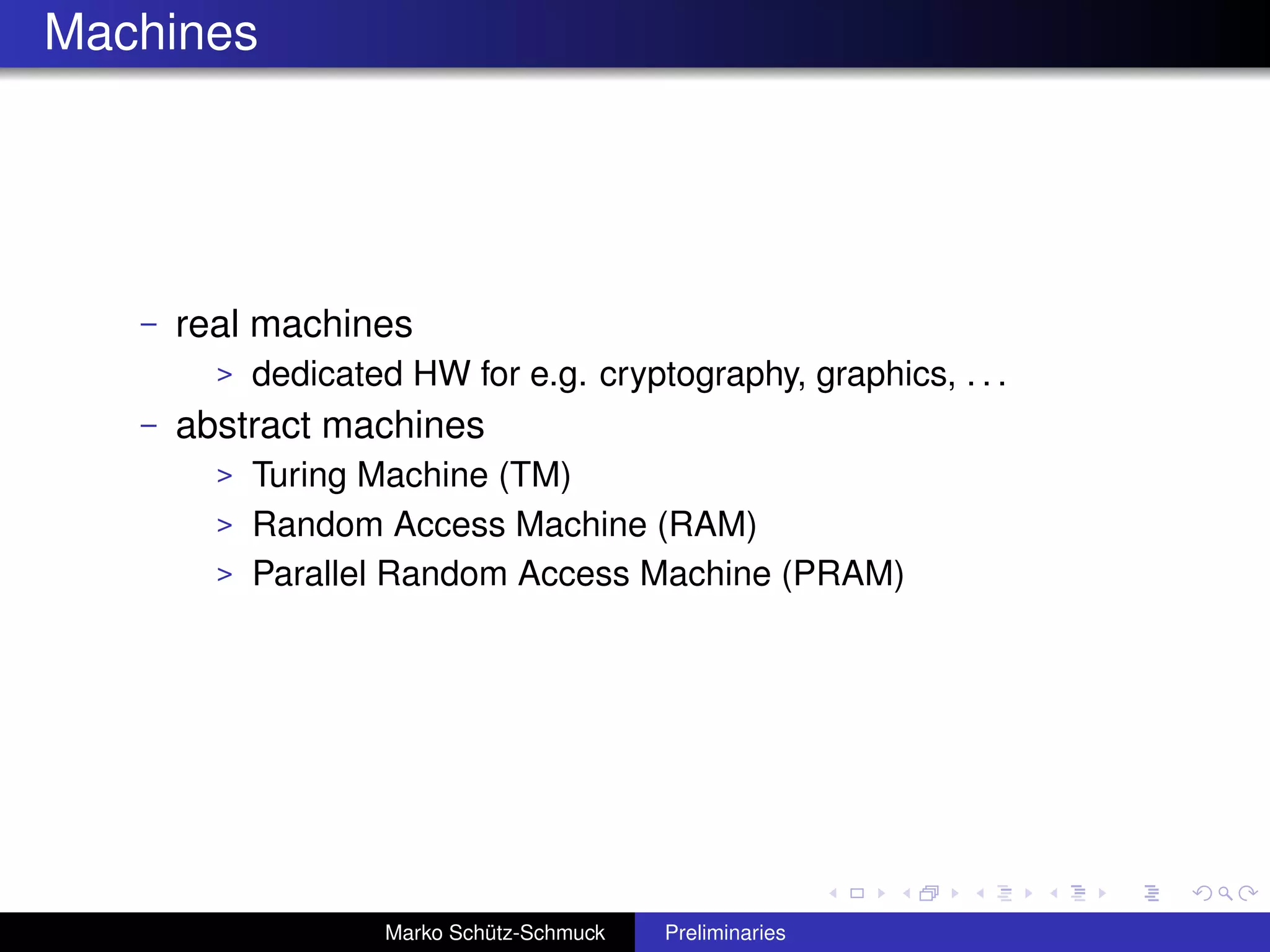
Machines


   –   real machines
         >   dedicated HW for e.g. cryptography, graphics, . . .
   –   abstract machines
         > Turing Machine (TM)
         > Random Access Machine (RAM)
         > Parallel Random Access Machine (PRAM)


                     Marko Schütz-Schmuck   Preliminaries
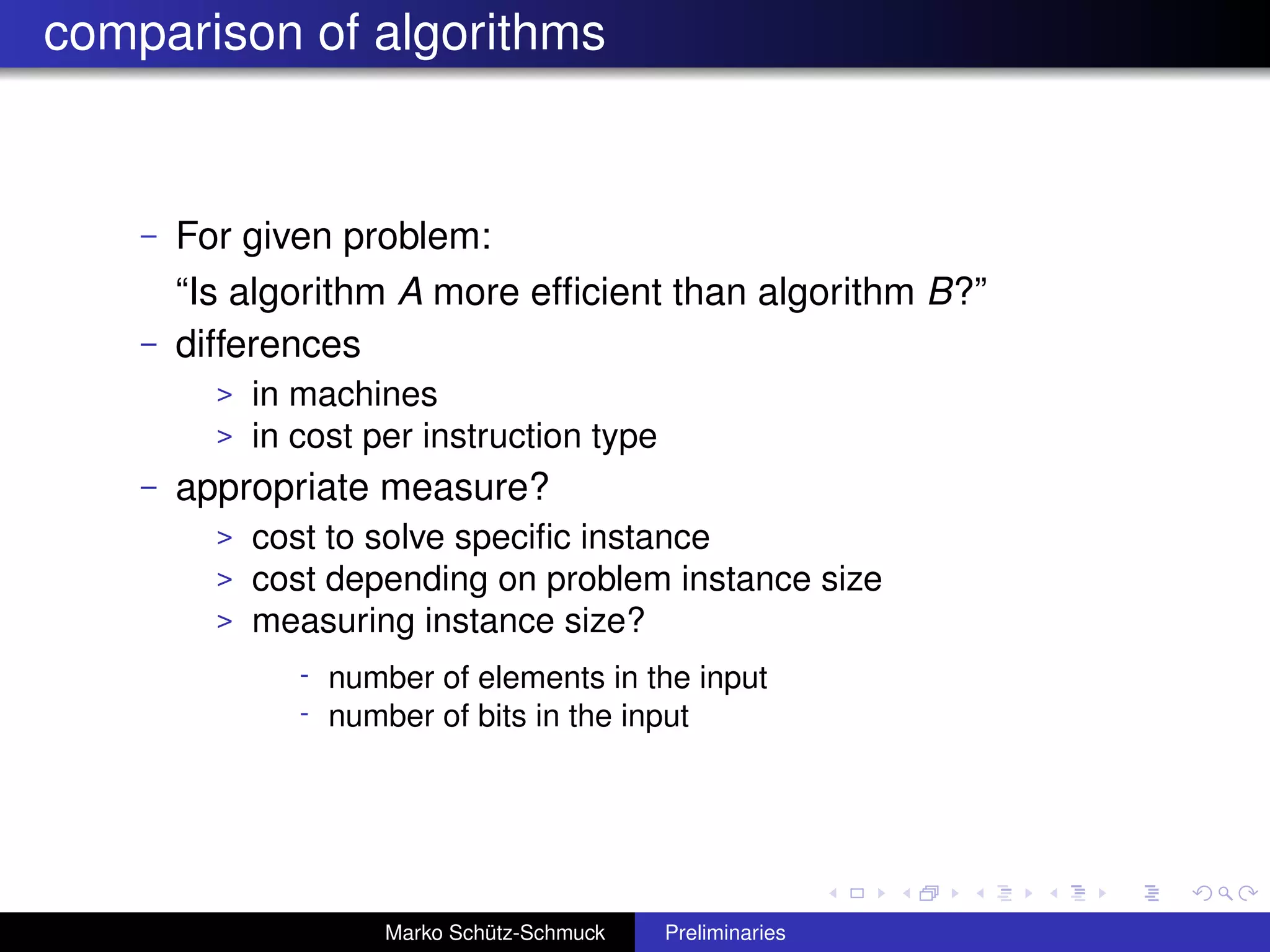
comparison of algorithms


    –   For given problem:
        “Is algorithm A more efficient than algorithm B?”
    –   differences
          >   in machines
          >   in cost per instruction type
    –   appropriate measure?
          >   cost to solve specific instance
          >   cost depending on problem instance size
          >   measuring instance size?
                 - number of elements in the input
                 - number of bits in the input


                       Marko Schütz-Schmuck   Preliminaries
O(·): "order of"


    –   theoretical justification
          > time: linear speed-up theorem
          > space: tape compression theorem


                     Marko Schütz-Schmuck   Preliminaries
example: insertion sort


  f o r j ← 2 to l e n g t h [ A ]
     do key ← A [ j ]
          i ← j − 1
         while i > 0 and A [ i ] > key
            do A [ i + 1 ] ← A [ i ]
                i ← i − 1
         A [ i + 1 ] ← key

    –   best case
        here: already sorted
    –   worst case
        here: inversely sorted


                    Marko Schütz-Schmuck   Preliminaries
worst-case and average case analysis


    –   worst-case: upper bound for running time on any input
        example: data set with frequent addition of data: search. . .
    –   average-case: often almost as bad as worst-case
        sometimes difficult to even choose a suitable distribution
    –   why is best-case running time meaningless?


                    Marko Schütz-Schmuck   Preliminaries
more efficient


    –   disregard constants
    –   compare only asymptotic growth
    –   possibly


                   Marko Schütz-Schmuck   Preliminaries
algorithm design


    –   incremental, e.g. insertion sort
    –   divide-and-conquer, e.g. merge sort


                    Marko Schütz-Schmuck   Preliminaries
MERGE(A, p, q, r)

  n1 ← q − p + 1
  n2 ← r − q
  c r e a t e a r r a y s L [ 1 . . n1 + 1 ] and R[ 1 . . n2 + 1 ]
  f o r i ← 1 to n1
      do L [ i ] ← A [ p + i − 1 ]
  f o r j ← 1 to n2
      do R[ j ] ← A [ q + j ]
  L [ n1 + 1 ] ← R[ n2 + 1 ] ← ∞
  i ← j ← 1
  f o r k ← p to r
      do i f L [ i ] ≤ R [ j ]
         then A [ k ] ← L [ i ]
             i ← i + 1
          else A [ k ] ← R[ j ]
             j ← j + 1

                   Marko Schütz-Schmuck   Preliminaries
merge correctness


   –   assume A[p..q] and A[q + 1..r ] are each sorted
   –   invariant
       The sub-array A[p..k − 1] contains the k − p smallest
       elements of L[1..n1 + 1] and R[1..n2 + 1], in sorted order.
       Moreover, L[i] and R[j] are the smallest elements of their
       arrays that have not been copied back into A.


                   Marko Schütz-Schmuck   Preliminaries
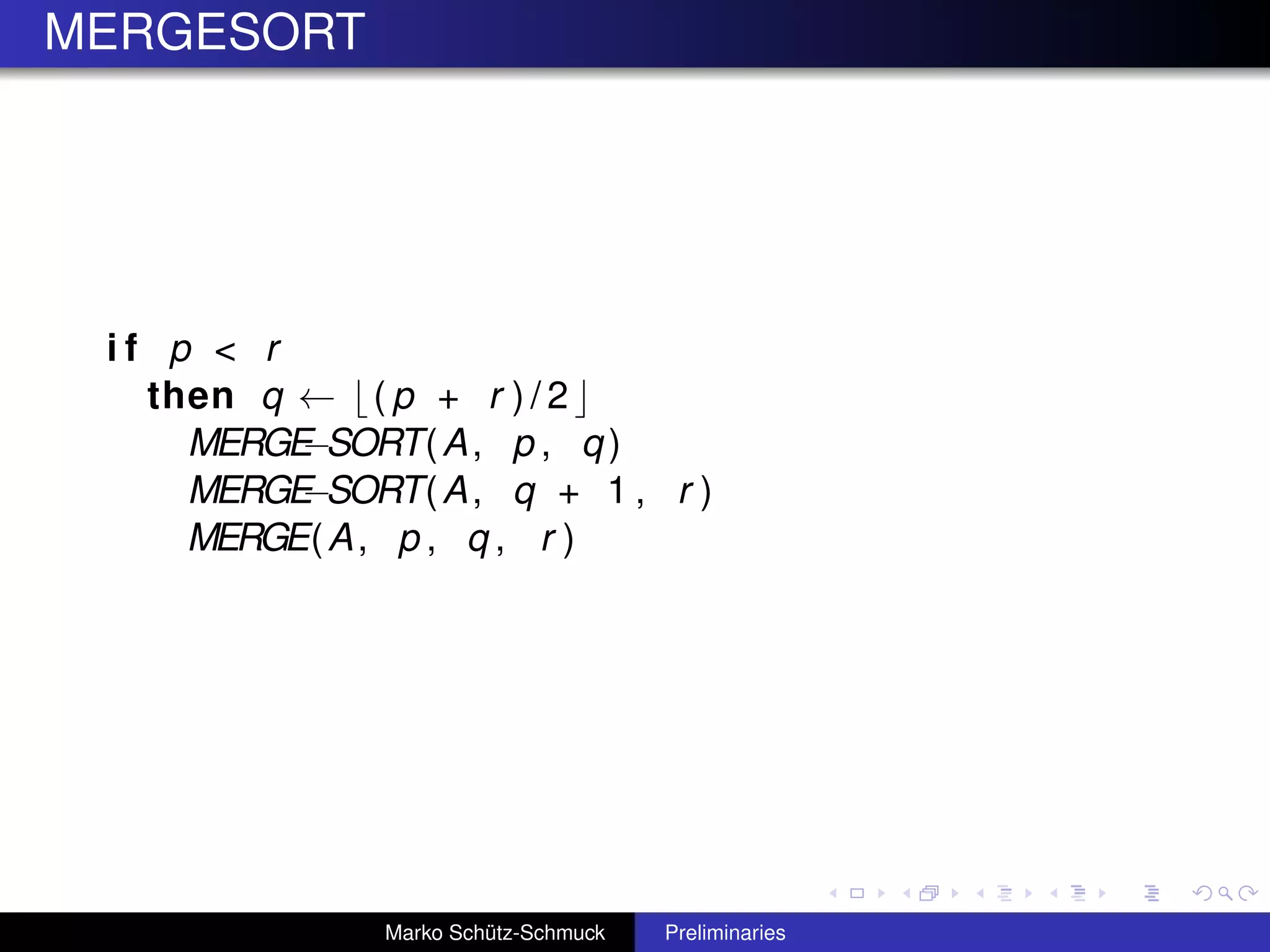
MERGESORT


 if p < r
   then q ← ( p + r ) / 2
     MERGE−SORT( A , p , q )
     MERGE−SORT( A , q + 1 , r )
     MERGE( A , p , q , r )


               Marko Schütz-Schmuck   Preliminaries
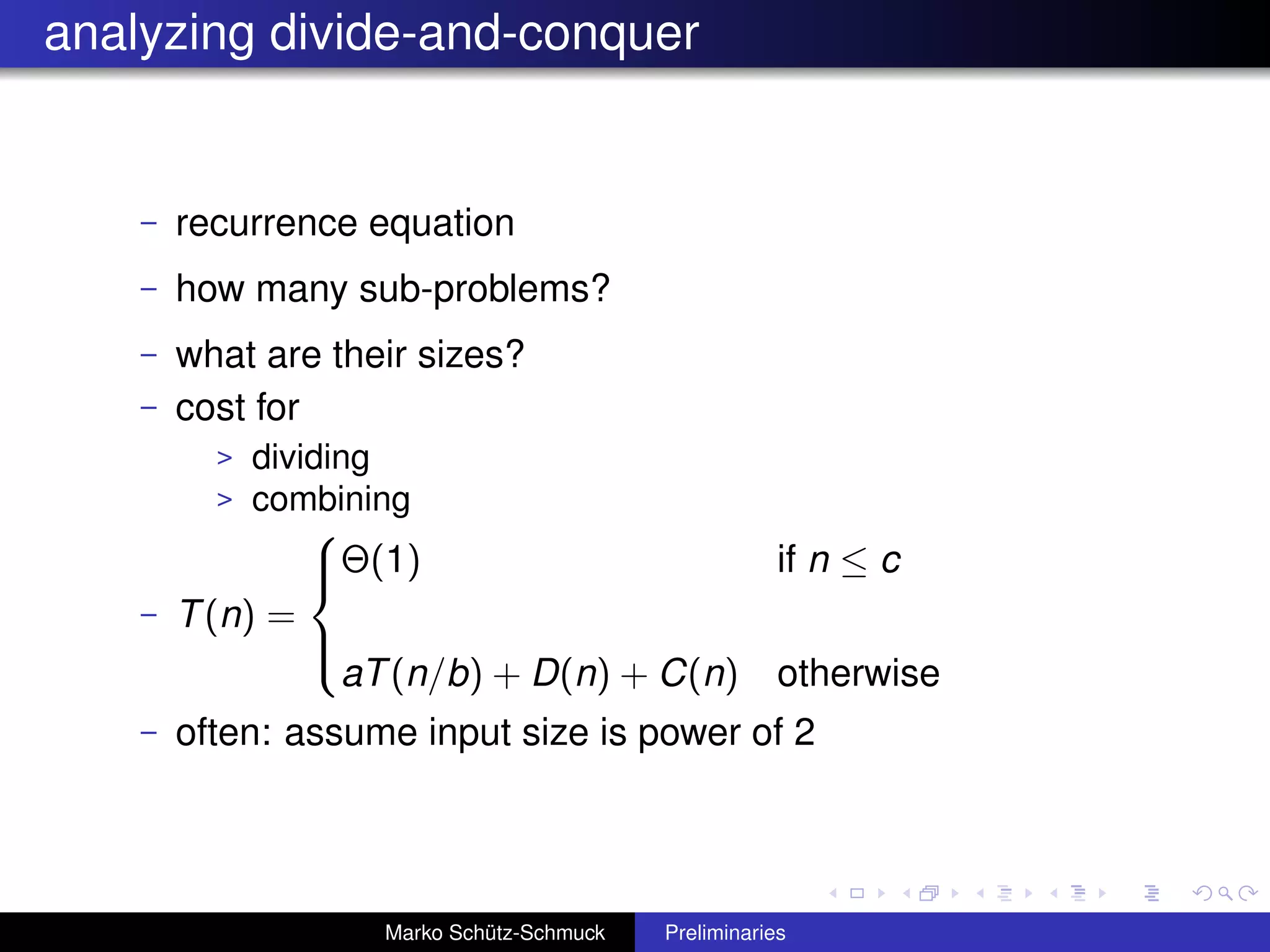
analyzing divide-and-conquer


    –   recurrence equation
    –   how many sub-problems?
    –   what are their sizes?
    –   cost for
          >   dividing
          >   combining
                  
                  Θ(1)
                                                        if n ≤ c
    –   T (n) =
                  
                   aT (n/b) + D(n) + C(n) otherwise
                  

    –   often: assume input size is power of 2


                      Marko Schütz-Schmuck   Preliminaries
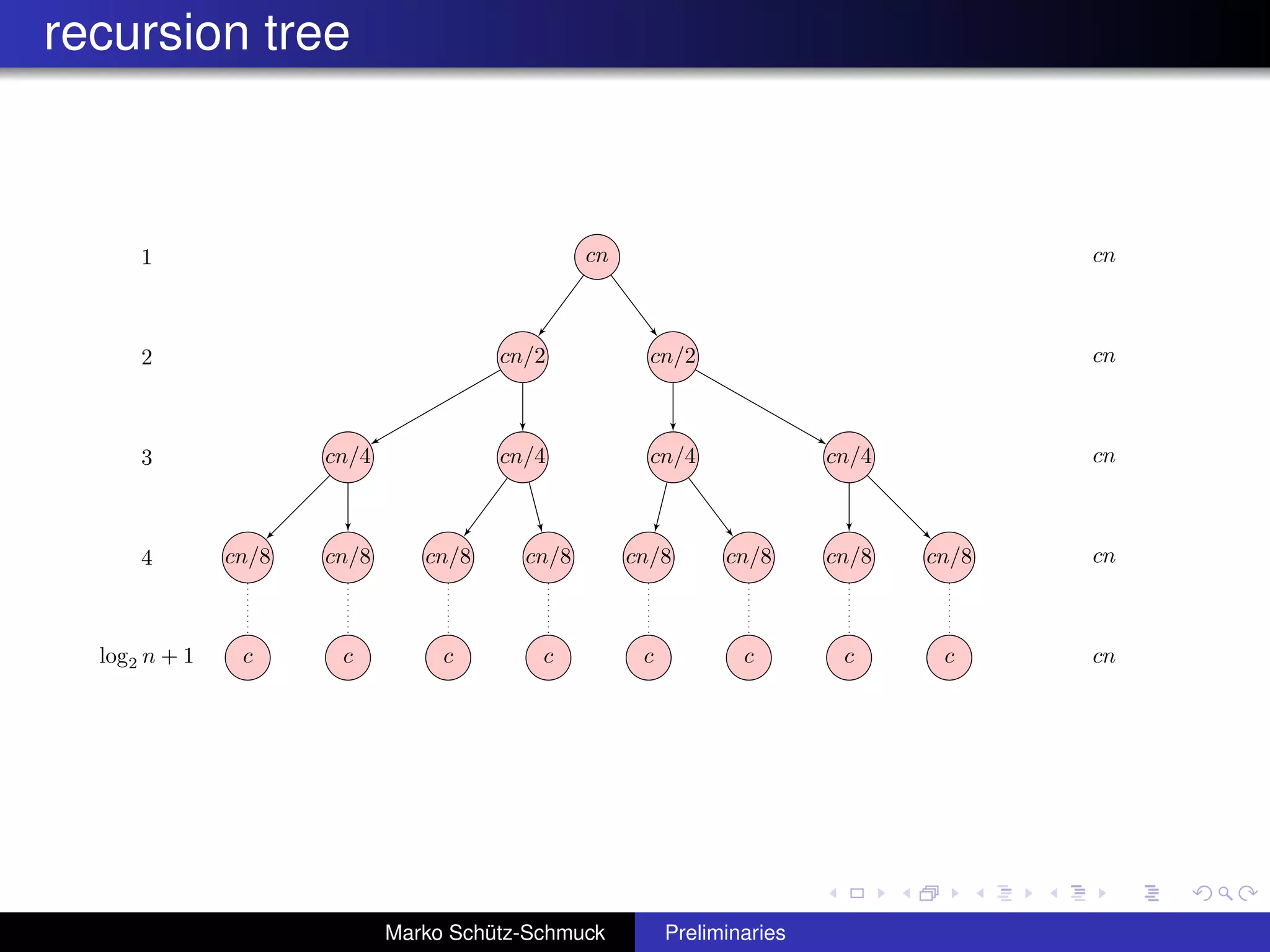
recursion tree


      1                                         cn                                      cn


      2                                cn/2            cn/2                             cn


      3               cn/4             cn/4            cn/4               cn/4          cn


      4        cn/8   cn/8      cn/8     cn/8        cn/8       cn/8      cn/8   cn/8   cn


  log2 n + 1    c      c          c        c          c           c        c      c     cn


                             Marko Schütz-Schmuck         Preliminaries
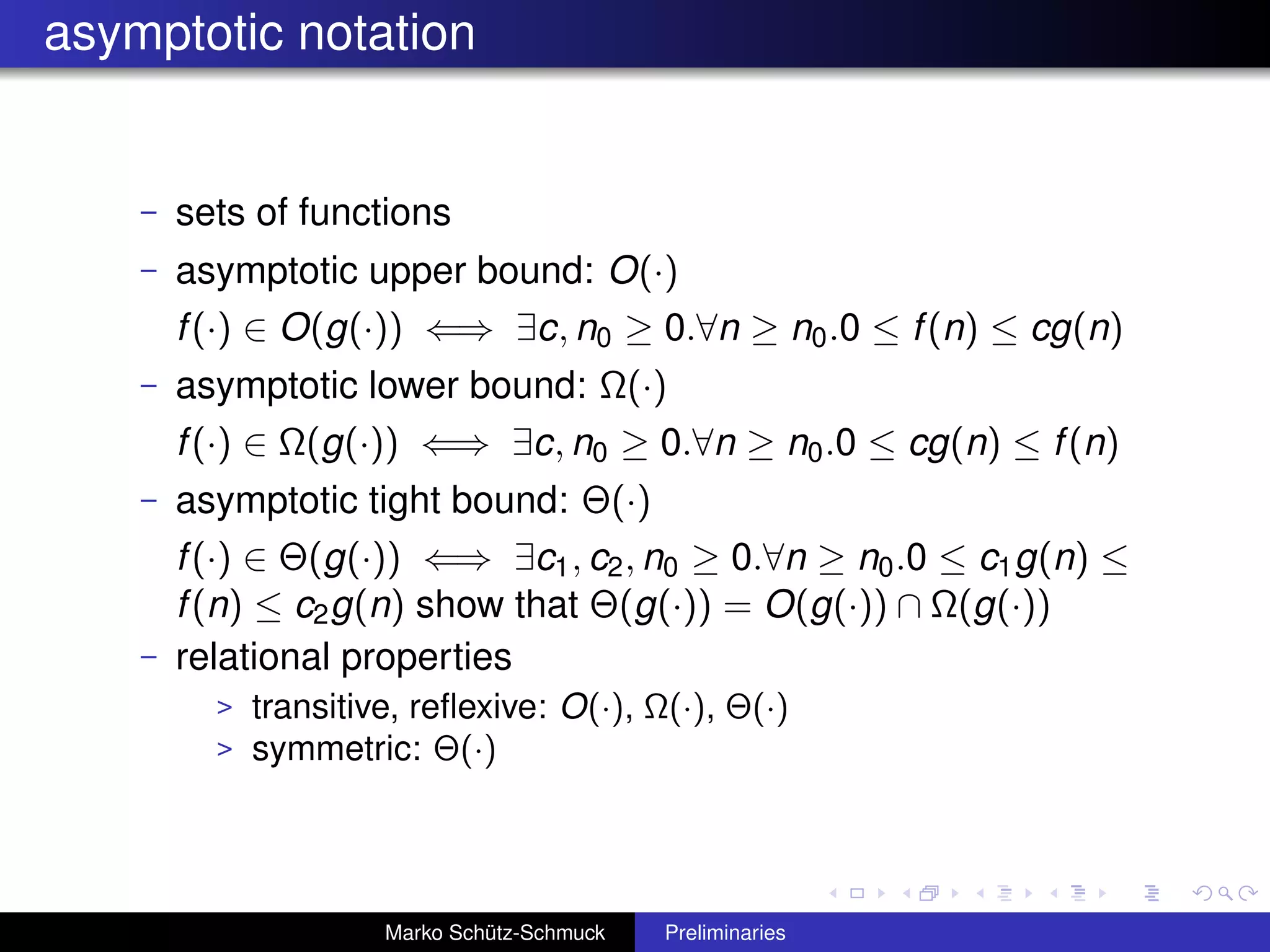
asymptotic notation


    –   sets of functions
    –   asymptotic upper bound: O(·)
        f (·) ∈ O(g(·)) ⇐⇒ ∃c, n0 ≥ 0.∀n ≥ n0 .0 ≤ f (n) ≤ cg(n)
    –   asymptotic lower bound: Ω(·)
        f (·) ∈ Ω(g(·)) ⇐⇒ ∃c, n0 ≥ 0.∀n ≥ n0 .0 ≤ cg(n) ≤ f (n)
    –   asymptotic tight bound: Θ(·)
        f (·) ∈ Θ(g(·)) ⇐⇒ ∃c1 , c2 , n0 ≥ 0.∀n ≥ n0 .0 ≤ c1 g(n) ≤
        f (n) ≤ c2 g(n) show that Θ(g(·)) = O(g(·)) ∩ Ω(g(·))
    –   relational properties
          >   transitive, reflexive: O(·), Ω(·), Θ(·)
          >   symmetric: Θ(·)


                       Marko Schütz-Schmuck   Preliminaries

02 preliminaries

  • 1.
    Preliminaries Marko Schütz-Schmuck Department of Mathematical Sciences University of Puerto Rico at Mayagüez Mayagüez, PR 24 August 2011 Marko Schütz-Schmuck Preliminaries
  • 2.
    Outline Marko Schütz-Schmuck Preliminaries
  • 3.
    Problems – implementation/solution independent – declarative specification – "input/output" or "given/sought" Marko Schütz-Schmuck Preliminaries
  • 4.
    Machines – real machines > dedicated HW for e.g. cryptography, graphics, . . . – abstract machines > Turing Machine (TM) > Random Access Machine (RAM) > Parallel Random Access Machine (PRAM) Marko Schütz-Schmuck Preliminaries
  • 5.
    comparison of algorithms – For given problem: “Is algorithm A more efficient than algorithm B?” – differences > in machines > in cost per instruction type – appropriate measure? > cost to solve specific instance > cost depending on problem instance size > measuring instance size? - number of elements in the input - number of bits in the input Marko Schütz-Schmuck Preliminaries
  • 6.
    O(·): "order of" – theoretical justification > time: linear speed-up theorem > space: tape compression theorem Marko Schütz-Schmuck Preliminaries
  • 7.
    example: insertion sort f o r j ← 2 to l e n g t h [ A ] do key ← A [ j ] i ← j − 1 while i > 0 and A [ i ] > key do A [ i + 1 ] ← A [ i ] i ← i − 1 A [ i + 1 ] ← key – best case here: already sorted – worst case here: inversely sorted Marko Schütz-Schmuck Preliminaries
  • 8.
    worst-case and averagecase analysis – worst-case: upper bound for running time on any input example: data set with frequent addition of data: search. . . – average-case: often almost as bad as worst-case sometimes difficult to even choose a suitable distribution – why is best-case running time meaningless? Marko Schütz-Schmuck Preliminaries
  • 9.
    more efficient – disregard constants – compare only asymptotic growth – possibly Marko Schütz-Schmuck Preliminaries
  • 10.
    algorithm design – incremental, e.g. insertion sort – divide-and-conquer, e.g. merge sort Marko Schütz-Schmuck Preliminaries
  • 11.
    MERGE(A, p, q,r) n1 ← q − p + 1 n2 ← r − q c r e a t e a r r a y s L [ 1 . . n1 + 1 ] and R[ 1 . . n2 + 1 ] f o r i ← 1 to n1 do L [ i ] ← A [ p + i − 1 ] f o r j ← 1 to n2 do R[ j ] ← A [ q + j ] L [ n1 + 1 ] ← R[ n2 + 1 ] ← ∞ i ← j ← 1 f o r k ← p to r do i f L [ i ] ≤ R [ j ] then A [ k ] ← L [ i ] i ← i + 1 else A [ k ] ← R[ j ] j ← j + 1 Marko Schütz-Schmuck Preliminaries
  • 12.
    merge correctness – assume A[p..q] and A[q + 1..r ] are each sorted – invariant The sub-array A[p..k − 1] contains the k − p smallest elements of L[1..n1 + 1] and R[1..n2 + 1], in sorted order. Moreover, L[i] and R[j] are the smallest elements of their arrays that have not been copied back into A. Marko Schütz-Schmuck Preliminaries
  • 13.
    MERGESORT if p< r then q ← ( p + r ) / 2 MERGE−SORT( A , p , q ) MERGE−SORT( A , q + 1 , r ) MERGE( A , p , q , r ) Marko Schütz-Schmuck Preliminaries
  • 14.
    analyzing divide-and-conquer – recurrence equation – how many sub-problems? – what are their sizes? – cost for > dividing > combining  Θ(1)  if n ≤ c – T (n) =  aT (n/b) + D(n) + C(n) otherwise  – often: assume input size is power of 2 Marko Schütz-Schmuck Preliminaries
  • 15.
    recursion tree 1 cn cn 2 cn/2 cn/2 cn 3 cn/4 cn/4 cn/4 cn/4 cn 4 cn/8 cn/8 cn/8 cn/8 cn/8 cn/8 cn/8 cn/8 cn log2 n + 1 c c c c c c c c cn Marko Schütz-Schmuck Preliminaries
  • 16.
    asymptotic notation – sets of functions – asymptotic upper bound: O(·) f (·) ∈ O(g(·)) ⇐⇒ ∃c, n0 ≥ 0.∀n ≥ n0 .0 ≤ f (n) ≤ cg(n) – asymptotic lower bound: Ω(·) f (·) ∈ Ω(g(·)) ⇐⇒ ∃c, n0 ≥ 0.∀n ≥ n0 .0 ≤ cg(n) ≤ f (n) – asymptotic tight bound: Θ(·) f (·) ∈ Θ(g(·)) ⇐⇒ ∃c1 , c2 , n0 ≥ 0.∀n ≥ n0 .0 ≤ c1 g(n) ≤ f (n) ≤ c2 g(n) show that Θ(g(·)) = O(g(·)) ∩ Ω(g(·)) – relational properties > transitive, reflexive: O(·), Ω(·), Θ(·) > symmetric: Θ(·) Marko Schütz-Schmuck Preliminaries