Information management process— Assessment and need
The appointing party shall establish the project’s information requirements, as described in
ISO 19650-1:2018, 5.3, to address the questions to which the appointing party needs answer(s)
at each of the key decision points throughout the project.
In doing this, the appointing party shall consider:
— the project scope;
— the intended purpose for which the information will be used by the appointing party;
— the project plan of work;
— the intended procurement route;
— the number of key decision points throughout the project;
— the decisions that the appointing party needs to make at each key decision point; and
— the questions to which the appointing party needs answers, to make informed decisions.
The appointing party should consider (1) Tasks of lead appointed party will responsible (2)
authority that appointed party will delegate to lead appointed party (3) competency that lead
appointed party need.
1. Appointing party selects lead appointed party
2. Appointing party Establishes the project’s information requirements
2.
The appointing partyshall establish the project’s information delivery milestones in
accordance with the project’s plan of work.
In doing this, the appointing party shall consider:
— the appointing party’s key decision points;
— its own information delivery obligations (if any);
— the nature and substance of information to be delivered at each key decision point; and
— the date(s) relative to each key decision point that the information model is to be
delivered.
3. Appointing party establishes the project’s information delivery milestones
Information management process — Assessment and need
3.
4. Appointing partyestablishes the project’s information standard
The appointing party shall establish any specific information standards required by
the appointing party’s organization within the project’s information standard.
In doing this, the appointing party shall consider:
a) the exchange of information:
— within the appointing party’s organization,
— between the appointing party and external stakeholders,
— between the appointing party and external operators or maintainers,
— between the prospective lead appointed party and the appointing party,
— between prospective appointed parties on the same project, and
— between interdependent projects;
b) the means of structuring and classifying information;
c) the method of assignment for level of information need; and
d) the use of information during the operational phase of the asset.
Information management process — Assessment and need
4.
5. Appointing partyestablishes the project’s information production methods and procedures
The appointing party shall establish any specific information production methods and
procedures required by their organization within the project’s information production methods
and procedures.
In doing this, the appointing party shall consider:
a) the capture of existing asset information;
b) the generation, review or approval of new information;
c) the security or distribution of information; and
d) the delivery of information to the appointing party.
Information management process — Assessment and need
5.
6. Appointing partyestablishes the project’s reference information and shared resources
The appointing party shall establish the reference information and shared resources that they intend
to share with the prospective lead appointed parties during the tender process or appointment, using
open data standards whenever possible to avoid duplication of effort and interoperability issues.
In doing this, the appointing party shall consider:
a) existing asset information:
— from within the appointing party’s organization;
— from adjacent asset owners (utility companies, etc.);
— under license from external providers (mapping and imagery, etc.); and
— within public libraries and other sources of historical records.
b) shared resources, for example:
— process output templates (BIM execution plan, master information delivery plan, etc.);
— information container templates (2D/3D geometrical models, documents, etc.);
— style libraries (lines, text and hatch, etc.); or
— object libraries (2D symbols, 3D objects, etc.).
c) library objects defined within national and regional standards.
Information management process — Assessment and need
6.
7. Appointing partyestablishes the project’s common data environment
The appointing party shall establish (implement, configure and support) the project’s common data
environment (CDE) to serve the overall requirements of the project and to support the collaborative
production of information.
The project’s common data environment shall enable:
a) each information container to have a unique ID, based upon an agreed and documented convention
comprised of fields separated by a delimiter;
b) each field to be assigned a value from an agreed and documented codification standard;
c) each information container to have the following attributes assigned:
— status (suitability);
— revision;
— classification (in accordance with the framework defined in ISO 12006-2);
d) the ability for information containers to transition between states;
e) the recording of the name of user and date when information container revisions transition between each
state; and
f) controlled access at an information container level.
It is strongly recommended that the project CDE is in place prior to issuing the invitation to tender, so that
information can be shared with tendering organizations in a secure manner.
Information management process — Assessment and need
7.
8. Appointing partyestablishes the project’s information protocol
The appointing party shall establish the project’s information protocol, as defined below,
including any associated license agreements, which will, subsequently and appropriately, be
incorporated into all appointments.
In doing this, the appointing party shall consider:
— specific obligations of the appointing party, prospective lead appointed parties and
prospective appointed parties relating to the management or production of information,
including the use of the project’s common data environment;
— any warranties or liabilities associated to the project information model;
— background and foreground intellectual property rights of information;
— the use of existing asset information;
— the use of shared resources;
— the use of information during the project, including any associated licensing terms; and
— the re-use of information following the appointment or in the event of termination.
Information management process — Assessment and need
8.
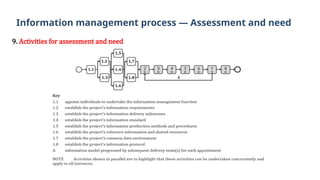
9. Activities forassessment and need
Information management process — Assessment and need
10.
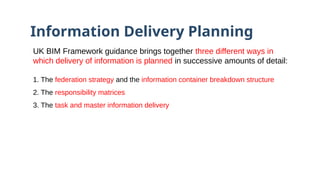
Information Delivery Planning
UKBIM Framework guidance brings together three different ways in
which delivery of information is planned in successive amounts of detail:
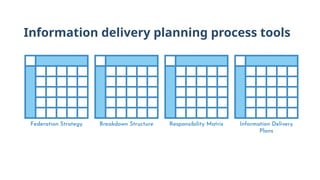
1. The federation strategy and the information container breakdown structure
2. The responsibility matrices
3. The task and master information delivery
Federation strategy
The purposeof the federation strategy and the Information Container
(model) breakdown structure is to help plan the production of
information by separate task teams to the appropriate Level of
Information Need at each project stage.
13.
Information Container Breakdown
Structure
•The breakdown of information containers relevant to their disciplines
should be outlined and defined in the BEP. The breakdown of these
information models should consider possible further splitting of the
models (due to size or package) at later stages and should be planned for.
• Identifying and breaking the information into packages/ zones early will
ensure the models' stability and size.
14.
Responsibility matrices
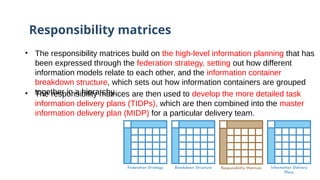
• Theresponsibility matrices build on the high-level information planning that has
been expressed through the federation strategy, setting out how different
information models relate to each other, and the information container
breakdown structure, which sets out how information containers are grouped
together in a hierarchy.
• The responsibility matrices are then used to develop the more detailed task
information delivery plans (TIDPs), which are then combined into the master
information delivery plan (MIDP) for a particular delivery team.
15.
Responsibility matrices
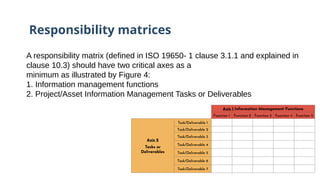
A responsibilitymatrix (defined in ISO 19650- 1 clause 3.1.1 and explained in
clause 10.3) should have two critical axes as a
minimum as illustrated by Figure 4:
1. Information management functions
2. Project/Asset Information Management Tasks or Deliverables
16.
Responsibility matrices
The responsibilitymatrix has two development stages:
• a “high level responsibility matrix”- (as part of the pre-appointment
• BIM execution plan) before an appointment is made between the
appointing party and lead appointed party.
• a “detailed responsibility matrix” - as part of confirming the
appointment.
For example
• a “high level responsibility matrix”-
“mechanical information”
• a “detailed responsibility matrix” - “air conditioning information” or “gas
distribution information”.
17.
High level responsibilitymatrix
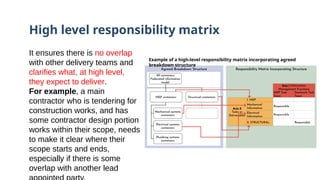
Example of a high-level responsibility matrix incorporating agreed
breakdown structure
It ensures there is no overlap
with other delivery teams and
clarifies what, at high level,
they expect to deliver.
For example, a main
contractor who is tendering for
construction works, and has
some contractor design portion
works within their scope, needs
to make it clear where their
scope starts and ends,
especially if there is some
overlap with another lead
18.
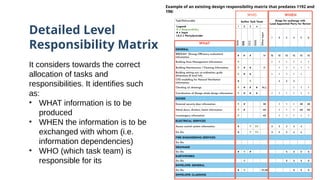
Detailed Level
Responsibility Matrix
Itconsiders towards the correct
allocation of tasks and
responsibilities. It identifies such
as:
• WHAT information is to be
produced
• WHEN the information is to be
exchanged with whom (i.e.
information dependencies)
• WHO (which task team) is
responsible for its
Example of an existing design responsibility matrix that predates 1192 and
19650 standards
19.
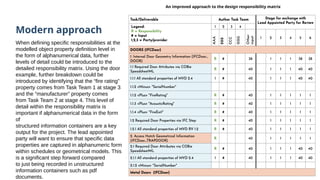
Modern approach
When definingspecific responsibilities at the
modelled object property definition level in
the form of alphanumerical data, further
levels of detail could be introduced to the
detailed responsibility matrix. Using the door
example, further breakdown could be
introduced by identifying that the “fire rating”
property comes from Task Team 1 at stage 3
and the “manufacturer” property comes
from Task Team 2 at stage 4. This level of
detail within the responsibility matrix is
important if alphanumerical data in the form
of
structured information containers are a key
output for the project. The lead appointed
party will want to ensure that specific data
properties are captured in alphanumeric form
within schedules or geometrical models. This
is a significant step forward compared
to just being recorded in unstructured
information containers such as pdf
documents.
An improved approach to the design responsibility matrix
20.
Process
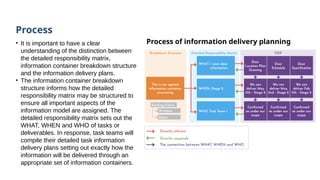
• It isimportant to have a clear
understanding of the distinction between
the detailed responsibility matrix,
information container breakdown structure
and the information delivery plans.
• The information container breakdown
structure informs how the detailed
responsibility matrix may be structured to
ensure all important aspects of the
information model are assigned. The
detailed responsibility matrix sets out the
WHAT, WHEN and WHO of tasks or
deliverables. In response, task teams will
compile their detailed task information
delivery plans setting out exactly how the
information will be delivered through an
appropriate set of information containers.
Process of information delivery planning
21.
Information delivery plans
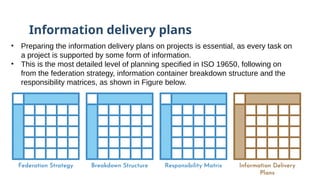
•Preparing the information delivery plans on projects is essential, as every task on
a project is supported by some form of information.
• This is the most detailed level of planning specified in ISO 19650, following on
from the federation strategy, information container breakdown structure and the
responsibility matrices, as shown in Figure below.
22.
Information delivery plans
Thetwo primary outputs of the information delivery planning process for each
delivery team are a set of TIDPs and their corresponding MIDP.
Task information delivery plan (TIDP)
Every team responsible for a task (a task team) must produce a delivery plan
for the
information relating to their respective works. This plan is referred to as the
TIDP.
23.
Task information deliveryplan (TIDP)
According to clause 5.4.4, the TIDP must then schedule out an agreed list of information containers to be
delivered, identifying for each one its:
1.Name and title
2.Predecessors or dependencies
3.Level of information need
4.Estimated time required for production
5.Author
6.Delivery milestones.
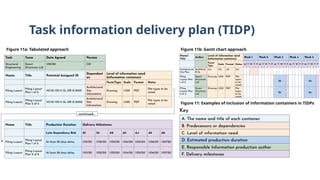
Figure 11 illustrates two approaches (a and b) for how information containers could be listed in a TIDP. The
figures adopt a colour-coded key to illustrate the alignment of each aspect of the TIDPs with the ISO 19650-2
requirements noted in section 4.4.1.
Figure 11a illustrates a tabulated approach, Figure 11b a Gantt chart approach. These are for illustration
purposes only (reflecting just two ways to approach a TIDP), and each delivery team should develop its own
approach appropriate to its appointment.
24.
Task information deliveryplan (TIDP)
Figure 11a: Tabulated approach Figure 11b: Gantt chart approach
Figure 11: Examples of inclusion of information containers in TIDPs
25.
Master information deliveryplan (MIDP)
The lead appointed party shall aggregate their appointed parties’ TIDPs to form
the delivery team’s MIDP. Clause 5.4.5 defines what the lead appointed party
shall consider when developing this aggregated plan, including:
• The assigned responsibilities within the detailed responsibility matrix
• Predecessor and dependency between the task teams
• Appointing party and lead appointed party review
Once the TIDPs have been aggregated, and taking the above into
consideration, the lead appointed party must:
• Baseline the deliverables and dates within the MIDP
• Notify each task team of changes
• Inform the appointing party of any



![[FREE PDF sample] Guidance Part 2 Processes for Project Delivery 4th Edition ...](https://cdn.slidesharecdn.com/ss_thumbnails/125776-250117013338-178f1b95-thumbnail.jpg?width=640&height=640&fit=bounds)


