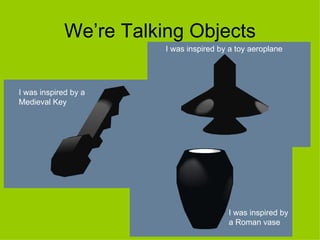
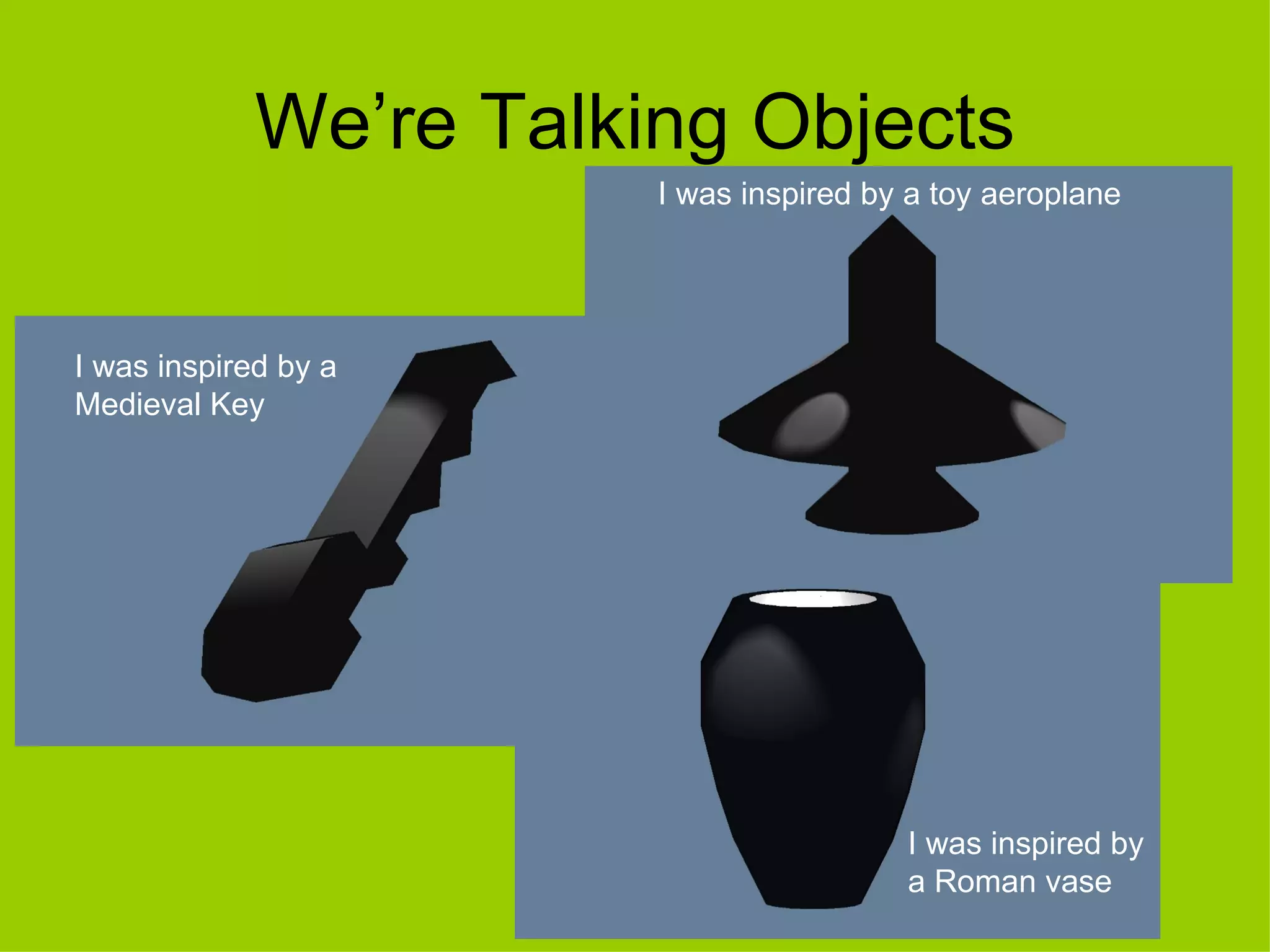
We’re Talking Objects
                        I was inspired by a toy aeroplane


I was inspired by a
Medieval Key


                                         I was inspired by
                                         a Roman vase
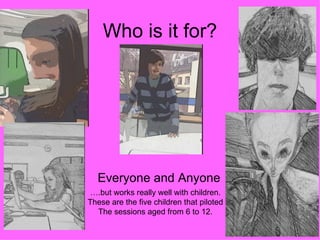
Who is it for?


  Everyone and Anyone
 ….but works really well with children.
These are the five children that piloted
  The sessions aged from 6 to 12.
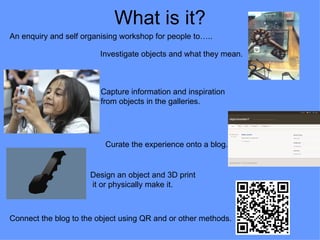
What is it?
An enquiry and self organising workshop for people to…..

                         Investigate objects and what they mean.


                         Capture information and inspiration
                         from objects in the galleries.


                          Curate the experience onto a blog.


                      Design an object and 3D print
                      it or physically make it.


Connect the blog to the object using QR and or other methods.
How does it work?
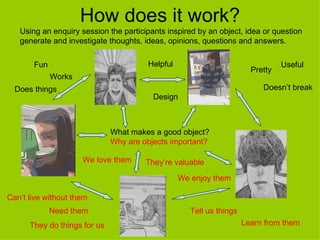
   Using an enquiry session the participants inspired by an object, idea or question
   generate and investigate thoughts, ideas, opinions, questions and answers.

       Fun                             Helpful                                  Useful
                                                                       Pretty
             Works
  Does things                                                             Doesn’t break
                                         Design


                              What makes a good object?
                              Why are objects important?

                     We love them      They’re valuable
                                                 We enjoy them

Can’t live without them
             Need them                              Tell us things
      They do things for us                                          Learn from them
How does it work?
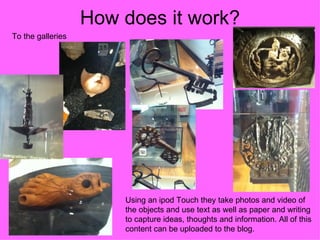
To the galleries


                       Using an ipod Touch they take photos and video of
                       the objects and use text as well as paper and writing
                       to capture ideas, thoughts and information. All of this
                       content can be uploaded to the blog.
How does it work?
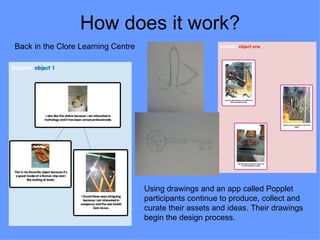
Back in the Clore Learning Centre


                                    Using drawings and an app called Popplet
                                    participants continue to produce, collect and
                                    curate their assets and ideas. Their drawings
                                    begin the design process.
How does it work?
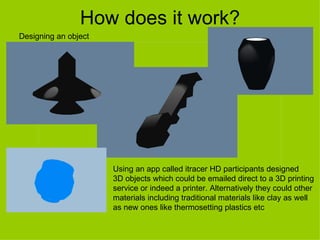
Designing an object


                      Using an app called itracer HD participants designed
                      3D objects which could be emailed direct to a 3D printing
                      service or indeed a printer. Alternatively they could other
                      materials including traditional materials like clay as well
                      as new ones like thermosetting plastics etc
How does it work?
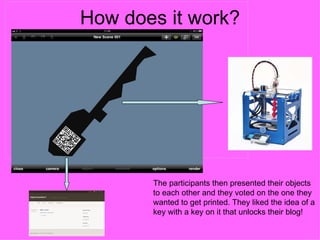
The Democratic Process


                         The participants then presented their objects
                         to each other and they voted on the one they
                         wanted to get printed. They liked the idea of a
                         key with a key on it that unlocks their blog!
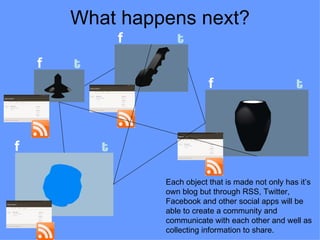
What happens next?
                f      t
    f   t
                                f                        t


f           t

                    Each object that is made not only has it’s
                    own blog but through RSS, Twitter,
                    Facebook and other social apps will be
                    able to create a community and
                    communicate with each other and well as
                    collecting information to share.
What do you need?

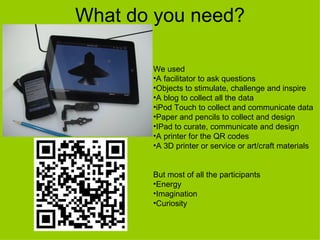
       We used
       •A facilitator to ask questions
       •Objects to stimulate, challenge and inspire
       •A blog to collect all the data
       •iPod Touch to collect and communicate data
       •Paper and pencils to collect and design
       •IPad to curate, communicate and design
       •A printer for the QR codes
       •A 3D printer or service or art/craft materials


       But most of all the participants
       •Energy
       •Imagination
       •Curiosity
Learning Framework?
This was a Blending Learning session using these methodologies
•Enquiry
•Self organisation
•Transmission
•Challenge and problem solving

And using traditional and non-traditional tools and services.

Running time. 3 Hours
Useful Lessons?
•3D Printing is expensive and takes a long time.
We will buy our own.

•Participants are not used to enquiry and self organisation.
We need this in formal learning.

•Participants are not used to collaboration.
We need this in formal learning.

•Participants need guidance through the enquiry stage.
We need more skilled practitioners.

•Museums can often not see the objects from the history.
We need to move from transmission to participation,
interaction and creation and diversify our learning programmes.

For more info contact pclifford@museumoflondon.org.uk

Kidding Around Case Study: Museum of London (#mw2012)

  • 1.
    We’re Talking Objects I was inspired by a toy aeroplane I was inspired by a Medieval Key I was inspired by a Roman vase
  • 2.
    Who is itfor? Everyone and Anyone ….but works really well with children. These are the five children that piloted The sessions aged from 6 to 12.
  • 3.
    What is it? Anenquiry and self organising workshop for people to….. Investigate objects and what they mean. Capture information and inspiration from objects in the galleries. Curate the experience onto a blog. Design an object and 3D print it or physically make it. Connect the blog to the object using QR and or other methods.
  • 4.
    How does itwork? Using an enquiry session the participants inspired by an object, idea or question generate and investigate thoughts, ideas, opinions, questions and answers. Fun Helpful Useful Pretty Works Does things Doesn’t break Design What makes a good object? Why are objects important? We love them They’re valuable We enjoy them Can’t live without them Need them Tell us things They do things for us Learn from them
  • 5.
    How does itwork? To the galleries Using an ipod Touch they take photos and video of the objects and use text as well as paper and writing to capture ideas, thoughts and information. All of this content can be uploaded to the blog.
  • 6.
    How does itwork? Back in the Clore Learning Centre Using drawings and an app called Popplet participants continue to produce, collect and curate their assets and ideas. Their drawings begin the design process.
  • 7.
    How does itwork? Designing an object Using an app called itracer HD participants designed 3D objects which could be emailed direct to a 3D printing service or indeed a printer. Alternatively they could other materials including traditional materials like clay as well as new ones like thermosetting plastics etc
  • 8.
    How does itwork? The Democratic Process The participants then presented their objects to each other and they voted on the one they wanted to get printed. They liked the idea of a key with a key on it that unlocks their blog!
  • 9.
    What happens next? f t f t f t f t Each object that is made not only has it’s own blog but through RSS, Twitter, Facebook and other social apps will be able to create a community and communicate with each other and well as collecting information to share.
  • 10.
    What do youneed? We used •A facilitator to ask questions •Objects to stimulate, challenge and inspire •A blog to collect all the data •iPod Touch to collect and communicate data •Paper and pencils to collect and design •IPad to curate, communicate and design •A printer for the QR codes •A 3D printer or service or art/craft materials But most of all the participants •Energy •Imagination •Curiosity
  • 11.
    Learning Framework? This wasa Blending Learning session using these methodologies •Enquiry •Self organisation •Transmission •Challenge and problem solving And using traditional and non-traditional tools and services. Running time. 3 Hours
  • 12.
    Useful Lessons? •3D Printingis expensive and takes a long time. We will buy our own. •Participants are not used to enquiry and self organisation. We need this in formal learning. •Participants are not used to collaboration. We need this in formal learning. •Participants need guidance through the enquiry stage. We need more skilled practitioners. •Museums can often not see the objects from the history. We need to move from transmission to participation, interaction and creation and diversify our learning programmes. For more info contact pclifford@museumoflondon.org.uk