Form and Style for ASTM Standards
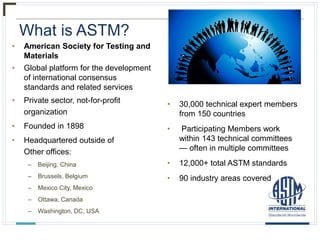
What is ASTM?
• American Society for Testing and
Materials
• Global platform for the development
of international consensus
standards and related services
• Private sector, not-for-profit
organization
• Founded in 1898
• Headquartered outside of
Other offices:
– Beijing, China
– Brussels, Belgium
– Mexico City, Mexico
– Ottawa, Canada
– Washington, DC, USA
• 30,000 technical expert members
from 150 countries
• Participating Members work
within 143 technical committees
— often in multiple committees
• 12,000+ total ASTM standards
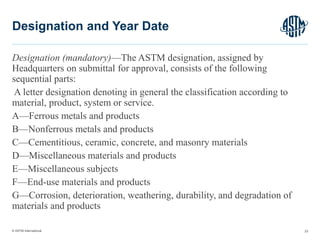
• 90 industry areas covered
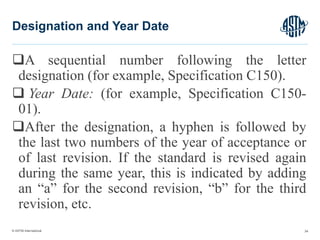
© ASTM International
Process for Standards Development
 Test Methods
 Specifications
 Practices
 Guides
 Classifications
 Terminology
What is a standard in ASTM?
12,000
Standards
© ASTM International
Introduction to ASTM Committee D02
on
Petroleum Products, Liquid Fuels,
and Lubricants
4
© ASTM International
5
Committee D02
 Largest ASTM Committee, organized in 1904
 Includes over 2,400 members from more than 65 countries
 Developer of over 800 petroleum, liquid fuels, and lubricant
standards that have helped to provide heat for homes, fuel
for automobiles and airplanes, and lubricants for machinery
 Sponsor of numerous technical publications, laboratory
quality assurance programs and technical and professional
training courses, workshops, and symposia.
© ASTM International
6
Committee D02 Scope
Liquid fuels derived from: petroleum or the liquefaction of coal,
shale, oil sands, or other naturally occurring materials including:
Liquid fuels, ....
Liquid and semi-solid lubricants ....
Liquid fuels derived from biological materials (biofuels)
Synthesized liquid fuels (also known as renewable or
alternative fuels)
Hydraulic fluids ....
Petroleum Coke ....
Gaseous fuels ....
Waxes ....
© ASTM International
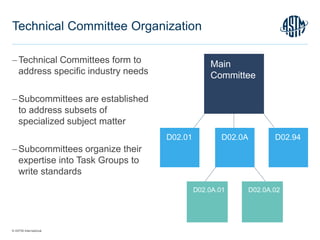
Technical Committees form to
address specific industry needs
Subcommittees are established
to address subsets of
specialized subject matter
Subcommittees organize their
expertise into Task Groups to
write standards
Technical Committee Organization
D02.01
D02.0A.01
D02.0A D02.94
Main
Committee
D02.0A.02
© ASTM International
 Membership
 All Subcommittee Chairmen & Committee Officers
 At Large Members, minimum 6
 Responsibilities
 SC Formation & dissolution
 SC Scopes & objectives
 Appoint Subcommittee Officers
 Reviews Main committee membership
 Committee bylaws & long range planning
 Awards panel
8
Executive Subcommittee
© ASTM International
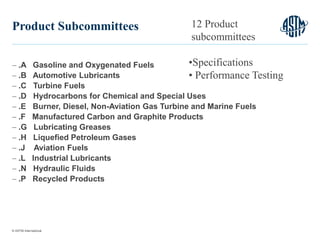
 .A Gasoline and Oxygenated Fuels
 .B Automotive Lubricants
 .C Turbine Fuels
 .D Hydrocarbons for Chemical and Special Uses
 .E Burner, Diesel, Non-Aviation Gas Turbine and Marine Fuels
 .F Manufactured Carbon and Graphite Products
 .G Lubricating Greases
 .H Liquefied Petroleum Gases
 .J Aviation Fuels
 .L Industrial Lubricants
 .N Hydraulic Fluids
 .P Recycled Products
9
Product Subcommittees 12 Product
subcommittees
•Specifications
• Performance Testing
© ASTM International
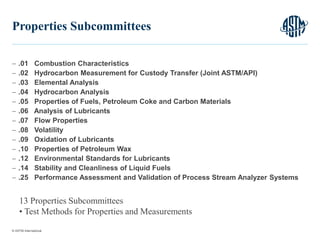
 .01 Combustion Characteristics
 .02 Hydrocarbon Measurement for Custody Transfer (Joint ASTM/API)
 .03 Elemental Analysis
 .04 Hydrocarbon Analysis
 .05 Properties of Fuels, Petroleum Coke and Carbon Materials
 .06 Analysis of Lubricants
 .07 Flow Properties
 .08 Volatility
 .09 Oxidation of Lubricants
 .10 Properties of Petroleum Wax
 .12 Environmental Standards for Lubricants
 .14 Stability and Cleanliness of Liquid Fuels
 .25 Performance Assessment and Validation of Process Stream Analyzer Systems
10
Properties Subcommittees
13 Properties Subcommittees
• Test Methods for Properties and Measurements
© ASTM International
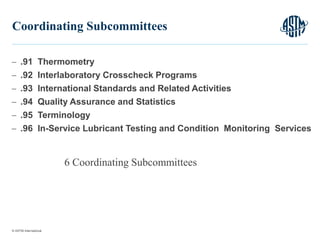
 .91 Thermometry
 .92 Interlaboratory Crosscheck Programs
 .93 International Standards and Related Activities
 .94 Quality Assurance and Statistics
 .95 Terminology
 .96 In-Service Lubricant Testing and Condition Monitoring Services
11
Coordinating Subcommittees
6 Coordinating Subcommittees
© ASTM International
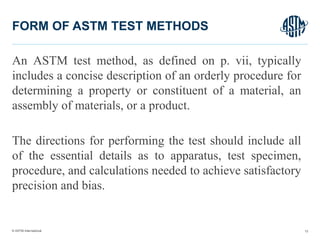
An ASTM test method, as defined on p. vii, typically
includes a concise description of an orderly procedure for
determining a property or constituent of a material, an
assembly of materials, or a product.
The directions for performing the test should include all
of the essential details as to apparatus, test specimen,
procedure, and calculations needed to achieve satisfactory
precision and bias.
12
FORM OF ASTM TEST METHODS
© ASTM International
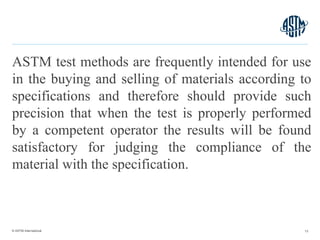
ASTM test methods are frequently intended for use
in the buying and selling of materials according to
specifications and therefore should provide such
precision that when the test is properly performed
by a competent operator the results will be found
satisfactory for judging the compliance of the
material with the specification.
13
© ASTM International
These test methods cover the determination of
fundamental properties of materials such as
density, absolute viscosity, softening point, and
flash point. They may include a variety of
different laboratory procedures such as chemical
and spectrochemical analyses, mechanical and
electrical tests, weathering tests, visual
examination, fire tests, performance
characteristics, sampling, nondestructive tests,
and radiation exposure tests. In some standards,
optional test methods are included. 14
© ASTM International
Statements addressing precision and bias are
required in ASTM test methods. This gives the user
of the test method an idea of the nature of the
sample to be prepared and analyzed and
information regarding the nature of the data
obtained by using the method. The requirement of
precision and bias statements does not mean that
numerical statements are required.
15
© ASTM International
It means that the spread of resulting data and its
relationship to an accepted reference material or
source (if available) shall be addressed. Some
test methods have no numerical expression of
precision or bias (for example, pass/fail tests,
spot tests.) In these cases, precision and bias
shall be addressed and the reasons for not
including relevant data explained
16
© ASTM International
Headings are those most generally used but may
not be all-inclusive. It may be necessary to include
other headings for specialized subjects. The
headings identified as “mandatory” are required.
Other headings shall be included when the subject
matter is pertinent to the document under
development, in which case, all instructions and
guidance for that particular section shall be
followed.
17
A1. Subject Headings of Text
© ASTM International
For example, if the standard does not contain
reference to any standard documents within the
text, it is not required to include a section on
Referenced Documents. If, however, specific
hazards are cited throughout the text, then the
section on Hazards shall be followed.
18
© ASTM International
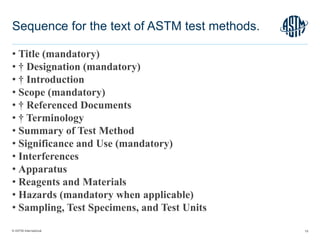
• Title (mandatory)
• † Designation (mandatory)
• † Introduction
• Scope (mandatory)
• † Referenced Documents
• † Terminology
• Summary of Test Method
• Significance and Use (mandatory)
• Interferences
• Apparatus
• Reagents and Materials
• Hazards (mandatory when applicable)
• Sampling, Test Specimens, and Test Units
19
Sequence for the text of ASTM test methods.
© ASTM International
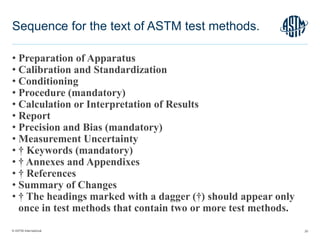
• Preparation of Apparatus
• Calibration and Standardization
• Conditioning
• Procedure (mandatory)
• Calculation or Interpretation of Results
• Report
• Precision and Bias (mandatory)
• Measurement Uncertainty
• † Keywords (mandatory)
• † Annexes and Appendixes
• † References
• Summary of Changes
• † The headings marked with a dagger (†) should appear only
once in test methods that contain two or more test methods.
20
Sequence for the text of ASTM test methods.
© ASTM International
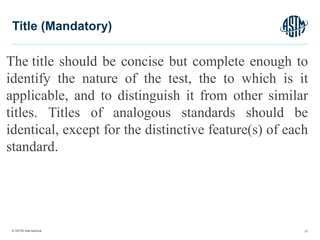
The title should be concise but complete enough to
identify the nature of the test, the to which is it
applicable, and to distinguish it from other similar
titles. Titles of analogous standards should be
identical, except for the distinctive feature(s) of each
standard.
21
Title (Mandatory)
© ASTM International
The essential features of a title are the particular property
or constituent being determined, the material to which the
test method is applicable, and when pertinent, the
technique or instrumentation. If the test method is
designated to determine a number of constituents or
properties, use a general title, omitting the names of
specific constituents or properties.
When a standard includes a number of individual test
methods for different constituents or properties, the title
need indicate only the general nature of the tests and the
material to which it is applicable.
22
© ASTM International
Designation (mandatory)—The ASTM designation, assigned by
Headquarters on submittal for approval, consists of the following
sequential parts:
A letter designation denoting in general the classification according to
material, product, system or service.
A—Ferrous metals and products
B—Nonferrous metals and products
C—Cementitious, ceramic, concrete, and masonry materials
D—Miscellaneous materials and products
E—Miscellaneous subjects
F—End-use materials and products
G—Corrosion, deterioration, weathering, durability, and degradation of
materials and products
23
Designation and Year Date
© ASTM International
A sequential number following the letter
designation (for example, Specification C150).
 Year Date: (for example, Specification C150-
01).
After the designation, a hyphen is followed by
the last two numbers of the year of acceptance or
of last revision. If the standard is revised again
during the same year, this is indicated by adding
an “a” for the second revision, “b” for the third
revision, etc.
24
Designation and Year Date
© ASTM International
The parenthetical phrase “(Reapproved 20 )”
to designate the year of last preapproval of a
standard, if applicable.
The designation numbers of standards that
have been discontinued are not reassigned.
25
© ASTM International
A separate section covering general introductory or
informational material is not generally used in
ASTM test methods.
Occasionally, a test method is of such a nature that
it requires an explanatory statement for proper
understanding by the user. In such instances an
introduction should be included immediately after
the title of the test method but without a section
number.
EX ASTM D905
26
Introduction
© ASTM International
•Include in this section information relating to the
purpose of the test method.
•State if the method is quantitative or qualitative,
and any known limitations. Concisely state the
property or constituent that is being determined
and the materials that can be analyzed. State the
range of concentrations/values determined.
27
Scope (Mandatory)
© ASTM International
•Include, where applicable, the analytical
technique, for example, gas chromatography, and
whether the test is performed in the laboratory,
field, or on-line.
•Include in this section the system of units to be
used in referee decisions.
• Include in this section any caveats required by
ASTM policy such as the caveats on safety
hazards and fire hazards
28
© ASTM International
• List in alphanumeric sequence the designation and
complete title of the following documents referenced
within the standard; ASTM standards and adjuncts; and
standards and codes of other organizations.
• Does not include the year date when designating
referenced documents unless there is a technical reason
for requiring a particular revision.
• When listing referenced adjuncts, provide a brief
description in this section, and a footnote of the
availability.
29
Referenced Documents
© ASTM International
Every standard should include a section on
terminology. All significant terms that may have a
meaning more specialized or more restricted than
the common dictionary meaning should be
defined within a standard, or the terminology
standard should be referenced.
Terminology Within a Standard may include
paragraphs on definitions, definitions of terms
specific to a standard, symbols, abbreviations,
acronyms, discussions, or a combination thereof
30
Terminology
© ASTM International
When more detail of the concept being defined is
desirable, supplementary information should be
added as a separate numbered paragraph labeled
“Discussion” immediately following the definition.
Use the term “Discussion” instead of “Note”
Symbols—In a standard with numerous equations
containing identical quantity symbols, symbols
may be listed alphabetically and unnumbered in
this section instead of under each equation
31
Discussions
© ASTM International
Include here a brief outline of the test method,
describing in the passive voice its essential
features without the details that are a necessary
part of the complete statement of procedure.
If desired, a brief statement of the principle of
the test method may be given this is particularly
desirable in the case of chemical methods and
should appear as the first paragraph.
32
Summary of Test Method
© ASTM International
In chemical methods state the type of
procedure, such as colorimetric,
electrometric, and volumetric, and describe
the source of color, major chemical
reaction including pertinent chemical
equations, etc.
33
Summary of Test Method
© ASTM International
Include in this section information that explains
the relevance and meaning of the test.
State the practical uses for the test and how it is
typically employed.
Include statements to provide the user with
comprehensive understanding of the following:
•The meaning of the test as related to the
manufacture and end use of the material,
34
Significance and Use (Mandatory)
© ASTM International
• The suitability of the test for specification
acceptance, design purposes, service evaluation,
regulatory statutes, manufacturing control,
development and research, and The fundamental
assumptions inherent in the test method that may
affect the usefulness of the results.
•Include any discretion needed in the interpretation
of the results of the test.
•Include, where applicable, comparisons of the test
to other similar procedures
35
Significance and Use (Mandatory)
© ASTM International
If the successful application of the test method
requires the inclusion of explanatory statements on
interference effects, include such information here;
otherwise, omit this section.
List briefly the constituents or properties that are
likely to cause interference and the amounts that
are known to interfere.
36
Interferences
© ASTM International
If the presence of an interfering factor affects the
precision or bias of the test results and
compensations are made in the calculations ,this
should be explained in this section and noted in
the appropriate section.
37
Interferences
© ASTM International
In this section, include a brief description of the
essential features of the apparatus and equipment
required for the test, and, where they clarify or
supplement the text, schematic drawings or
photographs. Cover in separate text divisions the
important features and requirements for the
apparatus.
38
Apparatus
© ASTM International
Do not list common laboratory apparatus, such as
flasks and beakers, but include any especially
modified forms or unusual sizes of common
apparatus that are required or that may require
special preparation.
Trademarks shall not be used unless a specific
manufacturer’s product is required for a well-
defined reason.
39
Apparatus
© ASTM International
When the same apparatus is used in several
standards, the detailed specifications should be
covered by a separate ASTM standard. Examples
of such standards are:
E1 Specification for ASTM Thermometers
E133 Specification for Distillation Equipment
40
Apparatus
© ASTM International
When more than one procedure is included in
one standard, list the reagents and materials
required for each procedure as a separate section
under each subdivision.
It is recommended that, where applicable, the
following be included as secondary sections “.1”
and “.2” of this section:
41
Reagents and Materials
© ASTM International
Purity of Reagents—Reagent grade chemicals
shall be used in all tests. Unless otherwise
indicated, it is intended that all reagents conform
to the specifications of the Committee on
Analytical Reagents of the American Chemical
Society where such specifications are available.
Other grades may be used, provided it is first
ascertained that the reagent is of sufficiently high
purity to permit its use without lessening the
accuracy of the determination.
42
Reagents and Materials
© ASTM International
Purity of Water—Unless otherwise indicated,
references to water shall be understood to mean
reagent water as defined by Type I,II or III of
Specification D1193
43
Reagents and Materials
© ASTM International
 List the reagents alphabetically in separate
divisions. Give the name of the reagent first,
followed by any descriptive terms . State the
desired concentration if significant; then follow
with instructions for preparation and
standardization (if required).
Specify the reagent concentration in applicable
terms, as follows:
Concentrated acids and bases … density, unless
mass percent is more generally used or required
44
Reagents and Materials
© ASTM International
 Dilute acids and bases … volume ratio, X + Y
(X volumes of reagent added to Y volumes of
water)
Non-standardized solutions … grams of reagent
as weighed out per litre of solution
Standardized solutions … normality, expressed
decimally; or the equivalent of 1 mL of solution
in terms of grams of a given element expressed
as “1 mL + xxx g of …”
45
Reagents and Materials
© ASTM International
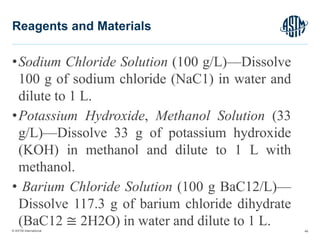
•Sodium Chloride Solution (100 g/L)—Dissolve
100 g of sodium chloride (NaC1) in water and
dilute to 1 L.
•Potassium Hydroxide, Methanol Solution (33
g/L)—Dissolve 33 g of potassium hydroxide
(KOH) in methanol and dilute to 1 L with
methanol.
• Barium Chloride Solution (100 g BaC12/L)—
Dissolve 117.3 g of barium chloride dihydrate
(BaC12 ≅ 2H2O) in water and dilute to 1 L. 46
Reagents and Materials
© ASTM International
Safety Hazards
Warning Statement—A warning statement
identifies a specific hazard and provides
information for avoiding or minimizing a
particular hazard.
Remedial Statements—A remedial statement
provides recommendations for treating a situation
resulting from an unsuccessfully controlled hazard
associated with the use of a standard.
47
Hazards
© ASTM International
A test unit is a unit or portion of a material that is
sufficient to obtain a test result(s) for the property
or properties to be measured. A test specimen is a
test unit or portion of a test unit upon which a
single or multiple observation is to be made. A test
result refers to the value obtained for a given
property from one test unit. A test unit may be a
subunit of a primary (first stage) sampling unit or it
may be a subunit of a composite of primary
sampling units or of increments from these primary
sampling units.
48
Sampling, Test Specimens, and Test Units
© ASTM International
The size of the test unit for chemical analysis
usually is given in the “Procedure” section, but if
significant in connection with pretreatment or
preparation, it should be included here. When a test
specimen is specified by mass, indicate the degree
of precision desired
49
Sampling, Test Specimens, and Test Units
© ASTM International
Use this section only when detailed instructions
are required for the initial assembly,
conditioning, or preparation of the apparatus
50
Preparation of Apparatus
© ASTM International
•Apparatus—Give detailed instructions, in the
imperative mood, for calibration and adjustment
of the apparatus necessary for the use of the test
method.
•Reference Standards and Blanks—Give detailed
instructions for the standardization and use of
reference standards and blanks used in the test
method. Describe any standard samples used to
assure uniformity of the test technique, and
standard specimens or photographic standards.
51
Calibration and Standardization
© ASTM International
Calibration Curves and Tables—Give detailed
instructions for the preparation and use of
calibration curves or tables, in accordance with the
suggestions presented in the Standards Style
Manual.
52
Calibration and Standardization
© ASTM International
Specify, in the imperative mood, the conditioning
atmosphere to be used and the time of exposure to
the atmosphere, as well as the atmosphere required
during the test, where necessary. State whether the
conditioning requirements apply to laboratory
samples as well as individual specimens. Indicate
any requirements for preconditioning.
53
Conditioning
© ASTM International
Include in proper sequence detailed directions for
performing the test. Describe the procedure in the
imperative mood, present tense; for example:
“Heat the test specimen …” rather than “The test
specimen shall be heated …” State the number of
samples to be taken, and also state the number of
specimens to be tested from each sample.
54
Procedure (Mandatory)
© ASTM International
Describe in detail the successive steps of the
procedure, grouping related operations into logical
divisions.
In chemical methods, specify the size of test
specimen and indicate the degree of precision
desired in the weighing. Consider the specimen
size and its accuracy of weighing in connection
with the ultimate use of the method.
55
Procedure (Mandatory)
© ASTM International
Calculation—State the directions in the
imperative mood for calculating the results of test
including any equations and any required
significant figures
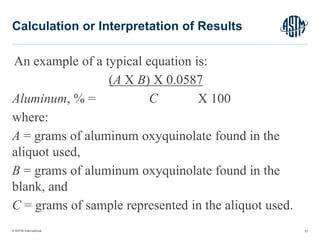
If necessary for clarity, a typical calculation
should be included in an explanatory note.
56
Calculation or Interpretation of Results
© ASTM International
An example of a typical equation is:
(A X B) X 0.0587
Aluminum, % = C X 100
where:
A = grams of aluminum oxyquinolate found in the
aliquot used,
B = grams of aluminum oxyquinolate found in the
blank, and
C = grams of sample represented in the aliquot used.
57
Calculation or Interpretation of Results
© ASTM International
Use this heading in place of “Calculation” when the
results of the test are expressed in descriptive form,
relative terms, or abstract values. List and define
the descriptive terms or classifications used. The
results of a test may be interpreted or expressed in
terms of a rating scale.
Examples of test methods that include rating
systems are: D130 Test Method for Detection of
Copper Corrosion from Petroleum Products by the
Copper Strip Tarnish Test
58
Interpretation of Results
© ASTM International
State in this section the detailed information
required in reporting the results of the test. When
two or more procedures are described in a test
method, the report shall indicate which procedure
was used. When the test method permits variation
in operating or other conditions, incorporate in the
report a statement as to the particular conditions
used in the test.
59
Report
© ASTM International
Statement of Precision (Mandatory):
Precision is the closeness of agreement between test results
obtained under prescribed conditions. A statement on
precision allows potential users of the test method to assess
in general terms its usefulness in proposed applications.
Every test method shall contain a statement
(1) regarding the precision of test results obtained in the same
laboratory under specifically defined conditions of within-
laboratory variability (repeatability conditions),
60
Precision and Bias (Mandatory)
© ASTM International
(2) regarding the precision of test results obtained
in different laboratories (reproducibility
conditions).
Use a statement such as the following:
Precision A—The repeatability standard deviation
has been determined to be (insert the test values
and corresponding repeatability values).
The reproducibility standard deviation has been
determined to be (insert test values and
corresponding reproducibility values).
61
Precision and Bias (Mandatory)
© ASTM International
Measurement uncertainty is an estimate of the
magnitude of systematic and random measurement
errors that may be reported along with the
measurement result.
An uncertainty statement relates to results obtained
in a laboratory carrying out the test method, as
opposed to precision and bias statements which are
mandatory parts of the method itself and normally
derived from an interlaboratory study conducted
during development of the test method.
62
Measurement Uncertainty
© ASTM International
In this section, identify the words, terms, or phrases, that
best represent the technical information presented in the
standard. Select the keywords from the title and body of
the document and include general, vernacular, and trade
terms. These keywords will be used in the preparation of
the ASTM Subject Index.
63
Keywords (Mandatory)
© ASTM International
Select three or more keywords that describe the
names of tests, procedures, special materials, or
the specific application(s) that will facilitate the
identification and retrieval of the standard.
All selected keywords shall be stand-alone terms;
the type of standard, incomplete phrases,
unattached adjectives, etc., shall not be used.
64
© ASTM International
Additional information may be included in one or more annexes and
appendixes to the test method.
The words “Mandatory Information” shall be included directly
under the title of annexes and the words “Nonmandatory
Information” shall be included directly under the title of appendixes.
65
Annexes and Appendixes
© ASTM International
Include in annexes any detailed information such
as that on apparatus or materials that is a
mandatory part of the test method but too lengthy
for inclusion in the main text.
Annexes shall precede appendixes. Examples of
such information are as follows:
66
Annexes
© ASTM International
• Glossary of terms used in the method,
•List of symbols,
•Detailed description of apparatus,
•Instructions for calibrating and standardizing
apparatus,
• Directions for cleaning apparatus, and
Operating instructions and adjustments of
specific makes of apparatus.
67
© ASTM International
An appendix to an ASTM standard is informative only and
is not a mandatory part of the standard. Information on the
following general subjects has been included in such
appendixes:
• Notes on significance and interpretation of the test
method, usually to amplify the statement in the text,
• Development of equations used in the calculations,
• Charts or supplementary information for computations,
• Suggested data forms for recording test results, and
• Commentary on rationale used in the development of the
test method 68
Appendixes
© ASTM International
Include only references to publications supporting or providing
needed supplementary information. Historical and acknowledgment
references are not desirable.
If there are five or more references, list them in an unnumbered
section at the end of the standard in the order in which they appear
in the text.
If there are fewer than five literature references, use footnotes.
69
References
© ASTM International
General—Footnotes referenced in the text are
intended only for reference and shall never include
any information or instructions necessary for the
proper application of the method.
Table footnotes are a part of the table
70
Footnotes
© ASTM International
Notes appearing in a given standard shall be numbered in sequence
separately in the main text, separately in sequence in the annex, and
separately in sequence in the appendix and should appear at the end
of the paragraph to which they pertain. If it is desired to refer to a
text note in connection with a specific word or phrase in the text, that
word or phrase should be followed by a reference to the note,
“(NOTE 1),” etc.
71
Notes
© ASTM International
Notes in the text are preferred for the following:
• To refer to editorial changes made in the text,
• To refer to similar or companion ASTM standards,
• Limitations of the application of the test when not covered in the text.
• Description, if included under “Scope,” of experimental means for
recognizing
• cases where the method is not applicable to the material under test.
• Description of additional (not alternative) apparatus, materials,
procedures, or calculations that are not actually required; or description
of merely recommended forms of construction of required apparatus.
• Explanation, if desired, of the reasons for a certain requirement or
direction. If brief, include in the text rather than as a note.
72
Notes
© ASTM International
Examples of adjuncts are as follows:
Comparison standards such as the copper strip corrosion standards
for Test Method D130 (lithograph aluminum strips),
• Charts such as the viscosity-temperature charts for liquid petroleum
for D341.
• Reference radiographs such as E155 or reference photographs, such
as E125.
• Technical data such as the twelve volumes of D1250, Petroleum
Measurement.
• Tables, and Drawings such as detailed drawings for the
construction of the smoke chamber in Test Method D2843.
73
Adjuncts
© ASTM International
(Mandatory for Precision and Bias Statements Producing Numerical Results)
Where numerical data have been generated to establish the
precision and bias of a test method, a research report is required.
The research report shall include a list of participating laboratories,
description of samples, a copy of the laboratory instructions, the
equipment/apparatus used, the data, a statistical summary and a
copy of the Precision and Bias Statement
74
Research Reports
© ASTM International
If the committee chooses to provide a Summary of Changes, place
this unnumbered section at the end of the standard and begin with
the following introductory paragraph:
Committee XXX has identified the location of selected changes to
this standard since the last issue (insert designation and year date )
that may impact the use of this standard.
75
Summary of Changes
© ASTM International 76
Questions?

01Form and Style for ASTM Standards.pptx

  • 1.
    Form and Stylefor ASTM Standards
  • 2.
    What is ASTM? •American Society for Testing and Materials • Global platform for the development of international consensus standards and related services • Private sector, not-for-profit organization • Founded in 1898 • Headquartered outside of Other offices: – Beijing, China – Brussels, Belgium – Mexico City, Mexico – Ottawa, Canada – Washington, DC, USA • 30,000 technical expert members from 150 countries • Participating Members work within 143 technical committees — often in multiple committees • 12,000+ total ASTM standards • 90 industry areas covered
  • 3.
    © ASTM International Processfor Standards Development  Test Methods  Specifications  Practices  Guides  Classifications  Terminology What is a standard in ASTM? 12,000 Standards
  • 4.
    © ASTM International Introductionto ASTM Committee D02 on Petroleum Products, Liquid Fuels, and Lubricants 4
  • 5.
    © ASTM International 5 CommitteeD02  Largest ASTM Committee, organized in 1904  Includes over 2,400 members from more than 65 countries  Developer of over 800 petroleum, liquid fuels, and lubricant standards that have helped to provide heat for homes, fuel for automobiles and airplanes, and lubricants for machinery  Sponsor of numerous technical publications, laboratory quality assurance programs and technical and professional training courses, workshops, and symposia.
  • 6.
    © ASTM International 6 CommitteeD02 Scope Liquid fuels derived from: petroleum or the liquefaction of coal, shale, oil sands, or other naturally occurring materials including: Liquid fuels, .... Liquid and semi-solid lubricants .... Liquid fuels derived from biological materials (biofuels) Synthesized liquid fuels (also known as renewable or alternative fuels) Hydraulic fluids .... Petroleum Coke .... Gaseous fuels .... Waxes ....
  • 7.
    © ASTM International TechnicalCommittees form to address specific industry needs Subcommittees are established to address subsets of specialized subject matter Subcommittees organize their expertise into Task Groups to write standards Technical Committee Organization D02.01 D02.0A.01 D02.0A D02.94 Main Committee D02.0A.02
  • 8.
    © ASTM International Membership  All Subcommittee Chairmen & Committee Officers  At Large Members, minimum 6  Responsibilities  SC Formation & dissolution  SC Scopes & objectives  Appoint Subcommittee Officers  Reviews Main committee membership  Committee bylaws & long range planning  Awards panel 8 Executive Subcommittee
  • 9.
    © ASTM International .A Gasoline and Oxygenated Fuels  .B Automotive Lubricants  .C Turbine Fuels  .D Hydrocarbons for Chemical and Special Uses  .E Burner, Diesel, Non-Aviation Gas Turbine and Marine Fuels  .F Manufactured Carbon and Graphite Products  .G Lubricating Greases  .H Liquefied Petroleum Gases  .J Aviation Fuels  .L Industrial Lubricants  .N Hydraulic Fluids  .P Recycled Products 9 Product Subcommittees 12 Product subcommittees •Specifications • Performance Testing
  • 10.
    © ASTM International .01 Combustion Characteristics  .02 Hydrocarbon Measurement for Custody Transfer (Joint ASTM/API)  .03 Elemental Analysis  .04 Hydrocarbon Analysis  .05 Properties of Fuels, Petroleum Coke and Carbon Materials  .06 Analysis of Lubricants  .07 Flow Properties  .08 Volatility  .09 Oxidation of Lubricants  .10 Properties of Petroleum Wax  .12 Environmental Standards for Lubricants  .14 Stability and Cleanliness of Liquid Fuels  .25 Performance Assessment and Validation of Process Stream Analyzer Systems 10 Properties Subcommittees 13 Properties Subcommittees • Test Methods for Properties and Measurements
  • 11.
    © ASTM International .91 Thermometry  .92 Interlaboratory Crosscheck Programs  .93 International Standards and Related Activities  .94 Quality Assurance and Statistics  .95 Terminology  .96 In-Service Lubricant Testing and Condition Monitoring Services 11 Coordinating Subcommittees 6 Coordinating Subcommittees
  • 12.
    © ASTM International AnASTM test method, as defined on p. vii, typically includes a concise description of an orderly procedure for determining a property or constituent of a material, an assembly of materials, or a product. The directions for performing the test should include all of the essential details as to apparatus, test specimen, procedure, and calculations needed to achieve satisfactory precision and bias. 12 FORM OF ASTM TEST METHODS
  • 13.
    © ASTM International ASTMtest methods are frequently intended for use in the buying and selling of materials according to specifications and therefore should provide such precision that when the test is properly performed by a competent operator the results will be found satisfactory for judging the compliance of the material with the specification. 13
  • 14.
    © ASTM International Thesetest methods cover the determination of fundamental properties of materials such as density, absolute viscosity, softening point, and flash point. They may include a variety of different laboratory procedures such as chemical and spectrochemical analyses, mechanical and electrical tests, weathering tests, visual examination, fire tests, performance characteristics, sampling, nondestructive tests, and radiation exposure tests. In some standards, optional test methods are included. 14
  • 15.
    © ASTM International Statementsaddressing precision and bias are required in ASTM test methods. This gives the user of the test method an idea of the nature of the sample to be prepared and analyzed and information regarding the nature of the data obtained by using the method. The requirement of precision and bias statements does not mean that numerical statements are required. 15
  • 16.
    © ASTM International Itmeans that the spread of resulting data and its relationship to an accepted reference material or source (if available) shall be addressed. Some test methods have no numerical expression of precision or bias (for example, pass/fail tests, spot tests.) In these cases, precision and bias shall be addressed and the reasons for not including relevant data explained 16
  • 17.
    © ASTM International Headingsare those most generally used but may not be all-inclusive. It may be necessary to include other headings for specialized subjects. The headings identified as “mandatory” are required. Other headings shall be included when the subject matter is pertinent to the document under development, in which case, all instructions and guidance for that particular section shall be followed. 17 A1. Subject Headings of Text
  • 18.
    © ASTM International Forexample, if the standard does not contain reference to any standard documents within the text, it is not required to include a section on Referenced Documents. If, however, specific hazards are cited throughout the text, then the section on Hazards shall be followed. 18
  • 19.
    © ASTM International •Title (mandatory) • † Designation (mandatory) • † Introduction • Scope (mandatory) • † Referenced Documents • † Terminology • Summary of Test Method • Significance and Use (mandatory) • Interferences • Apparatus • Reagents and Materials • Hazards (mandatory when applicable) • Sampling, Test Specimens, and Test Units 19 Sequence for the text of ASTM test methods.
  • 20.
    © ASTM International •Preparation of Apparatus • Calibration and Standardization • Conditioning • Procedure (mandatory) • Calculation or Interpretation of Results • Report • Precision and Bias (mandatory) • Measurement Uncertainty • † Keywords (mandatory) • † Annexes and Appendixes • † References • Summary of Changes • † The headings marked with a dagger (†) should appear only once in test methods that contain two or more test methods. 20 Sequence for the text of ASTM test methods.
  • 21.
    © ASTM International Thetitle should be concise but complete enough to identify the nature of the test, the to which is it applicable, and to distinguish it from other similar titles. Titles of analogous standards should be identical, except for the distinctive feature(s) of each standard. 21 Title (Mandatory)
  • 22.
    © ASTM International Theessential features of a title are the particular property or constituent being determined, the material to which the test method is applicable, and when pertinent, the technique or instrumentation. If the test method is designated to determine a number of constituents or properties, use a general title, omitting the names of specific constituents or properties. When a standard includes a number of individual test methods for different constituents or properties, the title need indicate only the general nature of the tests and the material to which it is applicable. 22
  • 23.
    © ASTM International Designation(mandatory)—The ASTM designation, assigned by Headquarters on submittal for approval, consists of the following sequential parts: A letter designation denoting in general the classification according to material, product, system or service. A—Ferrous metals and products B—Nonferrous metals and products C—Cementitious, ceramic, concrete, and masonry materials D—Miscellaneous materials and products E—Miscellaneous subjects F—End-use materials and products G—Corrosion, deterioration, weathering, durability, and degradation of materials and products 23 Designation and Year Date
  • 24.
    © ASTM International Asequential number following the letter designation (for example, Specification C150).  Year Date: (for example, Specification C150- 01). After the designation, a hyphen is followed by the last two numbers of the year of acceptance or of last revision. If the standard is revised again during the same year, this is indicated by adding an “a” for the second revision, “b” for the third revision, etc. 24 Designation and Year Date
  • 25.
    © ASTM International Theparenthetical phrase “(Reapproved 20 )” to designate the year of last preapproval of a standard, if applicable. The designation numbers of standards that have been discontinued are not reassigned. 25
  • 26.
    © ASTM International Aseparate section covering general introductory or informational material is not generally used in ASTM test methods. Occasionally, a test method is of such a nature that it requires an explanatory statement for proper understanding by the user. In such instances an introduction should be included immediately after the title of the test method but without a section number. EX ASTM D905 26 Introduction
  • 27.
    © ASTM International •Includein this section information relating to the purpose of the test method. •State if the method is quantitative or qualitative, and any known limitations. Concisely state the property or constituent that is being determined and the materials that can be analyzed. State the range of concentrations/values determined. 27 Scope (Mandatory)
  • 28.
    © ASTM International •Include,where applicable, the analytical technique, for example, gas chromatography, and whether the test is performed in the laboratory, field, or on-line. •Include in this section the system of units to be used in referee decisions. • Include in this section any caveats required by ASTM policy such as the caveats on safety hazards and fire hazards 28
  • 29.
    © ASTM International •List in alphanumeric sequence the designation and complete title of the following documents referenced within the standard; ASTM standards and adjuncts; and standards and codes of other organizations. • Does not include the year date when designating referenced documents unless there is a technical reason for requiring a particular revision. • When listing referenced adjuncts, provide a brief description in this section, and a footnote of the availability. 29 Referenced Documents
  • 30.
    © ASTM International Everystandard should include a section on terminology. All significant terms that may have a meaning more specialized or more restricted than the common dictionary meaning should be defined within a standard, or the terminology standard should be referenced. Terminology Within a Standard may include paragraphs on definitions, definitions of terms specific to a standard, symbols, abbreviations, acronyms, discussions, or a combination thereof 30 Terminology
  • 31.
    © ASTM International Whenmore detail of the concept being defined is desirable, supplementary information should be added as a separate numbered paragraph labeled “Discussion” immediately following the definition. Use the term “Discussion” instead of “Note” Symbols—In a standard with numerous equations containing identical quantity symbols, symbols may be listed alphabetically and unnumbered in this section instead of under each equation 31 Discussions
  • 32.
    © ASTM International Includehere a brief outline of the test method, describing in the passive voice its essential features without the details that are a necessary part of the complete statement of procedure. If desired, a brief statement of the principle of the test method may be given this is particularly desirable in the case of chemical methods and should appear as the first paragraph. 32 Summary of Test Method
  • 33.
    © ASTM International Inchemical methods state the type of procedure, such as colorimetric, electrometric, and volumetric, and describe the source of color, major chemical reaction including pertinent chemical equations, etc. 33 Summary of Test Method
  • 34.
    © ASTM International Includein this section information that explains the relevance and meaning of the test. State the practical uses for the test and how it is typically employed. Include statements to provide the user with comprehensive understanding of the following: •The meaning of the test as related to the manufacture and end use of the material, 34 Significance and Use (Mandatory)
  • 35.
    © ASTM International •The suitability of the test for specification acceptance, design purposes, service evaluation, regulatory statutes, manufacturing control, development and research, and The fundamental assumptions inherent in the test method that may affect the usefulness of the results. •Include any discretion needed in the interpretation of the results of the test. •Include, where applicable, comparisons of the test to other similar procedures 35 Significance and Use (Mandatory)
  • 36.
    © ASTM International Ifthe successful application of the test method requires the inclusion of explanatory statements on interference effects, include such information here; otherwise, omit this section. List briefly the constituents or properties that are likely to cause interference and the amounts that are known to interfere. 36 Interferences
  • 37.
    © ASTM International Ifthe presence of an interfering factor affects the precision or bias of the test results and compensations are made in the calculations ,this should be explained in this section and noted in the appropriate section. 37 Interferences
  • 38.
    © ASTM International Inthis section, include a brief description of the essential features of the apparatus and equipment required for the test, and, where they clarify or supplement the text, schematic drawings or photographs. Cover in separate text divisions the important features and requirements for the apparatus. 38 Apparatus
  • 39.
    © ASTM International Donot list common laboratory apparatus, such as flasks and beakers, but include any especially modified forms or unusual sizes of common apparatus that are required or that may require special preparation. Trademarks shall not be used unless a specific manufacturer’s product is required for a well- defined reason. 39 Apparatus
  • 40.
    © ASTM International Whenthe same apparatus is used in several standards, the detailed specifications should be covered by a separate ASTM standard. Examples of such standards are: E1 Specification for ASTM Thermometers E133 Specification for Distillation Equipment 40 Apparatus
  • 41.
    © ASTM International Whenmore than one procedure is included in one standard, list the reagents and materials required for each procedure as a separate section under each subdivision. It is recommended that, where applicable, the following be included as secondary sections “.1” and “.2” of this section: 41 Reagents and Materials
  • 42.
    © ASTM International Purityof Reagents—Reagent grade chemicals shall be used in all tests. Unless otherwise indicated, it is intended that all reagents conform to the specifications of the Committee on Analytical Reagents of the American Chemical Society where such specifications are available. Other grades may be used, provided it is first ascertained that the reagent is of sufficiently high purity to permit its use without lessening the accuracy of the determination. 42 Reagents and Materials
  • 43.
    © ASTM International Purityof Water—Unless otherwise indicated, references to water shall be understood to mean reagent water as defined by Type I,II or III of Specification D1193 43 Reagents and Materials
  • 44.
    © ASTM International List the reagents alphabetically in separate divisions. Give the name of the reagent first, followed by any descriptive terms . State the desired concentration if significant; then follow with instructions for preparation and standardization (if required). Specify the reagent concentration in applicable terms, as follows: Concentrated acids and bases … density, unless mass percent is more generally used or required 44 Reagents and Materials
  • 45.
    © ASTM International Dilute acids and bases … volume ratio, X + Y (X volumes of reagent added to Y volumes of water) Non-standardized solutions … grams of reagent as weighed out per litre of solution Standardized solutions … normality, expressed decimally; or the equivalent of 1 mL of solution in terms of grams of a given element expressed as “1 mL + xxx g of …” 45 Reagents and Materials
  • 46.
    © ASTM International •SodiumChloride Solution (100 g/L)—Dissolve 100 g of sodium chloride (NaC1) in water and dilute to 1 L. •Potassium Hydroxide, Methanol Solution (33 g/L)—Dissolve 33 g of potassium hydroxide (KOH) in methanol and dilute to 1 L with methanol. • Barium Chloride Solution (100 g BaC12/L)— Dissolve 117.3 g of barium chloride dihydrate (BaC12 ≅ 2H2O) in water and dilute to 1 L. 46 Reagents and Materials
  • 47.
    © ASTM International SafetyHazards Warning Statement—A warning statement identifies a specific hazard and provides information for avoiding or minimizing a particular hazard. Remedial Statements—A remedial statement provides recommendations for treating a situation resulting from an unsuccessfully controlled hazard associated with the use of a standard. 47 Hazards
  • 48.
    © ASTM International Atest unit is a unit or portion of a material that is sufficient to obtain a test result(s) for the property or properties to be measured. A test specimen is a test unit or portion of a test unit upon which a single or multiple observation is to be made. A test result refers to the value obtained for a given property from one test unit. A test unit may be a subunit of a primary (first stage) sampling unit or it may be a subunit of a composite of primary sampling units or of increments from these primary sampling units. 48 Sampling, Test Specimens, and Test Units
  • 49.
    © ASTM International Thesize of the test unit for chemical analysis usually is given in the “Procedure” section, but if significant in connection with pretreatment or preparation, it should be included here. When a test specimen is specified by mass, indicate the degree of precision desired 49 Sampling, Test Specimens, and Test Units
  • 50.
    © ASTM International Usethis section only when detailed instructions are required for the initial assembly, conditioning, or preparation of the apparatus 50 Preparation of Apparatus
  • 51.
    © ASTM International •Apparatus—Givedetailed instructions, in the imperative mood, for calibration and adjustment of the apparatus necessary for the use of the test method. •Reference Standards and Blanks—Give detailed instructions for the standardization and use of reference standards and blanks used in the test method. Describe any standard samples used to assure uniformity of the test technique, and standard specimens or photographic standards. 51 Calibration and Standardization
  • 52.
    © ASTM International CalibrationCurves and Tables—Give detailed instructions for the preparation and use of calibration curves or tables, in accordance with the suggestions presented in the Standards Style Manual. 52 Calibration and Standardization
  • 53.
    © ASTM International Specify,in the imperative mood, the conditioning atmosphere to be used and the time of exposure to the atmosphere, as well as the atmosphere required during the test, where necessary. State whether the conditioning requirements apply to laboratory samples as well as individual specimens. Indicate any requirements for preconditioning. 53 Conditioning
  • 54.
    © ASTM International Includein proper sequence detailed directions for performing the test. Describe the procedure in the imperative mood, present tense; for example: “Heat the test specimen …” rather than “The test specimen shall be heated …” State the number of samples to be taken, and also state the number of specimens to be tested from each sample. 54 Procedure (Mandatory)
  • 55.
    © ASTM International Describein detail the successive steps of the procedure, grouping related operations into logical divisions. In chemical methods, specify the size of test specimen and indicate the degree of precision desired in the weighing. Consider the specimen size and its accuracy of weighing in connection with the ultimate use of the method. 55 Procedure (Mandatory)
  • 56.
    © ASTM International Calculation—Statethe directions in the imperative mood for calculating the results of test including any equations and any required significant figures If necessary for clarity, a typical calculation should be included in an explanatory note. 56 Calculation or Interpretation of Results
  • 57.
    © ASTM International Anexample of a typical equation is: (A X B) X 0.0587 Aluminum, % = C X 100 where: A = grams of aluminum oxyquinolate found in the aliquot used, B = grams of aluminum oxyquinolate found in the blank, and C = grams of sample represented in the aliquot used. 57 Calculation or Interpretation of Results
  • 58.
    © ASTM International Usethis heading in place of “Calculation” when the results of the test are expressed in descriptive form, relative terms, or abstract values. List and define the descriptive terms or classifications used. The results of a test may be interpreted or expressed in terms of a rating scale. Examples of test methods that include rating systems are: D130 Test Method for Detection of Copper Corrosion from Petroleum Products by the Copper Strip Tarnish Test 58 Interpretation of Results
  • 59.
    © ASTM International Statein this section the detailed information required in reporting the results of the test. When two or more procedures are described in a test method, the report shall indicate which procedure was used. When the test method permits variation in operating or other conditions, incorporate in the report a statement as to the particular conditions used in the test. 59 Report
  • 60.
    © ASTM International Statementof Precision (Mandatory): Precision is the closeness of agreement between test results obtained under prescribed conditions. A statement on precision allows potential users of the test method to assess in general terms its usefulness in proposed applications. Every test method shall contain a statement (1) regarding the precision of test results obtained in the same laboratory under specifically defined conditions of within- laboratory variability (repeatability conditions), 60 Precision and Bias (Mandatory)
  • 61.
    © ASTM International (2)regarding the precision of test results obtained in different laboratories (reproducibility conditions). Use a statement such as the following: Precision A—The repeatability standard deviation has been determined to be (insert the test values and corresponding repeatability values). The reproducibility standard deviation has been determined to be (insert test values and corresponding reproducibility values). 61 Precision and Bias (Mandatory)
  • 62.
    © ASTM International Measurementuncertainty is an estimate of the magnitude of systematic and random measurement errors that may be reported along with the measurement result. An uncertainty statement relates to results obtained in a laboratory carrying out the test method, as opposed to precision and bias statements which are mandatory parts of the method itself and normally derived from an interlaboratory study conducted during development of the test method. 62 Measurement Uncertainty
  • 63.
    © ASTM International Inthis section, identify the words, terms, or phrases, that best represent the technical information presented in the standard. Select the keywords from the title and body of the document and include general, vernacular, and trade terms. These keywords will be used in the preparation of the ASTM Subject Index. 63 Keywords (Mandatory)
  • 64.
    © ASTM International Selectthree or more keywords that describe the names of tests, procedures, special materials, or the specific application(s) that will facilitate the identification and retrieval of the standard. All selected keywords shall be stand-alone terms; the type of standard, incomplete phrases, unattached adjectives, etc., shall not be used. 64
  • 65.
    © ASTM International Additionalinformation may be included in one or more annexes and appendixes to the test method. The words “Mandatory Information” shall be included directly under the title of annexes and the words “Nonmandatory Information” shall be included directly under the title of appendixes. 65 Annexes and Appendixes
  • 66.
    © ASTM International Includein annexes any detailed information such as that on apparatus or materials that is a mandatory part of the test method but too lengthy for inclusion in the main text. Annexes shall precede appendixes. Examples of such information are as follows: 66 Annexes
  • 67.
    © ASTM International •Glossary of terms used in the method, •List of symbols, •Detailed description of apparatus, •Instructions for calibrating and standardizing apparatus, • Directions for cleaning apparatus, and Operating instructions and adjustments of specific makes of apparatus. 67
  • 68.
    © ASTM International Anappendix to an ASTM standard is informative only and is not a mandatory part of the standard. Information on the following general subjects has been included in such appendixes: • Notes on significance and interpretation of the test method, usually to amplify the statement in the text, • Development of equations used in the calculations, • Charts or supplementary information for computations, • Suggested data forms for recording test results, and • Commentary on rationale used in the development of the test method 68 Appendixes
  • 69.
    © ASTM International Includeonly references to publications supporting or providing needed supplementary information. Historical and acknowledgment references are not desirable. If there are five or more references, list them in an unnumbered section at the end of the standard in the order in which they appear in the text. If there are fewer than five literature references, use footnotes. 69 References
  • 70.
    © ASTM International General—Footnotesreferenced in the text are intended only for reference and shall never include any information or instructions necessary for the proper application of the method. Table footnotes are a part of the table 70 Footnotes
  • 71.
    © ASTM International Notesappearing in a given standard shall be numbered in sequence separately in the main text, separately in sequence in the annex, and separately in sequence in the appendix and should appear at the end of the paragraph to which they pertain. If it is desired to refer to a text note in connection with a specific word or phrase in the text, that word or phrase should be followed by a reference to the note, “(NOTE 1),” etc. 71 Notes
  • 72.
    © ASTM International Notesin the text are preferred for the following: • To refer to editorial changes made in the text, • To refer to similar or companion ASTM standards, • Limitations of the application of the test when not covered in the text. • Description, if included under “Scope,” of experimental means for recognizing • cases where the method is not applicable to the material under test. • Description of additional (not alternative) apparatus, materials, procedures, or calculations that are not actually required; or description of merely recommended forms of construction of required apparatus. • Explanation, if desired, of the reasons for a certain requirement or direction. If brief, include in the text rather than as a note. 72 Notes
  • 73.
    © ASTM International Examplesof adjuncts are as follows: Comparison standards such as the copper strip corrosion standards for Test Method D130 (lithograph aluminum strips), • Charts such as the viscosity-temperature charts for liquid petroleum for D341. • Reference radiographs such as E155 or reference photographs, such as E125. • Technical data such as the twelve volumes of D1250, Petroleum Measurement. • Tables, and Drawings such as detailed drawings for the construction of the smoke chamber in Test Method D2843. 73 Adjuncts
  • 74.
    © ASTM International (Mandatoryfor Precision and Bias Statements Producing Numerical Results) Where numerical data have been generated to establish the precision and bias of a test method, a research report is required. The research report shall include a list of participating laboratories, description of samples, a copy of the laboratory instructions, the equipment/apparatus used, the data, a statistical summary and a copy of the Precision and Bias Statement 74 Research Reports
  • 75.
    © ASTM International Ifthe committee chooses to provide a Summary of Changes, place this unnumbered section at the end of the standard and begin with the following introductory paragraph: Committee XXX has identified the location of selected changes to this standard since the last issue (insert designation and year date ) that may impact the use of this standard. 75 Summary of Changes
  • 76.
    © ASTM International76 Questions?

Editor's Notes

  • #4 –A standard is a technical document that has been developed and approved through the ASTM consensus process. Test methods, specs, practices, guides, classifications and terminology. All standards are living documents and can be revised or proposed at any time. ASTM requires that they be reviewed every 5 years, but, in fast-moving sectors, it’s more frequent than that. There allows for responsiveness to market needs and technology changes. The mandatory five year review exists to ensure they remain relevant. – It’s backed by powerful tools and technologies that enhance global connectivity, such as collaboration areas for drafting standards, electronic balloting, virtual meetings and online member tools and resources. – These systems give members the freedom to be in instant contact, to share thinking and to review and develop standards more quickly. – This reinforces our reputation for timely as well as relevant standards.