Quality Control, Corrosion and Hydrocarbon Chemistry
Any provider /Prof
Dr. Waleed & Dr. Doaa
STUDENT'S NAME: ABDALLA MOHAMED FATHY OUF
Types of corrosion
Galvanic corrosion
Galvanic corrosion, also known as bimetallic corrosion, is an electrochemical process
whereby one metal corrodes in preference to another metal that it is in contact with
through an electrolyte.
Galvanic corrosion occurs when two dissimilar metals are immersed in a conductive
solution and are electrically connected. The anode metal combines with the cation in the
conductive solution so it forms rust and other chemical compounds. The cathode metal
receives electrons from the anode metal and doesn't break down. Galvanic corrosion can
cause welds to fail. It's a common problem on oil platforms and in other salt-water
installations.
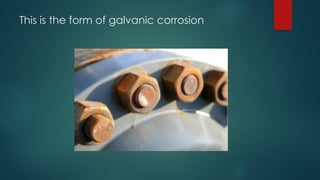
This is the form of galvanic corrosion
 To reduce corrosion providing insulation, buffers and
coatings are the most effective ways to reduce corrosion
risks when pairing other metals with stainless steel
products.
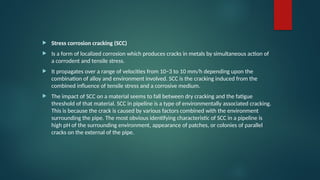
 Stress corrosion cracking (SCC)
 Is a form of localized corrosion which produces cracks in metals by simultaneous action of
a corrodent and tensile stress.
 It propagates over a range of velocities from 10−3 to 10 mm/h depending upon the
combination of alloy and environment involved. SCC is the cracking induced from the
combined influence of tensile stress and a corrosive medium.
 The impact of SCC on a material seems to fall between dry cracking and the fatigue
threshold of that material. SCC in pipeline is a type of environmentally associated cracking.
This is because the crack is caused by various factors combined with the environment
surrounding the pipe. The most obvious identifying characteristic of SCC in a pipeline is
high pH of the surrounding environment, appearance of patches, or colonies of parallel
cracks on the external of the pipe.
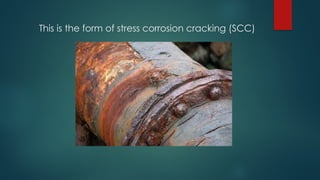
This is the form of stress corrosion cracking (SCC)
 Stress corrosion cracking can be prevented through
 Avoid the chemical species that causes SCC.
 Control of hardness and stress level (residual or load).
 Introduce compressive stress by shot-peening for example.
 Use of materials known not to crack in the specified environment.
 Microbiologically induced corrosion
 This type of corrosion is caused by bacterial activities. The bacteria produce waste
products like CO2, H2S, and organic acids that corrode the pipes by increasing the toxicity
of the flowing fluid in the pipeline. The microbes tend to form colonies in a hospitable
environment and allow enhanced corrosion under the colony. The formation of these
colonies is promoted by neutral water especially when stagnant. Numerous reports of the
presence of microbes in reservoirs had been published. It was found that found abundant
microbial flora indigenous in oil field formation waters, which included species of Bacillus,
Pseudomonas, Micrococcus, Mycobacterium, Clostridium, and Escherichia. Escherichia is
reported to contain hydrogenase, an enzyme that utilizes molecular hydrogen and may be
associated with cathodic hydrogen depolarization, causing corrosion of steel casings and
pipes in the oil field. Bacteria that form slime (some form of polysaccharides), such as
Achromobacter sp., Flavobacterium sp., and Desulfuricans sp., will adhere to each other,
forming a large mass. They also adhere to the walls of the pores, causing severe plugging
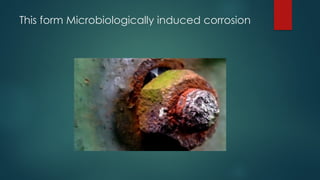
problems at injection wells. Microbiologically induced corrosion (MIC) is recognized by the
appearance of a black slimy waste material or nodules on the pipe surface as well as
pitting of the pipe wall underneath these deposits.
This form Microbiologically induced corrosion
 Method for reducing Microbiologically induced corrosion
 Microbiologically influenced corrosion, or microbial corrosion or
biological corrosion can be prevented through a number of
methods:
 Regular mechanical cleaning if possible.
 Chemical treatment with biocides to control the population of
bacteria.
 Complete drainage and dry-storage.
Reference
https://www.corrosionclinic.com/types_of_corrosion/microbiologically_
influenced_biological_microbial_corrosion.htm

Presentation1.pptx NCTU year 2 all about QC

  • 1.
    Quality Control, Corrosionand Hydrocarbon Chemistry Any provider /Prof Dr. Waleed & Dr. Doaa STUDENT'S NAME: ABDALLA MOHAMED FATHY OUF
  • 2.
    Types of corrosion Galvaniccorrosion Galvanic corrosion, also known as bimetallic corrosion, is an electrochemical process whereby one metal corrodes in preference to another metal that it is in contact with through an electrolyte. Galvanic corrosion occurs when two dissimilar metals are immersed in a conductive solution and are electrically connected. The anode metal combines with the cation in the conductive solution so it forms rust and other chemical compounds. The cathode metal receives electrons from the anode metal and doesn't break down. Galvanic corrosion can cause welds to fail. It's a common problem on oil platforms and in other salt-water installations.
  • 3.
    This is theform of galvanic corrosion
  • 4.
     To reducecorrosion providing insulation, buffers and coatings are the most effective ways to reduce corrosion risks when pairing other metals with stainless steel products.
  • 5.
     Stress corrosioncracking (SCC)  Is a form of localized corrosion which produces cracks in metals by simultaneous action of a corrodent and tensile stress.  It propagates over a range of velocities from 10−3 to 10 mm/h depending upon the combination of alloy and environment involved. SCC is the cracking induced from the combined influence of tensile stress and a corrosive medium.  The impact of SCC on a material seems to fall between dry cracking and the fatigue threshold of that material. SCC in pipeline is a type of environmentally associated cracking. This is because the crack is caused by various factors combined with the environment surrounding the pipe. The most obvious identifying characteristic of SCC in a pipeline is high pH of the surrounding environment, appearance of patches, or colonies of parallel cracks on the external of the pipe.
  • 6.
    This is theform of stress corrosion cracking (SCC)
  • 7.
     Stress corrosioncracking can be prevented through  Avoid the chemical species that causes SCC.  Control of hardness and stress level (residual or load).  Introduce compressive stress by shot-peening for example.  Use of materials known not to crack in the specified environment.
  • 8.
     Microbiologically inducedcorrosion  This type of corrosion is caused by bacterial activities. The bacteria produce waste products like CO2, H2S, and organic acids that corrode the pipes by increasing the toxicity of the flowing fluid in the pipeline. The microbes tend to form colonies in a hospitable environment and allow enhanced corrosion under the colony. The formation of these colonies is promoted by neutral water especially when stagnant. Numerous reports of the presence of microbes in reservoirs had been published. It was found that found abundant microbial flora indigenous in oil field formation waters, which included species of Bacillus, Pseudomonas, Micrococcus, Mycobacterium, Clostridium, and Escherichia. Escherichia is reported to contain hydrogenase, an enzyme that utilizes molecular hydrogen and may be associated with cathodic hydrogen depolarization, causing corrosion of steel casings and pipes in the oil field. Bacteria that form slime (some form of polysaccharides), such as Achromobacter sp., Flavobacterium sp., and Desulfuricans sp., will adhere to each other, forming a large mass. They also adhere to the walls of the pores, causing severe plugging problems at injection wells. Microbiologically induced corrosion (MIC) is recognized by the appearance of a black slimy waste material or nodules on the pipe surface as well as pitting of the pipe wall underneath these deposits.
  • 9.
    This form Microbiologicallyinduced corrosion
  • 10.
     Method forreducing Microbiologically induced corrosion  Microbiologically influenced corrosion, or microbial corrosion or biological corrosion can be prevented through a number of methods:  Regular mechanical cleaning if possible.  Chemical treatment with biocides to control the population of bacteria.  Complete drainage and dry-storage.
  • 11.