1. What is Scientific Integrity?
Online Course “Scientific Integrity”
“Scientific integrity forms the basis for trustworthy
research. It is an example of academic voluntary
commitment that encompasses a respectful attitude
towards peers, research participants, animals,
cultural assets, and the environment, and
strengthens and promotes vital public trust in
research.” (DFG 2019:7)
DFG 2019
Scientific Integrity
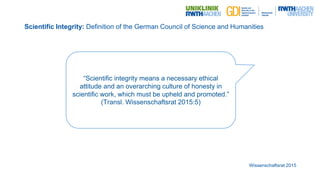
“Scientific integrity means a necessary ethical
attitude and an overarching culture of honesty in
scientific work, which must be upheld and promoted.”
(Transl. Wissenschaftsrat 2015:5)
Scientific Integrity: Definition of the German Council of Science and Humanities
Wissenschaftsrat 2015
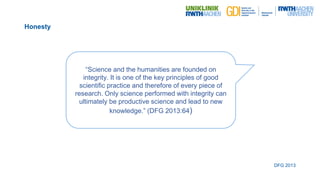
“Science and the humanities are founded on
integrity. It is one of the key principles of good
scientific practice and therefore of every piece of
research. Only science performed with integrity can
ultimately be productive science and lead to new
knowledge.” (DFG 2013:64)
Honesty
DFG 2013
Research as Knowledge Gain
Balzert et al. 2011
Discover reality and seek truth Give explanations on questions
Make the world understandable for
humans by means of theories,
hypotheses and laws
Make prognoses
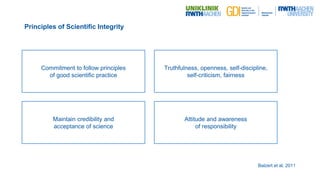
Principles of Scientific Integrity
Balzert et al. 2011
Commitment to follow principles
of good scientific practice
Truthfulness, openness, self-discipline,
self-criticism, fairness
Maintain credibility and
acceptance of science
Attitude and awareness
of responsibility
Criteria of Research
Swiss Academies of Arts and Science 2008
Further development and exchange Self-criticism and ethical reflection
Exchange and transparency Dialogue with society
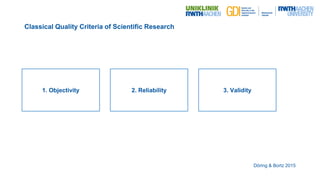
Classical Quality Criteria of Scientific Research
Döring & Bortz 2015
1. Objectivity 2. Reliability 3. Validity
References
• Akademien der Wissenschaft Schweiz (2008) Wissenschaftliche Integrität. Grundsätze und Verfahrensregeln.
• Balzert, H. et al. (2011) Wissenschaftliches Arbeiten: Ethik, Inhalt und Form. Herdecke/Witten: W3L.
• Deutsche Forschungsgemeinschaft (DFG) (2013) Sicherung guter wissenschaftlicher Praxis. Empfehlungen der
Kommission „Selbstkontrolle in der Wissenschaft“, Denkschrift. Weinheim.
• Deutsche Forschungsgemeinschaft (DFG) (2019) Leitlinien zur Sicherung guter wissenschaftlicher Praxis.
Kodex, online available:
https://www.dfg.de/download/pdf/foerderung/rechtliche_rahmenbedingungen/gute_wissenschaftliche_praxis/kod
ex_gwp.pdf (Status: 01.08.2019).
English translation available: German Research Foundation (2019) Guidelines for Safeguarding Good Research Practice. Code of
Conduct, online available:
https://www.dfg.de/download/pdf/foerderung/rechtliche_rahmenbedingungen/gute_wissenschaftliche_praxis/kodex_gwp_en.pdf
(Status: 25.06.2020).
• Döring, N. & Bortz, J. (2015) Forschungsmethoden und Evaluation in den Sozial- und Humanwissenschaften. 5.
Aufl. Springer.
References
• Sponholz, G. & Baitsch, H., (1999) Teaching research ethics (TRE). In: Ethik in der Medizin 11, S. 190–204.
Springer.
• Wissenschaftsrat (2015) Empfehlungen zu wissenschaftlicher Integrität. Positionspapier.

01 What is Scientific Integrity.pdf

  • 1.
    1. What isScientific Integrity? Online Course “Scientific Integrity”
  • 2.
    “Scientific integrity formsthe basis for trustworthy research. It is an example of academic voluntary commitment that encompasses a respectful attitude towards peers, research participants, animals, cultural assets, and the environment, and strengthens and promotes vital public trust in research.” (DFG 2019:7) DFG 2019 Scientific Integrity
  • 3.
    “Scientific integrity meansa necessary ethical attitude and an overarching culture of honesty in scientific work, which must be upheld and promoted.” (Transl. Wissenschaftsrat 2015:5) Scientific Integrity: Definition of the German Council of Science and Humanities Wissenschaftsrat 2015
  • 4.
    “Science and thehumanities are founded on integrity. It is one of the key principles of good scientific practice and therefore of every piece of research. Only science performed with integrity can ultimately be productive science and lead to new knowledge.” (DFG 2013:64) Honesty DFG 2013
  • 5.
    Research as KnowledgeGain Balzert et al. 2011 Discover reality and seek truth Give explanations on questions Make the world understandable for humans by means of theories, hypotheses and laws Make prognoses
  • 6.
    Principles of ScientificIntegrity Balzert et al. 2011 Commitment to follow principles of good scientific practice Truthfulness, openness, self-discipline, self-criticism, fairness Maintain credibility and acceptance of science Attitude and awareness of responsibility
  • 7.
    Criteria of Research SwissAcademies of Arts and Science 2008 Further development and exchange Self-criticism and ethical reflection Exchange and transparency Dialogue with society
  • 8.
    Classical Quality Criteriaof Scientific Research Döring & Bortz 2015 1. Objectivity 2. Reliability 3. Validity
  • 9.
    References • Akademien derWissenschaft Schweiz (2008) Wissenschaftliche Integrität. Grundsätze und Verfahrensregeln. • Balzert, H. et al. (2011) Wissenschaftliches Arbeiten: Ethik, Inhalt und Form. Herdecke/Witten: W3L. • Deutsche Forschungsgemeinschaft (DFG) (2013) Sicherung guter wissenschaftlicher Praxis. Empfehlungen der Kommission „Selbstkontrolle in der Wissenschaft“, Denkschrift. Weinheim. • Deutsche Forschungsgemeinschaft (DFG) (2019) Leitlinien zur Sicherung guter wissenschaftlicher Praxis. Kodex, online available: https://www.dfg.de/download/pdf/foerderung/rechtliche_rahmenbedingungen/gute_wissenschaftliche_praxis/kod ex_gwp.pdf (Status: 01.08.2019). English translation available: German Research Foundation (2019) Guidelines for Safeguarding Good Research Practice. Code of Conduct, online available: https://www.dfg.de/download/pdf/foerderung/rechtliche_rahmenbedingungen/gute_wissenschaftliche_praxis/kodex_gwp_en.pdf (Status: 25.06.2020). • Döring, N. & Bortz, J. (2015) Forschungsmethoden und Evaluation in den Sozial- und Humanwissenschaften. 5. Aufl. Springer.
  • 10.
    References • Sponholz, G.& Baitsch, H., (1999) Teaching research ethics (TRE). In: Ethik in der Medizin 11, S. 190–204. Springer. • Wissenschaftsrat (2015) Empfehlungen zu wissenschaftlicher Integrität. Positionspapier.