Installing and Basic Usage
OpenNebula Cloud Management Platform >
Innovative Open Source Technologies and Professional Services to
Build your Enterprise-ready Cloud Computing Environment
1/15© C12G Labs S.L.
All of the material in this Tutorial is copyright-protected and may not be published in other works without express
written permission from C12G Labs. All trademarks are property of their respective owners.
© C12G Labs S.L. Rev20130919
2Installing and Basic Usage
Agenda
Installing and Basic Usage
● Planning the Installation
● Installation (node 1 - Frontend)
● Installation (node 2 - Worker Node)
● Configuration
● Basic Usage
● Managing Hosts
● Images, Networks, Templates and VMs
● Managing Users, Quotas and ACLs
● Logging & Debugging
3Installing and Basic Usage
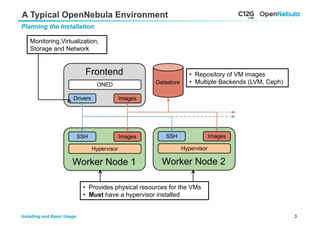
A Typical OpenNebula Environment
Planning the Installation
•  Repository of VM images
•  Multiple Backends (LVM, Ceph)
Monitoring,Virtualization,
Storage and Network
•  Provides physical resources for the VMs
•  Must have a hypervisor installed
4Installing and Basic Usage
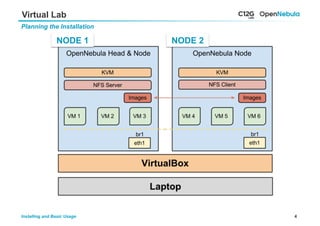
Virtual Lab
Planning the Installation
NODE 1 NODE 2
5Installing and Basic Usage
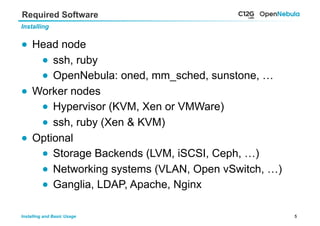
Required Software
Installing
● Head node
● ssh, ruby
● OpenNebula: oned, mm_sched, sunstone, …
● Worker nodes
● Hypervisor (KVM, Xen or VMWare)
● ssh, ruby (Xen & KVM)
● Optional
● Storage Backends (LVM, iSCSI, Ceph, …)
● Networking systems (VLAN, Open vSwitch, …)
● Ganglia, LDAP, Apache, Nginx
6Installing and Basic Usage
Installation node 1 - Frontend
Installing
Hands on (node1) !
● Activate repo and Install Packages
● Add QEMU drivers
● Configure NFS Server
# cp /var/tmp/tutorial/opennebula.repo /etc/
yum.repos.d/
# yum install opennebula-server opennebula-sunstone
opennebula-node-kvm opennebula-flow
# sed -i 's/"kvm" ]/"qemu" ]/' /etc/one/oned.conf
# cat /etc/exports
/var/lib/one
*(rw,sync,no_subtree_check,root_squash,anonuid=9869,anongid=9869)
7Installing and Basic Usage
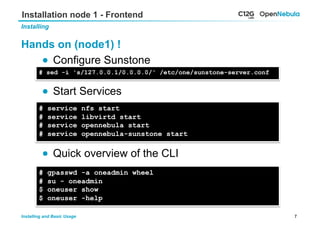
Installation node 1 - Frontend
Installing
Hands on (node1) !
● Configure Sunstone
● Start Services
● Quick overview of the CLI
# service nfs start
# service libvirtd start
# service opennebula start
# service opennebula-sunstone start
# gpasswd -a oneadmin wheel
# su - oneadmin
$ oneuser show
$ oneuser -help
# sed -i 's/127.0.0.1/0.0.0.0/' /etc/one/sunstone-server.conf
8Installing and Basic Usage
Installation node 1 - Frontend
Installing
Hands on (node1) !
● OpenNebula CLI Commands
$ one[TAB]
oneuser Manage Users oneimage Manage Images
onegroup Manage Groups onetemplate Manage Templates
oneacl Manage ACLs onevm Manage VMs
onehost Manage Hosts oneacct Accounting Tool
onecluster Manage Clusters onemarket Marketplace Tool
onevnet Manage Networks onedb DB Tool
onedatastore Manage Datastores
9Installing and Basic Usage
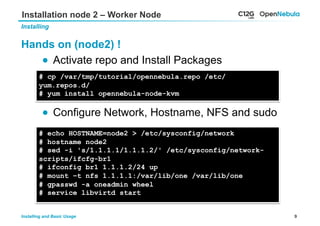
Installation node 2 – Worker Node
Installing
Hands on (node2) !
● Activate repo and Install Packages
● Configure Network, Hostname, NFS and sudo
# cp /var/tmp/tutorial/opennebula.repo /etc/
yum.repos.d/
# yum install opennebula-node-kvm
# echo HOSTNAME=node2 > /etc/sysconfig/network
# hostname node2
# sed -i 's/1.1.1.1/1.1.1.2/' /etc/sysconfig/network-
scripts/ifcfg-br1
# ifconfig br1 1.1.1.2/24 up
# mount –t nfs 1.1.1.1:/var/lib/one /var/lib/one
# gpasswd -a oneadmin wheel
# service libvirtd start
10Installing and Basic Usage
Configure Password-less SSH
Installing
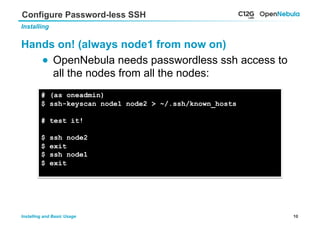
Hands on! (always node1 from now on)
● OpenNebula needs passwordless ssh access to
all the nodes from all the nodes:
# (as oneadmin)
$ ssh-keyscan node1 node2 > ~/.ssh/known_hosts
# test it!
$ ssh node2
$ exit
$ ssh node1
$ exit
11Installing and Basic Usage
Get User Information - Sunstone
Installing
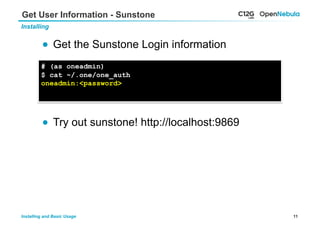
● Get the Sunstone Login information
● Try out sunstone! http://localhost:9869
# (as oneadmin)
$ cat ~/.one/one_auth
oneadmin:<password>
12Installing and Basic Usage
oned.conf
Configuration
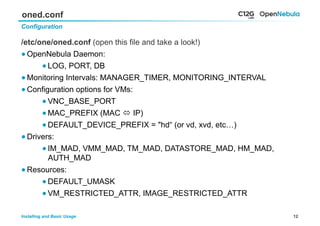
/etc/one/oned.conf (open this file and take a look!)
● OpenNebula Daemon:
● LOG, PORT, DB
● Monitoring Intervals: MANAGER_TIMER, MONITORING_INTERVAL
● Configuration options for VMs:
● VNC_BASE_PORT
● MAC_PREFIX (MAC  IP)
● DEFAULT_DEVICE_PREFIX = "hd“ (or vd, xvd, etc…)
● Drivers:
● IM_MAD, VMM_MAD, TM_MAD, DATASTORE_MAD, HM_MAD,
AUTH_MAD
● Resources:
● DEFAULT_UMASK
● VM_RESTRICTED_ATTR, IMAGE_RESTRICTED_ATTR
13Installing and Basic Usage
sched.conf
Configuration
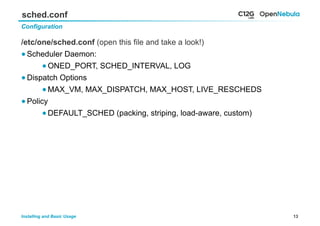
/etc/one/sched.conf (open this file and take a look!)
● Scheduler Daemon:
● ONED_PORT, SCHED_INTERVAL, LOG
● Dispatch Options
● MAX_VM, MAX_DISPATCH, MAX_HOST, LIVE_RESCHEDS
● Policy
● DEFAULT_SCHED (packing, striping, load-aware, custom)
14Installing and Basic Usage
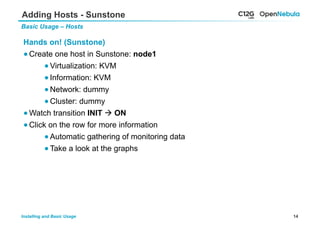
Adding Hosts - Sunstone
Basic Usage – Hosts
Hands on! (Sunstone)
● Create one host in Sunstone: node1
● Virtualization: KVM
● Information: KVM
● Network: dummy
● Cluster: dummy
● Watch transition INIT  ON
● Click on the row for more information
● Automatic gathering of monitoring data
● Take a look at the graphs
15Installing and Basic Usage
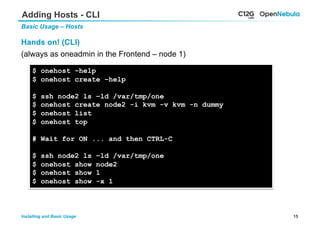
Adding Hosts - CLI
Basic Usage – Hosts
Hands on! (CLI)
(always as oneadmin in the Frontend – node 1)
$ onehost –help
$ onehost create –help
$ ssh node2 ls –ld /var/tmp/one
$ onehost create node2 -i kvm -v kvm -n dummy
$ onehost list
$ onehost top
# Wait for ON ... and then CTRL-C
$ ssh node2 ls –ld /var/tmp/one
$ onehost show node2
$ onehost show 1
$ onehost show -x 1
16Installing and Basic Usage
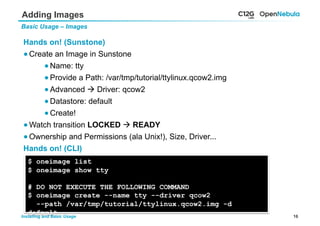
Adding Images
Basic Usage – Images
Hands on! (Sunstone)
● Create an Image in Sunstone
● Name: tty
● Provide a Path: /var/tmp/tutorial/ttylinux.qcow2.img
● Advanced  Driver: qcow2
● Datastore: default
● Create!
● Watch transition LOCKED  READY
● Ownership and Permissions (ala Unix!), Size, Driver...
Hands on! (CLI)
$ oneimage list
$ oneimage show tty
# DO NOT EXECUTE THE FOLLOWING COMMAND
$ oneimage create --name tty --driver qcow2
--path /var/tmp/tutorial/ttylinux.qcow2.img -d
default
17Installing and Basic Usage
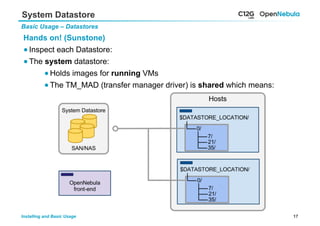
System Datastore
Basic Usage – Datastores
Hands on! (Sunstone)
● Inspect each Datastore:
● The system datastore:
● Holds images for running VMs
● The TM_MAD (transfer manager driver) is shared which means:
18Installing and Basic Usage
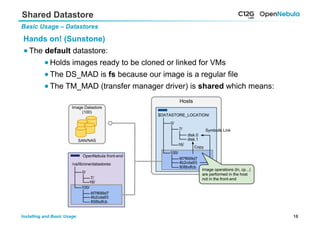
Shared Datastore
Basic Usage – Datastores
Hands on! (Sunstone)
● The default datastore:
● Holds images ready to be cloned or linked for VMs
● The DS_MAD is fs because our image is a regular file
● The TM_MAD (transfer manager driver) is shared which means:
19Installing and Basic Usage
Adding Networks
Basic Usage – Networks
Hands on! (Sunstone)
● Create a new Network
● Name: private
● Type: Fixed Network
● IP: 192.168.0.1 -> [ENTER] -> repeat ... -> 192.168.0.4
● Network Model: default
● Bridge: br1
br1
VM VM
Node 1
eth1
br1
Node 2
eth1
VM VM
20Installing and Basic Usage
Adding Networks
Basic Usage – Networks
Hands on! (Sunstone)
● Network extended information:
● Lease Management  Add, Hold and Remove Leases
Hands on! (CLI)
$ cat private2.net
NAME = private2
TYPE = fixed
BRIDGE = br1
LEASES = [ IP = 10.0.0.1 ]
LEASES = [ IP = 10.0.0.2 ]
$ onevnet create private2
$ onevnet list
$ onevnet show private
$ onevnet addleases private 192.168.0.105
$ onevnet hold private 192.168.0.105
21Installing and Basic Usage
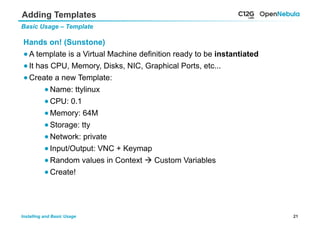
Adding Templates
Basic Usage – Template
Hands on! (Sunstone)
● A template is a Virtual Machine definition ready to be instantiated
● It has CPU, Memory, Disks, NIC, Graphical Ports, etc...
● Create a new Template:
● Name: ttylinux
● CPU: 0.1
● Memory: 64M
● Storage: tty
● Network: private
● Input/Output: VNC + Keymap
● Random values in Context  Custom Variables
● Create!
22Installing and Basic Usage
Adding Templates
Basic Usage – Template
Hands on! (CLI)
● Try the useful --dry option in the CLI
$ onetemplate create --help
$ onetemplate create --name ttylinux --cpu 0.1 
--memory 64 --disk tty --nic private --vnc --dry
NAME="ttylinux“
CPU=0.1
MEMORY=64
DISK=[
IMAGE="tty“
]
NIC=[
NETWORK="private“
]
GRAPHICS=[ TYPE="vnc", LISTEN="0.0.0.0" ]
23Installing and Basic Usage
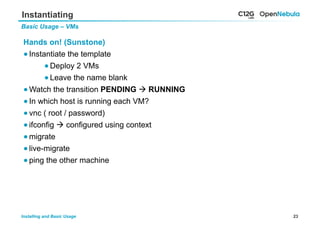
Instantiating
Basic Usage – VMs
Hands on! (Sunstone)
● Instantiate the template
● Deploy 2 VMs
● Leave the name blank
● Watch the transition PENDING  RUNNING
● In which host is running each VM?
● vnc ( root / password)
● ifconfig  configured using context
● migrate
● live-migrate
● ping the other machine
24Installing and Basic Usage
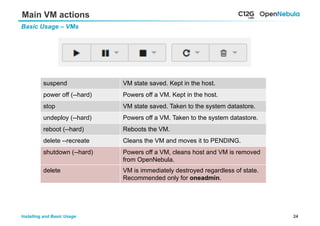
Main VM actions
Basic Usage – VMs
suspend VM state saved. Kept in the host.
power off (--hard) Powers off a VM. Kept in the host.
stop VM state saved. Taken to the system datastore.
undeploy (--hard) Powers off a VM. Taken to the system datastore.
reboot (--hard) Reboots the VM.
delete --recreate Cleans the VM and moves it to PENDING.
shutdown (--hard) Powers off a VM, cleans host and VM is removed
from OpenNebula.
delete VM is immediately destroyed regardless of state.
Recommended only for oneadmin.
25Installing and Basic Usage
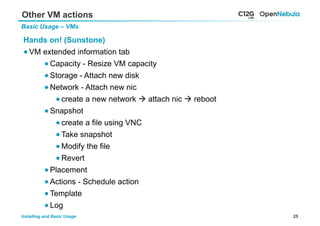
Other VM actions
Basic Usage – VMs
Hands on! (Sunstone)
● VM extended information tab
● Capacity - Resize VM capacity
● Storage - Attach new disk
● Network - Attach new nic
● create a new network  attach nic  reboot
● Snapshot
● create a file using VNC
● Take snapshot
● Modify the file
● Revert
● Placement
● Actions - Schedule action
● Template
● Log
26Installing and Basic Usage
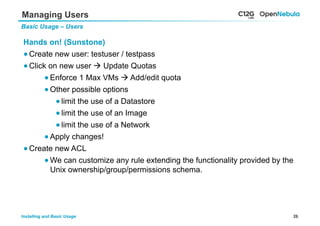
Managing Users
Basic Usage – Users
Hands on! (Sunstone)
● Create new user: testuser / testpass
● Click on new user  Update Quotas
● Enforce 1 Max VMs  Add/edit quota
● Other possible options
● limit the use of a Datastore
● limit the use of an Image
● limit the use of a Network
● Apply changes!
● Create new ACL
● We can customize any rule extending the functionality provided by the
Unix ownership/group/permissions schema.
27Installing and Basic Usage
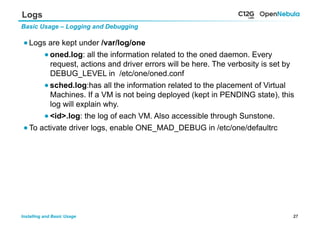
Logs
Basic Usage – Logging and Debugging
● Logs are kept under /var/log/one
● oned.log: all the information related to the oned daemon. Every
request, actions and driver errors will be here. The verbosity is set by
DEBUG_LEVEL in /etc/one/oned.conf
● sched.log:has all the information related to the placement of Virtual
Machines. If a VM is not being deployed (kept in PENDING state), this
log will explain why.
● <id>.log: the log of each VM. Also accessible through Sunstone.
● To activate driver logs, enable ONE_MAD_DEBUG in /etc/one/defaultrc
28Installing and Basic Usage
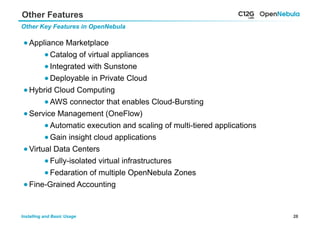
Other Features
Other Key Features in OpenNebula
● Appliance Marketplace
● Catalog of virtual appliances
● Integrated with Sunstone
● Deployable in Private Cloud
● Hybrid Cloud Computing
● AWS connector that enables Cloud-Bursting
● Service Management (OneFlow)
● Automatic execution and scaling of multi-tiered applications
● Gain insight cloud applications
● Virtual Data Centers
● Fully-isolated virtual infrastructures
● Fedaration of multiple OpenNebula Zones
● Fine-Grained Accounting
29Installing and Basic Usage
We Will Be Happy to Clarify Any Question
Questions?

OpenNebulaConf 2013 - Hands-on Tutorial: 2. Installing and Basic Usage

  • 1.
    Installing and BasicUsage OpenNebula Cloud Management Platform > Innovative Open Source Technologies and Professional Services to Build your Enterprise-ready Cloud Computing Environment 1/15© C12G Labs S.L. All of the material in this Tutorial is copyright-protected and may not be published in other works without express written permission from C12G Labs. All trademarks are property of their respective owners. © C12G Labs S.L. Rev20130919
  • 2.
    2Installing and BasicUsage Agenda Installing and Basic Usage ● Planning the Installation ● Installation (node 1 - Frontend) ● Installation (node 2 - Worker Node) ● Configuration ● Basic Usage ● Managing Hosts ● Images, Networks, Templates and VMs ● Managing Users, Quotas and ACLs ● Logging & Debugging
  • 3.
    3Installing and BasicUsage A Typical OpenNebula Environment Planning the Installation •  Repository of VM images •  Multiple Backends (LVM, Ceph) Monitoring,Virtualization, Storage and Network •  Provides physical resources for the VMs •  Must have a hypervisor installed
  • 4.
    4Installing and BasicUsage Virtual Lab Planning the Installation NODE 1 NODE 2
  • 5.
    5Installing and BasicUsage Required Software Installing ● Head node ● ssh, ruby ● OpenNebula: oned, mm_sched, sunstone, … ● Worker nodes ● Hypervisor (KVM, Xen or VMWare) ● ssh, ruby (Xen & KVM) ● Optional ● Storage Backends (LVM, iSCSI, Ceph, …) ● Networking systems (VLAN, Open vSwitch, …) ● Ganglia, LDAP, Apache, Nginx
  • 6.
    6Installing and BasicUsage Installation node 1 - Frontend Installing Hands on (node1) ! ● Activate repo and Install Packages ● Add QEMU drivers ● Configure NFS Server # cp /var/tmp/tutorial/opennebula.repo /etc/ yum.repos.d/ # yum install opennebula-server opennebula-sunstone opennebula-node-kvm opennebula-flow # sed -i 's/"kvm" ]/"qemu" ]/' /etc/one/oned.conf # cat /etc/exports /var/lib/one *(rw,sync,no_subtree_check,root_squash,anonuid=9869,anongid=9869)
  • 7.
    7Installing and BasicUsage Installation node 1 - Frontend Installing Hands on (node1) ! ● Configure Sunstone ● Start Services ● Quick overview of the CLI # service nfs start # service libvirtd start # service opennebula start # service opennebula-sunstone start # gpasswd -a oneadmin wheel # su - oneadmin $ oneuser show $ oneuser -help # sed -i 's/127.0.0.1/0.0.0.0/' /etc/one/sunstone-server.conf
  • 8.
    8Installing and BasicUsage Installation node 1 - Frontend Installing Hands on (node1) ! ● OpenNebula CLI Commands $ one[TAB] oneuser Manage Users oneimage Manage Images onegroup Manage Groups onetemplate Manage Templates oneacl Manage ACLs onevm Manage VMs onehost Manage Hosts oneacct Accounting Tool onecluster Manage Clusters onemarket Marketplace Tool onevnet Manage Networks onedb DB Tool onedatastore Manage Datastores
  • 9.
    9Installing and BasicUsage Installation node 2 – Worker Node Installing Hands on (node2) ! ● Activate repo and Install Packages ● Configure Network, Hostname, NFS and sudo # cp /var/tmp/tutorial/opennebula.repo /etc/ yum.repos.d/ # yum install opennebula-node-kvm # echo HOSTNAME=node2 > /etc/sysconfig/network # hostname node2 # sed -i 's/1.1.1.1/1.1.1.2/' /etc/sysconfig/network- scripts/ifcfg-br1 # ifconfig br1 1.1.1.2/24 up # mount –t nfs 1.1.1.1:/var/lib/one /var/lib/one # gpasswd -a oneadmin wheel # service libvirtd start
  • 10.
    10Installing and BasicUsage Configure Password-less SSH Installing Hands on! (always node1 from now on) ● OpenNebula needs passwordless ssh access to all the nodes from all the nodes: # (as oneadmin) $ ssh-keyscan node1 node2 > ~/.ssh/known_hosts # test it! $ ssh node2 $ exit $ ssh node1 $ exit
  • 11.
    11Installing and BasicUsage Get User Information - Sunstone Installing ● Get the Sunstone Login information ● Try out sunstone! http://localhost:9869 # (as oneadmin) $ cat ~/.one/one_auth oneadmin:<password>
  • 12.
    12Installing and BasicUsage oned.conf Configuration /etc/one/oned.conf (open this file and take a look!) ● OpenNebula Daemon: ● LOG, PORT, DB ● Monitoring Intervals: MANAGER_TIMER, MONITORING_INTERVAL ● Configuration options for VMs: ● VNC_BASE_PORT ● MAC_PREFIX (MAC  IP) ● DEFAULT_DEVICE_PREFIX = "hd“ (or vd, xvd, etc…) ● Drivers: ● IM_MAD, VMM_MAD, TM_MAD, DATASTORE_MAD, HM_MAD, AUTH_MAD ● Resources: ● DEFAULT_UMASK ● VM_RESTRICTED_ATTR, IMAGE_RESTRICTED_ATTR
  • 13.
    13Installing and BasicUsage sched.conf Configuration /etc/one/sched.conf (open this file and take a look!) ● Scheduler Daemon: ● ONED_PORT, SCHED_INTERVAL, LOG ● Dispatch Options ● MAX_VM, MAX_DISPATCH, MAX_HOST, LIVE_RESCHEDS ● Policy ● DEFAULT_SCHED (packing, striping, load-aware, custom)
  • 14.
    14Installing and BasicUsage Adding Hosts - Sunstone Basic Usage – Hosts Hands on! (Sunstone) ● Create one host in Sunstone: node1 ● Virtualization: KVM ● Information: KVM ● Network: dummy ● Cluster: dummy ● Watch transition INIT  ON ● Click on the row for more information ● Automatic gathering of monitoring data ● Take a look at the graphs
  • 15.
    15Installing and BasicUsage Adding Hosts - CLI Basic Usage – Hosts Hands on! (CLI) (always as oneadmin in the Frontend – node 1) $ onehost –help $ onehost create –help $ ssh node2 ls –ld /var/tmp/one $ onehost create node2 -i kvm -v kvm -n dummy $ onehost list $ onehost top # Wait for ON ... and then CTRL-C $ ssh node2 ls –ld /var/tmp/one $ onehost show node2 $ onehost show 1 $ onehost show -x 1
  • 16.
    16Installing and BasicUsage Adding Images Basic Usage – Images Hands on! (Sunstone) ● Create an Image in Sunstone ● Name: tty ● Provide a Path: /var/tmp/tutorial/ttylinux.qcow2.img ● Advanced  Driver: qcow2 ● Datastore: default ● Create! ● Watch transition LOCKED  READY ● Ownership and Permissions (ala Unix!), Size, Driver... Hands on! (CLI) $ oneimage list $ oneimage show tty # DO NOT EXECUTE THE FOLLOWING COMMAND $ oneimage create --name tty --driver qcow2 --path /var/tmp/tutorial/ttylinux.qcow2.img -d default
  • 17.
    17Installing and BasicUsage System Datastore Basic Usage – Datastores Hands on! (Sunstone) ● Inspect each Datastore: ● The system datastore: ● Holds images for running VMs ● The TM_MAD (transfer manager driver) is shared which means:
  • 18.
    18Installing and BasicUsage Shared Datastore Basic Usage – Datastores Hands on! (Sunstone) ● The default datastore: ● Holds images ready to be cloned or linked for VMs ● The DS_MAD is fs because our image is a regular file ● The TM_MAD (transfer manager driver) is shared which means:
  • 19.
    19Installing and BasicUsage Adding Networks Basic Usage – Networks Hands on! (Sunstone) ● Create a new Network ● Name: private ● Type: Fixed Network ● IP: 192.168.0.1 -> [ENTER] -> repeat ... -> 192.168.0.4 ● Network Model: default ● Bridge: br1 br1 VM VM Node 1 eth1 br1 Node 2 eth1 VM VM
  • 20.
    20Installing and BasicUsage Adding Networks Basic Usage – Networks Hands on! (Sunstone) ● Network extended information: ● Lease Management  Add, Hold and Remove Leases Hands on! (CLI) $ cat private2.net NAME = private2 TYPE = fixed BRIDGE = br1 LEASES = [ IP = 10.0.0.1 ] LEASES = [ IP = 10.0.0.2 ] $ onevnet create private2 $ onevnet list $ onevnet show private $ onevnet addleases private 192.168.0.105 $ onevnet hold private 192.168.0.105
  • 21.
    21Installing and BasicUsage Adding Templates Basic Usage – Template Hands on! (Sunstone) ● A template is a Virtual Machine definition ready to be instantiated ● It has CPU, Memory, Disks, NIC, Graphical Ports, etc... ● Create a new Template: ● Name: ttylinux ● CPU: 0.1 ● Memory: 64M ● Storage: tty ● Network: private ● Input/Output: VNC + Keymap ● Random values in Context  Custom Variables ● Create!
  • 22.
    22Installing and BasicUsage Adding Templates Basic Usage – Template Hands on! (CLI) ● Try the useful --dry option in the CLI $ onetemplate create --help $ onetemplate create --name ttylinux --cpu 0.1 --memory 64 --disk tty --nic private --vnc --dry NAME="ttylinux“ CPU=0.1 MEMORY=64 DISK=[ IMAGE="tty“ ] NIC=[ NETWORK="private“ ] GRAPHICS=[ TYPE="vnc", LISTEN="0.0.0.0" ]
  • 23.
    23Installing and BasicUsage Instantiating Basic Usage – VMs Hands on! (Sunstone) ● Instantiate the template ● Deploy 2 VMs ● Leave the name blank ● Watch the transition PENDING  RUNNING ● In which host is running each VM? ● vnc ( root / password) ● ifconfig  configured using context ● migrate ● live-migrate ● ping the other machine
  • 24.
    24Installing and BasicUsage Main VM actions Basic Usage – VMs suspend VM state saved. Kept in the host. power off (--hard) Powers off a VM. Kept in the host. stop VM state saved. Taken to the system datastore. undeploy (--hard) Powers off a VM. Taken to the system datastore. reboot (--hard) Reboots the VM. delete --recreate Cleans the VM and moves it to PENDING. shutdown (--hard) Powers off a VM, cleans host and VM is removed from OpenNebula. delete VM is immediately destroyed regardless of state. Recommended only for oneadmin.
  • 25.
    25Installing and BasicUsage Other VM actions Basic Usage – VMs Hands on! (Sunstone) ● VM extended information tab ● Capacity - Resize VM capacity ● Storage - Attach new disk ● Network - Attach new nic ● create a new network  attach nic  reboot ● Snapshot ● create a file using VNC ● Take snapshot ● Modify the file ● Revert ● Placement ● Actions - Schedule action ● Template ● Log
  • 26.
    26Installing and BasicUsage Managing Users Basic Usage – Users Hands on! (Sunstone) ● Create new user: testuser / testpass ● Click on new user  Update Quotas ● Enforce 1 Max VMs  Add/edit quota ● Other possible options ● limit the use of a Datastore ● limit the use of an Image ● limit the use of a Network ● Apply changes! ● Create new ACL ● We can customize any rule extending the functionality provided by the Unix ownership/group/permissions schema.
  • 27.
    27Installing and BasicUsage Logs Basic Usage – Logging and Debugging ● Logs are kept under /var/log/one ● oned.log: all the information related to the oned daemon. Every request, actions and driver errors will be here. The verbosity is set by DEBUG_LEVEL in /etc/one/oned.conf ● sched.log:has all the information related to the placement of Virtual Machines. If a VM is not being deployed (kept in PENDING state), this log will explain why. ● <id>.log: the log of each VM. Also accessible through Sunstone. ● To activate driver logs, enable ONE_MAD_DEBUG in /etc/one/defaultrc
  • 28.
    28Installing and BasicUsage Other Features Other Key Features in OpenNebula ● Appliance Marketplace ● Catalog of virtual appliances ● Integrated with Sunstone ● Deployable in Private Cloud ● Hybrid Cloud Computing ● AWS connector that enables Cloud-Bursting ● Service Management (OneFlow) ● Automatic execution and scaling of multi-tiered applications ● Gain insight cloud applications ● Virtual Data Centers ● Fully-isolated virtual infrastructures ● Fedaration of multiple OpenNebula Zones ● Fine-Grained Accounting
  • 29.
    29Installing and BasicUsage We Will Be Happy to Clarify Any Question Questions?