Lesson 1
KEY TEXT
“Search the scriptures;
for in them ye think ye
have eternal life: and
they are they which
testify of me”
John 5:39
REFLECTION
Though it’s important to know the Bible,
that alone isn’t enough.
Some of the biggest-name Bible
scholars have not even been believing
Christians.
Thus, we need to ask ourselves, How
can we make sure that our study and
reading of the Bible help us to come to a
better knowledge of Jesus and what He
has done for us?
That is, how can we make Bible study
something that transforms our lives?
 He knew the Scriptures.
 He gave authority to the
Scriptures.
 He used the Scriptures to
preach.
 He convinced people with
the Scriptures.
 His disciples followed His
example.
The Bible was made up only of
the Old Testament in Jesus’
day. It was known as “the
Scriptures”.
This week we’re studying how
Jesus used the Scriptures:
“And beginning at Moses and all the Prophets, He
expounded to them in all the Scriptures the things
concerning Himself” (Luke 24:27)
Jesus knew the Scriptures deeply.
How did He learn the Scriptures?
“In childhood, youth, and manhood,
Jesus studied the Scriptures. As a
little child He was daily at His
mother’s knee taught from the
scrolls of the prophets.
E.G.W. (Education, cp. 20, pg. 185)
In His youth the early morning and the evening
twilight often found Him alone on the mountainside
or among the trees of the forest, spending a quiet
hour in prayer and the study of God’s word. During
His ministry His intimate acquaintance with the
Scriptures testifies to His diligence in their study.
And since He gained knowledge as we may gain it, His
wonderful power, both mental and spiritual, is a
testimony to the value of the Bible as a means of
education”
Thanks to His knowledge of
the Bible, Jesus could …
Understand His mission.
“For the first time the
child Jesus looked
upon the temple
[Lk. 2:41-42]… He beheld
the bleeding victim
upon the altar of
sacrifice… He
witnessed the
impressive rites of the
paschal service
[Nm. 28:16]. Day by day
He saw their meaning
more clearly… The
mystery of His mission
was opening to the
Saviour”
(E.G.W., The Desire
of Ages, pg. 57)
Overcome temptation.
“But He answered and
said, “It is written, ‘Man
shall not live by bread
alone, but by every word
that proceeds from the
mouth of God.’”[Dt. 8:3]”
(Matthew 4:4)
“Jesus said to him, “It is
written again, ‘you shall
not tempt the Lord your
God.’”
[Dt. 6:16]” (Matthew 4:7)
“Then Jesus said to him,
“Away with you, Satan!
For it is written, ‘You shall
worship the Lord your
God, and Him only you
shall serve.’”[Dt. 6:13]”
(Matthew 4:10)
Explain His mission.
“Jesus said to them,
“Have you never read
in the Scriptures: ‘The
stone which the
builders rejected has
become the chief
cornerstone. This was
the Lord’s doing, and
it is marvelous in our
eyes’? [Sal. 118:22-23]...
And whoever falls on
this stone will be
broken; but on
whomever it falls, it
will grind him to
powder.””
(Matthew 21:42, 44)
Teach what was written
about Himself in the
Scriptures.
“And beginning at
Moses and all the
Prophets, He
expounded to
them in all the
Scriptures the
things concerning
Himself”
(Luke 24:27)
Jesus usually quoted examples and passages from the Bible
while discussing with His opponents or preaching. That way
He strengthened the authority of the Word of God.
“Do not think that I came to destroy the
Law or the Prophets. I did not come to
destroy but to fulfill” (Matthew 5:17)
• He made mention of David eating the showbread (1S. 21:1-6)
• He made mention of the sabbatical work of the priests in the temple
(Nm. 28:9-10)
• He quoted Hosea 6:6 “For I desire mercy and not sacrifice”
When the disciples began
to pluck heads of grain on
Sabbath (Mt. 12:1-8)
• He made mention of the commandment about honoring our parents
(Ex. 20:12; 21:17)
• He quoted Isaiah 29:13 “These people honor Me with their lips…”
To fight against the
traditions of the
Pharisees (Mt. 15:1-20)
• He quoted Psalm 82:6 “I said, “You are gods”
When people wanted to
stone Him for calling
Himself Son of God
(Jn. 10:32-38)
The only safe path is to
follow the example of
Christ: Praising, honoring
and obeying the Bible.
The Authority
of Scripture
Whenever Christ debated with the religious authorities, He relied not on
abstract philosophy, not even on personal authority, but on the teachings of
Scripture. When determining right from wrong, Jesus based His argument on
a scriptural bedrock. When opponents challenged Christ’s doctrinal purity,
He directed them to specific passages within Scripture. When considering
practical matters, Jesus referred listeners to divine revelation. Christ
understood that His divinely ordained mission was to accomplish that
which the ancient prophets had predicted.
Contrast Christ’s exalted understanding of Scripture with the
prevailing attitude often exhibited among even professed Christians
today. Entire denominations have come to deem the Bible as
interesting but, basically, unreliable historical manuscripts.
Everything—the six-day Creation, the flood, the Exodus, even the
bodily resurrection of Jesus (much less a literal Second Coming)—
has been called into question, or even relegated to the status of myth.
Flood
Resurrection
Second Coming
Creation
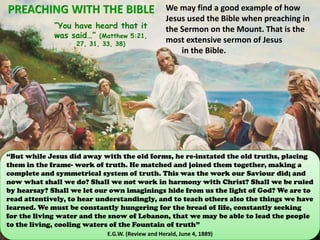
“You have heard that it
was said…” (Matthew 5:21,
27, 31, 33, 38)
We may find a good example of how
Jesus used the Bible when preaching in
the Sermon on the Mount. That is the
most extensive sermon of Jesus
in the Bible.
“But while Jesus did away with the old forms, he re-instated the old truths, placing
them in the frame- work of truth. He matched and joined them together, making a
complete and symmetrical system of truth. This was the work our Saviour did; and
now what shall we do? Shall we not work in harmony with Christ? Shall we be ruled
by hearsay? Shall we let our own imaginings hide from us the light of God? We are to
read attentively, to hear understandingly, and to teach others also the things we have
learned. We must be constantly hungering for the bread of life, constantly seeking
for the living water and the snow of Lebanon, that we may be able to lead the people
to the living, cooling waters of the Fountain of truth”
E.G.W. (Review and Herald, June 4, 1889)
“And as Moses lifted up the serpent in
the wilderness, even so must the Son
of Man be lifted up, that whoever
believes in Him should not perish but
have eternal life” (John 3:14-15)
Jesus tried to convinced people with the Bible
in private conversations or small groups,
instead of using miracles (Jn. 13:18-20; Lk. 10:25-28;
24:12-22)
“In teaching these disciples, Jesus
showed the importance of the Old
Testament as a witness to His
mission. Many professed Christians
now discard the Old Testament,
claiming that it is no longer of any
use. But such is not Christ’s teaching.
So highly did He value it that at one
time He said, “If they hear not Moses
and the prophets, neither will they
be persuaded, though one rose from
the dead.”” E.G.W. (The Desire of Ages, cp. 83, pg. 799)
Repeatedly, Christ
quotes Scripture in
conjunction with
His calls to
discipleship. This
clearly implies that
Jesus’ authority
and credibility
rested on
Scripture, not
merely on personal
charisma. This is
seen especially in
the ways in which
Jesus used the
Scriptures as He
worked with the
two disciples who
were on the road to
Emmaus.
“Beginning at Moses, the very
Alpha of Bible history, Christ
expounded in all the Scriptures
the things concerning Himself.
Had He first made Himself
known to them, their hearts
would have been satisfied. In
the fullness of their joy they
would have hungered for
nothing more. But it was nece-
ssary for them to understand
the witness borne to Him by
the types and prophecies of
the Old Testament. Upon these
their faith must be established.
Christ performed no miracle to convince them, but it was His first work to
explain the Scriptures. They had looked upon His death as the destruction of
all their hopes. Now He showed from the prophets that this was the very
strongest evidence for their faith. “In teaching these disciples, Jesus showed
the importance of the Old Testament as a witness to His mission.”—Ellen G.
White, The Desire of Ages, pp. 796–799.
Encourage the preaching of the Gospel
Romans 10:14-15 Isaiah 52:7
Place Jews and Gentiles on an equal footing
Romans 10:11-13 Isaiah 28:16
Welcome the Gentiles to the Church
Acts 15:1-31 Amos 9:11-12
Call people to conversion
Acts 3:18-26 Deuteronomy 18:18
Choose the successor of Judas
Acts 1:15-26 Psalm 69:25; 109:8
The first disciples made the Bible their life
guide and their rule of faith.
For example, they used the Bible to:
“Of Christ’s life and death and intercession, which
prophets had foretold, the apostles were to go forth as
witnesses. Christ in His humiliation, in His purity and
holiness, in His matchless love, was to be their theme.
And in order to preach the gospel in its fullness, they
must present the Saviour not only as revealed in His life
and teachings, but as foretold by the prophets of the Old
Testament and as symbolized by the sacrificial service”
E.G.W. (Christ’s Object Lessons, cp. 11, pg. 127)
As Jesus and the apostles did, we must preach by using the Word of God to
show Salvation to others.
REFLECTION
Dwell on Luke 24:32, especially the
phrase that their “heart[s] burn[ed]
within.
” What does that mean?
When was the last time your heart
burned within you over the truths
that we have been given?
If it hasn’t in a long time, might it
be because your heart has grown
cold? If so, how can you change?
Slideshare.net/chucho1943
We invite you to
download and study
each one of the 13
lessons about this
series
THIS SERVICE IS
FREE AND YOU
CAN USE IT
Discipleship

01 disciples and bible

  • 1.
  • 2.
    KEY TEXT “Search thescriptures; for in them ye think ye have eternal life: and they are they which testify of me” John 5:39
  • 3.
    REFLECTION Though it’s importantto know the Bible, that alone isn’t enough. Some of the biggest-name Bible scholars have not even been believing Christians. Thus, we need to ask ourselves, How can we make sure that our study and reading of the Bible help us to come to a better knowledge of Jesus and what He has done for us? That is, how can we make Bible study something that transforms our lives?
  • 4.
     He knewthe Scriptures.  He gave authority to the Scriptures.  He used the Scriptures to preach.  He convinced people with the Scriptures.  His disciples followed His example. The Bible was made up only of the Old Testament in Jesus’ day. It was known as “the Scriptures”. This week we’re studying how Jesus used the Scriptures:
  • 5.
    “And beginning atMoses and all the Prophets, He expounded to them in all the Scriptures the things concerning Himself” (Luke 24:27) Jesus knew the Scriptures deeply. How did He learn the Scriptures? “In childhood, youth, and manhood, Jesus studied the Scriptures. As a little child He was daily at His mother’s knee taught from the scrolls of the prophets. E.G.W. (Education, cp. 20, pg. 185) In His youth the early morning and the evening twilight often found Him alone on the mountainside or among the trees of the forest, spending a quiet hour in prayer and the study of God’s word. During His ministry His intimate acquaintance with the Scriptures testifies to His diligence in their study. And since He gained knowledge as we may gain it, His wonderful power, both mental and spiritual, is a testimony to the value of the Bible as a means of education”
  • 6.
    Thanks to Hisknowledge of the Bible, Jesus could … Understand His mission. “For the first time the child Jesus looked upon the temple [Lk. 2:41-42]… He beheld the bleeding victim upon the altar of sacrifice… He witnessed the impressive rites of the paschal service [Nm. 28:16]. Day by day He saw their meaning more clearly… The mystery of His mission was opening to the Saviour” (E.G.W., The Desire of Ages, pg. 57) Overcome temptation. “But He answered and said, “It is written, ‘Man shall not live by bread alone, but by every word that proceeds from the mouth of God.’”[Dt. 8:3]” (Matthew 4:4) “Jesus said to him, “It is written again, ‘you shall not tempt the Lord your God.’” [Dt. 6:16]” (Matthew 4:7) “Then Jesus said to him, “Away with you, Satan! For it is written, ‘You shall worship the Lord your God, and Him only you shall serve.’”[Dt. 6:13]” (Matthew 4:10) Explain His mission. “Jesus said to them, “Have you never read in the Scriptures: ‘The stone which the builders rejected has become the chief cornerstone. This was the Lord’s doing, and it is marvelous in our eyes’? [Sal. 118:22-23]... And whoever falls on this stone will be broken; but on whomever it falls, it will grind him to powder.”” (Matthew 21:42, 44) Teach what was written about Himself in the Scriptures. “And beginning at Moses and all the Prophets, He expounded to them in all the Scriptures the things concerning Himself” (Luke 24:27)
  • 7.
    Jesus usually quotedexamples and passages from the Bible while discussing with His opponents or preaching. That way He strengthened the authority of the Word of God. “Do not think that I came to destroy the Law or the Prophets. I did not come to destroy but to fulfill” (Matthew 5:17) • He made mention of David eating the showbread (1S. 21:1-6) • He made mention of the sabbatical work of the priests in the temple (Nm. 28:9-10) • He quoted Hosea 6:6 “For I desire mercy and not sacrifice” When the disciples began to pluck heads of grain on Sabbath (Mt. 12:1-8) • He made mention of the commandment about honoring our parents (Ex. 20:12; 21:17) • He quoted Isaiah 29:13 “These people honor Me with their lips…” To fight against the traditions of the Pharisees (Mt. 15:1-20) • He quoted Psalm 82:6 “I said, “You are gods” When people wanted to stone Him for calling Himself Son of God (Jn. 10:32-38) The only safe path is to follow the example of Christ: Praising, honoring and obeying the Bible.
  • 8.
    The Authority of Scripture WheneverChrist debated with the religious authorities, He relied not on abstract philosophy, not even on personal authority, but on the teachings of Scripture. When determining right from wrong, Jesus based His argument on a scriptural bedrock. When opponents challenged Christ’s doctrinal purity, He directed them to specific passages within Scripture. When considering practical matters, Jesus referred listeners to divine revelation. Christ understood that His divinely ordained mission was to accomplish that which the ancient prophets had predicted.
  • 9.
    Contrast Christ’s exaltedunderstanding of Scripture with the prevailing attitude often exhibited among even professed Christians today. Entire denominations have come to deem the Bible as interesting but, basically, unreliable historical manuscripts. Everything—the six-day Creation, the flood, the Exodus, even the bodily resurrection of Jesus (much less a literal Second Coming)— has been called into question, or even relegated to the status of myth. Flood Resurrection Second Coming Creation
  • 10.
    “You have heardthat it was said…” (Matthew 5:21, 27, 31, 33, 38) We may find a good example of how Jesus used the Bible when preaching in the Sermon on the Mount. That is the most extensive sermon of Jesus in the Bible. “But while Jesus did away with the old forms, he re-instated the old truths, placing them in the frame- work of truth. He matched and joined them together, making a complete and symmetrical system of truth. This was the work our Saviour did; and now what shall we do? Shall we not work in harmony with Christ? Shall we be ruled by hearsay? Shall we let our own imaginings hide from us the light of God? We are to read attentively, to hear understandingly, and to teach others also the things we have learned. We must be constantly hungering for the bread of life, constantly seeking for the living water and the snow of Lebanon, that we may be able to lead the people to the living, cooling waters of the Fountain of truth” E.G.W. (Review and Herald, June 4, 1889)
  • 11.
    “And as Moseslifted up the serpent in the wilderness, even so must the Son of Man be lifted up, that whoever believes in Him should not perish but have eternal life” (John 3:14-15) Jesus tried to convinced people with the Bible in private conversations or small groups, instead of using miracles (Jn. 13:18-20; Lk. 10:25-28; 24:12-22) “In teaching these disciples, Jesus showed the importance of the Old Testament as a witness to His mission. Many professed Christians now discard the Old Testament, claiming that it is no longer of any use. But such is not Christ’s teaching. So highly did He value it that at one time He said, “If they hear not Moses and the prophets, neither will they be persuaded, though one rose from the dead.”” E.G.W. (The Desire of Ages, cp. 83, pg. 799)
  • 12.
    Repeatedly, Christ quotes Scripturein conjunction with His calls to discipleship. This clearly implies that Jesus’ authority and credibility rested on Scripture, not merely on personal charisma. This is seen especially in the ways in which Jesus used the Scriptures as He worked with the two disciples who were on the road to Emmaus.
  • 13.
    “Beginning at Moses,the very Alpha of Bible history, Christ expounded in all the Scriptures the things concerning Himself. Had He first made Himself known to them, their hearts would have been satisfied. In the fullness of their joy they would have hungered for nothing more. But it was nece- ssary for them to understand the witness borne to Him by the types and prophecies of the Old Testament. Upon these their faith must be established. Christ performed no miracle to convince them, but it was His first work to explain the Scriptures. They had looked upon His death as the destruction of all their hopes. Now He showed from the prophets that this was the very strongest evidence for their faith. “In teaching these disciples, Jesus showed the importance of the Old Testament as a witness to His mission.”—Ellen G. White, The Desire of Ages, pp. 796–799.
  • 14.
    Encourage the preachingof the Gospel Romans 10:14-15 Isaiah 52:7 Place Jews and Gentiles on an equal footing Romans 10:11-13 Isaiah 28:16 Welcome the Gentiles to the Church Acts 15:1-31 Amos 9:11-12 Call people to conversion Acts 3:18-26 Deuteronomy 18:18 Choose the successor of Judas Acts 1:15-26 Psalm 69:25; 109:8 The first disciples made the Bible their life guide and their rule of faith. For example, they used the Bible to:
  • 15.
    “Of Christ’s lifeand death and intercession, which prophets had foretold, the apostles were to go forth as witnesses. Christ in His humiliation, in His purity and holiness, in His matchless love, was to be their theme. And in order to preach the gospel in its fullness, they must present the Saviour not only as revealed in His life and teachings, but as foretold by the prophets of the Old Testament and as symbolized by the sacrificial service” E.G.W. (Christ’s Object Lessons, cp. 11, pg. 127) As Jesus and the apostles did, we must preach by using the Word of God to show Salvation to others.
  • 16.
    REFLECTION Dwell on Luke24:32, especially the phrase that their “heart[s] burn[ed] within. ” What does that mean? When was the last time your heart burned within you over the truths that we have been given? If it hasn’t in a long time, might it be because your heart has grown cold? If so, how can you change?
  • 17.
    Slideshare.net/chucho1943 We invite youto download and study each one of the 13 lessons about this series THIS SERVICE IS FREE AND YOU CAN USE IT Discipleship