Lesson 4
“When I kept silent, my bones became brittle through my
groaning all day long. For day and night Your hand was
heavy upon me. My strength was drained as in the
droughts of summer.” (Psalm 32:3-4 TLV).
Sin takes our rest away. Getting it back has a cost:
repentance (Psalm 32:5). The story of David’s sin and
repentance is a notable example of this process.
I have sinned! What should I do?
Conceal it? 2 Samuel 11
Confess it? 2 Samuel 12:1-13
Then what?
Consequences of sin. 2 Samuel 12:14-23
A new heart. Salmo 51:1-12
New words. Salmo 51:13-19
“But the thing that David had done displeased the
Lord.” (2 Samuel 11:27)
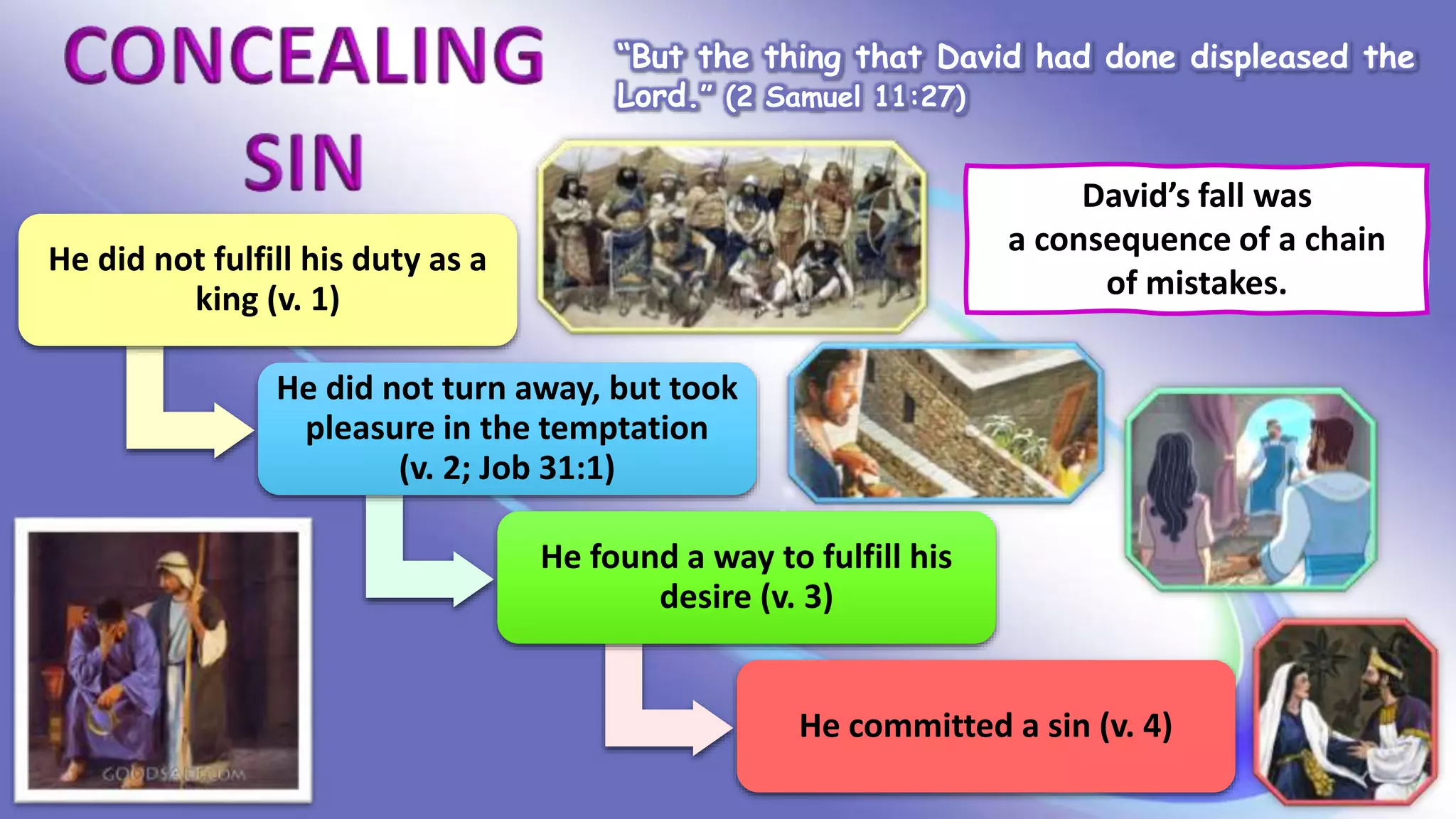
David’s fall was
a consequence of a chain
of mistakes.
He did not fulfill his duty as a
king (v. 1)
He did not turn away, but took
pleasure in the temptation
(v. 2; Job 31:1)
He found a way to fulfill his
desire (v. 3)
He committed a sin (v. 4)
He tried to conceal his sin by
fooling a good man (v. 5-12)
He put Uriah in a dangerous
position by getting him drunk
(v. 13)
He arranged a murder
(v. 14-25)
He tried to conceal his sin by
marrying Bathsheba (v. 26-27)
“But the thing that David had done displeased the
Lord.” (2 Samuel 11:27)
David’s fall was
a consequence of a chain
of mistakes.
“So David said to Nathan, ‘I have sinned against the Lord.’ And Nathan said to
David, ‘The Lord also has put away your sin; you shall not die.’” (2 Samuel 12:13)
God did not sit back and do nothing. He reacted to David’s flagrant
sin by sending prophet Nathan. Nathan used a parable to touch
David’s conscience, appealing to David’s sense of justice and his
experience as a shepherd (v. 1-6).
David’s repentance went beyond feeling
guilt over his sin against Uriah and
Bathsheba. He understood he had sinned
against God (Psalm 51:4).
Our sins ultimately hurt God and drive another nail into
the rough beam pointing heavenward on Golgotha.
Thanks to Jesus’ sacrifice, there is an immediate
response to true repentance: “The Lord also has put
away your sin.”
David was forgiven immediately, but God did not
prevent the consequences of his sin.
David sentenced himself to the loss of four of his sons:
the first son of Bathsheba, Amnon, Absalom, and
Adonijah.
However, repentance also had consequences. David
recovered “the joy of Your salvation.” (Psalm 51:12)
God forgave an adulterer, manipulator, and murderer.
Wouldn’t He forgive us too? God’s grace is so great that
He is always willing to forgive us, no matter how serious
our sins are.
“Create in me a clean heart, O God, and renew a
steadfast spirit within me.” (Psalm 51:10)
Only the Holy Spirit can change our hearts this
way (v. 11). He leads us to sanctification,
makes us new, strengthens us to resist
temptation, and gives us rest.
David asked God to erase his sins, to
purify him, and to change his thoughts
and feelings.
He did not want to rely on himself
anymore. We can have true safety, joy,
and happiness by relying on God alone.
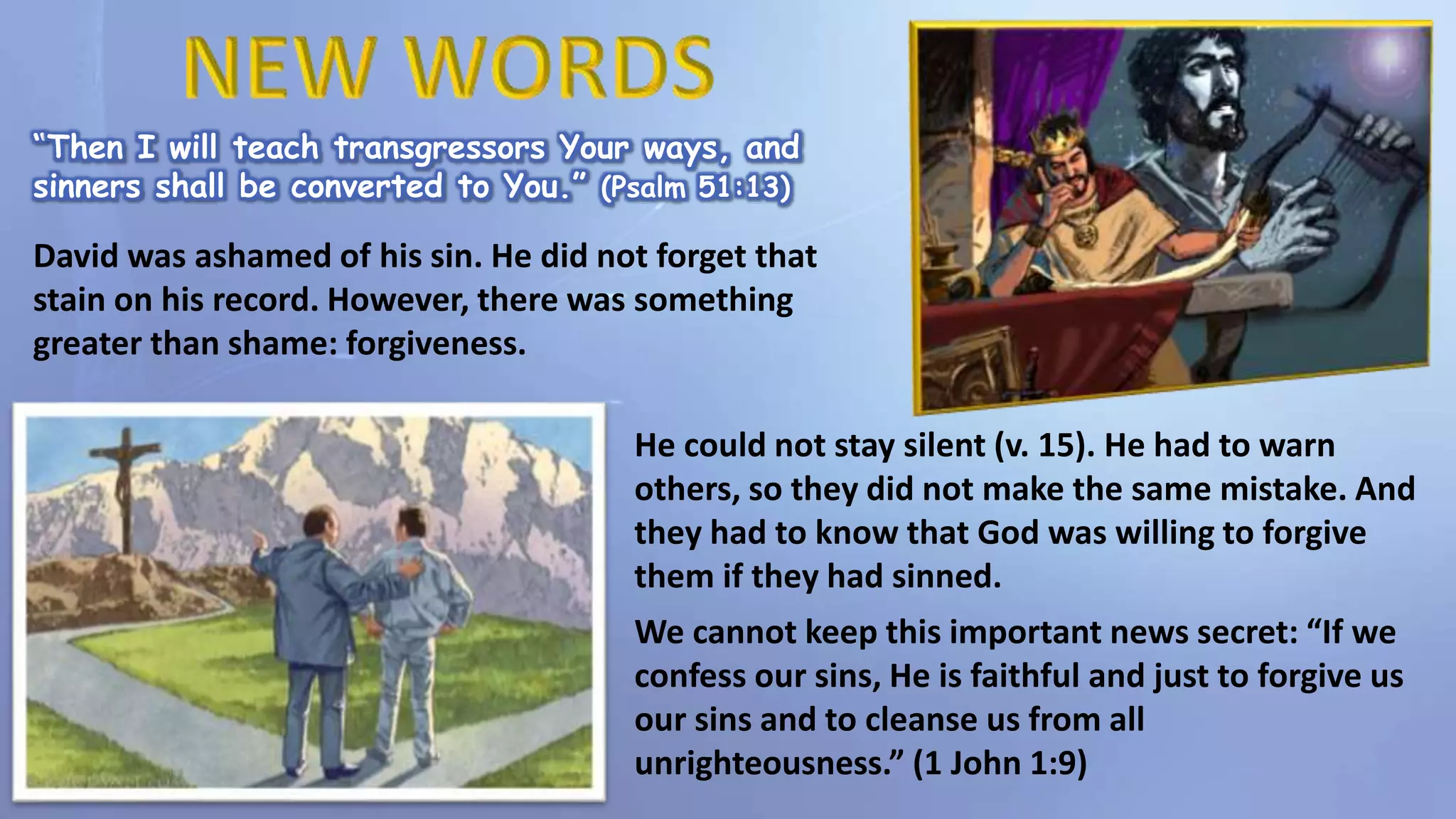
“Then I will teach transgressors Your ways, and
sinners shall be converted to You.” (Psalm 51:13)
David was ashamed of his sin. He did not forget that
stain on his record. However, there was something
greater than shame: forgiveness.
He could not stay silent (v. 15). He had to warn
others, so they did not make the same mistake. And
they had to know that God was willing to forgive
them if they had sinned.
We cannot keep this important news secret: “If we
confess our sins, He is faithful and just to forgive us
our sins and to cleanse us from all
unrighteousness.” (1 John 1:9)
“God’s forgiveness is not merely a
judicial act by which He sets us free
from condemnation.
It is not only forgiveness for sin,
but reclaiming from sin.
It is the outflow of redeeming love
that transforms the heart.”
E. G. W. (Thoughts From the Mount of Blessing, cp. 5, p. 114)
Slideshare.net/chucho1943
We invite you to download
and study each one of the 13
lessons about this serie:
THIS SERVICE IS
FREE AND YOU
CAN USE IT

04 the cost of rest

  • 1.
  • 3.
    “When I keptsilent, my bones became brittle through my groaning all day long. For day and night Your hand was heavy upon me. My strength was drained as in the droughts of summer.” (Psalm 32:3-4 TLV). Sin takes our rest away. Getting it back has a cost: repentance (Psalm 32:5). The story of David’s sin and repentance is a notable example of this process. I have sinned! What should I do? Conceal it? 2 Samuel 11 Confess it? 2 Samuel 12:1-13 Then what? Consequences of sin. 2 Samuel 12:14-23 A new heart. Salmo 51:1-12 New words. Salmo 51:13-19
  • 4.
    “But the thingthat David had done displeased the Lord.” (2 Samuel 11:27) David’s fall was a consequence of a chain of mistakes. He did not fulfill his duty as a king (v. 1) He did not turn away, but took pleasure in the temptation (v. 2; Job 31:1) He found a way to fulfill his desire (v. 3) He committed a sin (v. 4)
  • 5.
    He tried toconceal his sin by fooling a good man (v. 5-12) He put Uriah in a dangerous position by getting him drunk (v. 13) He arranged a murder (v. 14-25) He tried to conceal his sin by marrying Bathsheba (v. 26-27) “But the thing that David had done displeased the Lord.” (2 Samuel 11:27) David’s fall was a consequence of a chain of mistakes.
  • 6.
    “So David saidto Nathan, ‘I have sinned against the Lord.’ And Nathan said to David, ‘The Lord also has put away your sin; you shall not die.’” (2 Samuel 12:13) God did not sit back and do nothing. He reacted to David’s flagrant sin by sending prophet Nathan. Nathan used a parable to touch David’s conscience, appealing to David’s sense of justice and his experience as a shepherd (v. 1-6). David’s repentance went beyond feeling guilt over his sin against Uriah and Bathsheba. He understood he had sinned against God (Psalm 51:4). Our sins ultimately hurt God and drive another nail into the rough beam pointing heavenward on Golgotha. Thanks to Jesus’ sacrifice, there is an immediate response to true repentance: “The Lord also has put away your sin.”
  • 7.
    David was forgivenimmediately, but God did not prevent the consequences of his sin. David sentenced himself to the loss of four of his sons: the first son of Bathsheba, Amnon, Absalom, and Adonijah. However, repentance also had consequences. David recovered “the joy of Your salvation.” (Psalm 51:12) God forgave an adulterer, manipulator, and murderer. Wouldn’t He forgive us too? God’s grace is so great that He is always willing to forgive us, no matter how serious our sins are.
  • 8.
    “Create in mea clean heart, O God, and renew a steadfast spirit within me.” (Psalm 51:10) Only the Holy Spirit can change our hearts this way (v. 11). He leads us to sanctification, makes us new, strengthens us to resist temptation, and gives us rest. David asked God to erase his sins, to purify him, and to change his thoughts and feelings. He did not want to rely on himself anymore. We can have true safety, joy, and happiness by relying on God alone.
  • 9.
    “Then I willteach transgressors Your ways, and sinners shall be converted to You.” (Psalm 51:13) David was ashamed of his sin. He did not forget that stain on his record. However, there was something greater than shame: forgiveness. He could not stay silent (v. 15). He had to warn others, so they did not make the same mistake. And they had to know that God was willing to forgive them if they had sinned. We cannot keep this important news secret: “If we confess our sins, He is faithful and just to forgive us our sins and to cleanse us from all unrighteousness.” (1 John 1:9)
  • 10.
    “God’s forgiveness isnot merely a judicial act by which He sets us free from condemnation. It is not only forgiveness for sin, but reclaiming from sin. It is the outflow of redeeming love that transforms the heart.” E. G. W. (Thoughts From the Mount of Blessing, cp. 5, p. 114)
  • 11.
    Slideshare.net/chucho1943 We invite youto download and study each one of the 13 lessons about this serie: THIS SERVICE IS FREE AND YOU CAN USE IT