


Lesson 7
Key Text:
“Better is a dry morsel
with quietness,
than a house full of
feasting with strife”
Proverbs 17:1
Proverbs again denounces the deception of appearances. We
may seem to have everything the world offers—wealth, power,
pleasure, fame—yet, behind the facade, tension and misery
flourish. It’s even possible that the cause of this tension and
misery is precisely the wealth and pleasure that people strive so
hard for. As an Egyptian proverb notes: “Better is bread with a
happy heart than wealth with vexation.”—Miriam Lichtheim, The
New Kingdom, vol. 2 of Ancient Egyptian Literature: A Book of
Readings (Los Angeles: University of California Press, 2006), p. 156.
According to the book of Proverbs, the first step to solve this
problem is to recognize what our priorities are: peaceful
relationships are more important than wealth (Prov. 17:1).
What counts is not so much what we have but who we are
within ourselves. The advice that follows will help in
restoring this priority and lead us toward an inner peace
(shalom in the Hebrew) that will add to our happiness.
Solomon’s advice on
resolving
interpersonal
conflicts:
1. Cover the mistakes (Proverbs 17:9; 19:11)
2. Be just (Proverbs 17:10; 19:25)
3. Speak wisdom (Proverbs 18)
4. Listen (Proverbs 18:2, 17)
5. Be truthful (Proverbs 19)
“He who covers a transgression seeks
love, but he who repeats a matter
separates friends.” (Proverbs 17:9)
“The discretion of a man makes him
slow to anger, and his glory is to
overlook a transgression.” (Proverbs 19:11)
What should be our motivation to forgive our friends’ mistakes?
What’s the difference
between covering a
mistake and excusing sin?
“Covering” involves forgiving,
hiding and forgetting
(Psalm 85:2).
Sin must be forgiven but
reprimanded. It must be
hidden and never spread (by
gossiping) or excused. It must
be forgotten so friendship
prevails.
“A friend loves at all times, and a brother is born for adversity.”
(Proverbs 17:17)
We are advised instead to “cover”
the mistake. This is not, however,
to imply that we have to hide the
sin, to act
as if it never
happened,
as if the
person never
did wrong.
The sin that
is covered
is still present,
even though hidden. In fact, the Hebrew word for “cover”
in that expression has the specific con-notation of
“forgiving” (Ps. 85:2, Neh. 4:5). Love, not gossip, should
be our response to someone else’s mistake.
How does love
help in coping
with a friend’s
mistake?
One does not
love a friend
or spouse be-
cause he or
she is perfect. We love in spite of their mistakes and flaws.
Only through love do we learn not to judge others, because
with our own faults and shortcomings we could be just as
guilty. Instead, we can mourn with them over what they
have done, and seek in whatever way we can to help them
work through it. After all, what are friends for if not for this?
Think about a time you
messed up badly and
you were forgiven,
ministered to, and
comforted.
What does that tell you
about how, if possible,
you should do the same
for others?
REFLECTION
“Rebuke is more effective for
a wise man than a hundred
blows on a fool.” (Proverbs 17:10)
“Strike a scoffer, and the simple will become
wary; Rebuke one who has understanding, and
he will discern knowledge.” (Proverbs 19:25)
Sin must be
reprimanded. The
person who sinned must
be aware of his mistake
so he can correct his
behavior.
Jesus forgave sinners
and then He warned
them, “Sin no more.”
(John 5:14; 8:11).
Love must not be blind or unconditional when covering mistakes.
For example, the exercise of
charity toward the poor should
not be done at the expense of
justice; hence,
the recommen-
dation not to
favor the poor
in court (Exod.
23:3). If love
obliges us to
help the poor,
it would be
unjust to favor them when they are wrong, simply because
they are poor. Justice and truth should therefore go along
with love and compassion. It is this wise balance that
characterizes the torah, the law of God, and which is taught
and promoted in the book of Proverbs.
“Human beings, themselves given to evil, are prone to
deal untenderly with the tempted and the erring. They
cannot read the heart; they know not its struggle and
its pain. Of , of
, of , they
have need to learn.”
E.G.W. (The Acts of the Apostles, cp.51, pg. 516)
Words are
powerful, both for
good and for evil
(v. 21).
Wise words are
deep waters
flowing wisdom
(v. 4).
Foolish words cause
contention. They
deserve punishment
(v. 6). Those who speak
them get into trouble
(v. 7).
Gossip is tidbit.
They go down
deeply for evil
(v. 8).
We find great
difficulties when we
answer before
listening or before
meditating our words
before (v. 13).
The tongue may destroy
our reputation and lead
us to poverty or even
death. If we use it
according to God’s will,
it can do good
everywhere. Let’s use it
to bless, to cheer others
up and to proclaim the
Gospel.
We are again confronted with the
reality and power of words; in this
case we see how fools use their
mouths to their
own undoing.
Verse 13 is es-
pecially enligh-
tening. How
easy it is to
speak out befo-
re carefully lis-
tening and discerning what has been said to us. How
many times might we have spared ourselves, and others,
undue pain and strife if we had only learned to think
through carefully what we had just heard before
responding to it. There is indeed a time when silence is
the best response.
“Fools find no pleasure in understanding but delight
in airing their own opinions.” (Proverbs 18:2 NVI)
“We don’t need to discuss this. I’m right!”
We may be so confident about our own
wisdom that we think we don’t need to
listen to anybody else.
“The first one to plead his cause seems right, until
his neighbor comes and examines him.” (Proverbs 18:17)
If we listen to our adversary, we may find out that we
were actually wrong.
Those who are led by divine wisdom listen to both
sides before judging any question.
God is the only One who doesn’t need a second
opinion.
“Better is the poor who walks in his
integrity than one who is perverse in
his lips, and is a fool.” (Proverbs 19:1)
A lie may bring momentary benefits (a
promotion, a friend, escaping
punishment…). Nevertheless, liars are
always caught sooner or later.
Consequences are then serious, so we
finally find out that those previous
benefits were not actually worth it.
It becomes worse and worse. Everything
we got from lying rots and makes our
relationships bitter. That is a result of our
sin.
“A false witness will not go
unpunished, and he who speaks
lies will not escape.” (Proverbs 19:5)
5. Be Truthful
A king needed to appoint a new minister to the highest
office of his kingdom. For this purpose, he organized a
special contest on lying: who could utter the biggest lie. All
his ministers applied, and each one came and spoke their
biggest lie. But the king was not satisfied; their lies seemed
lame. The king then asked his closest and most trusted
counselor: “Why didn’t you apply?”
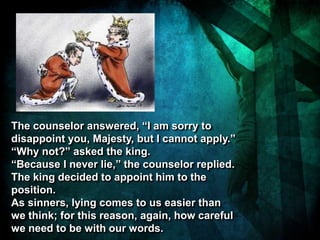
The counselor answered, “I am sorry to
disappoint you, Majesty, but I cannot apply.”
“Why not?” asked the king.
“Because I never lie,” the counselor replied.
The king decided to appoint him to the
position.
As sinners, lying comes to us easier than
we think; for this reason, again, how careful
we need to be with our words.
“Let truth telling be held with no loose hand or
uncertain grasp. Let it become a part of the life.
Playing fast and loose with truth, and
dissembling to suit one’s own selfish plans,
means shipwreck of faith. ‘Stand therefore,
having your loins girt about with truth.’
Ephesians 6:14. He who utters untruths sells
his soul in a cheap market. His falsehoods may
seem to serve in emergencies; he may thus seem
to make business advancement that he could
not gain by fair dealing; but he finally reaches
the place where he can trust no one.”
E.G.W. (The Acts of the Apostles, cp. 7, pg. 75)
Slideshare.net/chucho1943
PROVERBS * The Call of Wisdom
THIS SERVICE IS
FREE AND YOU
CAN USE IT
We invite you to download and study each one of the 13
lessons about this serie

Dealing with fights 07

  • 1.
  • 2.
    Key Text: “Better isa dry morsel with quietness, than a house full of feasting with strife” Proverbs 17:1
  • 3.
    Proverbs again denouncesthe deception of appearances. We may seem to have everything the world offers—wealth, power, pleasure, fame—yet, behind the facade, tension and misery flourish. It’s even possible that the cause of this tension and misery is precisely the wealth and pleasure that people strive so hard for. As an Egyptian proverb notes: “Better is bread with a happy heart than wealth with vexation.”—Miriam Lichtheim, The New Kingdom, vol. 2 of Ancient Egyptian Literature: A Book of Readings (Los Angeles: University of California Press, 2006), p. 156.
  • 4.
    According to thebook of Proverbs, the first step to solve this problem is to recognize what our priorities are: peaceful relationships are more important than wealth (Prov. 17:1). What counts is not so much what we have but who we are within ourselves. The advice that follows will help in restoring this priority and lead us toward an inner peace (shalom in the Hebrew) that will add to our happiness.
  • 5.
    Solomon’s advice on resolving interpersonal conflicts: 1.Cover the mistakes (Proverbs 17:9; 19:11) 2. Be just (Proverbs 17:10; 19:25) 3. Speak wisdom (Proverbs 18) 4. Listen (Proverbs 18:2, 17) 5. Be truthful (Proverbs 19)
  • 6.
    “He who coversa transgression seeks love, but he who repeats a matter separates friends.” (Proverbs 17:9) “The discretion of a man makes him slow to anger, and his glory is to overlook a transgression.” (Proverbs 19:11) What should be our motivation to forgive our friends’ mistakes? What’s the difference between covering a mistake and excusing sin? “Covering” involves forgiving, hiding and forgetting (Psalm 85:2). Sin must be forgiven but reprimanded. It must be hidden and never spread (by gossiping) or excused. It must be forgotten so friendship prevails. “A friend loves at all times, and a brother is born for adversity.” (Proverbs 17:17)
  • 7.
    We are advisedinstead to “cover” the mistake. This is not, however, to imply that we have to hide the sin, to act as if it never happened, as if the person never did wrong. The sin that is covered is still present, even though hidden. In fact, the Hebrew word for “cover” in that expression has the specific con-notation of “forgiving” (Ps. 85:2, Neh. 4:5). Love, not gossip, should be our response to someone else’s mistake.
  • 8.
    How does love helpin coping with a friend’s mistake? One does not love a friend or spouse be- cause he or she is perfect. We love in spite of their mistakes and flaws. Only through love do we learn not to judge others, because with our own faults and shortcomings we could be just as guilty. Instead, we can mourn with them over what they have done, and seek in whatever way we can to help them work through it. After all, what are friends for if not for this?
  • 9.
    Think about atime you messed up badly and you were forgiven, ministered to, and comforted. What does that tell you about how, if possible, you should do the same for others? REFLECTION
  • 10.
    “Rebuke is moreeffective for a wise man than a hundred blows on a fool.” (Proverbs 17:10) “Strike a scoffer, and the simple will become wary; Rebuke one who has understanding, and he will discern knowledge.” (Proverbs 19:25) Sin must be reprimanded. The person who sinned must be aware of his mistake so he can correct his behavior. Jesus forgave sinners and then He warned them, “Sin no more.” (John 5:14; 8:11). Love must not be blind or unconditional when covering mistakes.
  • 11.
    For example, theexercise of charity toward the poor should not be done at the expense of justice; hence, the recommen- dation not to favor the poor in court (Exod. 23:3). If love obliges us to help the poor, it would be unjust to favor them when they are wrong, simply because they are poor. Justice and truth should therefore go along with love and compassion. It is this wise balance that characterizes the torah, the law of God, and which is taught and promoted in the book of Proverbs.
  • 12.
    “Human beings, themselvesgiven to evil, are prone to deal untenderly with the tempted and the erring. They cannot read the heart; they know not its struggle and its pain. Of , of , of , they have need to learn.” E.G.W. (The Acts of the Apostles, cp.51, pg. 516)
  • 13.
    Words are powerful, bothfor good and for evil (v. 21). Wise words are deep waters flowing wisdom (v. 4). Foolish words cause contention. They deserve punishment (v. 6). Those who speak them get into trouble (v. 7). Gossip is tidbit. They go down deeply for evil (v. 8). We find great difficulties when we answer before listening or before meditating our words before (v. 13). The tongue may destroy our reputation and lead us to poverty or even death. If we use it according to God’s will, it can do good everywhere. Let’s use it to bless, to cheer others up and to proclaim the Gospel.
  • 14.
    We are againconfronted with the reality and power of words; in this case we see how fools use their mouths to their own undoing. Verse 13 is es- pecially enligh- tening. How easy it is to speak out befo- re carefully lis- tening and discerning what has been said to us. How many times might we have spared ourselves, and others, undue pain and strife if we had only learned to think through carefully what we had just heard before responding to it. There is indeed a time when silence is the best response.
  • 15.
    “Fools find nopleasure in understanding but delight in airing their own opinions.” (Proverbs 18:2 NVI) “We don’t need to discuss this. I’m right!” We may be so confident about our own wisdom that we think we don’t need to listen to anybody else. “The first one to plead his cause seems right, until his neighbor comes and examines him.” (Proverbs 18:17) If we listen to our adversary, we may find out that we were actually wrong. Those who are led by divine wisdom listen to both sides before judging any question. God is the only One who doesn’t need a second opinion.
  • 16.
    “Better is thepoor who walks in his integrity than one who is perverse in his lips, and is a fool.” (Proverbs 19:1) A lie may bring momentary benefits (a promotion, a friend, escaping punishment…). Nevertheless, liars are always caught sooner or later. Consequences are then serious, so we finally find out that those previous benefits were not actually worth it. It becomes worse and worse. Everything we got from lying rots and makes our relationships bitter. That is a result of our sin. “A false witness will not go unpunished, and he who speaks lies will not escape.” (Proverbs 19:5)
  • 17.
    5. Be Truthful Aking needed to appoint a new minister to the highest office of his kingdom. For this purpose, he organized a special contest on lying: who could utter the biggest lie. All his ministers applied, and each one came and spoke their biggest lie. But the king was not satisfied; their lies seemed lame. The king then asked his closest and most trusted counselor: “Why didn’t you apply?”
  • 18.
    The counselor answered,“I am sorry to disappoint you, Majesty, but I cannot apply.” “Why not?” asked the king. “Because I never lie,” the counselor replied. The king decided to appoint him to the position. As sinners, lying comes to us easier than we think; for this reason, again, how careful we need to be with our words.
  • 19.
    “Let truth tellingbe held with no loose hand or uncertain grasp. Let it become a part of the life. Playing fast and loose with truth, and dissembling to suit one’s own selfish plans, means shipwreck of faith. ‘Stand therefore, having your loins girt about with truth.’ Ephesians 6:14. He who utters untruths sells his soul in a cheap market. His falsehoods may seem to serve in emergencies; he may thus seem to make business advancement that he could not gain by fair dealing; but he finally reaches the place where he can trust no one.” E.G.W. (The Acts of the Apostles, cp. 7, pg. 75)
  • 20.
    Slideshare.net/chucho1943 PROVERBS * TheCall of Wisdom THIS SERVICE IS FREE AND YOU CAN USE IT We invite you to download and study each one of the 13 lessons about this serie