Reference,
Retention and
Reserve Samples
Definition (1)
• REFERENCE SAMPLE (EU):
A sample of a batch of starting material, packaging
material or finished product stored for the purpose of
being analyzed should the need arise during the shelf
life of the batch concerned
Critical intermediate or intermediate when sufficient
stability
Sufficient size to permit at least two occasions full
analytical
Definition (2)
• RETENTION SAMPLE (EU):
A sample of a fully packaged unit from a
batch of finished product stored for
identification purposes
In many instances, reference and retention
samples of finished products are presented
identically. In such circumstances, reference
and retention samples may be regarded as
interchangeable.
Definition (3)
• RESERVE SAMPLE (US):
A sample representative of each lot in each
shipment of each active ingredient or a sample
representative of each lot of drug product
At least two times the quantity necessary for all
tests required to determine whether the API or
drug product meets its established specifications
Drug products must be stored in the same
container-closure in which it is marketed.
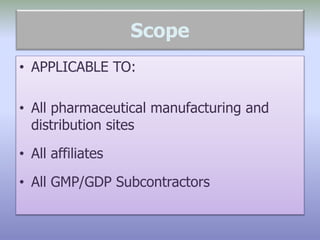
Scope
• APPLICABLE TO:
• All pharmaceutical manufacturing and
distribution sites
• All affiliates
• All GMP/GDP Subcontractors
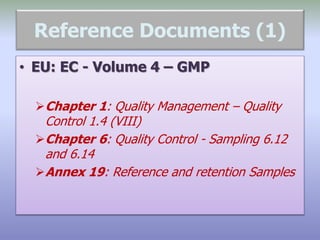
Reference Documents (1)
• EU: EC - Volume 4 – GMP
Chapter 1: Quality Management – Quality
Control 1.4 (VIII)
Chapter 6: Quality Control - Sampling 6.12
and 6.14
Annex 19: Reference and retention Samples
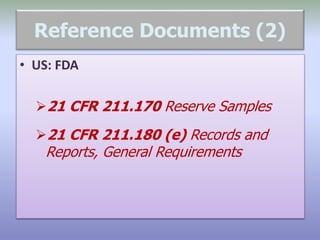
Reference Documents (2)
• US: FDA
21 CFR 211.170 Reserve Samples
21 CFR 211.180 (e) Records and
Reports, General Requirements
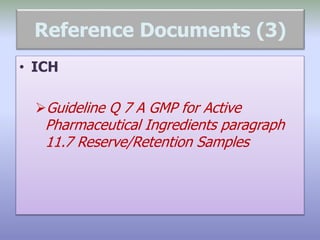
Reference Documents (3)
• ICH
Guideline Q 7 A GMP for Active
Pharmaceutical Ingredients paragraph
11.7 Reserve/Retention Samples
General Requirements (1)
• Requirements for retention samples (EU)
apply to reserve samples (US)
• Reference/Reserve Samples should be of
sufficient size to permit, on at least two
occasions, a full analytical control (including
sterility and pyrogens). Exception must be
approved by Site Quality Management and
agreed with relevant competent authority.
General Requirements (2)
• When batch is packaged in two or more
packaging operations (e.g. for different
markets),one retention sample taken from
each individual packaging operation
• The exception to this will be when a small
amount of a batch is packaged for different
markets or in case of very expensive
medicinal product then only one retention
sample can be taken.
General Requirements (3)
• Reference samples of each batch of the following
must be kept at the site at which they were used:
starting material
intermediate product
primary and printed packaging material*
*The printed materials as part of the reference
and/or retention sample of the finished product
can also be accepted as reference materials.
General Requirements (4)
• Must be Stored in a secure area and under conditions
consistent with specified storage conditions for material or
finished product
• Storage conditions must be recorded. In case of deviation
from specified conditions, document, investigate and assess
impact for each retention sample
• Access to these samples limited to authorized people
• Quality must authorise and documented any withdrawal of
any reference/retention samples.
API Sample Retention Period
• API samples should be retained for a time
period covering API shelf-life plus 6 years
(covers potential maximum 5 years shelf-
life of finished product)
• Same retention principle generally applies
for API intermediates as finished product
however the intermediate may have a
different SL than the finished product
therefore the above point will apply.
API Storage Requirements
• API samples should be stored in same
packaging system as marketed packaging
system
• API intermediate samples should also be
stored in same packaging system as
marketed packaging system.
Storage Requirements for APIs,
Excipients and Packaging Materials (1)
• Samples of APIs and excipients must be
retained (solvents, water, gases used in
manufacturing process are excluded)
• Sample containers must assure APIs and
excipients are protected throughout the
retention period
• Retention period:
Excipients and API: one year after the shelf-life of
drug product and at least two years after release of
the finished product if local regulations allow (EU)
Time period may be shortened if material stability
period is shorter.
Storage Requirements for APIs,
Excipients and Packaging Materials (2)
• Retention period (cont.)
Packaging material must be retained for the
duration of shelf-life of finished product
concerned (EU regulation).
Storage Requirements for
Finished Product
• Samples must be retained in marketed
primary and secondary packaging
• Retention period:
Minimum one year after expiry of finished
product
• Location:
Reference and Retention samples stored at
the site that releases the finished product
and/or according specific local requirements
(Canada, EU).
Storage Requirements for
Controlled Drugs
• Stored separate from other samples and
protection against forced entry
• Only authorised personnel must have
access to controlled drug area
• Monitoring and reconciliation logbook is
mandatory, there must be a defined
retention period for logbook after the date
of last product sampling.
Reserve Samples - Finished
Product
• Visual examination of representative lots of
retention (reserve) samples to be performed
if required by local regulation (products
marketed within the US or for the US market)
• Examination of finished products reserve
samples required during complaint
investigation and as part of Annual Product
Review (products marketed within the US or
for the US market).
Thank You
Any Questions

001-Retention-Reserve-and-Reference-Samples1 (1).pptx

  • 1.
  • 2.
    Definition (1) • REFERENCESAMPLE (EU): A sample of a batch of starting material, packaging material or finished product stored for the purpose of being analyzed should the need arise during the shelf life of the batch concerned Critical intermediate or intermediate when sufficient stability Sufficient size to permit at least two occasions full analytical
  • 3.
    Definition (2) • RETENTIONSAMPLE (EU): A sample of a fully packaged unit from a batch of finished product stored for identification purposes In many instances, reference and retention samples of finished products are presented identically. In such circumstances, reference and retention samples may be regarded as interchangeable.
  • 4.
    Definition (3) • RESERVESAMPLE (US): A sample representative of each lot in each shipment of each active ingredient or a sample representative of each lot of drug product At least two times the quantity necessary for all tests required to determine whether the API or drug product meets its established specifications Drug products must be stored in the same container-closure in which it is marketed.
  • 5.
    Scope • APPLICABLE TO: •All pharmaceutical manufacturing and distribution sites • All affiliates • All GMP/GDP Subcontractors
  • 6.
    Reference Documents (1) •EU: EC - Volume 4 – GMP Chapter 1: Quality Management – Quality Control 1.4 (VIII) Chapter 6: Quality Control - Sampling 6.12 and 6.14 Annex 19: Reference and retention Samples
  • 7.
    Reference Documents (2) •US: FDA 21 CFR 211.170 Reserve Samples 21 CFR 211.180 (e) Records and Reports, General Requirements
  • 8.
    Reference Documents (3) •ICH Guideline Q 7 A GMP for Active Pharmaceutical Ingredients paragraph 11.7 Reserve/Retention Samples
  • 9.
    General Requirements (1) •Requirements for retention samples (EU) apply to reserve samples (US) • Reference/Reserve Samples should be of sufficient size to permit, on at least two occasions, a full analytical control (including sterility and pyrogens). Exception must be approved by Site Quality Management and agreed with relevant competent authority.
  • 10.
    General Requirements (2) •When batch is packaged in two or more packaging operations (e.g. for different markets),one retention sample taken from each individual packaging operation • The exception to this will be when a small amount of a batch is packaged for different markets or in case of very expensive medicinal product then only one retention sample can be taken.
  • 11.
    General Requirements (3) •Reference samples of each batch of the following must be kept at the site at which they were used: starting material intermediate product primary and printed packaging material* *The printed materials as part of the reference and/or retention sample of the finished product can also be accepted as reference materials.
  • 12.
    General Requirements (4) •Must be Stored in a secure area and under conditions consistent with specified storage conditions for material or finished product • Storage conditions must be recorded. In case of deviation from specified conditions, document, investigate and assess impact for each retention sample • Access to these samples limited to authorized people • Quality must authorise and documented any withdrawal of any reference/retention samples.
  • 13.
    API Sample RetentionPeriod • API samples should be retained for a time period covering API shelf-life plus 6 years (covers potential maximum 5 years shelf- life of finished product) • Same retention principle generally applies for API intermediates as finished product however the intermediate may have a different SL than the finished product therefore the above point will apply.
  • 14.
    API Storage Requirements •API samples should be stored in same packaging system as marketed packaging system • API intermediate samples should also be stored in same packaging system as marketed packaging system.
  • 15.
    Storage Requirements forAPIs, Excipients and Packaging Materials (1) • Samples of APIs and excipients must be retained (solvents, water, gases used in manufacturing process are excluded) • Sample containers must assure APIs and excipients are protected throughout the retention period • Retention period: Excipients and API: one year after the shelf-life of drug product and at least two years after release of the finished product if local regulations allow (EU) Time period may be shortened if material stability period is shorter.
  • 16.
    Storage Requirements forAPIs, Excipients and Packaging Materials (2) • Retention period (cont.) Packaging material must be retained for the duration of shelf-life of finished product concerned (EU regulation).
  • 17.
    Storage Requirements for FinishedProduct • Samples must be retained in marketed primary and secondary packaging • Retention period: Minimum one year after expiry of finished product • Location: Reference and Retention samples stored at the site that releases the finished product and/or according specific local requirements (Canada, EU).
  • 18.
    Storage Requirements for ControlledDrugs • Stored separate from other samples and protection against forced entry • Only authorised personnel must have access to controlled drug area • Monitoring and reconciliation logbook is mandatory, there must be a defined retention period for logbook after the date of last product sampling.
  • 19.
    Reserve Samples -Finished Product • Visual examination of representative lots of retention (reserve) samples to be performed if required by local regulation (products marketed within the US or for the US market) • Examination of finished products reserve samples required during complaint investigation and as part of Annual Product Review (products marketed within the US or for the US market).
  • 20.