PILOT IMPLEMENTATION OF THE MATATAG K TO 10 CURRICULUM
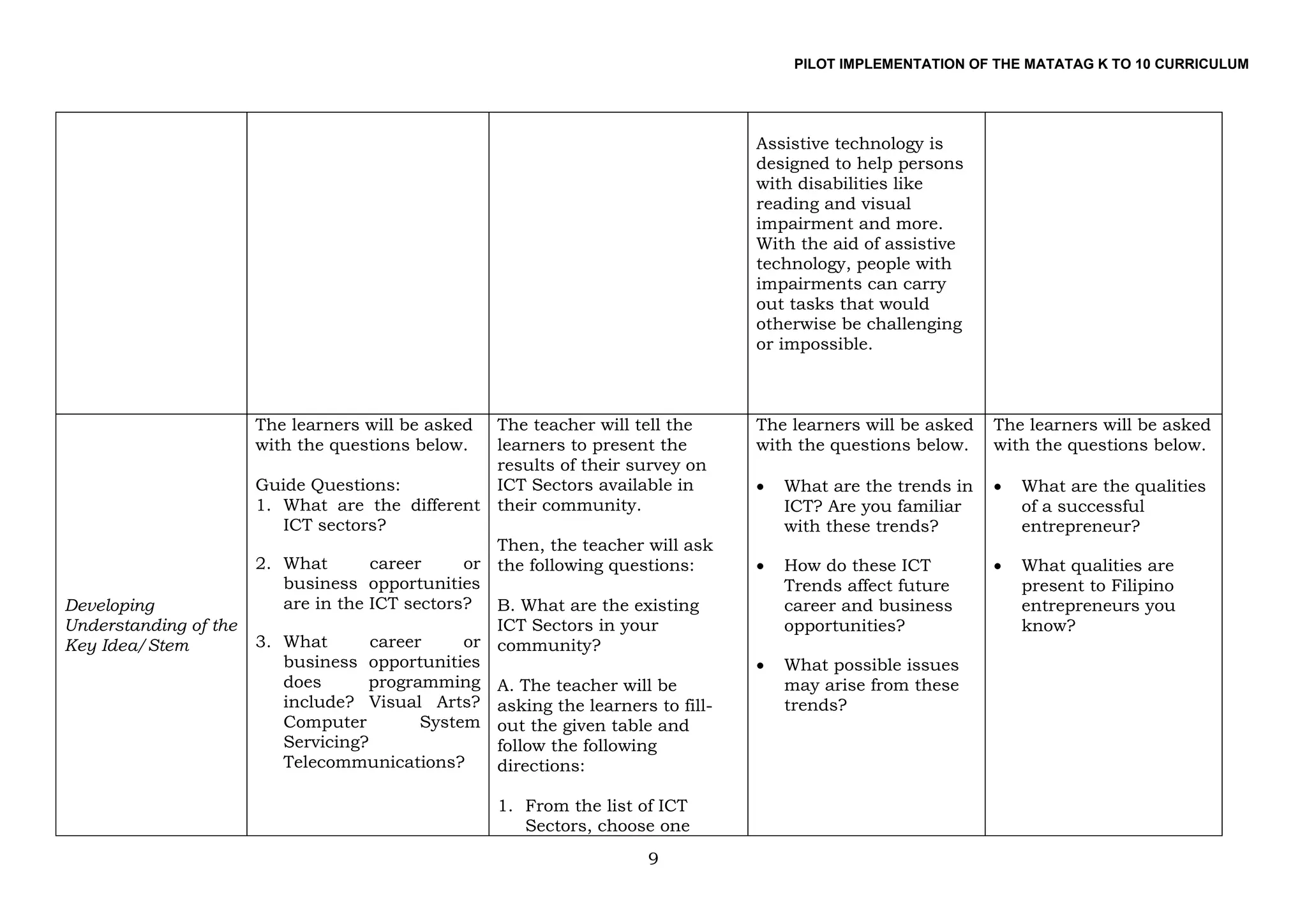
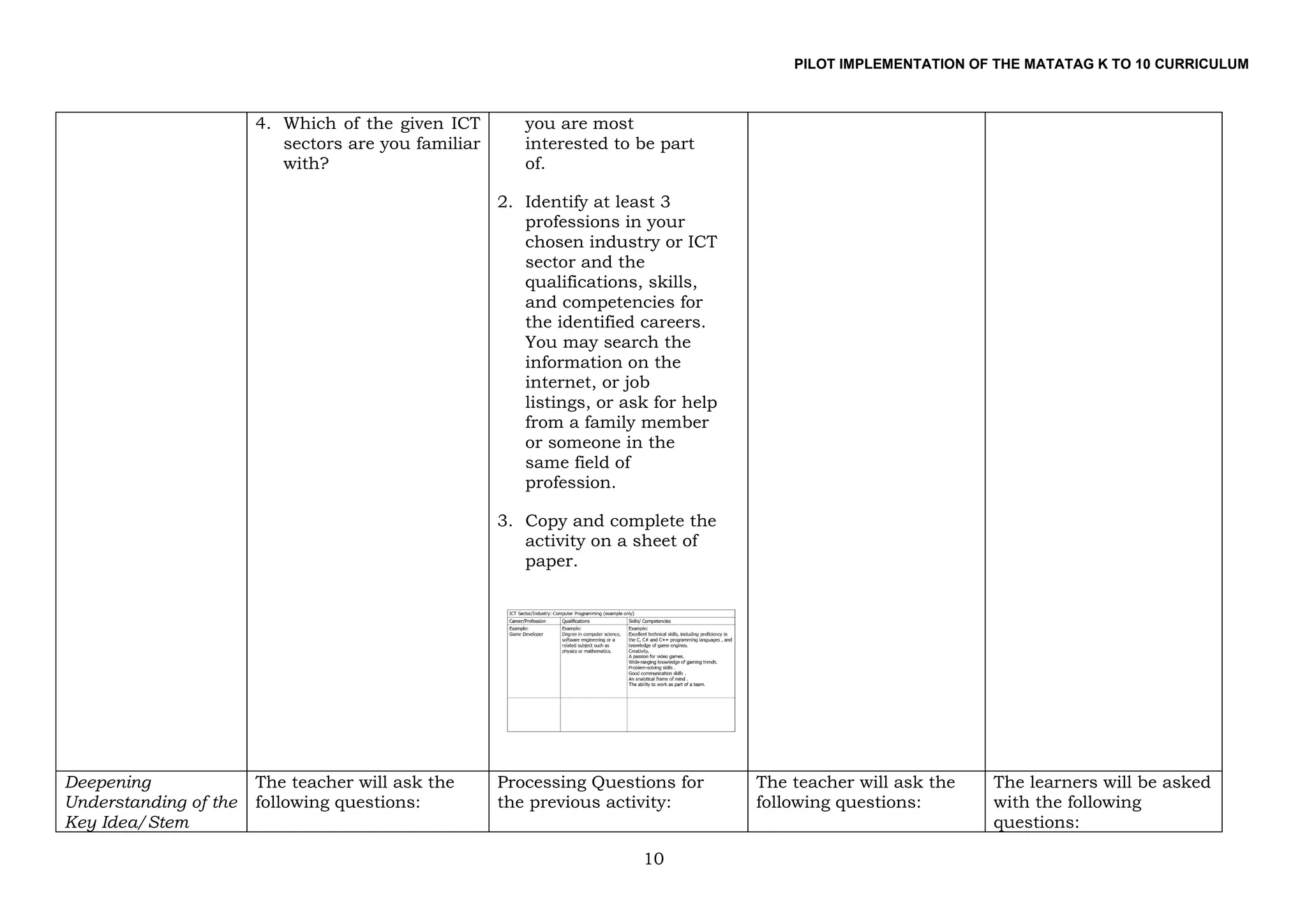
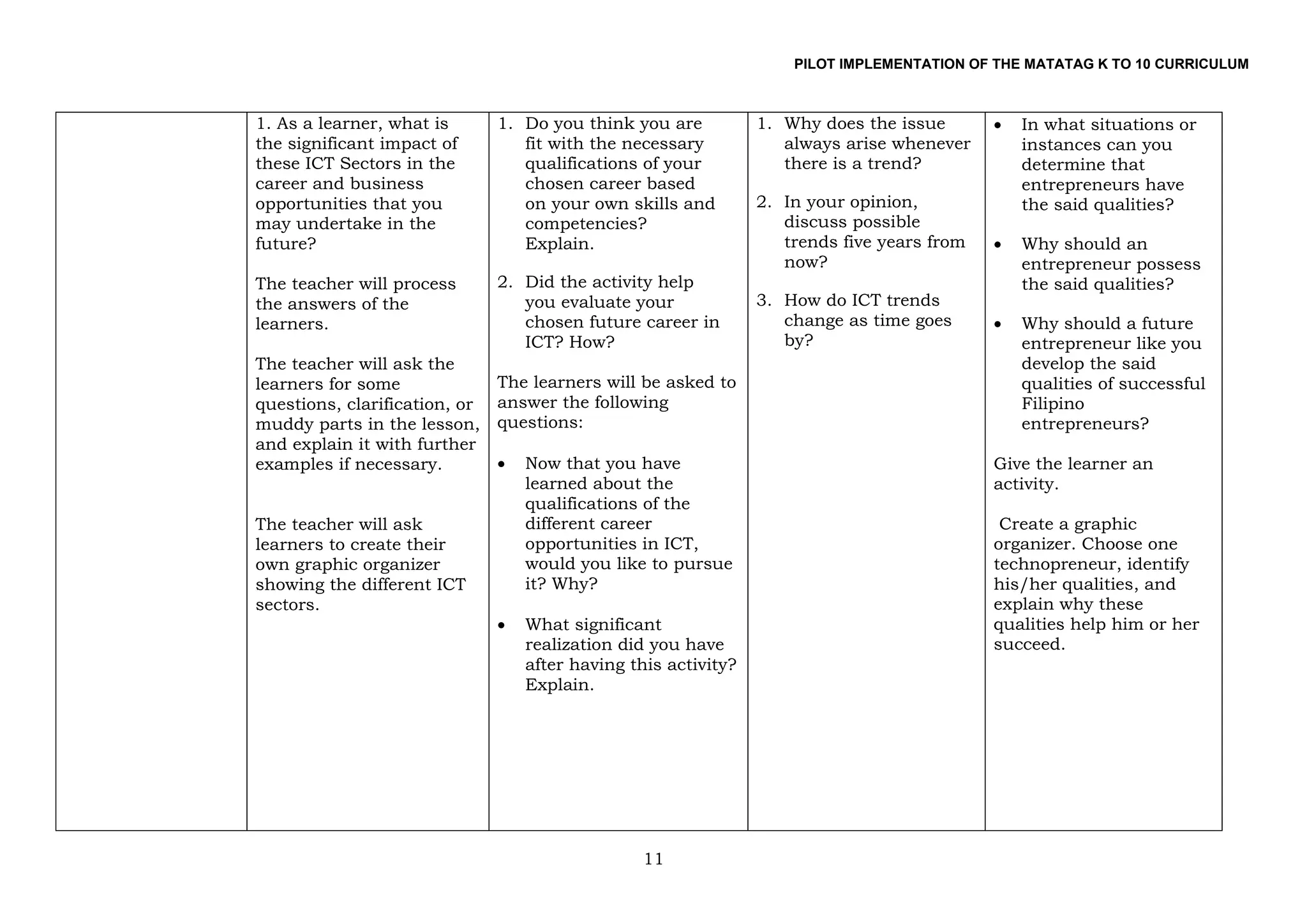
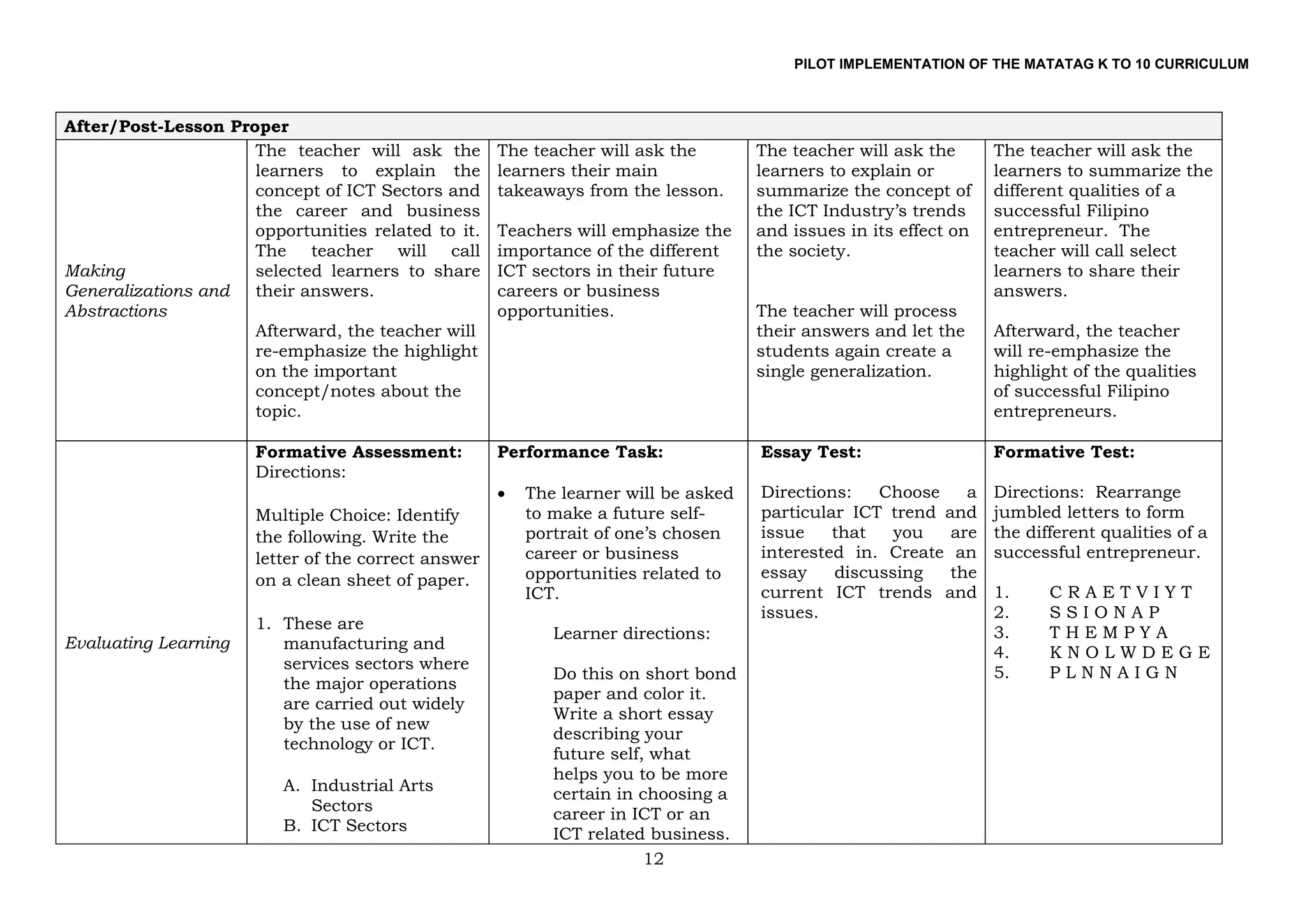
7
Lesson Exemplar
for TLE-ICT 7
Week
1
Quarter 1
Lesson Exemplar for Technology and Livelihood Education - ICT 7
Quarter 1: Week 1
SY 2023-2024
This material is intended exclusively for the use of teachers participating in the pilot implementation of the MATATAG K to 10 Curriculum
during the School Year 2023-2024. It aims to assist in delivering the curriculum content, standards, and lesson competencies. Any unauthorized
reproduction, distribution, modification, or utilization of this material beyond the designated scope is strictly prohibited and may result in
appropriate legal actions and disciplinary measures.
Borrowed content included in this material are owned by their respective copyright holders. Every effort has been made to locate and
obtain permission to use these materials from their respective copyright owners. The publisher and development team do not represent nor claim
ownership over them.
Every care has been taken to ensure the accuracy of the information provided in this material. For inquiries or feedback, please write or
call the Office of the Director of the Bureau of Learning Resources via telephone numbers (02) 8634-1072 and 8631-6922 or by email at
blr.od@deped.gov.ph.
Development Team
Writer: Alona T. Nieva
Content Editor: Darlene S. Interno, Virgilio O. Guevarra Jr.
Mechanical Editor: Elizabeth A. Soriano
Illustrator: Rolly J. Cano
Layout Artist: Julie Anne V. Vertudes
Management Team
Alberto T. Escobarte, CESO III, Viernalyn M. Nama,
Dianne Catherine Teves-Antonio, Virgilio O. Guevarra, Jr.,
Nenette Arcelle Joy P. Larinay, Lhovie C. Damian, Redgynn A. Bernales
PILOT IMPLEMENTATION OF THE MATATAG K TO 10 CURRICULUM
1
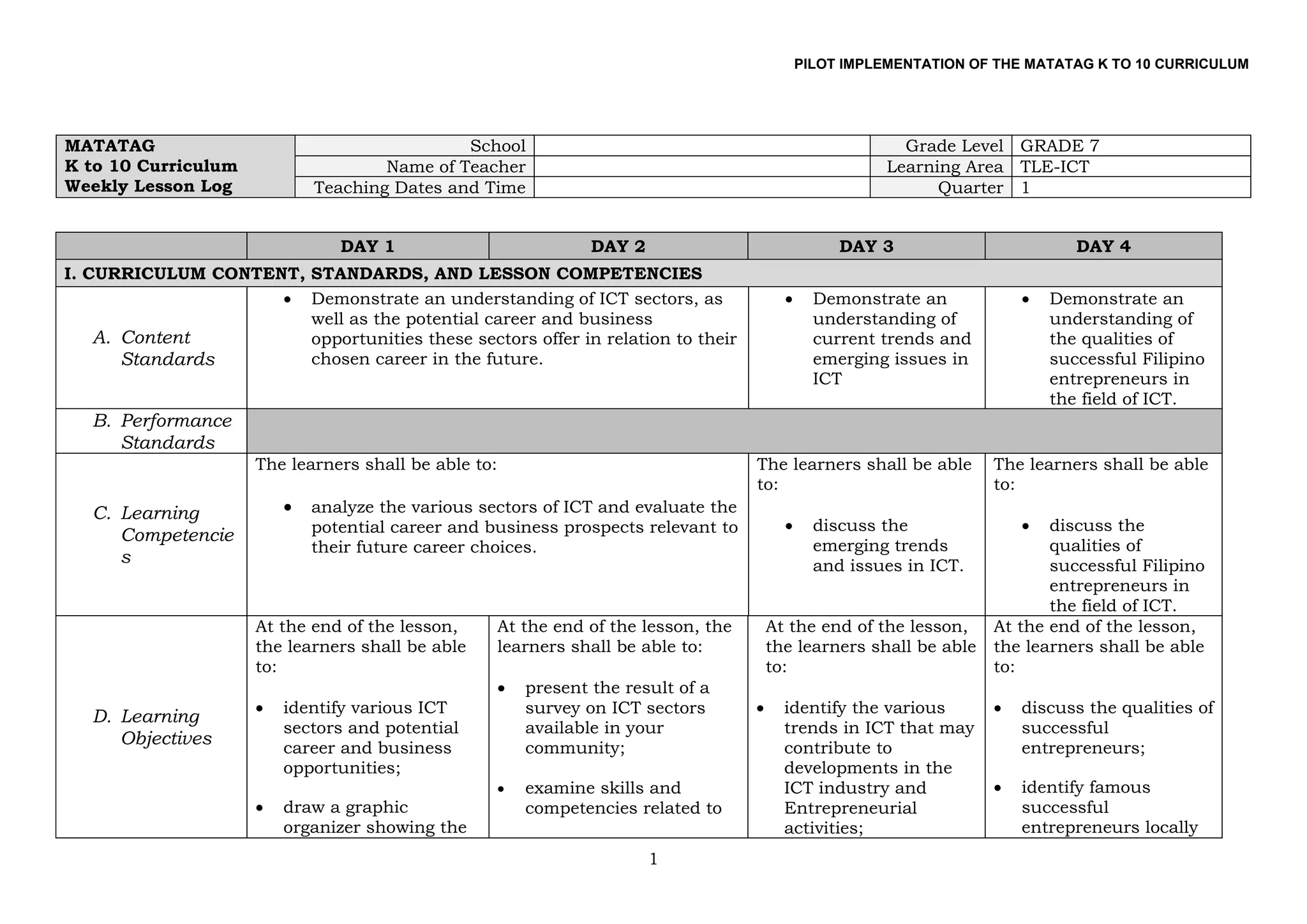
MATATAG
K to 10 Curriculum
Weekly Lesson Log
School Grade Level GRADE 7
Name of Teacher Learning Area TLE-ICT
Teaching Dates and Time Quarter 1
DAY 1 DAY 2 DAY 3 DAY 4
I. CURRICULUM CONTENT, STANDARDS, AND LESSON COMPETENCIES
A. Content
Standards
• Demonstrate an understanding of ICT sectors, as
well as the potential career and business
opportunities these sectors offer in relation to their
chosen career in the future.
• Demonstrate an
understanding of
current trends and
emerging issues in
ICT
• Demonstrate an
understanding of
the qualities of
successful Filipino
entrepreneurs in
the field of ICT.
B. Performance
Standards
C. Learning
Competencie
s
The learners shall be able to:
• analyze the various sectors of ICT and evaluate the
potential career and business prospects relevant to
their future career choices.
The learners shall be able
to:
• discuss the
emerging trends
and issues in ICT.
The learners shall be able
to:
• discuss the
qualities of
successful Filipino
entrepreneurs in
the field of ICT.
D. Learning
Objectives
At the end of the lesson,
the learners shall be able
to:
• identify various ICT
sectors and potential
career and business
opportunities;
• draw a graphic
organizer showing the
At the end of the lesson, the
learners shall be able to:
• present the result of a
survey on ICT sectors
available in your
community;
• examine skills and
competencies related to
At the end of the lesson,
the learners shall be able
to:
• identify the various
trends in ICT that may
contribute to
developments in the
ICT industry and
Entrepreneurial
activities;
At the end of the lesson,
the learners shall be able
to:
• discuss the qualities of
successful
entrepreneurs;
• identify famous
successful
entrepreneurs locally
PILOT IMPLEMENTATION OF THE MATATAG K TO 10 CURRICULUM
2
different ICT Sectors’
career and business
opportunities;
• conduct a survey on
ICT Sectors in the
community; and
• value the significance of
ICT Sectors to future
career or business
opportunities.
ICT career and business
opportunities; and
• appreciate the significant
relevance of the ICT
sectors in their future
career or business
opportunities.
• identify the issues that
may hamper any
progress in the ICT
industry; and
• reflect on the
significance of trends
and issues in ICT.
and internationally;
and
• create a graphic
organizer of the
different qualities of
successful Filipino
entrepreneurs.
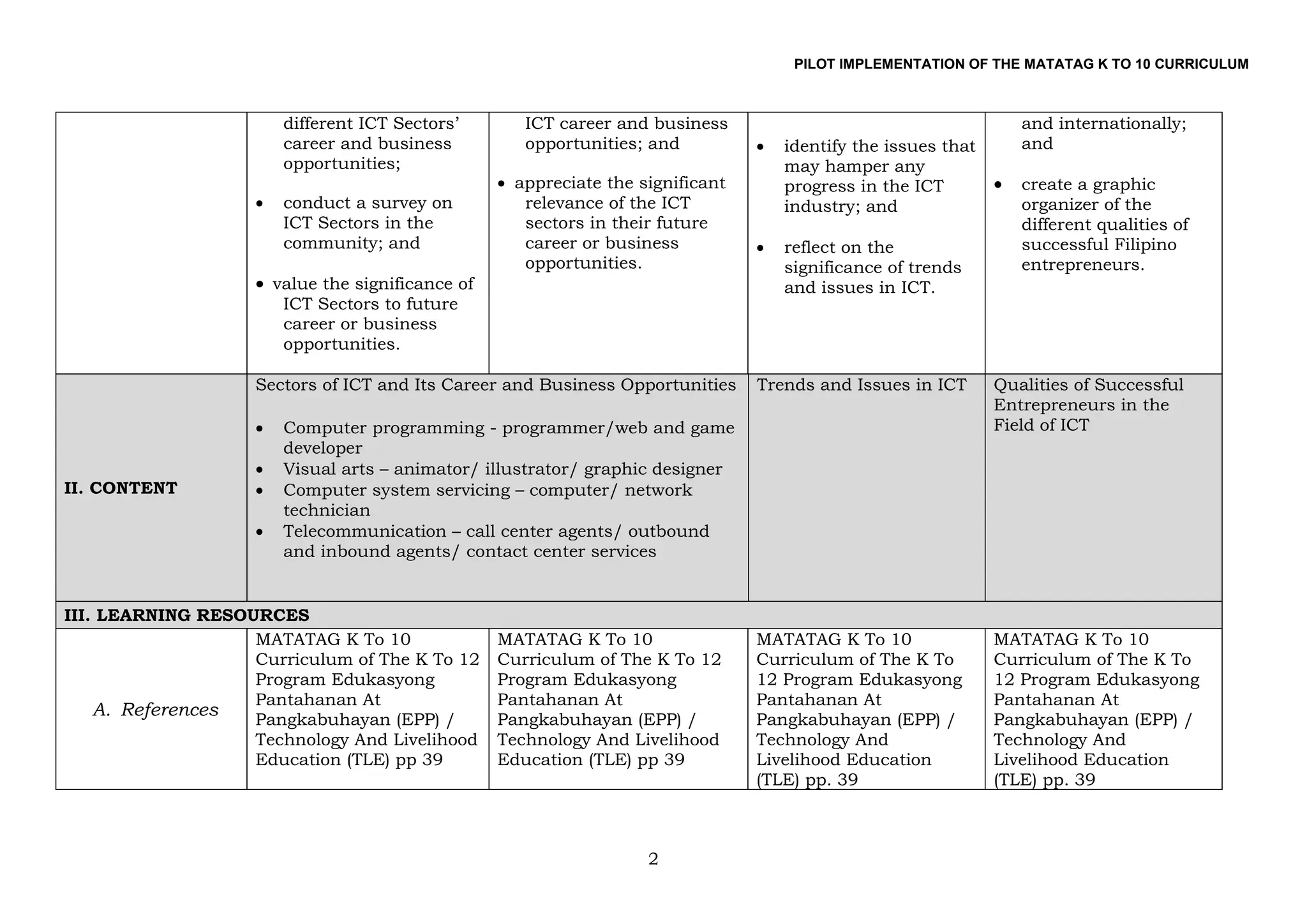
II. CONTENT
Sectors of ICT and Its Career and Business Opportunities
• Computer programming - programmer/web and game
developer
• Visual arts – animator/ illustrator/ graphic designer
• Computer system servicing – computer/ network
technician
• Telecommunication – call center agents/ outbound
and inbound agents/ contact center services
Trends and Issues in ICT Qualities of Successful
Entrepreneurs in the
Field of ICT
III. LEARNING RESOURCES
A. References
MATATAG K To 10
Curriculum of The K To 12
Program Edukasyong
Pantahanan At
Pangkabuhayan (EPP) /
Technology And Livelihood
Education (TLE) pp 39
MATATAG K To 10
Curriculum of The K To 12
Program Edukasyong
Pantahanan At
Pangkabuhayan (EPP) /
Technology And Livelihood
Education (TLE) pp 39
MATATAG K To 10
Curriculum of The K To
12 Program Edukasyong
Pantahanan At
Pangkabuhayan (EPP) /
Technology And
Livelihood Education
(TLE) pp. 39
MATATAG K To 10
Curriculum of The K To
12 Program Edukasyong
Pantahanan At
Pangkabuhayan (EPP) /
Technology And
Livelihood Education
(TLE) pp. 39
PILOT IMPLEMENTATION OF THE MATATAG K TO 10 CURRICULUM
3
B. Other
Learning
Resources
Choosing Your Career Path:
Job vs Business
IV. TEACHING AND LEARNING PROCEDURES
Before/Pre-Lesson Proper
Activating Prior
Knowledge
Start the class by
engaging them in a
Completion Game. Supply
the missing letters to
complete the word.
After the game, the
teachers will ask the
following questions:
• How do you find the
activity?
• What are the ICT
Sectors you were able
to identify in the
puzzle?
• What are the specific
career examples or
business opportunities
you can identify for
these sectors?
• Which among the ICT
Sectors indicated in
the puzzle are you
familiar with?
Review Activity:
The learners will identify the
ICT sector or career shown
in the following illustration
/picture:
1. (Network Technician)
2. (Graphic designer)
3. (Contact Center Agent)
Start the class by
engaging them in an
inquiry activity. Showing
the students a picture or
collage that depicts the
current trends in the ICT
Industry.
The teachers will ask the
following questions:
• What does the picture
depict?
• How can you relate it
to our previous lesson
in the career
opportunities in ICT?
The teacher will process
the learners’ responses.
Pictures of famous
entrepreneurs in the field
of information and
technology will be posted
on the board. Then,
student volunteers will
match the name tag with
the said pictures.
1. Orlando Vea
2. Joey Gurango
3. Diane Eustaquio
4. Gian Scottie Javelona
(Note to the
facilitator/teacher: the
pictures of this Filipino
technopreneurs are not
included in this exemplar
for copyright reason, you
can download at your end
for your reference)
PILOT IMPLEMENTATION OF THE MATATAG K TO 10 CURRICULUM
4
• What do these sectors
have in common?
The teacher will process
the learners’ responses.
4. (Web developer)
Lesson
Purpose/Intention
Explain to the learners
that the lesson will focus
on the Career and
Business Opportunities
related to ICT.
Explain to the learners that
the lesson will focus on
understanding ICT sectors,
as well as the potential
career and business
opportunities these sectors
offer in relation to their
chosen career in the future.
Explain to the learners
that the lesson will focus
on the concept of trends
and possible issues in the
ICT Industry.
The teacher will discuss
the objectives which
should be obtained for the
day.
• Identify famous
successful
entrepreneurs locally
and internationally.
• Discuss the qualities
of successful
entrepreneurs.
Lesson Language
Practice
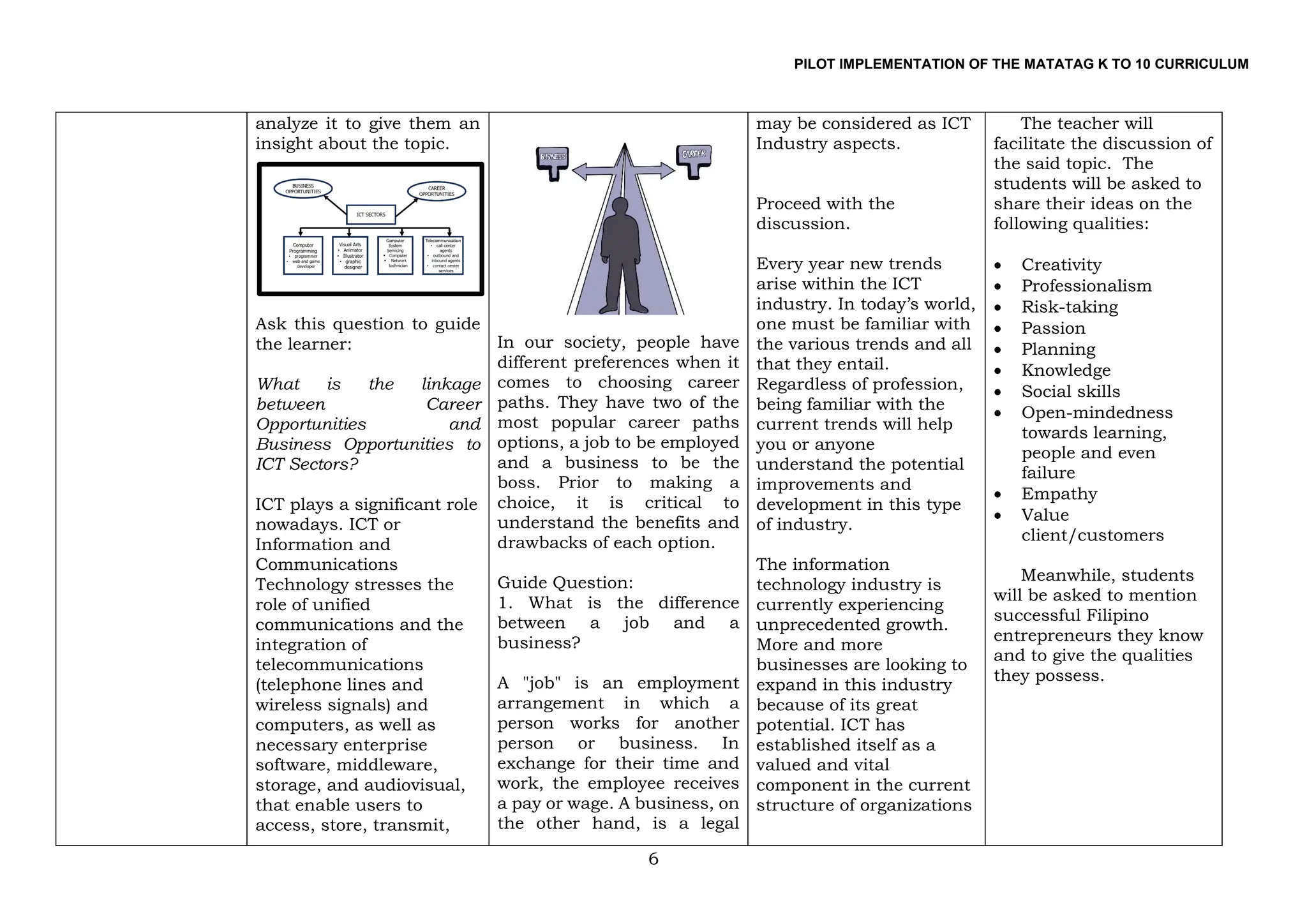
Present to the learner the
Word Pool Hunt Activity.
Present the learner the
graphic organizer below and
allow them to share their
insights/understanding
about the given words.
The teacher will facilitate
the discussion by asking
the learners to give their
insights on the unfamiliar
terms, phrases, or
sentences cited/identified
during the discussions.
Then, the teacher will
provide additional
information/knowledge
on those cited/identified
The teacher will
post/write important
terms related to
entrepreneurship:
• Entrepreneurship
• Entrepreneur
• Creativity
• Risk taking
PILOT IMPLEMENTATION OF THE MATATAG K TO 10 CURRICULUM
5
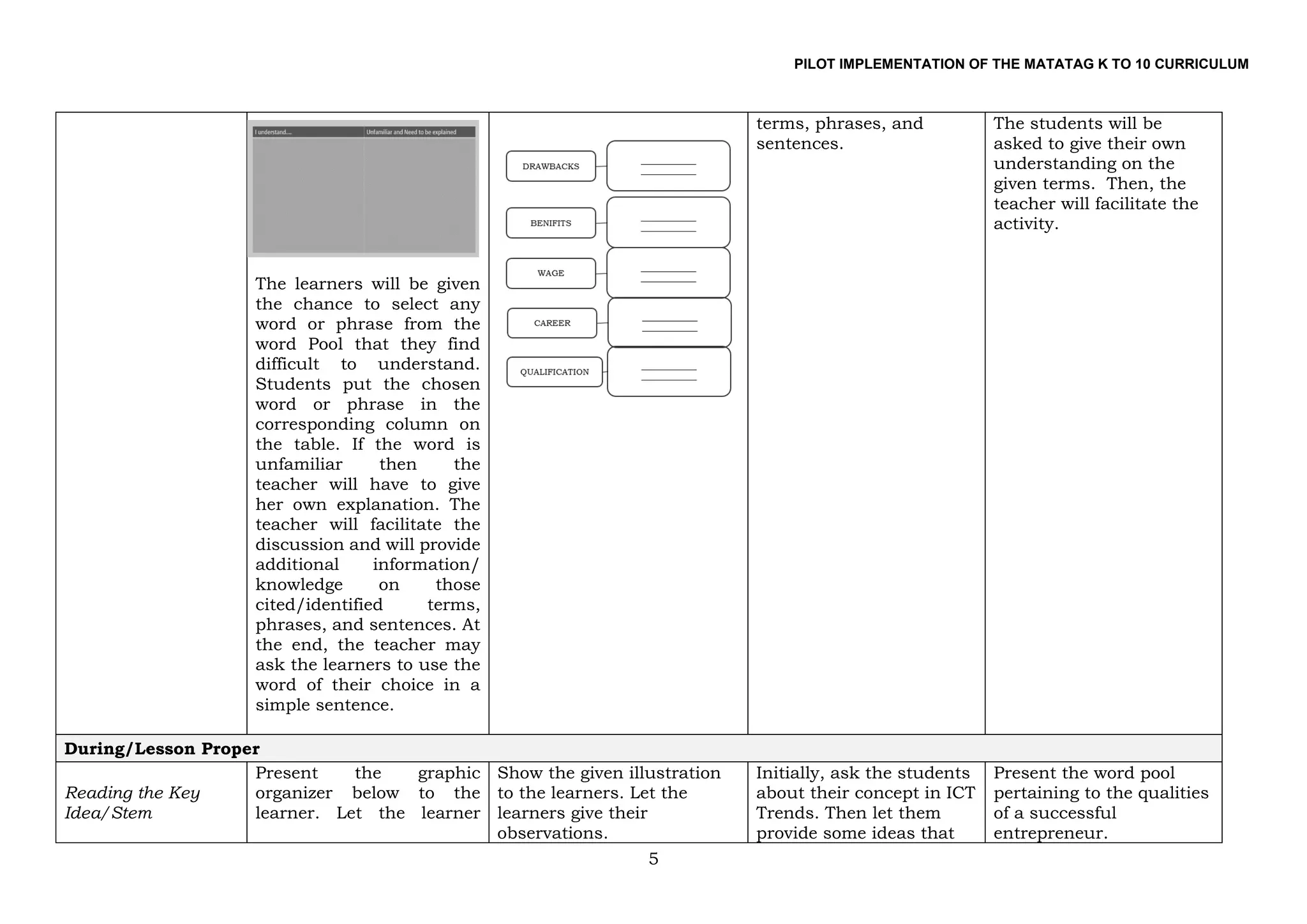
The learners will be given
the chance to select any
word or phrase from the
word Pool that they find
difficult to understand.
Students put the chosen
word or phrase in the
corresponding column on
the table. If the word is
unfamiliar then the
teacher will have to give
her own explanation. The
teacher will facilitate the
discussion and will provide
additional information/
knowledge on those
cited/identified terms,
phrases, and sentences. At
the end, the teacher may
ask the learners to use the
word of their choice in a
simple sentence.
terms, phrases, and
sentences.
The students will be
asked to give their own
understanding on the
given terms. Then, the
teacher will facilitate the
activity.
During/Lesson Proper
Reading the Key
Idea/Stem
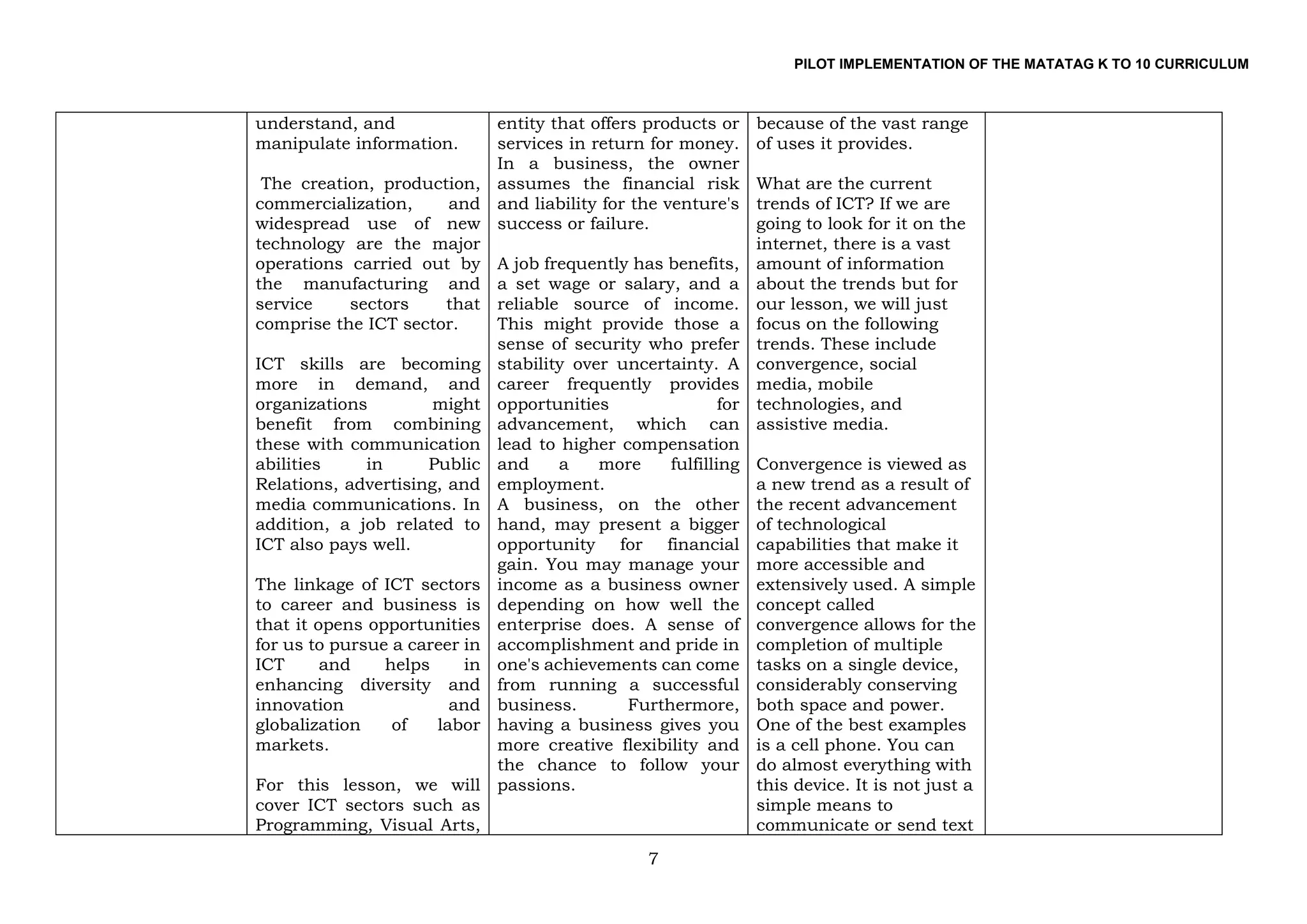
Present the graphic
organizer below to the
learner. Let the learner
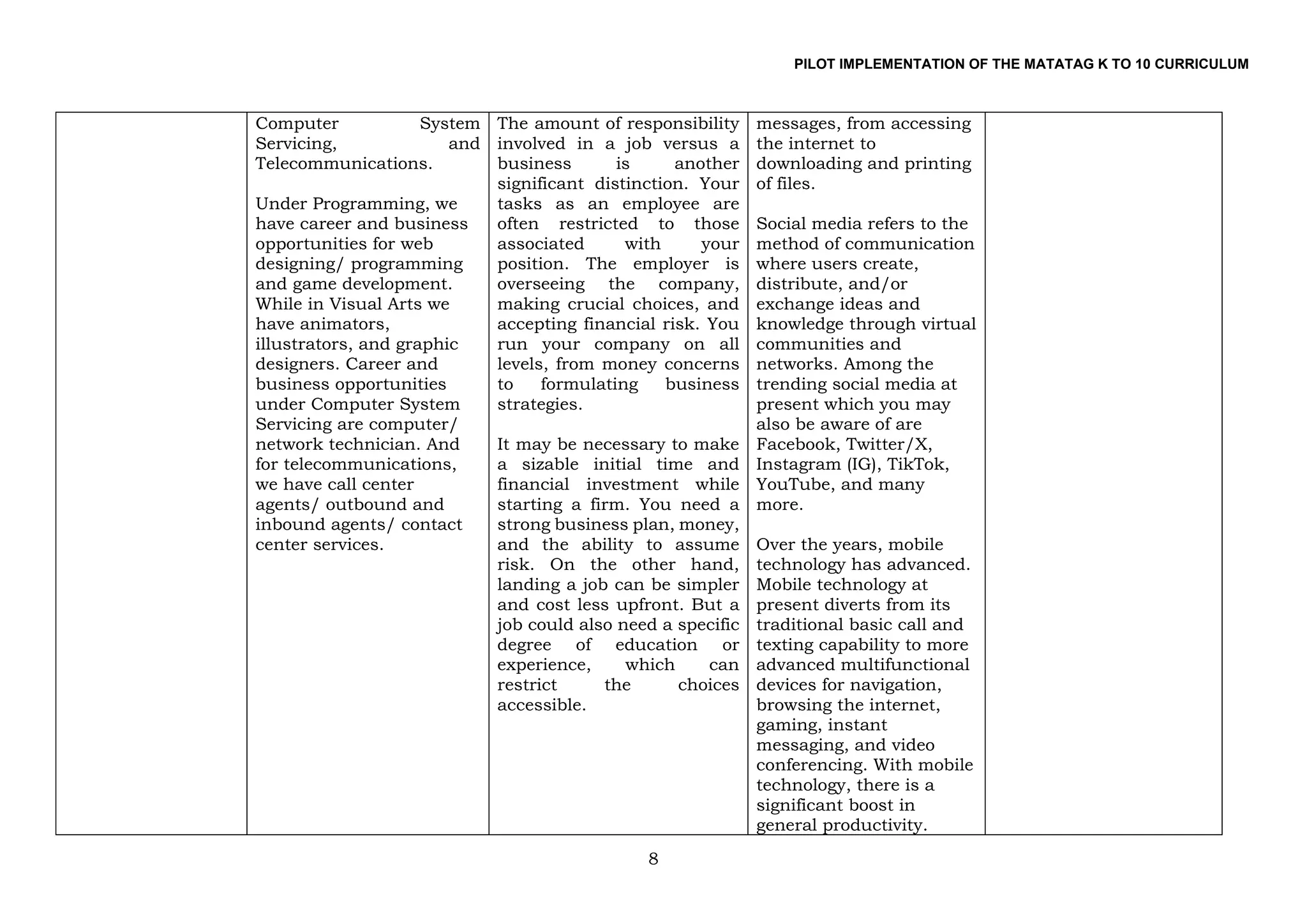
Show the given illustration
to the learners. Let the
learners give their
observations.
Initially, ask the students
about their concept in ICT
Trends. Then let them
provide some ideas that
Present the word pool
pertaining to the qualities
of a successful
entrepreneur.
PILOT IMPLEMENTATION OF THE MATATAG K TO 10 CURRICULUM
6
analyze it to give them an
insight about the topic.
Ask this question to guide
the learner:
What is the linkage
between Career
Opportunities and
Business Opportunities to
ICT Sectors?
ICT plays a significant role
nowadays. ICT or
Information and
Communications
Technology stresses the
role of unified
communications and the
integration of
telecommunications
(telephone lines and
wireless signals) and
computers, as well as
necessary enterprise
software, middleware,
storage, and audiovisual,
that enable users to
access, store, transmit,
In our society, people have
different preferences when it
comes to choosing career
paths. They have two of the
most popular career paths
options, a job to be employed
and a business to be the
boss. Prior to making a
choice, it is critical to
understand the benefits and
drawbacks of each option.
Guide Question:
1. What is the difference
between a job and a
business?
A "job" is an employment
arrangement in which a
person works for another
person or business. In
exchange for their time and
work, the employee receives
a pay or wage. A business, on
the other hand, is a legal
may be considered as ICT
Industry aspects.
Proceed with the
discussion.
Every year new trends
arise within the ICT
industry. In today’s world,
one must be familiar with
the various trends and all
that they entail.
Regardless of profession,
being familiar with the
current trends will help
you or anyone
understand the potential
improvements and
development in this type
of industry.
The information
technology industry is
currently experiencing
unprecedented growth.
More and more
businesses are looking to
expand in this industry
because of its great
potential. ICT has
established itself as a
valued and vital
component in the current
structure of organizations
The teacher will
facilitate the discussion of
the said topic. The
students will be asked to
share their ideas on the
following qualities:
• Creativity
• Professionalism
• Risk-taking
• Passion
• Planning
• Knowledge
• Social skills
• Open-mindedness
towards learning,
people and even
failure
• Empathy
• Value
client/customers
Meanwhile, students
will be asked to mention
successful Filipino
entrepreneurs they know
and to give the qualities
they possess.
PILOT IMPLEMENTATION OF THE MATATAG K TO 10 CURRICULUM
7
understand, and
manipulate information.
The creation, production,
commercialization, and
widespread use of new
technology are the major
operations carried out by
the manufacturing and
service sectors that
comprise the ICT sector.
ICT skills are becoming
more in demand, and
organizations might
benefit from combining
these with communication
abilities in Public
Relations, advertising, and
media communications. In
addition, a job related to
ICT also pays well.
The linkage of ICT sectors
to career and business is
that it opens opportunities
for us to pursue a career in
ICT and helps in
enhancing diversity and
innovation and
globalization of labor
markets.
For this lesson, we will
cover ICT sectors such as
Programming, Visual Arts,
entity that offers products or
services in return for money.
In a business, the owner
assumes the financial risk
and liability for the venture's
success or failure.
A job frequently has benefits,
a set wage or salary, and a
reliable source of income.
This might provide those a
sense of security who prefer
stability over uncertainty. A
career frequently provides
opportunities for
advancement, which can
lead to higher compensation
and a more fulfilling
employment.
A business, on the other
hand, may present a bigger
opportunity for financial
gain. You may manage your
income as a business owner
depending on how well the
enterprise does. A sense of
accomplishment and pride in
one's achievements can come
from running a successful
business. Furthermore,
having a business gives you
more creative flexibility and
the chance to follow your
passions.
because of the vast range
of uses it provides.
What are the current
trends of ICT? If we are
going to look for it on the
internet, there is a vast
amount of information
about the trends but for
our lesson, we will just
focus on the following
trends. These include
convergence, social
media, mobile
technologies, and
assistive media.
Convergence is viewed as
a new trend as a result of
the recent advancement
of technological
capabilities that make it
more accessible and
extensively used. A simple
concept called
convergence allows for the
completion of multiple
tasks on a single device,
considerably conserving
both space and power.
One of the best examples
is a cell phone. You can
do almost everything with
this device. It is not just a
simple means to
communicate or send text
PILOT IMPLEMENTATION OF THE MATATAG K TO 10 CURRICULUM
8
Computer System
Servicing, and
Telecommunications.
Under Programming, we
have career and business
opportunities for web
designing/ programming
and game development.
While in Visual Arts we
have animators,
illustrators, and graphic
designers. Career and
business opportunities
under Computer System
Servicing are computer/
network technician. And
for telecommunications,
we have call center
agents/ outbound and
inbound agents/ contact
center services.
The amount of responsibility
involved in a job versus a
business is another
significant distinction. Your
tasks as an employee are
often restricted to those
associated with your
position. The employer is
overseeing the company,
making crucial choices, and
accepting financial risk. You
run your company on all
levels, from money concerns
to formulating business
strategies.
It may be necessary to make
a sizable initial time and
financial investment while
starting a firm. You need a
strong business plan, money,
and the ability to assume
risk. On the other hand,
landing a job can be simpler
and cost less upfront. But a
job could also need a specific
degree of education or
experience, which can
restrict the choices
accessible.
messages, from accessing
the internet to
downloading and printing
of files.
Social media refers to the
method of communication
where users create,
distribute, and/or
exchange ideas and
knowledge through virtual
communities and
networks. Among the
trending social media at
present which you may
also be aware of are
Facebook, Twitter/X,
Instagram (IG), TikTok,
YouTube, and many
more.
Over the years, mobile
technology has advanced.
Mobile technology at
present diverts from its
traditional basic call and
texting capability to more
advanced multifunctional
devices for navigation,
browsing the internet,
gaming, instant
messaging, and video
conferencing. With mobile
technology, there is a
significant boost in
general productivity.
PILOT IMPLEMENTATION OF THE MATATAG K TO 10 CURRICULUM
9
Assistive technology is
designed to help persons
with disabilities like
reading and visual
impairment and more.
With the aid of assistive
technology, people with
impairments can carry
out tasks that would
otherwise be challenging
or impossible.
Developing
Understanding of the
Key Idea/Stem
The learners will be asked
with the questions below.
Guide Questions:
1. What are the different
ICT sectors?
2. What career or
business opportunities
are in the ICT sectors?
3. What career or
business opportunities
does programming
include? Visual Arts?
Computer System
Servicing?
Telecommunications?
The teacher will tell the
learners to present the
results of their survey on
ICT Sectors available in
their community.
Then, the teacher will ask
the following questions:
B. What are the existing
ICT Sectors in your
community?
A. The teacher will be
asking the learners to fill-
out the given table and
follow the following
directions:
1. From the list of ICT
Sectors, choose one
The learners will be asked
with the questions below.
• What are the trends in
ICT? Are you familiar
with these trends?
• How do these ICT
Trends affect future
career and business
opportunities?
• What possible issues
may arise from these
trends?
The learners will be asked
with the questions below.
• What are the qualities
of a successful
entrepreneur?
• What qualities are
present to Filipino
entrepreneurs you
know?
PILOT IMPLEMENTATION OF THE MATATAG K TO 10 CURRICULUM
10
4. Which of the given ICT
sectors are you familiar
with?
you are most
interested to be part
of.
2. Identify at least 3
professions in your
chosen industry or ICT
sector and the
qualifications, skills,
and competencies for
the identified careers.
You may search the
information on the
internet, or job
listings, or ask for help
from a family member
or someone in the
same field of
profession.
3. Copy and complete the
activity on a sheet of
paper.
Deepening
Understanding of the
Key Idea/Stem
The teacher will ask the
following questions:
Processing Questions for
the previous activity:
The teacher will ask the
following questions:
The learners will be asked
with the following
questions:
PILOT IMPLEMENTATION OF THE MATATAG K TO 10 CURRICULUM
11
1. As a learner, what is
the significant impact of
these ICT Sectors in the
career and business
opportunities that you
may undertake in the
future?
The teacher will process
the answers of the
learners.
The teacher will ask the
learners for some
questions, clarification, or
muddy parts in the lesson,
and explain it with further
examples if necessary.
The teacher will ask
learners to create their
own graphic organizer
showing the different ICT
sectors.
1. Do you think you are
fit with the necessary
qualifications of your
chosen career based
on your own skills and
competencies?
Explain.
2. Did the activity help
you evaluate your
chosen future career in
ICT? How?
The learners will be asked to
answer the following
questions:
• Now that you have
learned about the
qualifications of the
different career
opportunities in ICT,
would you like to pursue
it? Why?
• What significant
realization did you have
after having this activity?
Explain.
1. Why does the issue
always arise whenever
there is a trend?
2. In your opinion,
discuss possible
trends five years from
now?
3. How do ICT trends
change as time goes
by?
• In what situations or
instances can you
determine that
entrepreneurs have
the said qualities?
• Why should an
entrepreneur possess
the said qualities?
• Why should a future
entrepreneur like you
develop the said
qualities of successful
Filipino
entrepreneurs?
Give the learner an
activity.
Create a graphic
organizer. Choose one
technopreneur, identify
his/her qualities, and
explain why these
qualities help him or her
succeed.
PILOT IMPLEMENTATION OF THE MATATAG K TO 10 CURRICULUM
12
After/Post-Lesson Proper
Making
Generalizations and
Abstractions
The teacher will ask the
learners to explain the
concept of ICT Sectors and
the career and business
opportunities related to it.
The teacher will call
selected learners to share
their answers.
Afterward, the teacher will
re-emphasize the highlight
on the important
concept/notes about the
topic.
The teacher will ask the
learners their main
takeaways from the lesson.
Teachers will emphasize the
importance of the different
ICT sectors in their future
careers or business
opportunities.
The teacher will ask the
learners to explain or
summarize the concept of
the ICT Industry’s trends
and issues in its effect on
the society.
The teacher will process
their answers and let the
students again create a
single generalization.
The teacher will ask the
learners to summarize the
different qualities of a
successful Filipino
entrepreneur. The
teacher will call select
learners to share their
answers.
Afterward, the teacher
will re-emphasize the
highlight of the qualities
of successful Filipino
entrepreneurs.
Evaluating Learning
Formative Assessment:
Directions:
Multiple Choice: Identify
the following. Write the
letter of the correct answer
on a clean sheet of paper.
1. These are
manufacturing and
services sectors where
the major operations
are carried out widely
by the use of new
technology or ICT.
A. Industrial Arts
Sectors
B. ICT Sectors
Performance Task:
• The learner will be asked
to make a future self-
portrait of one’s chosen
career or business
opportunities related to
ICT.
Learner directions:
Do this on short bond
paper and color it.
Write a short essay
describing your
future self, what
helps you to be more
certain in choosing a
career in ICT or an
ICT related business.
Essay Test:
Directions: Choose a
particular ICT trend and
issue that you are
interested in. Create an
essay discussing the
current ICT trends and
issues.
Formative Test:
Directions: Rearrange
jumbled letters to form
the different qualities of a
successful entrepreneur.
1. C R A E T V I Y T
2. S S I O N A P
3. T H E M P Y A
4. K N O L W D E G E
5. P L N N A I G N
PILOT IMPLEMENTATION OF THE MATATAG K TO 10 CURRICULUM
13
C. Family and
Consumer Services
Sectors
D. AFA Sector
2. Which of the following
sectors can a contact
center agent be
included in?
A. CSS
B. Programming
C. Telecommunication
D. Visual Arts
3. Mr. Manuel is a
graphic illustrator.
Which of the following
ICT sectors does he
belong to?
A. CSS
B. Programming
C. Telecommunication
D. Visual Arts
4. Web development and
game development are
from what ICT Sector?
A. CSS
B. Programming
C. Telecommunication
D. Visual Arts
5. What is the
significance of different
ICT Sectors?
Note to the facilitator: Please
provide your rubrics
PILOT IMPLEMENTATION OF THE MATATAG K TO 10 CURRICULUM
14
A. It provides income
for our economy.
B. It provides career
and business
opportunities.
C. It provides
manufacturing and
services.
D. None of the above.
Additional Activities
for Application or
Remediation (if
applicable)
Assignment:
Ask the learner to survey
or research other ICT
sectors/ industries
available in their
community and have
statistical data to be used
on the next day.
Make a collage using
cutout pictures that will
best describe your idea on
the trends and issues in
the ICT Industry
Remarks
Reflection
The teacher will ask the
learner this question:
How does this lesson help
you to better understand
the concept of ICT Sectors
in choosing career and
business opportunities?
The teacher will ask the
learner this question:
How does this lesson help
you to evaluate what ICT
career or ICT-related
business you are going to
pursue in the future?
The teacher will ask the
learner this question:
How does this lesson help
you to better understand
the concept of Trends and
Issues in ICT?
Prepared by:
________________________
Subject Teacher
Reviewed by:
________________________
Master Teacher/Head Teacher
Approved by:
________________________
School Head
PILOT IMPLEMENTATION OF THE MATATAG K TO 10 CURRICULUM
1
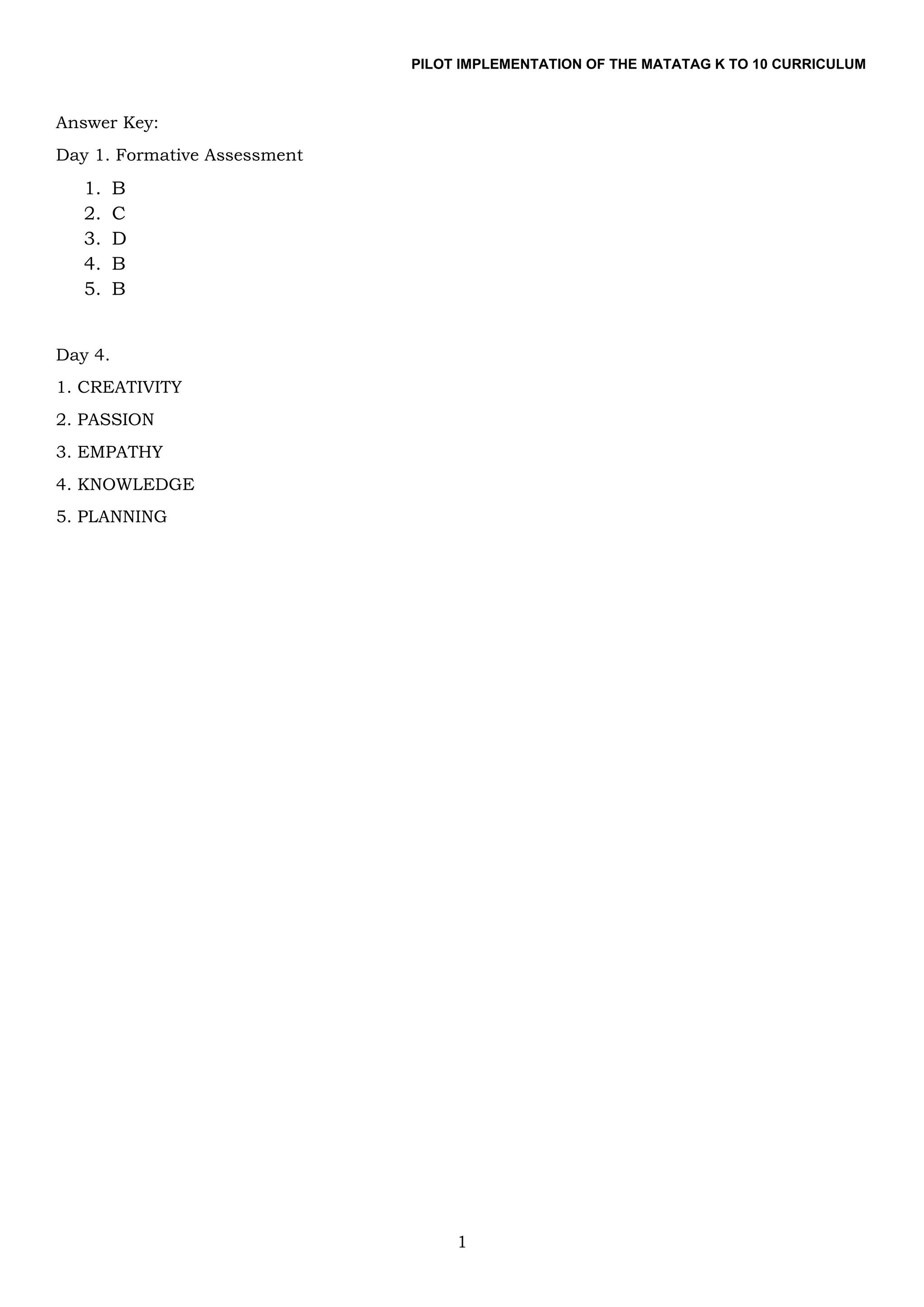
Answer Key:
Day 1. Formative Assessment
1. B
2. C
3. D
4. B
5. B
Day 4.
1. CREATIVITY
2. PASSION
3. EMPATHY
4. KNOWLEDGE
5. PLANNING

00 Matatag-Lesson Exemplar-TLE-ICT7_W1_v2

  • 1.
    PILOT IMPLEMENTATION OFTHE MATATAG K TO 10 CURRICULUM 7 Lesson Exemplar for TLE-ICT 7 Week 1 Quarter 1
  • 2.
    Lesson Exemplar forTechnology and Livelihood Education - ICT 7 Quarter 1: Week 1 SY 2023-2024 This material is intended exclusively for the use of teachers participating in the pilot implementation of the MATATAG K to 10 Curriculum during the School Year 2023-2024. It aims to assist in delivering the curriculum content, standards, and lesson competencies. Any unauthorized reproduction, distribution, modification, or utilization of this material beyond the designated scope is strictly prohibited and may result in appropriate legal actions and disciplinary measures. Borrowed content included in this material are owned by their respective copyright holders. Every effort has been made to locate and obtain permission to use these materials from their respective copyright owners. The publisher and development team do not represent nor claim ownership over them. Every care has been taken to ensure the accuracy of the information provided in this material. For inquiries or feedback, please write or call the Office of the Director of the Bureau of Learning Resources via telephone numbers (02) 8634-1072 and 8631-6922 or by email at blr.od@deped.gov.ph. Development Team Writer: Alona T. Nieva Content Editor: Darlene S. Interno, Virgilio O. Guevarra Jr. Mechanical Editor: Elizabeth A. Soriano Illustrator: Rolly J. Cano Layout Artist: Julie Anne V. Vertudes Management Team Alberto T. Escobarte, CESO III, Viernalyn M. Nama, Dianne Catherine Teves-Antonio, Virgilio O. Guevarra, Jr., Nenette Arcelle Joy P. Larinay, Lhovie C. Damian, Redgynn A. Bernales
  • 3.
    PILOT IMPLEMENTATION OFTHE MATATAG K TO 10 CURRICULUM 1 MATATAG K to 10 Curriculum Weekly Lesson Log School Grade Level GRADE 7 Name of Teacher Learning Area TLE-ICT Teaching Dates and Time Quarter 1 DAY 1 DAY 2 DAY 3 DAY 4 I. CURRICULUM CONTENT, STANDARDS, AND LESSON COMPETENCIES A. Content Standards • Demonstrate an understanding of ICT sectors, as well as the potential career and business opportunities these sectors offer in relation to their chosen career in the future. • Demonstrate an understanding of current trends and emerging issues in ICT • Demonstrate an understanding of the qualities of successful Filipino entrepreneurs in the field of ICT. B. Performance Standards C. Learning Competencie s The learners shall be able to: • analyze the various sectors of ICT and evaluate the potential career and business prospects relevant to their future career choices. The learners shall be able to: • discuss the emerging trends and issues in ICT. The learners shall be able to: • discuss the qualities of successful Filipino entrepreneurs in the field of ICT. D. Learning Objectives At the end of the lesson, the learners shall be able to: • identify various ICT sectors and potential career and business opportunities; • draw a graphic organizer showing the At the end of the lesson, the learners shall be able to: • present the result of a survey on ICT sectors available in your community; • examine skills and competencies related to At the end of the lesson, the learners shall be able to: • identify the various trends in ICT that may contribute to developments in the ICT industry and Entrepreneurial activities; At the end of the lesson, the learners shall be able to: • discuss the qualities of successful entrepreneurs; • identify famous successful entrepreneurs locally
  • 4.
    PILOT IMPLEMENTATION OFTHE MATATAG K TO 10 CURRICULUM 2 different ICT Sectors’ career and business opportunities; • conduct a survey on ICT Sectors in the community; and • value the significance of ICT Sectors to future career or business opportunities. ICT career and business opportunities; and • appreciate the significant relevance of the ICT sectors in their future career or business opportunities. • identify the issues that may hamper any progress in the ICT industry; and • reflect on the significance of trends and issues in ICT. and internationally; and • create a graphic organizer of the different qualities of successful Filipino entrepreneurs. II. CONTENT Sectors of ICT and Its Career and Business Opportunities • Computer programming - programmer/web and game developer • Visual arts – animator/ illustrator/ graphic designer • Computer system servicing – computer/ network technician • Telecommunication – call center agents/ outbound and inbound agents/ contact center services Trends and Issues in ICT Qualities of Successful Entrepreneurs in the Field of ICT III. LEARNING RESOURCES A. References MATATAG K To 10 Curriculum of The K To 12 Program Edukasyong Pantahanan At Pangkabuhayan (EPP) / Technology And Livelihood Education (TLE) pp 39 MATATAG K To 10 Curriculum of The K To 12 Program Edukasyong Pantahanan At Pangkabuhayan (EPP) / Technology And Livelihood Education (TLE) pp 39 MATATAG K To 10 Curriculum of The K To 12 Program Edukasyong Pantahanan At Pangkabuhayan (EPP) / Technology And Livelihood Education (TLE) pp. 39 MATATAG K To 10 Curriculum of The K To 12 Program Edukasyong Pantahanan At Pangkabuhayan (EPP) / Technology And Livelihood Education (TLE) pp. 39
  • 5.
    PILOT IMPLEMENTATION OFTHE MATATAG K TO 10 CURRICULUM 3 B. Other Learning Resources Choosing Your Career Path: Job vs Business IV. TEACHING AND LEARNING PROCEDURES Before/Pre-Lesson Proper Activating Prior Knowledge Start the class by engaging them in a Completion Game. Supply the missing letters to complete the word. After the game, the teachers will ask the following questions: • How do you find the activity? • What are the ICT Sectors you were able to identify in the puzzle? • What are the specific career examples or business opportunities you can identify for these sectors? • Which among the ICT Sectors indicated in the puzzle are you familiar with? Review Activity: The learners will identify the ICT sector or career shown in the following illustration /picture: 1. (Network Technician) 2. (Graphic designer) 3. (Contact Center Agent) Start the class by engaging them in an inquiry activity. Showing the students a picture or collage that depicts the current trends in the ICT Industry. The teachers will ask the following questions: • What does the picture depict? • How can you relate it to our previous lesson in the career opportunities in ICT? The teacher will process the learners’ responses. Pictures of famous entrepreneurs in the field of information and technology will be posted on the board. Then, student volunteers will match the name tag with the said pictures. 1. Orlando Vea 2. Joey Gurango 3. Diane Eustaquio 4. Gian Scottie Javelona (Note to the facilitator/teacher: the pictures of this Filipino technopreneurs are not included in this exemplar for copyright reason, you can download at your end for your reference)
  • 6.
    PILOT IMPLEMENTATION OFTHE MATATAG K TO 10 CURRICULUM 4 • What do these sectors have in common? The teacher will process the learners’ responses. 4. (Web developer) Lesson Purpose/Intention Explain to the learners that the lesson will focus on the Career and Business Opportunities related to ICT. Explain to the learners that the lesson will focus on understanding ICT sectors, as well as the potential career and business opportunities these sectors offer in relation to their chosen career in the future. Explain to the learners that the lesson will focus on the concept of trends and possible issues in the ICT Industry. The teacher will discuss the objectives which should be obtained for the day. • Identify famous successful entrepreneurs locally and internationally. • Discuss the qualities of successful entrepreneurs. Lesson Language Practice Present to the learner the Word Pool Hunt Activity. Present the learner the graphic organizer below and allow them to share their insights/understanding about the given words. The teacher will facilitate the discussion by asking the learners to give their insights on the unfamiliar terms, phrases, or sentences cited/identified during the discussions. Then, the teacher will provide additional information/knowledge on those cited/identified The teacher will post/write important terms related to entrepreneurship: • Entrepreneurship • Entrepreneur • Creativity • Risk taking
  • 7.
    PILOT IMPLEMENTATION OFTHE MATATAG K TO 10 CURRICULUM 5 The learners will be given the chance to select any word or phrase from the word Pool that they find difficult to understand. Students put the chosen word or phrase in the corresponding column on the table. If the word is unfamiliar then the teacher will have to give her own explanation. The teacher will facilitate the discussion and will provide additional information/ knowledge on those cited/identified terms, phrases, and sentences. At the end, the teacher may ask the learners to use the word of their choice in a simple sentence. terms, phrases, and sentences. The students will be asked to give their own understanding on the given terms. Then, the teacher will facilitate the activity. During/Lesson Proper Reading the Key Idea/Stem Present the graphic organizer below to the learner. Let the learner Show the given illustration to the learners. Let the learners give their observations. Initially, ask the students about their concept in ICT Trends. Then let them provide some ideas that Present the word pool pertaining to the qualities of a successful entrepreneur.
  • 8.
    PILOT IMPLEMENTATION OFTHE MATATAG K TO 10 CURRICULUM 6 analyze it to give them an insight about the topic. Ask this question to guide the learner: What is the linkage between Career Opportunities and Business Opportunities to ICT Sectors? ICT plays a significant role nowadays. ICT or Information and Communications Technology stresses the role of unified communications and the integration of telecommunications (telephone lines and wireless signals) and computers, as well as necessary enterprise software, middleware, storage, and audiovisual, that enable users to access, store, transmit, In our society, people have different preferences when it comes to choosing career paths. They have two of the most popular career paths options, a job to be employed and a business to be the boss. Prior to making a choice, it is critical to understand the benefits and drawbacks of each option. Guide Question: 1. What is the difference between a job and a business? A "job" is an employment arrangement in which a person works for another person or business. In exchange for their time and work, the employee receives a pay or wage. A business, on the other hand, is a legal may be considered as ICT Industry aspects. Proceed with the discussion. Every year new trends arise within the ICT industry. In today’s world, one must be familiar with the various trends and all that they entail. Regardless of profession, being familiar with the current trends will help you or anyone understand the potential improvements and development in this type of industry. The information technology industry is currently experiencing unprecedented growth. More and more businesses are looking to expand in this industry because of its great potential. ICT has established itself as a valued and vital component in the current structure of organizations The teacher will facilitate the discussion of the said topic. The students will be asked to share their ideas on the following qualities: • Creativity • Professionalism • Risk-taking • Passion • Planning • Knowledge • Social skills • Open-mindedness towards learning, people and even failure • Empathy • Value client/customers Meanwhile, students will be asked to mention successful Filipino entrepreneurs they know and to give the qualities they possess.
  • 9.
    PILOT IMPLEMENTATION OFTHE MATATAG K TO 10 CURRICULUM 7 understand, and manipulate information. The creation, production, commercialization, and widespread use of new technology are the major operations carried out by the manufacturing and service sectors that comprise the ICT sector. ICT skills are becoming more in demand, and organizations might benefit from combining these with communication abilities in Public Relations, advertising, and media communications. In addition, a job related to ICT also pays well. The linkage of ICT sectors to career and business is that it opens opportunities for us to pursue a career in ICT and helps in enhancing diversity and innovation and globalization of labor markets. For this lesson, we will cover ICT sectors such as Programming, Visual Arts, entity that offers products or services in return for money. In a business, the owner assumes the financial risk and liability for the venture's success or failure. A job frequently has benefits, a set wage or salary, and a reliable source of income. This might provide those a sense of security who prefer stability over uncertainty. A career frequently provides opportunities for advancement, which can lead to higher compensation and a more fulfilling employment. A business, on the other hand, may present a bigger opportunity for financial gain. You may manage your income as a business owner depending on how well the enterprise does. A sense of accomplishment and pride in one's achievements can come from running a successful business. Furthermore, having a business gives you more creative flexibility and the chance to follow your passions. because of the vast range of uses it provides. What are the current trends of ICT? If we are going to look for it on the internet, there is a vast amount of information about the trends but for our lesson, we will just focus on the following trends. These include convergence, social media, mobile technologies, and assistive media. Convergence is viewed as a new trend as a result of the recent advancement of technological capabilities that make it more accessible and extensively used. A simple concept called convergence allows for the completion of multiple tasks on a single device, considerably conserving both space and power. One of the best examples is a cell phone. You can do almost everything with this device. It is not just a simple means to communicate or send text
  • 10.
    PILOT IMPLEMENTATION OFTHE MATATAG K TO 10 CURRICULUM 8 Computer System Servicing, and Telecommunications. Under Programming, we have career and business opportunities for web designing/ programming and game development. While in Visual Arts we have animators, illustrators, and graphic designers. Career and business opportunities under Computer System Servicing are computer/ network technician. And for telecommunications, we have call center agents/ outbound and inbound agents/ contact center services. The amount of responsibility involved in a job versus a business is another significant distinction. Your tasks as an employee are often restricted to those associated with your position. The employer is overseeing the company, making crucial choices, and accepting financial risk. You run your company on all levels, from money concerns to formulating business strategies. It may be necessary to make a sizable initial time and financial investment while starting a firm. You need a strong business plan, money, and the ability to assume risk. On the other hand, landing a job can be simpler and cost less upfront. But a job could also need a specific degree of education or experience, which can restrict the choices accessible. messages, from accessing the internet to downloading and printing of files. Social media refers to the method of communication where users create, distribute, and/or exchange ideas and knowledge through virtual communities and networks. Among the trending social media at present which you may also be aware of are Facebook, Twitter/X, Instagram (IG), TikTok, YouTube, and many more. Over the years, mobile technology has advanced. Mobile technology at present diverts from its traditional basic call and texting capability to more advanced multifunctional devices for navigation, browsing the internet, gaming, instant messaging, and video conferencing. With mobile technology, there is a significant boost in general productivity.
  • 11.
    PILOT IMPLEMENTATION OFTHE MATATAG K TO 10 CURRICULUM 9 Assistive technology is designed to help persons with disabilities like reading and visual impairment and more. With the aid of assistive technology, people with impairments can carry out tasks that would otherwise be challenging or impossible. Developing Understanding of the Key Idea/Stem The learners will be asked with the questions below. Guide Questions: 1. What are the different ICT sectors? 2. What career or business opportunities are in the ICT sectors? 3. What career or business opportunities does programming include? Visual Arts? Computer System Servicing? Telecommunications? The teacher will tell the learners to present the results of their survey on ICT Sectors available in their community. Then, the teacher will ask the following questions: B. What are the existing ICT Sectors in your community? A. The teacher will be asking the learners to fill- out the given table and follow the following directions: 1. From the list of ICT Sectors, choose one The learners will be asked with the questions below. • What are the trends in ICT? Are you familiar with these trends? • How do these ICT Trends affect future career and business opportunities? • What possible issues may arise from these trends? The learners will be asked with the questions below. • What are the qualities of a successful entrepreneur? • What qualities are present to Filipino entrepreneurs you know?
  • 12.
    PILOT IMPLEMENTATION OFTHE MATATAG K TO 10 CURRICULUM 10 4. Which of the given ICT sectors are you familiar with? you are most interested to be part of. 2. Identify at least 3 professions in your chosen industry or ICT sector and the qualifications, skills, and competencies for the identified careers. You may search the information on the internet, or job listings, or ask for help from a family member or someone in the same field of profession. 3. Copy and complete the activity on a sheet of paper. Deepening Understanding of the Key Idea/Stem The teacher will ask the following questions: Processing Questions for the previous activity: The teacher will ask the following questions: The learners will be asked with the following questions:
  • 13.
    PILOT IMPLEMENTATION OFTHE MATATAG K TO 10 CURRICULUM 11 1. As a learner, what is the significant impact of these ICT Sectors in the career and business opportunities that you may undertake in the future? The teacher will process the answers of the learners. The teacher will ask the learners for some questions, clarification, or muddy parts in the lesson, and explain it with further examples if necessary. The teacher will ask learners to create their own graphic organizer showing the different ICT sectors. 1. Do you think you are fit with the necessary qualifications of your chosen career based on your own skills and competencies? Explain. 2. Did the activity help you evaluate your chosen future career in ICT? How? The learners will be asked to answer the following questions: • Now that you have learned about the qualifications of the different career opportunities in ICT, would you like to pursue it? Why? • What significant realization did you have after having this activity? Explain. 1. Why does the issue always arise whenever there is a trend? 2. In your opinion, discuss possible trends five years from now? 3. How do ICT trends change as time goes by? • In what situations or instances can you determine that entrepreneurs have the said qualities? • Why should an entrepreneur possess the said qualities? • Why should a future entrepreneur like you develop the said qualities of successful Filipino entrepreneurs? Give the learner an activity. Create a graphic organizer. Choose one technopreneur, identify his/her qualities, and explain why these qualities help him or her succeed.
  • 14.
    PILOT IMPLEMENTATION OFTHE MATATAG K TO 10 CURRICULUM 12 After/Post-Lesson Proper Making Generalizations and Abstractions The teacher will ask the learners to explain the concept of ICT Sectors and the career and business opportunities related to it. The teacher will call selected learners to share their answers. Afterward, the teacher will re-emphasize the highlight on the important concept/notes about the topic. The teacher will ask the learners their main takeaways from the lesson. Teachers will emphasize the importance of the different ICT sectors in their future careers or business opportunities. The teacher will ask the learners to explain or summarize the concept of the ICT Industry’s trends and issues in its effect on the society. The teacher will process their answers and let the students again create a single generalization. The teacher will ask the learners to summarize the different qualities of a successful Filipino entrepreneur. The teacher will call select learners to share their answers. Afterward, the teacher will re-emphasize the highlight of the qualities of successful Filipino entrepreneurs. Evaluating Learning Formative Assessment: Directions: Multiple Choice: Identify the following. Write the letter of the correct answer on a clean sheet of paper. 1. These are manufacturing and services sectors where the major operations are carried out widely by the use of new technology or ICT. A. Industrial Arts Sectors B. ICT Sectors Performance Task: • The learner will be asked to make a future self- portrait of one’s chosen career or business opportunities related to ICT. Learner directions: Do this on short bond paper and color it. Write a short essay describing your future self, what helps you to be more certain in choosing a career in ICT or an ICT related business. Essay Test: Directions: Choose a particular ICT trend and issue that you are interested in. Create an essay discussing the current ICT trends and issues. Formative Test: Directions: Rearrange jumbled letters to form the different qualities of a successful entrepreneur. 1. C R A E T V I Y T 2. S S I O N A P 3. T H E M P Y A 4. K N O L W D E G E 5. P L N N A I G N
  • 15.
    PILOT IMPLEMENTATION OFTHE MATATAG K TO 10 CURRICULUM 13 C. Family and Consumer Services Sectors D. AFA Sector 2. Which of the following sectors can a contact center agent be included in? A. CSS B. Programming C. Telecommunication D. Visual Arts 3. Mr. Manuel is a graphic illustrator. Which of the following ICT sectors does he belong to? A. CSS B. Programming C. Telecommunication D. Visual Arts 4. Web development and game development are from what ICT Sector? A. CSS B. Programming C. Telecommunication D. Visual Arts 5. What is the significance of different ICT Sectors? Note to the facilitator: Please provide your rubrics
  • 16.
    PILOT IMPLEMENTATION OFTHE MATATAG K TO 10 CURRICULUM 14 A. It provides income for our economy. B. It provides career and business opportunities. C. It provides manufacturing and services. D. None of the above. Additional Activities for Application or Remediation (if applicable) Assignment: Ask the learner to survey or research other ICT sectors/ industries available in their community and have statistical data to be used on the next day. Make a collage using cutout pictures that will best describe your idea on the trends and issues in the ICT Industry Remarks Reflection The teacher will ask the learner this question: How does this lesson help you to better understand the concept of ICT Sectors in choosing career and business opportunities? The teacher will ask the learner this question: How does this lesson help you to evaluate what ICT career or ICT-related business you are going to pursue in the future? The teacher will ask the learner this question: How does this lesson help you to better understand the concept of Trends and Issues in ICT? Prepared by: ________________________ Subject Teacher Reviewed by: ________________________ Master Teacher/Head Teacher Approved by: ________________________ School Head
  • 17.
    PILOT IMPLEMENTATION OFTHE MATATAG K TO 10 CURRICULUM 1 Answer Key: Day 1. Formative Assessment 1. B 2. C 3. D 4. B 5. B Day 4. 1. CREATIVITY 2. PASSION 3. EMPATHY 4. KNOWLEDGE 5. PLANNING